
• MDI
  • German version
  • Contact us
MDI Management Development
  • Agile leadership
  • Lateral Leadership
  • Leadership Impact
  • Leadership Development
Select Page
Beyond the Training Room – Turning Insights into Impact

Beyond the Training Room – Turning Insights into Impact

by Florian Biedermann | Oct 22, 2026 | Leadership Tips, Learning Transfer, Training Insights | 0 comments

Beyond the Training Room – Turning Insights into Impact

Traditionally, a training session ends with a recap and a round of feedback. In these face-to-face conversations, participants’ responses are often overwhelmingly positive. Usually, those who enjoyed the training are the most likely to speak up, while few participants feel comfortable telling the facilitator directly that they did not find it particularly valuable.

Depending on the questions asked, we hear that participants would recommend the training, that their expectations were met, and that the trainer was well prepared and explained the content clearly.

To capture these otherwise fleeting, subjective impressions, we at MDI have used our “1-Minute Feedback” for many years: a short questionnaire consisting of four questions, rated on a scale from 0 to 6, with 6 being the highest possible score. An open-text field also allows participants to share additional comments about the training.

Four questions – different perspectives

Our feedback questions explore different aspects of the learning experience:

  • Would I recommend the training or coaching?
  • Were my expectations met?
  • Was the trainer well prepared, and did they deliver the content effectively?
  • Am I confident that I can apply what I have learned?

A closer analysis of the responses reveals that, on average, the final statement — “I am confident that I can apply what I have learned” — consistently scores slightly lower than the others. In other words, confidence in applying the learning at work receives the lowest rating.

This does not make the positive feedback any less valuable. But it raises a crucial question: What is missing between “That was a good training session” and “I feel confident putting this into practice at work”?

Or, to use a sports analogy: Why are participants unable to reproduce their training performance when it matters — in the workplace?

The final question looks ahead. It shifts the focus from the training experience itself to what comes next: the next difficult feedback conversation, a conflict within the team, or a decision made under time pressure. In that sense, it is less an evaluation of the training and more an assessment of readiness for what follows.

One distinction is important: a lower score does not, in itself, demonstrate a lack of learning or a failure to transfer that learning into practice. It initially reflects participants’ subjective confidence in their ability to apply what they have learned. Whether they actually use it needs to be assessed separately.

Nevertheless, we should take this signal seriously. Believing we can successfully use a new skill is one relevant factor in transferring learning to the workplace.

feedback

What might explain the lower score?

A single number cannot tell us the reason. Instead, it should serve as a starting point for further questions.

“I understand it — but I haven’t practiced it enough yet.”

Understanding a conversation model, for example, is not the same as being able to use it in an emotionally charged situation.

Participants may not know how to apply it. What they may need is another opportunity to try it themselves, receive feedback, and try again. Realistic practice, a constructive approach to mistakes, and subsequent opportunities to apply the learning can all support transfer.

At MDI, we have developed a range of AI-powered role-play scenarios for precisely these situations. They allow participants to practice and refine what they have learned in realistic situations, both during the training and, importantly, afterwards. The AI provides feedback, with a choice of different feedback models.

“It works in training. But will it work in my situation?”

The example used in the training may have been clear to everyone. Yet participants’ own situations often turn out to be more complex than the practice scenario: an experienced team member responds dismissively, an unresolved conflict is affecting the team, or only ten minutes are available for an important conversation.

This raises the question of how closely the practice scenarios reflect participants’ actual challenges. It is therefore important not to oversimplify exercises, but to build them around realistic, specific situations from participants’ working lives.

“I don’t yet know whether my work environment will support it.”

Applying learning is not simply a matter of individual competence. It also requires opportunity and support. In most cases, workplace conditions differ considerably from those in a training session.

What happens when a leader wants to delegate differently after the training, but everyone around them continues to escalate every decision? Or when they want to provide regular feedback but find neither the time nor the support to do so?

Research on training transfer shows that support from both leaders and colleagues is relevant to the application of learning.

What we can change in practice

First, let us be clear: the goal is not to persuade participants to give higher ratings at the end of a training session. What matters is not the score, but the outcome.

More important than “What have I learned?” is “What can I apply from this training?” Our goal must therefore be to build a practical bridge between learning and everyday work.

1. Ask the crucial follow-up question

Alongside the rating, we could ask:

“What else do you need to feel confident applying what you have learned?”

Or, more specifically:

“In which situation do you already feel confident — and in which do you not?”

This helps us distinguish between a need for further practice, a clearer connection to real work, support in the workplace, or something else entirely.

2. Create practice loops rather than one-off exercises

One possible approach is to work through a real situation, receive targeted feedback, and then try the same situation again.

Rather than adding more content, we should provide more opportunities to build confidence through focused practice. These practice and feedback opportunities can be integrated into the training itself and into follow-up learning activities.

Here, too, support after the training — such as the AI-powered role-plays described earlier — is key to helping participants change or adapt their behavior.

3. Make the first application step specific and visible

“I will give more feedback” is an intention. For a transfer plan, I would make it more specific:

  • Who will I have the next conversation with?
  • When will it take place?
  • What specific behaviour do I want to try?
  • What might get in the way?
  • Who can give me feedback afterwards?

Action plans, peer exchange, and conversations with leaders are established approaches to supporting application after training.

Exercises and scenarios must reflect participants’ actual working situations as closely as possible, rather than relying on hypothetical cases disconnected from their experience.

transfer

4. Do not leave the transfer entirely to the participants

Even before the training, participants and their leaders could clarify:

What should be different afterwards? Where will there be a suitable opportunity to try something out? What support will be needed?

This makes application a shared responsibility rather than an additional expectation that participants are left to manage on their own.

Research highlights the importance of a supportive work environment and genuine opportunities to apply learning. It therefore makes sense to build post-training activities into the programme design from the outset. Follow-up peer-learning groups, transfer labs, coaching, and the involvement of participants’ leaders can all be valuable elements.

5. Ask different questions after the training

The 1-Minute Feedback provides an important snapshot. Six to twelve weeks after the training, it is useful to ask follow-up questions that reflect the time elapsed and explore how participants have applied their learning:

  • What specifically have you tried?
  • What worked, and what did not work yet?
  • What changes have you observed?
  • What supported or prevented application?

This complements the immediate assessment with experience from everyday work.

Transfer is not a single moment. Initial attempts, feedback, and further adjustments can develop into changed behavior over time. A second or third feedback cycle, including one around six months after the training, can help capture longer-term changes.

The lowest score can prompt the most valuable question

Naturally, every trainer, consultant, and project manager appreciates excellent training evaluations. At the same time, this kind of affirmation carries the risk of interpreting the training and its design as “close to perfection”.

That does not mean we should rush to question every training programme. Rather, we need to understand what support is still missing between learning and action. In my view, this is one of the central responsibilities of L&D: not only to create a compelling learning experience, but also to design for transfer.

A noticeably lower rating should therefore not be dismissed as an unwelcome judgement or a sign of a negative attitude. Instead, it can provide both an incentive and a useful indication of where the training or its transfer support could be improved.

Of course, some negative feedback may reflect a participant’s mood more than the quality of the training. The open-text comments, where provided, can often help us understand the context. If they explain the negative rating or highlight unmet expectations or missing content, they should also inform improvements to the training where appropriate.

What have you experienced when it comes to the gap between high training satisfaction and lower confidence in applying the learning — and what helps you close it?

Florian Biedermann

Florian Biedermann

Learning & Development Consultant at MDI

Florian Biedermann is a Learning & Development Consultant at MDI (Management Development Institute) – a global consulting company that offers solutions for leadership development. His focus is on making complex issues understandable and inspiring people to think – and act. Florian previously worked for many years as an author and manager in the e-learning sector, after spending over a decade as a freelance journalist.


  • LinkedIn

What serves you next?

Zeca Ruiz on Cross-Generational Leadership and Navigating Change

by Jana Wölfl | 13. May 2026 | Leadership Impact, MDI Spotlight Series, Training Insights | 0 Comments

Zeca Ruiz on Cross-Generational Leadership and Navigating Change This blog is an excerpt from our new podcast! You can find the entire podcast episode here. Zeca Ruiz on Cross-Generational Leadership and Navigating Change In the fourth episode of our podcast “Voices...
Read More

How Do You Lead People Who Don’t Think the Way You Do?

by Zeca Ruiz | 4. February 2026 | Leadership Impact, Leadership Tips, Learning Transfer | 0 Comments

How Do You Lead People Who Don't Think the Way You Do? Do you want to listen to this article? Click here to access our AI-generated audio version!   How do you lead people who do not think the way you do? Leadership is a challenge, especially when you are not...
Read More

How You Deal With Neurodiversity as a Leader

by Iris Kandlbauer | 3. February 2026 | Leadership Impact, Leadership Tips, Short Knowledge Bits | 0 Comments

How You Deal With Neurodiversity as a Leader You prefer listening to this article? You can find our AI-generated audio version below! How You Deal With Neurodiversity as a Leader What might be behind “strange” behavior in a team—and how leaders can deal with it...
Read More

Generation Z isn’t the Problem but Our System is

by Zeca Ruiz | 3. December 2025 | Impuls series, International leadership development, Leadership in the digital transformation | 0 Comments

Generation Z Isn’t the Problem, but Our System is. Read this article on crossgenerational management by Zeca Ruiz to find out more!

Read More

The Lasting Impact of Leadership Horizon – Meike’s Perspectives

by Meike Hinnenberg | 2. July 2025 | Leadership Impact, MDI Inside, Short Knowledge Bits | 0 Comments

The Lasting Impact of Leadership Horizon - Meike's Perspectives Do you prefer to listen to this article? Click below to access our AI-generated audio version!The Lasting Impact of Leadership Horizon - Meike's Perspectives MDI’s Meike Hinnenberg shares her reflections...
Read More

Success Through Change: How to Stay Oriented During Transitions

by Anita Berger | 14. April 2025 | Impuls series, Leadership Impact, Leadership Tips | 0 Comments

Success Through Change: How to Stay Oriented During Transitions Do you prefer to listen to this article? Click below to access our AI-generated audio version:Success Through Change: How to Stay Oriented During Transitions Change processes often involve challenges....
Read More

4 Tips on How to Shape Change Processes as a Leader

by Anita Berger | 3. April 2025 | Impuls series, Leadership Impact, Leadership Tips | 0 Comments

4 Tips on How to Shape Change Processes as a Leader Do you prefer to listen to this article? Click below to access our AI-generated audio version:4 Tips on How to Shape Change Processes as a Leader Imagine a dynamic network of paths that is constantly changing. While...
Read More

Successful Team Building for Boehringer Ingelheim RCV

by Anita Berger | 29. March 2024 | Customer Story, International leadership development, MDI Inside | 0 Comments

Successful Team Building for Boehringer Ingelheim RCV Do you prefer to listen to this article? Click below to access our AI-generated audio version:Successful Team Building for Boehringer Ingelheim RCV In the interview with our MDI trainer and partner, Anita Berger On...
Read More

Organize Your Team in a Hybrid Workplace

by Peter Grabuschnig | 14. March 2024 | Impuls series, International leadership development, Leadership in the digital transformation | 0 Comments

Organize Your Team in a Hybrid Workplace Prefer to listen to the article? Click below to access our AI speech-generated audio. However, if you want to read it as usual, keep scrolling.Organize Your Team in a Hybrid Workplace In his new Rise Course, our MDI trainer and...
Read More

Exploring the Influence of AI on Leadership Roles – an experiment by a CEO

by Gunther Fürstberger | 14. November 2023 | International leadership development, Leadership and AI, Leadership in the digital transformation | 0 Comments

Exploring the Influence of AI on Leadership Roles: Learn more about the ongoing ChatGPT experiment by MDI CEO Gunther Fürstberger Do you prefer to listen to this article? Click below to access our AI-generated version. Exploring the Influence of AI on Leadership...
Read More
Zeca Ruiz on Cross-Generational Leadership and Navigating Change

Zeca Ruiz on Cross-Generational Leadership and Navigating Change

by Jana Wölfl | May 13, 2026 | Leadership Impact, MDI Spotlight Series, Training Insights | 0 comments

Zeca Ruiz on Cross-Generational Leadership and Navigating Change

This blog is an excerpt from our new podcast! You can find the entire podcast episode here.

Zeca Ruiz on Cross-Generational Leadership and Navigating Change

In the fourth episode of our podcast “Voices of Leadership | An MDI Spotlight Series,” we virtually sat down with trainer and consultant Zeca Ruiz to discuss cross-generational management, change, and what leadership looks like in a world that keeps evolving faster than ever.

Zeca works across Latin America and Europe and focuses on leadership development, emotional intelligence, cultural transformation, and team dynamics in complex environments. During our conversation, he shared not only practical insights about leading multi-generational teams, but also deeply personal stories from his own journey into leadership.

One thing became clear very quickly: for Zeca, leadership is closely connected to change.

“Change is the only permanent thing in life.”

At the beginning of our conversation, we asked Zeca what his “superpower” as a trainer would be. His answer immediately set the tone for the rest of the discussion.

“I like to think of myself as a facilitator of transitions.”

For him, leadership is not about controlling people. It is about helping people navigate uncertainty, transformation, and growth. Zeca explained that this perspective comes from personal experience. He had originally chosen a different career path, until his father passed away unexpectedly. At only 24 years old, Zeca suddenly had to take over the family business with 150 employees.

At the same time, the world was going through the financial crisis of 2008. Business was struggling, uncertainty was everywhere, and Zeca found himself in a leadership role he had never prepared for. Instead of focusing purely on processes and structures, he started focusing on people.

“I realized that nobody was talking about leadership itself.”

That realization became a turning point. He began studying emotional intelligence, communication, coaching, and leadership development. Over time, he discovered that sustainable leadership is not created through authority alone, but through understanding people’s needs, motivations, and emotions.

What cross-generational management really means

One of the main topics of our conversation was cross-generational leadership. According to Zeca, many organizations today have up to four generations working together in the same team. While this diversity can be incredibly powerful, it can also create misunderstandings, conflicts, and frustration if leaders fail to understand the different perspectives involved.

“Our generation is a sociological concept that refers to a group of people who grew up during the same historical period and were shaped by similar experiences.”

Because each generation grew up in a different environment, their expectations around work, communication, feedback, motivation, and leadership can differ significantly. For Zeca, this is where leadership becomes especially important. Instead of judging differences, leaders need to understand them.

“If we don’t understand the differences, we will have a lot of conflicts.”

What cross-generational management really means

Understanding Generation Z

During the conversation, we also spoke in depth about Generation Z and why many organizations currently struggle to engage younger employees. According to Zeca, Gen Z grew up in a completely different world than previous generations. They were shaped by rapid technological change, constant access to information, economic instability, and a world where systems and structures change continuously.

“They need purpose. They will not just do whatever you ask because you are their boss.”

For many traditional leaders, this shift can feel uncomfortable. Hierarchical structures and purely authority-based leadership often do not work well anymore. At the same time, Zeca emphasized that younger generations also bring extraordinary strengths into organizations. He described Gen Z as highly flexible, fast-moving, and capable of learning quickly.

However, he also explained that many younger employees are more emotionally sensitive when it comes to feedback and criticism. For leaders, this means communication needs to become more conscious, empathetic, and transparent.

Why older generations still matter deeply

While much of the discussion focused on Gen Z, Zeca repeatedly emphasized that leadership is not about choosing one generation over another. Older generations still play a critical role in organizations because they provide experience, context, stability, and perspective.

“Millennials, Gen X, and Baby Boomers built the systems that Generation Z is now entering.”

Previous generations were often shaped by ideas such as long-term effort, stability, loyalty, and career development over decades. But according to Zeca, today’s reality moves much faster. For him, the real opportunity lies in combining the adaptability and creativity of younger generations with the experience and contextual understanding of older generations.

Leadership today requires flexibility

Throughout the conversation, one message appeared again and again: leadership today requires flexibility. Leaders can no longer rely on rigid structures, fixed expectations, or one-size-fits-all approaches.

“We have to be more flexible, and we have to adapt faster than ever.”

For Zeca, successful leaders are the ones who are able to understand different motivations, different communication styles, and different emotional needs within their teams. He also stressed that many people naturally resist change. That is why modern leadership requires emotional intelligence, empathy, communication skills, and the ability to create trust during uncertain times.

Leadership today requires flexibility

Leadership starts with understanding people

One of the most memorable moments in the conversation came when Zeca reflected on what leadership really means to him today. After years of working with organizations, leaders, and teams across different cultures, he believes that leadership is ultimately about understanding people.

“If we don’t use the right communication, or if we don’t understand their needs and their processes, it’s going to be difficult to have them engaged.”

This mindset also shapes his work as a trainer and consultant today. Whether he is working on leadership development, culture change, or emotional intelligence, the core question remains the same:

How do we help people grow through change instead of simply surviving it?

Conclusion

Our conversation with Zeca Ruiz showed that cross-generational leadership is far more than managing age differences. It is about understanding how people were shaped by their experiences, adapting leadership styles to different needs, and creating environments where different generations can learn from one another instead of competing against each other.

At the same time, the conversation reminded us that leadership itself is changing rapidly. Traditional structures, rigid hierarchies, and purely authority-based leadership models are becoming less effective in a world defined by uncertainty and constant transformation.

For Zeca, the future of leadership belongs to leaders who are flexible, emotionally intelligent, and capable of guiding people through change with empathy and clarity.

“Change is the only permanent thing in life.”

And perhaps that is exactly why human-centered leadership matters more than ever.

Jana Wölfl

Jana Wölfl

Marketing Assistant

Jana Wölfl is a marketing assistant at MDI and works on our blog. She has already been responsible for several areas of marketing, such as designing our new website and administering our personalist.at portal.

This could also interest you:

Leading Through AI Transformation: 5 Leadership Challenges and How to Address Them

by Balázs Lóránd | 28. October 2026 | Leadership and AI, Leadership Horizon | 0 Comments

Leading Through AI Transformation: 5 Leadership Challenges and How to Address Them As we prepare for our annual Leadership Horizon Conference, we’re taking a look back at some of the highlights of our successful 2026 edition. In his insightful business case “As AI...
Read More

Beyond the Training Room – Turning Insights into Impact

by Florian Biedermann | 22. October 2026 | Leadership Tips, Learning Transfer, Training Insights | 0 Comments

Beyond the Training Room – Turning Insights into Impact Traditionally, a training session ends with a recap and a round of feedback. In these face-to-face conversations, participants’ responses are often overwhelmingly positive. Usually, those who enjoyed the training...
Read More

Are Leaders Asking the Wrong Questions About Employee Retention?

by Zeca Ruiz | 15. October 2026 | Leadership Tips, Short Knowledge Bits | 0 Comments

Are Leaders Asking the Wrong Questions About Employee Retention? I was recently invited to give a talk at an association of business owners in Brazil, which was organizing a symposium on a timely topic: workforce challenges in a fast-moving, digital world. Right in...
Read More

10 Tips for Effective Communication With Dominant Partners

by Dominik Etzl, Rafael Ungvari | 4. October 2026 | Best Practice, Leadership Tips, learning effectiveness | 0 Comments

Homer Simpson has been delighting young and old for many years. Short-tempered to the point of being slightly irascible, he speaks his mind directly. He’s constantly getting annoyed over trivial matters and doesn’t seem to place much value on the opinions and advice...
Read More

4 Heuristics to Stop Mistaking Symptoms for Cause in the AI Era

by Zeca Ruiz | 24. September 2026 | Digital Transformation, Leadership and AI, Leadership Tips | 0 Comments

4 Heuristics to Stop Mistaking Symptoms for Cause in the AI Era The AI era is intensifying an old problem: acting too fast on the wrong diagnosis. Every one of us has lived through, or heard about, some organizational mess born from exactly that. In every era, every...
Read More

Human First: Leadership in the Age of AI

by Johanna Glechner | 14. September 2026 | Digital Transformation, Leadership and AI, Leadership in the digital transformation | 0 Comments

Human First: Leadership in the Age of AI My professional journey has always taken place at the intersection of two worlds that, for a long time, were treated as separate: technology and leadership. With a background in business informatics, I started my career in...
Read More

AI Transformation Is Leadership Work

by Gunther Fürstberger | 28. August 2026 | Leadership and AI, Leadership Tips, MDI Whitepaper | 0 Comments

AI Transformation Is Leadership Work The four-step loop that turns individual experiments into lasting change Many companies are already using AI—and still not transforming. Tools, pilot projects, and guidelines only add up to transformation once they deliberately...
Read More

What If AI Doesn’t Replace Us — But Drowns Us Out?

by Martin Maglia | 24. July 2026 | Digital Transformation, Leadership and AI, Short Knowledge Bits | 0 Comments

What If AI Doesn't Replace Us — But Drowns Us Out? Over the weekend, I watched a thought-provoking video from Rick Beato. (You can find the link at the end of this article.) For those who don't know him: Rick Beato is a musician, producer, educator, guitarist, and one...
Read More

Use It or Lose It: How AI and Digital Tools May Be Changing Our Brains

by Florian Biedermann | 26. June 2026 | Leadership and AI, Leadership Tips, Learning Transfer | 0 Comments

Use It or Lose It: How AI and Digital Tools May Be Changing Our Brains You travel to Madrid and want to chat with the locals, but you realize that after five years without practice, your rudimentary Spanish skills are now practically nonexistent and you even struggle...
Read More

How Artificial Intelligence Shapes Who We Become

by Meike Hinnenberg | 19. May 2026 | Impuls series, Leadership and AI, Leadership in the digital transformation | 0 Comments

How Artificial Intelligence Shapes Who We Become Meike’s Reflections on Artificial Intelligence Do you prefer to listen to this article? Click below to access our AI-generated audio version!How Artificial Intelligence Shapes Who We Become Meike’s Reflections on...
Read More
How to Stay Connected: Leadership in Challenging Times

How to Stay Connected: Leadership in Challenging Times

by Jana Wölfl | Aug 28, 2025 | Impuls series, Leadership in the digital transformation, Training Insights | 0 comments

How to Stay Connected: Leadership in Challenging Times

This blog is an excerpt from our new podcast! You can find the entire podcast episode here.

Staying connected: Leadership in challenging times

In our new video podcast format, “Voices of Leadership – an MDI Spotlight Series,” we regularly bring leadership experts in front of the camera to talk to them about their passions in leadership development.

Our first guest was Peter Grabuschnig – we spoke with him about the challenges in the current work climate, received his tips for new leaders, and discussed a topic close to his heart. Read this blog post to learn more about our first podcast episode!

What really matters to Peter

Right at the beginning, Peter introduces us to the topic close to his heart – connectedness in challenging times.

“I’ve noticed that we are more connected than ever before, but people feel little real connection.”

He explains that, especially with the changes brought about by the COVID-19 pandemic and new home office regulations, it has become more difficult to connect with one another, both among employees and between leaders and employees. At the same time, we are increasingly losing touch with ourselves and our values.

Peter emphasizes that it is an important challenge to restore this sense and be passionate about something again. He also says that he likes to use personality models in his training sessions. These can help participants to meet each other halfway and create a pleasant working environment despite personality differences.

Peter’s best feedback

When it comes to training, we ask Peter what feedback he remembers most. He tells us about participants who were skeptical at first but ended up giving him a high five with total enthusiasm.

He also says that participants often tell him that they’re using the tools they learned and that it’s working.

“I don’t think there’s anything better than that.”

What really matters to Peter

What should leaders change?

Remove judgment and listen consciously. Peter asserts that (negative) judgment, especially in conversations with employees, only causes lasting harm and demotivates employees.

At the same time, he says it is essential for leaders to listen consciously to their employees and thereby build a genuine relationship. The main thing here is to give the other person your full attention and show genuine interest.

“Genuine connection doesn’t take long. A few short sentences are enough.”

He also emphasizes that different people in a team are important assets and that sufficient communication is the most important tool here.

What will challenge us in the coming years?

For Peter, one thing is clear: we need human contact to actively combat increasing loneliness.

“Humans are social beings. We are community creatures; we need other people. Oxytocin is released when we hug someone, not when we have a nice MS Teams meeting with someone.”

Working from home means that many interactions with colleagues are lost. We are often more productive at home, but at what cost? Peter sees this as the biggest challenge – how can we balance productivity and connectedness in a hybrid, rapidly changing world?

Peter as a time traveler

Finally, we asked Peter what advice he would give his younger self if he could travel back in time. His answer: He doesn’t have to know everything. As a young trainer, he often felt that he had to be able to do everything and design the perfect training program. Now he knows:

“Being present is much more important than perfection.”

Authenticity also plays a major role: “If I am authentic, then hopefully my participants can be too!”

Conclusion

Our conversation with Peter showed us how important genuine connection is in today’s work environment. Leadership does not mean always knowing everything, but rather being present, listening, and consciously shaping relationships. Especially in times of remote work and hybrid structures, creating closeness and trust remains a central task.

Peter reminds us that leadership does not primarily work through processes or tools, but through people. Authenticity and genuine interest are often the key to strengthening teams in the long term.

Want to listen to the whole podcast? Here you can access the YouTube video! Follow us to make sure you don’t miss any more conversations with leadership experts.

Jana Wölfl

Jana Wölfl

Marketing Assistant

Jana Wölfl is a marketing assistant at MDI and works on our blog. She has already been responsible for several areas of marketing, such as designing our new website and administering our personalist.at portal.

Download our new MDI Whitepaper:

This could also interest you:

Leading Through AI Transformation: 5 Leadership Challenges and How to Address Them

by Balázs Lóránd | 28. October 2026 | Leadership and AI, Leadership Horizon | 0 Comments

Leading Through AI Transformation: 5 Leadership Challenges and How to Address Them As we prepare for our annual Leadership Horizon Conference, we’re taking a look back at some of the highlights of our successful 2026 edition. In his insightful business case “As AI...
Read More

Beyond the Training Room – Turning Insights into Impact

by Florian Biedermann | 22. October 2026 | Leadership Tips, Learning Transfer, Training Insights | 0 Comments

Beyond the Training Room – Turning Insights into Impact Traditionally, a training session ends with a recap and a round of feedback. In these face-to-face conversations, participants’ responses are often overwhelmingly positive. Usually, those who enjoyed the training...
Read More

Are Leaders Asking the Wrong Questions About Employee Retention?

by Zeca Ruiz | 15. October 2026 | Leadership Tips, Short Knowledge Bits | 0 Comments

Are Leaders Asking the Wrong Questions About Employee Retention? I was recently invited to give a talk at an association of business owners in Brazil, which was organizing a symposium on a timely topic: workforce challenges in a fast-moving, digital world. Right in...
Read More

10 Tips for Effective Communication With Dominant Partners

by Dominik Etzl, Rafael Ungvari | 4. October 2026 | Best Practice, Leadership Tips, learning effectiveness | 0 Comments

Homer Simpson has been delighting young and old for many years. Short-tempered to the point of being slightly irascible, he speaks his mind directly. He’s constantly getting annoyed over trivial matters and doesn’t seem to place much value on the opinions and advice...
Read More

4 Heuristics to Stop Mistaking Symptoms for Cause in the AI Era

by Zeca Ruiz | 24. September 2026 | Digital Transformation, Leadership and AI, Leadership Tips | 0 Comments

4 Heuristics to Stop Mistaking Symptoms for Cause in the AI Era The AI era is intensifying an old problem: acting too fast on the wrong diagnosis. Every one of us has lived through, or heard about, some organizational mess born from exactly that. In every era, every...
Read More

Human First: Leadership in the Age of AI

by Johanna Glechner | 14. September 2026 | Digital Transformation, Leadership and AI, Leadership in the digital transformation | 0 Comments

Human First: Leadership in the Age of AI My professional journey has always taken place at the intersection of two worlds that, for a long time, were treated as separate: technology and leadership. With a background in business informatics, I started my career in...
Read More

AI Transformation Is Leadership Work

by Gunther Fürstberger | 28. August 2026 | Leadership and AI, Leadership Tips, MDI Whitepaper | 0 Comments

AI Transformation Is Leadership Work The four-step loop that turns individual experiments into lasting change Many companies are already using AI—and still not transforming. Tools, pilot projects, and guidelines only add up to transformation once they deliberately...
Read More

What If AI Doesn’t Replace Us — But Drowns Us Out?

by Martin Maglia | 24. July 2026 | Digital Transformation, Leadership and AI, Short Knowledge Bits | 0 Comments

What If AI Doesn't Replace Us — But Drowns Us Out? Over the weekend, I watched a thought-provoking video from Rick Beato. (You can find the link at the end of this article.) For those who don't know him: Rick Beato is a musician, producer, educator, guitarist, and one...
Read More

Use It or Lose It: How AI and Digital Tools May Be Changing Our Brains

by Florian Biedermann | 26. June 2026 | Leadership and AI, Leadership Tips, Learning Transfer | 0 Comments

Use It or Lose It: How AI and Digital Tools May Be Changing Our Brains You travel to Madrid and want to chat with the locals, but you realize that after five years without practice, your rudimentary Spanish skills are now practically nonexistent and you even struggle...
Read More

How Artificial Intelligence Shapes Who We Become

by Meike Hinnenberg | 19. May 2026 | Impuls series, Leadership and AI, Leadership in the digital transformation | 0 Comments

How Artificial Intelligence Shapes Who We Become Meike’s Reflections on Artificial Intelligence Do you prefer to listen to this article? Click below to access our AI-generated audio version!How Artificial Intelligence Shapes Who We Become Meike’s Reflections on...
Read More
The Right Questions at The Right Time – Thinking From Within!

The Right Questions at The Right Time – Thinking From Within!

by Marcin Swierkocki | Dec 9, 2024 | Leadership Tips, MDI Inside, Training Insights | 0 comments

The Right Questions at The Right Time – Thinking From Within!

Do you prefer to listen to this article? Click below to access our AI-generated audio version!

The Right Questions at the Right Time – Thinking From Within!

It is not easy to find oneself in a world based on chaos, noise, and incoherence of values. Out of the needs flowing in one’s mind, it seems impossible to choose the one the most hidden, most needed, most personal, most genuine, and authentic. For what reason is it so difficult to delve into oneself?

Year-End Reflections: Embracing Change and Uncertainty

The end of the year makes us reflect and think about what we’ve done and achieved. However, it’s also a time for conclusions and a summary of our activities. The current times have made us realize that everything can change in the blink of an eye.

The image of the reality we perceive has been distorted in one way or another – AI applications, globalization, integration, or maybe decentralization. Who knows? And what can you do about that?

Finding Purpose: A Grounded Start to the New Year

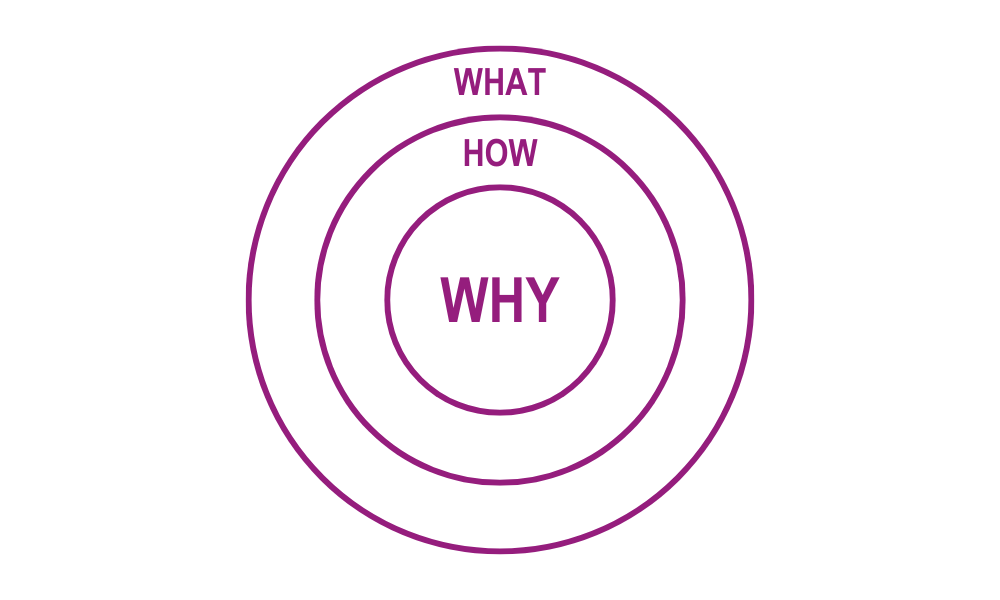
Today’s times have catalyzed, often ground-breaking, changes in the way we communicate both internally and with our customers. Therefore, in order not to ‘go crazy,’ it is helpful to have your answer to the question – ‘why’ do I do what I do? For me, it gives me coherence between how I think and what I do, the inner peace and joy that comes from feeling that I can use the potential I have been given for worthy causes.

Hence, let’s not just focus on the what and the how because this allows neither reflection nor having the right perspective. Without this, life just seems to be shallow! And that’s not the right way to start New Year…

Unveiling Purpose: Integrating Models for Lasting Impact

Discovering your “why” can truly transform your life and work. It provides a sense of clarity and purpose that fuels real motivation and helps you stay authentic, even through challenges.

It’s not just a path to personal success; it’s the heart of building something meaningful and lasting – a business or career that feels deeply fulfilling and genuinely worthwhile.

I will take a moment below to zoom in on how the two models I know from the training setup can work together. This is my interpretation, and any comments or feedback will be highly appreciated.

Unveiling Purpose: Integrating Models for Lasting Impact

The Dilts Logical Levels framework and Sinek’s Golden Circle

are both correlated, as they address the layers of meaning/purpose of human actions. Each of these models explores the why, how, and what of human actions, albeit with a slightly different focus.

Here’s how they work together:

1. Why (Sinek) ↔ Identity and Purpose (Dilts)

The Golden Circle – Why, in Sinek’s case, is the purpose and cause that drives individuals and organizations. It is the reason behind our actions, beyond the outcome, and provides us with a sense of what we do!

Logical levels – Identity and Purpose. At Dilts’, the Identity level represents ‘Who’ we are, encompassing our beliefs about ourselves and our deeper purpose. At the top of his pyramid, purpose extends to a relationship with vision and mission (in the organizational context), often linked to our contribution to a larger system.

Both frameworks represent an overarching vision and motivation, guiding everything else.

WHY WHAT HOW

2. How (Sinek) ↔ Beliefs, Skills and Behaviors (Dilts)

The Golden Circle – How, in Sinek’s case, defines the process and methods. It is how we bring purpose to life, often through unique processes, values, or distinctive characteristics.

Logical levels – Beliefs, skills, and behaviors. In Dilts’ model, Beliefs inform what we believe is possible or worth the effort (shaping the How), while skills refer to our capabilities and strategies used to implement actions. Behaviors are the actual actions taken, representing the translation of beliefs and our skills into something tangible!

This Dilts level relates to Sinek’s How as it defines our approach, skillset, and actions that make the goal achievable. Beliefs drive motivation, skills enable action, and behaviors embody these values in practice.

3. What (Sinek) ↔ Environment and Results (Dilts)

Golden Circle – In Sinek’s terms, What is the outcome, the actual product, service, or result achieved? It is what people see and is often the most tangible aspect of the organization or person’s work.

Logical levels – Environment and results. Dilts places the environment as the lowest level where the activities that shape outcomes occur. It is the place where the results are observed, evaluated, and adjusted.

Both models represent concrete, visible output experienced by others. In both frameworks, the What is a visible manifestation of deeper levels shows how purpose and beliefs are ultimately realized.

Conclusions:

Sinek’s Golden Circle

Dilts’ logical levels

Why    

Purpose and Identity

How

Beliefs, Skills, and Behaviors

What

Environment and Results

Aligning these models allows us to understand not only the outcome (What) but also the deeper motivations standing behind our actions (Why) and processes (How) that drive our behavior. This synergy is particularly useful for leaders to properly guide their co-workers and organizational development.

Marcin Swierkocki

Marcin Swierkocki

Trainer, Coach & MDI Partner

Marcin Swierkocki works as an HR business consultant who has specialized in L&D, change- and project management. He brings over 25 years of international experience in change management and operational development with him. His personal motto is influenced by Viktor Frankl: ‘Between stimulus and response there is a space. In that space is our power to choose our response. In our response lies our growth…’. His personal inspiration comes from his optimistic and positive character and by draining the energy that successfully supporting others gives him.

  • LinkedIn

What serves you next?

Leading Through AI Transformation: 5 Leadership Challenges and How to Address Them

by Balázs Lóránd | 28. October 2026 | Leadership and AI, Leadership Horizon | 0 Comments

Leading Through AI Transformation: 5 Leadership Challenges and How to Address Them As we prepare for our annual Leadership Horizon Conference, we’re taking a look back at some of the highlights of our successful 2026 edition. In his insightful business case “As AI...
Read More

Beyond the Training Room – Turning Insights into Impact

by Florian Biedermann | 22. October 2026 | Leadership Tips, Learning Transfer, Training Insights | 0 Comments

Beyond the Training Room – Turning Insights into Impact Traditionally, a training session ends with a recap and a round of feedback. In these face-to-face conversations, participants’ responses are often overwhelmingly positive. Usually, those who enjoyed the training...
Read More

Are Leaders Asking the Wrong Questions About Employee Retention?

by Zeca Ruiz | 15. October 2026 | Leadership Tips, Short Knowledge Bits | 0 Comments

Are Leaders Asking the Wrong Questions About Employee Retention? I was recently invited to give a talk at an association of business owners in Brazil, which was organizing a symposium on a timely topic: workforce challenges in a fast-moving, digital world. Right in...
Read More

10 Tips for Effective Communication With Dominant Partners

by Dominik Etzl, Rafael Ungvari | 4. October 2026 | Best Practice, Leadership Tips, learning effectiveness | 0 Comments

Homer Simpson has been delighting young and old for many years. Short-tempered to the point of being slightly irascible, he speaks his mind directly. He’s constantly getting annoyed over trivial matters and doesn’t seem to place much value on the opinions and advice...
Read More

4 Heuristics to Stop Mistaking Symptoms for Cause in the AI Era

by Zeca Ruiz | 24. September 2026 | Digital Transformation, Leadership and AI, Leadership Tips | 0 Comments

4 Heuristics to Stop Mistaking Symptoms for Cause in the AI Era The AI era is intensifying an old problem: acting too fast on the wrong diagnosis. Every one of us has lived through, or heard about, some organizational mess born from exactly that. In every era, every...
Read More

Human First: Leadership in the Age of AI

by Johanna Glechner | 14. September 2026 | Digital Transformation, Leadership and AI, Leadership in the digital transformation | 0 Comments

Human First: Leadership in the Age of AI My professional journey has always taken place at the intersection of two worlds that, for a long time, were treated as separate: technology and leadership. With a background in business informatics, I started my career in...
Read More

AI Transformation Is Leadership Work

by Gunther Fürstberger | 28. August 2026 | Leadership and AI, Leadership Tips, MDI Whitepaper | 0 Comments

AI Transformation Is Leadership Work The four-step loop that turns individual experiments into lasting change Many companies are already using AI—and still not transforming. Tools, pilot projects, and guidelines only add up to transformation once they deliberately...
Read More

What If AI Doesn’t Replace Us — But Drowns Us Out?

by Martin Maglia | 24. July 2026 | Digital Transformation, Leadership and AI, Short Knowledge Bits | 0 Comments

What If AI Doesn't Replace Us — But Drowns Us Out? Over the weekend, I watched a thought-provoking video from Rick Beato. (You can find the link at the end of this article.) For those who don't know him: Rick Beato is a musician, producer, educator, guitarist, and one...
Read More

Use It or Lose It: How AI and Digital Tools May Be Changing Our Brains

by Florian Biedermann | 26. June 2026 | Leadership and AI, Leadership Tips, Learning Transfer | 0 Comments

Use It or Lose It: How AI and Digital Tools May Be Changing Our Brains You travel to Madrid and want to chat with the locals, but you realize that after five years without practice, your rudimentary Spanish skills are now practically nonexistent and you even struggle...
Read More

How Artificial Intelligence Shapes Who We Become

by Meike Hinnenberg | 19. May 2026 | Impuls series, Leadership and AI, Leadership in the digital transformation | 0 Comments

How Artificial Intelligence Shapes Who We Become Meike’s Reflections on Artificial Intelligence Do you prefer to listen to this article? Click below to access our AI-generated audio version!How Artificial Intelligence Shapes Who We Become Meike’s Reflections on...
Read More
How to Become a Compassionate Leader – 3 tools

How to Become a Compassionate Leader – 3 tools

by Gunther Fürstberger | Apr 18, 2023 | International leadership development, Leadership in the digital transformation, MDI Inside, Training Insights | 0 comments

How to Become a Compassionate Leader in 3 Steps

At MDI, we not only develop others, but also ourselves. That’s why our CEO Gunther Fürstberger attended a three-day seminar by systems researcher Peter Senge in Stockholm, where he gained some insights. He reports on his experiences in this blog post.

The Compassionate Leadership Masterclass

Peter Senge wrote a classic of leadership literature in 1990 with “The 5th Discipline”. When I read that he was giving a 3-day seminar in Stockholm as part of the Inner Development Goals Initiative, I knew I had to experience it. I thought about Marcus Aurelius who already said “You have to know the great ones of your time”.

The sold out Compassionate Systems Leadership Masterclass by Peter Senge and Gustav Böll took place in the artistic setting of Fotografiska Museum with about 100 participants from March 29 to 31, 2023.

The seminar title sounds a bit complicated. What is Compassionate Systems Leadership all about? A first key to understanding is the organizer: the Inner Development Initiative. In 2016, UN member states adopted the 2030 Agenda for Sustainable Development. Since then, our planet has continued to deteriorate.

A new leadership system for a better planet

Us earthlings have obviously not yet developed the skills and attitude it takes to undo the damage of the industrial age.

This is where the Inner Development Initiative comes in: The change in attitude must begin with the individual. Engaging broadly and deeply with the Inner Development Goals in the 5 categories of Being, Thinking, Relating, Collaborating, and Acting will help achieve the UN Sustainable Development Goals.

Our planet now needs a different kind of leadership than we know from the industrial age. It starts with feeling nature and other people and should lead to some sense of connection with others or even all beings on the planet.

Hardly anyone wants to intentionally cause grievances, but who is really aware of the effects of their own actions? System thinking can help to understand both short- and long-term impacts and interactions a little better.

New findings on two levels

Learning for me has taken place on two levels during these days. On the one hand, I got to know new tools or deepened known tools. On the other hand, the trainers were an inspiration in their handling of the group and their use of methods.

From the numerous thinking tools I pick out the three that I found particularly typical for Compassionate Systems Leadership.

Tool 1

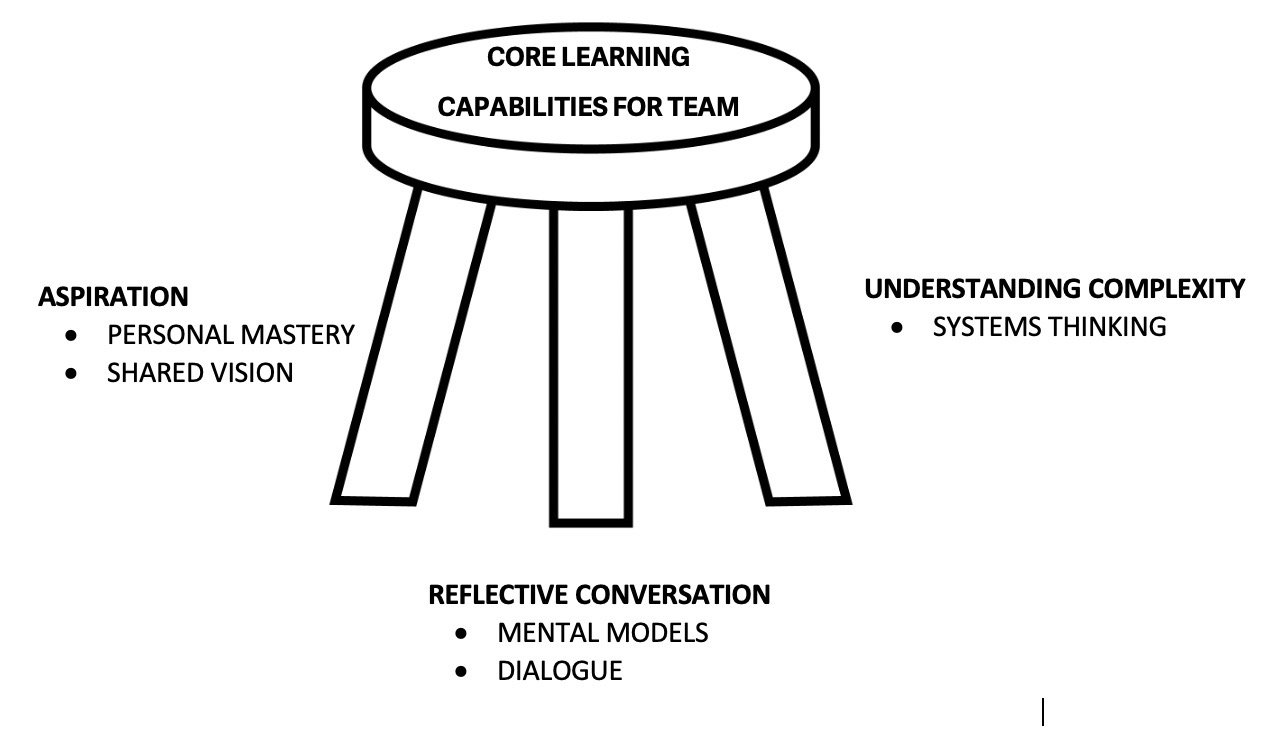
First, as an overview tool, there is the three-legged chair (see figure 1). The legs represent aspiration, reflective conversations, and systems awareness. If one leg is missing, the stool falls over.

Without a creative imagining of a better environment, there is no improvement. Without reflection or a deeper understanding of systems, we quickly end up in dead ends despite having good intentions. 

Three-legged chair

Tool 2

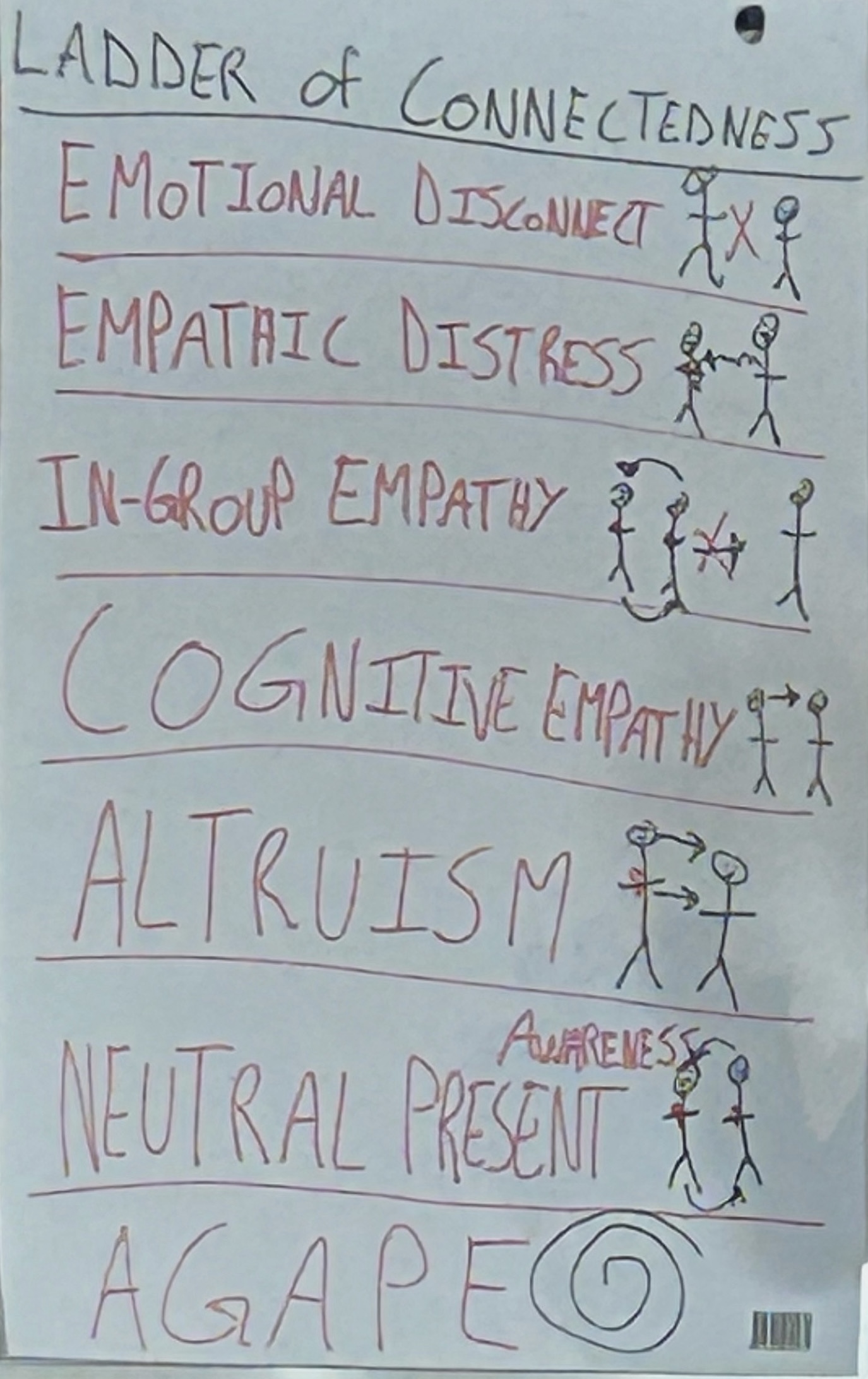
The ladder of connectedness

The second tool is the “ladder of connectedness” (see figure 2), which confused me initially: From bottom to top, the ladder levels are called “agape, neutral presence, altruism, cognitive empathy, in-group empathy, empathic stress, and emotional distance.”

We can harness gravity to move toward deeper connectedness, i.e., strive more toward the lower levels. Confusion can be a sign of real learning. I could not easily assign this idea to an already stored concept. It seemed to fit most closely with a Buddhist understanding.

We may not achieve agape, all-connected love, but we can create a neutral presence even in difficult situations. It also needs the higher levels: A surgeon should manage to distance themselves emotionally for self-protection.

Neutral instead of empathetic

Distance also helps sometimes in conflicts that go round in circles. Empathic stress is something I can relate to as a father of younger children. When my 8-year-old and my 6-year-old argue loudly with each other, it seems easier for me to demand that they stop for the short term because it helps me reduce my internal tension. But in the long run, it doesn’t help me.

In-group empathy may lead to good cooperation in the team, in the company or even in one’s own country, but at the same time it may exclude those who do not belong to the group. I take it upon myself to practice more neutral presence, which is enduring tension and contradiction.

Ladder of Connectedness

Tool 3

Creative Tension

Now our third and a simpler tool (see figure 3): The principle of creative tension. I already knew that a vision needs the right level of challenge, because something we have already achieved or something we can never achieve is not good as a vision.

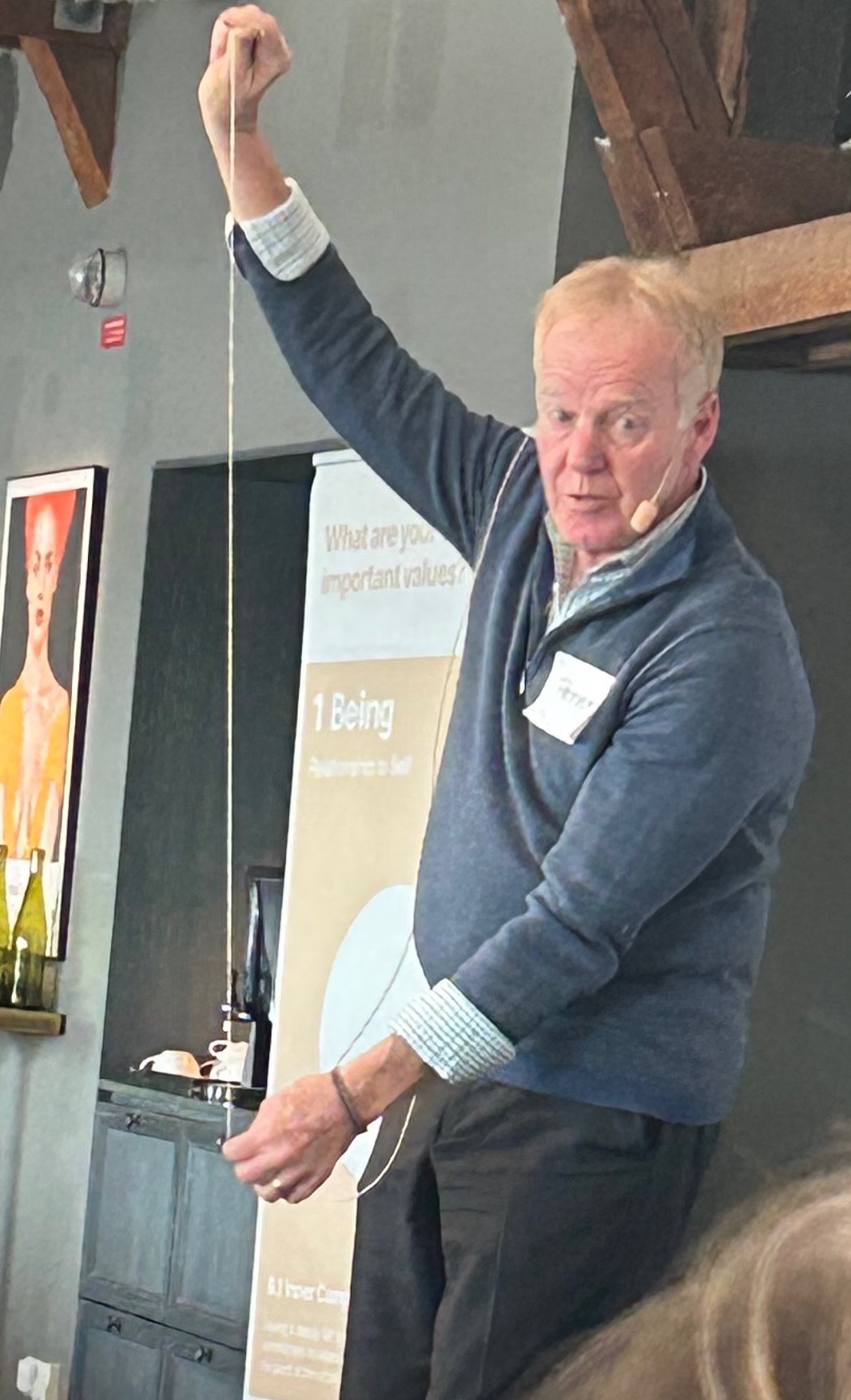
I found the continuation of the thought interesting: We can imagine the tension between reality and vision as a rubber band. When that tension becomes too uncomfortable for us, we often tend to either lower our aspirations or not tell the whole truth about the current state.

An energy source for change

A good example are an organization’s sustainability goals. When we consciously seek and hold this tension, we tap into the energy source for change. This principle of creativity is also found in theater as drama, in music as tonus, and in the Greek rhetoric. In this respect, it is not a new idea, but it is effective when we strive for change.

I was also interested in what Peter Senge is like as a person. I have already met some of the “greats of the lecture scene” away from the stage and with some of them I had the impression that it was difficult for them to live the conveyed messages themselves. That is also human.

Peter with rubber band

Peter Senge as a Human

In the morning of Day three, there was an emotionally expressed resistance from a participant who questioned the usefulness of the whole seminar. She said Peter Senge held on to the statement that we always have a choice and do not have to be influenced by external circumstances, despite her doubts expressed the day before.

Now I was curious. Will he maybe feel attacked and defend himself or let it stand as an individual opinion? He did not react immediately, but let other participants speak first. Later, he resonated, apologized, thanked for the learning opportunity, and did so with an authenticity and elegance that really impressed me.

He always treated his much younger co-trainer at eye level and was so moved several times that tears came to his eyes.

My summary

In the spirit of Marcus Aurelius, I had the opportunity to meet two greats of our time. Especially the combination of two trainers from different generations fits the challenges of our time.

Even though I have not implemented all of the presented contexts and tools and I am also not sure whether the term Compassionate System Leadership will become widely accepted, I recommend every leader to deal with the basic idea. A more sustainable leadership culture would do us and the planet good.

Mag. Gunther Fürstberger

Mag. Gunther Fürstberger

CEO | MDI Management Development International

Gunther Fürstberger is a management trainer, author and CEO of MDI – a global consulting company providing solutions for leadership development. His main interest is to make the world a better place through sustainable leadership. He has worked for clients including ABB, Abbvie, Boehringer Ingelheim, DHL, Google, Hornbach, PWC and Swarovski. His core competence is leadership in digital transformation. At the age of 20 he already started working as a trainer and he also served as HR manager in international corporations.

  • LinkedIn

What serves you next?

Leadership Horizon powered by HR INSIDE SMMIT

Leading Through AI Transformation: 5 Leadership Challenges and How to Address Them

Leading Through AI Transformation: 5 Leadership Challenges and How to Address Them As we prepare...
Read More

Beyond the Training Room – Turning Insights into Impact

Beyond the Training Room – Turning Insights into Impact Traditionally, a training session ends...
Read More

Are Leaders Asking the Wrong Questions About Employee Retention?

Are Leaders Asking the Wrong Questions About Employee Retention? I was recently invited to give a...
Read More

10 Tips for Effective Communication With Dominant Partners

Homer Simpson has been delighting young and old for many years. Short-tempered to the point of...
Read More

4 Heuristics to Stop Mistaking Symptoms for Cause in the AI Era

4 Heuristics to Stop Mistaking Symptoms for Cause in the AI Era The AI era is intensifying an old...
Read More

Human First: Leadership in the Age of AI

Human First: Leadership in the Age of AI My professional journey has always taken place at the...
Read More

AI Transformation Is Leadership Work

AI Transformation Is Leadership Work The four-step loop that turns individual experiments into...
Read More

What If AI Doesn’t Replace Us — But Drowns Us Out?

What If AI Doesn't Replace Us — But Drowns Us Out? Over the weekend, I watched a thought-provoking...
Read More

Use It or Lose It: How AI and Digital Tools May Be Changing Our Brains

Use It or Lose It: How AI and Digital Tools May Be Changing Our Brains You travel to Madrid and...
Read More

How Artificial Intelligence Shapes Who We Become

How Artificial Intelligence Shapes Who We Become Meike’s Reflections on Artificial Intelligence Do...
Read More
3 tips for efficient and sustainable OKR results

3 tips for efficient and sustainable OKR results

by Gunther Fürstberger | Oct 17, 2022 | Best Practice, Leadership Tips, Training Insights | 0 comments

3 tips for efficient and sustain

Do you want to learn more about OKR – Objectives & Key Results? Here are 3 leadership tips for efficient and sustainable OKR results.

1. Reserve the meeting dates for a year in advance

Long-term OKR scheduling

Long-term scheduling makes it easier to adjust to spontaneous changes on short notice. OKR meetings should become a routine. Habits, once achieved, require little energy. When team members have learned that, for example, the OKR quarterly planning meeting is always on the last Thursday of the quarter and an OKR check-in meeting is scheduled every other Thursday in between – OKR becomes a no-brainer.

OKR should become a no-brainer

Experience has shown that only the timely meetings are a challenge due to many other planned events. If you always send the appointment invitations for the entire next year, the company will get used to it and you will have more energy for content-related work.

Very practical are serial appointments with individual corrections, e.g. if they fall on holidays or on the Christmas vacation.

2. Max. 8 participants in the quarterly OKR planning meeting

The optimal OKR meeting size

4 – 8 participants are an optimal size for quarterly planning meetings, in order to consider sufficiently different perspectives on the one hand and to be able to discuss actively and time-efficiently on the other. However, if the team consists of fewer members, that is also OK. 2-3 people can manage with much less time.

In planning meetings at higher hierarchical levels, such as when developing the OKR set for the entire company, more people often want to be present. This is understandable, since the quarterly priorities are set for the company.

However, discussions with more than 8 people can be lengthy or lead to different levels of participation.

Take turns and have a OKR rotation schedule

One proven way to keep the number of participants low is for owners of similar departments or functions to take turns participating. If you personally do not have a place in the next meeting, you can make your wishes known in advance via the backlog list or another representative.

All hands OKR meeting

Never has it been more important to adjust continually to a dynamic environment. OKR proves to be a great method to overcome crisis situations – read more about it here. 

3. Visualize the progress also during the quarter 

Discuss your progress regularly

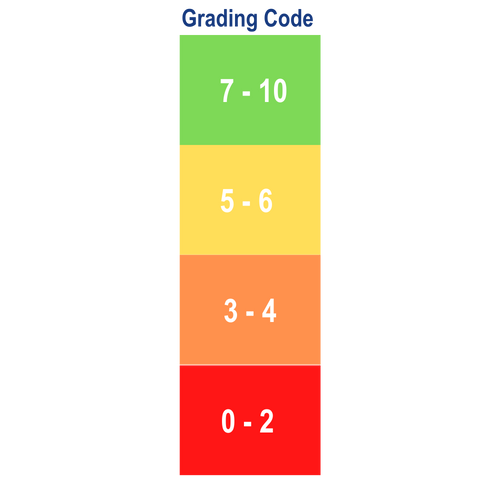
Choosing well-worded OKRs is one side of success, the other is discussing progress regularly, e.g. bi-weekly. For this, it helps to visibly grade progress. Some prefer to work with color codes from the beginning. I.e. all Key Results start in red and partly reach the colors orange, yellow and green during the quarter. Others prefer to work with the numbers 0,0 – 1 during the quarter and use the colors only at the quarterly review. A third possibility are progress bars, where the filled area increases step by step.

Progress visualization increases motivation because messenger substances such as dopamine and endorphins are released in the brain.

Mag. Gunther Fürstberger

Mag. Gunther Fürstberger

CEO | MDI Management Development International

Gunther Fürstberger is a management trainer, author and CEO of Metaforum and MDI – a global consulting company providing solutions for leadership development. His main interest is to make the world a better place through excellent leadership. He has worked for clients including ABB, Abbvie, Boehringer Ingelheim, DHL, Hornbach, PWC and Swarovski. His core competence is leadership in digital transformation. He gained his own leadership experience as HR Manager of McDonald’s Central Europe/Central Asia.  At the age of 20 he already started working as a trainer.

  • LinkedIn

What serves you next?

Benefits of OKR

What are the benefits of the OKR system?

What are the benefits of the OKR method and how does it work exactly? MDI trainer and OKR master Susanne Spath gives us an introduction and a story to visualize the OKR method.

Read article

Agile leadership orientation and basics

Agile leadership - orientation and basics

There are plenty of agile methods – but what are the benefits of each method? MDI trainer Alexandra Sock talks about her agile leadership seminar, which gives you an overview of different agile methods.

Read article

Scrum& Agile leadership

Scrum & Agile leadership

Scrum is one of the oldest agile methods and is the mother of all agile methods in many people’s opinion. Susanne Spath is OKR master and Scrum certified gives us an introduction to this method and tells us for whom it makes sense to implement Scrum.

Read article

or maybe this?

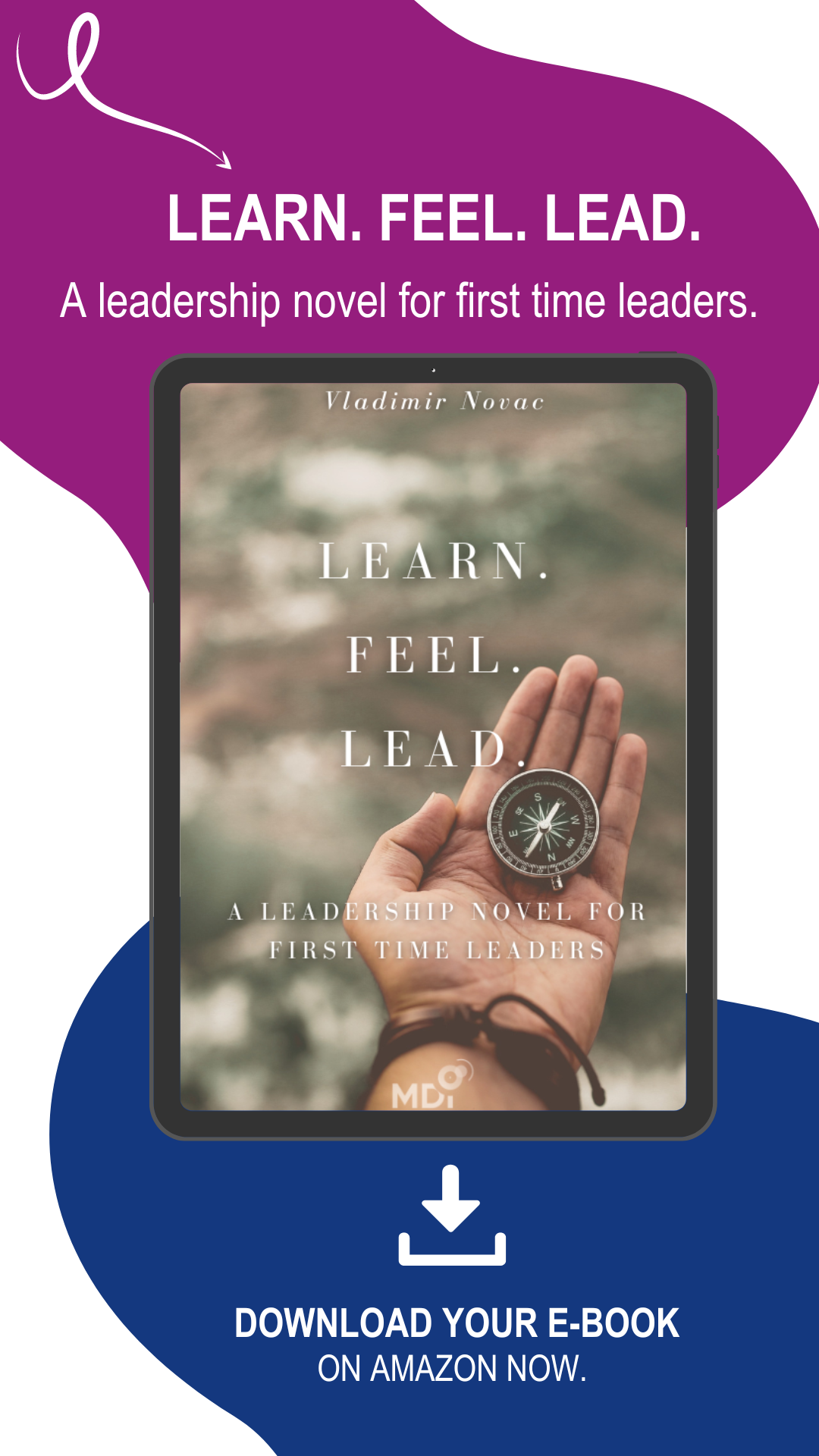
A leadership novel for first-time leaders

A leadership novel for first-time leaders

by Vladimir Novac | Aug 22, 2022 | Leadership Tips, Training Insights, training new leader | 0 comments

‘Learn. Feel. Lead’ is a Must-Read

A leadership novel for the first-time leaders

that aims at coaching first-time leaders into effectiveness, through fictional situations and characters.

In other words, a self-development book within a fictional setting.

Introduction:

Luca is a sales representative in a company (Aurora Inc.) which is struggling to survive. You will meet a bunch of colourful, authentic, stressed-out characters.

Further to unexpected events, Luca is promoted into a leadership position, without any formal training or mentoring. From now on, Luca will face several challenges but will be helped along the way by odd, informal characters: a printer, a mother, a truck driver, a homeless person, and so on.

The idea behind this is that you never know what kind of disguise your teacher will take next. Every chapter offers a challenge and a solution, including its implementation. Luca learns that it is paramount to understand the expectations of his stakeholders, learn massively what needs to be learned, he needs to become effective in assessing his co-workers, giving them feedback, facilitating decision making, managing his bosses, understand what modern leadership is.

All that, at the same time, managing a challenging family life, and about to become a father for the first time.

About the author

​Vladimir Novac is based in Bucharest, Romania and works as top-executive leadership trainer and coach around the globe. He is certified NLP Practicioner and Change Indicator Analyst and especially dedicated to the topics of team development, self leadership, performance management and change. Inspired by a big personal mission, he is enriching the MDI world since many years with knowledge and passion.

Hello Vladimir,

thanks for taking the time to answer a few quick questions about your exciting new book!

First of all, of course, we want to know what motivated you.

Why did you write this book in the first place?

Of all leaders in any organization, new leaders go through the most challenging journey.

From agony to ecstasy, from sheer confusion to blinding clarity, the ups and downs of a first time leader are difficult to foresee, not only by the leaders themselves but also by their direct managers.

In my 20 years experience of working with leaders around the world, I have become familiar with their challenges and needs. And it is probably a good time to address them. Hence, the book.

Where or how can you apply the book well as a first-time leader?

I think that every leader can benefit from this book, although my primary target is first-time leaders.

The well-known and still very valid, concepts in the book, from stakeholders’ analysis to Tuckman’s stages of team development, are presented as a story, where theory becomes alive, a ‘3 D’ rendering of what a first-time leader can go through in the first months of their job.

Every theory is presented as a practical example – a stage with authentic characters that reveal themselves to you, dialogue after dialogue.

Can you draw important insights as HR and L&D from this book?

A former HR Manager myself, I am painfully aware of HR, and L&D’s struggles when it comes to ensuring that new leaders have what they need in order to succeed. I do not think there has ever been a more complex environment for a Leader than it is now… 

As a leader myself, the book addresses both the skill set needed for the first months in a leadership position as well as the mindset. While the skill set is easily acquired by most, mindset is less addressed: and it is exactly what we should be focusing on.

Mindset for first-time leaders

This book accounts for some of the thoughts, concerns, fears, as well as small victories, and epiphanies,  that new leaders can experience. 

I believe that this book can make a difference, can silently guide new leaders through the labyrinth of their everyday challenges. I believe that this book can support the growth of your future performers.

One leader at a time.

Download your copy of “Learn. Feel. Lead.

A leadership novel for the first-time leaders” now.

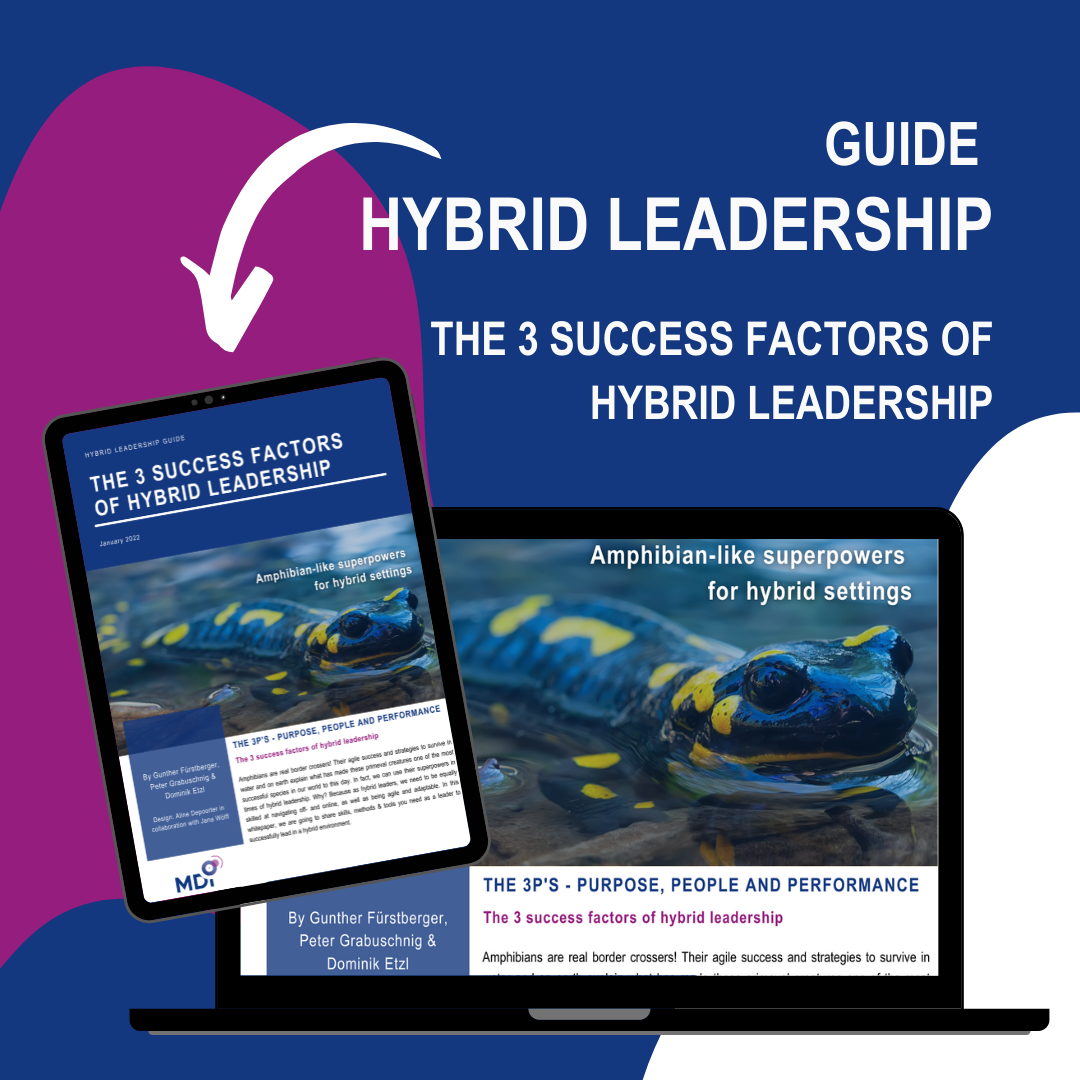
Or Check out our “Hybrid Leadership” guide:

What serves you next?

4 Heuristics to Stop Mistaking Symptoms for Cause in the AI Era

by Zeca Ruiz | 24. September 2026 | Digital Transformation, Leadership and AI, Leadership Tips | 0 Comments

4 Heuristics to Stop Mistaking Symptoms for Cause in the AI Era The AI era is intensifying an old problem: acting too fast on the wrong diagnosis. Every one of us has lived through, or heard about, some organizational mess born from exactly that. In every era, every...
Read More

Human First: Leadership in the Age of AI

by Johanna Glechner | 14. September 2026 | Digital Transformation, Leadership and AI, Leadership in the digital transformation | 0 Comments

Human First: Leadership in the Age of AI My professional journey has always taken place at the intersection of two worlds that, for a long time, were treated as separate: technology and leadership. With a background in business informatics, I started my career in...
Read More

What If AI Doesn’t Replace Us — But Drowns Us Out?

by Martin Maglia | 24. July 2026 | Digital Transformation, Leadership and AI, Short Knowledge Bits | 0 Comments

What If AI Doesn't Replace Us — But Drowns Us Out? Over the weekend, I watched a thought-provoking video from Rick Beato. (You can find the link at the end of this article.) For those who don't know him: Rick Beato is a musician, producer, educator, guitarist, and one...
Read More

What AI Shows You — and What It Doesn’t

by Meike Hinnenberg | 1. April 2026 | Digital Transformation, Impuls series, Leadership and AI | 0 Comments

What AI Shows You — and What It Doesn't Meike’s Reflections on Artificial Intelligence Do you prefer to listen to this article? Click below to access our AI-generated audio version! What AI Shows You — and What It Doesn't Meike’s Reflections on Artificial Intelligence...
Read More

A Success Story – When AI Sharpens Human Judgement

by Claude MacDonald, Rafael Ungvari | 6. March 2026 | Customer Story, Digital Transformation, Leadership and AI | 0 Comments

A Success Story – When AI Sharpens Human Judgement Do you prefer to listen to this article? Click here to access our AI-generated audio version! When AI Amplifies Human Judgment: A Customer Success Story About This Project At MDI, we believe that great leadership and...
Read More

Generation Z isn’t the Problem but Our System is

by Zeca Ruiz | 3. December 2025 | Impuls series, International leadership development, Leadership in the digital transformation | 0 Comments

Generation Z Isn’t the Problem, but Our System is. Read this article on crossgenerational management by Zeca Ruiz to find out more!

Read More

From Lab to Practice: What We Learned With AI

by Rafael Ungvari | 3. September 2025 | Digital Transformation, Leadership and AI, Short Knowledge Bits | 0 Comments

From Lab to Practice: What We Learned With AI Do you prefer to listen to this article? Click here to access our AI-generated audio version! From Lab to Practice: What We Learned With AI AI in organizations isn’t a one-size-fits-all solution. And in people development,...
Read More

Leadership and AI: Between Responsibility and Opportunity

by Marina Begic | 6. May 2025 | Digital Transformation, Leadership and AI, Leadership Tips | 0 Comments

Leadership and AI: Between Responsibility and Opportunity Do you prefer to listen to this article? Click below to access our AI-generated audio version!Leadership and AI: Between responsibility and opportunity Artificial intelligence is no longer a pipe dream – it is...
Read More

AI Hears; Humans Listen: Become a Master of Attunement

by Hamza Khan | 18. April 2025 | Digital Transformation, Leadership and AI, Leadership in the digital transformation | 0 Comments

AI Hears; Humans Listen: Become a Master of Attunement Prefer to listen to the article? Click below to access our AI speech-generated audio. However, if you want to read it as usual, keep scrolling.AI Hears; Humans Listen: Become a Master of Attunement Not Black...
Read More

AI Transformation: How Companies Need to Adapt

by Gunther Fürstberger | 12. February 2025 | Digital Transformation, Leadership and AI, Leadership Tips | 0 Comments

AI transformation: how companies and leaders need to adapt Economic history repeatedly shows how technological leaps revolutionize entire industries. 150 years ago, sailing ships dominated world trade, while steamships were only used on lakes and rivers. But within 30...
Read More

Dubai, Madrid and soon Bangkok – around the world with MDI

Dubai, Madrid and soon Bangkok – around the world with MDI

by Alina Helmlinger, Marina Begic, Nicole Altenberger | Jul 7, 2022 | Best Practice, International leadership development, Training Insights | 0 comments

Turbulent camel rides in Dubai, a heated scavenger hunt at the Madrid Palace and an exciting business rally

our L&D Consultants Marina Begic, Nicole Altenberger and Alina Helmlinger have experienced quite a bit over the past few months. Here they describe how it all came about, what exactly they did there, and what’s awaiting next for them…

Dubai, Madrid and soon Bangkok – around the world with MDI

Pitch 

In late November 2021, we were invited by a client to participate in an RFP for 4 regional meetings – an event of sales executives. Since this was a newly acquired company that we hadn’t worked with before, we didn’t think our chances were particularly high. In most tenders there is time pressure, we know that. Despite the end of the year, the high implementation risk (first major f2f events after Corona) and the usual pre-Christmas stress, we accepted the challenge. After all, this is exactly our playground 😉

At the pitch, we were able to convince them with an innovative presentation using an e-learning tool and a concept based on the 70-20-10 model, where the focus is on maximum practical benefit and integrated transfer assurance.

Here our agile mdi mindset was really beneficial. After receiving the confirmation that we won the project,  we were asked to start the planning right before Christmas – which was also new for us 😉 

Scope clarification

The detailed program was developed in close coordination with an internal project team and adapted to the current needs of the Western Europe+Canada and Africa+Middle East regions. The conference program was developed around the following guiding themes:

Leadership

High Performing Teams

Coaching

Here we were able to apply our experience from years of international rollouts and demonstrate our leadership development expertise. It was important for us and the international project team to always keep the key themes in mind, while at the same time considering the needs of the regions. To this end, regular project meetings were held with international and regional working groups during the cocreation phase, which lasted approximately 4-5 months. A quick response, high passion and motivation of all participants characterized the cooperation.

In the end, we had an exciting 2-day program filled with keynotes, panel discussions and goal-oriented activities- in addition to content inputs, there was also an experience factor.

Empowerment 

In the course of working with up to a total of 100 people, we were not only able to get to know the needs of the clients very well, but also the corporate culture. Thus, content and activities were created with and by all project members. The goal was to involve the target group as much as possible, both in the cocreation phase and then on stage itself.

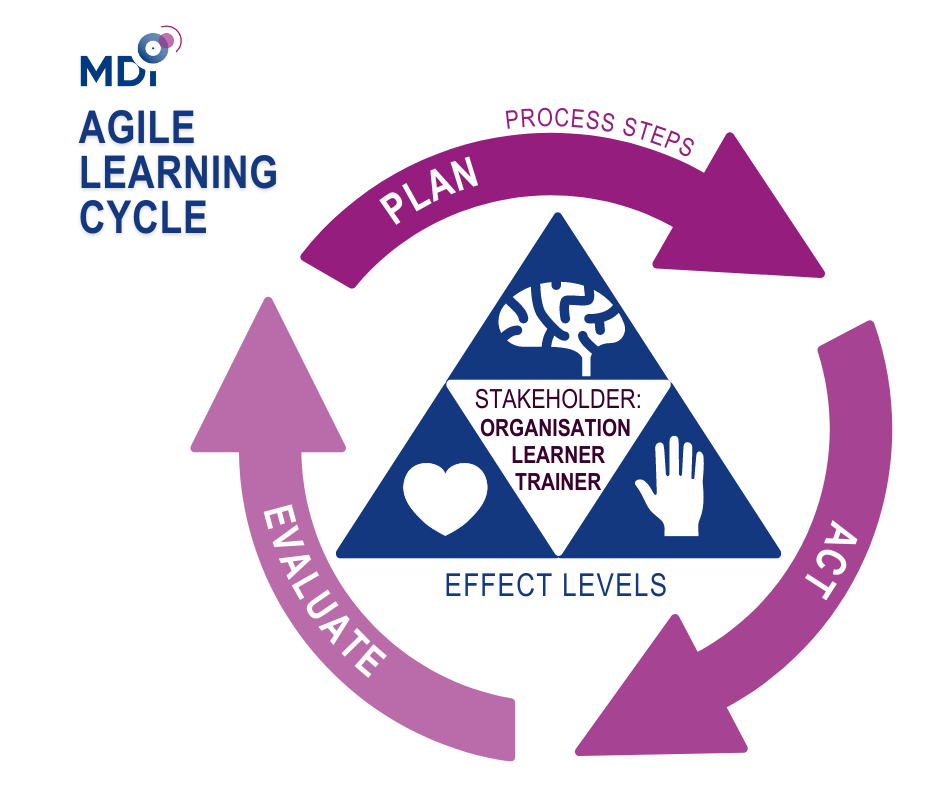
The overall concept was developed with three levels of impact in mind:

Head

Hands

Heart

The interaction of these three levels of impact can be seen in this graphic.

The guiding themes of all events were identical, but based on cultural, corporate and situational backgrounds, the agenda was customized and tailored to the group of people on site.

Learning Objectives

The project was designed to address the following leadership learning objectives:

  • Leaders who think strategically and lead their companies with strong business acumen
  • Leaders who manage their company through their people and develop high-performing teams
  • Leaders who are flexible in their approach to inspire, coach and bring out the best in each member of their team

Agenda

A varied agenda with a mix of diverse methods provided the framework for exciting exchanges and experiential values:

  • Key Notes: Plenary on stage in front of all participants. A mixture of theoretical content and company-specific context. The goal is to inspire and creatively engage the audience.
  • Involvement of the audience in the plenary: to get audience input, participants were invited to share their assessment & opinion via “Slido” – in this case it was supported via the project’s own created app and QR code.
  • Activities: participants were actively involved in the implementation and experienced the impact/ content first hand.
  • Panel discussions: with key players within the company to facilitate translation into the company’s internal context. An interactive discussion to facilitate reflection and learning after the content and activities targeting key insights for the audience.

Individualization: Where were the differences ?

Although, it was the same client and there was a common theme and goal, it was exciting for us to observe the importance of individualization for the two regions Western Europe+Canada and Middle East+Africa. To achieve maximum impact, the “Heart” impact level was addressed more in Dubai and “Head” in Madrid. Both had a lot of “Hand” in common.


Dubai: (Midde East+Africa)

  • Target group: first Head of Sales, then changed to Crossfunctional teams (Finance, Marketing, Sales, Legal, HR, etc) and General Managers
  • Needs: new leadership, new composition of regions, networking between countries and functions in focus
  • Way of working: more agile, fast paced, short preparation time, no prework, longer transfer period
  • Social program: desert safari, saxophonist, gala dinner in the desert, camel riding, falcons, drumming workshop

Madrid: (Western Europe+ Canada)

  • Target group: Head of Sales, General Managers
  • Needs: to stay on the road to success, to strengthen the sales leadership force
  • Way of working: meticulous, longer preparation, extensive prework with thematic newsletters and tasks.
  • social program: scavenger hunt at the palace, evening event with exquisite dinner in an exclusive vineyard. Here we had our crowd favorite Gia Helena with us as Master of Ceremonies, who kept the audience of around 100 people in good spirits.

High competition factor

What was even more striking with the target group of sales executives was the competition factor. Not only did the content of the event have to be perfectly aligned with the current needs of the respective region under the global guiding themes, but it also had to be entertaining and produce clear winners. For this target group, we not only added competition components to the activities, but also designed a business rally

Here is a brief summary of our main activities:

Trust Walk

An interactive and entertaining activity that makes aspects of “high performance teams” tangible (in the sense of: own experience beats theory). It bridges the gap between “knowing” (logic) and “feeling” (emotional understanding), so that the inspiration to act (practical relevance) makes sense in the upcoming event elements (panel discussion, leadership camp). The focus is on generating experience, as a course has to be completed in different roles (leader, follower, observer) – with varying degrees of difficulty.

Coaching Game

This activity focused on learning the purpose of coaching and the benefits of coaching conversations. To raise awareness of coaching as a leadership tool and peer-to-peer empowerment and to get a “hands-on mindset” by having the opportunity to coach yourself in a small setting of 4 people, with the support of self-created card sets, with appropriate, challenging and pointed coaching questions. Participants are given the opportunity and the right framework for self-reflection as a leader.

Business Rally

Based on a scavenger hunt, company-relevant content was transformed into an entertaining and fast-paced business rally. The leader supports their groups to apply skills to address leadership challenges (behaviors from the CDF supported by experiential learning). The fun factor is supported with the help of a fictional frame story and with a competitive situation, ambition came out in all participants.

Leadership Camp

This activity is about deriving the content into actionable and concrete action steps (action steps in the areas of leadership, coaching and high performing teams). The goal is to achieve a definition of actions and key results for the next few months within a region. This 2-hour workation is used intensively and the results are presented in plenary – which are quite impressive. With this last activity all participants are motivated to start the implementation in their respective countries.

Our learnings 

  • Match the right people with the right skills to the project parts
  • Stick to the time and the project plan
  • Be flexible with the content and react to the audience´s needs
  • Always celebrate the milestones and the successes

81% NPS

We are highly motivated after these energetic events and thankful that face-to-face events are possible again. Looking back, “Teamwork makes the dream work” – and the intensive preparation time more than paid off. It was great to see how the thread of content ran through both regions – we took individual wishes into account and can therefore look back on two successful events. The cooperation of all participants as well as the co-creation with the content experts made a state-of-the-art event possible.

From the Team MDI we were actively supported by: Helena Gia Gutierrez, (Moderation Madrid), Peter Grabuschnig (Activity Manager Dubai & Madrid), Alina Olar (Project Management), Marilena Maris (Key-Notes), Ursula Weixlbaumer-Norz (Business Rally)

This is also reflected in a Net Promoter Score, a recommendation rate of 81%.

We thank you for your trust and are already looking forward to the roll-out in the regions – Bangkok, here we come 🙂

Marina Begic

Marina Begic

Digital Business Development Expertin und Senior L&D Consultant

Marina has been working on new, effective learning methods and the future of corporate learning for over 15 years. In her current role, she is responsible for Digital Business Development at MDI, where her focus is not driven by the current buzzwords, but primarily on the feasibility of digital transformation for clients such as Erste Group, Lenzing, Semperit, Deutsche Bahn, Andritz AG, Uniqa, Mayr-Melnhof, Frequentis, RHIM. Her greatest strength is bringing loose ends together, which she impressively demonstrates time and time again with her big picture view and multi-dimensional approach. Her greatest passion is to provide learners not only with an experience, but also with real, lasting value for their real challenges.

  • LinkedIn
Nicole Altenberger, BA

Nicole Altenberger, BA

Senior L&D Consultant

Since 2020 Nicole has been accompanying leaders and companies from all over the world on their journey and supports them in the creation and tailoring of suitable training and development measures. This highly diversified work has resulted in numerous different settings, in which she has had the opportunity to learn the most effective and target-oriented methods. In doing so, the personal learning experience has not been neglected either. Her clients include companies such as Agrana, Albelli, Coca-Cola, Erste Group, Frequentis, Migros, OMV, Rewe, RHI Magnesita, Swarovski, Voestalpine, Wienerberger. Her interest in the area of Learning & Development was deepened during her studies in “Business Consultancy International” and substantiated by relevant work experience within an internationally active group. Already at a young age Nicole Altenberger is one of the top Learning & Development Consultants at MDI and runs her own team.

  • LinkedIn
Alina Helmlinger, MA

Alina Helmlinger, MA

L&D Consultant

Since 2021, Alina has been working as an L&D Consultant at MDI and supports clients from various industries in the customized design of various management development programs and trainings. In addition to her practical knowledge and the experience she has already gained in the field of development, she can draw on sound theoretical knowledge from her Bachelor’s degree in Human Resources Management and her Master’s degree in Organizational and Personnel Development, which she successfully completed in June 2022. Alina maintains her balance, especially in challenging situations, and manages to reconcile the interests of different stakeholders in complex projects, enabling her to design tailor-made HR solutions that are aligned with the needs of her customers.

  • LinkedIn

What serves you next?

Digital training formats for leadership development

We help make leadership development more agile with our digital training formats:

  • E-learnings
  • e-consulting
  • Blended Learning Journeys
  • Virtual Leadership
  • virtual reality
  • digital learning transfer

– we have just the right thing for your needs!

Explore now!

or even …

Zeca Ruiz on Cross-Generational Leadership and Navigating Change

by Jana Wölfl | 13. May 2026 | Leadership Impact, MDI Spotlight Series, Training Insights | 0 Comments

Zeca Ruiz on Cross-Generational Leadership and Navigating Change This blog is an excerpt from our new podcast! You can find the entire podcast episode here. Zeca Ruiz on Cross-Generational Leadership and Navigating Change In the fourth episode of our podcast “Voices...
Read More

How Do You Lead People Who Don’t Think the Way You Do?

by Zeca Ruiz | 4. February 2026 | Leadership Impact, Leadership Tips, Learning Transfer | 0 Comments

How Do You Lead People Who Don't Think the Way You Do? Do you want to listen to this article? Click here to access our AI-generated audio version!   How do you lead people who do not think the way you do? Leadership is a challenge, especially when you are not...
Read More

How You Deal With Neurodiversity as a Leader

by Iris Kandlbauer | 3. February 2026 | Leadership Impact, Leadership Tips, Short Knowledge Bits | 0 Comments

How You Deal With Neurodiversity as a Leader You prefer listening to this article? You can find our AI-generated audio version below! How You Deal With Neurodiversity as a Leader What might be behind “strange” behavior in a team—and how leaders can deal with it...
Read More

Generation Z isn’t the Problem but Our System is

by Zeca Ruiz | 3. December 2025 | Impuls series, International leadership development, Leadership in the digital transformation | 0 Comments

Generation Z Isn’t the Problem, but Our System is. Read this article on crossgenerational management by Zeca Ruiz to find out more!

Read More

The Lasting Impact of Leadership Horizon – Meike’s Perspectives

by Meike Hinnenberg | 2. July 2025 | Leadership Impact, MDI Inside, Short Knowledge Bits | 0 Comments

The Lasting Impact of Leadership Horizon - Meike's Perspectives Do you prefer to listen to this article? Click below to access our AI-generated audio version!The Lasting Impact of Leadership Horizon - Meike's Perspectives MDI’s Meike Hinnenberg shares her reflections...
Read More

Success Through Change: How to Stay Oriented During Transitions

by Anita Berger | 14. April 2025 | Impuls series, Leadership Impact, Leadership Tips | 0 Comments

Success Through Change: How to Stay Oriented During Transitions Do you prefer to listen to this article? Click below to access our AI-generated audio version:Success Through Change: How to Stay Oriented During Transitions Change processes often involve challenges....
Read More

4 Tips on How to Shape Change Processes as a Leader

by Anita Berger | 3. April 2025 | Impuls series, Leadership Impact, Leadership Tips | 0 Comments

4 Tips on How to Shape Change Processes as a Leader Do you prefer to listen to this article? Click below to access our AI-generated audio version:4 Tips on How to Shape Change Processes as a Leader Imagine a dynamic network of paths that is constantly changing. While...
Read More

Successful Team Building for Boehringer Ingelheim RCV

by Anita Berger | 29. March 2024 | Customer Story, International leadership development, MDI Inside | 0 Comments

Successful Team Building for Boehringer Ingelheim RCV Do you prefer to listen to this article? Click below to access our AI-generated audio version:Successful Team Building for Boehringer Ingelheim RCV In the interview with our MDI trainer and partner, Anita Berger On...
Read More

Organize Your Team in a Hybrid Workplace

by Peter Grabuschnig | 14. March 2024 | Impuls series, International leadership development, Leadership in the digital transformation | 0 Comments

Organize Your Team in a Hybrid Workplace Prefer to listen to the article? Click below to access our AI speech-generated audio. However, if you want to read it as usual, keep scrolling.Organize Your Team in a Hybrid Workplace In his new Rise Course, our MDI trainer and...
Read More

Exploring the Influence of AI on Leadership Roles – an experiment by a CEO

by Gunther Fürstberger | 14. November 2023 | International leadership development, Leadership and AI, Leadership in the digital transformation | 0 Comments

Exploring the Influence of AI on Leadership Roles: Learn more about the ongoing ChatGPT experiment by MDI CEO Gunther Fürstberger Do you prefer to listen to this article? Click below to access our AI-generated version. Exploring the Influence of AI on Leadership...
Read More

« Older Entries

Information

  • Imprint
  • MDI company website

Social Media

  • Facebook
  • Twitter
  • Youtube
  • LinkedIn

© MDI Management Development Institute, 2020