
Leading Through AI Transformation: 5 Leadership Challenges and How to Address Them
Leading Through AI Transformation: 5 Leadership Challenges and How to Address Them
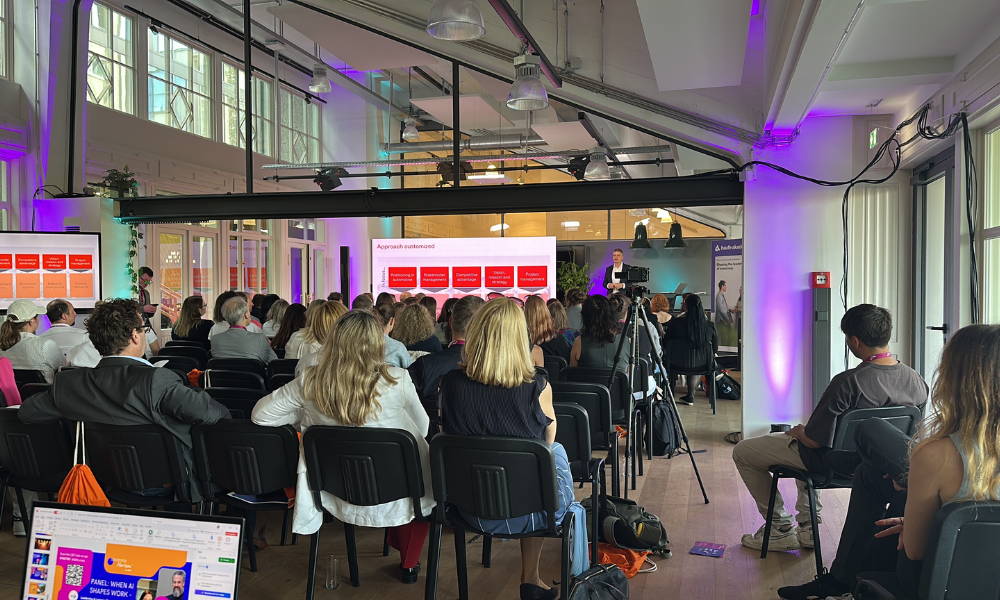
As we prepare for our annual Leadership Horizon Conference, we’re taking a look back at some of the highlights of our successful 2026 edition. In his insightful business case “As AI Scales, Leadership Evolves” our guest speaker Dr. Balázs Lóránd explored how artificial intelligence is reshaping organizations and what this means for leadership. His presentation sparked important questions, some of which remained unanswered.
In this exclusive Q&A, he revisits five key challenges, sharing his perspectives on AI-driven decision-making, the future of work, organizational agility, change management, and team spirit. Discover why, even as AI transforms the way we work, leadership remains fundamentally human.
1. AI and Decision-Making: Are We Missing New Opportunities?
AI makes decisions based on past data. Do you see a danger in that? Could this mean missing entirely new opportunities?
It depends on how we define AI, and on which of the available technologies we actually use. Great new ideas and unconventional solutions still mostly come from humans. But genuinely new strategies and different solutions can emerge from AI as well.
In the automotive domain, there are three technologies to consider:
- Neural network-based computer vision (CV) – the technology behind self-driving
- Large language models (LLMs)
- A combination of the two
Traditional deep learning-based computer vision relies on supervised training. When new traffic participants appear (for example, a new type of vehicle on the road), we have to add new data to the model’s training set. Here, the possibilities are limited by the quality and diversity of the available data. Most neural networks can only produce results they were trained for, or at best certain new combinations of them.
With LLMs, the picture is different. Their decisions and proposals are not deterministic: there is a degree of randomness built into how they generate answers. Thanks to this, LLMs can come up with new combinations of existing knowledge – which is often exactly where fresh ideas begin, besides the human creativity.
And in self-driving, where it is possible to use neural network-based CV and LLMs together – in so-called Vision Language Models and Vision Language Action models – truly new opportunities can open up.
So the right combination of technologies, guided by human judgment, does not close the door to new opportunities. It can open it.

2. AI and the Future of Work: How Can Leaders Prepare Their People?
AI will replace certain jobs. How should organizations and leaders deal with that?
Many software development steps and processes can already be handed over to AI. Humans provide the initial prompt or specification, and at the end, someone must verify what the AI has produced. We call this AI output verification.
Rapid advances in AI are reshaping the entire software development industry, along with many jobs and responsibilities. Developers now need to think on a more abstract level to prompt the AI well, but humans are still needed: humans who can check code quality, repair it and verify it. Not everyone is ready for this shift, and as a result, a certain selection process among developers is already underway.
At the same time, new jobs are emerging and leaders have a crucial role in preparing people for this transition and enabling reskilling on a large scale. Humans must remain responsible and accountable, at the very least for AI safety, AI security and compliance. New roles are also appearing around the cost side of AI: how to optimize token consumption and choose the right model for a given task or project.
Take software architects, for example as a high-value role in any organization. Architects who can see and handle complexity are more in demand than ever, because AI-generated code must be checked and verified, at least in safety-critical systems like the ones operating in self-driving cars.
All in all, where the agentification of certain tasks and processes is possible, we as humans become more efficient, and fewer people are needed to deliver the same output. But since many players in the market are working on similar transformations, this kind of efficiency alone does not create a competitive advantage. What does create a competitive advantage is how well we prepare our people for the new world of work.
3. Leadership in Uncertainty: How Can We Set Goals When the Future Is Unpredictable?
In times of AI, things are changing so quickly that we can hardly define a stable target picture. How do you cope with this complexity and uncertainty?
It is getting increasingly difficult to set numerical targets for a company. It is only possible for the short term, for a given iteration, and with the necessary level of agility. But even without predicting the future, a vision and a mission can still be defined, together with the position we want to hold in the market (not the exact figure).
Let me give an example: When we were building our own in-house GPU cluster in Frankfurt to train our neural networks, we fixed the final result in advance: at least its compute and storage capacity, its performance and the timeframe of build up.
How we would get there was not predictable beforehand: what to do in each timebox, which new technologies would emerge, which ones to test and for how long. The WHAT was fixed, the HOW stayed flexible. That is how we were able to combine stability with agility.
Corporate values can provide another source of stability in the organization – and these should stay firmly in human hands. In my previous role, the values I worked with were openness, transparency, diversity and unity, flexibility and structure.
When the target picture keeps moving, values are what provide us stability.

4. Organizational Change: Who Drives Transformation in the AI Era?
Who changes an organization, and in which direction? This seems to be a major challenge in times of organizational uncertainty.
Many actors can change an organization. Internally, it is the individuals, above all the leaders and the experts. Externally, competitors, the market and customers shape organizations too. And then there is disruption, which is happening everywhere right now based on the rapid advances in AI.
The leadership of an organization is a key factor that sets a company apart from its competitors. Leaders provide the right vision and mission and should use them to drive change actively. Defining the direction of change is their responsibility.
In today’s transformations (as digital transformation and AI adoption) we often see that new programs and organizational changes are also initiated by colleagues. In other words, change can be driven bottom-up, not only top-down. And it has to be: AI adoption cannot be achieved through top-down initiatives alone.
The speed of change is crucial as well. A large multinational with a long history carries a strong organizational memory. Startups, without that memory, can change direction quickly and come up with new solutions. The best approach is to find a way to combine these two models.
As for the direction of change: what matters most today are not new ideas at all: strengthening agility and building a learning organization. As AI develops rapidly, we need people who learn new skills every day (AI output validation, for example), and teams that can easily adapt and reorganize themselves on a regular basis.
5. Team Spirit and Leadership: How Do We Build Trust During Change?
Do you believe your team’s spirit is a result of leadership and development opportunities?
Yes, and it does not happen by accident. Leaders should deliberately focus on building team spirit and maintaining it.
Several factors contribute:
- Leadership development programs are indispensable. Besides mentoring and coaching, team coaching can be especially valuable.
- Share lessons learned and stop inappropriate practices in the organization as soon as they are identified.
- Make best practices visible to everyone.
All of these are leadership responsibilities. Feedback should be heard and truly listened to on a regular basis. Together, these practices have a real impact on maintaining team spirit and building trust across the organization.
One more factor helps strengthen team spirit in times of uncertainty: the stability of the team, reflected in a low turnover rate. When team members stay together, they can survive several changes and reorganizations, a point I also made in my presentation at the MDI Leadership Horizon Conference in Vienna in 2026.
AI is transforming how we work, make decisions, and organize our teams. Yet one thing remains clear: leadership is still fundamentally human.
Which of these five leadership challenges is the most pressing in your organization right now, and what will you do about it this quarter?
Did we get you hooked for more? Get your Early Bird Leadership Horizon Tickets for 2027 here!

Dr. Balázs Lóránd
Artificial Intelligence & Leadership
Balázs Lóránd, Ph.D, was Managing Director and Head of Artificial Intelligence at AUMOVIO Autonomous Mobility, where he built one of the automotive industry’s largest AI development centers, with more than 300 professionals. Combining executive leadership with a decade of university teaching and research, he focuses on the organizational and human dimensions of AI adoption and digital transformation. His approach: Fix the what, free the how.