
• MDI
  • German version
  • Contact us
MDI Management Development
  • Agile leadership
  • Lateral Leadership
  • Leadership Impact
  • Leadership Development
Select Page
The 4 Stages of Development: What Leaders Need to Know

The 4 Stages of Development: What Leaders Need to Know

by Florian Biedermann | Nov 5, 2026 | Leadership Impact, Leadership Tips | 0 comments

The 4 Stages of Development: What Leaders Need to Know

A blog post inspired by Ivan Petric’s essay “Model of Models: Three Models. One Process. (Model modela: Tri modela. Jedan proces.)“

Whether we are learning a new skill, stepping into a leadership role, or building a high-performing team, development rarely follows a straight line. Initial enthusiasm often gives way to frustration, uncertainty, and challenges before real progress becomes visible.

But what if these experiences are not setbacks, but natural stages of the same development process?

In this first part of our two-part blog series, we explore how three well-known development models reveal a shared pattern of growth, and what leaders, coaches, and trainers can learn from it. Drawing on insights from coach and NLP trainer Ivan Petric, we take a closer look at why frustration is often a necessary part of learning and how the right support can make all the difference.

Model of Models

What do a young boy from Makarska, Lionel Messi, and a first-time manager have in common? Yes, it’s the letter M – but actually we did not mean that. According to coach and NLP trainer Ivan Petric, they all go through the same journey. It just looks different each time.

In his essay “Model of Models“, Petric takes three frameworks that most of us in learning and development keep in separate drawers and puts them side by side. What he finds is useful for anyone who coaches, leads, trains, or raises people.

Three drawers, one pattern

For years Petric kept three models apart. One came from NLP training, one from leadership work, and one from team development. Each had its own literature, its own experts, and of course, its own PowerPoint slides.

  • The Four Stages of Competence describe how an individual learns a skill. We move from unconscious incompetence to conscious incompetence, then to conscious competence and finally to unconscious competence.
  • Situational Leadership describes how a leader should support someone who is developing in a specific task. The development levels run from D1, the enthusiastic beginner, through D2, the disillusioned learner, and D3, the capable but cautious contributor, to D4, the self-reliant achiever.
  • Tuckman’s model of team development describes how a group learns to work together: Forming, Storming, Norming, and Performing.

The authors, disciplines, and content are different. But when Petric stopped paying attention to the labels, the same structure showed through:

Competence

Situational Leadership

Team Development

Emotional dynamic

Unconscious Incompetence

D1

Forming

Excitement, anticipation, novelty

Conscious Incompetence

D2

Storming

Reality check, frustration, uncertainty

Conscious Competence

D3

Norming

Practice, growing skill and confidence

Unconscious Competence

D4

Performing

Stability, autonomy, ease

Petric finds the last column the most interesting, and so do I. It reflects what he actually observes when working with people. What changes is not only what a person can do. It is also how they experience themselves and the process they are in.

Strip away the labels and what is left? A new beginning. A collision with reality and its complexity. Gradual adjustment and the building of new skills. And finally, more stable, independent and effective performance. These are not three models that happen to match. They are three perspectives on the same developmental process, at three different levels: the individual, the individual within an organisation, and the group.

Three drawers, one pattern

Why this matters: knowledge becomes transferable

Petric credits NLP not so much as one more model but as a way of looking at things. Its central idea is modelling: when someone succeeds at something, you look past the content of their story and ask how the process behind the result is structured.

What happens first? What next? What changes when feedback comes in? And could the same structure appear somewhere else under a completely different name?

He puts it simply: a beginner sees a technique, a more experienced person starts to see a pattern, and once you understand the process, you are no longer limited to a single technique. Seeing the shared pattern does not mean ignoring the differences. But it does something valuable. You can see what you understand about leadership in a child learning something new. What you observe in a sports team, you can recognize in a project team.

This search for patterns across levels later became the foundation of what Petric calls Fractal Coaching: moving from the whole to the structure to the detail and back to the whole, while checking what repeats and at which level an intervention makes sense.

The critical phase is not the beginning

Back to Marko. He is twelve or thirteen, his room is covered in posters, his hair is getting longer, and he sees himself on stage playing riffs while the front row screams. The rest is technical detail. His parents, who still have a kimono in the wardrobe from the time he was going to be the next Bruce Lee, are more cautious. Eventually his father gives in and buys a guitar.

Then the real problem starts.

In the first lesson, the teacher’s fingers land exactly where they should. Marko’s fingers hit the wrong string, miss the fret, and produce sounds that have nothing to do with the records. By the time he has moved from one chord to the next, the song would already be over. On day three, the guitar is lying next to his bed. By day five, he is wondering whether drums might suit him better. The strings are too stiff anyway, and an electric guitar would surely be easier.

Marko analyses the problem in great detail. The only thing his analysis misses is that all of this is completely normal.

This is why Petric considers the second stage, conscious incompetence, D2 or Storming, perhaps the most decisive in the whole process. Not because it is the most important in theory, but because this is where we so often decide whether to continue or quit. In this phase, we do not only learn chords, a new business process, or a coaching technique. We also learn how we react when results do not come, when feedback is negative, and when our original self-image no longer holds.

Can I tell a mistake apart from personal failure? Can I try again? Can I ask for help without feeling incompetent?

The same thing happens at work. Someone starts a new job full of energy. A few months later, the job no longer looks like the interview: deadlines, difficult relationships, decisions without enough information, tasks that were not in the job description. If the manager only sees falling motivation, the conclusion is “wrong person“. If the employee only sees their own frustration, the conclusion is “wrong company“. Sometimes both are right. But sometimes they are looking at a perfectly normal developmental step and mistaking it for a final diagnosis.

guitar lesson

Constructive frustration versus overload

Marko’s father had two easy options. He could fix the problem right away: the guitar is not working, so buy drums, then a piano, then maybe a moped. Or he could go to the other extreme: “You wanted this, now deal with it.” Neither is smart development management.

Instead, he held to their agreement: stick with it until the end of the term, then decide. And the teacher did something important. He did not call Marko lazy or give him a lecture on discipline. He took two chords and slowed everything down until Marko managed, for the first time, to switch between them without chaos. Once it sounded clean. Once it didn’t. But Marko had heard that he could do it.

A person in the second phase rarely needs us to solve the whole problem. They need enough support to see that there is a way through, enough structure to take the next step, and enough responsibility to take that step themselves.

That is why Petric rejects the idea that a good teacher, parent, coach, or manager is someone who removes discomfort. Development is hardly possible without meeting the limits of what we can do. The real question is what kind of environment we build around that point. If a task is so hard there is no chance of success, frustration leads to giving up. If it is so easy there is no challenge, nothing new develops. In between lies the zone where we try, fail, correct, and see little progress.

Safety is not sterility. Safety means I can make mistakes without being exposed, receive feedback without being attacked, and try again.

We cannot skip developmental stages. But we can help people go through them better: with clearer expectations, better feedback, and fewer unnecessary mistakes, without the illusion that we can teleport someone from beginner to expert.

Development Is a Process, Not a Shortcut

Whether someone is learning to play the guitar, taking on a new leadership role, or finding their place in a team, the underlying lesson remains the same: growth takes time, practice, and the willingness to work through uncertainty.

For leaders, this means recognizing that frustration is not always a sign that something is going wrong. Sometimes, it is a sign that development is happening. The challenge is knowing when to provide guidance, when to create space for learning, and when to let people find their own way forward.

But what happens when we apply these development patterns beyond the individual?

In Part 2 of this blog series, we will continue exploring Ivan Petric’s insights and what they mean for leadership, coaching, and team development.

Florian Biedermann

Florian Biedermann

Learning & Development Consultant at MDI

Florian Biedermann is a Learning & Development Consultant at MDI (Management Development Institute) – a global consulting company that offers solutions for leadership development. His focus is on making complex issues understandable and inspiring people to think – and act. Florian previously worked for many years as an author and manager in the e-learning sector, after spending over a decade as a freelance journalist.


  • LinkedIn

What serves you next?

The 4 Stages of Development: What Leaders Need to Know

by Florian Biedermann | 5. November 2026 | Leadership Impact, Leadership Tips | 0 Comments

The 4 Stages of Development: What Leaders Need to Know A blog post inspired by Ivan Petric's essay "Model of Models: Three Models. One Process. (Model modela: Tri modela. Jedan proces.)“ Whether we are learning a new skill, stepping into a leadership role, or building...
Read More

Zeca Ruiz on Cross-Generational Leadership and Navigating Change

by Jana Wölfl | 13. May 2026 | Leadership Impact, MDI Spotlight Series, Training Insights | 0 Comments

Zeca Ruiz on Cross-Generational Leadership and Navigating Change This blog is an excerpt from our new podcast! You can find the entire podcast episode here. Zeca Ruiz on Cross-Generational Leadership and Navigating Change In the fourth episode of our podcast “Voices...
Read More

How Do You Lead People Who Don’t Think the Way You Do?

by Zeca Ruiz | 4. February 2026 | Leadership Impact, Leadership Tips, Learning Transfer | 0 Comments

How Do You Lead People Who Don't Think the Way You Do? Do you want to listen to this article? Click here to access our AI-generated audio version!   How do you lead people who do not think the way you do? Leadership is a challenge, especially when you are not...
Read More

How You Deal With Neurodiversity as a Leader

by Iris Kandlbauer | 3. February 2026 | Leadership Impact, Leadership Tips, Short Knowledge Bits | 0 Comments

How You Deal With Neurodiversity as a Leader You prefer listening to this article? You can find our AI-generated audio version below! How You Deal With Neurodiversity as a Leader What might be behind “strange” behavior in a team—and how leaders can deal with it...
Read More

Generation Z isn’t the Problem but Our System is

by Zeca Ruiz | 3. December 2025 | Impuls series, International leadership development, Leadership in the digital transformation | 0 Comments

Generation Z Isn’t the Problem, but Our System is. Read this article on crossgenerational management by Zeca Ruiz to find out more!

Read More

The Lasting Impact of Leadership Horizon – Meike’s Perspectives

by Meike Hinnenberg | 2. July 2025 | Leadership Impact, MDI Inside, Short Knowledge Bits | 0 Comments

The Lasting Impact of Leadership Horizon - Meike's Perspectives Do you prefer to listen to this article? Click below to access our AI-generated audio version!The Lasting Impact of Leadership Horizon - Meike's Perspectives MDI’s Meike Hinnenberg shares her reflections...
Read More

Success Through Change: How to Stay Oriented During Transitions

by Anita Berger | 14. April 2025 | Impuls series, Leadership Impact, Leadership Tips | 0 Comments

Success Through Change: How to Stay Oriented During Transitions Do you prefer to listen to this article? Click below to access our AI-generated audio version:Success Through Change: How to Stay Oriented During Transitions Change processes often involve challenges....
Read More

4 Tips on How to Shape Change Processes as a Leader

by Anita Berger | 3. April 2025 | Impuls series, Leadership Impact, Leadership Tips | 0 Comments

4 Tips on How to Shape Change Processes as a Leader Do you prefer to listen to this article? Click below to access our AI-generated audio version:4 Tips on How to Shape Change Processes as a Leader Imagine a dynamic network of paths that is constantly changing. While...
Read More

Successful Team Building for Boehringer Ingelheim RCV

by Anita Berger | 29. March 2024 | Customer Story, International leadership development, MDI Inside | 0 Comments

Successful Team Building for Boehringer Ingelheim RCV Do you prefer to listen to this article? Click below to access our AI-generated audio version:Successful Team Building for Boehringer Ingelheim RCV In the interview with our MDI trainer and partner, Anita Berger On...
Read More

Organize Your Team in a Hybrid Workplace

by Peter Grabuschnig | 14. March 2024 | Impuls series, International leadership development, Leadership in the digital transformation | 0 Comments

Organize Your Team in a Hybrid Workplace Prefer to listen to the article? Click below to access our AI speech-generated audio. However, if you want to read it as usual, keep scrolling.Organize Your Team in a Hybrid Workplace In his new Rise Course, our MDI trainer and...
Read More
Zeca Ruiz on Cross-Generational Leadership and Navigating Change

Zeca Ruiz on Cross-Generational Leadership and Navigating Change

by Jana Wölfl | May 13, 2026 | Leadership Impact, MDI Spotlight Series, Training Insights | 0 comments

Zeca Ruiz on Cross-Generational Leadership and Navigating Change

This blog is an excerpt from our new podcast! You can find the entire podcast episode here.

Zeca Ruiz on Cross-Generational Leadership and Navigating Change

In the fourth episode of our podcast “Voices of Leadership | An MDI Spotlight Series,” we virtually sat down with trainer and consultant Zeca Ruiz to discuss cross-generational management, change, and what leadership looks like in a world that keeps evolving faster than ever.

Zeca works across Latin America and Europe and focuses on leadership development, emotional intelligence, cultural transformation, and team dynamics in complex environments. During our conversation, he shared not only practical insights about leading multi-generational teams, but also deeply personal stories from his own journey into leadership.

One thing became clear very quickly: for Zeca, leadership is closely connected to change.

“Change is the only permanent thing in life.”

At the beginning of our conversation, we asked Zeca what his “superpower” as a trainer would be. His answer immediately set the tone for the rest of the discussion.

“I like to think of myself as a facilitator of transitions.”

For him, leadership is not about controlling people. It is about helping people navigate uncertainty, transformation, and growth. Zeca explained that this perspective comes from personal experience. He had originally chosen a different career path, until his father passed away unexpectedly. At only 24 years old, Zeca suddenly had to take over the family business with 150 employees.

At the same time, the world was going through the financial crisis of 2008. Business was struggling, uncertainty was everywhere, and Zeca found himself in a leadership role he had never prepared for. Instead of focusing purely on processes and structures, he started focusing on people.

“I realized that nobody was talking about leadership itself.”

That realization became a turning point. He began studying emotional intelligence, communication, coaching, and leadership development. Over time, he discovered that sustainable leadership is not created through authority alone, but through understanding people’s needs, motivations, and emotions.

What cross-generational management really means

One of the main topics of our conversation was cross-generational leadership. According to Zeca, many organizations today have up to four generations working together in the same team. While this diversity can be incredibly powerful, it can also create misunderstandings, conflicts, and frustration if leaders fail to understand the different perspectives involved.

“Our generation is a sociological concept that refers to a group of people who grew up during the same historical period and were shaped by similar experiences.”

Because each generation grew up in a different environment, their expectations around work, communication, feedback, motivation, and leadership can differ significantly. For Zeca, this is where leadership becomes especially important. Instead of judging differences, leaders need to understand them.

“If we don’t understand the differences, we will have a lot of conflicts.”

What cross-generational management really means

Understanding Generation Z

During the conversation, we also spoke in depth about Generation Z and why many organizations currently struggle to engage younger employees. According to Zeca, Gen Z grew up in a completely different world than previous generations. They were shaped by rapid technological change, constant access to information, economic instability, and a world where systems and structures change continuously.

“They need purpose. They will not just do whatever you ask because you are their boss.”

For many traditional leaders, this shift can feel uncomfortable. Hierarchical structures and purely authority-based leadership often do not work well anymore. At the same time, Zeca emphasized that younger generations also bring extraordinary strengths into organizations. He described Gen Z as highly flexible, fast-moving, and capable of learning quickly.

However, he also explained that many younger employees are more emotionally sensitive when it comes to feedback and criticism. For leaders, this means communication needs to become more conscious, empathetic, and transparent.

Why older generations still matter deeply

While much of the discussion focused on Gen Z, Zeca repeatedly emphasized that leadership is not about choosing one generation over another. Older generations still play a critical role in organizations because they provide experience, context, stability, and perspective.

“Millennials, Gen X, and Baby Boomers built the systems that Generation Z is now entering.”

Previous generations were often shaped by ideas such as long-term effort, stability, loyalty, and career development over decades. But according to Zeca, today’s reality moves much faster. For him, the real opportunity lies in combining the adaptability and creativity of younger generations with the experience and contextual understanding of older generations.

Leadership today requires flexibility

Throughout the conversation, one message appeared again and again: leadership today requires flexibility. Leaders can no longer rely on rigid structures, fixed expectations, or one-size-fits-all approaches.

“We have to be more flexible, and we have to adapt faster than ever.”

For Zeca, successful leaders are the ones who are able to understand different motivations, different communication styles, and different emotional needs within their teams. He also stressed that many people naturally resist change. That is why modern leadership requires emotional intelligence, empathy, communication skills, and the ability to create trust during uncertain times.

Leadership today requires flexibility

Leadership starts with understanding people

One of the most memorable moments in the conversation came when Zeca reflected on what leadership really means to him today. After years of working with organizations, leaders, and teams across different cultures, he believes that leadership is ultimately about understanding people.

“If we don’t use the right communication, or if we don’t understand their needs and their processes, it’s going to be difficult to have them engaged.”

This mindset also shapes his work as a trainer and consultant today. Whether he is working on leadership development, culture change, or emotional intelligence, the core question remains the same:

How do we help people grow through change instead of simply surviving it?

Conclusion

Our conversation with Zeca Ruiz showed that cross-generational leadership is far more than managing age differences. It is about understanding how people were shaped by their experiences, adapting leadership styles to different needs, and creating environments where different generations can learn from one another instead of competing against each other.

At the same time, the conversation reminded us that leadership itself is changing rapidly. Traditional structures, rigid hierarchies, and purely authority-based leadership models are becoming less effective in a world defined by uncertainty and constant transformation.

For Zeca, the future of leadership belongs to leaders who are flexible, emotionally intelligent, and capable of guiding people through change with empathy and clarity.

“Change is the only permanent thing in life.”

And perhaps that is exactly why human-centered leadership matters more than ever.

Jana Wölfl

Jana Wölfl

Marketing Assistant

Jana Wölfl is a marketing assistant at MDI and works on our blog. She has already been responsible for several areas of marketing, such as designing our new website and administering our personalist.at portal.

This could also interest you:

From Individual Growth to Leadership and Team Development

by Florian Biedermann | 12. November 2026 | Impuls series, Leadership and AI, Learning Transfer | 0 Comments

From Individual Growth to Leadership and Team Development In the first part of our blog series, inspired by coach and NLP trainer Ivan Petric's essay Model of Models, we explored how three well-known development models reveal a shared pattern of growth. From initial...
Read More

The 4 Stages of Development: What Leaders Need to Know

by Florian Biedermann | 5. November 2026 | Leadership Impact, Leadership Tips | 0 Comments

The 4 Stages of Development: What Leaders Need to Know A blog post inspired by Ivan Petric's essay "Model of Models: Three Models. One Process. (Model modela: Tri modela. Jedan proces.)“ Whether we are learning a new skill, stepping into a leadership role, or building...
Read More

Leading Through AI Transformation: 5 Leadership Challenges and How to Address Them

by Balázs Lóránd | 28. October 2026 | Leadership and AI, Leadership Horizon | 0 Comments

Leading Through AI Transformation: 5 Leadership Challenges and How to Address Them As we prepare for our annual Leadership Horizon Conference, we’re taking a look back at some of the highlights of our successful 2026 edition. In his insightful business case “As AI...
Read More

Beyond the Training Room – Turning Insights into Impact

by Florian Biedermann | 22. October 2026 | Leadership Tips, Learning Transfer, Training Insights | 0 Comments

Beyond the Training Room – Turning Insights into Impact Traditionally, a training session ends with a recap and a round of feedback. In these face-to-face conversations, participants’ responses are often overwhelmingly positive. Usually, those who enjoyed the training...
Read More

Are Leaders Asking the Wrong Questions About Employee Retention?

by Zeca Ruiz | 15. October 2026 | Leadership Tips, Short Knowledge Bits | 0 Comments

Are Leaders Asking the Wrong Questions About Employee Retention? I was recently invited to give a talk at an association of business owners in Brazil, which was organizing a symposium on a timely topic: workforce challenges in a fast-moving, digital world. Right in...
Read More

10 Tips for Effective Communication With Dominant Partners

by Dominik Etzl, Rafael Ungvari | 4. October 2026 | Best Practice, Leadership Tips, learning effectiveness | 0 Comments

Homer Simpson has been delighting young and old for many years. Short-tempered to the point of being slightly irascible, he speaks his mind directly. He’s constantly getting annoyed over trivial matters and doesn’t seem to place much value on the opinions and advice...
Read More

4 Heuristics to Stop Mistaking Symptoms for Cause in the AI Era

by Zeca Ruiz | 24. September 2026 | Digital Transformation, Leadership and AI, Leadership Tips | 0 Comments

4 Heuristics to Stop Mistaking Symptoms for Cause in the AI Era The AI era is intensifying an old problem: acting too fast on the wrong diagnosis. Every one of us has lived through, or heard about, some organizational mess born from exactly that. In every era, every...
Read More

Human First: Leadership in the Age of AI

by Johanna Glechner | 14. September 2026 | Digital Transformation, Leadership and AI, Leadership in the digital transformation | 0 Comments

Human First: Leadership in the Age of AI My professional journey has always taken place at the intersection of two worlds that, for a long time, were treated as separate: technology and leadership. With a background in business informatics, I started my career in...
Read More

AI Transformation Is Leadership Work

by Gunther Fürstberger | 28. August 2026 | Leadership and AI, Leadership Tips, MDI Whitepaper | 0 Comments

AI Transformation Is Leadership Work The four-step loop that turns individual experiments into lasting change Many companies are already using AI—and still not transforming. Tools, pilot projects, and guidelines only add up to transformation once they deliberately...
Read More

What If AI Doesn’t Replace Us — But Drowns Us Out?

by Martin Maglia | 24. July 2026 | Digital Transformation, Leadership and AI, Short Knowledge Bits | 0 Comments

What If AI Doesn't Replace Us — But Drowns Us Out? Over the weekend, I watched a thought-provoking video from Rick Beato. (You can find the link at the end of this article.) For those who don't know him: Rick Beato is a musician, producer, educator, guitarist, and one...
Read More
How Do You Lead People Who Don’t Think the Way You Do?

How Do You Lead People Who Don’t Think the Way You Do?

by Zeca Ruiz | Feb 4, 2026 | Leadership Impact, Leadership Tips, Learning Transfer | 0 comments

How Do You Lead People Who Don’t Think the Way You Do?

Do you want to listen to this article? Click here to access our AI-generated audio version!


How do you lead people who do not think the way you do?

Leadership is a challenge, especially when you are not always aligned with your colleagues and employees. Our MDI Ambassador Zeca Ruiz proves that even resistance in your team can be a good thing. You want to know why and how to deal with this? Read this blog article to find out more!

First mistake: Don’t confuse alignment with unanimity

I want to start with a simple, and perhaps uncomfortable, provocation for many leaders. If everyone on your team thinks like you, something is not right.

For a long time, I believed that good leadership meant achieving quick alignment, minimal friction, and decisions flowing with little or no resistance. Today, I think exactly the opposite. Teams that are overly aligned, in the sense of agreement, tend to be fragile, predictable, and dangerous in the long run. One of the most common leadership traps is confusing alignment with unanimity.

Why You Seek Agreement

When we seek to make people think like us, it is usually not a strategic choice. It is about comfort. Agreement gives us a false sense of control, reduces our anxiety, and makes us feel validated. The problem is that it also removes the questioning that could prevent mistakes, poorly calibrated decisions, and strategic blind spots.

The truth is, you do not want people to think like you. You want them to challenge you. When they press the right buttons, the ones that test whether you truly believe in the direction you are proposing, they strengthen the decision, refine the path, and turn a personal idea into a collective commitment.

Strong contributors do not accept everything. They question, create tension, ask for clarity, and force the leader out of autopilot. And strong leaders can hold that space with presence, inner security, and genuine openness, without becoming defensive, without confusing discomfort with threat, and without silencing differences to preserve authority.

Why You Seek Agreement

This is exactly where a fundamental distinction comes in, one that deeply changed the way I lead and develop leaders. You do not need people to agree with the path. You need them to be committed to the shared destination. The role of leadership is not to create copies of yourself, but to sustain a direction that is clear enough to allow diversity of thought without losing coherence.

This Requires an Important Mindset Shift.

Questioning is not disloyalty. Thinking differently is not a lack of engagement. On the contrary, it is often a sign of responsibility, ownership, and genuine commitment to the outcome. In practice, what truly matters is ensuring that you and your team want the same outcomes, even if you take different routes to get there. That only happens when the leader stops trying to convince and starts translating the vision into the language, pace, and motivators of each team member.

People do not engage with your vision. They engage when they can see the vision through their own motivators and their own language. Now, moving into the practical side, here are a few DOs and DON’Ts that make a real difference in everyday leadership.

DOs

  • Align on the why before discussing the how.
  • Explicitly invite dissent in important decisions.
  • Publicly recognize those who challenge you with respect and constructive intent.

DON’Ts

  • Do not confuse questioning with a lack of commitment.
  • Do not demand alignment of form when alignment of intention is what truly matters.
  • Do not label people who think differently as difficult.

Putting Gen Z Into Context

How to Create Real Commitment

In addition, I like to work with a simple set of questions that help reveal motivators and create real commitment.

  • What makes you genuinely care about this project?
  • What would need to happen for you to commit even more?
  • What are you seeing here that I might not be seeing?
  • What would you regret not saying now if things went wrong later?

These questions do something powerful. They move a person from executor to co-creator. And when someone feels like a co-creator, the level of commitment changes completely.

Emotional Maturity All the Way

At the end of the day, leading people who do not think like you is less about management and more about emotional maturity. It is about holding tension without needing to win. It is about sustaining a direction that is clear enough for different voices to contribute without diluting meaning.

Perhaps the most noble role of leadership is not to create loyal followers, but to create spaces where different people can commit to something greater than themselves.

So, Here is the Final Reflection.

Who on your team truly challenges you today?
And when that happens, do you respond with defensiveness or with curiosity?

Zeca Ruiz

Zeca Ruiz

Leadership Trainer and Consultant

Zeca Ruiz is a Leadership Trainer, Facilitator and Consultant in Human and Organizational Development. He works in leadership development across Latin America and Europe, with experience in cultural transformation processes, team dynamics and the integration of systemic methodologies into corporate practice. He is a specialist in complex thinking, a generative coach and an integrative therapist, working at the intersection between human behavior, learning and the evolution of systems. He leads trainings, talks and development programs that combine depth, clarity and practical application to prepare people and organizations for high complexity environments.

  • LinkedIn

What serves you next?

The 4 Stages of Development: What Leaders Need to Know

by Florian Biedermann | 5. November 2026 | Leadership Impact, Leadership Tips | 0 Comments

The 4 Stages of Development: What Leaders Need to Know A blog post inspired by Ivan Petric's essay "Model of Models: Three Models. One Process. (Model modela: Tri modela. Jedan proces.)“ Whether we are learning a new skill, stepping into a leadership role, or building...
Read More

Zeca Ruiz on Cross-Generational Leadership and Navigating Change

by Jana Wölfl | 13. May 2026 | Leadership Impact, MDI Spotlight Series, Training Insights | 0 Comments

Zeca Ruiz on Cross-Generational Leadership and Navigating Change This blog is an excerpt from our new podcast! You can find the entire podcast episode here. Zeca Ruiz on Cross-Generational Leadership and Navigating Change In the fourth episode of our podcast “Voices...
Read More

How Do You Lead People Who Don’t Think the Way You Do?

by Zeca Ruiz | 4. February 2026 | Leadership Impact, Leadership Tips, Learning Transfer | 0 Comments

How Do You Lead People Who Don't Think the Way You Do? Do you want to listen to this article? Click here to access our AI-generated audio version!   How do you lead people who do not think the way you do? Leadership is a challenge, especially when you are not...
Read More

How You Deal With Neurodiversity as a Leader

by Iris Kandlbauer | 3. February 2026 | Leadership Impact, Leadership Tips, Short Knowledge Bits | 0 Comments

How You Deal With Neurodiversity as a Leader You prefer listening to this article? You can find our AI-generated audio version below! How You Deal With Neurodiversity as a Leader What might be behind “strange” behavior in a team—and how leaders can deal with it...
Read More

Generation Z isn’t the Problem but Our System is

by Zeca Ruiz | 3. December 2025 | Impuls series, International leadership development, Leadership in the digital transformation | 0 Comments

Generation Z Isn’t the Problem, but Our System is. Read this article on crossgenerational management by Zeca Ruiz to find out more!

Read More

The Lasting Impact of Leadership Horizon – Meike’s Perspectives

by Meike Hinnenberg | 2. July 2025 | Leadership Impact, MDI Inside, Short Knowledge Bits | 0 Comments

The Lasting Impact of Leadership Horizon - Meike's Perspectives Do you prefer to listen to this article? Click below to access our AI-generated audio version!The Lasting Impact of Leadership Horizon - Meike's Perspectives MDI’s Meike Hinnenberg shares her reflections...
Read More

Success Through Change: How to Stay Oriented During Transitions

by Anita Berger | 14. April 2025 | Impuls series, Leadership Impact, Leadership Tips | 0 Comments

Success Through Change: How to Stay Oriented During Transitions Do you prefer to listen to this article? Click below to access our AI-generated audio version:Success Through Change: How to Stay Oriented During Transitions Change processes often involve challenges....
Read More

4 Tips on How to Shape Change Processes as a Leader

by Anita Berger | 3. April 2025 | Impuls series, Leadership Impact, Leadership Tips | 0 Comments

4 Tips on How to Shape Change Processes as a Leader Do you prefer to listen to this article? Click below to access our AI-generated audio version:4 Tips on How to Shape Change Processes as a Leader Imagine a dynamic network of paths that is constantly changing. While...
Read More

Successful Team Building for Boehringer Ingelheim RCV

by Anita Berger | 29. March 2024 | Customer Story, International leadership development, MDI Inside | 0 Comments

Successful Team Building for Boehringer Ingelheim RCV Do you prefer to listen to this article? Click below to access our AI-generated audio version:Successful Team Building for Boehringer Ingelheim RCV In the interview with our MDI trainer and partner, Anita Berger On...
Read More

Organize Your Team in a Hybrid Workplace

by Peter Grabuschnig | 14. March 2024 | Impuls series, International leadership development, Leadership in the digital transformation | 0 Comments

Organize Your Team in a Hybrid Workplace Prefer to listen to the article? Click below to access our AI speech-generated audio. However, if you want to read it as usual, keep scrolling.Organize Your Team in a Hybrid Workplace In his new Rise Course, our MDI trainer and...
Read More
How You Deal With Neurodiversity as a Leader

How You Deal With Neurodiversity as a Leader

by Iris Kandlbauer | Feb 3, 2026 | Leadership Impact, Leadership Tips, Short Knowledge Bits | 0 comments

How You Deal With Neurodiversity as a Leader

You prefer listening to this article? You can find our AI-generated audio version below!

How You Deal With Neurodiversity as a Leader

What might be behind “strange” behavior in a team—and how leaders can deal with it constructively.

Irritating behavior—people who are absent

Everyone knows them: the colleague who never attends team events, prefers to work with headphones on, and hardly ever consults with others, but who works with incredible precision and delivers great results. Or the colleague who is chaotic, often late, full of ideas that have made many a project a success, but lacks structure.

It’s easy to jump to conclusions: unmotivated, uncooperative, lazy, they just need to make a little effort… Discussions are held, behavior is demanded – and often nothing happens. Or worse, performance declines and sick days increase. What is going on?

What could really be behind it

Instead of jumping to the conclusion that someone “just doesn’t want to,” it’s worth taking a look behind the façade. Because conspicuous or supposedly inappropriate behavior often has deeper causes:

  • Trauma & developmental experiences: People who have experienced trauma in the past often withdraw in social contexts.
  • Social anxiety/anxiety disorders: What looks like disinterest can be deep insecurity or fear of embarrassment.
  • Cultural or linguistic differences: Misunderstandings can easily arise when norms and communication styles don’t match.
  • Mental illness: Depression or overload often manifest themselves insidiously, for example through social isolation or frequent mistakes.
  • Chronic exhaustion: Care work, illness, or constant pressure lead to cognitive and emotional exhaustion.
  • Personality traits & temperament: Not everyone is extroverted or team-oriented—and they don’t have to be.
  • Neurodiversity: Autism, ADHD, giftedness, or dyslexia affect approximately 20% of people. Often, these conditions are accompanied by special strengths—but also by behavior that deviates from the “norm.”
Neurodiversity at Work

The other perspective: Challenges as strengths

What may appear to be a deficiency at first glance can actually be a resource:

  • Viktor Frankl developed logotherapy from his trauma.
  • Frida Kahlo turned emotional pain into art that still moves people today.
  • People with ADHD bring creative ideas to teams.
  • Introverts like Warren Buffett make wise decisions with caution.

Those who embrace diversity also get a diversity of solutions, ideas, and perspectives.

What does this mean for leadership?

Good leadership recognizes that people tick differently—and that this is precisely where great potential lies. It’s not about making everyone the same, but about creating the right conditions so that individual strengths can become visible and effective.

In practice, this means:

  • Instead of rushing to judgment: Look closely, observe, and understand patterns
  • Don’t just lay down rules: Have conversations, listen, and ask about needs
  • Instead of one-size-fits-all solutions: Allow for flexibility and individual ways of working
  • Don’t fixate on shortcomings: Focus on existing strengths and opportunities for development

This does not mean simply accepting problematic behavior. But it does mean understanding its origin before reacting—and then providing targeted and appropriate guidance.

Ideas for your leadership practice:

See irritations as an invitation to dialogue.

Ask yourself: What does this person need to be able to work well? What conditions promote performance and belonging for this person?

Because the ability to lead diversity determines how future-proof a company really is.

Iris Kandlbauer

Iris Kandlbauer

Trainer and Coach

Iris Kandlbauer is a coach and trainer for leadership development with a focus on dealing with diversity in teams. She supports managers in understanding and productively utilizing different ways of thinking, working, and communicating—for example, through giftedness, neurodiversity, or cultural influences. She previously worked for many years as a teacher, trainer, and specialist in interpersonal dynamics, and now brings her educational experience to bear in effective leadership coaching and sustainable team development.

  • LinkedIn

This could also interest you:

From Individual Growth to Leadership and Team Development

by Florian Biedermann | 12. November 2026 | Impuls series, Leadership and AI, Learning Transfer | 0 Comments

From Individual Growth to Leadership and Team Development In the first part of our blog series, inspired by coach and NLP trainer Ivan Petric's essay Model of Models, we explored how three well-known development models reveal a shared pattern of growth. From initial...
Read More

The 4 Stages of Development: What Leaders Need to Know

by Florian Biedermann | 5. November 2026 | Leadership Impact, Leadership Tips | 0 Comments

The 4 Stages of Development: What Leaders Need to Know A blog post inspired by Ivan Petric's essay "Model of Models: Three Models. One Process. (Model modela: Tri modela. Jedan proces.)“ Whether we are learning a new skill, stepping into a leadership role, or building...
Read More

Leading Through AI Transformation: 5 Leadership Challenges and How to Address Them

by Balázs Lóránd | 28. October 2026 | Leadership and AI, Leadership Horizon | 0 Comments

Leading Through AI Transformation: 5 Leadership Challenges and How to Address Them As we prepare for our annual Leadership Horizon Conference, we’re taking a look back at some of the highlights of our successful 2026 edition. In his insightful business case “As AI...
Read More

Beyond the Training Room – Turning Insights into Impact

by Florian Biedermann | 22. October 2026 | Leadership Tips, Learning Transfer, Training Insights | 0 Comments

Beyond the Training Room – Turning Insights into Impact Traditionally, a training session ends with a recap and a round of feedback. In these face-to-face conversations, participants’ responses are often overwhelmingly positive. Usually, those who enjoyed the training...
Read More

Are Leaders Asking the Wrong Questions About Employee Retention?

by Zeca Ruiz | 15. October 2026 | Leadership Tips, Short Knowledge Bits | 0 Comments

Are Leaders Asking the Wrong Questions About Employee Retention? I was recently invited to give a talk at an association of business owners in Brazil, which was organizing a symposium on a timely topic: workforce challenges in a fast-moving, digital world. Right in...
Read More

10 Tips for Effective Communication With Dominant Partners

by Dominik Etzl, Rafael Ungvari | 4. October 2026 | Best Practice, Leadership Tips, learning effectiveness | 0 Comments

Homer Simpson has been delighting young and old for many years. Short-tempered to the point of being slightly irascible, he speaks his mind directly. He’s constantly getting annoyed over trivial matters and doesn’t seem to place much value on the opinions and advice...
Read More

4 Heuristics to Stop Mistaking Symptoms for Cause in the AI Era

by Zeca Ruiz | 24. September 2026 | Digital Transformation, Leadership and AI, Leadership Tips | 0 Comments

4 Heuristics to Stop Mistaking Symptoms for Cause in the AI Era The AI era is intensifying an old problem: acting too fast on the wrong diagnosis. Every one of us has lived through, or heard about, some organizational mess born from exactly that. In every era, every...
Read More

Human First: Leadership in the Age of AI

by Johanna Glechner | 14. September 2026 | Digital Transformation, Leadership and AI, Leadership in the digital transformation | 0 Comments

Human First: Leadership in the Age of AI My professional journey has always taken place at the intersection of two worlds that, for a long time, were treated as separate: technology and leadership. With a background in business informatics, I started my career in...
Read More

AI Transformation Is Leadership Work

by Gunther Fürstberger | 28. August 2026 | Leadership and AI, Leadership Tips, MDI Whitepaper | 0 Comments

AI Transformation Is Leadership Work The four-step loop that turns individual experiments into lasting change Many companies are already using AI—and still not transforming. Tools, pilot projects, and guidelines only add up to transformation once they deliberately...
Read More

What If AI Doesn’t Replace Us — But Drowns Us Out?

by Martin Maglia | 24. July 2026 | Digital Transformation, Leadership and AI, Short Knowledge Bits | 0 Comments

What If AI Doesn't Replace Us — But Drowns Us Out? Over the weekend, I watched a thought-provoking video from Rick Beato. (You can find the link at the end of this article.) For those who don't know him: Rick Beato is a musician, producer, educator, guitarist, and one...
Read More
The Lasting Impact of Leadership Horizon – Meike’s Perspectives

The Lasting Impact of Leadership Horizon – Meike’s Perspectives

by Meike Hinnenberg | Jul 2, 2025 | Leadership Impact, MDI Inside, Short Knowledge Bits | 0 comments

The Lasting Impact of Leadership Horizon – Meike’s Perspectives

Do you prefer to listen to this article? Click below to access our AI-generated audio version!

The Lasting Impact of Leadership Horizon – Meike’s Perspectives

MDI’s Meike Hinnenberg shares her reflections on this year’s Leadership Horizon and what it means to be a leader in today’s climate. Read this blog article to gain insight into her perspectives!

The #Leadership Horizon took place over a month ago.
And yet – it still lingers in my mind.

In an age where the average attention span has dropped to just 47 seconds (down from 2.5 minutes in 2004, as #GloriaMark describes), that’s not nothing.

So why does this event stay with me?

Certainly because of the valuable insights into current developments in #AI. But more than that:

It was the multi-perspectivity and the rare, dialogical space between those perspectives that left a lasting impression.

This wasn’t a sales pitch. Nor an ideologically charged debate. It was a shared space to explore the tension between

  • inspiration
  • rapid development
  • uncertainty
  • and the sheer unpredictability of a technology that both fascinates and challenges us.

Leadership and Multiperspectivity

In today’s public discourse, I often miss this kind of space. Instead, I encounter ideological simplifications that seem to fuel polarization, reducing complex issues to binary narratives. This tendency not only falls short of doing justice to the complexity of our interconnected world but also obstructs meaningful responses and undermines the solidarity we so urgently need.

In contrast, spaces like the Leadership Horizon – where different perspectives are not just tolerated but invited – feel like rare and necessary counterexamples. This event inspired me on a deeper level, much like the writings of #KlausEidenschink on conflict, polarity, and the question of the good within the evil.

It reminded me that true dialogue does not seek harmony at any cost or resolution too quickly, but stays with the tension, holds the paradox, and allows transformation to unfold from within it.

Leadership and Multiperspectivity

A Core Leadership Competence

This ability to hold tension and to stay with complexity is not just useful – it’s essential for us as leaders, because in leadership, we constantly navigate ambiguity and contradiction.

And especially now – as we face various disruptions and questions around systemic transformation, diversity etc. – we don’t need more polarization. We need the ability to manage polarities. To lead across differences. To hold both clarity and contradiction.

I know from experience how easy it is to ask for this complexity tolerance – and how hard it is to practice it. Especially under pressure, our systems revert to simplification, control, and reactivity.

That’s why this is not just about mindset – but about #conscious leadership and about creating spaces of real dialogue, where perspectives can challenge and transform us and where we remain generous in our shared human finitude.

What helps you create those spaces in your organization – where not just alignment, but true dialogue can emerge?

Meike Hinnenberg

Meike Hinnenberg

Learning & Development Consultant

Meike Hinnenberg is a trainer, Learning and Development Consultant, and Team Lead at MDI Management Development GmbH and specializes in communication, conflict management, diversity & inclusion, and lateral leadership.

  • LinkedIn

What serves you next?

From Individual Growth to Leadership and Team Development

by Florian Biedermann | 12. November 2026 | Impuls series, Leadership and AI, Learning Transfer | 0 Comments

From Individual Growth to Leadership and Team Development In the first part of our blog series, inspired by coach and NLP trainer Ivan Petric's essay Model of Models, we explored how three well-known development models reveal a shared pattern of growth. From initial...
Read More

The 4 Stages of Development: What Leaders Need to Know

by Florian Biedermann | 5. November 2026 | Leadership Impact, Leadership Tips | 0 Comments

The 4 Stages of Development: What Leaders Need to Know A blog post inspired by Ivan Petric's essay "Model of Models: Three Models. One Process. (Model modela: Tri modela. Jedan proces.)“ Whether we are learning a new skill, stepping into a leadership role, or building...
Read More

Leading Through AI Transformation: 5 Leadership Challenges and How to Address Them

by Balázs Lóránd | 28. October 2026 | Leadership and AI, Leadership Horizon | 0 Comments

Leading Through AI Transformation: 5 Leadership Challenges and How to Address Them As we prepare for our annual Leadership Horizon Conference, we’re taking a look back at some of the highlights of our successful 2026 edition. In his insightful business case “As AI...
Read More

Beyond the Training Room – Turning Insights into Impact

by Florian Biedermann | 22. October 2026 | Leadership Tips, Learning Transfer, Training Insights | 0 Comments

Beyond the Training Room – Turning Insights into Impact Traditionally, a training session ends with a recap and a round of feedback. In these face-to-face conversations, participants’ responses are often overwhelmingly positive. Usually, those who enjoyed the training...
Read More

Are Leaders Asking the Wrong Questions About Employee Retention?

by Zeca Ruiz | 15. October 2026 | Leadership Tips, Short Knowledge Bits | 0 Comments

Are Leaders Asking the Wrong Questions About Employee Retention? I was recently invited to give a talk at an association of business owners in Brazil, which was organizing a symposium on a timely topic: workforce challenges in a fast-moving, digital world. Right in...
Read More

10 Tips for Effective Communication With Dominant Partners

by Dominik Etzl, Rafael Ungvari | 4. October 2026 | Best Practice, Leadership Tips, learning effectiveness | 0 Comments

Homer Simpson has been delighting young and old for many years. Short-tempered to the point of being slightly irascible, he speaks his mind directly. He’s constantly getting annoyed over trivial matters and doesn’t seem to place much value on the opinions and advice...
Read More

4 Heuristics to Stop Mistaking Symptoms for Cause in the AI Era

by Zeca Ruiz | 24. September 2026 | Digital Transformation, Leadership and AI, Leadership Tips | 0 Comments

4 Heuristics to Stop Mistaking Symptoms for Cause in the AI Era The AI era is intensifying an old problem: acting too fast on the wrong diagnosis. Every one of us has lived through, or heard about, some organizational mess born from exactly that. In every era, every...
Read More

Human First: Leadership in the Age of AI

by Johanna Glechner | 14. September 2026 | Digital Transformation, Leadership and AI, Leadership in the digital transformation | 0 Comments

Human First: Leadership in the Age of AI My professional journey has always taken place at the intersection of two worlds that, for a long time, were treated as separate: technology and leadership. With a background in business informatics, I started my career in...
Read More

AI Transformation Is Leadership Work

by Gunther Fürstberger | 28. August 2026 | Leadership and AI, Leadership Tips, MDI Whitepaper | 0 Comments

AI Transformation Is Leadership Work The four-step loop that turns individual experiments into lasting change Many companies are already using AI—and still not transforming. Tools, pilot projects, and guidelines only add up to transformation once they deliberately...
Read More

What If AI Doesn’t Replace Us — But Drowns Us Out?

by Martin Maglia | 24. July 2026 | Digital Transformation, Leadership and AI, Short Knowledge Bits | 0 Comments

What If AI Doesn't Replace Us — But Drowns Us Out? Over the weekend, I watched a thought-provoking video from Rick Beato. (You can find the link at the end of this article.) For those who don't know him: Rick Beato is a musician, producer, educator, guitarist, and one...
Read More
Success Through Change: How to Stay Oriented During Transitions

Success Through Change: How to Stay Oriented During Transitions

by Anita Berger | Apr 14, 2025 | Impuls series, Leadership Impact, Leadership Tips | 0 comments

Success Through Change: How to Stay Oriented During Transitions

Do you prefer to listen to this article?

Click below to access our AI-generated audio version:

Success Through Change: How to Stay Oriented During Transitions

Change processes often involve challenges. They not only require structural adjustments but also an emotional examination of the new. For leaders, in particular, this means accompanying employees through the change, constructively absorbing resistance, and creating new perspectives. In this blog post, you will learn how to successfully implement changes and support your team in reorienting themselves.

This blog post is part of a change management series. Click here to go to the first part.

5. Letting Go and Finding New Perspectives

Psychological ownership – a concept developed by Jon L. Pierce, Tatiana Kostova, and Kurt T. Dirks – describes the feeling of personal responsibility and identification with a task or way of working, regardless of actual ownership. Employees invest time, energy, and commitment in their work, which creates a strong bond.

However, in change processes, this identification can lead to resistance, as it means letting go of what is familiar. In this case, it is the leader’s job to consciously guide this process while also providing orientation.

Tips:

  • Acknowledge the past: Give credit for your team’s past successes and show appreciation for their commitment.
  • Clarify the change: Be open about the need for change and emphasize the benefits for the team and the organization.
  • Offer new ways of identification: Encourage employees to actively participate in shaping change by giving them responsibility and the opportunity to help develop new structures.

6. Take Responsibility and Use Resources Wisely

Successful change requires not only strategic decisions but also a conscious use of resources. As a leader, you are challenged to strengthen your resilience while effectively leading your team through the change.

Tips:

  • Reflect on your role: regularly question your position in the change process and get support through coaching or peer feedback.
  • Self-care plan: consciously pay attention to your resources to maintain energy and clarity.
  • Use technological tools: rely on digital support, for example, through AI tools such as ChatGPT or knowledge databases, to gain new perspectives and find more efficient solutions.

Take responsibility and use resources wisely

7. Communication as the Key to Success

Transparent and continuous communication is essential to build trust and reduce uncertainty. Change processes are more likely to succeed if goals are repeatedly explained, expectations are formulated, and questions are actively encouraged.

Tips:

  • Provide regular updates: Continuously communicate the progress and background of the change.
  • Facilitate open dialogue: Create spaces for questions, feedback, and constructive exchange.
  • Consider individual needs: Tailor your communication to different types of employees to achieve the highest possible level of acceptance and participation.

8. A Structured Approach With the ADKAR-Model

The ADKAR model provides a clear structure for guiding change processes and taking employees with you step by step:

  1. Awareness: Create an understanding of the need for change.
  2. Desire: Create motivation by highlighting the benefits for individuals and the team.
  3. Knowledge: Ensure that all employees receive the necessary information and training.
  4. Ability: Support implementation with targeted coaching and constructive feedback.
  5. Reinforcement: Promote sustainable change through continuous support, further development, and transparent performance measurement.

Conclusion: Actively Shaping Change

Change processes are challenging but manageable with the right strategy. Through appreciative communication, clear structures, and conscious use of resources, you can safely lead your team through the change. Encourage a growth-oriented mindset, enable co-creation, and pay attention to your stability – because only those who are stable themselves can accompany others through challenging times.

Anita Berger

Anita Berger

MDI partner and trainer

Anita Berger is an executive coach, consultant, and trainer with a strong focus on leadership development in the VUCA/BANI world, design and facilitation of transformation processes and organizational culture development, as well as international human resources management. She is a co-owner and partner of MDI, Management Development International. With over 25 years of experience in management and leadership positions (including in the management of Coca-Cola Hellenic Austria & Slovenia & Konica Minolta Business Solutions) in various industries and company sizes, from medium-sized businesses to international corporations. Numerous contributions focus on leading virtual and hybrid teams, agile change management, organizational and leadership culture, as well as strategic talent management.
  • LinkedIn

Download our MDI Whitepaper here:

What might help you next?

From Individual Growth to Leadership and Team Development

by Florian Biedermann | 12. November 2026 | Impuls series, Leadership and AI, Learning Transfer | 0 Comments

From Individual Growth to Leadership and Team Development In the first part of our blog series, inspired by coach and NLP trainer Ivan Petric's essay Model of Models, we explored how three well-known development models reveal a shared pattern of growth. From initial...
Read More

The 4 Stages of Development: What Leaders Need to Know

by Florian Biedermann | 5. November 2026 | Leadership Impact, Leadership Tips | 0 Comments

The 4 Stages of Development: What Leaders Need to Know A blog post inspired by Ivan Petric's essay "Model of Models: Three Models. One Process. (Model modela: Tri modela. Jedan proces.)“ Whether we are learning a new skill, stepping into a leadership role, or building...
Read More

Leading Through AI Transformation: 5 Leadership Challenges and How to Address Them

by Balázs Lóránd | 28. October 2026 | Leadership and AI, Leadership Horizon | 0 Comments

Leading Through AI Transformation: 5 Leadership Challenges and How to Address Them As we prepare for our annual Leadership Horizon Conference, we’re taking a look back at some of the highlights of our successful 2026 edition. In his insightful business case “As AI...
Read More

Beyond the Training Room – Turning Insights into Impact

by Florian Biedermann | 22. October 2026 | Leadership Tips, Learning Transfer, Training Insights | 0 Comments

Beyond the Training Room – Turning Insights into Impact Traditionally, a training session ends with a recap and a round of feedback. In these face-to-face conversations, participants’ responses are often overwhelmingly positive. Usually, those who enjoyed the training...
Read More

Are Leaders Asking the Wrong Questions About Employee Retention?

by Zeca Ruiz | 15. October 2026 | Leadership Tips, Short Knowledge Bits | 0 Comments

Are Leaders Asking the Wrong Questions About Employee Retention? I was recently invited to give a talk at an association of business owners in Brazil, which was organizing a symposium on a timely topic: workforce challenges in a fast-moving, digital world. Right in...
Read More

10 Tips for Effective Communication With Dominant Partners

by Dominik Etzl, Rafael Ungvari | 4. October 2026 | Best Practice, Leadership Tips, learning effectiveness | 0 Comments

Homer Simpson has been delighting young and old for many years. Short-tempered to the point of being slightly irascible, he speaks his mind directly. He’s constantly getting annoyed over trivial matters and doesn’t seem to place much value on the opinions and advice...
Read More

4 Heuristics to Stop Mistaking Symptoms for Cause in the AI Era

by Zeca Ruiz | 24. September 2026 | Digital Transformation, Leadership and AI, Leadership Tips | 0 Comments

4 Heuristics to Stop Mistaking Symptoms for Cause in the AI Era The AI era is intensifying an old problem: acting too fast on the wrong diagnosis. Every one of us has lived through, or heard about, some organizational mess born from exactly that. In every era, every...
Read More

Human First: Leadership in the Age of AI

by Johanna Glechner | 14. September 2026 | Digital Transformation, Leadership and AI, Leadership in the digital transformation | 0 Comments

Human First: Leadership in the Age of AI My professional journey has always taken place at the intersection of two worlds that, for a long time, were treated as separate: technology and leadership. With a background in business informatics, I started my career in...
Read More

AI Transformation Is Leadership Work

by Gunther Fürstberger | 28. August 2026 | Leadership and AI, Leadership Tips, MDI Whitepaper | 0 Comments

AI Transformation Is Leadership Work The four-step loop that turns individual experiments into lasting change Many companies are already using AI—and still not transforming. Tools, pilot projects, and guidelines only add up to transformation once they deliberately...
Read More

What If AI Doesn’t Replace Us — But Drowns Us Out?

by Martin Maglia | 24. July 2026 | Digital Transformation, Leadership and AI, Short Knowledge Bits | 0 Comments

What If AI Doesn't Replace Us — But Drowns Us Out? Over the weekend, I watched a thought-provoking video from Rick Beato. (You can find the link at the end of this article.) For those who don't know him: Rick Beato is a musician, producer, educator, guitarist, and one...
Read More
4 Tips on How to Shape Change Processes as a Leader

4 Tips on How to Shape Change Processes as a Leader

by Anita Berger | Apr 3, 2025 | Impuls series, Leadership Impact, Leadership Tips | 0 comments

4 Tips on How to Shape Change Processes as a Leader

Do you prefer to listen to this article?

Click below to access our AI-generated audio version:

4 Tips on How to Shape Change Processes as a Leader

Imagine a dynamic network of paths that is constantly changing. While technological advances create new connections, existing paths are blocked by geopolitical tensions, economic crises, or social upheaval. In our globally interconnected world, events overlap rapidly – an enormous challenge that repeatedly tests companies and leaders.

As a leader, you bear responsibility in this complex environment and actively shape change. But how can you successfully support change processes? In this blog post, you will learn how to consider both the emotional and rational aspects of change, how to integrate resistance constructively, and how to promote a future-oriented mindset. With practical tips, you will develop strategies to fulfill your leadership responsibilities with clarity and effectiveness in times of high complexity and change.

1. Recognizing Different Reactions to Change

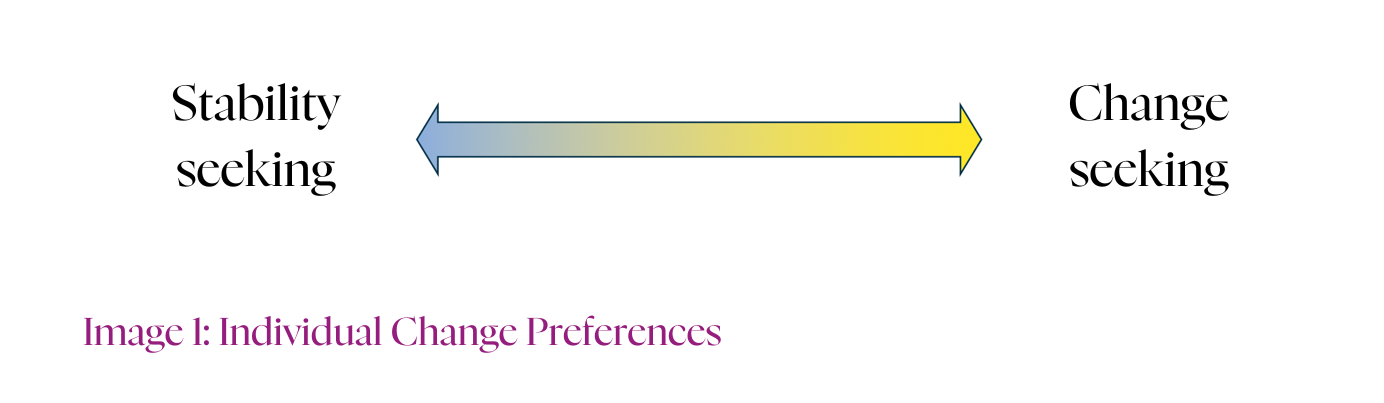
People react differently to change. While “change seekers” (people with an affinity for change) quickly recognize and want to take advantage of new opportunities, “change preservers” (people with a focus on preservation) feel more secure in the familiar status quo. These preferences are often based on individual values, experiences, and personality traits. The challenge for you as a leader is to involve both groups in change processes.

Individual Change Preferences

Tips:

  • Observe the behavior and reactions of your employees to recognize their change preferences.
  • Create orientation and proceed step by step to provide (process) security.
  • Use the energy of the “change seekers” to drive innovation while also acknowledging the contributions of the “change preservers” by involving them through transparent communication.

2. Consider Emotions in the Change Process

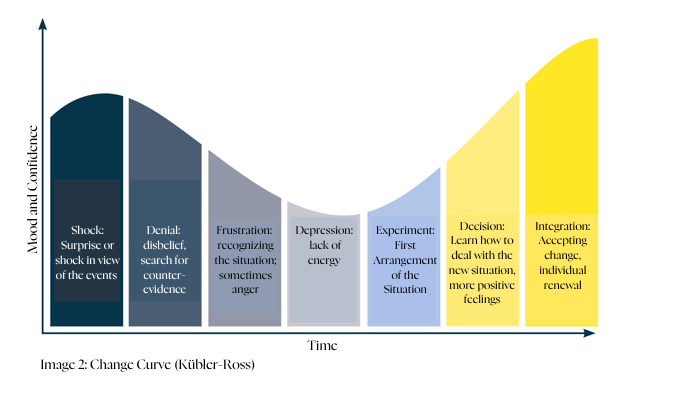
Resistance is part of every change process. As Elisabeth Kübler-Ross’s change curve (Figure 2) shows, many people go through emotional phases such as shock, frustration, and uncertainty before they reach acceptance and integration.

Tips:

  • Create an open atmosphere in which people can express their emotions and concerns.
  • Explain the change process clearly and repeatedly to enable a thorough understanding.
  • Show empathy and recognize the stress that comes with change.

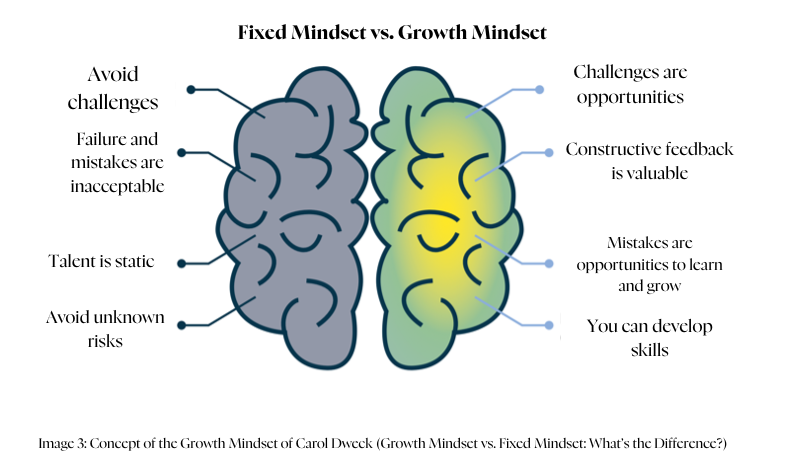
    3. Establish a Growth Mindset

    A growth mindset helps you see challenges as opportunities, learn from mistakes, and continuously develop. This attitude is essential to remain capable of action in dynamic and complex situations.

    Tips:

    • Promote a willingness to embrace change by creating a learning-oriented environment – for example, through regular reflection sessions in which developmental steps and insights are discussed.
    • Establish an open feedback culture that supports the exchange of perspectives and ideas.
    • Create targeted learning opportunities, e.g. through peer learning or mentoring programs.
    • Celebrate progress – even small successes – and focus on positive development.
    • Set an example by being open to feedback and showing your willingness to learn.

      4. Broaden Your Perspective: Critically Question the Status Quo

      Discussions about change often focus either on the advantages of the new or the disadvantages of the change. However, the question of what disadvantages the status quo entails or whether it is even a viable option is rarely asked. This perspective can provide valuable insights for the change process.

      Image 2 Change Curve (Kübler-Ross)
      Fixed Mindset vs. Growth Mindset

      Tips:

      • Make the drivers of change transparent to create understanding and acceptance.
      • Explain the risks and disadvantages of sticking to the status quo – or make it clear if this is not a realistic option.
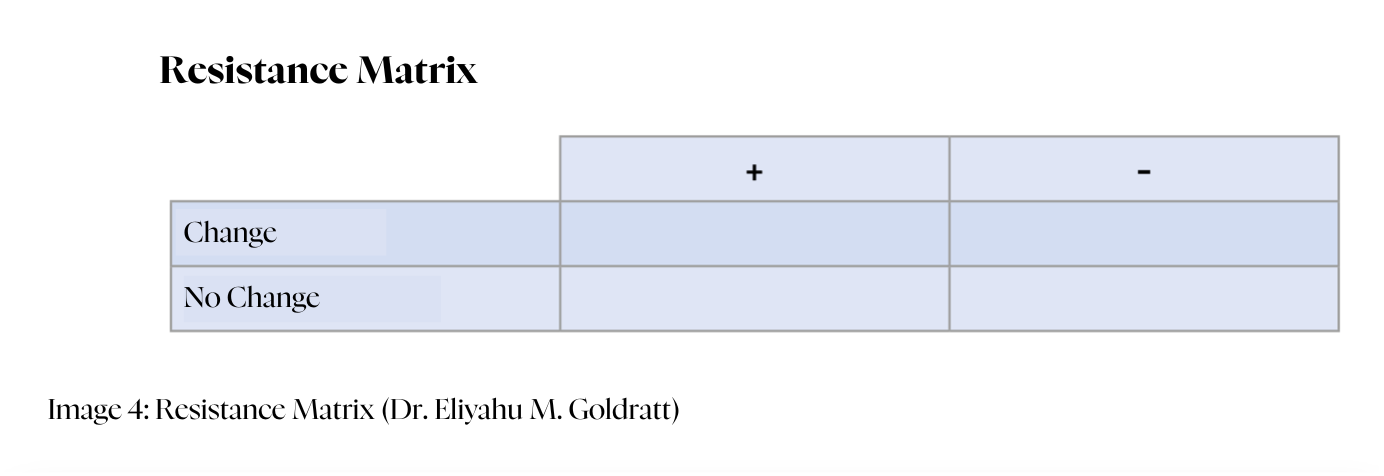
      • Use analytical tools such as the resistance matrix (Figure 4) to systematically illuminate all perspectives.
      Resistance Matrix

      Conclusion

      Change is a constant in today’s world – and as a leader, you have the task of actively shaping that change. By recognizing your team’s change preferences, taking emotions seriously, promoting a growth mindset, and incorporating different perspectives, you can successfully manage change processes. With the right strategies and clear communication, you can motivate your team to embrace change as an opportunity and help shape it.

      This blog article is the first in a series on change management. Click here to go to the second part!

      Anita Berger

      Anita Berger

      MDI partner and trainer

      Anita Berger is an executive coach, consultant, and trainer with a strong focus on leadership development in the VUCA/BANI world, design and facilitation of transformation processes and organizational culture development, as well as international human resources management. She is a co-owner and partner of MDI, Management Development International. With over 25 years of experience in management and leadership positions (including in the management of Coca-Cola Hellenic Austria & Slovenia & Konica Minolta Business Solutions) in various industries and company sizes, from medium-sized businesses to international corporations. Numerous contributions focus on leading virtual and hybrid teams, agile change management, organizational and leadership culture, as well as strategic talent management.
      • LinkedIn

      Download our MDI Whitepaper here:

      What might help you next?

      From Individual Growth to Leadership and Team Development

      by Florian Biedermann | 12. November 2026 | Impuls series, Leadership and AI, Learning Transfer | 0 Comments

      From Individual Growth to Leadership and Team Development In the first part of our blog series, inspired by coach and NLP trainer Ivan Petric's essay Model of Models, we explored how three well-known development models reveal a shared pattern of growth. From initial...
      Read More

      The 4 Stages of Development: What Leaders Need to Know

      by Florian Biedermann | 5. November 2026 | Leadership Impact, Leadership Tips | 0 Comments

      The 4 Stages of Development: What Leaders Need to Know A blog post inspired by Ivan Petric's essay "Model of Models: Three Models. One Process. (Model modela: Tri modela. Jedan proces.)“ Whether we are learning a new skill, stepping into a leadership role, or building...
      Read More

      Leading Through AI Transformation: 5 Leadership Challenges and How to Address Them

      by Balázs Lóránd | 28. October 2026 | Leadership and AI, Leadership Horizon | 0 Comments

      Leading Through AI Transformation: 5 Leadership Challenges and How to Address Them As we prepare for our annual Leadership Horizon Conference, we’re taking a look back at some of the highlights of our successful 2026 edition. In his insightful business case “As AI...
      Read More

      Beyond the Training Room – Turning Insights into Impact

      by Florian Biedermann | 22. October 2026 | Leadership Tips, Learning Transfer, Training Insights | 0 Comments

      Beyond the Training Room – Turning Insights into Impact Traditionally, a training session ends with a recap and a round of feedback. In these face-to-face conversations, participants’ responses are often overwhelmingly positive. Usually, those who enjoyed the training...
      Read More

      Are Leaders Asking the Wrong Questions About Employee Retention?

      by Zeca Ruiz | 15. October 2026 | Leadership Tips, Short Knowledge Bits | 0 Comments

      Are Leaders Asking the Wrong Questions About Employee Retention? I was recently invited to give a talk at an association of business owners in Brazil, which was organizing a symposium on a timely topic: workforce challenges in a fast-moving, digital world. Right in...
      Read More

      10 Tips for Effective Communication With Dominant Partners

      by Dominik Etzl, Rafael Ungvari | 4. October 2026 | Best Practice, Leadership Tips, learning effectiveness | 0 Comments

      Homer Simpson has been delighting young and old for many years. Short-tempered to the point of being slightly irascible, he speaks his mind directly. He’s constantly getting annoyed over trivial matters and doesn’t seem to place much value on the opinions and advice...
      Read More

      4 Heuristics to Stop Mistaking Symptoms for Cause in the AI Era

      by Zeca Ruiz | 24. September 2026 | Digital Transformation, Leadership and AI, Leadership Tips | 0 Comments

      4 Heuristics to Stop Mistaking Symptoms for Cause in the AI Era The AI era is intensifying an old problem: acting too fast on the wrong diagnosis. Every one of us has lived through, or heard about, some organizational mess born from exactly that. In every era, every...
      Read More

      Human First: Leadership in the Age of AI

      by Johanna Glechner | 14. September 2026 | Digital Transformation, Leadership and AI, Leadership in the digital transformation | 0 Comments

      Human First: Leadership in the Age of AI My professional journey has always taken place at the intersection of two worlds that, for a long time, were treated as separate: technology and leadership. With a background in business informatics, I started my career in...
      Read More

      AI Transformation Is Leadership Work

      by Gunther Fürstberger | 28. August 2026 | Leadership and AI, Leadership Tips, MDI Whitepaper | 0 Comments

      AI Transformation Is Leadership Work The four-step loop that turns individual experiments into lasting change Many companies are already using AI—and still not transforming. Tools, pilot projects, and guidelines only add up to transformation once they deliberately...
      Read More

      What If AI Doesn’t Replace Us — But Drowns Us Out?

      by Martin Maglia | 24. July 2026 | Digital Transformation, Leadership and AI, Short Knowledge Bits | 0 Comments

      What If AI Doesn't Replace Us — But Drowns Us Out? Over the weekend, I watched a thought-provoking video from Rick Beato. (You can find the link at the end of this article.) For those who don't know him: Rick Beato is a musician, producer, educator, guitarist, and one...
      Read More
      Recap: This was the L&D Summer at MDI

      Recap: This was the L&D Summer at MDI

      by Iris Burner | Oct 3, 2023 | Leadership Impact, MDI Inside, Short Knowledge Bits | 0 comments

      Recap: This was the L&D summer at MDI

      Prefer to listen to the article? Click below to access our AI speech-generated audio. However, if you want to read it as usual, keep scrolling.

      Recap: This was the L&D summer at MDI

      Summer at MDI is not only the time to relax from the heat and the stress of everyday life but also the time to get educated and gain new inspiration. This July, two of our MDI colleagues experienced an enriching educational journey at the Metaforum Summer Camp in Italy.

      Read this blog post to learn about their experiences and get inspired!

      Congress of Diversity and Practice

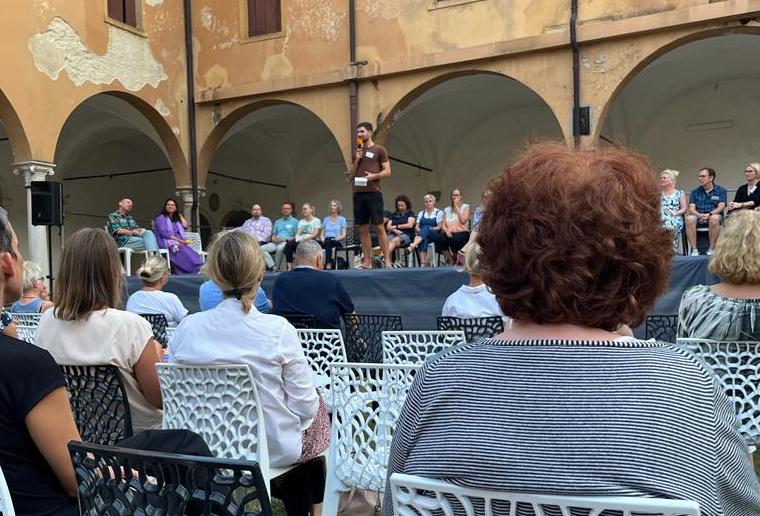
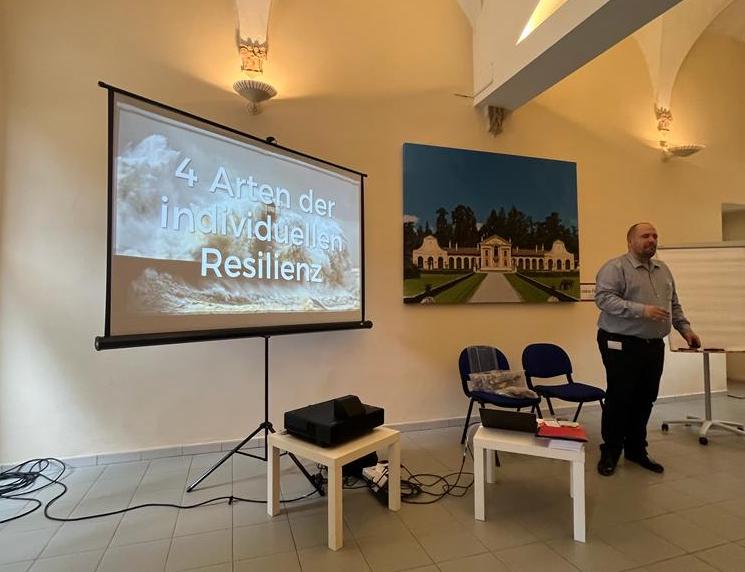
      Iris, one of our team members, had the opportunity to participate in the “Congress of Diversity and Practice“, a two-day event that combined knowledge and practical experience in a unique way. The congress offered a selection of about 20 workshops, from which the participants could choose 6.

      The main focus was on actively experiencing different workshop formats. From interactive discussions to practical exercises, there were numerous opportunities to absorb new knowledge and integrate it into one’s own work.

      Metaforum

      From resilience to sustainability

      Workshops covered a variety of exciting topics, including resilience, mindfulness, and sustainability. Participants had the opportunity to try out methods such as Dynamic Facilitation and Lego Serious Play, which challenged their problem-solving and communication skills in new ways.

      These hands-on approaches allowed participants to unleash their creative potential and develop innovative solutions.

      More than a learning event

      But the congress was much more than just a learning event. The atmosphere was characterized by openness and cooperation. The joint lunch and dinner offered the perfect opportunity to exchange ideas with colleagues from other companies and departments.

      At the various evening events, it was possible to make valuable contacts in a relaxed atmosphere and to benefit from the experiences of others. The congress took place in an idyllic monastery near Padua, surrounded by picturesque vineyards.

      This environment was not only inspiring but also created a calm and concentrated learning atmosphere. Participants were able to enjoy the beauty of the surroundings while giving free rein to their creativity and willingness to learn.

      4 Arten der Resilienz

      A broadening of our horizons

      The Metaforum Summer Camp and the “Congress of Diversity and Practice” have not only enriched the personal and professional development of our MDI colleagues but also helped to move our company forward.

      The new insights and ideas they brought back from Italy will undoubtedly help improve our L&D initiatives and expand the diversity of our offerings.

      Conclusion

      Overall, the L&D Summer at MDI this year was a resounding success. It demonstrated once again how important continuous education and sharing of knowledge and experiences are to our success.

      We are excited to see how the fresh ideas and impressions from Italy will shape our future projects and look forward to more inspiring summers at MDI.

      Iris Burner

      Iris Burner

      L&D Consultant

      Since 2022, Iris has been an L&D Consultant at MDI, supporting leaders and organisations worldwide in personal development and creating tailored training programs. She values the personal learning experience and ensures clients benefit from valuable insights. With a background in adult education and professional experience in a renowned corporation, Iris has a comprehensive understanding of company needs and develops customized solutions for sustainable development and growth.


      Together with other L&D consultants, Iris contributed to our MDI whitepaper and shared her experiences with PORR.

      • LinkedIn

      Download our Whitepaper:

      Paper Mock Up

      This could also interest you:

      From Individual Growth to Leadership and Team Development

      by Florian Biedermann | 12. November 2026 | Impuls series, Leadership and AI, Learning Transfer | 0 Comments

      From Individual Growth to Leadership and Team Development In the first part of our blog series, inspired by coach and NLP trainer Ivan Petric's essay Model of Models, we explored how three well-known development models reveal a shared pattern of growth. From initial...
      Read More

      The 4 Stages of Development: What Leaders Need to Know

      by Florian Biedermann | 5. November 2026 | Leadership Impact, Leadership Tips | 0 Comments

      The 4 Stages of Development: What Leaders Need to Know A blog post inspired by Ivan Petric's essay "Model of Models: Three Models. One Process. (Model modela: Tri modela. Jedan proces.)“ Whether we are learning a new skill, stepping into a leadership role, or building...
      Read More

      Leading Through AI Transformation: 5 Leadership Challenges and How to Address Them

      by Balázs Lóránd | 28. October 2026 | Leadership and AI, Leadership Horizon | 0 Comments

      Leading Through AI Transformation: 5 Leadership Challenges and How to Address Them As we prepare for our annual Leadership Horizon Conference, we’re taking a look back at some of the highlights of our successful 2026 edition. In his insightful business case “As AI...
      Read More

      Beyond the Training Room – Turning Insights into Impact

      by Florian Biedermann | 22. October 2026 | Leadership Tips, Learning Transfer, Training Insights | 0 Comments

      Beyond the Training Room – Turning Insights into Impact Traditionally, a training session ends with a recap and a round of feedback. In these face-to-face conversations, participants’ responses are often overwhelmingly positive. Usually, those who enjoyed the training...
      Read More

      Are Leaders Asking the Wrong Questions About Employee Retention?

      by Zeca Ruiz | 15. October 2026 | Leadership Tips, Short Knowledge Bits | 0 Comments

      Are Leaders Asking the Wrong Questions About Employee Retention? I was recently invited to give a talk at an association of business owners in Brazil, which was organizing a symposium on a timely topic: workforce challenges in a fast-moving, digital world. Right in...
      Read More

      10 Tips for Effective Communication With Dominant Partners

      by Dominik Etzl, Rafael Ungvari | 4. October 2026 | Best Practice, Leadership Tips, learning effectiveness | 0 Comments

      Homer Simpson has been delighting young and old for many years. Short-tempered to the point of being slightly irascible, he speaks his mind directly. He’s constantly getting annoyed over trivial matters and doesn’t seem to place much value on the opinions and advice...
      Read More

      4 Heuristics to Stop Mistaking Symptoms for Cause in the AI Era

      by Zeca Ruiz | 24. September 2026 | Digital Transformation, Leadership and AI, Leadership Tips | 0 Comments

      4 Heuristics to Stop Mistaking Symptoms for Cause in the AI Era The AI era is intensifying an old problem: acting too fast on the wrong diagnosis. Every one of us has lived through, or heard about, some organizational mess born from exactly that. In every era, every...
      Read More

      Human First: Leadership in the Age of AI

      by Johanna Glechner | 14. September 2026 | Digital Transformation, Leadership and AI, Leadership in the digital transformation | 0 Comments

      Human First: Leadership in the Age of AI My professional journey has always taken place at the intersection of two worlds that, for a long time, were treated as separate: technology and leadership. With a background in business informatics, I started my career in...
      Read More

      AI Transformation Is Leadership Work

      by Gunther Fürstberger | 28. August 2026 | Leadership and AI, Leadership Tips, MDI Whitepaper | 0 Comments

      AI Transformation Is Leadership Work The four-step loop that turns individual experiments into lasting change Many companies are already using AI—and still not transforming. Tools, pilot projects, and guidelines only add up to transformation once they deliberately...
      Read More

      What If AI Doesn’t Replace Us — But Drowns Us Out?

      by Martin Maglia | 24. July 2026 | Digital Transformation, Leadership and AI, Short Knowledge Bits | 0 Comments

      What If AI Doesn't Replace Us — But Drowns Us Out? Over the weekend, I watched a thought-provoking video from Rick Beato. (You can find the link at the end of this article.) For those who don't know him: Rick Beato is a musician, producer, educator, guitarist, and one...
      Read More
      « Older Entries

      Information

      • Imprint
      • MDI company website

      Social Media

      • Facebook
      • Twitter
      • Youtube
      • LinkedIn

      © MDI Management Development Institute, 2020