
• MDI
  • German version
  • Contact us
MDI Management Development
  • Agile leadership
  • Lateral Leadership
  • Leadership Impact
  • Leadership Development
Select Page
What is Sustainable Individualization in Leadership?

What is Sustainable Individualization in Leadership?

by Iris Burner | Jun 28, 2023 | Digital Transformation, Leadership Impact, Leadership in the digital transformation | 0 comments

Sustainable individualization in leadership – pious hope or real alternative?

In line with the last blog post on our MDI website “Inner Development Goals For a Better Leadership World“, this time we dedicate ourselves to the megatrend topic of individualization and the connection with the Inner Development Goals (IDGs) towards sustainable leadership.

Individualization instead of multi-module programs

The status quo often shows that companies rely on multi-module programs to develop and train their executives. Depending on the target group, these programs provide a broad general basis of tools and methods – a so-called “toolbox” from which the appropriate tool can be selected according to the situation.

In times of ever scarcer resources (keywords: time and knowledge, cost efficiency and environment) and living realities in climate change, however, one topic is increasingly coming to the fore in the education and training of our future shapers of tomorrow: individualization.

Individualization – one of the 12 megatrends

Individualization was presented by the Zukunftsinstitut 2023 as one of the 12 megatrends. These megatrends are the central trends of our time. They are the biggest drivers of change in business and society and shape our future – not just in the short term, but in the medium to long term. Megatrends unfold their dynamics over decades.

IDGs & SDGs 2030

This time horizon may seem long, especially considering the Inner Development Goals (IDGs), which are based on the implementation of the Sustainable Development Goals for 2030. This deadline means that the implementation of this megatrend can no longer be delayed. 

But when we think of Sustainable Development Goals, can we give individualization any room at all? Doesn’t individualization always consume considerably more resources than a collective measure? 

Megatrend-Map

Quelle: Zukunftsinstitut.de 

Sustainability vs. Individualization – Dealbreaker or Complement?

Sustainability and individualization have an interesting interaction with IDGs. On the one hand, individualization can be seen as a potential challenge to sustainability, as it may require more resources and lead to fragmentation of actions. If individualized programs are developed for each leader or individual, this can add time and cost and may be inefficient.

On the other hand, individualization also offers opportunities for sustainability. By enabling people to consider their interests, strengths, and needs, tailored development and education can take place. When leaders are supported in their development processes and have the opportunity to leverage their strengths, they can develop more effective leadership approaches that are also aligned with sustainability goals.

Promoting Individual Strengths and Creating Sustainability for Leaders and Organizations

IDGs are leveraging the megatrend of individualization to promote personal development and inner growth. By focusing on individual needs and goals, they enable people to realize their full potential and shape their own growth. This also includes the development of leadership competencies required for the sustainable transformation of organizations and societies.

Sustainable individualization in leadership thus means reconciling individual development and sustainability goals. This requires careful planning and design of educational activities to address both individual needs and sustainability issues. It is about fostering individual strengths while creating a common foundation for sustainable leadership.

Transfer to practice – 3 concrete approaches

What concrete measures can companies now take to initiate a sustainable and individualized leadership era?

1. IDG potential analysis

As a possible tool, the IDG potential analysis, for example, can provide an initial basic assessment. The basis of this analysis is a questionnaire based on the five IDGs (Being, Thinking, Relating, Collaborating, and Acting). By evaluating the analysis, the leader receives a self-assessment and finds out where they stand on the company values.


The results of the analysis serve as a basis for targeted measures to promote personal and professional growth in line with the IDGs and are particularly suitable for organizational and personnel development, leadership, team development, and change processes.

generational management

2. Team workshops with team profiles

In order to validate the self-assessment, there is also the possibility to get an external assessment from a colleague. Based on this, there is the possibility to conduct team workshops with team profiles to strengthen cooperation regarding the IDGs.

3. Mentoring program

Another way to put these findings into practice is to implement a mentoring program. This program supports leaders in realizing their individual goals and needs and integrating sustainability-oriented approaches into their leadership practice.

Executives are paired individually with an experienced mentor to foster their personal development and leadership skills. Thus, individual leaders’ needs and goals are addressed by assigning them a mentor who has experience and expertise in the specific areas the leader wants to work on.

The mentoring relationship allows executives to identify their individual strengths and weaknesses and work on them specifically. At the same time, the mentor and mentee are in a two-way exchange on a variety of topics, allowing them to learn from and with each other. This helps the leaders to integrate sustainability-oriented approaches into their leadership practice and to drive positive change in their organizations.

Conclusion

Ultimately, IDGs and customization can help create a new generation of leaders who are both personally fulfilled and focused on sustainable change. By addressing the individual needs and potential of each individual, IDGs can pave the way for sustainable and individualized leadership that can have a positive impact on organizations, society, and the environment.

Commitment MDI – We support leaders who strive for a better world

As an official partner of the Inner Development Goals (IDG), we are actively engaged in collaborating with other stakeholders, organizations, and individuals to advance the integration of transformational sustainable development skills into our leadership development. Our goal is to facilitate dialogue, knowledge sharing, and collaboration to advance the SDGs agenda.

Iris Burner

Iris Burner

Learning & Development Consultant

Since 2022, Iris has been an L&D Consultant at MDI, supporting leaders and organisations worldwide in personal development and creating tailored training programs. She values the personal learning experience and ensures clients benefit from valuable insights. With a background in adult education and professional experience in a renowned corporation, Iris has a comprehensive understanding of company needs and develops customized solutions for sustainable development and growth.

  • LinkedIn

This could also help you:

Human First: Leadership in the Age of AI

by Johanna Glechner | 14. September 2026 | Digital Transformation, Leadership and AI, Leadership in the digital transformation | 0 Comments

Human First: Leadership in the Age of AI My professional journey has always taken place at the intersection of two worlds that, for a long time, were treated as separate: technology and leadership. With a background in business informatics, I started my career in...
Read More

AI Transformation Is Leadership Work

by Gunther Fürstberger | 28. August 2026 | Leadership and AI, Leadership Tips, MDI Whitepaper | 0 Comments

AI Transformation Is Leadership Work The four-step loop that turns individual experiments into lasting change Many companies are already using AI—and still not transforming. Tools, pilot projects, and guidelines only add up to transformation once they deliberately...
Read More

What If AI Doesn’t Replace Us — But Drowns Us Out?

by Martin Maglia | 24. July 2026 | Digital Transformation, Leadership and AI, Short Knowledge Bits | 0 Comments

What If AI Doesn't Replace Us — But Drowns Us Out? Over the weekend, I watched a thought-provoking video from Rick Beato. (You can find the link at the end of this article.) For those who don't know him: Rick Beato is a musician, producer, educator, guitarist, and one...
Read More

Use It or Lose It: How AI and Digital Tools May Be Changing Our Brains

by Florian Biedermann | 26. June 2026 | Leadership and AI, Leadership Tips, Learning Transfer | 0 Comments

Use It or Lose It: How AI and Digital Tools May Be Changing Our Brains You travel to Madrid and want to chat with the locals, but you realize that after five years without practice, your rudimentary Spanish skills are now practically nonexistent and you even struggle...
Read More

How Artificial Intelligence Shapes Who We Become

by Meike Hinnenberg | 19. May 2026 | Impuls series, Leadership and AI, Leadership in the digital transformation | 0 Comments

How Artificial Intelligence Shapes Who We Become Meike’s Reflections on Artificial Intelligence Do you prefer to listen to this article? Click below to access our AI-generated audio version!How Artificial Intelligence Shapes Who We Become Meike’s Reflections on...
Read More

Zeca Ruiz on Cross-Generational Leadership and Navigating Change

by Jana Wölfl | 13. May 2026 | Leadership Impact, MDI Spotlight Series, Training Insights | 0 Comments

Zeca Ruiz on Cross-Generational Leadership and Navigating Change This blog is an excerpt from our new podcast! You can find the entire podcast episode here. Zeca Ruiz on Cross-Generational Leadership and Navigating Change In the fourth episode of our podcast “Voices...
Read More

What AI Shows You — and What It Doesn’t

by Meike Hinnenberg | 1. April 2026 | Digital Transformation, Impuls series, Leadership and AI | 0 Comments

What AI Shows You — and What It Doesn't Meike’s Reflections on Artificial Intelligence Do you prefer to listen to this article? Click below to access our AI-generated audio version! What AI Shows You — and What It Doesn't Meike’s Reflections on Artificial Intelligence...
Read More

Leading in the Age of AI: How AI Discourse Shapes Responsibility and Power

by Meike Hinnenberg | 18. March 2026 | Impuls series, Leadership and AI, Leadership Tips | 0 Comments

Leading in the Age of AI: How AI Discourse Shapes Responsibility and Power Meike’s Reflections on Artificial Intelligence Do you prefer to listen to this article? Click below to access our AI-generated audio version!Leading in the Age of AI: How AI Discourse Shapes...
Read More

AI Ethics for Leaders: Why Context and Critical Thinking Matter More Than Ever

by Meike Hinnenberg | 11. March 2026 | Impuls series, Leadership and AI, Learning Transfer | 0 Comments

AI Ethics for Leaders: Why Context and Critical Thinking Matter More Than Ever. Meike’s Reflections on Artificial Intelligence Do you prefer to listen to this article? Click below to access our AI-generated audio version!AI Ethics for Leaders: Why Context and Critical...
Read More

A Success Story – When AI Sharpens Human Judgement

by Claude MacDonald, Rafael Ungvari | 6. March 2026 | Customer Story, Digital Transformation, Leadership and AI | 0 Comments

A Success Story – When AI Sharpens Human Judgement Do you prefer to listen to this article? Click here to access our AI-generated audio version! When AI Amplifies Human Judgment: A Customer Success Story About This Project At MDI, we believe that great leadership and...
Read More
Successful instruments for Employee Retention

Successful instruments for Employee Retention

by Christoph Monschein | Apr 26, 2023 | International leadership development, Leadership in the digital transformation, Leadership Tips | 0 comments

Successful instruments for Employee Retention

Employer Branding: How to position your company sustainably as an attractive employer

Today’s employers and leaders face several challenges. The search for qualified employees is becoming increasingly difficult and lengthy, and if you want to win over the best minds on the market, you have to have a lot to offer today’s applicants.

More than ever, the tables are being turned: High potentials are choosing their employers, not the other way around. In this distinct employee market, the company must withstand the critical gaze of potential candidates and convince them of its attractiveness as an employer.

For some time now, the recruiting process has therefore become one of the most challenging tasks for companies. The war for talents, i.e. the competition between companies for the best talents and specialists, has also become a fixed part of everyday working life in Austria.

The change of values in employer branding

It wasn’t all that long ago that if an employer offered a secure job with a good or above-average salary and a generous bonus on top, then they could choose from a pool of talent and secure the candidates who best fit the advertised positions.

Today, this is no longer enough to find motivated employees. The “cash for time” model has had its day in this country.

The younger generations in particular have much higher expectations of employers today. The focus is on topics such as the working environment, flexibility and hierarchies, corporate culture, purpose, and, last but not least, how the company deals with corporate social responsibility.

In addition to salary, flexible working time models and a healthy work-life balance, appreciation, respectful interaction, well-being in the workplace and meaningful work are of particular importance today and successful instruments for Employee Retention. 

Strengthening employer branding and positioning as an employer of choice

Companies have different ideas about corporate image and what it should look like in the future. But they all have the same goals: They want to offer their employees a better jobs and retain them in the long term. Employer branding helps to improve the company’s image and reputation as well as its employer brand.

It is an important element in achieving greater employee loyalty and reducing turnover rates, which are costly for companies. Employees who feel valued by their employer stay with the company longer and perform better. This means that employers not only have the opportunity to attract new talent but also to retain existing employees.


But how does a company manage to position itself as an employer of choice and thus secure competitive advantages in the battle for high potentials and retain the best minds?

employer branding

These are the questions companies need to ask themselves as part of the employer branding process today

  • What image do I want to have on the employer market?
  • How can I get & keep the employees I need to achieve my goals?
  • What does the “new generation” expect from employers?
  • What can established companies learn from start-ups?
  • What is the company’s purpose and how is it lived?

Measures to improve the employer brand

There are many ways in employer branding to create a modern and pleasant working environment with additional incentive systems. Since employees can be very different – keyword “Clash of Generations” – it is important to turn different screws to meet as many needs as possible.

Today, a compensation package has long been more than just a salary. It is therefore a challenge for modern management to put together a good overall package and to be authentic at the same time. Roughly speaking, there are 5 pillars that should be considered.

1. Work-Life-Balance

The name of the game in today’s job search. A good work-life balance is not only desired by applicants, it is a prerequisite and is at least as important as adequate pay. Today, it is more important than ever that the job fits in well with private life, not the other way around. This is what a company can offer in order to fulfill this wish:

  • Home Office
  • Remote Work
  • Flexible time management
  • 4-day week
  • Offer flexibility
  • Workation

2. Trust – Be a Leader, not a Boss

Employer branding is an important instrument for employee retention. It is about the social reputation of a company and the recognition of its employees as appreciative employers.

Independent work is playing an increasingly important role. In modern companies, employees are no longer purely followers of orders. Instead, they show initiative and assume responsibility. Meaningful areas of responsibility, flat hierarchies, opportunities for creative participation and development, and the strengths of each person are in the foreground.

This aspect of the management culture has a significant impact on employer branding. Positive reviews on evaluation platforms by employees should not be underestimated. Particular attention should be paid to the following:

  • Trust employees, relinquish control
  • Focus on independent work
  • Strengthen initiative & Motivation
  • Room for mistakes – talk about them & learn
  • transparency
  • communication
  • Feedback culture

3. (Tax-free) Benefits: An indispensable part of modern employer branding

A simple way to show appreciation to employees is through (tax-free) benefits. Gratitude for the work performed by employees should be reflected in more than just their salary.

The lunch allowance is particularly attractive in Austria. Tax allowances of up to €8 per employee per working day (equivalent to an annual tax allowance of €1,760 per employee) make this incentive particularly worthwhile for both sides. A varied and balanced diet has been proven to have a positive effect on human health.

As an employer, the well-being of your employees and staff catering should therefore be close to your heart – at least because of expensive sick leave and reduced productivity.

Employer Branding

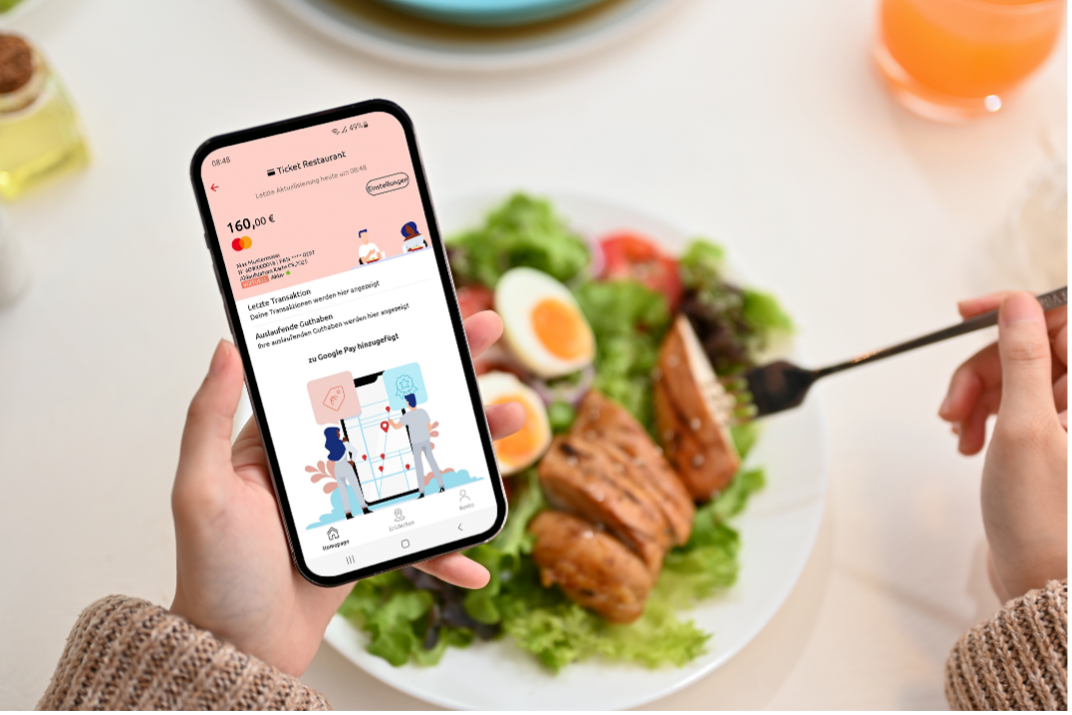
Around 300,000 employees across Austria are already using Edenred’s digital meal and food vouchers. These can be easily redeemed by recycled plastic card or directly by smartphone with Apple Pay or Google Pay at more than 20,000 redemption points in retail and catering, including online.

This ensures a balanced lunch break both in the office and in the home office – a factor that should not be underestimated, both in promoting health and employee loyalty and motivation.

The following benefits are particularly suitable as employer branding measures:

  • Meal subsidy
  • Gifts on occasions (e.g. wedding, birth, anniversary, Christmas)
  • Public transport ticket
  • Support for sports activities
  • Retirement provision
  • Discounts

4. Culture & Purpose: Indispensable in Employer Branding for Generation Z

It is becoming increasingly important, especially for young talents of the younger generations who are striving to enter the job market, that the company’s values match their own. Applicants are also increasingly paying attention to the sincere and authentic commitment of companies in the areas of sustainability and social issues – the keyword here is corporate social responsibility.

The purpose is becoming the criterion by which young applicants in particular choose their employer. It must create meaning and be in harmony with that of the employees in order to motivate and evoke the best.

Pay particular attention to the following points for successful employer branding:

  • Sincere and authentic commitment
  • No social and greenwashing
  • Clear definition & communication of purpose
  • Live purpose & values
  • Allow employees to set their own initiatives

5. Workplace – more than just a desk

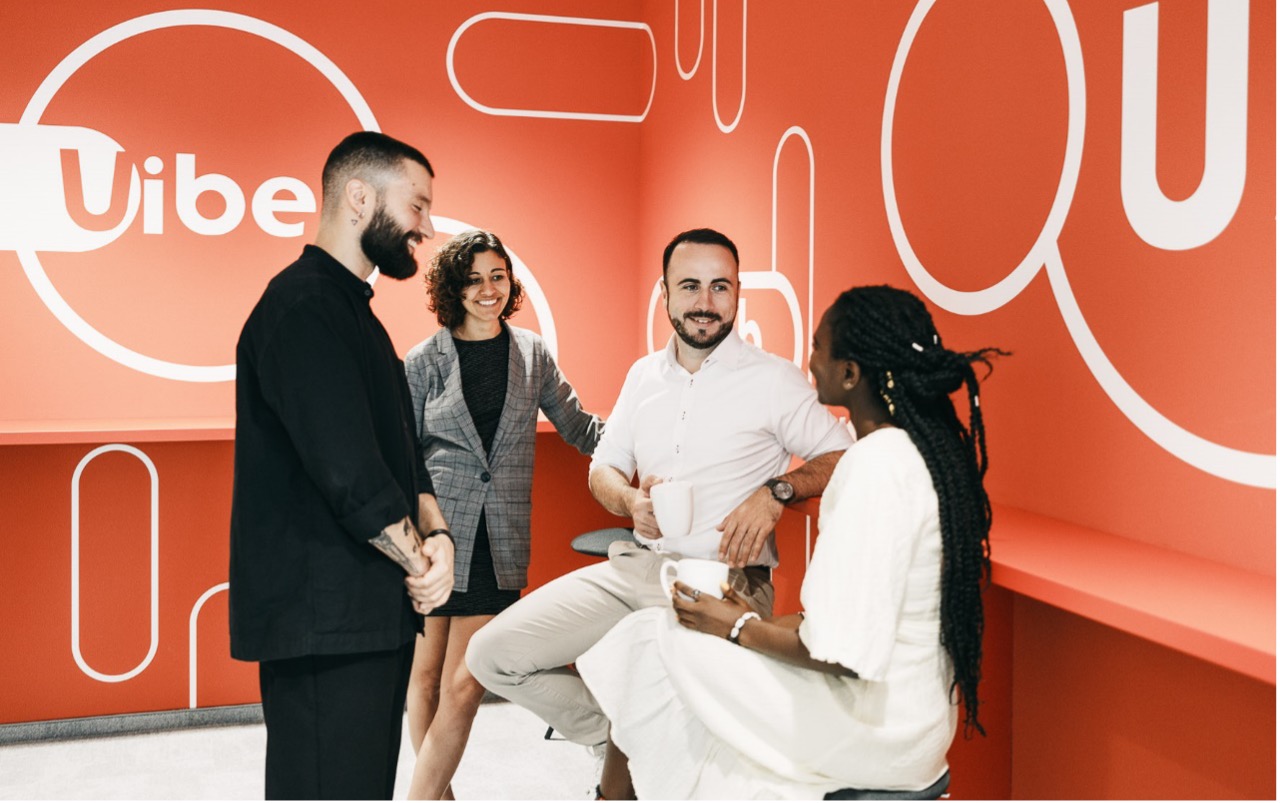
What may sound trivial at first glance is also part of employer branding: modern office environments are becoming increasingly popular. In order to work together successfully and develop innovative ideas, employees need appropriate spaces in which they can feel comfortable and develop.

Decentralized working often leads to desk-sharing concepts in offices. When desks are shared, fewer physical workstations are needed. This in turn means that space can be created for new premises. Here, the focus should be on connecting activities. Anyone who thinks a ping-pong table is the end of productivity has already lost out on some applicants. Team spirit and corporate culture can be crucial in employer branding.

A few suggestions for the use of won premises:

  • Telephone boxes
  • Writable walls
  • Space for recreation & creative development
  • Social spaces (games, food, etc.)

Employer Branding

Conclusion

Today’s applicants are looking for their employer. They expect more and want to change things. Companies need to rethink and quickly adapt to the new conditions in the labor market. The current recruiting market is an applicant market.

Companies need to clearly understand that it is not necessarily the job seekers who apply to the company, but also the companies as employers. If this understanding is given, an important first step towards modern employer branding has been taken.

To prepare for this, a very clear definition is needed of what a company can offer job seekers and why potential employees would want to work for it. Not only salary plays a role, but also and above all the purpose behind the company, the corporate culture, the team spirit, development opportunities, benefits, flexible working, and much more.

At the end of the day, it’s all about the “image” of the company. A good image requires real change and is more than clever communication. The topic of employer branding should therefore be pushed authentically across all channels and offer an honest insight into the company’s everyday life.

Christoph Monschein

Christoph Monschein

General Manager of Edenred Austria & Transformation Leader

Christoph is a transformation leader with >10 years of achieving growth and value creation in both P&L leadership and top-management consulting positions.

His experience includes delivering and implementing growth strategies as well as transformation strategies, developing management teams, leading local and global teams and driving change.

  • LinkedIn

What serves you next?

Leadership Horizon powered by HR INSIDE SMMIT

Human First: Leadership in the Age of AI

Human First: Leadership in the Age of AI My professional journey has always taken place at the...
Read More

AI Transformation Is Leadership Work

AI Transformation Is Leadership Work The four-step loop that turns individual experiments into...
Read More

What If AI Doesn’t Replace Us — But Drowns Us Out?

What If AI Doesn't Replace Us — But Drowns Us Out? Over the weekend, I watched a thought-provoking...
Read More

Use It or Lose It: How AI and Digital Tools May Be Changing Our Brains

Use It or Lose It: How AI and Digital Tools May Be Changing Our Brains You travel to Madrid and...
Read More

How Artificial Intelligence Shapes Who We Become

How Artificial Intelligence Shapes Who We Become Meike’s Reflections on Artificial Intelligence Do...
Read More

Zeca Ruiz on Cross-Generational Leadership and Navigating Change

Zeca Ruiz on Cross-Generational Leadership and Navigating Change This blog is an excerpt from our...
Read More

What AI Shows You — and What It Doesn’t

What AI Shows You — and What It Doesn't Meike’s Reflections on Artificial Intelligence Do you...
Read More

Leading in the Age of AI: How AI Discourse Shapes Responsibility and Power

Leading in the Age of AI: How AI Discourse Shapes Responsibility and Power Meike’s Reflections on...
Read More

AI Ethics for Leaders: Why Context and Critical Thinking Matter More Than Ever

AI Ethics for Leaders: Why Context and Critical Thinking Matter More Than Ever. Meike’s...
Read More

A Success Story – When AI Sharpens Human Judgement

A Success Story – When AI Sharpens Human Judgement Do you prefer to listen to this article? Click...
Read More
How to Become a Compassionate Leader – 3 tools

How to Become a Compassionate Leader – 3 tools

by Gunther Fürstberger | Apr 18, 2023 | International leadership development, Leadership in the digital transformation, MDI Inside, Training Insights | 0 comments

How to Become a Compassionate Leader in 3 Steps

At MDI, we not only develop others, but also ourselves. That’s why our CEO Gunther Fürstberger attended a three-day seminar by systems researcher Peter Senge in Stockholm, where he gained some insights. He reports on his experiences in this blog post.

The Compassionate Leadership Masterclass

Peter Senge wrote a classic of leadership literature in 1990 with “The 5th Discipline”. When I read that he was giving a 3-day seminar in Stockholm as part of the Inner Development Goals Initiative, I knew I had to experience it. I thought about Marcus Aurelius who already said “You have to know the great ones of your time”.

The sold out Compassionate Systems Leadership Masterclass by Peter Senge and Gustav Böll took place in the artistic setting of Fotografiska Museum with about 100 participants from March 29 to 31, 2023.

The seminar title sounds a bit complicated. What is Compassionate Systems Leadership all about? A first key to understanding is the organizer: the Inner Development Initiative. In 2016, UN member states adopted the 2030 Agenda for Sustainable Development. Since then, our planet has continued to deteriorate.

A new leadership system for a better planet

Us earthlings have obviously not yet developed the skills and attitude it takes to undo the damage of the industrial age.

This is where the Inner Development Initiative comes in: The change in attitude must begin with the individual. Engaging broadly and deeply with the Inner Development Goals in the 5 categories of Being, Thinking, Relating, Collaborating, and Acting will help achieve the UN Sustainable Development Goals.

Our planet now needs a different kind of leadership than we know from the industrial age. It starts with feeling nature and other people and should lead to some sense of connection with others or even all beings on the planet.

Hardly anyone wants to intentionally cause grievances, but who is really aware of the effects of their own actions? System thinking can help to understand both short- and long-term impacts and interactions a little better.

New findings on two levels

Learning for me has taken place on two levels during these days. On the one hand, I got to know new tools or deepened known tools. On the other hand, the trainers were an inspiration in their handling of the group and their use of methods.

From the numerous thinking tools I pick out the three that I found particularly typical for Compassionate Systems Leadership.

Tool 1

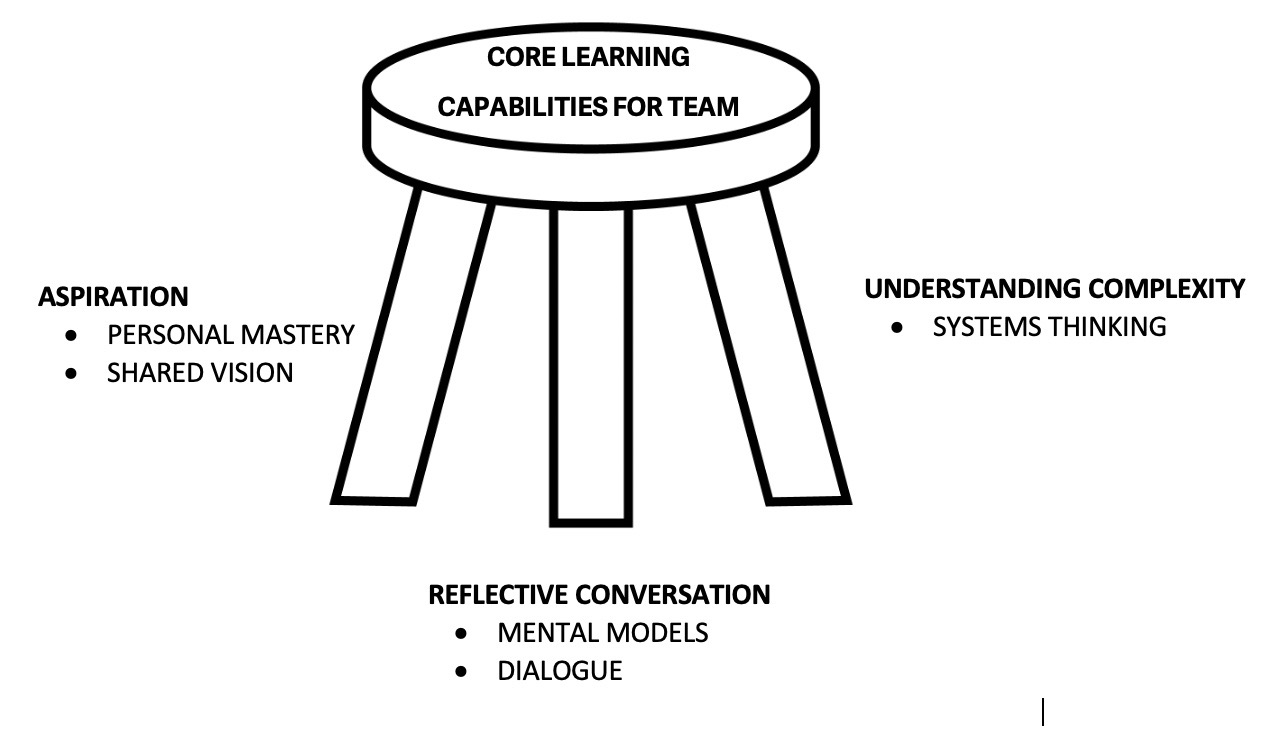
First, as an overview tool, there is the three-legged chair (see figure 1). The legs represent aspiration, reflective conversations, and systems awareness. If one leg is missing, the stool falls over.

Without a creative imagining of a better environment, there is no improvement. Without reflection or a deeper understanding of systems, we quickly end up in dead ends despite having good intentions. 

Three-legged chair

Tool 2

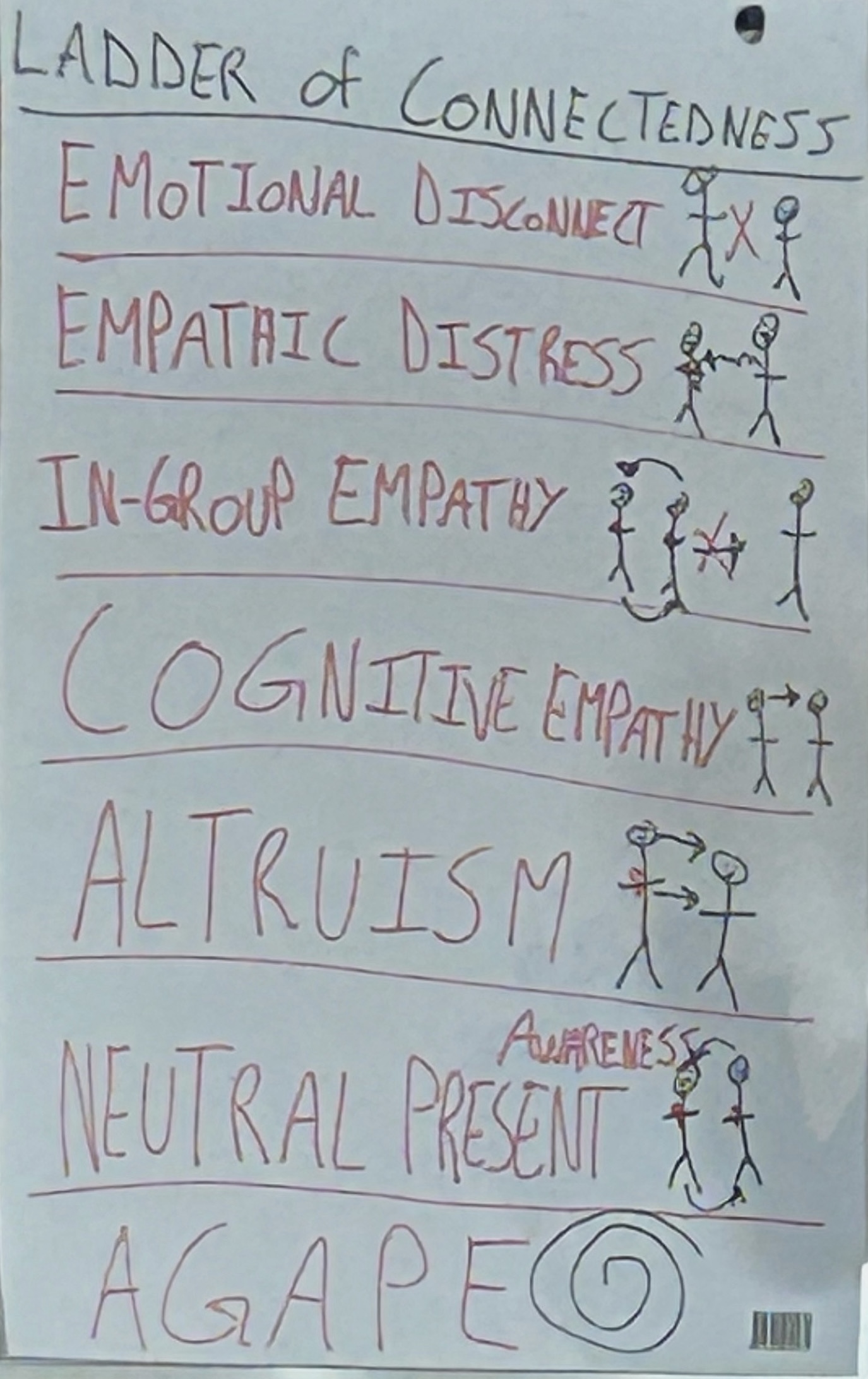
The ladder of connectedness

The second tool is the “ladder of connectedness” (see figure 2), which confused me initially: From bottom to top, the ladder levels are called “agape, neutral presence, altruism, cognitive empathy, in-group empathy, empathic stress, and emotional distance.”

We can harness gravity to move toward deeper connectedness, i.e., strive more toward the lower levels. Confusion can be a sign of real learning. I could not easily assign this idea to an already stored concept. It seemed to fit most closely with a Buddhist understanding.

We may not achieve agape, all-connected love, but we can create a neutral presence even in difficult situations. It also needs the higher levels: A surgeon should manage to distance themselves emotionally for self-protection.

Neutral instead of empathetic

Distance also helps sometimes in conflicts that go round in circles. Empathic stress is something I can relate to as a father of younger children. When my 8-year-old and my 6-year-old argue loudly with each other, it seems easier for me to demand that they stop for the short term because it helps me reduce my internal tension. But in the long run, it doesn’t help me.

In-group empathy may lead to good cooperation in the team, in the company or even in one’s own country, but at the same time it may exclude those who do not belong to the group. I take it upon myself to practice more neutral presence, which is enduring tension and contradiction.

Ladder of Connectedness

Tool 3

Creative Tension

Now our third and a simpler tool (see figure 3): The principle of creative tension. I already knew that a vision needs the right level of challenge, because something we have already achieved or something we can never achieve is not good as a vision.

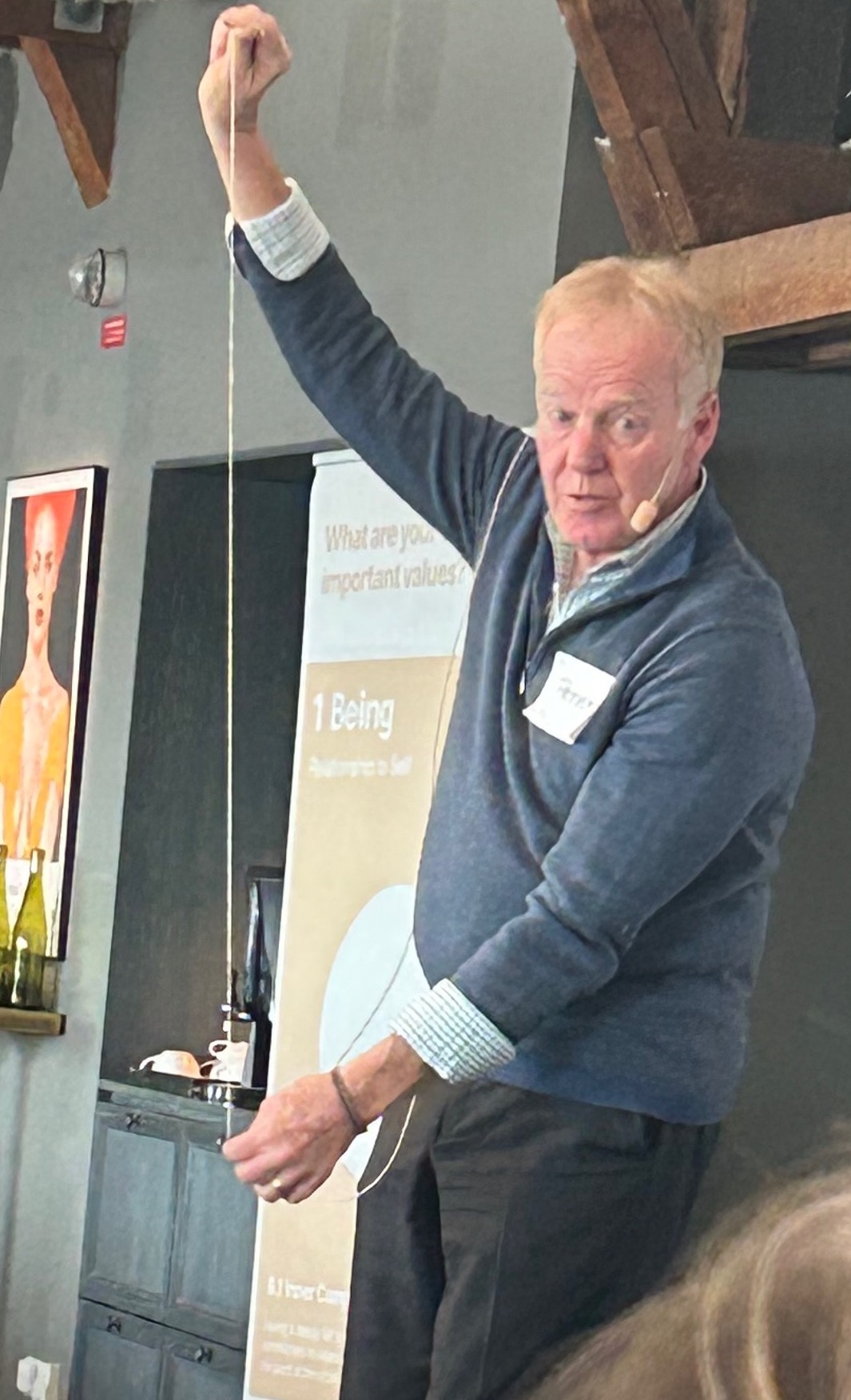
I found the continuation of the thought interesting: We can imagine the tension between reality and vision as a rubber band. When that tension becomes too uncomfortable for us, we often tend to either lower our aspirations or not tell the whole truth about the current state.

An energy source for change

A good example are an organization’s sustainability goals. When we consciously seek and hold this tension, we tap into the energy source for change. This principle of creativity is also found in theater as drama, in music as tonus, and in the Greek rhetoric. In this respect, it is not a new idea, but it is effective when we strive for change.

I was also interested in what Peter Senge is like as a person. I have already met some of the “greats of the lecture scene” away from the stage and with some of them I had the impression that it was difficult for them to live the conveyed messages themselves. That is also human.

Peter with rubber band

Peter Senge as a Human

In the morning of Day three, there was an emotionally expressed resistance from a participant who questioned the usefulness of the whole seminar. She said Peter Senge held on to the statement that we always have a choice and do not have to be influenced by external circumstances, despite her doubts expressed the day before.

Now I was curious. Will he maybe feel attacked and defend himself or let it stand as an individual opinion? He did not react immediately, but let other participants speak first. Later, he resonated, apologized, thanked for the learning opportunity, and did so with an authenticity and elegance that really impressed me.

He always treated his much younger co-trainer at eye level and was so moved several times that tears came to his eyes.

My summary

In the spirit of Marcus Aurelius, I had the opportunity to meet two greats of our time. Especially the combination of two trainers from different generations fits the challenges of our time.

Even though I have not implemented all of the presented contexts and tools and I am also not sure whether the term Compassionate System Leadership will become widely accepted, I recommend every leader to deal with the basic idea. A more sustainable leadership culture would do us and the planet good.

Mag. Gunther Fürstberger

Mag. Gunther Fürstberger

CEO | MDI Management Development International

Gunther Fürstberger is a management trainer, author and CEO of MDI – a global consulting company providing solutions for leadership development. His main interest is to make the world a better place through sustainable leadership. He has worked for clients including ABB, Abbvie, Boehringer Ingelheim, DHL, Google, Hornbach, PWC and Swarovski. His core competence is leadership in digital transformation. At the age of 20 he already started working as a trainer and he also served as HR manager in international corporations.

  • LinkedIn

What serves you next?

Leadership Horizon powered by HR INSIDE SMMIT

Human First: Leadership in the Age of AI

Human First: Leadership in the Age of AI My professional journey has always taken place at the...
Read More

AI Transformation Is Leadership Work

AI Transformation Is Leadership Work The four-step loop that turns individual experiments into...
Read More

What If AI Doesn’t Replace Us — But Drowns Us Out?

What If AI Doesn't Replace Us — But Drowns Us Out? Over the weekend, I watched a thought-provoking...
Read More

Use It or Lose It: How AI and Digital Tools May Be Changing Our Brains

Use It or Lose It: How AI and Digital Tools May Be Changing Our Brains You travel to Madrid and...
Read More

How Artificial Intelligence Shapes Who We Become

How Artificial Intelligence Shapes Who We Become Meike’s Reflections on Artificial Intelligence Do...
Read More

Zeca Ruiz on Cross-Generational Leadership and Navigating Change

Zeca Ruiz on Cross-Generational Leadership and Navigating Change This blog is an excerpt from our...
Read More

What AI Shows You — and What It Doesn’t

What AI Shows You — and What It Doesn't Meike’s Reflections on Artificial Intelligence Do you...
Read More

Leading in the Age of AI: How AI Discourse Shapes Responsibility and Power

Leading in the Age of AI: How AI Discourse Shapes Responsibility and Power Meike’s Reflections on...
Read More

AI Ethics for Leaders: Why Context and Critical Thinking Matter More Than Ever

AI Ethics for Leaders: Why Context and Critical Thinking Matter More Than Ever. Meike’s...
Read More

A Success Story – When AI Sharpens Human Judgement

A Success Story – When AI Sharpens Human Judgement Do you prefer to listen to this article? Click...
Read More
Hybrid Leadership – Making the best of both worlds

Hybrid Leadership – Making the best of both worlds

by Gunther Fürstberger | Jun 27, 2022 | Leadership in the digital transformation, MDI Inside | 0 comments

Hybrid Leadership – Making the the best of both worlds

Even though the call to return to the office is noticeable in many places, home office has come to stay. For leaders, the task is to manage and motivate teams in a mix of presence, absence and making the best of both worlds with efficient hybrid leadership

Better work-life balance

According to a recent study by telecoms company Cisco, 79 per cent of workers think their work-life balance has improved as a result of hybrid working. A total of 28,000 employees from 27 countries were surveyed. In Austria, almost half see hybrid working as the model of the future, 64 percent want to be able to choose whether they attend meetings online or offline in the future.

While at the beginning of the pandemic there was no alternative to working at home, the attitude of employees has clearly changed. And now, at the latest, the understanding of leadership must also change.

Still unfamiliar

“Surprisingly, a natural approach to leading hybrid teams is still rather the exception,”

says Gunther Fürstberger, Managing Director of MDI Training.

Mostly, for example, meetings are planned either online or in presence. “Hybrid meetings are often seen as difficult and inefficient, although it has been possible for a few years now to communicate very pleasantly and efficiently with online and present participants at the same time with little financial effort.”

The hybrid world is here to stay

There is a broad consensus that the hybrid world is here to stay. What is still lacking is the corresponding mindset. Fürstberger understands this to mean the awareness that technical possibilities should be gladly and increasingly utilised for efficiency as well as positive effects on the environment.

Hybrid Leadership Workshop 

In a one-day MDI workshop, participants learn how to put the success factors of hybrid leadership “Purpose”, “People” and “Performance” into practice, but also how to strengthen togetherness and motivation despite distance.

Continue reading

Just click here to continue reading the entire (german) interview with “Die Presse”.

Read the full "the Presse" interview
Mag. Gunther Fürstberger

Mag. Gunther Fürstberger

CEO | MDI Management Development International

Gunther Fürstberger is a management trainer, author and CEO of Metaforum and MDI – a global consulting company providing solutions for leadership development. His main interest is to make the world a better place through excellent leadership. He has worked for clients including ABB, Abbvie, Boehringer Ingelheim, DHL, Hornbach, PWC and Swarovski. His core competence is leadership in digital transformation. He gained his own leadership experience as HR Manager of McDonald’s Central Europe/Central Asia.  At the age of 20 he already started working as a trainer.


  • Facebook
  • LinkedIn

What serves you next?

The 3 biggest challenges of hybrid work

The 3 biggest challenges of hybrid work

by Statements from the personaList community | May 27, 2022 | Customer Story, Digital Transformation, Leadership in the digital transformation | 0 comments

The 3 biggest challenges of hybrid work – voices from the personalist.at community

In the course of an Leadership Horizon Conference competition, some members of the personalist.at community asked themselves the following question – What are my 3 biggest challenges when it comes to leading an organization in the new age of hybrid work?

Employee retention

A common concern among participants seems to be employee retention – spending so much time in the home office significantly increases the distance between the company and its employees.

One participant commented:

More home office cannot work at the expense of team spirit and identification. How do we still manage to maintain the bond with the company & the players or allow it to develop?

Re-establish the corporate culture

In addition, it is now necessary to fully re-establish the corporate culture that was previously destructed. There are several factors (e.g. generational diversity) and different needs (e.g. different working days) that now have to find a harmony.

Complicated organization

What additionally puts obstacles in the way of hybrid company development is the complicated organization. The onboarding process clearly needs a change here, because new employees now hardly find a connection without the personal exchange. We all need to learn from and with the situation.

An involved in the competition wrote:

Reintegrate learning into the hybrid workday: Shaping the learning organization: moving away from pandemic crisis management and into forward-looking planning and action.

Constructive approaches to your hybrid challenges

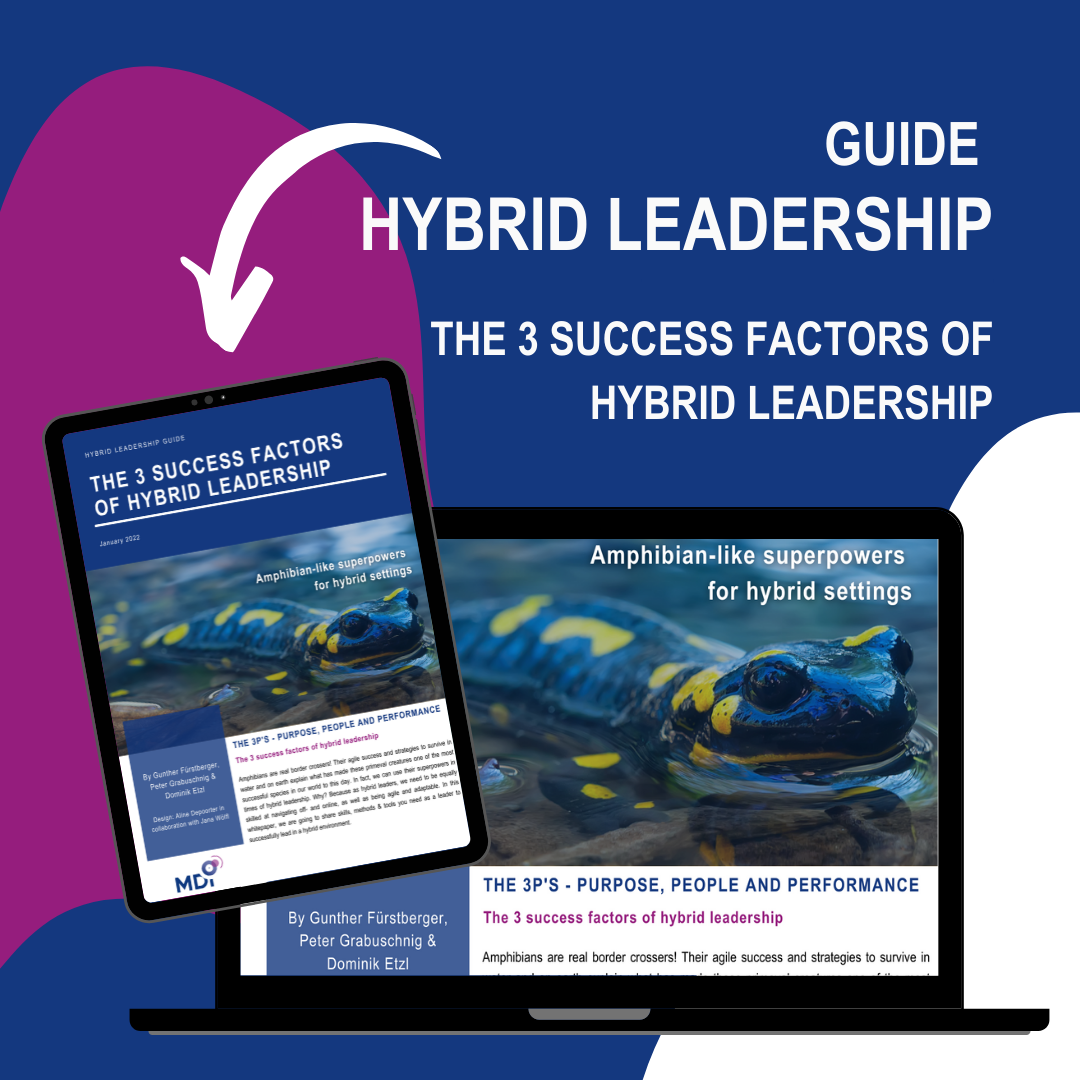
Take a look at our guide HYBRID LEADERSHIP or read these posts on our blog: 6 things you can do to support your hybrid team & 5 tips to increase trust when working hybrid.

Get the "Hybrid Leadership" Guide

What serves you next?

The effects of home office

The effects of home office

by Dr. Kilian Wawoe | Apr 14, 2022 | Digital Transformation, Leadership in the digital transformation | 0 comments

An Interview on the effects of home office with Dr. Kilian Wawoe

Dr. Kilian Wawoe investigated the consequences of the increasing numbers of home office days for people and companies and the effects of home office.  During lockdown, he found more than 600 articles about working from home, talked with hundreds of people about their experiences with home office, took questionnaires from thousands of workers and worked with dozens of companies on a new form of collaboration that he calls “corporate brain.“

What are the implications of the increasing number of home office days for companies?

We are in a unique situation – the entire world is participating in the largest “experiment” in the history of labour. The lessons we can learn from the lockdowns are that we can quite easily work from home, which means

  • less commuting
  • producing less pollution
  • experiencing less stress
  • seeing increased productivity

What are the consequences of home office days for employees and the team?

The problem is that the impact of Home Office varies greatly from person to person. As a result, many companies are leaving the choice up to their employees. This is risky because employees come to the office to meet their colleagues and learn.

The future of work is therefore not about the individual, but actually about the group.

Should there be a home office obligation in order to work efficiently and sustainably?

We have to be careful with efficiency in the workplace. Many workers report that they are more productive in the home office, but work is also about imparting and teaching knowledge. That may not be efficient, but very important. We need to think about commitments, but in a different direction: The obligation for employees to come back to the office. Some of the employees state that they don’t want to work in the office at all, or only a little. But companies need these individuals to be part of the group, nonetheless.

What is the best solution for the increasing employees’ desire for home office days?

I advise companies to have an open discussion with their employees about the future of work. But please be careful: There is one group whose time during the pandemic was particularly difficult. We should make sure that these employees are heard. Many people want to protect their “rights they acquired during the pandemic”. Managers need to protect those interests of the group.

How many days of home office a week/month has been shown to be the “gold standard”?

“With the knowledge you gained from the Corona crisis, how many times would you want to go to the office?” This question is so obvious that it is asked in almost every organization. However, there are three mistakes.

Work is not about “you.” but about “we.” Work is a team sport that is about working together. It’s not about “how often,” it’s about “what” you come to the office for.

When we come to work and isolate ourselves all day, what do we then bring to the group? It’s not about ‘wanting’, it’s about what we want to ‘do’ in the office.

The question is: “What are we going to do with the knowledge that we have gained during the pandemic to make the team work (remotely)?” Because the office is a place to connect, coach and collide.

What do you think will happen after the Corona pandemic? 

First, we need to develop a vision for human resources.  

  • How are we going to make sure the right things are happening in the workplace? 
  • For example, how do we make sure that new employees can actually learn the job? 
  • How do we make sure that there is a culture of integration, even for those who don’t like to work from home? 
  • Also, how do we avoid unnecessary travel? 

Clearly, it is difficult to find a common denominator for these very different projects or to make a statement about the results if the evaluations have not yet taken place. Nevertheless the results are based on the theory, the interviews, the questionnaire interviews, the questionnaire surveys, the focus groups, discussions with experts and the initial projects.

I think that my approaches can contribute to the following:  

  • Improved employee performance 
  • Better functioning teams 
  • More involvement of young and vulnerable employees 
  • Improved job satisfaction 
  • Better health 
  • Less stress and burnout 
  • Less pressure on the environment 
  • Never again sitting in an overcrowded train or bus 
  • And never, ever being stuck in a traffic jam again 

Ultimately, however, we need leaders who make decisions. And if certain people don’t like the new way of working, companies should not be afraid to part with them as well. Because the pandemic has taught us unique lessons and we should all take the time to learn them. 

Dr. Kilian Wawoe

Dr. Kilian Wawoe

Assistant Professor Human Resources Management

Dr. Killial Wawoe worked in various positions in HR in the Netherlands, Belgium, Monaco and India.

Currently he is active as a lecturer for Human Resources Management at the VU University of Amsterdam.

www.humanresearch.nl 


  • LinkedIn

What serves you next?

Zeca Ruiz on Cross-Generational Leadership and Navigating Change

by Jana Wölfl | 13. May 2026 | Leadership Impact, MDI Spotlight Series, Training Insights | 0 Comments

Zeca Ruiz on Cross-Generational Leadership and Navigating Change This blog is an excerpt from our new podcast! You can find the entire podcast episode here. Zeca Ruiz on Cross-Generational Leadership and Navigating Change In the fourth episode of our podcast “Voices...
Read More

How Do You Lead People Who Don’t Think the Way You Do?

by Zeca Ruiz | 4. February 2026 | Leadership Impact, Leadership Tips, Learning Transfer | 0 Comments

How Do You Lead People Who Don't Think the Way You Do? Do you want to listen to this article? Click here to access our AI-generated audio version!   How do you lead people who do not think the way you do? Leadership is a challenge, especially when you are not...
Read More

How You Deal With Neurodiversity as a Leader

by Iris Kandlbauer | 3. February 2026 | Leadership Impact, Leadership Tips, Short Knowledge Bits | 0 Comments

How You Deal With Neurodiversity as a Leader You prefer listening to this article? You can find our AI-generated audio version below! How You Deal With Neurodiversity as a Leader What might be behind “strange” behavior in a team—and how leaders can deal with it...
Read More

Generation Z isn’t the Problem but Our System is

by Zeca Ruiz | 3. December 2025 | Impuls series, International leadership development, Leadership in the digital transformation | 0 Comments

Generation Z Isn’t the Problem, but Our System is. Read this article on crossgenerational management by Zeca Ruiz to find out more!

Read More

The Lasting Impact of Leadership Horizon – Meike’s Perspectives

by Meike Hinnenberg | 2. July 2025 | Leadership Impact, MDI Inside, Short Knowledge Bits | 0 Comments

The Lasting Impact of Leadership Horizon - Meike's Perspectives Do you prefer to listen to this article? Click below to access our AI-generated audio version!The Lasting Impact of Leadership Horizon - Meike's Perspectives MDI’s Meike Hinnenberg shares her reflections...
Read More

Success Through Change: How to Stay Oriented During Transitions

by Anita Berger | 14. April 2025 | Impuls series, Leadership Impact, Leadership Tips | 0 Comments

Success Through Change: How to Stay Oriented During Transitions Do you prefer to listen to this article? Click below to access our AI-generated audio version:Success Through Change: How to Stay Oriented During Transitions Change processes often involve challenges....
Read More

4 Tips on How to Shape Change Processes as a Leader

by Anita Berger | 3. April 2025 | Impuls series, Leadership Impact, Leadership Tips | 0 Comments

4 Tips on How to Shape Change Processes as a Leader Do you prefer to listen to this article? Click below to access our AI-generated audio version:4 Tips on How to Shape Change Processes as a Leader Imagine a dynamic network of paths that is constantly changing. While...
Read More

Successful Team Building for Boehringer Ingelheim RCV

by Anita Berger | 29. March 2024 | Customer Story, International leadership development, MDI Inside | 0 Comments

Successful Team Building for Boehringer Ingelheim RCV Do you prefer to listen to this article? Click below to access our AI-generated audio version:Successful Team Building for Boehringer Ingelheim RCV In the interview with our MDI trainer and partner, Anita Berger On...
Read More

Organize Your Team in a Hybrid Workplace

by Peter Grabuschnig | 14. March 2024 | Impuls series, International leadership development, Leadership in the digital transformation | 0 Comments

Organize Your Team in a Hybrid Workplace Prefer to listen to the article? Click below to access our AI speech-generated audio. However, if you want to read it as usual, keep scrolling.Organize Your Team in a Hybrid Workplace In his new Rise Course, our MDI trainer and...
Read More

Exploring the Influence of AI on Leadership Roles – an experiment by a CEO

by Gunther Fürstberger | 14. November 2023 | International leadership development, Leadership and AI, Leadership in the digital transformation | 0 Comments

Exploring the Influence of AI on Leadership Roles: Learn more about the ongoing ChatGPT experiment by MDI CEO Gunther Fürstberger Do you prefer to listen to this article? Click below to access our AI-generated version. Exploring the Influence of AI on Leadership...
Read More

or maybe this?

How can VR help with leadership training?

How can VR help with leadership training?

by Anita Berger, Dominik Etzl | Oct 11, 2021 | Leadership Impact, Leadership in the digital transformation, Leadership Tips | 0 comments

How can VR help with leadership training?

Our Virtual Reality & Leadership Development Experts Anita Berger & Dominik Etzl talk in this Interview about Leadership Impact through VR.

Immersive learning through virtual reality

can help organizations address some of today’s key leadership challenges.

Why is virtual reality for leaders on the rise?

Dominik Etzl: Apart from the fact that VR is cool and is guaranteed to remain in every participant’s memory for a long time, VR leadership training solves a long unsolved problem: bringing virtual teams together in a (virtual) room where they can work together on problems and solutions – not just via the camera in front of the screen – but with full physical engagement and an almost face-to-face feeling.

What do new VR leadership trainings look like in practice?

Anita Berger: Some of the training experiences are designed to be “played” alone, practicing individual situations for yourself over and over again and constantly improving – for example, giving a presentation in front of a virtual audience or even the board of directors.

Other VR trainings involve the whole team and you can think of it more like a virtual escape room.

Others you do alone, but you have physical coaches next to you who guide you through the various scenarios and reflect on what you’ve experienced between VR experiences.

In addition, a distinction can be made between those VR trainings that are tailored to one’s own company and learning situations and those that are standardized and can thus be used in a variety of ways.

In order to have the greatest possible impact, it makes sense – as is already known from face-to-face training – not to view VR leadership training as a stand-alone solution, but to integrate it into a learning process that includes a good mix of synchronous and

What opportunities and possibilities does VR offer?

Anita Berger: VR offers the opportunity to engage with a broad range of content topics in an experiential way from different perspectives in iterative loops.

Different perspectives: Currently at MDI we work with 3 roles:

  • the space travelers
  • the guides/coaches 
  • the observers.

All have the opportunity to immerse themselves in all roles.

The space travelers are the players who, if you use the soccer analogy, are supposed to be on the field scoring the goals. The space mission is about saving others.

The guides/coaches have the opportunity to help the space travelers accomplish the mission. They are the coaches on the sidelines who do not play themselves, but are instrumental in the success of the mission by recognizing and responding to what the spacewalkers need.

Observers are tasked with watching what is happening on the field and on the sidelines, and sharing it in debriefings. One can also use the role of observers for assessment or development settings.

After each mission, participants switch roles and therefore gather lessons learned from the different perspectives.

Iterative Loops:

As in real life, there are many uncertainties, knowledge, and information that must first be acquired. Participants experience certain phases as exciting, fascinating, frustrating or chaotic.

After each round, what is experienced is reflected upon, processed and placed in the respective context of the content. The mission is started repeatedly until it succeeds. Therefore, the knowledge gained from the previous mission can be implemented right away.

Content topics:

The Apollo mission makes it possible to work on various topics and sets of questions.

For example, if the content context refers to “Overcoming Disruption” the different phases of

  • “Fail Fast”
  • Learning Together”
  • “Performing together”

in the different missions can be experienced by the participants.

Reflection phase:

In addition, a content-related discussion can take place, for example on topics such as:

  • Dealing with and coping with uncertainty, complexity and (over-)demanding situations.
  • Performance as a (virtual) team
  • Leading (virtual) teams to performance, through communication, collaboration, inclusion
  • situationally adapted leadership
  • Strengthening (self-)confidence and resilience
  • taking and transferring responsibility

The novel setting offers attractive and exciting development opportunities for leaders at all seniority levels up to top executives and for entire teams.

Can you actually learn better with VR?

Anita Berger: It’s best to let the results of studies speak for themselves

  • Learning takes place up to 4 times faster than in a traditional seminar setting.
  • VR learners are up to 275% more confident in implementing what they have learned after training
  • a 40% improvement over classroom training and
  • a 35% improvement over e-learning training.
  • VR participants felt 3.75 times more emotionally connected to the content than face-to-face learners and 2.3 times more than e-learners.
  • Three-quarters of participants surveyed said they had a wake-up call during the VR course on diversity and inclusion and realized they were not as inclusive as they thought.
  • During VR learning, participants were significantly less likely to drift off with their attention.
  • In the PWC study, participants in the VR setting were up to 4 times more focused during training than their e-learning peers and 1.5 times more focused than their face-to-face training peers.
PwC VR Soft Skills Training Efficacy Study

Virtual Reality for Leaders | Hands-on VR Workshop on 26.11.2021

In this compact hands-on workshop, we will show how leaders learn immersively using VR.

Experience three exciting perspectives for leadership & development in one day:

As an active participant, as a coach and as an observer.

Secure your workshop seat now!

What technology and requirements do you need for implementation?

Dominik Etzl: Until recently, the hurdle to working with VR in your own company was relatively high.

In addition to the special VR hardware from Oculus, Vive, or Sony, for example, you also needed a powerful PC to start the system in the first place. In addition, there were a lot of cables and sensors. If, on top of that, you didn’t have a permanent VR room available, but had to set up and take down again and again, or even move to a different location, you can imagine that this was partly off-putting and only suitable for a niche.

However, these times have largely been history since 2021 the latest. Nowadays, you can buy a powerful VR set starting at €350 and it includes everything you need in terms of hardware to get started. Processing power and sensors have been built into the headset in the latest models, e.g. the Oculus Quest 2, so that a PC, cables or external sensors are no longer necessary.

This makes it very easy and uncomplicated to set up and transport – even for those who have no experience with VR. In the past, it was still common to rent VR hardware – today, a purchase makes much more sense in most cases, because the price difference is cancelled out by the effort. The only requirement is now a room of about 2.5 x 2.5 meters per player, which can easily be found in most offices.

Can every company afford this?

Dominik Etzl: As already written above, one can distinguish between those VR training experiences that are tailored to one’s own company and those that can be purchased in a standardized way.

Which one is right for one’s needs depends primarily on whether the skills that are to be learned with it concern very specific processes in the company, or whether it is about, the general ability to collaborate, agile principles, handling resistance, etc.

Whereas the former usually requires several months of production time and corresponding financial resources, VR leadership training aimed at general soft skills is already available at a slightly higher normal daily training rate. Then you also have trained VR experts to ensure that the VR training is effective. 

The original german article was written for magazintraining by

Anita Berger

Anita Berger

Executive Coach, Consultant, Trainer & Managing Partner MDI

Anita Berger is an executive coach, consultant and trainer specialising in leadership development and international human resource management. She is a partner of MDI Management Development International. For more than 15 years she has worked in management and leadership positions (among others as HR-
Director at Coca-Cola Hellenic and HR Manager at Konica Minolta Business Solutions).

  • LinkedIn
Dominik Etzl

Dominik Etzl

Trainer & Solution Development Manager MDI & Manager Metaforum International.

​Dominik Etzl is Solution Development Manager and Trainer at MDI Management Development GmbH and Managing Director of Metaforum International. His focus is on topics of digital transformation, as well as OKR (Objectives & Key Results), agile leadership and lateral leadership. His goal is to support managers in leading a valuable contribution to their environment: on an individual, corporate and societal level.

  • LinkedIn

What might help you next?

Human First: Leadership in the Age of AI

by Johanna Glechner | 14. September 2026 | Digital Transformation, Leadership and AI, Leadership in the digital transformation | 0 Comments

Human First: Leadership in the Age of AI My professional journey has always taken place at the intersection of two worlds that, for a long time, were treated as separate: technology and leadership. With a background in business informatics, I started my career in...
Read More

AI Transformation Is Leadership Work

by Gunther Fürstberger | 28. August 2026 | Leadership and AI, Leadership Tips, MDI Whitepaper | 0 Comments

AI Transformation Is Leadership Work The four-step loop that turns individual experiments into lasting change Many companies are already using AI—and still not transforming. Tools, pilot projects, and guidelines only add up to transformation once they deliberately...
Read More

What If AI Doesn’t Replace Us — But Drowns Us Out?

by Martin Maglia | 24. July 2026 | Digital Transformation, Leadership and AI, Short Knowledge Bits | 0 Comments

What If AI Doesn't Replace Us — But Drowns Us Out? Over the weekend, I watched a thought-provoking video from Rick Beato. (You can find the link at the end of this article.) For those who don't know him: Rick Beato is a musician, producer, educator, guitarist, and one...
Read More

Use It or Lose It: How AI and Digital Tools May Be Changing Our Brains

by Florian Biedermann | 26. June 2026 | Leadership and AI, Leadership Tips, Learning Transfer | 0 Comments

Use It or Lose It: How AI and Digital Tools May Be Changing Our Brains You travel to Madrid and want to chat with the locals, but you realize that after five years without practice, your rudimentary Spanish skills are now practically nonexistent and you even struggle...
Read More

How Artificial Intelligence Shapes Who We Become

by Meike Hinnenberg | 19. May 2026 | Impuls series, Leadership and AI, Leadership in the digital transformation | 0 Comments

How Artificial Intelligence Shapes Who We Become Meike’s Reflections on Artificial Intelligence Do you prefer to listen to this article? Click below to access our AI-generated audio version!How Artificial Intelligence Shapes Who We Become Meike’s Reflections on...
Read More

Zeca Ruiz on Cross-Generational Leadership and Navigating Change

by Jana Wölfl | 13. May 2026 | Leadership Impact, MDI Spotlight Series, Training Insights | 0 Comments

Zeca Ruiz on Cross-Generational Leadership and Navigating Change This blog is an excerpt from our new podcast! You can find the entire podcast episode here. Zeca Ruiz on Cross-Generational Leadership and Navigating Change In the fourth episode of our podcast “Voices...
Read More

What AI Shows You — and What It Doesn’t

by Meike Hinnenberg | 1. April 2026 | Digital Transformation, Impuls series, Leadership and AI | 0 Comments

What AI Shows You — and What It Doesn't Meike’s Reflections on Artificial Intelligence Do you prefer to listen to this article? Click below to access our AI-generated audio version! What AI Shows You — and What It Doesn't Meike’s Reflections on Artificial Intelligence...
Read More

Leading in the Age of AI: How AI Discourse Shapes Responsibility and Power

by Meike Hinnenberg | 18. March 2026 | Impuls series, Leadership and AI, Leadership Tips | 0 Comments

Leading in the Age of AI: How AI Discourse Shapes Responsibility and Power Meike’s Reflections on Artificial Intelligence Do you prefer to listen to this article? Click below to access our AI-generated audio version!Leading in the Age of AI: How AI Discourse Shapes...
Read More

AI Ethics for Leaders: Why Context and Critical Thinking Matter More Than Ever

by Meike Hinnenberg | 11. March 2026 | Impuls series, Leadership and AI, Learning Transfer | 0 Comments

AI Ethics for Leaders: Why Context and Critical Thinking Matter More Than Ever. Meike’s Reflections on Artificial Intelligence Do you prefer to listen to this article? Click below to access our AI-generated audio version!AI Ethics for Leaders: Why Context and Critical...
Read More

A Success Story – When AI Sharpens Human Judgement

by Claude MacDonald, Rafael Ungvari | 6. March 2026 | Customer Story, Digital Transformation, Leadership and AI | 0 Comments

A Success Story – When AI Sharpens Human Judgement Do you prefer to listen to this article? Click here to access our AI-generated audio version! When AI Amplifies Human Judgment: A Customer Success Story About This Project At MDI, we believe that great leadership and...
Read More
How leaders successfully drive innovation

How leaders successfully drive innovation

by Anita Berger | Feb 25, 2021 | Agile Leadership, Leadership in the digital transformation, Leadership Tips | 0 comments

Driving business innovation as a leader

Successfully driving business innovation as a leader is essential to living a positive innovation culture and strong innovation management. We therefore provide insights into well-implementable processes that combine creative thinking with analytical thoroughness. #positiveinnovationculture #innovationmanagement

Are you a leader?

Things are going really well in your area of responsibility right now, or maybe you’re currently facing some big challenges.

Or are you an HR business partner, HR developer or organizational developer?

Your task is to support and advise these leaders?

Regardless of your current situation, you are asking yourself, “How can I strategically develop my area of responsibility and drive and implement innovative initiatives?

We’ll provide insight into easy-to-implement processes* that combine creative thinking with analytical accuracy, as well as identify new opportunities – and that are aligned with both the needs of your customers and your business or organization.


Anita Berger

Anita Berger

Executive Coach, Consultant, Trainer & Managing Partner MDI

Anita Berger is an executive coach, consultant and trainer specialising in leadership development and international human resource management. She is a partner of MDI Management Development International. For more than 15 years she has worked in management and leadership positions (among others as HR-
Director at Coca-Cola Hellenic and HR Manager at Konica Minolta Business Solutions).

  • LinkedIn

Strategy Process Map & Strategy Choice Cascade

This is a first introduction into the processes. We apply methods from design thinking (such as brainstorming, prototyping and iteration) to business modeling and strategy.

The processes include the “Strategy Process Map” and the “Strategy Choice Cascade” based on the work of IDEOU.

*IDEOU provides design-driven approaches to help companies innovate and grow.

The “Strategy Process Map” consists of seven main steps.


Step 1: Identify your strategic problem

You identify the biggest challenge with your current strategy. What is preventing you from achieving your company’s goals? The problem you identify is the one you will work on as you move forward in the strategy process.

Step 2: Frame a strategic question

You reformulate the problem into a strategic question to set the conditions for generating opportunities. The question “How can we, …” helps create the framework for generating new ideas.

Step 3: Generate strategic possibilities

Here you need to explore strategic possibilities and thus strategic decision-making opportunities to solve your problem and answer your strategic question.

Step 4: “What would have to be true?”

In this step, you define the requirements and conditions for each of your possibilities that have to be true in order for each of them to become a winning strategy.

Step 5: Identify barriers

Select the conditions – the things that would have to be true – that might be the most difficult or uncertain. Test these conditions before deciding on a possibility as a new strategy. 

Step 6: Test to learn

You test to learn. Conduct research and testing and create iterative prototypes to learn what might work.

Step 7: Make a choice.

Make a choice. Based on what you’ve learned, you decide on a strategic option.

The Strategy Choice Cascade” contains 5 essential elements

It provides an important contribution to making the right decision for you in the strategy process. It also provides the framework to visualize and communicate your strategy.


  1. “Winning aspiration”: define what it means for your company to “win”. What do you want to achieve?
  2. “Where to play”:What is your “playing field” where you want to compete or not.
  3. “How to win”:What is the advantage over the competition, e.g. reduce costs or add value?
  4. “Capabilities”: what is needed to win?
  5. “Management systems”: what infrastructure and systems can support?

Turning Theory into Practice

We support you with an accessible process to do the work of innovation. 

Make strategic choices and turn ideas into reality with us!

Just let us know how we can support you.

Get in touch!

Do you want to master the most effective tools and concepts for innovation, productivity and growth?

Then shape your path to success in digitalisation with agile leadership!

Secure a place on the course now

What might help you next?

Human First: Leadership in the Age of AI

by Johanna Glechner | 14. September 2026 | Digital Transformation, Leadership and AI, Leadership in the digital transformation | 0 Comments

Human First: Leadership in the Age of AI My professional journey has always taken place at the intersection of two worlds that, for a long time, were treated as separate: technology and leadership. With a background in business informatics, I started my career in...
Read More

AI Transformation Is Leadership Work

by Gunther Fürstberger | 28. August 2026 | Leadership and AI, Leadership Tips, MDI Whitepaper | 0 Comments

AI Transformation Is Leadership Work The four-step loop that turns individual experiments into lasting change Many companies are already using AI—and still not transforming. Tools, pilot projects, and guidelines only add up to transformation once they deliberately...
Read More

What If AI Doesn’t Replace Us — But Drowns Us Out?

by Martin Maglia | 24. July 2026 | Digital Transformation, Leadership and AI, Short Knowledge Bits | 0 Comments

What If AI Doesn't Replace Us — But Drowns Us Out? Over the weekend, I watched a thought-provoking video from Rick Beato. (You can find the link at the end of this article.) For those who don't know him: Rick Beato is a musician, producer, educator, guitarist, and one...
Read More

Use It or Lose It: How AI and Digital Tools May Be Changing Our Brains

by Florian Biedermann | 26. June 2026 | Leadership and AI, Leadership Tips, Learning Transfer | 0 Comments

Use It or Lose It: How AI and Digital Tools May Be Changing Our Brains You travel to Madrid and want to chat with the locals, but you realize that after five years without practice, your rudimentary Spanish skills are now practically nonexistent and you even struggle...
Read More

How Artificial Intelligence Shapes Who We Become

by Meike Hinnenberg | 19. May 2026 | Impuls series, Leadership and AI, Leadership in the digital transformation | 0 Comments

How Artificial Intelligence Shapes Who We Become Meike’s Reflections on Artificial Intelligence Do you prefer to listen to this article? Click below to access our AI-generated audio version!How Artificial Intelligence Shapes Who We Become Meike’s Reflections on...
Read More

Zeca Ruiz on Cross-Generational Leadership and Navigating Change

by Jana Wölfl | 13. May 2026 | Leadership Impact, MDI Spotlight Series, Training Insights | 0 Comments

Zeca Ruiz on Cross-Generational Leadership and Navigating Change This blog is an excerpt from our new podcast! You can find the entire podcast episode here. Zeca Ruiz on Cross-Generational Leadership and Navigating Change In the fourth episode of our podcast “Voices...
Read More

What AI Shows You — and What It Doesn’t

by Meike Hinnenberg | 1. April 2026 | Digital Transformation, Impuls series, Leadership and AI | 0 Comments

What AI Shows You — and What It Doesn't Meike’s Reflections on Artificial Intelligence Do you prefer to listen to this article? Click below to access our AI-generated audio version! What AI Shows You — and What It Doesn't Meike’s Reflections on Artificial Intelligence...
Read More

Leading in the Age of AI: How AI Discourse Shapes Responsibility and Power

by Meike Hinnenberg | 18. March 2026 | Impuls series, Leadership and AI, Leadership Tips | 0 Comments

Leading in the Age of AI: How AI Discourse Shapes Responsibility and Power Meike’s Reflections on Artificial Intelligence Do you prefer to listen to this article? Click below to access our AI-generated audio version!Leading in the Age of AI: How AI Discourse Shapes...
Read More

AI Ethics for Leaders: Why Context and Critical Thinking Matter More Than Ever

by Meike Hinnenberg | 11. March 2026 | Impuls series, Leadership and AI, Learning Transfer | 0 Comments

AI Ethics for Leaders: Why Context and Critical Thinking Matter More Than Ever. Meike’s Reflections on Artificial Intelligence Do you prefer to listen to this article? Click below to access our AI-generated audio version!AI Ethics for Leaders: Why Context and Critical...
Read More

A Success Story – When AI Sharpens Human Judgement

by Claude MacDonald, Rafael Ungvari | 6. March 2026 | Customer Story, Digital Transformation, Leadership and AI | 0 Comments

A Success Story – When AI Sharpens Human Judgement Do you prefer to listen to this article? Click here to access our AI-generated audio version! When AI Amplifies Human Judgment: A Customer Success Story About This Project At MDI, we believe that great leadership and...
Read More
« Older Entries
Next Entries »

Information

  • Imprint
  • MDI company website

Social Media

  • Facebook
  • Twitter
  • Youtube
  • LinkedIn

© MDI Management Development Institute, 2020