
• MDI
  • German version
  • Contact us
MDI Management Development
  • Agile leadership
  • Lateral Leadership
  • Leadership Impact
  • Leadership Development
Select Page
A Success Story – When AI Sharpens Human Judgement

A Success Story – When AI Sharpens Human Judgement

by Claude MacDonald, Rafael Ungvari | Mar 6, 2026 | Customer Story, Digital Transformation, Leadership and AI | 0 comments

A Success Story – When AI Sharpens Human Judgement

Do you prefer to listen to this article? Click here to access our AI-generated audio version!

When AI Amplifies Human Judgment: A Customer Success Story

About This Project

At MDI, we believe that great leadership and sales development isn’t just about knowledge transfer — it’s about behavior change. This customer story reflects a collaboration between Claude MacDonald, MDI trainer and Sales Culture Architect, and Rafael Ungvari, MDI’s AI Product & Solution Lead, who designed and implemented the AI-driven learning environment for this engagement. Together, they bring a rare combination: deep human expertise in consultative selling and the technical capability to turn that expertise into scalable AI-powered practice tools.

The Challenge: Great Training, Not Enough Practice

Our client is a global B2B organization in the industrial chemicals industry, operating across multiple business units with complex sales cycles and technically sophisticated offerings. Sales leaders and managers play a critical role in developing the consultative selling capability of their teams, which makes closing the practice gap not just a training question but a leadership priority.

The goal was clear: strengthen Discovery skills. That means helping sales professionals ask better questions, genuinely uncover client needs, qualify opportunities more accurately, and walk into customer conversations fully prepared.

Here’s the honest challenge: the existing training worked. It created shared language and awareness. But awareness alone doesn’t change behavior. And behavior only changes with practice — lots of it.

Think of elite athletes. They don’t improve by playing more games. They improve because the practice-to-play ratio is deliberately high. In sales, that ratio is almost always inverted. Real customer conversations are high-stakes environments — there’s limited room to experiment, fail, and try again.

That’s exactly the gap we needed to close.

Why AI – and Why Role Play?

The answer wasn’t more classroom time. It was deliberate, repeatable practice at scale.

AI-driven role play made it possible to create realistic Discovery conversations on demand. Participants could practice, reflect, adjust, and replay scenarios multiple times — something impossible to replicate with peer simulations or occasional classroom role plays.

Without AI, the solution would have looked like traditional role play: useful, but hard to scale, difficult to repeat, and dependent on the availability of skilled practice partners. With AI, we could give every participant a realistic, challenging practice environment they could return to again and again.

Crucially: AI didn’t replace human judgment. It amplified it by giving people more chances to sharpen their questioning, their listening, and their situational awareness before the stakes were real.

How the Solution Was Designed

The concept was straightforward: AI avatars simulated customer interactions specifically designed to challenge participants on the exact capabilities that matter most in Discovery — questioning quality, listening and sense-making, problem framing, and opportunity qualification.

A typical session combined a short conceptual input with an AI-driven discovery role play, followed by structured reflection and a facilitator-led debrief. Participants encountered realistic customer responses and had to adapt their approach in real time — not follow a script.

The human-AI balance was intentional. Human facilitators anchored the learning in business reality, coached participants on consultative behaviors, and helped translate practice into field application. AI provided the environment: repeatable, realistic, and safe to experiment in.

The Challenge: Great Training, Not Enough Practice

What Participants Experienced

The most significant shift was in the practice-to-play ratio. Participants could run the same scenario multiple times, testing different questions and conversational strategies. This dramatically increased the practice-to-play ratio, accelerating skill development in Discovery conversations. The experience felt realistic, engaging, and directly connected to daily work — not abstract, not theoretical.

A few voices from participants (anonymized):

“The AI role plays were incredibly helpful. Being able to repeat scenarios helped me improve my discovery conversations.”

“This was a breath of fresh air — challenging, practical, and directly applicable.”

“The AI tools made it easier to structure my thinking before real customer calls.”

Results: What Actually Changed

Observed outcomes included stronger Discovery conversations with better questions and sharper listening, more structured pre-call preparation, improved opportunity qualification, and increased confidence in leading customer discussions.

Compared to traditional formats, the AI-enabled approach proved more scalable (accessible to more participants, more often), more effective (higher practice volume, faster skill development), and more sustainable (embedded as an ongoing practice tool rather than a one-time event).

Key Takeaway: AI Works Best When It Amplifies Humans

The most important lesson from this project is deceptively simple: AI is most powerful when used to amplify human judgment, not replace it.

Building consultative selling capability — especially in Discovery — requires far more deliberate practice than traditional training formats can realistically provide. AI-driven role play creates a scalable, repeatable way to embed that practice into sales development programs.

When does this approach make sense? When the capability gap is behavioral rather than knowledge-based, when practice volume matters, and when you need a safe environment for experimentation and failure.

When doesn’t it make sense? When the learning goal is primarily about mindset shifts, relationship dynamics, or complex emotional intelligence work — areas where human nuance and real relationship context are irreplaceable.

The future of effective sales training isn’t AI or humans. It’s knowing exactly where each one adds the most value — and designing for both.

Interested in exploring AI-driven role play for your sales or leadership development programs? Contact us at https://mdi-training.com/ai-enhanced-leadership-training/

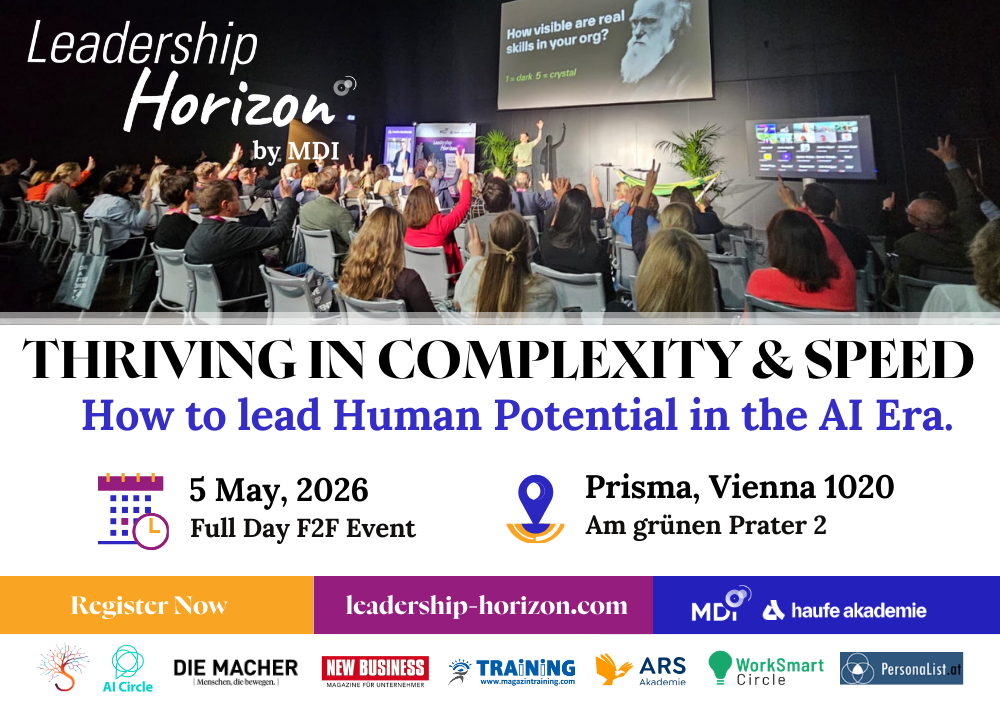
Are you interested and you want to hear more from Claude MacDonald? Claude will speak at our next Leadership Horizon conference on May 5th with his keynote Business Case: When AI Amplifies Human Judgment: Lessons from the Field. 

Get your tickets now!

Claude MacDonald

Claude MacDonald

Sales Culture Architect & Leadership Strategist

Claude MacDonald is recognized as an expert in sales culture transformation. Over the past 25 years, Claude has trained and coached more than 25,000 managers, professionals, and employees from prominent organizations in Canada, the United States, and Europe. His work focuses on building the mindsets, skills, and habits that drive lasting commercial performance — from frontline sales professionals to senior leadership teams.

  • LinkedIn
Rafael Ungvari

Rafael Ungvari

Artificial Intelligence Expert

Rafael is an AI specialist at MDI and is working to redefine leadership development through artificial intelligence. To implement this idea, he has worked with our team to establish the MDI AI Leadership Lab, which serves as a hub for experimenting with and applying AI solutions together with clients and trainers.

His work builds on his studies in business informatics at WU Vienna, where he combines business perspectives with technical expertise to develop practical and sustainable digital solutions.

  • LinkedIn

Save your tickets and join us on May 5th!

Leadership Horizon 2026 Banner

This could also interest you:

AI Ethics for Leaders: Why Context and Critical Thinking Matter More Than Ever

by Meike Hinnenberg | 11. March 2026 | Impuls series, Leadership and AI, Learning Transfer | 0 Comments

AI Ethics for Leaders: Why Context and Critical Thinking Matter More Than Ever. Meike’s Reflections on Artificial Intelligence Do you prefer to listen to this article? Click below to access our AI-generated audio version!AI Ethics for Leaders: Why Context and Critical...
Read More

A Success Story – When AI Sharpens Human Judgement

by Claude MacDonald, Rafael Ungvari | 6. March 2026 | Customer Story, Digital Transformation, Leadership and AI | 0 Comments

A Success Story – When AI Sharpens Human Judgement Do you prefer to listen to this article? Click here to access our AI-generated audio version! When AI Amplifies Human Judgment: A Customer Success Story About This Project At MDI, we believe that great leadership and...
Read More

How Do You Lead People Who Don’t Think the Way You Do?

by Zeca Ruiz | 4. February 2026 | Leadership Impact, Leadership Tips, Learning Transfer | 0 Comments

How Do You Lead People Who Don't Think the Way You Do? Do you want to listen to this article? Click here to access our AI-generated audio version!   How do you lead people who do not think the way you do? Leadership is a challenge, especially when you are not...
Read More

How You Deal With Neurodiversity as a Leader

by Iris Kandlbauer | 3. February 2026 | Leadership Impact, Leadership Tips, Short Knowledge Bits | 0 Comments

How You Deal With Neurodiversity as a Leader You prefer listening to this article? You can find our AI-generated audio version below! How You Deal With Neurodiversity as a Leader What might be behind “strange” behavior in a team—and how leaders can deal with it...
Read More

Anita’s Key to Success for International Cooperation

by Jana Wölfl | 3. February 2026 | Leadership and AI, Leadership Tips, MDI Spotlight Series | 0 Comments

Anita's Key to Success for International Cooperation This blog is an excerpt from our new podcast! You can find the entire podcast episode here. Anita's Key to Success for International Cooperation In our new video podcast format, “Voices of Leadership – an MDI...
Read More

Fostering True Workplace Commitment

by Marcin Swierkocki | 14. January 2026 | Leadership Tips, Learning Transfer, Short Knowledge Bits | 0 Comments

Fostering True Workplace Commitment Do you prefer to listen to this article? Click below to access our AI-generated audio version! Fostering True Workplace Commitment Throughout my years of practice, I've found that deep workplace commitment is achieved not through...
Read More

Marcin Swierkocki on the Full Range Leadership Model

by Jana Wölfl | 19. December 2025 | Leadership and AI, Leadership Tips, MDI Spotlight Series | 0 Comments

Marcin Swierkocki on the Full Range Leadership Model This blog is an excerpt from our new podcast! You can find the entire podcast episode here. Marcin Swierkocki on the Full Range Leadership Model In the newest episode of our podcast “Voices of Leadership | An MDI...
Read More

Self-Efficacy in Change: Why It Matters

by Anita Berger | 17. December 2025 | Leadership Tips, Learning Transfer, Short Knowledge Bits | 0 Comments

Why It Matters When Transformation Gets Hard Do you prefer to listen to this article? Click below to access our AI-generated audio version:Self-Efficacy: Why It Matters When Transformation Gets Hard Change can be exhausting.Especially when things are unclear,...
Read More

Generation Z isn’t the Problem but Our System is

by Zeca Ruiz | 3. December 2025 | Impuls series, International leadership development, Leadership in the digital transformation | 0 Comments

Generation Z Isn’t the Problem, but Our System is. Read this article on crossgenerational management by Zeca Ruiz to find out more!

Read More

From Lab to Practice: What We Learned With AI

by Rafael Ungvari | 3. September 2025 | Digital Transformation, Leadership and AI, Short Knowledge Bits | 0 Comments

From Lab to Practice: What We Learned With AI Do you prefer to listen to this article? Click here to access our AI-generated audio version! From Lab to Practice: What We Learned With AI AI in organizations isn’t a one-size-fits-all solution. And in people development,...
Read More
From Lab to Practice: What We Learned With AI

From Lab to Practice: What We Learned With AI

by Rafael Ungvari | Sep 3, 2025 | Digital Transformation, Leadership and AI, Short Knowledge Bits | 0 comments

From Lab to Practice: What We Learned With AI

Do you prefer to listen to this article? Click here to access our AI-generated audio version!

From Lab to Practice: What We Learned With AI

AI in organizations isn’t a one-size-fits-all solution.

And in people development, this becomes even more obvious: AI only creates value when it’s tailored to how people actually learn and practice skills.

At MDI, we’ve been working on this question for more than 1.5 years. What started as an internal experiment with ChatGPT quickly grew into our AI Leadership Lab – a sandbox where we could prototype, test, and refine how AI could support leadership development.

Our Journey With AI

Along the way, we moved from simple chatbots to immersive roleplays with voice and avatars. We discovered that immersion is not an add-on, but the goal. Our first demos now feel almost nostalgic – clicking a button, waiting for a response – compared to today’s fluid dialogues with emotional, human-like voices.

We also learned that systemic design matters more than model hype. GPT-3.5 to 4 was a leap, but not a breakthrough. The real difference came from how we designed scenarios: choosing the right challenge, calibrating resistance, and iterating with our trainers until the practice felt authentic.

And finally, we realized that feedback cannot be generic. AI’s true learning value comes when feedback is contextual, practical, and directly connected to the learner’s performance. That’s why we co-created feedback models with our trainers, based on real workshop experience.

Those internal learnings became the foundation of our Lab. But what happens when you take this approach outside – into client organizations?

From Internal Lab to Client Projects

In our first client projects implementing the AI Leadership Lab, one thing became crystal clear:

Success doesn’t depend on AI itself – it depends on how well the application is tailored to the organization.

Here’s what we learned in practice:

Our Journey With AI

1. Industry- & Company-Specific Adaptation

Generic simulations don’t work. For AI learning to have impact, scenarios must reflect the company’s reality:

  • the industry’s challenges,
  • the roles participants actually face,
  • and the objectives that matter most.

That’s why we don’t deliver “out of the box” roleplays. We co-develop scenarios with clients, allowing participants to rehearse the exact conversations and situations they encounter in their day-to-day work. AI enables the scaling of this realism across multiple contexts.

2. Co-Creation as a Success Factor

An AI Lab isn’t something you roll out. It has to emerge in co-creation:

  • our 1.5 years of Lab learning,
  • combined with our leadership development expertise,
  • and the client’s own learning and development (L&D) goals, models, and training structures.

This triangulation is what makes the Lab not only innovative but also credible, relevant, and sustainable within the organization.

3. Integration over Isolation

AI roleplays only create value when they are integrated into existing learning journeys, not used as isolated demonstrations.

That means embedding them into training modules, aligning them with objectives, and positioning them as part of the transfer process.

This way, AI strengthens the overall program instead of standing apart. It becomes a sustainable elementof leadership development – not just an add-on.

From experiment to system

Looking back, there’s a clear arc:

  • In our internal Lab, we learned the principles of immersion, design, feedback, and stakeholder involvement.
  • In client projects, we learned how to apply these principles to various industries, cultures, and learning and development (L&D) structures.

Together, these experiences show how AI can move from experiment → tailored system → scalable practice.

Final reflection

AI will not transform leadership development on its own. But when it is:

  • adapted to the industry and company context,
  • co-created with trainers, participants, and L&D teams,
  • and integrated into existing programs,

…then it can turn training into truly immersive, relevant, and scalable development.

That’s the future we’re building with the AI Leadership Lab – step by step, from lab to practice.

Rafael Ungvari

Rafael Ungvari

Artificial Intelligence Expert

Rafael is an AI specialist at MDI and is working to redefine leadership development through artificial intelligence. To implement this idea, he has worked with our team to establish the MDI AI Leadership Lab, which serves as a hub for experimenting with and applying AI solutions together with clients and trainers.

His work builds on his studies in business informatics at WU Vienna, where he combines business perspectives with technical expertise to develop practical and sustainable digital solutions.

  • LinkedIn

Download our new MDI Whitepaper:

This could also interest you:

AI Ethics for Leaders: Why Context and Critical Thinking Matter More Than Ever

by Meike Hinnenberg | 11. March 2026 | Impuls series, Leadership and AI, Learning Transfer | 0 Comments

AI Ethics for Leaders: Why Context and Critical Thinking Matter More Than Ever. Meike’s Reflections on Artificial Intelligence Do you prefer to listen to this article? Click below to access our AI-generated audio version!AI Ethics for Leaders: Why Context and Critical...
Read More

A Success Story – When AI Sharpens Human Judgement

by Claude MacDonald, Rafael Ungvari | 6. March 2026 | Customer Story, Digital Transformation, Leadership and AI | 0 Comments

A Success Story – When AI Sharpens Human Judgement Do you prefer to listen to this article? Click here to access our AI-generated audio version! When AI Amplifies Human Judgment: A Customer Success Story About This Project At MDI, we believe that great leadership and...
Read More

How Do You Lead People Who Don’t Think the Way You Do?

by Zeca Ruiz | 4. February 2026 | Leadership Impact, Leadership Tips, Learning Transfer | 0 Comments

How Do You Lead People Who Don't Think the Way You Do? Do you want to listen to this article? Click here to access our AI-generated audio version!   How do you lead people who do not think the way you do? Leadership is a challenge, especially when you are not...
Read More

How You Deal With Neurodiversity as a Leader

by Iris Kandlbauer | 3. February 2026 | Leadership Impact, Leadership Tips, Short Knowledge Bits | 0 Comments

How You Deal With Neurodiversity as a Leader You prefer listening to this article? You can find our AI-generated audio version below! How You Deal With Neurodiversity as a Leader What might be behind “strange” behavior in a team—and how leaders can deal with it...
Read More

Anita’s Key to Success for International Cooperation

by Jana Wölfl | 3. February 2026 | Leadership and AI, Leadership Tips, MDI Spotlight Series | 0 Comments

Anita's Key to Success for International Cooperation This blog is an excerpt from our new podcast! You can find the entire podcast episode here. Anita's Key to Success for International Cooperation In our new video podcast format, “Voices of Leadership – an MDI...
Read More

Fostering True Workplace Commitment

by Marcin Swierkocki | 14. January 2026 | Leadership Tips, Learning Transfer, Short Knowledge Bits | 0 Comments

Fostering True Workplace Commitment Do you prefer to listen to this article? Click below to access our AI-generated audio version! Fostering True Workplace Commitment Throughout my years of practice, I've found that deep workplace commitment is achieved not through...
Read More

Marcin Swierkocki on the Full Range Leadership Model

by Jana Wölfl | 19. December 2025 | Leadership and AI, Leadership Tips, MDI Spotlight Series | 0 Comments

Marcin Swierkocki on the Full Range Leadership Model This blog is an excerpt from our new podcast! You can find the entire podcast episode here. Marcin Swierkocki on the Full Range Leadership Model In the newest episode of our podcast “Voices of Leadership | An MDI...
Read More

Self-Efficacy in Change: Why It Matters

by Anita Berger | 17. December 2025 | Leadership Tips, Learning Transfer, Short Knowledge Bits | 0 Comments

Why It Matters When Transformation Gets Hard Do you prefer to listen to this article? Click below to access our AI-generated audio version:Self-Efficacy: Why It Matters When Transformation Gets Hard Change can be exhausting.Especially when things are unclear,...
Read More

Generation Z isn’t the Problem but Our System is

by Zeca Ruiz | 3. December 2025 | Impuls series, International leadership development, Leadership in the digital transformation | 0 Comments

Generation Z Isn’t the Problem, but Our System is. Read this article on crossgenerational management by Zeca Ruiz to find out more!

Read More

From Lab to Practice: What We Learned With AI

by Rafael Ungvari | 3. September 2025 | Digital Transformation, Leadership and AI, Short Knowledge Bits | 0 Comments

From Lab to Practice: What We Learned With AI Do you prefer to listen to this article? Click here to access our AI-generated audio version! From Lab to Practice: What We Learned With AI AI in organizations isn’t a one-size-fits-all solution. And in people development,...
Read More
Leadership and AI: Between Responsibility and Opportunity

Leadership and AI: Between Responsibility and Opportunity

by Marina Begic | May 6, 2025 | Digital Transformation, Leadership and AI, Leadership Tips | 0 comments

Leadership and AI: Between Responsibility and Opportunity

Do you prefer to listen to this article? Click below to access our AI-generated audio version!

Leadership and AI: Between responsibility and opportunity

Artificial intelligence is no longer a pipe dream – it is changing our working world here and now. It is about much more than technology: it is about attitude. How do we want to lead when machines think for themselves? How do we provide orientation when uncertainty is becoming the new constant?

Trust instead of fear

Many leaders worry about being replaced by AI. But this fear is rarely justified. Julie Sweet, CEO of Accenture, says that not a single one of her client companies plans to replace employees with AI. On the contrary – the technology is intended to relieve, not displace.

An international study of over 4,000 executives shows that the majority see AI as an opportunity for efficiency, better decision-making, and higher quality of collaboration. At the same time, there is often a lack of know-how, courage, and a clear strategy to truly leverage this potential.

This is where leaders are called upon to take responsibility – not in the future, but now. After all, we cannot outsource technological developments. We are challenged to recognize the opportunities of AI – and to boldly break new ground.

Beyond Efficiency – How AI Can Make Leadership Better

AI is often reduced to speed, cost-cutting, and automation. But its true value lies in enhancing quality: helping us to act more strategically, communicate more clearly, lead more reflectively, and master complexity.

Artificial Intelligence does not replace leadership – it enhances and empowers it. When used wisely, it strengthens human connection, creates space for meaningful work and reflection – all the things that define modern leadership.

AI as a lever for better leadership – not only for efficiency

Three Levels Where AI Strengthens Leadership

1. Individual Level

Through AI, leaders gain time by automating tasks like text generation, research, or translation. This frees up space for strategic thinking, personal development, and effective leadership.

2. Team Level

AI-powered tools improve collaboration and communication through feedback systems, knowledge platforms, and digital simulations. Meetings become more structured, decisions more grounded.

3. Organizational Level
Data-driven decisions, automated processes, and innovation impulses – AI enables organizations to become adaptive and learning-driven. Leadership becomes a catalyst for true transformation. 

Technology Is Not Enough – Values Remain Central

The more algorithms become part of our everyday lives, the more crucial human qualities become: empathy, responsibility, and ethical orientation. Good leadership remains human where it matters – wherever decisions impact people.

The use of AI brings new questions: What should be automated – and what must remain human? Which values must be preserved? Leadership today means finding clear answers and demonstrating authentic values.

At the same time, even though empathy itself can’t be programmed, AI can sometimes appear more patient or neutral than humans. What matters is not what AI can do theoretically, but how we shape and use it.

Leading today means creating spaces for experimentation, encouraging reflection, and integrating technology responsibly, not out of tech enthusiasm, but because we want to shape the future.

Learning as a Leadership Mandate – Rethought with AI

Judith Marks, CEO of Otis, summed it up: Leadership means setting a strategic direction while continuously learning. This is precisely where AI can unlock enormous potential.

What many e-learning platforms have long promised, AI can finally deliver: individualized, flexible, and needs-based learning – anytime, anywhere. Learning paths adapt dynamically, and feedback is delivered in real-time.

Especially when it comes to building soft skills – like conversation techniques, feedback, or conflict management – AI is a powerful enabler. Intelligent simulations react live, reflect real-world challenges, and promote sustainable development.

At MDI, we actively use this technology in leadership training, especially for interactive roleplays designed to strengthen leadership skills. Participants receive direct, situation-based feedback, boosting their effectiveness through repetition and practice.

Why the big breakthrough is still a long time coming

Why the Big Breakthrough Is Still Pending

Despite positive attitudes, studies show that only 13% of companies report a tangible AI impact. Why is that?

One key factor: Trust. Julie Sweet distinguishes two dimensions:

  • Functional trust: Does the technology work reliably? Built through usage, experience, and good change management.

  • Emotional trust: Will AI take away my job? Will it diminish my role?

It’s often emotional trust that becomes the stumbling block. Yet history shows: change has always been a constant in the labor market. 80% of today’s jobs didn’t exist 100 years ago.

Thus, the real question is not: “What will AI take from me?” but rather: “What can it give me – and what will I make of it?” This is where modern leadership truly begins: by driving a shift in perspective.

First Steps – How Leaders Can Get Started

1. Experiment yourself: Try tools like ChatGPT for everyday tasks. Build realistic familiarity.

2. Communicate openly: Share your experiences and uncertainties. It builds trust.

3. Enable experimentation: Encourage your team to try new tools. Build a culture of learning.

4. Discuss ethics: What can and should be automated? What must remain human?

5. Identify potentials: Where along the value chain can AI create real added value?

6. Lead by example: Show authentic values, use AI thoughtfully, and actively shape the future.

Conclusion: Future-Proof Leadership Combines Humanity and Technology

AI is not a threat nor a miracle cure – it is a tool. How we use it will determine its value.

If we recognize Artificial Intelligence as an opportunity to make our work more meaningful, our communication clearer, and our decisions more sound, we create a new kind of leadership – one that unites technology and humanity. For greater impact, greater purpose, and a stronger future.

Marina Begic

Marina Begic

Head of Business Development – Digital Transformation Driver

Marina has been working on new, effective learning methods and the future of corporate learning for over 15 years. In her current role, she is responsible for Digital Business Development at MDI, where her focus is not driven by the current buzzwords, but primarily on the feasibility of digital transformation for clients such as Erste Group, Lenzing, Semperit, Deutsche Bahn, Andritz AG, Uniqa, Mayr-Melnhof, Frequentis, RHIM. Her greatest strength is bringing loose ends together, which she impressively demonstrates time and time again with her big picture view and multi-dimensional approach. Her greatest passion is to provide learners not only with an experience, but also with real, lasting value for their real challenges.

  • LinkedIn

What serves you next?

How Do You Lead People Who Don’t Think the Way You Do?

by Zeca Ruiz | 4. February 2026 | Leadership Impact, Leadership Tips, Learning Transfer | 0 Comments

How Do You Lead People Who Don't Think the Way You Do? Do you want to listen to this article? Click here to access our AI-generated audio version!   How do you lead people who do not think the way you do? Leadership is a challenge, especially when you are not...
Read More

How You Deal With Neurodiversity as a Leader

by Iris Kandlbauer | 3. February 2026 | Leadership Impact, Leadership Tips, Short Knowledge Bits | 0 Comments

How You Deal With Neurodiversity as a Leader You prefer listening to this article? You can find our AI-generated audio version below! How You Deal With Neurodiversity as a Leader What might be behind “strange” behavior in a team—and how leaders can deal with it...
Read More

Generation Z isn’t the Problem but Our System is

by Zeca Ruiz | 3. December 2025 | Impuls series, International leadership development, Leadership in the digital transformation | 0 Comments

Generation Z Isn’t the Problem, but Our System is. Read this article on crossgenerational management by Zeca Ruiz to find out more!

Read More

The Lasting Impact of Leadership Horizon – Meike’s Perspectives

by Meike Hinnenberg | 2. July 2025 | Leadership Impact, MDI Inside, Short Knowledge Bits | 0 Comments

The Lasting Impact of Leadership Horizon - Meike's Perspectives Do you prefer to listen to this article? Click below to access our AI-generated audio version!The Lasting Impact of Leadership Horizon - Meike's Perspectives MDI’s Meike Hinnenberg shares her reflections...
Read More

Success Through Change: How to Stay Oriented During Transitions

by Anita Berger | 14. April 2025 | Impuls series, Leadership Impact, Leadership Tips | 0 Comments

Success Through Change: How to Stay Oriented During Transitions Do you prefer to listen to this article? Click below to access our AI-generated audio version:Success Through Change: How to Stay Oriented During Transitions Change processes often involve challenges....
Read More

4 Tips on How to Shape Change Processes as a Leader

by Anita Berger | 3. April 2025 | Impuls series, Leadership Impact, Leadership Tips | 0 Comments

4 Tips on How to Shape Change Processes as a Leader Do you prefer to listen to this article? Click below to access our AI-generated audio version:4 Tips on How to Shape Change Processes as a Leader Imagine a dynamic network of paths that is constantly changing. While...
Read More

Successful Team Building for Boehringer Ingelheim RCV

by Anita Berger | 29. March 2024 | Customer Story, International leadership development, MDI Inside | 0 Comments

Successful Team Building for Boehringer Ingelheim RCV Do you prefer to listen to this article? Click below to access our AI-generated audio version:Successful Team Building for Boehringer Ingelheim RCV In the interview with our MDI trainer and partner, Anita Berger On...
Read More

Organize Your Team in a Hybrid Workplace

by Peter Grabuschnig | 14. March 2024 | Impuls series, International leadership development, Leadership in the digital transformation | 0 Comments

Organize Your Team in a Hybrid Workplace Prefer to listen to the article? Click below to access our AI speech-generated audio. However, if you want to read it as usual, keep scrolling.Organize Your Team in a Hybrid Workplace In his new Rise Course, our MDI trainer and...
Read More

Exploring the Influence of AI on Leadership Roles – an experiment by a CEO

by Gunther Fürstberger | 14. November 2023 | International leadership development, Leadership and AI, Leadership in the digital transformation | 0 Comments

Exploring the Influence of AI on Leadership Roles: Learn more about the ongoing ChatGPT experiment by MDI CEO Gunther Fürstberger Do you prefer to listen to this article? Click below to access our AI-generated version. Exploring the Influence of AI on Leadership...
Read More

AI as a Co-Trainer in Leadership Development

by Gunther Fürstberger | 14. November 2023 | Impuls series, International leadership development, Leadership and AI | 0 Comments

Artificial Intelligence as a Co-Trainer in Leadership Development Do you prefer to listen to this blog article? Click below to access our AI-generated version. Artificial Intelligence as a Co-Trainer in Leadership Development In a world that is constantly evolving, we...
Read More
AI Hears; Humans Listen: Become a Master of Attunement

AI Hears; Humans Listen: Become a Master of Attunement

by Hamza Khan | Apr 18, 2025 | Digital Transformation, Leadership and AI, Leadership in the digital transformation | 0 comments

AI Hears; Humans Listen: Become a Master of Attunement

Prefer to listen to the article? Click below to access our AI speech-generated audio. However, if you want to read it as usual, keep scrolling.

AI Hears; Humans Listen: Become a Master of Attunement

Not Black Mirror. Not Severance. The reality we’re in is starting to feel a lot more like Her.

According to eye-opening research published in Harvard Business Review, the most common use of generative AI isn’t writing code, synthesizing data, or even creating content.

It’s companionship.

Let that sink in. At the frontier of one of the most advanced technological revolutions in history, people aren’t just looking for answers or performance enhancements—they’re looking to feel heard.

The Burnout I Didn’t Catch

At this year’s Leadership Horizon, my partner Bailey Parnell and I are set to announce the groundbreaking AI product we’re building at SkillsCamp. It’s the fastest-moving venture I’ve ever been a part of. 

In my previous companies, we’d maybe pivot once or twice a year. Now we’re pivoting multiple times a day. Strategies shift at breakfast. Features change by lunch. Priorities rearrange by dinner.

It’s exhilarating. It’s also exhausting.

In the middle of this whirlwind, we missed something important—one of our teammates was struggling to keep up. The constant change had become disorienting. They were slipping into the early stages of burnout. And here’s the part that really hit me:

I wrote the book on beating burnout.

The Burnout Gamble is explicitly about how leaders can prevent precisely this kind of thing. On top of that, during my keynote speech at Leadership Horizon a few years back, I preached the gospel of human-centered leadership—of slowing down to tune in. Of attunement.

Even though I had been hearing my colleague, the truth is, I hadn’t been listening.

I had only been reacting. Optimizing. Building the future of leadership. But not asking, in the way that only a human can:

“Kaif al hal?” (كيف الحال؟)

It’s Arabic for “How are you?”—but it literally translates to: How is your heart doing? AI can’t ask that. At least not yet. And even when it can, it won’t mean it.

Everything’s Amazing. Nobody’s Happy.

Over the past year, we’ve seen an explosion in AI capabilities. From Claude and DeepSeek to custom GPTs, agents, copilots, and beyond—we’ve unlocked tools that can write like us, talk like us, and think faster than us. And yet amid all this brilliance, morale is shaky. Anxiety is rising. Relationships at work feel more fragile. Loneliness is still trending. 

Somehow, despite everything being amazing…nobody seems to be fully happy. And that’s because the problem isn’t just about what’s being built. It’s about what’s being missed.

Become a Master of Attunement

Stephen Covey once said:

“The biggest communication problem is that we do not listen to understand. We listen to reply.”

These days, we don’t even reply—we prompt. We’ve become so good at asking AI the right questions, we’ve forgotten how to ask each other the real ones.

So here’s an idea: Let AI be your productivity engine. Your logic brain. Your pattern-detecting genius. But let you be the soul. The resonator. The attuner. The etymology of attunement is “to bring into harmony.” It’s not about fixing people—it’s about feeling with them.

Become a Master of Attunement

In leadership, this means mastering what I call the Listening Ladder:

Emotion

Response Style

Example

Pity

Recognize

“That’s awful. At least it’s almost Friday.”

Sympathy

Care

“I’m sorry to hear that. That sounds tough.”

Empathy

Feel

“I hear you—it sounds like this workload is really taking a toll.”

Compassion

Act

“Let’s find a way to ease your load together.”

Attunement isn’t passive. It’s an active presence. It’s emotionally intelligent alignment. It’s not just knowing what someone is going through—it’s standing with them in it, and saying: I’m here.

But Isn’t AI Getting Good at This?

Sure, AI can detect emotional cues through text or tone. It can simulate concern. It can even give decent advice. But there’s a line it can’t cross: It doesn’t feel.

AI won’t sit in silence with a teammate who just got a life-changing diagnosis. It doesn’t notice how someone’s voice slightly trembles when they mumble “I’m fine.” Machines can’t experience shame, grief, awe, or love.

And it can’t ask, from the heart: How is your heart doing?

So yes, AI may one day outpace us in logic, language, and even innovation. But the sacred skill of soul-to-soul listening—that remains deeply, beautifully human.

The Future of Leadership

Ray Kurzweil prophesied that the 21st century won’t bring 100 years of progress—it will bring the equivalent of 20,000.

But no matter how far we go, one truth stays constant: People don’t quit companies. They quit leaders who don’t listen.

As the future of work accelerates, the leaders who thrive won’t be the ones who outpace AI. They’ll be the ones who partner with AI—and lead like humans.

Consider this your invitation to become irreplaceable. Learn to attune. Ask real questions. Listen with your whole body. Respond with presence. And the next time someone on your team seems off, don’t just check their output.

Check their heart.

Hamza Khan

Hamza Khan

Keynote Speaker

Hamza Khan is a best-selling author, award-winning entrepreneur, and globally-renowned keynote speaker whose TEDx talk “Stop Managing, Start Leading” has been viewed over two million times.

The world’s leading organizations trust him to enhance modern leadership, inspire purposeful productivity, nurture lasting resilience, and navigate constant change.

  • Facebook
  • Twitter
  • LinkedIn

This could also interest you:

AI Ethics for Leaders: Why Context and Critical Thinking Matter More Than Ever

by Meike Hinnenberg | 11. March 2026 | Impuls series, Leadership and AI, Learning Transfer | 0 Comments

AI Ethics for Leaders: Why Context and Critical Thinking Matter More Than Ever. Meike’s Reflections on Artificial Intelligence Do you prefer to listen to this article? Click below to access our AI-generated audio version!AI Ethics for Leaders: Why Context and Critical...
Read More

A Success Story – When AI Sharpens Human Judgement

by Claude MacDonald, Rafael Ungvari | 6. March 2026 | Customer Story, Digital Transformation, Leadership and AI | 0 Comments

A Success Story – When AI Sharpens Human Judgement Do you prefer to listen to this article? Click here to access our AI-generated audio version! When AI Amplifies Human Judgment: A Customer Success Story About This Project At MDI, we believe that great leadership and...
Read More

How Do You Lead People Who Don’t Think the Way You Do?

by Zeca Ruiz | 4. February 2026 | Leadership Impact, Leadership Tips, Learning Transfer | 0 Comments

How Do You Lead People Who Don't Think the Way You Do? Do you want to listen to this article? Click here to access our AI-generated audio version!   How do you lead people who do not think the way you do? Leadership is a challenge, especially when you are not...
Read More

How You Deal With Neurodiversity as a Leader

by Iris Kandlbauer | 3. February 2026 | Leadership Impact, Leadership Tips, Short Knowledge Bits | 0 Comments

How You Deal With Neurodiversity as a Leader You prefer listening to this article? You can find our AI-generated audio version below! How You Deal With Neurodiversity as a Leader What might be behind “strange” behavior in a team—and how leaders can deal with it...
Read More

Anita’s Key to Success for International Cooperation

by Jana Wölfl | 3. February 2026 | Leadership and AI, Leadership Tips, MDI Spotlight Series | 0 Comments

Anita's Key to Success for International Cooperation This blog is an excerpt from our new podcast! You can find the entire podcast episode here. Anita's Key to Success for International Cooperation In our new video podcast format, “Voices of Leadership – an MDI...
Read More

Fostering True Workplace Commitment

by Marcin Swierkocki | 14. January 2026 | Leadership Tips, Learning Transfer, Short Knowledge Bits | 0 Comments

Fostering True Workplace Commitment Do you prefer to listen to this article? Click below to access our AI-generated audio version! Fostering True Workplace Commitment Throughout my years of practice, I've found that deep workplace commitment is achieved not through...
Read More

Marcin Swierkocki on the Full Range Leadership Model

by Jana Wölfl | 19. December 2025 | Leadership and AI, Leadership Tips, MDI Spotlight Series | 0 Comments

Marcin Swierkocki on the Full Range Leadership Model This blog is an excerpt from our new podcast! You can find the entire podcast episode here. Marcin Swierkocki on the Full Range Leadership Model In the newest episode of our podcast “Voices of Leadership | An MDI...
Read More

Self-Efficacy in Change: Why It Matters

by Anita Berger | 17. December 2025 | Leadership Tips, Learning Transfer, Short Knowledge Bits | 0 Comments

Why It Matters When Transformation Gets Hard Do you prefer to listen to this article? Click below to access our AI-generated audio version:Self-Efficacy: Why It Matters When Transformation Gets Hard Change can be exhausting.Especially when things are unclear,...
Read More

Generation Z isn’t the Problem but Our System is

by Zeca Ruiz | 3. December 2025 | Impuls series, International leadership development, Leadership in the digital transformation | 0 Comments

Generation Z Isn’t the Problem, but Our System is. Read this article on crossgenerational management by Zeca Ruiz to find out more!

Read More

From Lab to Practice: What We Learned With AI

by Rafael Ungvari | 3. September 2025 | Digital Transformation, Leadership and AI, Short Knowledge Bits | 0 Comments

From Lab to Practice: What We Learned With AI Do you prefer to listen to this article? Click here to access our AI-generated audio version! From Lab to Practice: What We Learned With AI AI in organizations isn’t a one-size-fits-all solution. And in people development,...
Read More

AI Transformation: How Companies Need to Adapt

AI Transformation: How Companies Need to Adapt

by Gunther Fürstberger | Feb 12, 2025 | Digital Transformation, Leadership and AI, Leadership Tips | 0 comments

AI transformation: how companies and leaders need to adapt

Economic history repeatedly shows how technological leaps revolutionize entire industries. 150 years ago, sailing ships dominated world trade, while steamships were only used on lakes and rivers. But within 30 years, the ratio was reversed: steamships took over the market, while sailing ships lost their importance.

Interestingly, it was not the established companies with capital that drove this change, but new companies that took advantage of the new technology. This is a pattern that keeps repeating itself – just as Blockbuster was replaced by Netflix or the traditional automotive industry is facing the challenge of electric mobility.

What does this mean for our time?

Digitization and, in particular, artificial intelligence (AI) are today’s disruptive technologies. Companies are faced with a choice: do they want to be among the pioneers or do they want to wait and see? The question of what our job description will look like in five to ten years is not a hypothetical one.

Stability or change? The influence on digital transformation

Some people tend to seek stability, to preserve security and proven values. Others, on the other hand, are change-seekers, curious and willing to explore new technologies. However, digital transformation requires companies to actively engage with change.

Europe tends to regulate rather than innovate. However, AI applications are becoming increasingly important, and it is crucial not only to consider the risks but also to seize the opportunities. Responsible participation is essential to avoid being controlled from the outside.

AI and its impact on companies

AI and its impact on companies

AI is changing many aspects of the economy:

  • Business opportunities and risks: Those who do not adapt could soon become irrelevant. Established processes can become ineffective while new technologies are faster, more efficient and more cost-effective.
  • Efficiency and productivity: Automated processes improve workflows, reduce errors and increase the speed of decision-making.
  • The world of work: Some jobs will disappear, while new ones will be created. The challenge lies in preparing employees for the new world of work.
  • Learning and development: AI makes it easier to create and personalize learning content, enabling better education and development processes in the long term.
  • Customer focus: AI can help create personalized customer experiences and better understand needs.

The role of leaders

Leaders face the challenge of creating transparency. They must educate about the potential, limitations, and deployment scenarios of AI, but they must also promote acceptance and reduce fears. A successful transformation does not proceed linearly, but rather in so-called transformation loops:


  1. Why? Why are we doing this?
  2. Planning: What steps are necessary?
  3. Implementation: How do we implement it?
  4. Evaluation: What works well, what doesn’t?

Methods for successful AI integration

  • Target group: Clarifies for whom and for what purpose AI is used. This involves defining what results are to be achieved and how success will be measured.
  • AI roadmap & AI transformation map: Structured implementation planning helps to formulate corporate goals clearly and in a solution-oriented manner.
  • Commitment game board: Maximizes employee participation by actively involving various stakeholders in the process.
  • ADKAR model: Helps with individual change by raising awareness, motivation, knowledge transfer, application and reinforcement. The following questions could be asked: Why do we have to change? What’s in it for me? What new skills do I need? How can I apply what I have learned? How do I maintain the change?
Learning from practice: AI at MDI

Learning from practice: AI at MDI

At MDI, we have set up an AI task force that works according to the principle “do, reflect, learn, do”. Early involvement and continuous reflection ensure that insights can be implemented quickly. In addition, we are constantly developing our AI Leadership Lab, which revolutionizes learning processes through AI-supported role playing, knowledge bots and leadership coaching.

Sustainable integration into everyday business

Regular reviews and retrospectives are crucial to the long-term success of AI in everyday business. Companies should ask themselves:

  • What are the intermediate results?
  • What are the successes?
  • What went well?
  • Where is there room for improvement?

Implementing AI requires not only technical know-how but also communication skills. Building trust is essential because the longer internal communication is neglected, the greater the resistance to transformation.

Leaders of the future

To successfully deal with AI, leaders need five core competencies:

  1. Recognizing the potential of AI
  2. Enthusiasm for lifelong learning with AI
  3. Mastering agile transformation management
  4. Ensuring ethical communication
  5. Promoting responsible thinking

The AI revolution is in full swing – companies and executives must position themselves now to remain successful in the long term.

Want to learn more about this topic? Watch the new (German) webinar here “Mastering AI Integration: Your Roadmap for Leadership Success and Sustainable Transformation” by Gunther Fürstberger. Dive into the world of AI leadership!

Gunther Fürstberger

Gunther Fürstberger

CEO | MDI Management Development International

Gunther Fürstberger is a management trainer, author and CEO of Metaforum and MDI – a global consulting company providing solutions for leadership development. His main interest is to make the world a better place through excellent leadership. He has worked for clients including ABB, Abbvie, Boehringer Ingelheim, DHL, Hornbach, PWC and Swarovski. His core competence is leadership in digital transformation. He gained his own leadership experience as HR Manager of McDonald’s Central Europe/Central Asia.  At the age of 20 he already started working as a trainer.

  • LinkedIn

What serves you next?

How Do You Lead People Who Don’t Think the Way You Do?

by Zeca Ruiz | 4. February 2026 | Leadership Impact, Leadership Tips, Learning Transfer | 0 Comments

How Do You Lead People Who Don't Think the Way You Do? Do you want to listen to this article? Click here to access our AI-generated audio version!   How do you lead people who do not think the way you do? Leadership is a challenge, especially when you are not...
Read More

How You Deal With Neurodiversity as a Leader

by Iris Kandlbauer | 3. February 2026 | Leadership Impact, Leadership Tips, Short Knowledge Bits | 0 Comments

How You Deal With Neurodiversity as a Leader You prefer listening to this article? You can find our AI-generated audio version below! How You Deal With Neurodiversity as a Leader What might be behind “strange” behavior in a team—and how leaders can deal with it...
Read More

Generation Z isn’t the Problem but Our System is

by Zeca Ruiz | 3. December 2025 | Impuls series, International leadership development, Leadership in the digital transformation | 0 Comments

Generation Z Isn’t the Problem, but Our System is. Read this article on crossgenerational management by Zeca Ruiz to find out more!

Read More

The Lasting Impact of Leadership Horizon – Meike’s Perspectives

by Meike Hinnenberg | 2. July 2025 | Leadership Impact, MDI Inside, Short Knowledge Bits | 0 Comments

The Lasting Impact of Leadership Horizon - Meike's Perspectives Do you prefer to listen to this article? Click below to access our AI-generated audio version!The Lasting Impact of Leadership Horizon - Meike's Perspectives MDI’s Meike Hinnenberg shares her reflections...
Read More

Success Through Change: How to Stay Oriented During Transitions

by Anita Berger | 14. April 2025 | Impuls series, Leadership Impact, Leadership Tips | 0 Comments

Success Through Change: How to Stay Oriented During Transitions Do you prefer to listen to this article? Click below to access our AI-generated audio version:Success Through Change: How to Stay Oriented During Transitions Change processes often involve challenges....
Read More

4 Tips on How to Shape Change Processes as a Leader

by Anita Berger | 3. April 2025 | Impuls series, Leadership Impact, Leadership Tips | 0 Comments

4 Tips on How to Shape Change Processes as a Leader Do you prefer to listen to this article? Click below to access our AI-generated audio version:4 Tips on How to Shape Change Processes as a Leader Imagine a dynamic network of paths that is constantly changing. While...
Read More

Successful Team Building for Boehringer Ingelheim RCV

by Anita Berger | 29. March 2024 | Customer Story, International leadership development, MDI Inside | 0 Comments

Successful Team Building for Boehringer Ingelheim RCV Do you prefer to listen to this article? Click below to access our AI-generated audio version:Successful Team Building for Boehringer Ingelheim RCV In the interview with our MDI trainer and partner, Anita Berger On...
Read More

Organize Your Team in a Hybrid Workplace

by Peter Grabuschnig | 14. March 2024 | Impuls series, International leadership development, Leadership in the digital transformation | 0 Comments

Organize Your Team in a Hybrid Workplace Prefer to listen to the article? Click below to access our AI speech-generated audio. However, if you want to read it as usual, keep scrolling.Organize Your Team in a Hybrid Workplace In his new Rise Course, our MDI trainer and...
Read More

Exploring the Influence of AI on Leadership Roles – an experiment by a CEO

by Gunther Fürstberger | 14. November 2023 | International leadership development, Leadership and AI, Leadership in the digital transformation | 0 Comments

Exploring the Influence of AI on Leadership Roles: Learn more about the ongoing ChatGPT experiment by MDI CEO Gunther Fürstberger Do you prefer to listen to this article? Click below to access our AI-generated version. Exploring the Influence of AI on Leadership...
Read More

AI as a Co-Trainer in Leadership Development

by Gunther Fürstberger | 14. November 2023 | Impuls series, International leadership development, Leadership and AI | 0 Comments

Artificial Intelligence as a Co-Trainer in Leadership Development Do you prefer to listen to this blog article? Click below to access our AI-generated version. Artificial Intelligence as a Co-Trainer in Leadership Development In a world that is constantly evolving, we...
Read More
Step by Step to Success with AI-Powered Solutions

Step by Step to Success with AI-Powered Solutions

by Marina Begic | Oct 31, 2024 | Best Practice, Digital Transformation, Leadership and AI | 0 comments

Step by Step to Success with AI-supported Solutions

Do you prefer to listen to this article? Click below to access our AI-generated audio version!

Step by Step to Success with AI-supported Solutions

A successful AI transformation in human resources development does not happen overnight. It is a process that requires a strategic approach and an agile implementation. How do you get employees on board? Combining both poles.

Sound familiar? Employees and colleagues approach you and tell you about the latest AI apps they are trying out. Many of them mention, some do not, that they do not even know whether they are allowed to use AI tools in the company. Your company may be working on a policy right now. There may not yet be a company-wide regulation or it may not yet be known. Don’t worry, you’re not alone in this attitude; 80% of companies are also waiting.

The importance of AI integration for employee motivation and competitive advantage

This could be fatal, on the one hand, because the initial motivation of employees, which is so often desired from the point of view of personnel development and leadership, could be curbed as a result. On the other hand, it could put them at a competitive disadvantage. A possible first-mover advantage shrinks with every day that passes without working on optimization using AI.

In addition to the motivation, some have no interest in the topic of AI and think they can “sit it out” or are unable to exert any influence anyway. So how can we get everyone on board? After all, as we know, we move faster when we’re all rowing in the same direction.

AI Readiness Check: assess the starting position.

Before companies embark on the AI transformation of their HR development, it makes sense to assess their current AI readiness. An AI readiness check helps to evaluate the initial situation and discuss it together. This AI readiness check provides, for example, results in the categories of strategic orientation, know-how, culture, resources, and data after a 10-minute self-assessment.

With a common starting point, it is easier to identify opportunities for integrating AI into the L&D strategy. Such a readiness check can be used in any area of the company.

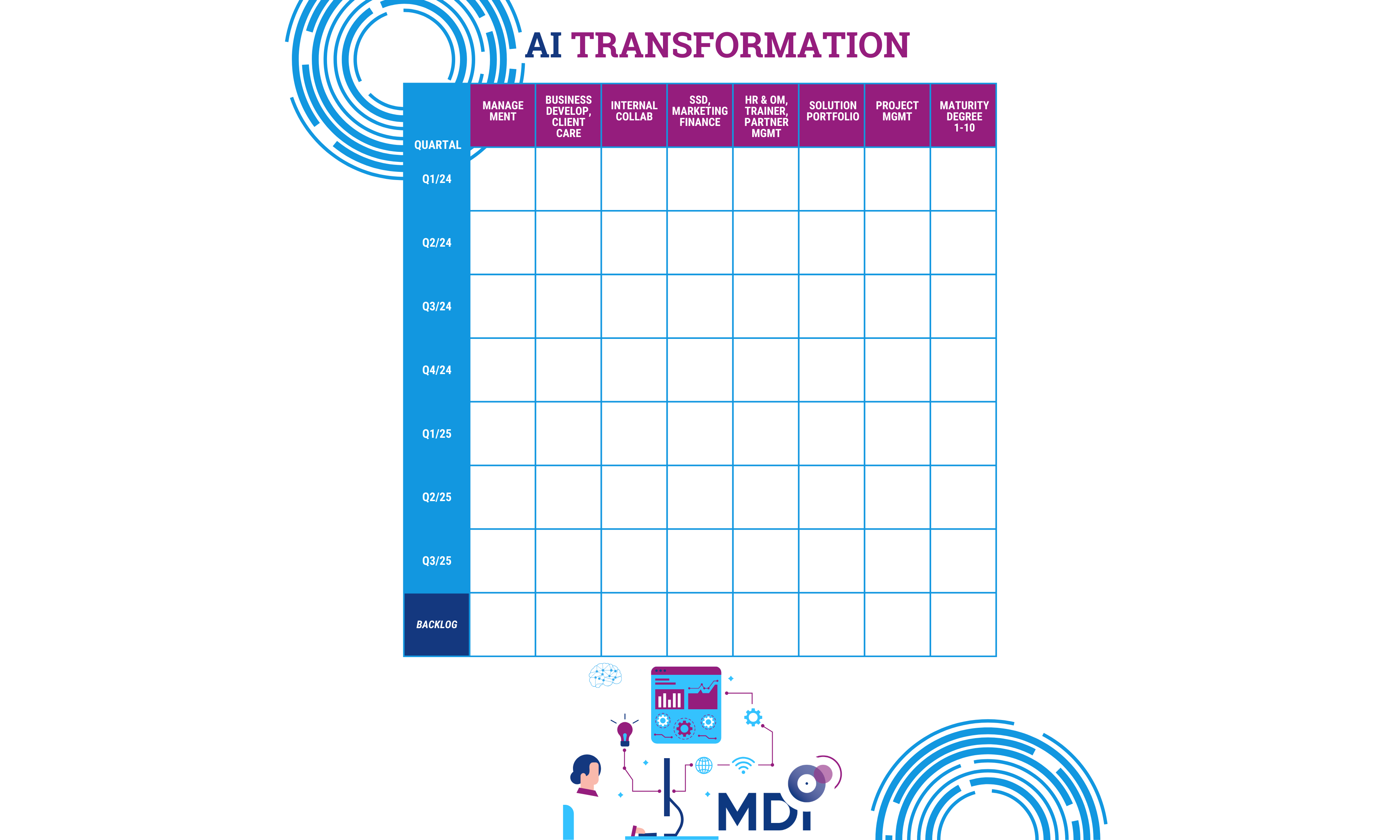
AI Transformation (1000 x 600 mm)

Agile approach – AI Autonomy Day

Organize an AI Autonomy Day: Provide everyone with a day a year to work on any topic in the field of AI. Provide as little guidance as possible. Also, provide a small budget for any licenses. It is important to note that, by the GDPR, no personal or company data should be transferred to unprotected LLMs.

Trying it out can happen individually, in a team, across departments/hierarchies/teams. Provide a communication platform and make it transparent which topics are being worked on. Set a date for presenting the results. Invite relevant stakeholders and decide together what will be done with the results. Repeat the process every six months or even every quarter.

To take it to a strategic level, we recommend setting up an AI transformation roadmap. This roadmap will track the progress and plans for each area. You can decide whether to share the roadmap with everyone individually or by team/area. The results and the maturity level of the project should be recorded by the company management.

This tool offers you the following advantages:

  • Clear vision and strategic direction
  • Improved communication and alignment with stakeholders
  • Controlled resource and time management
  • Risk reduction and adaptability
  • Focused innovation and development of use cases
  • Structured approach – a clear process gets the ball rolling

To find out what leverage AI can have in your company, you need to have a basic knowledge of AI and the (technical) possibilities of AI (weak AI vs reactive AI vs AI with limited storage capacity) . On the other hand, you need to know your processes very well. Those who already have a detailed process map have a clear advantage here.

As a first step, evaluate the AI potential based on your processes and divide your processes into three process types. Then evaluate the savings potential of the activity to determine your starting point with the greatest potential.



Weak AI vs. Reactive AI vs. AI With Limited Storage Capacity

Weak AI: performs tasks, does not learn new skills (voice assistants, generative AI: image generation, text generation, research & diagnosis)

Reactive AI: does not build up memory, reacts to stimuli (spam filters, recommendation systems based on historical data such as Netflix, Amazon)

AI with limited storage capacity: stores knowledge, learns from it and makes forecasts (weather, finance, self-driving cars, chatbots)

(Source: https://ki-campus.org/videos/ki-in-unserem-alltag?locale=de)

Further training & communication

To use the topic of AI profitably and responsibly for everyone in personal development, in the team, and the company, you cannot avoid acquiring a basic knowledge of AI yourself and motivating others to do the same.

Join communities, exchange ideas with peers, and take small steps. But take them consistently and lead by example. Support your colleagues and managers with training, workshops, exchanges, and networking opportunities. Create personalized wikis and AI assistants (e.g. using GPT Builder) to make knowledge more accessible.


Marina Begic

Marina Begic

Head of Business Development – Digital Transformation Driver

Marina has been working on new, effective learning methods and the future of corporate learning for over 15 years. In her current role, she is responsible for Digital Business Development at MDI, where her focus is not driven by the current buzzwords, but primarily on the feasibility of digital transformation for clients such as Erste Group, Lenzing, Semperit, Deutsche Bahn, Andritz AG, Uniqa, Mayr-Melnhof, Frequentis, RHIM. Her greatest strength is bringing loose ends together, which she impressively demonstrates time and time again with her big picture view and multi-dimensional approach. Her greatest passion is to provide learners not only with an experience, but also with real, lasting value for their real challenges.

  • LinkedIn

What serves you next?

How Do You Lead People Who Don’t Think the Way You Do?

by Zeca Ruiz | 4. February 2026 | Leadership Impact, Leadership Tips, Learning Transfer | 0 Comments

How Do You Lead People Who Don't Think the Way You Do? Do you want to listen to this article? Click here to access our AI-generated audio version!   How do you lead people who do not think the way you do? Leadership is a challenge, especially when you are not...
Read More

How You Deal With Neurodiversity as a Leader

by Iris Kandlbauer | 3. February 2026 | Leadership Impact, Leadership Tips, Short Knowledge Bits | 0 Comments

How You Deal With Neurodiversity as a Leader You prefer listening to this article? You can find our AI-generated audio version below! How You Deal With Neurodiversity as a Leader What might be behind “strange” behavior in a team—and how leaders can deal with it...
Read More

Generation Z isn’t the Problem but Our System is

by Zeca Ruiz | 3. December 2025 | Impuls series, International leadership development, Leadership in the digital transformation | 0 Comments

Generation Z Isn’t the Problem, but Our System is. Read this article on crossgenerational management by Zeca Ruiz to find out more!

Read More

The Lasting Impact of Leadership Horizon – Meike’s Perspectives

by Meike Hinnenberg | 2. July 2025 | Leadership Impact, MDI Inside, Short Knowledge Bits | 0 Comments

The Lasting Impact of Leadership Horizon - Meike's Perspectives Do you prefer to listen to this article? Click below to access our AI-generated audio version!The Lasting Impact of Leadership Horizon - Meike's Perspectives MDI’s Meike Hinnenberg shares her reflections...
Read More

Success Through Change: How to Stay Oriented During Transitions

by Anita Berger | 14. April 2025 | Impuls series, Leadership Impact, Leadership Tips | 0 Comments

Success Through Change: How to Stay Oriented During Transitions Do you prefer to listen to this article? Click below to access our AI-generated audio version:Success Through Change: How to Stay Oriented During Transitions Change processes often involve challenges....
Read More

4 Tips on How to Shape Change Processes as a Leader

by Anita Berger | 3. April 2025 | Impuls series, Leadership Impact, Leadership Tips | 0 Comments

4 Tips on How to Shape Change Processes as a Leader Do you prefer to listen to this article? Click below to access our AI-generated audio version:4 Tips on How to Shape Change Processes as a Leader Imagine a dynamic network of paths that is constantly changing. While...
Read More

Successful Team Building for Boehringer Ingelheim RCV

by Anita Berger | 29. March 2024 | Customer Story, International leadership development, MDI Inside | 0 Comments

Successful Team Building for Boehringer Ingelheim RCV Do you prefer to listen to this article? Click below to access our AI-generated audio version:Successful Team Building for Boehringer Ingelheim RCV In the interview with our MDI trainer and partner, Anita Berger On...
Read More

Organize Your Team in a Hybrid Workplace

by Peter Grabuschnig | 14. March 2024 | Impuls series, International leadership development, Leadership in the digital transformation | 0 Comments

Organize Your Team in a Hybrid Workplace Prefer to listen to the article? Click below to access our AI speech-generated audio. However, if you want to read it as usual, keep scrolling.Organize Your Team in a Hybrid Workplace In his new Rise Course, our MDI trainer and...
Read More

Exploring the Influence of AI on Leadership Roles – an experiment by a CEO

by Gunther Fürstberger | 14. November 2023 | International leadership development, Leadership and AI, Leadership in the digital transformation | 0 Comments

Exploring the Influence of AI on Leadership Roles: Learn more about the ongoing ChatGPT experiment by MDI CEO Gunther Fürstberger Do you prefer to listen to this article? Click below to access our AI-generated version. Exploring the Influence of AI on Leadership...
Read More

AI as a Co-Trainer in Leadership Development

by Gunther Fürstberger | 14. November 2023 | Impuls series, International leadership development, Leadership and AI | 0 Comments

Artificial Intelligence as a Co-Trainer in Leadership Development Do you prefer to listen to this blog article? Click below to access our AI-generated version. Artificial Intelligence as a Co-Trainer in Leadership Development In a world that is constantly evolving, we...
Read More
The ARS Seminar: Lateral Leadership and AI Role-Playing

The ARS Seminar: Lateral Leadership and AI Role-Playing

by Gunther Fürstberger | Aug 23, 2024 | Digital Transformation, Leadership in the digital transformation, MDI Inside | 0 comments

The ARS Seminar: Lateral Leadership and AI Role-Playing

Immerse yourself in the world of lateral leadership with us and experience realistic role-playing with state-of-the-art AI technology! These methods bring a breath of fresh air to the world of leadership development and show how modern approaches can be successfully applied in practice.

Role-playing in Training

Role-plays have been used in communication training for decades to try out real-life challenges in a safe environment and develop skills. These usually take place either with voluntary participants in front of the group or several groups in parallel.

In the first case, the trainer can give direct feedback, in the second case more participants have the opportunity to practice. Not everyone loves role-playing, but overall it is an effective method for developing social skills.

However, the method also has disadvantages that can now be overcome by artificial intelligence: Trainers or even professional actresses don’t work for free. Training and application dates may be far apart, and by then much will have been forgotten.

Role-playing in training

Large Language Models

With the help of LLMs (Large Language Models), on the other hand, it is possible to train as often as required at a fraction of the cost shortly before real-life use. The ChatGPT 4.0 app offers well-functioning language input and output and can access extensive knowledge, such as the DISG model or the Harvard Principles of Negotiation.

Some trainers at MDI have been experimenting with it for a year now, and the participants are enthusiastic. We demonstrate a role play in front of the group, involve several participants, and then pass on the prompt used for self-practice.

AI in Various Management Systems

We have further developed the prompts so that the feedback from the AI is precisely aligned with the models taught in the seminar. In addition, the resistance intensity of the AI role-play partner has been optimized.

Anyone who would like to experience this in reality will have the opportunity to do so in the ARS seminar “Lateral Leadership” from 22.10. to 23.10. Further exciting role-playing functions are currently being developed.

Mag. Gunther Fürstberger

Mag. Gunther Fürstberger

CEO | MDI Management Development International

Gunther Fürstberger is a management trainer, author and CEO of Metaforum and MDI – a global consulting company providing solutions for leadership development. His main interest is to make the world a better place through excellent leadership. He has worked for clients including ABB, Abbvie, Boehringer Ingelheim, DHL, Hornbach, PWC and Swarovski. His core competence is leadership in digital transformation. He gained his own leadership experience as HR Manager of McDonald’s Central Europe/Central Asia.  At the age of 20 he already started working as a trainer.

  • LinkedIn

Download our International Whitepaper:


What serves you next?

AI Ethics for Leaders: Why Context and Critical Thinking Matter More Than Ever

by Meike Hinnenberg | 11. March 2026 | Impuls series, Leadership and AI, Learning Transfer | 0 Comments

AI Ethics for Leaders: Why Context and Critical Thinking Matter More Than Ever. Meike’s Reflections on Artificial Intelligence Do you prefer to listen to this article? Click below to access our AI-generated audio version!AI Ethics for Leaders: Why Context and Critical...
Read More

A Success Story – When AI Sharpens Human Judgement

by Claude MacDonald, Rafael Ungvari | 6. March 2026 | Customer Story, Digital Transformation, Leadership and AI | 0 Comments

A Success Story – When AI Sharpens Human Judgement Do you prefer to listen to this article? Click here to access our AI-generated audio version! When AI Amplifies Human Judgment: A Customer Success Story About This Project At MDI, we believe that great leadership and...
Read More

How Do You Lead People Who Don’t Think the Way You Do?

by Zeca Ruiz | 4. February 2026 | Leadership Impact, Leadership Tips, Learning Transfer | 0 Comments

How Do You Lead People Who Don't Think the Way You Do? Do you want to listen to this article? Click here to access our AI-generated audio version!   How do you lead people who do not think the way you do? Leadership is a challenge, especially when you are not...
Read More

How You Deal With Neurodiversity as a Leader

by Iris Kandlbauer | 3. February 2026 | Leadership Impact, Leadership Tips, Short Knowledge Bits | 0 Comments

How You Deal With Neurodiversity as a Leader You prefer listening to this article? You can find our AI-generated audio version below! How You Deal With Neurodiversity as a Leader What might be behind “strange” behavior in a team—and how leaders can deal with it...
Read More

Anita’s Key to Success for International Cooperation

by Jana Wölfl | 3. February 2026 | Leadership and AI, Leadership Tips, MDI Spotlight Series | 0 Comments

Anita's Key to Success for International Cooperation This blog is an excerpt from our new podcast! You can find the entire podcast episode here. Anita's Key to Success for International Cooperation In our new video podcast format, “Voices of Leadership – an MDI...
Read More

Fostering True Workplace Commitment

by Marcin Swierkocki | 14. January 2026 | Leadership Tips, Learning Transfer, Short Knowledge Bits | 0 Comments

Fostering True Workplace Commitment Do you prefer to listen to this article? Click below to access our AI-generated audio version! Fostering True Workplace Commitment Throughout my years of practice, I've found that deep workplace commitment is achieved not through...
Read More

Marcin Swierkocki on the Full Range Leadership Model

by Jana Wölfl | 19. December 2025 | Leadership and AI, Leadership Tips, MDI Spotlight Series | 0 Comments

Marcin Swierkocki on the Full Range Leadership Model This blog is an excerpt from our new podcast! You can find the entire podcast episode here. Marcin Swierkocki on the Full Range Leadership Model In the newest episode of our podcast “Voices of Leadership | An MDI...
Read More

Self-Efficacy in Change: Why It Matters

by Anita Berger | 17. December 2025 | Leadership Tips, Learning Transfer, Short Knowledge Bits | 0 Comments

Why It Matters When Transformation Gets Hard Do you prefer to listen to this article? Click below to access our AI-generated audio version:Self-Efficacy: Why It Matters When Transformation Gets Hard Change can be exhausting.Especially when things are unclear,...
Read More

Generation Z isn’t the Problem but Our System is

by Zeca Ruiz | 3. December 2025 | Impuls series, International leadership development, Leadership in the digital transformation | 0 Comments

Generation Z Isn’t the Problem, but Our System is. Read this article on crossgenerational management by Zeca Ruiz to find out more!

Read More

From Lab to Practice: What We Learned With AI

by Rafael Ungvari | 3. September 2025 | Digital Transformation, Leadership and AI, Short Knowledge Bits | 0 Comments

From Lab to Practice: What We Learned With AI Do you prefer to listen to this article? Click here to access our AI-generated audio version! From Lab to Practice: What We Learned With AI AI in organizations isn’t a one-size-fits-all solution. And in people development,...
Read More
How to Increase Performance in a Hybrid Set-Up

How to Increase Performance in a Hybrid Set-Up

by Peter Grabuschnig | Mar 14, 2024 | Digital Transformation, eLearning, Leadership Tips | 0 comments

How to Increase Performance in a Hybrid Set-Up

Prefer to listen to the article? Click below to access our AI speech-generated audio. However, if you want to read it as usual, keep scrolling.

How to Increase Performance in a Hybrid Set-Up

Is sitting 8 hours in the office productive? At the moment we are getting paid for the time spent at work. In the future, however, and this is something we already realize, the results will matter more than the time spent to achieve them.

In his new Rise Course, our MDI trainer and partner Peter Grabuschnig shares all his knowledge on Hybrid Leadership.

It offers a reflective look at your leadership behavior in times of new work, work location, and increasing flexibility. In this blog article, he will introduce you to the third pillar of the 3P model – Performance and explain how you can improve the performance of your team.

Time Spent vs Results Delivered

Working a lot of overtime and the associated assumption of hardworking employees is becoming increasingly outdated. Just because someone sits in front of a screen for 8 hours, doesn’t necessarily mean that they are also productive and efficient.

In many areas of our work, we have ready-defined clear factors that show us whether someone is performing. This is especially true in jobs that can be measured through numbers. There, we have personal Key Performance Indicators (KPIs) and targets that you have to achieve.

In some positions, however, measuring performance is not so simple. In this case, it is necessary to define the KPIs, measures, and goals together which are used to measure whether one has been productive or successful. What we can see is a shift from Time Spent to Results Delivered.

Debunking Hybrid Leadership Assumptions

One of my clients had the most productive year in its history after introducing hybrid work. This is largely due to the employees working more productively at home. In the beginning, the assumption was that people would be too distracted in the home office or that they would need more motivation than usual.

However, this assumption was quickly disproven. In some cases, even the opposite was true. Due to the social interactions in the office, most employees do not get to 8 hours of focused and productive work per day.

Now, if individuals finish the same work faster at the home office than in the office, they effectively save themselves several hours in their days.

Beyond the Horizon: GenAI and Ethical Leadership

The Future Leader

Companies will have to think about how to deal with this in the future. After all, you are paid for the time spent working and not for the results you deliver. In the future, the focus per performance measurement will be more on the results and less on the working hours.

This means that as leaders, we will have to think about how and what goals we define with our employees. What work packages do we put together? How do we ultimately evaluate and measure performance?

Trust in Hybrid Leadership

Trust also becomes very important, as well as self-organization. Some people are better at this, while others struggle. If you think about your team, you will probably immediately think of people you know who do a good job at home and who you trust.

On the other hand, there are probably some people you are not 100% sure about, right? Now you can of course try to insist on presence in the office with those employees you don’t trust very much. But whether that makes things better is another question.

Because even in the office you can’t know if they are working productively or just killing time. Performance is not necessarily dependent on where you work, but rather on what goals you set and how you track and measure the results.

If you are not sure what performance to measure in your employees, discuss it with them. Work out together what makes sense and how they can show you as a leader that they are actively contributing to the results.

Being Transparent as a Leader

Transparency plays a particularly important role here. The classical micromanager who follows his employees’ every move will have a very difficult time in the hybrid system. On the other hand, too little supervision is also a disadvantage since you should know what your employees are doing all day.

Try to create a balance. Instead of constantly having to ask whether something has been done, first define for yourself what information you actually need and then make a plan with your team on how to get it.

This can happen through a stand-up, a Jour-Fix, but also asynchronously. It is only important that you make it clear to your employees that this is not about checking on them in a narrower sense, but also about their performance and them being seen and noticed.

Think about how you currently measure the performance of your employees. Is it mainly hard factors (numbers, data, facts,…) or is it also soft factors on an interpersonal level?

On a scale from 1 to 10, how satisfied are you per employee with the performance evaluation? Note: this does not mean the performance itself. Perhaps you have a personal proximity bias that rates the performance of certain employees higher or lower?

We hope you have enjoyed this snippet from Peter’s Rise course! You can contact us if you are interested in this course or follow along on our blog, where we will share other content of the course as well.

Click Here to Contact us
Peter Grabuschnig

Peter Grabuschnig

Trainer, Coach & MDI Partner

Peter is a partner and trainer at MDI, advising major international corporations on implementing hybrid work policies and building a hybrid work and leadership culture.

He is considered an expert in training design. With his Webinar Guru Framework he has developed a tool that helps to design training content for successful and activating virtual learning.

  • LinkedIn

Get a glimpse into the elearning:

« Older Entries

Information

  • Imprint
  • MDI company website

Social Media

  • Facebook
  • Twitter
  • Youtube
  • LinkedIn

© MDI Management Development Institute, 2020