
• MDI
  • German version
  • Contact us
MDI Management Development
  • Agile leadership
  • Lateral Leadership
  • Leadership Impact
  • Leadership Development
Select Page
Leadership in Transition: Insights from Leadership Horizon 2024

Leadership in Transition: Insights from Leadership Horizon 2024

by Christoph Wirl | Jul 4, 2024 | Leadership and AI, Leadership Tips, MDI Inside | 0 comments

Photo credits: Jenny Theolin


Leadership in Transition: Insights from Leadership Horizon 2024

This was our Leadership Horizon Conference of 2024! Click here and immerse yourself in the Highlights.

Leadership in transition: Insights from Leadership Horizon 2024

Here you can find the original report by magazine training editor Christoph Wirl: 

A guide to the most effective strategies for integrating artificial intelligence – We report on the Leadership Horizon conference.

MDI’s Leadership Horizon Conference retook place this year on June 4 at SO/Vienna and was dedicated to the increasing fusion of leadership practices and Artificial Intelligence (AI). It served as a platform for the exchange of practical findings and strategies for integrating AI into management processes.

Around 160 HR experts and managers from various industries came together to share their experiences and visions. The event was English-language and hybrid, allowing international participants to attend both online and in person.

The impressive line-up of speakers was consistently compelling. The event offered a successful mix of inspiring keynotes, practice-oriented workshops, and insightful business cases.

The two sides of the AI coin

CEO Gunther Fürstberger opened the conference with a virtual avatar, created with the HeyGen program’s help, and looked very similar to the real speaker. He spoke about the importance of artificial intelligence for both companies and managers.

He showed both sides of the coin: For example, many people have already been killed through the use of AI-controlled drones in war zones. At the same time, however, the use of artificial intelligence in medicine has already saved the lives of millions of people or significantly improved their health.

AI therefore has a clear impact on our society, which is why we need to develop and use this technology responsibly. We need to harness the potential of AI for the benefit of humanity while carefully weighing up the potential risks and ethical challenges.
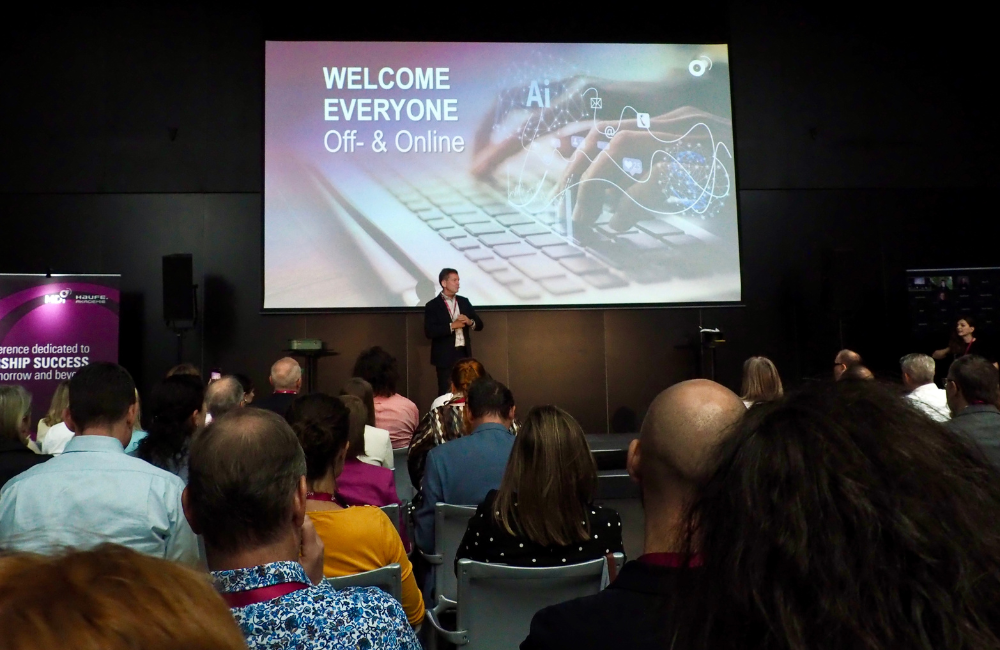
Photocredits: Jenny Theolin

AI is not magic

When the conference moderators asked the audience who was not yet sufficiently familiar with the topic of artificial intelligence, more than half of the attendees responded. This just goes to show that we need to engage more with this forward-looking topic.

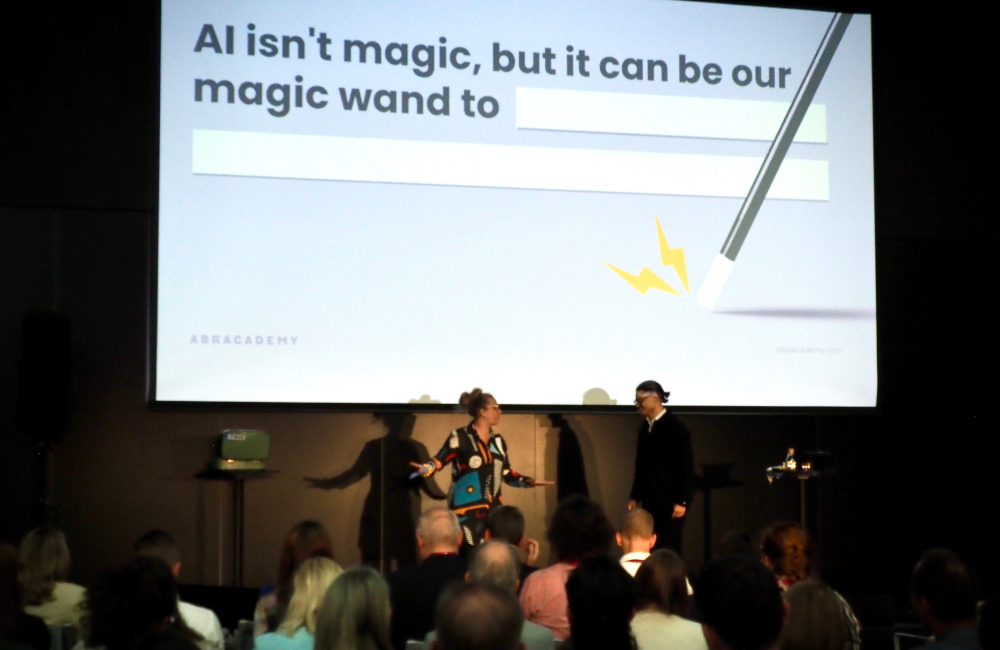
Afterward, magician Tobias Grünfelder from the Abracademy fascinated the participants and drew parallels between the art of magic and artificial intelligence:

“AI is not magic – we just need to look behind the scenes. Just as professional magicians do not rely on a single trick, we should also take a holistic approach to the application of artificial intelligence. It is not enough to see AI as some kind of magic bullet that solves all problems by itself. Instead, it is important to understand the underlying mechanisms and functioning of AI systems to be able to use them effectively and responsibly.”

AI-powered leadership

Johannes von Mikulicz-Radecki also emphasized the complexity of using AI in leadership in his presentation “AI-Powered Leadership”:

“The time when you could experiment with AI and try out different use cases is over. Now it’s about putting what you’ve learned into practice.”

This requires managers to clearly understand the possibilities and limitations of artificial intelligence and the ability to strategically integrate this technology into their business processes. In addition, von Mikulicz-Radecki emphasized the general relevance of AI tools in companies:

“Artificial intelligence is too important to be left only to management.”
Photocredits: Jenny Theolin

An insight into UNIQA’s AI strategies

Later, keynote speaker Cristina Anculescu showed how UNIQA has optimized the employee experience with the help of AI tools. She reported that 47% of Gen Z employees surveyed said they received better career advice from AI than from their managers. For example, some upload their LinkedIn profile to ChatGPT and ask for suggestions for improvement.

In response, UNIQA has used AI to develop and promote individual career paths for its employees. Intelligent algorithms are used to create individual development plans. These are based on the strengths, interests, and goals of individual employees.

The downside of flexible home office arrangements

After the lunch break, renowned expert and speaker Ryan Jenkins was connected live from the USA. The technical implementation went smoothly so that both the participants on-site and the online participants were able to follow his presentation without any problems. He addressed the importance of interpersonal connections within a company:

“When employees feel isolated, they are up to seven times more likely to work inefficiently.”

He noted that due to excessive use of our smartphones and online media, we are often unable to build and maintain relationships with our colleagues. In this day and age, people are more independent of each other than ever before, making it harder to make and maintain connections. Jenkins therefore warned that the often overly flexible home office regulations should be critically scrutinized.
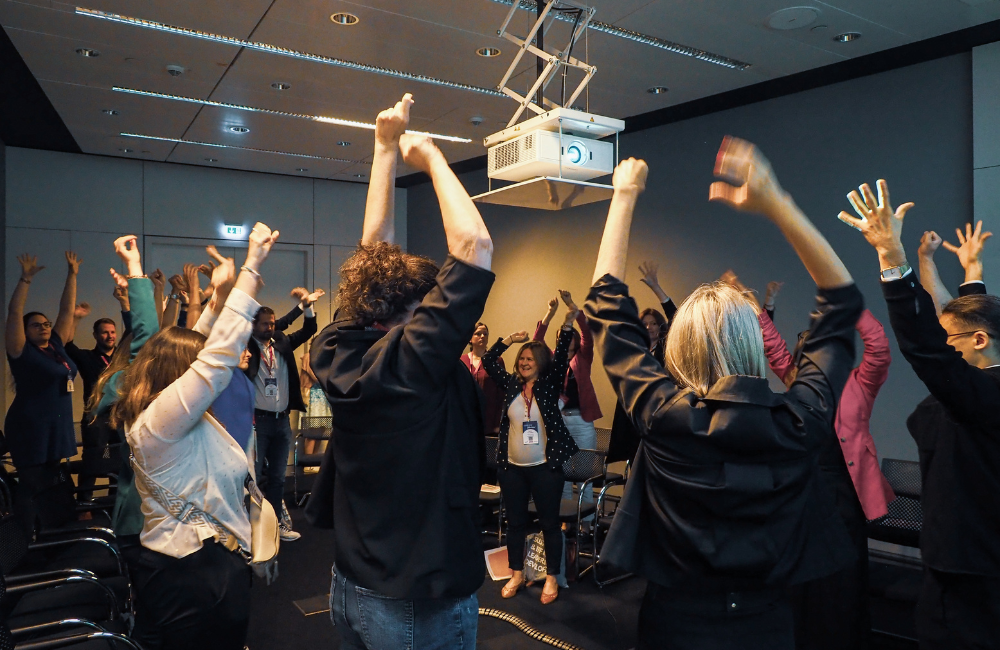
Photo credits: Jenny Theolin

Dangers and fears around AI

Rebecca Johnson presented the possibility of learning using AI avatars and introduced a specific tool that enables particularly effective practice of negotiation skills.

In her final presentation, Bailey Parnell tried to allay the audience’s fears of artificial intelligence. She explained basic concepts such as machine learning and deep learning and introduced various AI tools, including Canva, Suno, Copilot, and image generation software.

She also addressed the potential dangers of AI and discussed possible job losses due to automation, the loss of privacy and the problem of bias in AI systems.

Conclusion on Leadership in Transition: Insights from Leadership Horizon 2024

The Leadership Horizon Conference 2024 once again proved to be a great event for executives who want to integrate AI into their corporate strategies. It provided valuable insights into current trends and inspired thinking about the future role of technology in leadership.

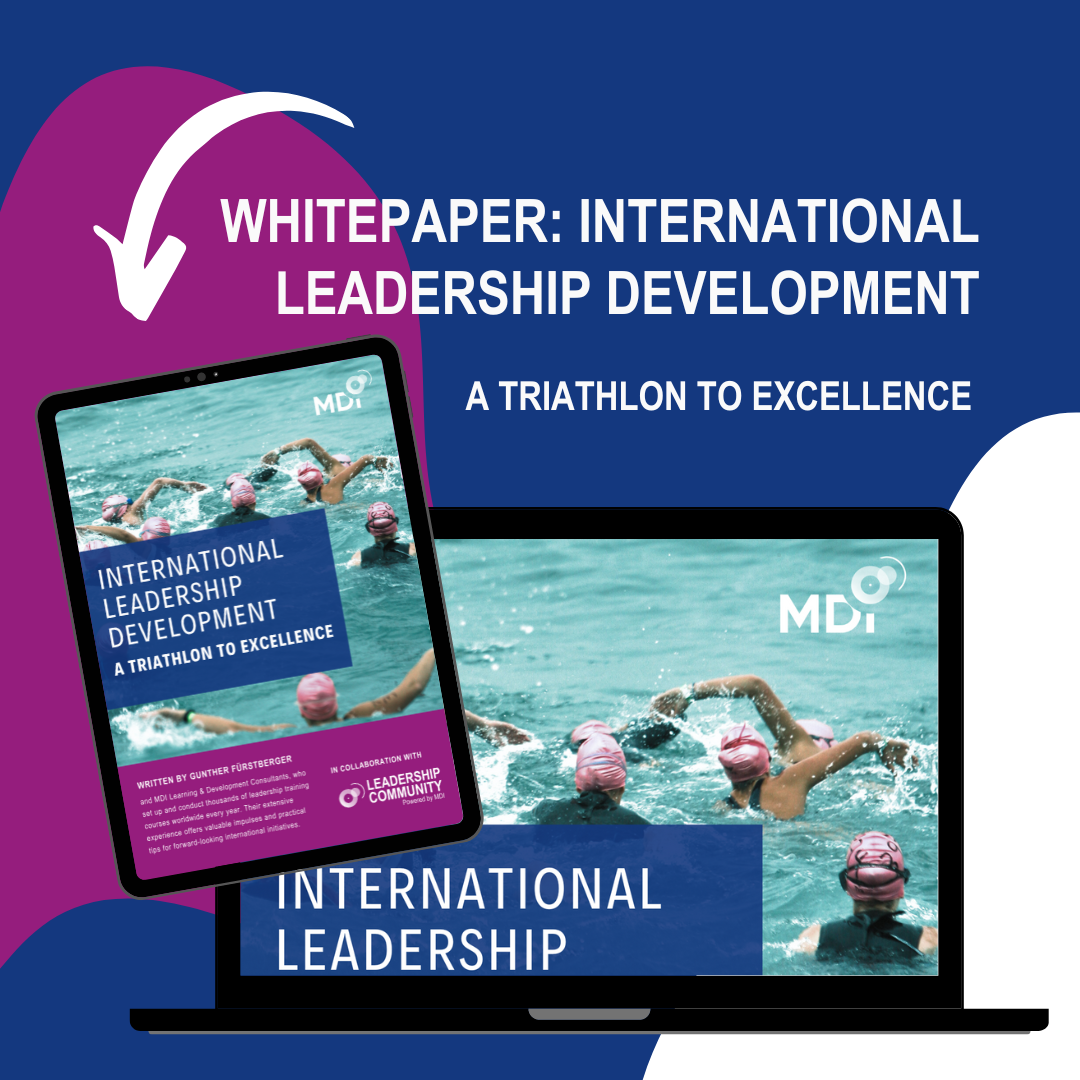
Download our International Whitepaper:
 

What serves you next?

What If AI Doesn’t Replace Us — But Drowns Us Out?

by Martin Maglia | 24. June 2026 | Digital Transformation, Leadership and AI, Short Knowledge Bits | 0 Comments

What If AI Doesn't Replace Us — But Drowns Us Out? Over the weekend, I watched a thought-provoking video from Rick Beato. (You can find the link at the end of this article.) For those who don't know him: Rick Beato is a musician, producer, educator, guitarist, and one...
Read More

Use It or Lose It: How AI and Digital Tools May Be Changing Our Brains

by Florian Biedermann | 26. May 2026 | Leadership and AI, Leadership Tips, Learning Transfer | 0 Comments

Use It or Lose It: How AI and Digital Tools May Be Changing Our Brains You travel to Madrid and want to chat with the locals, but you realize that after five years without practice, your rudimentary Spanish skills are now practically nonexistent and you even struggle...
Read More

How Artificial Intelligence Shapes Who We Become

by Meike Hinnenberg | 19. May 2026 | Impuls series, Leadership and AI, Leadership in the digital transformation | 0 Comments

How Artificial Intelligence Shapes Who We Become Meike’s Reflections on Artificial Intelligence Do you prefer to listen to this article? Click below to access our AI-generated audio version!How Artificial Intelligence Shapes Who We Become Meike’s Reflections on...
Read More

Zeca Ruiz on Cross-Generational Leadership and Navigating Change

by Jana Wölfl | 13. May 2026 | Leadership Impact, MDI Spotlight Series, Training Insights | 0 Comments

Zeca Ruiz on Cross-Generational Leadership and Navigating Change This blog is an excerpt from our new podcast! You can find the entire podcast episode here. Zeca Ruiz on Cross-Generational Leadership and Navigating Change In the fourth episode of our podcast “Voices...
Read More

AI-Empowered Leadership: 6 Guiding Principles

by Gunther Fürstberger | 14. April 2026 | Leadership and AI, Leadership Tips, MDI Whitepaper | 0 Comments

AI-Empowered Leadership: 6 Guiding Principles This blog post is a detailed summary of the whitepaper "Guiding Principles of AI-Empowered Leadership" by MDI's CEO, Gunther Fürstberger. You can find the full whitepaper here! Let's be honest: most conversations about AI...
Read More

What AI Shows You — and What It Doesn’t

by Meike Hinnenberg | 1. April 2026 | Digital Transformation, Impuls series, Leadership and AI | 0 Comments

What AI Shows You — and What It Doesn't Meike’s Reflections on Artificial Intelligence Do you prefer to listen to this article? Click below to access our AI-generated audio version! What AI Shows You — and What It Doesn't Meike’s Reflections on Artificial Intelligence...
Read More

Leading in the Age of AI: How AI Discourse Shapes Responsibility and Power

by Meike Hinnenberg | 18. March 2026 | Impuls series, Leadership and AI, Leadership Tips | 0 Comments

Leading in the Age of AI: How AI Discourse Shapes Responsibility and Power Meike’s Reflections on Artificial Intelligence Do you prefer to listen to this article? Click below to access our AI-generated audio version!Leading in the Age of AI: How AI Discourse Shapes...
Read More

AI Ethics for Leaders: Why Context and Critical Thinking Matter More Than Ever

by Meike Hinnenberg | 11. March 2026 | Impuls series, Leadership and AI, Learning Transfer | 0 Comments

AI Ethics for Leaders: Why Context and Critical Thinking Matter More Than Ever. Meike’s Reflections on Artificial Intelligence Do you prefer to listen to this article? Click below to access our AI-generated audio version!AI Ethics for Leaders: Why Context and Critical...
Read More

A Success Story – When AI Sharpens Human Judgement

by Claude MacDonald, Rafael Ungvari | 6. March 2026 | Customer Story, Digital Transformation, Leadership and AI | 0 Comments

A Success Story – When AI Sharpens Human Judgement Do you prefer to listen to this article? Click here to access our AI-generated audio version! When AI Amplifies Human Judgment: A Customer Success Story About This Project At MDI, we believe that great leadership and...
Read More

How Do You Lead People Who Don’t Think the Way You Do?

by Zeca Ruiz | 4. February 2026 | Leadership Impact, Leadership Tips, Learning Transfer | 0 Comments

How Do You Lead People Who Don't Think the Way You Do? Do you want to listen to this article? Click here to access our AI-generated audio version!   How do you lead people who do not think the way you do? Leadership is a challenge, especially when you are not...
Read More
Purpose – Why Hybrid is more than a Buzzword

Purpose – Why Hybrid is more than a Buzzword

by Peter Grabuschnig | Mar 14, 2024 | Impuls series, Leadership Tips, Learning Transfer | 0 comments

Purpose – Why Hybrid is more than a Buzzword

Prefer to listen to the article? Click below to access our AI speech-generated audio. However, if you want to read it as usual, keep scrolling.

Purpose – Why Hybrid is more than a Buzzword

Is hybrid just a new trend? And what do different life realities of our employees have to do with it? In his new Rise Course, our MDI trainer and partner Peter Grabuschnig shares all his knowledge on Hybrid Leadership.

It offers a reflective look at your leadership behavior in times of new work, work location, and increasing flexibility. In this blog article, we will introduce you to the first pillar of the 3P model – Purpose. Enjoy reading!

What does hybrid even mean?

Even though the word hybrid can have different meanings in different contexts, one thing is clear – Hybrid is a mixture of two or more components. When we refer to Hybrid, we mean a combination of different workplaces, such as the office, the home office, or even abroad.

However, if we are honest, hybrid is still not perfect. That’s why I recommend considering how to enable more flexibility for employees in the future.

So who and what does this hybrid lifestyle have an impact on?

1. Ourselves:

In many companies you can now decide for yourself whether to work from home or at the office. This has significantly increased our flexibility.

2. The team:

Simply talking to our colleagues or going for a quick coffee break is not as easy as it used to be. Also, when planning office times, it is more likely to exclude others by forming groups or avoiding certain colleagues.

3. Leadership:

This goes far beyond the team level. It requires transparent communication, clear goals, and a strong commitment to the company. Maintaining performance and much more is expected of you as a leader.

4. Company:

Many companies are already considering what hybrid means for them and what benefits they can derive from it. One international client I advised even had the most productive year after the change to a hybrid setup.

Another customer decided to reduce the number of office buildings to 60%. The latter, however, is not a sustainable solution as there are days on which more people will want to go to the office.

An Appeal for better leaders

Why should I as a leader care about leading a hybrid team?

Around 45% of the global workforce, at least according to McKinsey, can do hybrid work. Whether we like it or not, for these 45% the newly gained flexibility plays an enormous role in balancing work and life.

Hybrid is also exciting from an evolutionary point of view – we went through the agricultural era, the age of industrialization, and the labor movement. Today, our computers and smartphones dictate when and where we work.

By deciding where we work, we are now able to balance our work and personal lives much better. Not only that, it has also improved other aspects:

1. Technology:

We had to learn how to use new technologies and things are now working that we couldn’t have thought possible a few years ago. For example, taking part in an online workshop with the whole team from home.

From a technical point of view, a lot has developed in the last few years. Some new technologies such as VR will digitalize our collaboration even further in the future. It would, for example, make it possible to meet in a virtual room in 3D instead of just looking at your laptop in two dimensions.

Other developments such as AI or augmented reality are also revolutionizing the way we collaborate remotely.

2. Employees:

We can no longer avoid a hybrid setup – that is mainly because our employees have demanded it and even threatened to quit if they can’t work in a flexible environment.

So to be an attractive employer today, you need to think carefully about what you need your employees to do in the office, where flexibility makes sense, and what you can offer them.

Let’s now take a closer look at the individual life realities of our team members…

People have different expectations and life concepts, their job has to suit them. If it doesn’t fit, you look for another job. The fact that many aspects of our work can be taken over by machines gives us more freedom to create.

The classical performance-based society which encourages a lot of overtime and focuses on presence is becoming increasingly outdated.

A Microsoft study has shown the situation regarding hybrid working among employees and their individual preferences. Two out of 10 respondents would like to work exclusively from the office. This can be due to a variety of reasons, such as feeling lonely at home.

Surprisingly, 3 out of 10 don’t want to go back to the office at all. This could be due to care obligations, for example. Half of the respondents want a combination. Some prefer one home office day per week, while others would like to have more. These figures give us an idea of how many different life realities we as leaders now have to juggle.

Hybride Arbeit

The one-size-fits-all approach is no longer possible and there is no uniform solution that satisfies everyone. We have to respond individually to each employee and develop a suitable solution for the whole team.

The work environment has changed considerably, but the requirements for leadership have remained the same. Employees still expect recognition, fairness, open and transparent communication, a motivating work environment in which they can develop, and flexibility to balance life and work.

The leadership priorities have shifted. For example, in the hybrid daily routine, much more attention needs to be paid to communication, so that everyone knows everything they need to know.

What has changed is not the content but the context in which we work. Thus, we need to adapt our systems and behavior to the context to be successful.

I would like to give you one more piece of food for thought. I would like to invite you to take a retrospective look at the last 6 months of your work.

  • What experiences have you had in terms of hybrid working? What has (not) worked well?
  • What were/what are your challenges?
  • What challenges will your team face in the future? What would you like to develop or continue from what you have already experienced and tried out?

You can do this task individually, with a colleague, or even in a small workshop with your whole team.

We hope you have enjoyed this snippet from Peter’s Rise course! You can contact us if you are interested in this course or follow along on our blog, where we will share other content of the course as well.

Click Here to Contact us
Peter Grabuschnig

Peter Grabuschnig

Trainer, Coach & MDI Partner

Peter is a partner and trainer at MDI, advising major international corporations on implementing hybrid work policies and building a hybrid work and leadership culture.

He is considered an expert in training design. With his Webinar Guru Framework he has developed a tool that helps to design training content for successful and activating virtual learning.

  • LinkedIn

Get a glimpse into the elearning:

Organize Your Team in a Hybrid Workplace

Organize Your Team in a Hybrid Workplace

by Peter Grabuschnig | Mar 14, 2024 | Impuls series, International leadership development, Leadership in the digital transformation | 0 comments

Organize Your Team in a Hybrid Workplace

Prefer to listen to the article? Click below to access our AI speech-generated audio. However, if you want to read it as usual, keep scrolling.

Organize Your Team in a Hybrid Workplace

In his new Rise Course, our MDI trainer and partner Peter Grabuschnig shares all his knowledge on Hybrid Leadership.

It offers a reflective look at your leadership behavior in times of new work, work location, and increasing flexibility. In this blog article, he will introduce you to the second pillar of the 3P model – People.

Peter will present you with a few questions regarding People and hybrid work that you can reflect on to improve as a leader. Enjoy reading!

Organization Pre-Considerations

What can you as a leader do to adapt with your team to the realities of hybrid work? I would recommend that you first analyze the current situation of your team. You can answer the following questions:

  • How is your team currently structured?
  • Who are the team members?
  • What work areas are there in the team?
  • How would you describe the team in regards to belonging, knowledge levels, motivation, loyalty,…
  • How do you function as a team? What’s going well and what is going not well?
  • How well do you support each other?
  • What tasks do you handle together as a team?
  • What work is currently done in the office or the home office?
  • What work do you think needs to be done in the office?
  • Who is open to change and who is more skeptical about hybrid leadership?

This will give you an overview of where you currently stand. Continue with the other steps when you’re done with your analysis.

Expectations

As a second step, I want you to think about your expectations. Ask yourself questions such as:

  • What do your employees expect from you and vice versa when it comes to hybrid work?
  • What objections can arise or have already arisen?
  • What advantages have resulted for the team from hybrid working?
  • What are your go’s and no-go’s?

The clearer you are about what you want to expect from your team, the better you can communicate your expectations and achieve your goals.

Organize Your Team in a Hybrid Workplace

General Collaboration Setup

Lastly, we look at the General Collaboration Setup. Deal with the following issues:

  • What formal and informal rules are there?
  • Are they all known, intentional, and communicated? (For example, is an employee allowed to go to the supermarket in the afternoon? Or can a father come to the office later because his child is sick?)

These questions show us some of the things that should be clarified. In a hybrid setup, there needs to be much more communication and coordination on things that may never have been an issue in a normal office routine.

Hybrid working also means that there are new tasks and responsibilities, at least in some teams. As a leader, do you sometimes feel like you have to take care of everything on your own? This can quickly become overwhelming.

Think about this:

  • Are there new or changed tasks or responsibilities? Is there someone in the team who can take on this task or perhaps even wants to do it? By delegating smartly, you will save yourself some time. This includes how we organize our work.
  • What processes already exist and are these suitable for hybrid working? Check that those processes that have been changed are working well.

The final area that we will cover in this section is legal frameworks. Our laws are still made for our industrially driven system and as we know, new laws take time. As attractive as it may sound, not every company can offer its employees third-place-working, for example.

This has to do with country-specific labor laws. The country you work in also has insurance and tax implications. Before promising any freedom, you should take a close look at the legal situation and also keep a good eye on it to react quickly in case of any changes.

We hope you have enjoyed this snippet from Peter’s Rise course! You can contact us if you are interested in this course or follow along on our blog, where we will share other content of the course as well.

Click Here to Contact us
Peter Grabuschnig

Peter Grabuschnig

Trainer, Coach & MDI Partner

Peter is a partner and trainer at MDI, advising major international corporations on implementing hybrid work policies and building a hybrid work and leadership culture.

He is considered an expert in training design. With his Webinar Guru Framework he has developed a tool that helps to design training content for successful and activating virtual learning.

  • LinkedIn

Get a glimpse into the elearning:

Changing the World with Hybrid Leadership

Changing the World with Hybrid Leadership

by Peter Grabuschnig | Mar 14, 2024 | eLearning, Impuls series, Leadership Tips | 0 comments

Changing the World with Hybrid Leadership

Prefer to listen to the article? Click below to access our AI speech-generated audio. However, if you want to read it as usual, keep scrolling.

Changing the World with Hybrid Leadership

In his new Rise Course, our trainer and partner Peter Grabuschnig shares all his knowledge on Hybrid Leadership. It offers a reflective look at your leadership behavior in times of new work, work location, and increasing flexibility.

In this blog article, we will introduce you to the overall course and give you a few basic concepts that will be dealt with. Enjoy reading!

The Three Ps

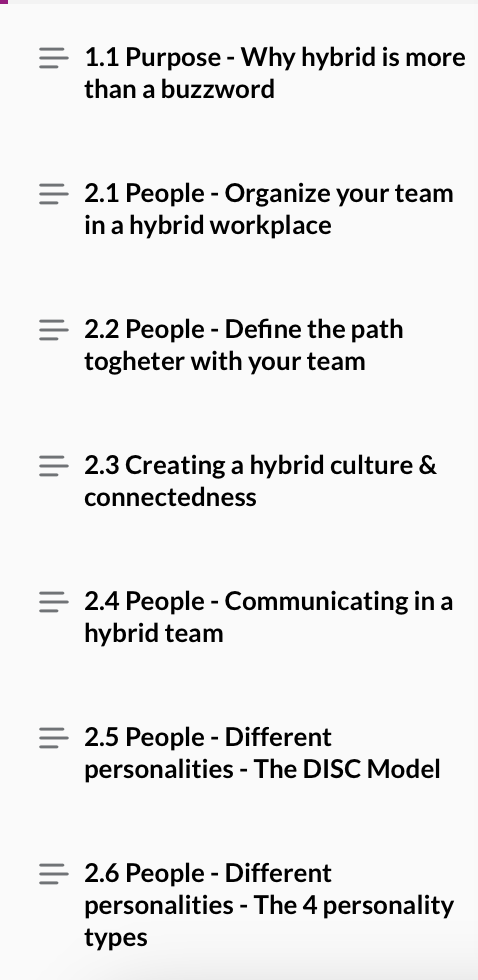
The topic is explored from three different angles: the Purpose-People-Performance (3Ps) model developed by MDI. The course will provide theoretical knowledge and practical tips and tools that you can implement directly into your day-to-day work as a leader.

Purpose – We will look at why hybrid leadership is important and why it is not just a new buzzword.

People – We work and reflect on organizational and interpersonal issues. 

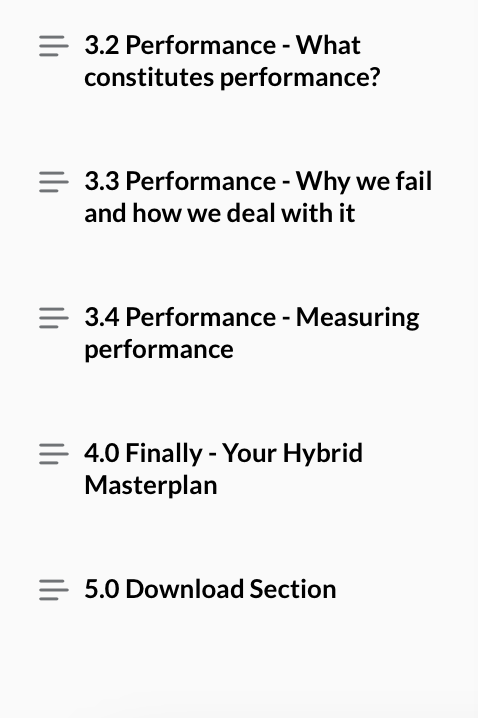
Performance – We will evaluate what constitutes performance and how we can better measure performance in the hybrid day-to-day.

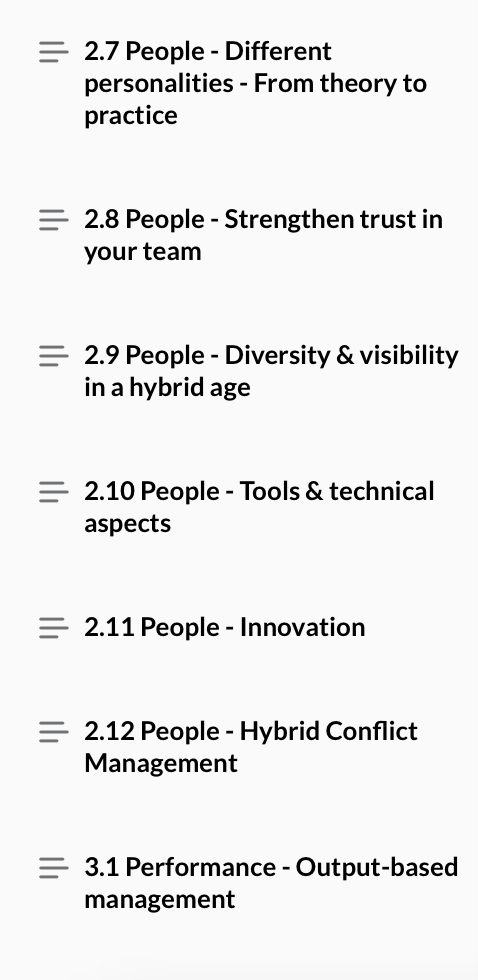
What will be covered?

  • The impact of the flexibilization of the working world on leaders
  • Why it is no longer possible to avoid a hybrid working world and how to make the most out of it
  • How to organize your team efficiently in the new environment
  • How to deal with different life realities and personalities
  • How to conduct difficult conversations and what is important in hybrid conflicts
  • Which role do diversity and inclusion play in the hybrid context
  • What you need to foster innovation in the team
  • What you need to achieve high performance in the team
  • How to measure and push performance despite a hybrid setup

Modules

The course is modular. So you can view it entirely, or just focus on areas that are particularly relevant for you. The first module “Purpose” is recommended to be viewed in its entirety.

Goal

The goal is not to reinvent leadership, but to question and reflect on one’s leadership in the hybrid context and to get new impulses and ideas on how to lead oneself and the team in the new context of a hybrid workplace.

We are very excited to experience this new adventure with you and delve more into the complex and exciting world of hybrid leadership! You can contact us if you are interested in this Rise course or follow along on our blog, where we will share a few snippets of the course as well.

Click Here to Contact us
Peter Grabuschnig

Peter Grabuschnig

Trainer, Coach & MDI Partner

Peter is a partner and trainer at MDI, advising major international corporations on implementing hybrid work policies and building a hybrid work and leadership culture.

He is considered an expert in training design. With his Webinar Guru Framework he has developed a tool that helps to design training content for successful and activating virtual learning.

  • LinkedIn

Get a glimpse into the elearning:

AI in Leadership – the Ethical Dimension

AI in Leadership – the Ethical Dimension

by Alina Helmlinger | Jan 29, 2024 | Impuls series, Leadership and AI, Leadership Tips | 0 comments

AI in Leadership – The Ethical Dimension

Do you prefer to listen to this article? Click below to access our AI-generated version of this blog article!

This blog post is a continuation of an interview ” AI-Enhanced Leadership: Maximizing Potential with Intelligent Tools. Click here to read the first part.

The topic of AI is also very much about ethics. I would be particularly interested in this: What ethical considerations should leaders consider when dealing with AI?

AI can process vast amounts of data both now and in the future. This means, for example, that I can easily develop an algorithm with AI to monitor employees even better, work out certain behavioral patterns, and much more.

In other words, I can use AI to make something completely transparent that a human would never have been able to do. In theory, I could develop an AI that uses workflows to tell me exactly which employees are productive and when or who is working at their weakest.

I could also use an AI to monitor the entire company. Of course, this poses a major ethical problem – do you use artificial intelligence to monitor or facilitate work processes? These are two poles that AI could cover.

The question is, what do you want?

In your opinion, how can AI help to create personalized learning experiences for leaders and thus promote their individual development?

With AI, for example, I could create a training program for a leader where they can study at any time. The program explains content at all levels – very simple, highly complex, in a different language or format.

Soon it will also be possible to write with AI via WhatsApp, for example, to better understand the content. But this would also be possible in completely different formats – for example, I could talk to the AI or watch an AI-generated video.

In general, AI could cover everything for me. For example, I could tell it that I want to work on a language model and AI would explain to me what I need and also generate a mind map for me. This AI program would be user-friendly. That means I could use it when and where I want and at the level I need. The AI would also give me constant feedback on my learning progress and tell me where there is room for improvement.

Soon AI will be able to respond to my every wish.

AI learning modules for leaders

I hear a lot about individualization and the promotion of time- and location-independent learning, which will simply make everyday life easier – not just for leaders, but for everyone in general.

Exactly, it is independent of time and place, but can also always be tailored to my needs.

That brings me to my next question: how do you see the role of AI in the future training and development of leaders, what are the limits?

When it comes to learning content in training courses, AI will relatively soon replace the role of the trainer, because AI can do this well on an individual level. Perhaps even better than humans because of the large database.

I can simulate social interactions with an AI, but that’s where I see the limits of AI. In other words, whenever it comes to dealing with other people, AI can teach me the basics and the theory – but it can’t do the actual interpersonal aspects, i.e. working with other people.

You can also see it now after Corona, there was a brief online peak, but then people switched back to face-to-face interaction. People realized that they were missing that. This means that human interaction is now more important in a company. Nobody wants to sit in front of a screen and have everything explained to them by an AI.

Cool, thank you very much, Niels. Is there anything else you would like to add or haven’t said yet?

I see education and training as the most important skills of the 21st century – whether as a leader or an employee, everyone will have to keep learning in the 21st century and AI won’t be able to do that for us. If anything, the opposite is true – we have to learn even more than before, but AIs also make learning much easier for us.

In other words, it all evens out somewhere. We have to keep up with developments and keep learning, but this is also getting easier and easier. In other words, in the 21st century, it’s all about continuing to develop and educate ourselves and putting a bit of effort into our brains – even if we no longer have to thanks to AI.

Conclusion

With AI, (almost) anything will soon be possible – from a conversation to a generated leadership development program. Although many roles can be replaced, it is important to strengthen the interpersonal level and focus on soft skills.

You can find Niels’ homepage here!

Alina Helmlinger

Alina Helmlinger

L&D Consultant, MA

Alina has been an L&D Consultant at MDI since 2021 and supports clients from various industries in the tailor-made design of various leadership development programs and training courses. In addition to her practical knowledge and the experience she has already gained in further training, she draws on her sound theoretical knowledge from her Bachelor’s degree in Human Resources Management and her Master’s degree in Organizational and Personnel Development, which she completed in June 2022. Alina keeps calm, especially in challenging situations and leaders to reconcile the interests of different stakeholders in complex projects, thereby designing tailor-made HR solutions geared towards customers’ needs.

  • LinkedIn

Download our MDI Paper:

Paper Mock Up

This could also help you:

What If AI Doesn’t Replace Us — But Drowns Us Out?

by Martin Maglia | 24. June 2026 | Digital Transformation, Leadership and AI, Short Knowledge Bits | 0 Comments

What If AI Doesn't Replace Us — But Drowns Us Out? Over the weekend, I watched a thought-provoking video from Rick Beato. (You can find the link at the end of this article.) For those who don't know him: Rick Beato is a musician, producer, educator, guitarist, and one...
Read More

Use It or Lose It: How AI and Digital Tools May Be Changing Our Brains

by Florian Biedermann | 26. May 2026 | Leadership and AI, Leadership Tips, Learning Transfer | 0 Comments

Use It or Lose It: How AI and Digital Tools May Be Changing Our Brains You travel to Madrid and want to chat with the locals, but you realize that after five years without practice, your rudimentary Spanish skills are now practically nonexistent and you even struggle...
Read More

How Artificial Intelligence Shapes Who We Become

by Meike Hinnenberg | 19. May 2026 | Impuls series, Leadership and AI, Leadership in the digital transformation | 0 Comments

How Artificial Intelligence Shapes Who We Become Meike’s Reflections on Artificial Intelligence Do you prefer to listen to this article? Click below to access our AI-generated audio version!How Artificial Intelligence Shapes Who We Become Meike’s Reflections on...
Read More

Zeca Ruiz on Cross-Generational Leadership and Navigating Change

by Jana Wölfl | 13. May 2026 | Leadership Impact, MDI Spotlight Series, Training Insights | 0 Comments

Zeca Ruiz on Cross-Generational Leadership and Navigating Change This blog is an excerpt from our new podcast! You can find the entire podcast episode here. Zeca Ruiz on Cross-Generational Leadership and Navigating Change In the fourth episode of our podcast “Voices...
Read More

AI-Empowered Leadership: 6 Guiding Principles

by Gunther Fürstberger | 14. April 2026 | Leadership and AI, Leadership Tips, MDI Whitepaper | 0 Comments

AI-Empowered Leadership: 6 Guiding Principles This blog post is a detailed summary of the whitepaper "Guiding Principles of AI-Empowered Leadership" by MDI's CEO, Gunther Fürstberger. You can find the full whitepaper here! Let's be honest: most conversations about AI...
Read More

What AI Shows You — and What It Doesn’t

by Meike Hinnenberg | 1. April 2026 | Digital Transformation, Impuls series, Leadership and AI | 0 Comments

What AI Shows You — and What It Doesn't Meike’s Reflections on Artificial Intelligence Do you prefer to listen to this article? Click below to access our AI-generated audio version! What AI Shows You — and What It Doesn't Meike’s Reflections on Artificial Intelligence...
Read More

Leading in the Age of AI: How AI Discourse Shapes Responsibility and Power

by Meike Hinnenberg | 18. March 2026 | Impuls series, Leadership and AI, Leadership Tips | 0 Comments

Leading in the Age of AI: How AI Discourse Shapes Responsibility and Power Meike’s Reflections on Artificial Intelligence Do you prefer to listen to this article? Click below to access our AI-generated audio version!Leading in the Age of AI: How AI Discourse Shapes...
Read More

AI Ethics for Leaders: Why Context and Critical Thinking Matter More Than Ever

by Meike Hinnenberg | 11. March 2026 | Impuls series, Leadership and AI, Learning Transfer | 0 Comments

AI Ethics for Leaders: Why Context and Critical Thinking Matter More Than Ever. Meike’s Reflections on Artificial Intelligence Do you prefer to listen to this article? Click below to access our AI-generated audio version!AI Ethics for Leaders: Why Context and Critical...
Read More

A Success Story – When AI Sharpens Human Judgement

by Claude MacDonald, Rafael Ungvari | 6. March 2026 | Customer Story, Digital Transformation, Leadership and AI | 0 Comments

A Success Story – When AI Sharpens Human Judgement Do you prefer to listen to this article? Click here to access our AI-generated audio version! When AI Amplifies Human Judgment: A Customer Success Story About This Project At MDI, we believe that great leadership and...
Read More

How Do You Lead People Who Don’t Think the Way You Do?

by Zeca Ruiz | 4. February 2026 | Leadership Impact, Leadership Tips, Learning Transfer | 0 Comments

How Do You Lead People Who Don't Think the Way You Do? Do you want to listen to this article? Click here to access our AI-generated audio version!   How do you lead people who do not think the way you do? Leadership is a challenge, especially when you are not...
Read More
« Older Entries
Next Entries »

Information

  • Imprint
  • MDI company website

Social Media

  • Facebook
  • Twitter
  • Youtube
  • LinkedIn

© MDI Management Development Institute, 2020