
• MDI
  • German version
  • Contact us
MDI Management Development
  • Agile leadership
  • Lateral Leadership
  • Leadership Impact
  • Leadership Development
Select Page
How Artificial Intelligence Shapes Who We Become

How Artificial Intelligence Shapes Who We Become

by Meike Hinnenberg | May 19, 2026 | Impuls series, Leadership and AI, Leadership in the digital transformation | 0 comments

How Artificial Intelligence Shapes Who We Become

Meike’s Reflections on Artificial Intelligence

Do you prefer to listen to this article? Click below to access our AI-generated audio version!

How Artificial Intelligence Shapes Who We Become

Meike’s Reflections on Artificial Intelligence

This is the forth part of MDI’s leadership architect Meike Hinnenberg’s new blog reflection series on AI. You can find the previous parts on our blog site! Stay tuned for more 🙂

How Artificial Intelligence Shapes Who We Become | Lines of Subjectivation

Maybe the most certain of all philosophical problems is the problem of the present time and of what we are in this very moment. (Michel Foucault: The Subject and Power) The most profound technologies are those that disappear. They weave themselves into the fabric of everyday life until they are undistinguishable from it. (Marc Weiser: The computer for the 21st Century)

The Hidden Labor Behind AI – A Berlin Exhibition

May 2026 in Berlin; spring has arrived. Light enters the room, and a quiet warmth settles in the apartment. The window is slightly open. I sit at the same table. Again, coffee – dark, dense, almost earthy in its intensity – fills the room.

While I follow its taste, while I continue working on this text, fragments of the exhibition The Language of Soil, which I visited earlier today, return. In this installation, the artist Anna Ehrenstein directs attention to platform workers in Nairobi, Congo, and Egypt – workers who sustain what is called Artificial Intelligence, and for whom Jeff Bezos once used the phrase “artificial artificial intelligence.”

Employed by outsourcing partners of Big Tech companies, their work remains largely unseen. The exhibition brings together interviews, workshops, and collective narrative formats in a 220° video installation, rendering perceptible the “interplay of (post-)colonial continuities, global economies, and the labor that underpins algorithmic systems“.

Voices from the Invisible Infrastructure

I am watching. I am listening. A father, closely connected to his family, now estranged from his daughter; her presence recalls the CSAM he is required to review and label each day. A woman working as a content moderator, checking and filtering visual material from an armed conflict that has also affected her own family, from whom she has had no sign of life. Syrian refugees, shaped by war, displacement, and flight, now labeling sequences of images – war, torture, suicide, rape, child abuse – images that do not remain external, but return.

Micro-Tasks, Micro-Pay

Payment is calculated per micro-task. Ten, twenty, twenty-five cents. Sometimes less. It accumulates slowly, often to less than two dollars per hour. Contracts remain short. They are extended or they are not. Refusal is possible, but not without consequence. Continuity depends on compliance. The work moves; the workers remain replaceable.

Where Do I Stand in This Formation?

As I follow this movement of memories, questions begin to insist: Where am I located in the formation I am trying to describe? How am I affected by it? How do I relate to it?

Has something like an exterior position been gained through thinking the dispositif of Artificial Intelligence, through its lines of visibility and enunciation? Is this now a stable place from which I can speak with a certain autonomy, perhaps even judge it? Or is this, too, only a movement within the same singular and historically situated configuration?

The Illusion of the Exterior Subject

It would be tempting to assume that what has come into view simply persists as knowledge at my disposal, while I myself remain unaffected. Such a perspective preserves the familiar figure of an exterior, self-assured subject and a stable reality upon which it acts by means of technology. And yet this assumption falters. If Artificial Intelligence is approached not merely as a set of tools but as a condition of world-disclosure, the situation becomes more complex.

If the preceding analysis marks a shift in the conditions of seeing and saying, if what appeared self-evident is shown to depend on structured exclusions, then this shift cannot be limited to the object. It implicates the position of the one who sees and speaks, and with it the conditions under which others remain unseen and unheard. What comes into view does not simply add itself to knowledge; it alters the field in which both subject and world take shape.

Foucault and the Making of Subjects

The man described […], whom we are invited to free, is already in himself the effect of a subjection much more profound than himself.

Michel Foucault’s understood his own work as an attempt “to create a history of the different modes by which, in our culture, human beings are made subjects.” (Michel Foucault: Subject and Power) We are not subjects prior to these processes. We are born into historically specific arrangements, dispositifs, within which we speak and are spoken about, see and are seen, act and are acted upon. Even if this idea is an affront to one’s ego, subjectivity does not precede these relations; it takes shape within them. Or, in a Deleuzian inflection: we are continually in processes of becoming-subject.

Lines of Visibility: Who Gets to Appear

If lines of visibility are conditions of perception – if they determine what can appear, in what form, and from which position – then they do not merely organize objects. They also distribute subjects: they situate them, relate them to one another, and define the positions from which something like a “self” can emerge within a given regime of visibility.

Lines of Enunciation: Who Gets to Speak

If lines of enunciation are conditions of sayability – if they determine who or what can speak, where agency is grammatically and conceptually placed, what can be said and in what form it becomes meaningful – then they also affect the subject. For those who speak are not exterior to these conditions.

They take shape within them. What can be articulated, and from which position it can appear as intelligible, does not simply structure discourse; it structures the one who speaks. Subjectivity emerges here not as origin, but as effect: as something formed within a field of available statements, distinctions, and attributions of agency.

To speak is therefore not only to express oneself, but to enter a space already organized in advance, to adopt positions, to repeat or displace existing formulations, to inhabit or refuse a grammar that distributes agency and responsibility. What appears as a self speaking is inseparable from the conditions of enunciation through which it becomes legible, both to others and to itself.

Lines of Enunciation: Who Gets to Speak

Lines of Subjectivation in the Dispositif of Artificial Intelligence

In a Deleuzian sense, lines of subjectivation do not designate identities or inner states. They are trajectories through which subjects are produced: ways in which beings are called into relation with themselves, assigned positions of responsibility, and made capable or incapable of acting, speaking or refusing. They are neither purely imposed nor freely chosen, but emerge in the interplay of practices, norms, and material arrangements.

Within the dispositif of Artificial Intelligence, such lines are not peripheral; they are constitutive of its operation. They do not merely run alongside technical systems but traverse them, linking infrastructures of computation with everyday forms of self-relation.

We are simultaneously involved in their production and their effects: by generating data, labeling and rating outputs, prompting and correcting systems, but also by adopting Artificial Intelligence as interface, infrastructure and environment. At the same time, we are produced through these same relations and practices – as users, data subjects, workers, experts, and objects of prediction.

The Figure of the User

One dominant line of subjectivation produces the figure of the user. Here, the subject is addressed as an interacting point within a system, defined through traces of behavior and patterns of response. Agency is not denied but redirected: it appears as choice within pre-structured environments, as optimization within given parameters. The subject becomes legible insofar as it is continuously translated into data, and governable insofar as it can be rendered comparable, measurable and adjustable.

The Subject as Data

A further line produces the subject as data itself. In this configuration, life is not primarily addressed as expression but as extractable material. Actions, preferences, and linguistic traces are transformed into features, categories, and probabilities. Subjectivity no longer precedes this process; it is retroactively assembled through classification. What one is becomes inseparable from what one can be made to count as.

The Invisible Worker

Another line concerns labor. Here, subjects appear as infrastructural operators of AI systems: annotators, moderators, raters, validators. Their work is essential yet structurally displaced from visibility. It appears only in functional form, as “human-in-the-loop,” as quality control, as correction, while the conditions of its production remain largely unacknowledged. Subjectivation takes the form of simultaneous centrality and erasure.

The Subject of Expertise

A further line produces subjects of expertise. Engineers, researchers, and ethicists are positioned as rational stewards of complex systems. Responsibility is localized at the level of technical decision-making, while broader political and economic structures recede into the background. In this way, agency is reorganized as competence, and critique is often translated into questions of design, optimization, or governance.

The Predictive Subject

Finally, a predictive line of subjectivation renders individuals as anticipatable entities. In domains such as policing, border regimes, or welfare systems, subjects appear as risks, scores, or probabilities. They are addressed not primarily in relation to what they do, but in relation to what they are expected to do. In this configuration, subjectivation operates in advance of action: it produces subjects through the pre-structuring of possible futures.

Alternative Practices: What the Dispositif Cannot Fully Capture

However, not all lines of subjectivation find equal conditions of existence within the dispositif of Artificial Intelligence. Alongside those described above that are actively produced and stabilized, there are others that remain structurally disfavored, forms of becoming-subject that do not easily enter regimes of datafication, optimization, or classification. These are not external to the field, but they appear as weak intensities within it, continually at risk of being neutralized or translated into more legible forms.

If lines of subjectivation traverse the dispositif in this way – if they produce us even as we reproduce them – then the question cannot be limited to which subjects are made possible, but must also address which remain difficult to sustain, and how this difference is lived. If they emerge in the interplay of practices, norms, and material arrangements, a further question arises: what other forms of becoming-subject might be opened through different practices? And which forms of self-relation do we, in turn, sustain or reinforce?

Alternative Practices: What the Dispositif Cannot Fully Capture<br />

Writing: From Struggle with Meaning to Selection Among Outputs

What is the difference between writing a text in the slow proximity of one’s own words – hesitating, revising, following a thought that resists formulation – and producing a text through a system that calculates probable continuations? What shifts in the relation to language, if expression no longer emerges from a struggle with meaning, but from selection among pre-structured possibilities? What kind of subject takes shape when writing becomes prompting, when articulation becomes navigation within a space of outputs already statistically composed?

What becomes of thought when it is no longer allowed to remain without immediate result? What changes if attention is not held in suspension – wandering, returning, lingering – but is continuously operationalized as input, as signal, as resource? What kind of self is formed when thinking is oriented towards an immediate answer, rather than toward the possibility of not yet knowing what it is that one thinks?

What happens to relation when conversation is displaced by mediation? When the effort to encounter another – through hesitation, misunderstanding, goodwill, care, kindness – is replaced by a system that purportedly anticipates, summarizes, or simulates response? What is lost when affect appears as something that can be retrieved on demand, rather than something that emerges in the unpredictability of presence?

What becomes perceptible when an artwork interrupts the smooth passage from image to category? When what is seen does not immediately resolve into recognition, but remains suspended – irreducible to function, resistant to immediate use? What kind of subject emerges in such a moment, in which perception is not yet captured by classification, and meaning does not stabilize into a single trajectory?

And what shifts when the figure of the “annotator” ceases to appear as function and becomes encounter? When the one who labels, filters, and corrects is no longer integrated as an invisible component of the system, but appears as a situated other, whose experience cannot be exhausted by the categories that depend on it and who makes a claim on us? What becomes unstable when this presence can no longer be fully translated into data, role, or task?

Points of Non-Coincidence: Where Other Trajectories Begin

These questions do not lead outside the dispositif. They do not restore an untouched subject prior to its formation. But they begin to indicate points at which its operations do not fully close, and thus sites at which what Waldenfels calls Antwortlichkeit becomes possible. For in each case, something remains that does not coincide with its capture: a hesitation in language, a surplus in perception, a resistance in relation, a remainder in the other that exceeds the roles through which they are made intelligible.

It is perhaps here – not beyond, but within these moments of non-coincidence – that other trajectories of subjectivation become thinkable. Not as stable alternatives, but as fragile deviations: ways of speaking, seeing, and relating that do not entirely align with the imperatives of calculation, prediction, and optimization, and that, precisely in this misalignment, keep the field from becoming fully closed and protect us from totalization.

Which Forms of Life Do We Sustain?

What these movements begin to make visible is a relation that resists simplification. We are not external to the dispositif we describe. We do not stand before it as sovereign subjects, capable of steering it from a position of independence. We are formed within it – through its lines of visibility, its regimes of enunciation, its processes of subjectivation. What we can see, what we can say, what we can become is never simply our own.

And yet, this does not exhaust the relation. For if we are shaped within these configurations, we are not only their effect. We participate in their continuation. We stabilize them through our practices, our repetitions, our forms of use. But precisely in this, a different possibility emerges: that what is reproduced can also be shifted. That even within the field that forms us, there are movements – hesitations, deviations, reconfigurations – through which other trajectories of subjectivation can be fostered.

Neither Determined Nor Free: A More Demanding Question

The question, then, is not whether we are determined or free. It is more demanding: which forms of life do we sustain through the ways we see, speak, and relate? Which subjects do we become when we align ourselves seamlessly with these systems – when we allow their operations to pass through us without resistance, when we accept their abstractions as sufficient descriptions of ourselves and others? And what becomes unavailable in this alignment: which forms of attention, of relation, of language, of responsibility begin to recede when they are no longer practiced?

Conversely, what might it mean to remain within these formations without fully coinciding with them? To inhabit their structures, but not to let them settle entirely into what we take ourselves to be? If there is no outside from which to act, then intervention must take place within the very relations that bind us – within the practices through which subjectivity is continuously produced and reproduced.

Toward the Distribution of Forces

It is here that another dimension comes into view. For the dispositif does not only organize what can be seen, said, and become; it also distributes forces. It channels, intensifies, and stabilizes them. It produces asymmetries, accumulations, and thresholds. To understand how these movements hold, how they persist, and how they might be altered, it becomes necessary to follow not only lines of visibility, enunciation, and subjectivation, but also the lines along which forces are arranged, transmitted, and transformed.

Meike Hinnenberg

Meike Hinnenberg

Learning & Development Architect

Meike Hinnenberg is a trainer and Learning and Development Architect at MDI Management Development GmbH and specializes in communication, conflict management, diversity & inclusion, and lateral leadership.


  • LinkedIn

What serves you next?

What If AI Doesn’t Replace Us — But Drowns Us Out?

by Martin Maglia | 24. June 2026 | Digital Transformation, Leadership and AI, Short Knowledge Bits | 0 Comments

What If AI Doesn't Replace Us — But Drowns Us Out? Over the weekend, I watched a thought-provoking video from Rick Beato. (You can find the link at the end of this article.) For those who don't know him: Rick Beato is a musician, producer, educator, guitarist, and one...
Read More

Use It or Lose It: How AI and Digital Tools May Be Changing Our Brains

by Florian Biedermann | 26. May 2026 | Leadership and AI, Leadership Tips, Learning Transfer | 0 Comments

Use It or Lose It: How AI and Digital Tools May Be Changing Our Brains You travel to Madrid and want to chat with the locals, but you realize that after five years without practice, your rudimentary Spanish skills are now practically nonexistent and you even struggle...
Read More

How Artificial Intelligence Shapes Who We Become

by Meike Hinnenberg | 19. May 2026 | Impuls series, Leadership and AI, Leadership in the digital transformation | 0 Comments

How Artificial Intelligence Shapes Who We Become Meike’s Reflections on Artificial Intelligence Do you prefer to listen to this article? Click below to access our AI-generated audio version!How Artificial Intelligence Shapes Who We Become Meike’s Reflections on...
Read More

Zeca Ruiz on Cross-Generational Leadership and Navigating Change

by Jana Wölfl | 13. May 2026 | Leadership Impact, MDI Spotlight Series, Training Insights | 0 Comments

Zeca Ruiz on Cross-Generational Leadership and Navigating Change This blog is an excerpt from our new podcast! You can find the entire podcast episode here. Zeca Ruiz on Cross-Generational Leadership and Navigating Change In the fourth episode of our podcast “Voices...
Read More

AI-Empowered Leadership: 6 Guiding Principles

by Gunther Fürstberger | 14. April 2026 | Leadership and AI, Leadership Tips, MDI Whitepaper | 0 Comments

AI-Empowered Leadership: 6 Guiding Principles This blog post is a detailed summary of the whitepaper "Guiding Principles of AI-Empowered Leadership" by MDI's CEO, Gunther Fürstberger. You can find the full whitepaper here! Let's be honest: most conversations about AI...
Read More

What AI Shows You — and What It Doesn’t

by Meike Hinnenberg | 1. April 2026 | Digital Transformation, Impuls series, Leadership and AI | 0 Comments

What AI Shows You — and What It Doesn't Meike’s Reflections on Artificial Intelligence Do you prefer to listen to this article? Click below to access our AI-generated audio version! What AI Shows You — and What It Doesn't Meike’s Reflections on Artificial Intelligence...
Read More

Leading in the Age of AI: How AI Discourse Shapes Responsibility and Power

by Meike Hinnenberg | 18. March 2026 | Impuls series, Leadership and AI, Leadership Tips | 0 Comments

Leading in the Age of AI: How AI Discourse Shapes Responsibility and Power Meike’s Reflections on Artificial Intelligence Do you prefer to listen to this article? Click below to access our AI-generated audio version!Leading in the Age of AI: How AI Discourse Shapes...
Read More

AI Ethics for Leaders: Why Context and Critical Thinking Matter More Than Ever

by Meike Hinnenberg | 11. March 2026 | Impuls series, Leadership and AI, Learning Transfer | 0 Comments

AI Ethics for Leaders: Why Context and Critical Thinking Matter More Than Ever. Meike’s Reflections on Artificial Intelligence Do you prefer to listen to this article? Click below to access our AI-generated audio version!AI Ethics for Leaders: Why Context and Critical...
Read More

A Success Story – When AI Sharpens Human Judgement

by Claude MacDonald, Rafael Ungvari | 6. March 2026 | Customer Story, Digital Transformation, Leadership and AI | 0 Comments

A Success Story – When AI Sharpens Human Judgement Do you prefer to listen to this article? Click here to access our AI-generated audio version! When AI Amplifies Human Judgment: A Customer Success Story About This Project At MDI, we believe that great leadership and...
Read More

How Do You Lead People Who Don’t Think the Way You Do?

by Zeca Ruiz | 4. February 2026 | Leadership Impact, Leadership Tips, Learning Transfer | 0 Comments

How Do You Lead People Who Don't Think the Way You Do? Do you want to listen to this article? Click here to access our AI-generated audio version!   How do you lead people who do not think the way you do? Leadership is a challenge, especially when you are not...
Read More
AI-Empowered Leadership: 6 Guiding Principles

AI-Empowered Leadership: 6 Guiding Principles

by Gunther Fürstberger | Apr 14, 2026 | Leadership and AI, Leadership Tips, MDI Whitepaper | 0 comments

Download the full whitepaper here

AI-Empowered Leadership: 6 Guiding Principles

This blog post is a detailed summary of the whitepaper “Guiding Principles of AI-Empowered Leadership” by MDI’s CEO, Gunther Fürstberger. You can find the full whitepaper here!

Let’s be honest: most conversations about AI in leadership quickly turn into either breathless hype or vague unease. What’s actually missing is a clear, grounded perspective on what it means to lead well in an age where AI is becoming part of everyday work.

That’s exactly what MDI’s CEO Gunther Fürstberger tackles in his latest whitepaper. If you’re a leader trying to figure out how to work with AI in a way that’s confident, effective, and responsible — this one is worth your time. Here’s a detailed look at the six guiding principles!


Principle 1: Leadership responsibility stays with the individual

AI already outperforms us in many cognitive areas — processing speed, pattern recognition, and handling vast amounts of data. That gap will only grow. And yet: AI is a tool, not an actor. It can analyze, simulate, suggest, and optimize. But meaning, purpose, judgment, and accountability remain human tasks.

Leadership doesn’t mean being the strongest or most intelligent entity in the room. It means taking responsibility for impact, people, and consequences. That responsibility can’t be delegated — not to algorithms, not to AI systems. Leaders who understand AI as a superior but supportive tool keep their ability to shape the future. Those who treat it as a threat lose room to maneuver. Those who treat it as a tool gain sovereignty.

Principle 2: AI collaboration is a superpower

The decisive skill in the AI age isn’t knowledge about AI — it’s the ability to collaborate effectively with AI systems. Research confirms that AI-enabled collaboration can significantly increase productivity and efficiency. The German Economic Institute reports that employees using AI applications tend to achieve better performance results, particularly where expertise and experience are already present.

What AI does well today: automated data analysis, contextual summaries of large volumes of information, and structured scenario planning. These functions reduce cognitive overload and create space for strategic thinking.

Leaders are increasingly evaluated on their ability to integrate AI potential into organizational culture, build AI competence within their teams, and uphold ethical and long-term goals at the same time. AI collaboration is no longer a nice-to-have — it’s a central lever for productivity, innovation, and lasting leadership impact.


Principle 3: Performance grows through the development of humans and AI in interaction

Even in AI-augmented teams, the team remains fundamentally human. AI agents are powerful tools — capable of learning, sometimes acting autonomously. But they lack consciousness, moral judgment, and genuine interpersonal skills. They operate within the goals and frameworks that humans define.

Three dimensions are crucial for human development in the AI age:

Self-leadership: Working with AI requires the ability to reflect on your own thinking and decision-making processes. When do you trust the AI? Where do you push back? Critical thinking and ethical clarity matter more than pure knowledge accumulation. A classic self-management principle also becomes more important: proactivity. AI systems tempt us toward reactivity — staying grounded requires deliberate distance, breaks, and AI-free time.

Collaboration: The more AI takes over operational tasks, the more central genuine human competencies become: building relationships, resolving conflict, building trust, conveying meaning. In AI-augmented teams, transparency about who uses which systems — and how — is essential, as is a strong learning culture as the foundation.

Working with AI: Professional AI use requires new skills: precise goal definition, clear prompting, iterative improvement, and quality control. AI should neither be mystified nor blindly trusted. It’s a powerful tool that must be consciously managed and reviewed.

When people keep developing, consciously shape their collaboration, and systematically build and improve AI agents, a dynamic learning architecture emerges at its best. Performance then doesn’t grow linearly — it grows cumulatively.

Download the full whitepaper here
Performance grows through the development of humans and AI in interaction

Principle 4: The division of labor with AI is dynamic

What is clearly a human task today may be supported or taken over by AI tomorrow. That makes leadership in the AI age an ongoing exercise in role reflection.

The central guiding question: What can human leaders do better — and what can AI do better?

Today, a leader’s strengths lie primarily in building relationships, creating meaning, making sound judgments, and taking responsibility. AI is already highly capable at routines, pattern recognition, and scaling.

But the shift is already underway. In a year, AI systems will be even better at personalizing and playing through complex scenarios. In three years, many analysis and planning tasks will be largely AI-supported. In five years, a large part of operational control processes could be automated — while the human leader becomes more of an architect of meaning, culture, and frameworks of responsibility.

There’s also an identity question here: what do we as leaders want to keep for ourselves — and what do we consciously hand over to AI? What matters is not a one-time decision, but the continuous development of collaboration. Trying out new forms of cooperation regularly — ideally daily — builds a dynamic balance: AI as amplifier, not replacement.

Principle 5: Securing the future requires a determined and responsible AI transformation

Economic history shows that technological disruptions rarely proceed linearly — they are abrupt, radical, and frequently underestimated. Around 155 years ago, sailing ships dominated world trade with roughly 90% market share. Thirty years later, steamships controlled 80%. The decisive advantage didn’t go to those who owned the technology — it went to those who consistently built new business models on top of it.

Today, AI isn’t multiplying our physical strength — it’s multiplying our intelligence. AI agents are changing not just individual processes but entire value chains, decision-making logics, and competency profiles.

Future-proofing doesn’t begin in a strategy paper. It begins in the calendar. Two concrete levers:

Regularly questioning your own tasks: Which of your tasks can AI already take over today? Which in a year? In three to five years? Administrative routines, data analysis, first drafts, market comparisons — all of this can be automated. Consciously delegating these tasks to AI frees up time for what only humans can do.

Regularly switching to the best new platform or tool: Technological progress is exponential. What leads today may be mediocre tomorrow. Transformation also means questioning technological loyalties. Not convenience, but performance should be the deciding factor.

Principle 6: The well-being of people and nature is the overarching benchmark for AI development

AI is one of the most powerful technologies of our time. It has the potential to cause immense suffering — and equally great benefit. Rarely before has a technological development been so rapid, so global, and so profound in its impact on the economy, society, politics, and individual lives.

The overarching benchmark cannot be efficiency, profitability, or geopolitical dominance alone. It must be the well-being of humanity and nature.

The ambivalence is real: emotion recognition can support psychotherapy — and be used for surveillance in authoritarian contexts. Generative AI can democratize creativity — and produce disinformation at an unprecedented scale. AI in medicine supports early cancer detection — and raises new questions about data sovereignty and equitable access.

There’s also an ecological dimension that is often underestimated. Training large AI models consumes enormous amounts of energy and water. If AI further accelerates consumption and resource use, it exacerbates ecological crises. Conversely, it can be a crucial tool in the fight against climate change.

For organizations, this means: ethics must not be a fig leaf — it needs to be integrated into innovation processes. AI projects should be systematically assessed for their social and environmental impacts. And transparency toward customers and employees builds trust while reducing long-term reputational risks.

Progress is measured not only by speed or scale but also by its contribution to a successful life and a livable environment.

Mindset is what matters

If there’s one thing these six principles make clear, it’s this: the real divide won’t be between organizations that use AI and those that don’t. It will be between leaders who shape this shift with intention — and those who just go along for the ride.

So ask yourself: Which of these principles is already part of how you lead? And where is there still room to grow? The whitepaper goes deep on all six — and if any of this resonated, it’s well worth reading in full. 

Because ultimately: AI serves humanity — not the other way around.

    Download the full whitepaper here
    Gunther Fürstberger

    Gunther Fürstberger

    CEO | MDI Management Development International

    Gunther Fürstberger is a management trainer, author and CEO of Metaforum and MDI – a global consulting company providing solutions for leadership development. His main interest is to make the world a better place through excellent leadership. He has worked for clients including ABB, Abbvie, Boehringer Ingelheim, DHL, Hornbach, PWC and Swarovski. His core competence is leadership in digital transformation. He gained his own leadership experience as HR Manager of McDonald’s Central Europe/Central Asia.  At the age of 20 he already started working as a trainer.

    • LinkedIn

    What serves you next?

    Zeca Ruiz on Cross-Generational Leadership and Navigating Change

    by Jana Wölfl | 13. May 2026 | Leadership Impact, MDI Spotlight Series, Training Insights | 0 Comments

    Zeca Ruiz on Cross-Generational Leadership and Navigating Change This blog is an excerpt from our new podcast! You can find the entire podcast episode here. Zeca Ruiz on Cross-Generational Leadership and Navigating Change In the fourth episode of our podcast “Voices...
    Read More

    How Do You Lead People Who Don’t Think the Way You Do?

    by Zeca Ruiz | 4. February 2026 | Leadership Impact, Leadership Tips, Learning Transfer | 0 Comments

    How Do You Lead People Who Don't Think the Way You Do? Do you want to listen to this article? Click here to access our AI-generated audio version!   How do you lead people who do not think the way you do? Leadership is a challenge, especially when you are not...
    Read More

    How You Deal With Neurodiversity as a Leader

    by Iris Kandlbauer | 3. February 2026 | Leadership Impact, Leadership Tips, Short Knowledge Bits | 0 Comments

    How You Deal With Neurodiversity as a Leader You prefer listening to this article? You can find our AI-generated audio version below! How You Deal With Neurodiversity as a Leader What might be behind “strange” behavior in a team—and how leaders can deal with it...
    Read More

    Generation Z isn’t the Problem but Our System is

    by Zeca Ruiz | 3. December 2025 | Impuls series, International leadership development, Leadership in the digital transformation | 0 Comments

    Generation Z Isn’t the Problem, but Our System is. Read this article on crossgenerational management by Zeca Ruiz to find out more!

    Read More

    The Lasting Impact of Leadership Horizon – Meike’s Perspectives

    by Meike Hinnenberg | 2. July 2025 | Leadership Impact, MDI Inside, Short Knowledge Bits | 0 Comments

    The Lasting Impact of Leadership Horizon - Meike's Perspectives Do you prefer to listen to this article? Click below to access our AI-generated audio version!The Lasting Impact of Leadership Horizon - Meike's Perspectives MDI’s Meike Hinnenberg shares her reflections...
    Read More

    Success Through Change: How to Stay Oriented During Transitions

    by Anita Berger | 14. April 2025 | Impuls series, Leadership Impact, Leadership Tips | 0 Comments

    Success Through Change: How to Stay Oriented During Transitions Do you prefer to listen to this article? Click below to access our AI-generated audio version:Success Through Change: How to Stay Oriented During Transitions Change processes often involve challenges....
    Read More

    4 Tips on How to Shape Change Processes as a Leader

    by Anita Berger | 3. April 2025 | Impuls series, Leadership Impact, Leadership Tips | 0 Comments

    4 Tips on How to Shape Change Processes as a Leader Do you prefer to listen to this article? Click below to access our AI-generated audio version:4 Tips on How to Shape Change Processes as a Leader Imagine a dynamic network of paths that is constantly changing. While...
    Read More

    Successful Team Building for Boehringer Ingelheim RCV

    by Anita Berger | 29. March 2024 | Customer Story, International leadership development, MDI Inside | 0 Comments

    Successful Team Building for Boehringer Ingelheim RCV Do you prefer to listen to this article? Click below to access our AI-generated audio version:Successful Team Building for Boehringer Ingelheim RCV In the interview with our MDI trainer and partner, Anita Berger On...
    Read More

    Organize Your Team in a Hybrid Workplace

    by Peter Grabuschnig | 14. March 2024 | Impuls series, International leadership development, Leadership in the digital transformation | 0 Comments

    Organize Your Team in a Hybrid Workplace Prefer to listen to the article? Click below to access our AI speech-generated audio. However, if you want to read it as usual, keep scrolling.Organize Your Team in a Hybrid Workplace In his new Rise Course, our MDI trainer and...
    Read More

    Exploring the Influence of AI on Leadership Roles – an experiment by a CEO

    by Gunther Fürstberger | 14. November 2023 | International leadership development, Leadership and AI, Leadership in the digital transformation | 0 Comments

    Exploring the Influence of AI on Leadership Roles: Learn more about the ongoing ChatGPT experiment by MDI CEO Gunther Fürstberger Do you prefer to listen to this article? Click below to access our AI-generated version. Exploring the Influence of AI on Leadership...
    Read More
    Leading in the Age of AI: How AI Discourse Shapes Responsibility and Power

    Leading in the Age of AI: How AI Discourse Shapes Responsibility and Power

    by Meike Hinnenberg | Mar 18, 2026 | Impuls series, Leadership and AI, Leadership Tips | 0 comments

    Leading in the Age of AI: How AI Discourse Shapes Responsibility and Power

    Meike’s Reflections on Artificial Intelligence

    Do you prefer to listen to this article? Click below to access our AI-generated audio version!

    Leading in the Age of AI: How AI Discourse Shapes Responsibility and Power

    Meike’s Reflections on Artificial Intelligence

    This is the second of seven parts of MDI’s leadership architect Meike Hinnenberg’s new blog reflection series on AI. You can find the first part here! Stay tuned for more 🙂

    Chapter II – Lines of Enunciation

    By distinguishing Artificial Intelligence as an industrial apparatus from machine learning as a set of practices, Crawford performs a gesture of ethical resistance. She interrupts the smooth circulation of the term, exposing Artificial Intelligence not as a settled object but as a line of enunciation – and in doing so opens a different path through the field.

    In Deleuze’s sense, lines of enunciation are neither utterances nor texts, neither speakers nor doctrines. They are conditions of sayability that circulate within a dispositif, delineating what can be named, thought, and acted upon.

    Most often, lines of enunciation remain invisible precisely because they work so well. They do not appear as commands, norms, or ideologies; they slip into language as description, into grammar as agency, into names that seem to pre-exist the things they gather. They do not ask to be believed: one does not need to agree with a line of enunciation to use it.

    How AI Discourse Shapes Reality and Responsibility

    These lines are not primarily repressive; they are productive. They bring objects into being (AI), generate problems (alignment, bias), propose solutions (ethical AI), and sketch futures (AI will transform everything). A critique that treats them merely as false representations, therefore, misses the point. Their force lies not (only) in what they conceal, but also in the realities they help bring into existence.

    Understanding this productivity – and, with it, understanding technology not simply as an instrument to be used wisely but as a mode of world-disclosure – is essential, especially with regard to the question of responsibility. We are not outside the dispositif. We are not independent of the social, technological, and linguistic structures through which the world becomes accessible to us. Our relation to ourselves and our access to reality are shaped within them.

    How AI Discourse Shapes Reality and Responsibility

    Response-ability

    What is therefore required is not the illusion of standing beyond these structures, but the effort to understand how the dispositif operates: what realities it brings into being, how we are positioned within it, and how we might relate to it, act within it, or even shift its lines. For now, being independent of these conditions does not mean we would not be responsible. Responsibility may instead take the form that Bernhard Waldenfels calls Antwortlichkeit (response-ability): a responsiveness to what addresses us before we fully understand it, a response that can never entirely catch up with what precedes it.

    Let us follow this path a little further to see how it shapes the field. If we turn, for example, to the website of the OECD, we read:

    AI holds the potential to address complex challenges from enhancing education and improving health care, to driving scientific innovation and climate action. However, AI systems also pose risks to privacy, safety, security, and human autonomy. Effective governance is essential to ensure AI development and deployment are safe, secure and trustworthy, with policies and regulation that foster innovation and competition.

    How Discourse Limits What Can Be Questioned

    The OECD text speaks in a language in which Artificial Intelligence already acts: it drives, addresses, and enhances. Politics enters only later, as a moderating hand. In this grammar, Artificial Intelligence appears as an agent capable of benefit or harm, yet never itself fundamentally in question. Within this frame, one may debate safety, trust, and regulation, but more structural questions about extraction, power concentration, or the desirability of AI as such struggle to surface as relevant statements. The force of such enunciation lies not in persuading belief, but in pre-structuring the field of speech itself.

    By distinguishing Artificial Intelligence as an industrial apparatus from machine learning as a set of practices, Crawford renders such a line of enunciation visible and thereby intervenes in the field of sayability. By questioning whether Artificial Intelligence is even artificial or intelligent, she shows that what appeared as an autonomous historical actor is in fact a constructed convergence: an industrial apparatus, a planetary infrastructure grounded in colonial continuities and distributed human labor.

    What material and historical infrastructures make AI possible?

    By shifting the question from “Is AI fair?” to “What material and historical infrastructures make AI possible?”, the unity of the term Artificial Intelligence fractures like the ice layer of a winter-frozen lake.

    And another layer of the acoustic landscape begins to surface: the breathing of ventilation shafts, the murmur of moving earth, the metallic heartbeat of drills, the slow chewing of stone by machines, the deep-throated hum of engines, the churning of propellers folding the sea behind them, the wind threading through stacked containers, a quiet choreography of clicks and pauses labeling one image after another, bodies trying to keep time with logistics, repetition measured in beeps, the percussion of parcels in transit – a subdued sonority of work that must remain unnoticed, a human rhythm beneath the supposedly smooth surface of automation.

    Meike Hinnenberg

    Meike Hinnenberg

    Learning & Development Architect

    Meike Hinnenberg is a trainer and Learning and Development Architect at MDI Management Development GmbH and specializes in communication, conflict management, diversity & inclusion, and lateral leadership.

    • LinkedIn

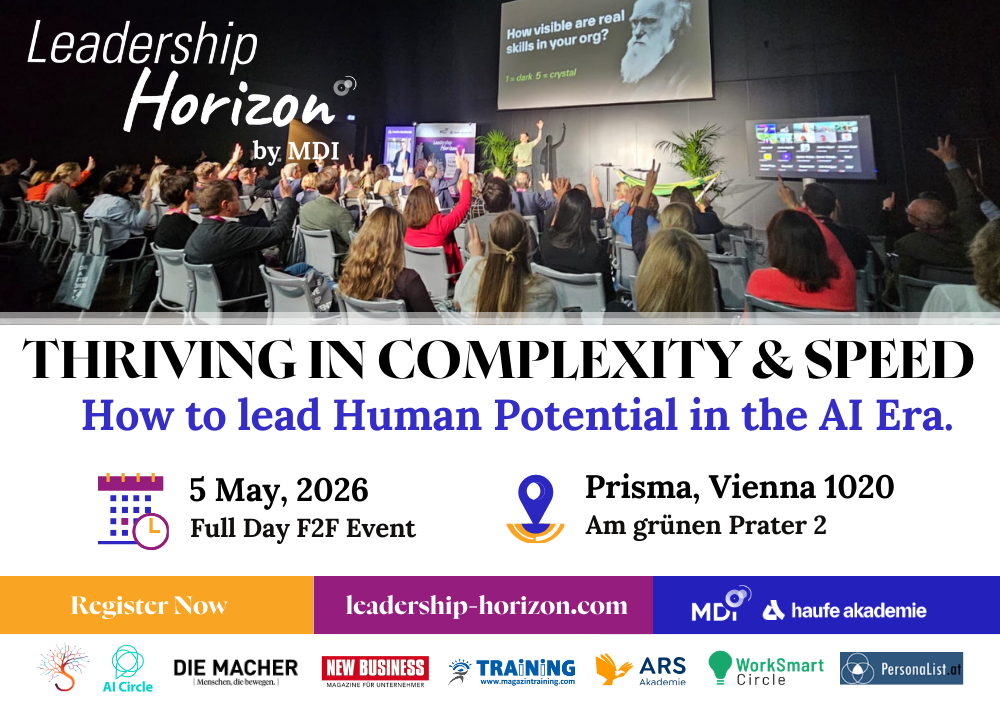
    Join us on May 5th for our yearly Leadership Horizon Conference!

    Leadership Horizon 2026 Banner

    What serves you next?

    What If AI Doesn’t Replace Us — But Drowns Us Out?

    by Martin Maglia | 24. June 2026 | Digital Transformation, Leadership and AI, Short Knowledge Bits | 0 Comments

    What If AI Doesn't Replace Us — But Drowns Us Out? Over the weekend, I watched a thought-provoking video from Rick Beato. (You can find the link at the end of this article.) For those who don't know him: Rick Beato is a musician, producer, educator, guitarist, and one...
    Read More

    Use It or Lose It: How AI and Digital Tools May Be Changing Our Brains

    by Florian Biedermann | 26. May 2026 | Leadership and AI, Leadership Tips, Learning Transfer | 0 Comments

    Use It or Lose It: How AI and Digital Tools May Be Changing Our Brains You travel to Madrid and want to chat with the locals, but you realize that after five years without practice, your rudimentary Spanish skills are now practically nonexistent and you even struggle...
    Read More

    How Artificial Intelligence Shapes Who We Become

    by Meike Hinnenberg | 19. May 2026 | Impuls series, Leadership and AI, Leadership in the digital transformation | 0 Comments

    How Artificial Intelligence Shapes Who We Become Meike’s Reflections on Artificial Intelligence Do you prefer to listen to this article? Click below to access our AI-generated audio version!How Artificial Intelligence Shapes Who We Become Meike’s Reflections on...
    Read More

    Zeca Ruiz on Cross-Generational Leadership and Navigating Change

    by Jana Wölfl | 13. May 2026 | Leadership Impact, MDI Spotlight Series, Training Insights | 0 Comments

    Zeca Ruiz on Cross-Generational Leadership and Navigating Change This blog is an excerpt from our new podcast! You can find the entire podcast episode here. Zeca Ruiz on Cross-Generational Leadership and Navigating Change In the fourth episode of our podcast “Voices...
    Read More

    AI-Empowered Leadership: 6 Guiding Principles

    by Gunther Fürstberger | 14. April 2026 | Leadership and AI, Leadership Tips, MDI Whitepaper | 0 Comments

    AI-Empowered Leadership: 6 Guiding Principles This blog post is a detailed summary of the whitepaper "Guiding Principles of AI-Empowered Leadership" by MDI's CEO, Gunther Fürstberger. You can find the full whitepaper here! Let's be honest: most conversations about AI...
    Read More

    What AI Shows You — and What It Doesn’t

    by Meike Hinnenberg | 1. April 2026 | Digital Transformation, Impuls series, Leadership and AI | 0 Comments

    What AI Shows You — and What It Doesn't Meike’s Reflections on Artificial Intelligence Do you prefer to listen to this article? Click below to access our AI-generated audio version! What AI Shows You — and What It Doesn't Meike’s Reflections on Artificial Intelligence...
    Read More

    Leading in the Age of AI: How AI Discourse Shapes Responsibility and Power

    by Meike Hinnenberg | 18. March 2026 | Impuls series, Leadership and AI, Leadership Tips | 0 Comments

    Leading in the Age of AI: How AI Discourse Shapes Responsibility and Power Meike’s Reflections on Artificial Intelligence Do you prefer to listen to this article? Click below to access our AI-generated audio version!Leading in the Age of AI: How AI Discourse Shapes...
    Read More

    AI Ethics for Leaders: Why Context and Critical Thinking Matter More Than Ever

    by Meike Hinnenberg | 11. March 2026 | Impuls series, Leadership and AI, Learning Transfer | 0 Comments

    AI Ethics for Leaders: Why Context and Critical Thinking Matter More Than Ever. Meike’s Reflections on Artificial Intelligence Do you prefer to listen to this article? Click below to access our AI-generated audio version!AI Ethics for Leaders: Why Context and Critical...
    Read More

    A Success Story – When AI Sharpens Human Judgement

    by Claude MacDonald, Rafael Ungvari | 6. March 2026 | Customer Story, Digital Transformation, Leadership and AI | 0 Comments

    A Success Story – When AI Sharpens Human Judgement Do you prefer to listen to this article? Click here to access our AI-generated audio version! When AI Amplifies Human Judgment: A Customer Success Story About This Project At MDI, we believe that great leadership and...
    Read More

    How Do You Lead People Who Don’t Think the Way You Do?

    by Zeca Ruiz | 4. February 2026 | Leadership Impact, Leadership Tips, Learning Transfer | 0 Comments

    How Do You Lead People Who Don't Think the Way You Do? Do you want to listen to this article? Click here to access our AI-generated audio version!   How do you lead people who do not think the way you do? Leadership is a challenge, especially when you are not...
    Read More
    How Do You Lead People Who Don’t Think the Way You Do?

    How Do You Lead People Who Don’t Think the Way You Do?

    by Zeca Ruiz | Feb 4, 2026 | Leadership Impact, Leadership Tips, Learning Transfer | 0 comments

    How Do You Lead People Who Don’t Think the Way You Do?

    Do you want to listen to this article? Click here to access our AI-generated audio version!


    How do you lead people who do not think the way you do?

    Leadership is a challenge, especially when you are not always aligned with your colleagues and employees. Our MDI Ambassador Zeca Ruiz proves that even resistance in your team can be a good thing. You want to know why and how to deal with this? Read this blog article to find out more!

    First mistake: Don’t confuse alignment with unanimity

    I want to start with a simple, and perhaps uncomfortable, provocation for many leaders. If everyone on your team thinks like you, something is not right.

    For a long time, I believed that good leadership meant achieving quick alignment, minimal friction, and decisions flowing with little or no resistance. Today, I think exactly the opposite. Teams that are overly aligned, in the sense of agreement, tend to be fragile, predictable, and dangerous in the long run. One of the most common leadership traps is confusing alignment with unanimity.

    Why You Seek Agreement

    When we seek to make people think like us, it is usually not a strategic choice. It is about comfort. Agreement gives us a false sense of control, reduces our anxiety, and makes us feel validated. The problem is that it also removes the questioning that could prevent mistakes, poorly calibrated decisions, and strategic blind spots.

    The truth is, you do not want people to think like you. You want them to challenge you. When they press the right buttons, the ones that test whether you truly believe in the direction you are proposing, they strengthen the decision, refine the path, and turn a personal idea into a collective commitment.

    Strong contributors do not accept everything. They question, create tension, ask for clarity, and force the leader out of autopilot. And strong leaders can hold that space with presence, inner security, and genuine openness, without becoming defensive, without confusing discomfort with threat, and without silencing differences to preserve authority.

    Why You Seek Agreement

    This is exactly where a fundamental distinction comes in, one that deeply changed the way I lead and develop leaders. You do not need people to agree with the path. You need them to be committed to the shared destination. The role of leadership is not to create copies of yourself, but to sustain a direction that is clear enough to allow diversity of thought without losing coherence.

    This Requires an Important Mindset Shift.

    Questioning is not disloyalty. Thinking differently is not a lack of engagement. On the contrary, it is often a sign of responsibility, ownership, and genuine commitment to the outcome. In practice, what truly matters is ensuring that you and your team want the same outcomes, even if you take different routes to get there. That only happens when the leader stops trying to convince and starts translating the vision into the language, pace, and motivators of each team member.

    People do not engage with your vision. They engage when they can see the vision through their own motivators and their own language. Now, moving into the practical side, here are a few DOs and DON’Ts that make a real difference in everyday leadership.

    DOs

    • Align on the why before discussing the how.
    • Explicitly invite dissent in important decisions.
    • Publicly recognize those who challenge you with respect and constructive intent.

    DON’Ts

    • Do not confuse questioning with a lack of commitment.
    • Do not demand alignment of form when alignment of intention is what truly matters.
    • Do not label people who think differently as difficult.

    Putting Gen Z Into Context

    How to Create Real Commitment

    In addition, I like to work with a simple set of questions that help reveal motivators and create real commitment.

    • What makes you genuinely care about this project?
    • What would need to happen for you to commit even more?
    • What are you seeing here that I might not be seeing?
    • What would you regret not saying now if things went wrong later?

    These questions do something powerful. They move a person from executor to co-creator. And when someone feels like a co-creator, the level of commitment changes completely.

    Emotional Maturity All the Way

    At the end of the day, leading people who do not think like you is less about management and more about emotional maturity. It is about holding tension without needing to win. It is about sustaining a direction that is clear enough for different voices to contribute without diluting meaning.

    Perhaps the most noble role of leadership is not to create loyal followers, but to create spaces where different people can commit to something greater than themselves.

    So, Here is the Final Reflection.

    Who on your team truly challenges you today?
    And when that happens, do you respond with defensiveness or with curiosity?

    Zeca Ruiz

    Zeca Ruiz

    Leadership Trainer and Consultant

    Zeca Ruiz is a Leadership Trainer, Facilitator and Consultant in Human and Organizational Development. He works in leadership development across Latin America and Europe, with experience in cultural transformation processes, team dynamics and the integration of systemic methodologies into corporate practice. He is a specialist in complex thinking, a generative coach and an integrative therapist, working at the intersection between human behavior, learning and the evolution of systems. He leads trainings, talks and development programs that combine depth, clarity and practical application to prepare people and organizations for high complexity environments.

    • LinkedIn

    What serves you next?

    Zeca Ruiz on Cross-Generational Leadership and Navigating Change

    by Jana Wölfl | 13. May 2026 | Leadership Impact, MDI Spotlight Series, Training Insights | 0 Comments

    Zeca Ruiz on Cross-Generational Leadership and Navigating Change This blog is an excerpt from our new podcast! You can find the entire podcast episode here. Zeca Ruiz on Cross-Generational Leadership and Navigating Change In the fourth episode of our podcast “Voices...
    Read More

    How Do You Lead People Who Don’t Think the Way You Do?

    by Zeca Ruiz | 4. February 2026 | Leadership Impact, Leadership Tips, Learning Transfer | 0 Comments

    How Do You Lead People Who Don't Think the Way You Do? Do you want to listen to this article? Click here to access our AI-generated audio version!   How do you lead people who do not think the way you do? Leadership is a challenge, especially when you are not...
    Read More

    How You Deal With Neurodiversity as a Leader

    by Iris Kandlbauer | 3. February 2026 | Leadership Impact, Leadership Tips, Short Knowledge Bits | 0 Comments

    How You Deal With Neurodiversity as a Leader You prefer listening to this article? You can find our AI-generated audio version below! How You Deal With Neurodiversity as a Leader What might be behind “strange” behavior in a team—and how leaders can deal with it...
    Read More

    Generation Z isn’t the Problem but Our System is

    by Zeca Ruiz | 3. December 2025 | Impuls series, International leadership development, Leadership in the digital transformation | 0 Comments

    Generation Z Isn’t the Problem, but Our System is. Read this article on crossgenerational management by Zeca Ruiz to find out more!

    Read More

    The Lasting Impact of Leadership Horizon – Meike’s Perspectives

    by Meike Hinnenberg | 2. July 2025 | Leadership Impact, MDI Inside, Short Knowledge Bits | 0 Comments

    The Lasting Impact of Leadership Horizon - Meike's Perspectives Do you prefer to listen to this article? Click below to access our AI-generated audio version!The Lasting Impact of Leadership Horizon - Meike's Perspectives MDI’s Meike Hinnenberg shares her reflections...
    Read More

    Success Through Change: How to Stay Oriented During Transitions

    by Anita Berger | 14. April 2025 | Impuls series, Leadership Impact, Leadership Tips | 0 Comments

    Success Through Change: How to Stay Oriented During Transitions Do you prefer to listen to this article? Click below to access our AI-generated audio version:Success Through Change: How to Stay Oriented During Transitions Change processes often involve challenges....
    Read More

    4 Tips on How to Shape Change Processes as a Leader

    by Anita Berger | 3. April 2025 | Impuls series, Leadership Impact, Leadership Tips | 0 Comments

    4 Tips on How to Shape Change Processes as a Leader Do you prefer to listen to this article? Click below to access our AI-generated audio version:4 Tips on How to Shape Change Processes as a Leader Imagine a dynamic network of paths that is constantly changing. While...
    Read More

    Successful Team Building for Boehringer Ingelheim RCV

    by Anita Berger | 29. March 2024 | Customer Story, International leadership development, MDI Inside | 0 Comments

    Successful Team Building for Boehringer Ingelheim RCV Do you prefer to listen to this article? Click below to access our AI-generated audio version:Successful Team Building for Boehringer Ingelheim RCV In the interview with our MDI trainer and partner, Anita Berger On...
    Read More

    Organize Your Team in a Hybrid Workplace

    by Peter Grabuschnig | 14. March 2024 | Impuls series, International leadership development, Leadership in the digital transformation | 0 Comments

    Organize Your Team in a Hybrid Workplace Prefer to listen to the article? Click below to access our AI speech-generated audio. However, if you want to read it as usual, keep scrolling.Organize Your Team in a Hybrid Workplace In his new Rise Course, our MDI trainer and...
    Read More

    Exploring the Influence of AI on Leadership Roles – an experiment by a CEO

    by Gunther Fürstberger | 14. November 2023 | International leadership development, Leadership and AI, Leadership in the digital transformation | 0 Comments

    Exploring the Influence of AI on Leadership Roles: Learn more about the ongoing ChatGPT experiment by MDI CEO Gunther Fürstberger Do you prefer to listen to this article? Click below to access our AI-generated version. Exploring the Influence of AI on Leadership...
    Read More
    How You Deal With Neurodiversity as a Leader

    How You Deal With Neurodiversity as a Leader

    by Iris Kandlbauer | Feb 3, 2026 | Leadership Impact, Leadership Tips, Short Knowledge Bits | 0 comments

    How You Deal With Neurodiversity as a Leader

    You prefer listening to this article? You can find our AI-generated audio version below!

    How You Deal With Neurodiversity as a Leader

    What might be behind “strange” behavior in a team—and how leaders can deal with it constructively.

    Irritating behavior—people who are absent

    Everyone knows them: the colleague who never attends team events, prefers to work with headphones on, and hardly ever consults with others, but who works with incredible precision and delivers great results. Or the colleague who is chaotic, often late, full of ideas that have made many a project a success, but lacks structure.

    It’s easy to jump to conclusions: unmotivated, uncooperative, lazy, they just need to make a little effort… Discussions are held, behavior is demanded – and often nothing happens. Or worse, performance declines and sick days increase. What is going on?

    What could really be behind it

    Instead of jumping to the conclusion that someone “just doesn’t want to,” it’s worth taking a look behind the façade. Because conspicuous or supposedly inappropriate behavior often has deeper causes:

    • Trauma & developmental experiences: People who have experienced trauma in the past often withdraw in social contexts.
    • Social anxiety/anxiety disorders: What looks like disinterest can be deep insecurity or fear of embarrassment.
    • Cultural or linguistic differences: Misunderstandings can easily arise when norms and communication styles don’t match.
    • Mental illness: Depression or overload often manifest themselves insidiously, for example through social isolation or frequent mistakes.
    • Chronic exhaustion: Care work, illness, or constant pressure lead to cognitive and emotional exhaustion.
    • Personality traits & temperament: Not everyone is extroverted or team-oriented—and they don’t have to be.
    • Neurodiversity: Autism, ADHD, giftedness, or dyslexia affect approximately 20% of people. Often, these conditions are accompanied by special strengths—but also by behavior that deviates from the “norm.”
    Neurodiversity at Work

    The other perspective: Challenges as strengths

    What may appear to be a deficiency at first glance can actually be a resource:

    • Viktor Frankl developed logotherapy from his trauma.
    • Frida Kahlo turned emotional pain into art that still moves people today.
    • People with ADHD bring creative ideas to teams.
    • Introverts like Warren Buffett make wise decisions with caution.

    Those who embrace diversity also get a diversity of solutions, ideas, and perspectives.

    What does this mean for leadership?

    Good leadership recognizes that people tick differently—and that this is precisely where great potential lies. It’s not about making everyone the same, but about creating the right conditions so that individual strengths can become visible and effective.

    In practice, this means:

    • Instead of rushing to judgment: Look closely, observe, and understand patterns
    • Don’t just lay down rules: Have conversations, listen, and ask about needs
    • Instead of one-size-fits-all solutions: Allow for flexibility and individual ways of working
    • Don’t fixate on shortcomings: Focus on existing strengths and opportunities for development

    This does not mean simply accepting problematic behavior. But it does mean understanding its origin before reacting—and then providing targeted and appropriate guidance.

    Ideas for your leadership practice:

    See irritations as an invitation to dialogue.

    Ask yourself: What does this person need to be able to work well? What conditions promote performance and belonging for this person?

    Because the ability to lead diversity determines how future-proof a company really is.

    Iris Kandlbauer

    Iris Kandlbauer

    Trainer and Coach

    Iris Kandlbauer is a coach and trainer for leadership development with a focus on dealing with diversity in teams. She supports managers in understanding and productively utilizing different ways of thinking, working, and communicating—for example, through giftedness, neurodiversity, or cultural influences. She previously worked for many years as a teacher, trainer, and specialist in interpersonal dynamics, and now brings her educational experience to bear in effective leadership coaching and sustainable team development.

    • LinkedIn

    This could also interest you:

    What If AI Doesn’t Replace Us — But Drowns Us Out?

    by Martin Maglia | 24. June 2026 | Digital Transformation, Leadership and AI, Short Knowledge Bits | 0 Comments

    What If AI Doesn't Replace Us — But Drowns Us Out? Over the weekend, I watched a thought-provoking video from Rick Beato. (You can find the link at the end of this article.) For those who don't know him: Rick Beato is a musician, producer, educator, guitarist, and one...
    Read More

    Use It or Lose It: How AI and Digital Tools May Be Changing Our Brains

    by Florian Biedermann | 26. May 2026 | Leadership and AI, Leadership Tips, Learning Transfer | 0 Comments

    Use It or Lose It: How AI and Digital Tools May Be Changing Our Brains You travel to Madrid and want to chat with the locals, but you realize that after five years without practice, your rudimentary Spanish skills are now practically nonexistent and you even struggle...
    Read More

    How Artificial Intelligence Shapes Who We Become

    by Meike Hinnenberg | 19. May 2026 | Impuls series, Leadership and AI, Leadership in the digital transformation | 0 Comments

    How Artificial Intelligence Shapes Who We Become Meike’s Reflections on Artificial Intelligence Do you prefer to listen to this article? Click below to access our AI-generated audio version!How Artificial Intelligence Shapes Who We Become Meike’s Reflections on...
    Read More

    Zeca Ruiz on Cross-Generational Leadership and Navigating Change

    by Jana Wölfl | 13. May 2026 | Leadership Impact, MDI Spotlight Series, Training Insights | 0 Comments

    Zeca Ruiz on Cross-Generational Leadership and Navigating Change This blog is an excerpt from our new podcast! You can find the entire podcast episode here. Zeca Ruiz on Cross-Generational Leadership and Navigating Change In the fourth episode of our podcast “Voices...
    Read More

    AI-Empowered Leadership: 6 Guiding Principles

    by Gunther Fürstberger | 14. April 2026 | Leadership and AI, Leadership Tips, MDI Whitepaper | 0 Comments

    AI-Empowered Leadership: 6 Guiding Principles This blog post is a detailed summary of the whitepaper "Guiding Principles of AI-Empowered Leadership" by MDI's CEO, Gunther Fürstberger. You can find the full whitepaper here! Let's be honest: most conversations about AI...
    Read More

    What AI Shows You — and What It Doesn’t

    by Meike Hinnenberg | 1. April 2026 | Digital Transformation, Impuls series, Leadership and AI | 0 Comments

    What AI Shows You — and What It Doesn't Meike’s Reflections on Artificial Intelligence Do you prefer to listen to this article? Click below to access our AI-generated audio version! What AI Shows You — and What It Doesn't Meike’s Reflections on Artificial Intelligence...
    Read More

    Leading in the Age of AI: How AI Discourse Shapes Responsibility and Power

    by Meike Hinnenberg | 18. March 2026 | Impuls series, Leadership and AI, Leadership Tips | 0 Comments

    Leading in the Age of AI: How AI Discourse Shapes Responsibility and Power Meike’s Reflections on Artificial Intelligence Do you prefer to listen to this article? Click below to access our AI-generated audio version!Leading in the Age of AI: How AI Discourse Shapes...
    Read More

    AI Ethics for Leaders: Why Context and Critical Thinking Matter More Than Ever

    by Meike Hinnenberg | 11. March 2026 | Impuls series, Leadership and AI, Learning Transfer | 0 Comments

    AI Ethics for Leaders: Why Context and Critical Thinking Matter More Than Ever. Meike’s Reflections on Artificial Intelligence Do you prefer to listen to this article? Click below to access our AI-generated audio version!AI Ethics for Leaders: Why Context and Critical...
    Read More

    A Success Story – When AI Sharpens Human Judgement

    by Claude MacDonald, Rafael Ungvari | 6. March 2026 | Customer Story, Digital Transformation, Leadership and AI | 0 Comments

    A Success Story – When AI Sharpens Human Judgement Do you prefer to listen to this article? Click here to access our AI-generated audio version! When AI Amplifies Human Judgment: A Customer Success Story About This Project At MDI, we believe that great leadership and...
    Read More

    How Do You Lead People Who Don’t Think the Way You Do?

    by Zeca Ruiz | 4. February 2026 | Leadership Impact, Leadership Tips, Learning Transfer | 0 Comments

    How Do You Lead People Who Don't Think the Way You Do? Do you want to listen to this article? Click here to access our AI-generated audio version!   How do you lead people who do not think the way you do? Leadership is a challenge, especially when you are not...
    Read More
    « Older Entries

    Information

    • Imprint
    • MDI company website

    Social Media

    • Facebook
    • Twitter
    • Youtube
    • LinkedIn

    © MDI Management Development Institute, 2020