

• MDI
  • German version
  • Contact us
MDI Management Development
  • Agile leadership
  • Lateral Leadership
  • Leadership Impact
  • Leadership Development
Select Page
Step by Step to Success with AI-Powered Solutions

Step by Step to Success with AI-Powered Solutions

by Marina Begic | Oct 31, 2024 | Best Practice, Digital Transformation, Leadership and AI | 0 comments

Step by Step to Success with AI-supported Solutions

Do you prefer to listen to this article? Click below to access our AI-generated audio version!

Step by Step to Success with AI-supported Solutions

A successful AI transformation in human resources development does not happen overnight. It is a process that requires a strategic approach and an agile implementation. How do you get employees on board? Combining both poles.

Sound familiar? Employees and colleagues approach you and tell you about the latest AI apps they are trying out. Many of them mention, some do not, that they do not even know whether they are allowed to use AI tools in the company. Your company may be working on a policy right now. There may not yet be a company-wide regulation or it may not yet be known. Don’t worry, you’re not alone in this attitude; 80% of companies are also waiting.

The importance of AI integration for employee motivation and competitive advantage

This could be fatal, on the one hand, because the initial motivation of employees, which is so often desired from the point of view of personnel development and leadership, could be curbed as a result. On the other hand, it could put them at a competitive disadvantage. A possible first-mover advantage shrinks with every day that passes without working on optimization using AI.

In addition to the motivation, some have no interest in the topic of AI and think they can “sit it out” or are unable to exert any influence anyway. So how can we get everyone on board? After all, as we know, we move faster when we’re all rowing in the same direction.

AI Readiness Check: assess the starting position.

Before companies embark on the AI transformation of their HR development, it makes sense to assess their current AI readiness. An AI readiness check helps to evaluate the initial situation and discuss it together. This AI readiness check provides, for example, results in the categories of strategic orientation, know-how, culture, resources, and data after a 10-minute self-assessment.

With a common starting point, it is easier to identify opportunities for integrating AI into the L&D strategy. Such a readiness check can be used in any area of the company.
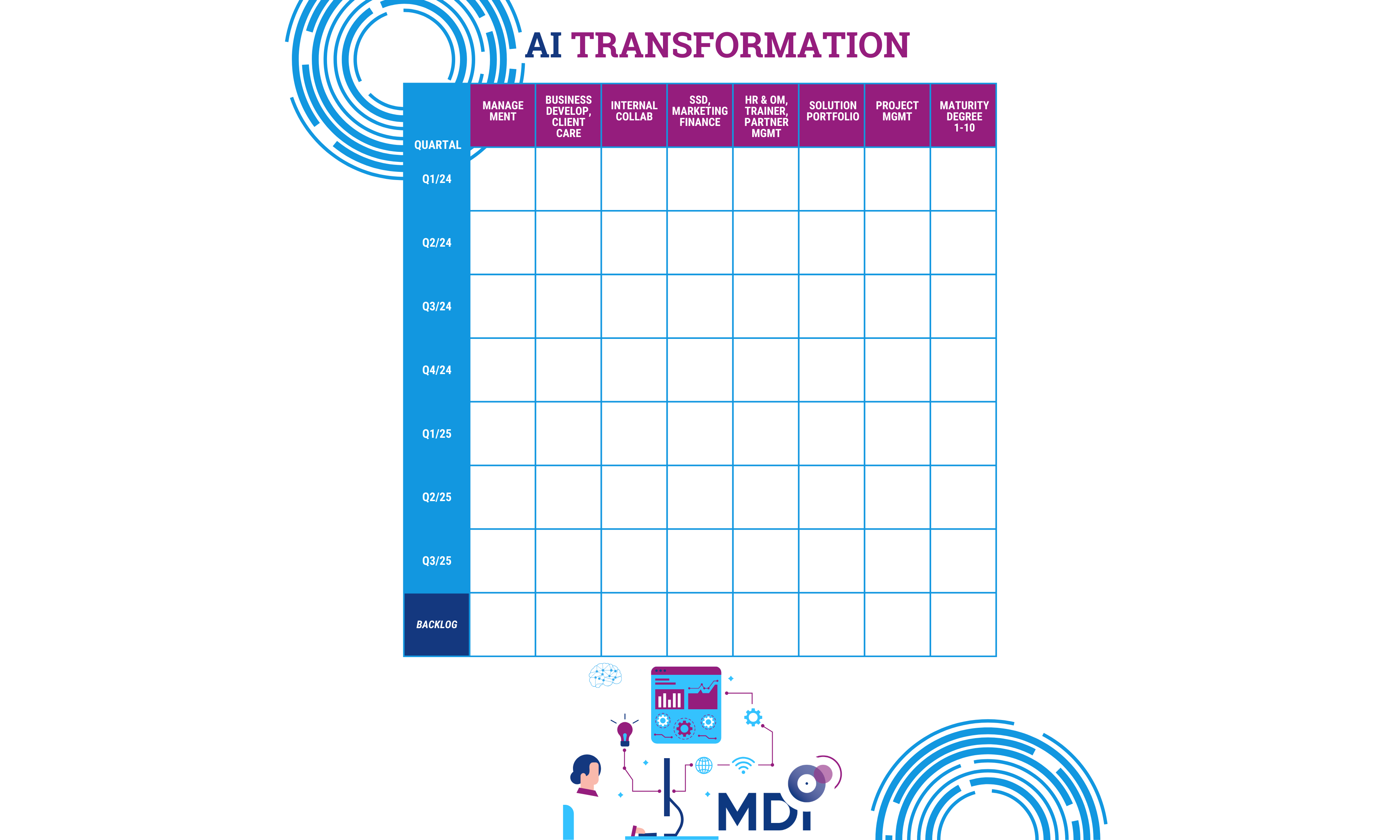
AI Transformation (1000 x 600 mm)

Agile approach – AI Autonomy Day

Organize an AI Autonomy Day: Provide everyone with a day a year to work on any topic in the field of AI. Provide as little guidance as possible. Also, provide a small budget for any licenses. It is important to note that, by the GDPR, no personal or company data should be transferred to unprotected LLMs.

Trying it out can happen individually, in a team, across departments/hierarchies/teams. Provide a communication platform and make it transparent which topics are being worked on. Set a date for presenting the results. Invite relevant stakeholders and decide together what will be done with the results. Repeat the process every six months or even every quarter.

To take it to a strategic level, we recommend setting up an AI transformation roadmap. This roadmap will track the progress and plans for each area. You can decide whether to share the roadmap with everyone individually or by team/area. The results and the maturity level of the project should be recorded by the company management.

This tool offers you the following advantages:

  • Clear vision and strategic direction
  • Improved communication and alignment with stakeholders
  • Controlled resource and time management
  • Risk reduction and adaptability
  • Focused innovation and development of use cases
  • Structured approach – a clear process gets the ball rolling

To find out what leverage AI can have in your company, you need to have a basic knowledge of AI and the (technical) possibilities of AI (weak AI vs reactive AI vs AI with limited storage capacity) . On the other hand, you need to know your processes very well. Those who already have a detailed process map have a clear advantage here.

As a first step, evaluate the AI potential based on your processes and divide your processes into three process types. Then evaluate the savings potential of the activity to determine your starting point with the greatest potential.



Weak AI vs. Reactive AI vs. AI With Limited Storage Capacity

Weak AI: performs tasks, does not learn new skills (voice assistants, generative AI: image generation, text generation, research & diagnosis)

Reactive AI: does not build up memory, reacts to stimuli (spam filters, recommendation systems based on historical data such as Netflix, Amazon)

AI with limited storage capacity: stores knowledge, learns from it and makes forecasts (weather, finance, self-driving cars, chatbots)

(Source: https://ki-campus.org/videos/ki-in-unserem-alltag?locale=de)

Further training & communication

To use the topic of AI profitably and responsibly for everyone in personal development, in the team, and the company, you cannot avoid acquiring a basic knowledge of AI yourself and motivating others to do the same.

Join communities, exchange ideas with peers, and take small steps. But take them consistently and lead by example. Support your colleagues and managers with training, workshops, exchanges, and networking opportunities. Create personalized wikis and AI assistants (e.g. using GPT Builder) to make knowledge more accessible.

 

Marina Begic

Marina Begic

Head of Business Development – Digital Transformation Driver

Marina has been working on new, effective learning methods and the future of corporate learning for over 15 years. In her current role, she is responsible for Digital Business Development at MDI, where her focus is not driven by the current buzzwords, but primarily on the feasibility of digital transformation for clients such as Erste Group, Lenzing, Semperit, Deutsche Bahn, Andritz AG, Uniqa, Mayr-Melnhof, Frequentis, RHIM. Her greatest strength is bringing loose ends together, which she impressively demonstrates time and time again with her big picture view and multi-dimensional approach. Her greatest passion is to provide learners not only with an experience, but also with real, lasting value for their real challenges.


  • LinkedIn

What serves you next?

Zeca Ruiz on Cross-Generational Leadership and Navigating Change

by Jana Wölfl | 13. May 2026 | Leadership Impact, MDI Spotlight Series, Training Insights | 0 Comments

Zeca Ruiz on Cross-Generational Leadership and Navigating Change This blog is an excerpt from our new podcast! You can find the entire podcast episode here. Zeca Ruiz on Cross-Generational Leadership and Navigating Change In the fourth episode of our podcast “Voices...
Read More

How Do You Lead People Who Don’t Think the Way You Do?

by Zeca Ruiz | 4. February 2026 | Leadership Impact, Leadership Tips, Learning Transfer | 0 Comments

How Do You Lead People Who Don't Think the Way You Do? Do you want to listen to this article? Click here to access our AI-generated audio version!   How do you lead people who do not think the way you do? Leadership is a challenge, especially when you are not...
Read More

How You Deal With Neurodiversity as a Leader

by Iris Kandlbauer | 3. February 2026 | Leadership Impact, Leadership Tips, Short Knowledge Bits | 0 Comments

How You Deal With Neurodiversity as a Leader You prefer listening to this article? You can find our AI-generated audio version below! How You Deal With Neurodiversity as a Leader What might be behind “strange” behavior in a team—and how leaders can deal with it...
Read More

Generation Z isn’t the Problem but Our System is

by Zeca Ruiz | 3. December 2025 | Impuls series, International leadership development, Leadership in the digital transformation | 0 Comments

Generation Z Isn’t the Problem, but Our System is. Read this article on crossgenerational management by Zeca Ruiz to find out more!

Read More

The Lasting Impact of Leadership Horizon – Meike’s Perspectives

by Meike Hinnenberg | 2. July 2025 | Leadership Impact, MDI Inside, Short Knowledge Bits | 0 Comments

The Lasting Impact of Leadership Horizon - Meike's Perspectives Do you prefer to listen to this article? Click below to access our AI-generated audio version!The Lasting Impact of Leadership Horizon - Meike's Perspectives MDI’s Meike Hinnenberg shares her reflections...
Read More

Success Through Change: How to Stay Oriented During Transitions

by Anita Berger | 14. April 2025 | Impuls series, Leadership Impact, Leadership Tips | 0 Comments

Success Through Change: How to Stay Oriented During Transitions Do you prefer to listen to this article? Click below to access our AI-generated audio version:Success Through Change: How to Stay Oriented During Transitions Change processes often involve challenges....
Read More

4 Tips on How to Shape Change Processes as a Leader

by Anita Berger | 3. April 2025 | Impuls series, Leadership Impact, Leadership Tips | 0 Comments

4 Tips on How to Shape Change Processes as a Leader Do you prefer to listen to this article? Click below to access our AI-generated audio version:4 Tips on How to Shape Change Processes as a Leader Imagine a dynamic network of paths that is constantly changing. While...
Read More

Successful Team Building for Boehringer Ingelheim RCV

by Anita Berger | 29. March 2024 | Customer Story, International leadership development, MDI Inside | 0 Comments

Successful Team Building for Boehringer Ingelheim RCV Do you prefer to listen to this article? Click below to access our AI-generated audio version:Successful Team Building for Boehringer Ingelheim RCV In the interview with our MDI trainer and partner, Anita Berger On...
Read More

Organize Your Team in a Hybrid Workplace

by Peter Grabuschnig | 14. March 2024 | Impuls series, International leadership development, Leadership in the digital transformation | 0 Comments

Organize Your Team in a Hybrid Workplace Prefer to listen to the article? Click below to access our AI speech-generated audio. However, if you want to read it as usual, keep scrolling.Organize Your Team in a Hybrid Workplace In his new Rise Course, our MDI trainer and...
Read More

Exploring the Influence of AI on Leadership Roles – an experiment by a CEO

by Gunther Fürstberger | 14. November 2023 | International leadership development, Leadership and AI, Leadership in the digital transformation | 0 Comments

Exploring the Influence of AI on Leadership Roles: Learn more about the ongoing ChatGPT experiment by MDI CEO Gunther Fürstberger Do you prefer to listen to this article? Click below to access our AI-generated version. Exploring the Influence of AI on Leadership...
Read More
The ARS Seminar: Lateral Leadership and AI Role-Playing

The ARS Seminar: Lateral Leadership and AI Role-Playing

by Gunther Fürstberger | Aug 23, 2024 | Digital Transformation, Leadership in the digital transformation, MDI Inside | 0 comments

The ARS Seminar: Lateral Leadership and AI Role-Playing

Immerse yourself in the world of lateral leadership with us and experience realistic role-playing with state-of-the-art AI technology! These methods bring a breath of fresh air to the world of leadership development and show how modern approaches can be successfully applied in practice.

Role-playing in Training

Role-plays have been used in communication training for decades to try out real-life challenges in a safe environment and develop skills. These usually take place either with voluntary participants in front of the group or several groups in parallel.

In the first case, the trainer can give direct feedback, in the second case more participants have the opportunity to practice. Not everyone loves role-playing, but overall it is an effective method for developing social skills.

However, the method also has disadvantages that can now be overcome by artificial intelligence: Trainers or even professional actresses don’t work for free. Training and application dates may be far apart, and by then much will have been forgotten.

Role-playing in training

Large Language Models

With the help of LLMs (Large Language Models), on the other hand, it is possible to train as often as required at a fraction of the cost shortly before real-life use. The ChatGPT 4.0 app offers well-functioning language input and output and can access extensive knowledge, such as the DISG model or the Harvard Principles of Negotiation.

Some trainers at MDI have been experimenting with it for a year now, and the participants are enthusiastic. We demonstrate a role play in front of the group, involve several participants, and then pass on the prompt used for self-practice.

AI in Various Management Systems

We have further developed the prompts so that the feedback from the AI is precisely aligned with the models taught in the seminar. In addition, the resistance intensity of the AI role-play partner has been optimized.

Anyone who would like to experience this in reality will have the opportunity to do so in the ARS seminar “Lateral Leadership” from 22.10. to 23.10. Further exciting role-playing functions are currently being developed.

Mag. Gunther Fürstberger

Mag. Gunther Fürstberger

CEO | MDI Management Development International

Gunther Fürstberger is a management trainer, author and CEO of Metaforum and MDI – a global consulting company providing solutions for leadership development. His main interest is to make the world a better place through excellent leadership. He has worked for clients including ABB, Abbvie, Boehringer Ingelheim, DHL, Hornbach, PWC and Swarovski. His core competence is leadership in digital transformation. He gained his own leadership experience as HR Manager of McDonald’s Central Europe/Central Asia.  At the age of 20 he already started working as a trainer.

  • LinkedIn

Download our International Whitepaper:


What serves you next?

How Artificial Intelligence Shapes Who We Become

by Meike Hinnenberg | 19. May 2026 | Impuls series, Leadership and AI, Leadership in the digital transformation | 0 Comments

How Artificial Intelligence Shapes Who We Become Meike’s Reflections on Artificial Intelligence Do you prefer to listen to this article? Click below to access our AI-generated audio version!How Artificial Intelligence Shapes Who We Become Meike’s Reflections on...
Read More

Zeca Ruiz on Cross-Generational Leadership and Navigating Change

by Jana Wölfl | 13. May 2026 | Leadership Impact, MDI Spotlight Series, Training Insights | 0 Comments

Zeca Ruiz on Cross-Generational Leadership and Navigating Change This blog is an excerpt from our new podcast! You can find the entire podcast episode here. Zeca Ruiz on Cross-Generational Leadership and Navigating Change In the fourth episode of our podcast “Voices...
Read More

AI-Empowered Leadership: 6 Guiding Principles

by Gunther Fürstberger | 14. April 2026 | Leadership and AI, Leadership Tips, MDI Whitepaper | 0 Comments

AI-Empowered Leadership: 6 Guiding Principles This blog post is a detailed summary of the whitepaper "Guiding Principles of AI-Empowered Leadership" by MDI's CEO, Gunther Fürstberger. You can find the full whitepaper here! Let's be honest: most conversations about AI...
Read More

What AI Shows You — and What It Doesn’t

by Meike Hinnenberg | 1. April 2026 | Digital Transformation, Impuls series, Leadership and AI | 0 Comments

What AI Shows You — and What It Doesn't Meike’s Reflections on Artificial Intelligence Do you prefer to listen to this article? Click below to access our AI-generated audio version! What AI Shows You — and What It Doesn't Meike’s Reflections on Artificial Intelligence...
Read More

Leading in the Age of AI: How AI Discourse Shapes Responsibility and Power

by Meike Hinnenberg | 18. March 2026 | Impuls series, Leadership and AI, Leadership Tips | 0 Comments

Leading in the Age of AI: How AI Discourse Shapes Responsibility and Power Meike’s Reflections on Artificial Intelligence Do you prefer to listen to this article? Click below to access our AI-generated audio version!Leading in the Age of AI: How AI Discourse Shapes...
Read More

AI Ethics for Leaders: Why Context and Critical Thinking Matter More Than Ever

by Meike Hinnenberg | 11. March 2026 | Impuls series, Leadership and AI, Learning Transfer | 0 Comments

AI Ethics for Leaders: Why Context and Critical Thinking Matter More Than Ever. Meike’s Reflections on Artificial Intelligence Do you prefer to listen to this article? Click below to access our AI-generated audio version!AI Ethics for Leaders: Why Context and Critical...
Read More

A Success Story – When AI Sharpens Human Judgement

by Claude MacDonald, Rafael Ungvari | 6. March 2026 | Customer Story, Digital Transformation, Leadership and AI | 0 Comments

A Success Story – When AI Sharpens Human Judgement Do you prefer to listen to this article? Click here to access our AI-generated audio version! When AI Amplifies Human Judgment: A Customer Success Story About This Project At MDI, we believe that great leadership and...
Read More

How Do You Lead People Who Don’t Think the Way You Do?

by Zeca Ruiz | 4. February 2026 | Leadership Impact, Leadership Tips, Learning Transfer | 0 Comments

How Do You Lead People Who Don't Think the Way You Do? Do you want to listen to this article? Click here to access our AI-generated audio version!   How do you lead people who do not think the way you do? Leadership is a challenge, especially when you are not...
Read More

How You Deal With Neurodiversity as a Leader

by Iris Kandlbauer | 3. February 2026 | Leadership Impact, Leadership Tips, Short Knowledge Bits | 0 Comments

How You Deal With Neurodiversity as a Leader You prefer listening to this article? You can find our AI-generated audio version below! How You Deal With Neurodiversity as a Leader What might be behind “strange” behavior in a team—and how leaders can deal with it...
Read More

Anita’s Key to Success for International Cooperation

by Jana Wölfl | 3. February 2026 | Leadership and AI, Leadership Tips, MDI Spotlight Series | 0 Comments

Anita's Key to Success for International Cooperation This blog is an excerpt from our new podcast! You can find the entire podcast episode here. Anita's Key to Success for International Cooperation In our new video podcast format, “Voices of Leadership – an MDI...
Read More
Exploring the Influence of AI on Leadership Roles – an experiment by a CEO

Exploring the Influence of AI on Leadership Roles – an experiment by a CEO

by Gunther Fürstberger | Nov 14, 2023 | International leadership development, Leadership and AI, Leadership in the digital transformation | 0 comments

Exploring the Influence of AI on Leadership Roles:

Learn more about the ongoing ChatGPT experiment by MDI CEO Gunther Fürstberger

Do you prefer to listen to this article? Click below to access our AI-generated version. 

Exploring the Influence of AI on Leadership Roles:

Learn more about the ongoing ChatGPT experiment by MDI CEO Gunther Fürstberger

In a ChatGPT experiment, our CEO Gunther Fürstberger tried to test the boundaries between artificial intelligence and humans. He asked himself and ChatGPT the same questions to determine the differences. Read this blog post to see the results.

You can connect with Gunther Fürstberger on LinkedIn and join the conversation! 

“How much can the 4 main roles of a leader according to Covey be supported by AI”

Answers from Gunther Fürstberger:

1. Creating trust: Transparency: AI can visualize the most important things. AI can provide reliable and well-founded answers.

2. Develop visions: AI can calculate the probability of achieving a vision and create proposals for the Strategic Roadmap

3. Implement strategies: AI can coordinate alignment and coordination of priorities between departments and over time

4. Coach potentials: AI can make learning suggestions

Answers from ChatGPT:

The four main roles of a leader according to Covey – building trust, developing vision, implementing strategies, and coaching potential – can be supported to varying degrees by AI technologies. Here is an assessment of how each of these roles could benefit from AI:

Creating trust

AI can help bring transparency and objectivity to decision-making processes. Data-driven analytics can help leaders make informed decisions and build trust by demonstrating that decisions are based on verifiable information.

Developing visions

AI can help extract information from large amounts of data and identify trends that can help develop long-term visions and strategies. AI models can recognize patterns that are difficult for humans to perceive, providing valuable insights for the development of plans.

Implementing strategies

AI can assist in project and resource management. By analyzing data and predicting outcomes, AI can help leaders to better plan and adapt their strategies. Automation of recurring tasks can also create more time for strategic thinking.

Coaching potential

This is one of the biggest challenges for AI. While AI can assist to some extent in identifying individual strengths and weaknesses, the interpersonal and emotional intelligence required for effective coaching is a capability that AI has not yet fully achieved. However, AI can support learning platforms and personalized training to support the individual growth of team members.

It is important to note that AI is not meant to replace human leaders, but rather to complement and support them. Human intuition, interpersonal skills, and the ability to solve problems creatively remain crucial, especially in situations that require empathy, emotional understanding, and complex decision-making.

Better Leadership World with IDGs

“What can humans do better?”

Answers from Gunther Fürstberger:

1. Creating trust

When we talk about leading people, humans have a similar advantage. Trust is made up of integrity and competence. In terms of integrity, humans can draw on more experience with people (e.g. in the family) than with AI and would probably currently place more trust in a human leader. People can draw on intuitive skills.

2. Develop visions

Humans can use their own emotions to check how much a vision appeals to them.

3. Implement strategies

People can sometimes better recognize and deal with resistance.

4. Coaching potential

Some people are passionate about supporting the development of others.

ChatGPT answers:

Humans bring a set of skills and qualities that are difficult or even impossible to replicate by Artificial Intelligence (AI). Here are some areas where humans are often better:

Emotional intelligence and empathy

Humans can perceive subtle emotional nuances, understand interpersonal relationships, and show empathy. These skills are crucial in leadership positions, especially when it comes to motivating employees, resolving conflicts, and creating a supportive work environment.

Creativity and innovation

Creativity involves linking different ideas and concepts in unexpected ways. Humans can come up with unconventional solutions, develop ideas, and drive innovation beyond the programmatic capabilities of AI.

Complex interpersonal communication

Interpreting body language, non-verbal communication, and subtle signs is a human strength. In complex interpersonal situations, such as negotiations or conflict resolution, human understanding of communication is invaluable.

Values and ethics

People have moral and ethical considerations that influence their decision-making. The ability to weigh up right and wrong is strongly influenced by individual values and social norms, which AI does not have in the same way.

Intuition and gut feeling

People often make quick decisions based on intuition or gut feeling, based on experience and emotional signals. This can be useful in situations where data is incomplete or decision-making needs to be quick.

Contextual understanding

People can better grasp the context of a situation, including cultural, social, and historical aspects. This is important for making decisions based on a broader perspective.

Adaptability

People can adapt quickly to unexpected changes and new situations. They can react flexibly to unforeseen events and develop alternative solutions.

It is important to emphasize that AI and human skills can complement each other. AI can automate repetitive tasks, facilitate data analysis, and serve as a source of information, while humans bring their unique skills to manage complex situations and foster human relationships.

The 5 most important soft skills for leaders in the age of AI

How does AI influence the management task of delegation?

What do we delegate?

Answer from Gunther Fürstberger:

What we delegate and what we prefer to do ourselves is a personal question. It has to do with our abilities and wishes. If you want to build up a large company or a corporation should delegate as much as possible. If you want to learn as an expert, keep the exciting topics for yourself and delegate routine tasks.

As it ultimately comes down to the question of what work you want to do, what you find meaningful, and what you enjoy, it is probably better to engage in an internal dialogue about this than to leave these decisions to an AI app. AI programs such as Insightful can coach you on this, however.

Answer from ChatGPT:

Task automation

AI can automate repetitive and time-consuming tasks. This allows leaders to focus on more strategic and creative tasks.

Data analysis and decision-making

Leaders can delegate the analysis of large amounts of data and the derivation of insights to
AI systems to make informed decisions.

Communication and information management

Chatbots and intelligent assistance systems can support the management of communication and information by filtering emails, scheduling appointments, and organizing information.

Who do we delegate to?

Answer from Gunther Fürstberger:

AI itself takes on the function of an employee to whom it can be delegated. And the most interesting thing is that this employee is sure to get better, can take on more, and deliver higher-quality results. It wasn’t so long ago that we were hiring translation agencies to translate training materials into other languages.

Now this works in seconds with good quality. Learning search engines provide us with relevant information, and travel portals with suitable and affordable transportation and accommodation options. Navigation systems save us from traffic jams and radar fines. OpenAI can summarize books in 1000 characters or write poems for the Christmas party.

Which “human employees” you delegate to depends, for example, on their available capacity, skills, and wishes. If you as a line leader have a management span of e.g. 10 employees, then your assessment based on interviews is probably sufficient to decide which tasks you pass on to which person.

If the number of delegation candidates is very high, machine learning can help to create a selection of suitable candidates. There are consultant or coach databases and recruiting programs that suggest the top selection from a large number of people according to defined criteria.

Answer from ChatGPT:

AI systems and robots

Tasks can be delegated to specialized AI systems or robots that have been developed for specific tasks or processes.

Employees and teams

Leaders must decide which tasks are delegated to employees and teams and ensure that the resources and skills are in place to complete these tasks successfully. 

ai's developments

How do we delegate?

Answer from Gunther Fürstberger:

How you delegate determines the confidence and motivation with which your employees will carry out the task. Depending on their level of experience, employees should be given more or less autonomy. If the person receiving the delegation is a professional, it is sufficient to state the purpose of the task. “For example, could you please make sure that the visitors are happy”.

This would be too much for a beginner. This assessment of employees is currently still the responsibility of the leader and not an AI program. However, ChatGPT could be used to design skill tests or self-assessments. However, AI tools such as Taskade.com are good at generating lists of detailed tasks from main tasks.

Answer from ChatGPT:

Skills assessment

Leaders need to assess the skills and strengths of their employees and AI systems to delegate the right tasks to the right people or systems

Clear communication

Clear communication is crucial to set the expectations and goals of delegation. This is
particularly important when delegating tasks to AI systems as the programming and configuration must be correct.

Monitoring and feedback

Leaders need to monitor the progress and performance of delegated tasks and provide regular feedback to ensure that objectives are being met. Overall, integrating AI into delegation processes allows for a more efficient and targeted use of resources, enabling leaders to focus on strategic and valuable tasks while improving the overall performance of the organization.

However, it is important to consider the human and ethical aspects of delegation in the context of AI and ensure that it is in line with the organization’s values and goals.

How can AI contribute to corporate management?

Answer from Gunther Fürstberger:

Artificial intelligence has had a permanent place at the table in our leadership meetings since July 2023. It’s not yet a robot dressed in a costume or suit with speech recognition and output, but a member of the leadership team who gives AI a voice. At the moment, I’m taking care of it and doing it as follows:

1. We have a shared agenda document in MsTeams. About 1 day before our weekly 50-minute leadership meeting, I look at the agenda and select 1 topic, for which I usually create a ChatGPT4 prompt.

2. I show the answer in the meeting and we discuss it. There are almost always good suggestions that give us new ideas.

3. AI does not yet have a (co-)decision-making role. At the moment, it is more of a valued advisory role.

We have decided to integrate AI into company management for 2 main reasons:

As a management development institute, we see it as our responsibility to help shape the opportunities and risks of AI in leadership in general. This raises many interesting and challenging questions, such as “Do we want organizations in our society that will one day no longer be led by humans, but by AI?”

At the moment, we believe in the co-creation of leaders with AI and also want to learn from our own experiences in the spirit of “walking the talk“.

b. As a company, we are convinced that we need to keep disrupting ourselves to develop further and make a relevant and efficient contribution to society. AI currently offers enormous potential for disruption, which we want to exploit with passion and a sense of responsibility.

An interesting side effect of integrating AI at the management level is that we are using AI more consistently in a wide range of operational areas. We have now also launched an AI transformation journey for all areas of the company and introduced AI co-trainers. But there will be separate blog posts about this.

From today’s perspective, we can recommend the integration of AI in corporate management and would be delighted if you would also share your experiences with us, for example in the comments.

Leadership between Connectedness and AI-2

Now the answer from ChatGPT-4 to a slightly customized prompt:

“Please describe an example of the integration of AI in board meetings”

AI integration in board meetings: a practical example

Initial situation

An international technology company wants to increase the effectiveness of its board meetings. The meetings are often characterized by extensive reports, presentations, and data analyses, which slows down decision-making processes. It is decided to introduce an AI-powered solution to streamline discussions and facilitate real-time, data-based decisions.

Solution

1. Preparation of the meeting

An AI system consolidates all relevant data and reports from the various departments in advance. It checks these for completeness, up-to-dateness, and consistency. It then generates a summary of the most important points and visualizes them in easy-to-understand diagrams and graphics.

2. During the meeting

An AI-supported assistant projects information onto a screen in real-time. For example, if a board member asks a question about sales development in a specific market, the AI immediately displays the relevant data, historical trends, and forecasts. Through machine learning and pattern recognition, the AI can also suggest potential causes for deviations or anomalies.

3. Interactive discussions

The system enables board members to run through “what if” scenarios in real-time. For example, when discussing how an increase in the marketing budget could affect sales, the AI simulates the potential impact based on historical data and current market conditions.

4. Recording and task management

The AI records the meeting and transcribes it in real-time. Based on the discussion, it recognizes action items and assignments and automatically creates meeting minutes with a list of tasks, responsibilities, and deadlines.

5. Feedback loop

After the meeting, the AI collects feedback from the participants to continuously improve the process and the data presented. It learns from this feedback to make future meetings even more effective.

Conclusion

Integrating AI into board meetings can significantly speed up and improve the decision-making process. Providing data in real-time enables fact-based discussion and helps the board to make informed and strategic decisions. However, it is important to ensure that AI recommendations are transparent and that human intuition and expertise continue to play a central role in the decision-making process.

Insight from the ChatGTP response

So far, we have mainly used AI as a source of inspiration in management meetings. We will soon be trying out AI meeting software to optimize meeting documentation, including the formulation of action items.

Hopefully, these questions have given you something to think about. As you can see, there are still some differences between human and AI-created answers. 

Mag. Gunther Fürstberger

Mag. Gunther Fürstberger

CEO | MDI Management Development International

Gunther Fürstberger is a management trainer, author and CEO of Metaforum and MDI – a global consulting company providing solutions for leadership development. His main interest is to make the world a better place through excellent leadership. He has worked for clients including ABB, Abbvie, Boehringer Ingelheim, DHL, Hornbach, PWC and Swarovski. His core competence is leadership in digital transformation. He gained his own leadership experience as HR Manager of McDonald’s Central Europe/Central Asia.  At the age of 20 he already started working as a trainer.

  • LinkedIn

Download our International Whitepaper:


What serves you next?

How Artificial Intelligence Shapes Who We Become

by Meike Hinnenberg | 19. May 2026 | Impuls series, Leadership and AI, Leadership in the digital transformation | 0 Comments

How Artificial Intelligence Shapes Who We Become Meike’s Reflections on Artificial Intelligence Do you prefer to listen to this article? Click below to access our AI-generated audio version!How Artificial Intelligence Shapes Who We Become Meike’s Reflections on...
Read More

Zeca Ruiz on Cross-Generational Leadership and Navigating Change

by Jana Wölfl | 13. May 2026 | Leadership Impact, MDI Spotlight Series, Training Insights | 0 Comments

Zeca Ruiz on Cross-Generational Leadership and Navigating Change This blog is an excerpt from our new podcast! You can find the entire podcast episode here. Zeca Ruiz on Cross-Generational Leadership and Navigating Change In the fourth episode of our podcast “Voices...
Read More

AI-Empowered Leadership: 6 Guiding Principles

by Gunther Fürstberger | 14. April 2026 | Leadership and AI, Leadership Tips, MDI Whitepaper | 0 Comments

AI-Empowered Leadership: 6 Guiding Principles This blog post is a detailed summary of the whitepaper "Guiding Principles of AI-Empowered Leadership" by MDI's CEO, Gunther Fürstberger. You can find the full whitepaper here! Let's be honest: most conversations about AI...
Read More

What AI Shows You — and What It Doesn’t

by Meike Hinnenberg | 1. April 2026 | Digital Transformation, Impuls series, Leadership and AI | 0 Comments

What AI Shows You — and What It Doesn't Meike’s Reflections on Artificial Intelligence Do you prefer to listen to this article? Click below to access our AI-generated audio version! What AI Shows You — and What It Doesn't Meike’s Reflections on Artificial Intelligence...
Read More

Leading in the Age of AI: How AI Discourse Shapes Responsibility and Power

by Meike Hinnenberg | 18. March 2026 | Impuls series, Leadership and AI, Leadership Tips | 0 Comments

Leading in the Age of AI: How AI Discourse Shapes Responsibility and Power Meike’s Reflections on Artificial Intelligence Do you prefer to listen to this article? Click below to access our AI-generated audio version!Leading in the Age of AI: How AI Discourse Shapes...
Read More

AI Ethics for Leaders: Why Context and Critical Thinking Matter More Than Ever

by Meike Hinnenberg | 11. March 2026 | Impuls series, Leadership and AI, Learning Transfer | 0 Comments

AI Ethics for Leaders: Why Context and Critical Thinking Matter More Than Ever. Meike’s Reflections on Artificial Intelligence Do you prefer to listen to this article? Click below to access our AI-generated audio version!AI Ethics for Leaders: Why Context and Critical...
Read More

A Success Story – When AI Sharpens Human Judgement

by Claude MacDonald, Rafael Ungvari | 6. March 2026 | Customer Story, Digital Transformation, Leadership and AI | 0 Comments

A Success Story – When AI Sharpens Human Judgement Do you prefer to listen to this article? Click here to access our AI-generated audio version! When AI Amplifies Human Judgment: A Customer Success Story About This Project At MDI, we believe that great leadership and...
Read More

How Do You Lead People Who Don’t Think the Way You Do?

by Zeca Ruiz | 4. February 2026 | Leadership Impact, Leadership Tips, Learning Transfer | 0 Comments

How Do You Lead People Who Don't Think the Way You Do? Do you want to listen to this article? Click here to access our AI-generated audio version!   How do you lead people who do not think the way you do? Leadership is a challenge, especially when you are not...
Read More

How You Deal With Neurodiversity as a Leader

by Iris Kandlbauer | 3. February 2026 | Leadership Impact, Leadership Tips, Short Knowledge Bits | 0 Comments

How You Deal With Neurodiversity as a Leader You prefer listening to this article? You can find our AI-generated audio version below! How You Deal With Neurodiversity as a Leader What might be behind “strange” behavior in a team—and how leaders can deal with it...
Read More

Anita’s Key to Success for International Cooperation

by Jana Wölfl | 3. February 2026 | Leadership and AI, Leadership Tips, MDI Spotlight Series | 0 Comments

Anita's Key to Success for International Cooperation This blog is an excerpt from our new podcast! You can find the entire podcast episode here. Anita's Key to Success for International Cooperation In our new video podcast format, “Voices of Leadership – an MDI...
Read More
The 5 most important soft skills for leaders in the age of AI

The 5 most important soft skills for leaders in the age of AI

by Jana Wölfl | Sep 29, 2023 | Impuls series, Leadership and AI, Leadership Tips | 0 comments

The 5 most important soft skills for leaders in the age of AI

Prefer to listen to the article? Click below to access our AI speech-generated audio. However, if you want to read it as usual, keep scrolling.

The 5 most important soft skills for leaders in the age of AI

In times where artificial intelligence knows no boundaries and numerous programs can seemingly replace any work, leaders are placing more and more value on so-called soft management skills.

In this blog post, you will learn what exactly we mean by this and why soft management skills are indispensable, especially in the context of artificial intelligence. However, if you want to learn more about the basics of artificial intelligence, you can read the first blog post of our AI series here.

Hard vs. soft management skills

While hard management skills focus more on actually doing the job, e.g. dealing with data, managing and analyzing projects, and allocating budget, soft skills are mainly about the human aspect of leadership.

Thus, it is more about empathy, cohesion, transparent communication, etc., which means that leaders should pay more attention to social interaction with their employees. While both areas of leadership are equally relevant, there is one important factor that differentiates them:

Artificial intelligence can replace the hard aspects of leadership, but not the “soft” ones.

Especially in the aforementioned areas – i.e., data analysis and management, forecasting and budgeting – but also in project management, marketing, and HR, there are now quite a few programs that significantly simplify a leader’s tasks and make them more efficient. 

While artificial intelligence can save us some work, it cannot replace the human aspect. So the more AI takes over these technical tasks, the more important it is for leaders to focus on soft skills.

The 5 most important soft skills for leaders in the age of AI

The 5 most important soft skills for leaders in the age of AI

Of course, there is a wide range of relevant soft skills that you should apply as a leader in your everyday work. Here we present the 5 most essential ones.

1. Transparent communication

As a leader, you should be able to talk openly and honestly with your employees about internal and external topics. Also, in the context of artificial intelligence, it is important to clearly communicate to your employees where AI will be used and how your work structures will now change.

You can find more about Transparent Communication in Gunther Fürstberger’s book “Winning Commitment as a Lateral Leader” in the chapter “The Communicator and the Three Commitment Steps”.

2. Empathy and social understanding

Especially in times where roles in the company are changing rapidly and new programs and devices are constantly being introduced, it is important to be able to empathize with your employees and also understand what they need.

Because in the end, of course, it’s not just about your vision as a leader, but also about making sure your employees feel comfortable with the move to artificially intelligent programs and that any concerns about the issue can be listened to and addressed as far as possible.

More on how to boost your empathy in this article.

3. Adaptability

As a leader, you should be constantly learning about new programs and technologies to stay current. It is important not to be afraid of these changes and adapt to them as soon as possible.

soft skills

4. Awareness of cultural and gender differences

The use of artificial intelligence varies from culture to culture, which you should be especially aware of when working with other countries. Also, there is a large gender gap in the tech industry, and some AI algorithms harbor unintended biases and gender stereotypes.

Being aware of these factors can help you be mindful of the inclusive use of artificially intelligent programs.

You can read more about this topic in this article.

5. Critical thinking

While AI programs can handle some of our routine tasks, their flawless problem-solving is not guaranteed. Therefore, it is up to you as a leader to review the programs’ solutions and critically question whether they have actually handled the problem ideally.

In this article, you will find tips on how to improve your critical thinking.

Conclusion

Especially now that artificial intelligence can take over more and more tasks and facilitate processes, it is important for leaders to strengthen and develop their soft skills. Thus, a smooth transition to AI programs can succeed not only for you but also for your team and the entire organization.

Jana Wölfl

Jana Wölfl

Marketing Assistant

Jana Wölfl works at MDI as a marketing assistant and writes blog posts for our site in addition to her studies at Leiden University.

She also works for SDI and supports us with writing content there as well.

  • LinkedIn

Download our new MDI Whitepaper:

This could also interest you:

How Artificial Intelligence Shapes Who We Become

by Meike Hinnenberg | 19. May 2026 | Impuls series, Leadership and AI, Leadership in the digital transformation | 0 Comments

How Artificial Intelligence Shapes Who We Become Meike’s Reflections on Artificial Intelligence Do you prefer to listen to this article? Click below to access our AI-generated audio version!How Artificial Intelligence Shapes Who We Become Meike’s Reflections on...
Read More

Zeca Ruiz on Cross-Generational Leadership and Navigating Change

by Jana Wölfl | 13. May 2026 | Leadership Impact, MDI Spotlight Series, Training Insights | 0 Comments

Zeca Ruiz on Cross-Generational Leadership and Navigating Change This blog is an excerpt from our new podcast! You can find the entire podcast episode here. Zeca Ruiz on Cross-Generational Leadership and Navigating Change In the fourth episode of our podcast “Voices...
Read More

AI-Empowered Leadership: 6 Guiding Principles

by Gunther Fürstberger | 14. April 2026 | Leadership and AI, Leadership Tips, MDI Whitepaper | 0 Comments

AI-Empowered Leadership: 6 Guiding Principles This blog post is a detailed summary of the whitepaper "Guiding Principles of AI-Empowered Leadership" by MDI's CEO, Gunther Fürstberger. You can find the full whitepaper here! Let's be honest: most conversations about AI...
Read More

What AI Shows You — and What It Doesn’t

by Meike Hinnenberg | 1. April 2026 | Digital Transformation, Impuls series, Leadership and AI | 0 Comments

What AI Shows You — and What It Doesn't Meike’s Reflections on Artificial Intelligence Do you prefer to listen to this article? Click below to access our AI-generated audio version! What AI Shows You — and What It Doesn't Meike’s Reflections on Artificial Intelligence...
Read More

Leading in the Age of AI: How AI Discourse Shapes Responsibility and Power

by Meike Hinnenberg | 18. March 2026 | Impuls series, Leadership and AI, Leadership Tips | 0 Comments

Leading in the Age of AI: How AI Discourse Shapes Responsibility and Power Meike’s Reflections on Artificial Intelligence Do you prefer to listen to this article? Click below to access our AI-generated audio version!Leading in the Age of AI: How AI Discourse Shapes...
Read More

AI Ethics for Leaders: Why Context and Critical Thinking Matter More Than Ever

by Meike Hinnenberg | 11. March 2026 | Impuls series, Leadership and AI, Learning Transfer | 0 Comments

AI Ethics for Leaders: Why Context and Critical Thinking Matter More Than Ever. Meike’s Reflections on Artificial Intelligence Do you prefer to listen to this article? Click below to access our AI-generated audio version!AI Ethics for Leaders: Why Context and Critical...
Read More

A Success Story – When AI Sharpens Human Judgement

by Claude MacDonald, Rafael Ungvari | 6. March 2026 | Customer Story, Digital Transformation, Leadership and AI | 0 Comments

A Success Story – When AI Sharpens Human Judgement Do you prefer to listen to this article? Click here to access our AI-generated audio version! When AI Amplifies Human Judgment: A Customer Success Story About This Project At MDI, we believe that great leadership and...
Read More

How Do You Lead People Who Don’t Think the Way You Do?

by Zeca Ruiz | 4. February 2026 | Leadership Impact, Leadership Tips, Learning Transfer | 0 Comments

How Do You Lead People Who Don't Think the Way You Do? Do you want to listen to this article? Click here to access our AI-generated audio version!   How do you lead people who do not think the way you do? Leadership is a challenge, especially when you are not...
Read More

How You Deal With Neurodiversity as a Leader

by Iris Kandlbauer | 3. February 2026 | Leadership Impact, Leadership Tips, Short Knowledge Bits | 0 Comments

How You Deal With Neurodiversity as a Leader You prefer listening to this article? You can find our AI-generated audio version below! How You Deal With Neurodiversity as a Leader What might be behind “strange” behavior in a team—and how leaders can deal with it...
Read More

Anita’s Key to Success for International Cooperation

by Jana Wölfl | 3. February 2026 | Leadership and AI, Leadership Tips, MDI Spotlight Series | 0 Comments

Anita's Key to Success for International Cooperation This blog is an excerpt from our new podcast! You can find the entire podcast episode here. Anita's Key to Success for International Cooperation In our new video podcast format, “Voices of Leadership – an MDI...
Read More

Information

  • Imprint
  • MDI company website

Social Media

  • Facebook
  • Twitter
  • Youtube
  • LinkedIn

© MDI Management Development Institute, 2020