
• MDI
  • German version
  • Contact us
MDI Management Development
  • Agile leadership
  • Lateral Leadership
  • Leadership Impact
  • Leadership Development
Select Page
How to become resilient? Your personal superpower

How to become resilient? Your personal superpower

by Anita Berger, ARD | Sep 26, 2022 | Agile Leadership, Leadership Tips | 0 comments

How to become resilient? Your personal superpower

Meeting the challenges in the VUCA/BANI world

In this article you will get an insight into key competencies as well as starting points to strengthen your own resilience. Concrete reflection questions and tips for implementation will let you become a “pro” of your own superpower.

VUCA & BANI

VUCA or BANI as explanatory models for our challenges

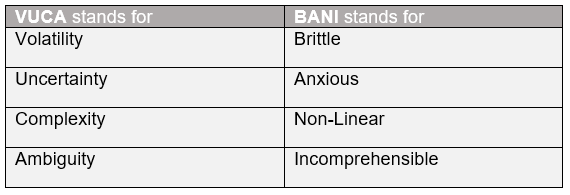
In our daily professional lives, we are constantly confronted with turbulence. The following models provide a framework to bring challenges closer for companies and for society as a whole:

All these terms define what we are up against in this ever-changing society – a fragile system that is only fueled by uncertainty and anxiety, as well as complex, non-linear problems. The demands on organizations and leadership are sometimes ambiguous and contradictory, but also incomprehensible.

Key competencies for your superpower

to meet these challenges

Resilience in dealing with crises and challenges

Jamais Cascio counters these complex models with a response option: RAAT (Resilience, Awareness, Adaptation and Transparency). For the first factor alone – resilience – there are several models. I present the Vienna Resilience Model below.

Seven key resilience competencies

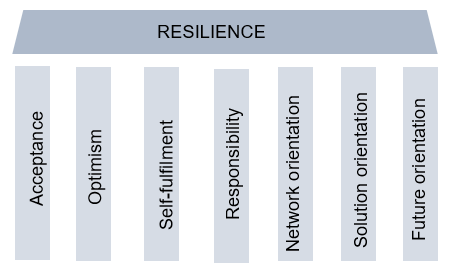
The Vienna Resilience Model describes seven key resilience competencies that positively influence a person’s resilience:

The basic pillars of resilience are 

  • acceptance
  • optimism
  • self-fulfilment
  • responsibility
  • network orientation
  • solution orientation
  • future orientation.

Each of these factors plays an important role in strengthening one’s resilience.

Strengthening the superpower of resilience holistically

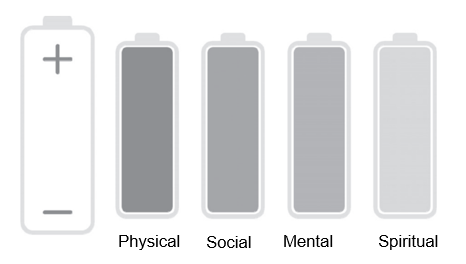
In contrast to the Vienna Resilience Model, Stephen Covey identifies four pillars in his 7 Habits of Highly Effective People, which are also found in most other models to strengthen one’s resources and thus one’s resilience.

When reflecting on how you use your resources, you should take each resource individually and consider how well you take care of each. This could be in the form of the following approaches, for example:

  • Physical: I regularly keep myself informed about things that affect my health and fitness.
  • Mental: I clear my head every day through, for example, music, silence or relaxation exercises.
  • Social: I listen to others and pay attention to what they have to say instead of thinking about what I want to say.
  • Spiritual: I have the courage to stand my ground even when others oppose me.

Becoming the “pro” of your own superpower –

tips for implementation

If we want to strengthen our resilience, we sometimes need to develop new habits and behaviors or retrain “bad habits” (for example, taking the stairs instead of the elevator). James Clear’s (2020) 1% method states that the best way to achieve goals is to get a little better every day, i.e., to work towards them in small steps for maximum impact. Improving 1% per day will yield a 37-fold increase in one year.

Conclusion

The VUCA or BANI world presents challenges to all of us. In dealing with these challenges, we can further “nurture” or build our key competencies of resilience by being aware of them as a first step.

In small steps and with the coupling to our previous habits, we can then integrate our resources, which further strengthens our superpower resilience holistically into our behavioral repertoire

Read the full (german) article that was written for ARD Magazin | Edition 6814/6/2022

Anita Berger

Anita Berger

Executive Coach, Consultant, Trainer & Managing Partner MDI

Anita Berger is an executive coach, consultant and trainer specialising in leadership development and international human resource management. She is a partner of MDI Management Development International. For more than 15 years she has worked in management and leadership positions (among others as HR-
Director at Coca-Cola Hellenic and HR Manager at Konica Minolta Business Solutions).

  • LinkedIn

What might help you next?

Use It or Lose It: How AI and Digital Tools May Be Changing Our Brains

by Florian Biedermann | 26. May 2026 | Leadership and AI, Leadership Tips, Learning Transfer | 0 Comments

Use It or Lose It: How AI and Digital Tools May Be Changing Our Brains You travel to Madrid and want to chat with the locals, but you realize that after five years without practice, your rudimentary Spanish skills are now practically nonexistent and you even struggle...
Read More

How Artificial Intelligence Shapes Who We Become

by Meike Hinnenberg | 19. May 2026 | Impuls series, Leadership and AI, Leadership in the digital transformation | 0 Comments

How Artificial Intelligence Shapes Who We Become Meike’s Reflections on Artificial Intelligence Do you prefer to listen to this article? Click below to access our AI-generated audio version!How Artificial Intelligence Shapes Who We Become Meike’s Reflections on...
Read More

Zeca Ruiz on Cross-Generational Leadership and Navigating Change

by Jana Wölfl | 13. May 2026 | Leadership Impact, MDI Spotlight Series, Training Insights | 0 Comments

Zeca Ruiz on Cross-Generational Leadership and Navigating Change This blog is an excerpt from our new podcast! You can find the entire podcast episode here. Zeca Ruiz on Cross-Generational Leadership and Navigating Change In the fourth episode of our podcast “Voices...
Read More

AI-Empowered Leadership: 6 Guiding Principles

by Gunther Fürstberger | 14. April 2026 | Leadership and AI, Leadership Tips, MDI Whitepaper | 0 Comments

AI-Empowered Leadership: 6 Guiding Principles This blog post is a detailed summary of the whitepaper "Guiding Principles of AI-Empowered Leadership" by MDI's CEO, Gunther Fürstberger. You can find the full whitepaper here! Let's be honest: most conversations about AI...
Read More

What AI Shows You — and What It Doesn’t

by Meike Hinnenberg | 1. April 2026 | Digital Transformation, Impuls series, Leadership and AI | 0 Comments

What AI Shows You — and What It Doesn't Meike’s Reflections on Artificial Intelligence Do you prefer to listen to this article? Click below to access our AI-generated audio version! What AI Shows You — and What It Doesn't Meike’s Reflections on Artificial Intelligence...
Read More

Leading in the Age of AI: How AI Discourse Shapes Responsibility and Power

by Meike Hinnenberg | 18. March 2026 | Impuls series, Leadership and AI, Leadership Tips | 0 Comments

Leading in the Age of AI: How AI Discourse Shapes Responsibility and Power Meike’s Reflections on Artificial Intelligence Do you prefer to listen to this article? Click below to access our AI-generated audio version!Leading in the Age of AI: How AI Discourse Shapes...
Read More

AI Ethics for Leaders: Why Context and Critical Thinking Matter More Than Ever

by Meike Hinnenberg | 11. March 2026 | Impuls series, Leadership and AI, Learning Transfer | 0 Comments

AI Ethics for Leaders: Why Context and Critical Thinking Matter More Than Ever. Meike’s Reflections on Artificial Intelligence Do you prefer to listen to this article? Click below to access our AI-generated audio version!AI Ethics for Leaders: Why Context and Critical...
Read More

A Success Story – When AI Sharpens Human Judgement

by Claude MacDonald, Rafael Ungvari | 6. March 2026 | Customer Story, Digital Transformation, Leadership and AI | 0 Comments

A Success Story – When AI Sharpens Human Judgement Do you prefer to listen to this article? Click here to access our AI-generated audio version! When AI Amplifies Human Judgment: A Customer Success Story About This Project At MDI, we believe that great leadership and...
Read More

How Do You Lead People Who Don’t Think the Way You Do?

by Zeca Ruiz | 4. February 2026 | Leadership Impact, Leadership Tips, Learning Transfer | 0 Comments

How Do You Lead People Who Don't Think the Way You Do? Do you want to listen to this article? Click here to access our AI-generated audio version!   How do you lead people who do not think the way you do? Leadership is a challenge, especially when you are not...
Read More

How You Deal With Neurodiversity as a Leader

by Iris Kandlbauer | 3. February 2026 | Leadership Impact, Leadership Tips, Short Knowledge Bits | 0 Comments

How You Deal With Neurodiversity as a Leader You prefer listening to this article? You can find our AI-generated audio version below! How You Deal With Neurodiversity as a Leader What might be behind “strange” behavior in a team—and how leaders can deal with it...
Read More
The Future of Workplace Learning – Digitization Boost

The Future of Workplace Learning – Digitization Boost

by Marina Begic | Apr 13, 2021 | Agile Leadership, eLearning, Impuls series, learning effectiveness | 0 comments

Impuls Series - The Future of Workplace Learning

Part 1 with Marina Begic: Digital Business Development Expert and Senior L&D Consultant

Our Digital Business Development Expert and Senior L&D Consultant Marina Begic is currently focusing intensively on “The Future of Workplace Learning”.

Fast and targeted learning, especially for leaders, is becoming increasingly important in an intensifying digital and agile world. Therefore, Marina shares her personal learnings with us. Let’s get started with the topic “Digitization Boost”.

By the way, we’ll soon continue with our second part: “Why you can do without Learning managment systems? (LMS)” We’re looking forward to it already!

Hey, Marina is a member of our LinkedIn expert group

If you would like to exchange thoughts and ideas about “Agile Leadership Development”, please send us a request. We are looking forward to you and your valuable impulses!

Join us now!

The Future of Workplace Learning

“friendly reminder”

Who doesn’t know this or a similar situation? The newly announced learning platform, which has been around for 2 years now, “will change the learning culture in the company in the long term, teach us innovative things and save us a lot of time”. Finally it comes out with the first two e-learnings: Fire Protection Ordinance and Compliance…

While you read the bubble text about “maintaining a safe distance from machines in production”, you can visibly see that a lot of effort has been made to maintain the corporate design and the new diversity policy, right down to the avatar named Lucy. After successfully completing the first two courses (there is no other way, since you can click around, until you find the right answer in the final quiz), the third one comes out 3 months later…

After resetting the access data of the e-learning platform (for the 7th company internal tool),

by finding the announcement mail with the link to the platform, one looks with joyful expectation and sees the only new e-learning course is on the topic of “IT security”. The deadline for completion is by the end of the quarter, so there is still enough time. We quickly close the program again. However, this time we set our favorites, so that the next time we do not have to look trough all our mails. In addition our e-mails do not become less and there is still so much to do for the upcoming presentation of a new project this week…

Three days after the end of the quarter comes the third “friendly reminder” from the supervisor, this time in red and capital letters. It tells us to complete the e-learning course “IT Security”, otherwise the quarterly commission cannot be paid on time if the learning objectives have not been achieved.

It’s hard to set priorities here, isn’t it?

The Future of Workplace Learning – Digitization Boost

Current developments

In the 21st-century-skills (P21) the following 4 skills were defined in the area of learning to be able to participate in modern working life:

  • critical thinking
  • creativity
  • collaboration
  • communication

The model has been extended, discussed and modified many times, but it is remarkable that the active and interpersonal part has always remained. Experts agree that learning alone is no longer sustainable in the 21st century.

Technical innovations have redefined teaching and learning

With the breaking down of technical barriers thanks to cloud solutions, more stable and faster internet, learning management systems (LMS) have become increasingly popular. The Corona pandemic gave the perceived need for LMSs another boost.

Face-to-face training sessions have had to be cancelled from one day to the next, and to ensure that learning doesn’t stop, numerous programs have helped to ensure that knowledge building, training and skills transfer can still take place. In other words, synchronous or asynchronous formats were put in place.

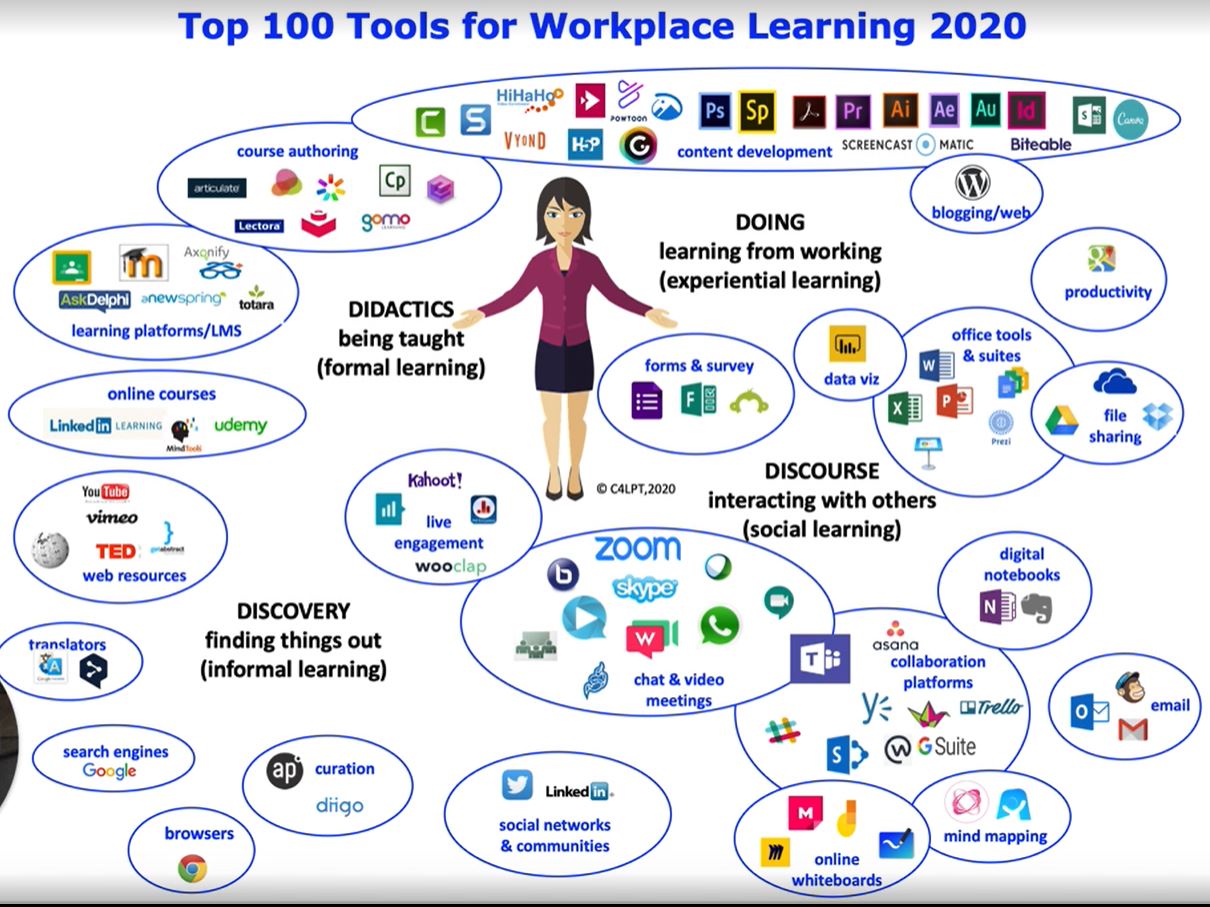
In Jane Hart’s annual international study of the “Top Tools for Learning” in over 45 countries, it can be seen that learning in the workplace does not happen only or only to a small extent via LMS.

The majority of learning does not take place via formal tools, but via informal and, in particular, via active tools, i.e. by trying things out for oneself and talking about them or sharing them!

Top Tools for Learning 2020 (Hart, 2020) 

Since the introduction of e-learnings, the decline of face-to-face training has been prophesied.

Despite many proven advantages such as cost savings, increased learning transfer, more flexible learning through location and time-independent learning, it was only the Corona pandemic that made the necessity of digital learning formats apparent to even the very last companies.

It has become clear that there will be no return to the old ways.

Two-thirds of companies are planning to move employees to remote working in the long term. It is now known that the half-life of knowledge is decreasing insanely fast and that one must continue to learn continuously in one’s working life.

A century ago, it took about 35 years to correct or replace half the knowledge an engineer learned in college. New estimates put the half-life of an engineering degree between 2.5 and five years. The basics remain, but other things evolve.

“Those who don’t evolve with the times will soon no longer be able to do their jobs.” (Jane Hart 2020)

Marina Begic

Marina Begic

Digital Business Development Expertin und Senior L&D Consultant

Marina has been working on new, effective learning methods and the future of corporate learning for over 15 years. In her current role, she is responsible for Digital Business Development at MDI, where her focus is not driven by the current buzzwords, but primarily on the feasibility of digital transformation for clients such as Erste Group, Lenzing, Semperit, Deutsche Bahn, Andritz AG, Uniqa, Mayr-Melnhof, Frequentis, RHIM. Her greatest strength is bringing loose ends together, which she impressively demonstrates time and time again with her big picture view and multi-dimensional approach. Her greatest passion is to provide learners not only with an experience, but also with real, lasting value for their real challenges.

  • LinkedIn

Digital training formats for leadership development

We help make leadership development more agile with our digital training formats:

  • E-learnings
  • e-consulting
  • Blended Learning Journeys
  • Virtual Leadership
  • virtual reality
  • digital learning transfer

– we have just the right thing for your needs!

Explore now!

What serves you next?

Zeca Ruiz on Cross-Generational Leadership and Navigating Change

by Jana Wölfl | 13. May 2026 | Leadership Impact, MDI Spotlight Series, Training Insights | 0 Comments

Zeca Ruiz on Cross-Generational Leadership and Navigating Change This blog is an excerpt from our new podcast! You can find the entire podcast episode here. Zeca Ruiz on Cross-Generational Leadership and Navigating Change In the fourth episode of our podcast “Voices...
Read More

How Do You Lead People Who Don’t Think the Way You Do?

by Zeca Ruiz | 4. February 2026 | Leadership Impact, Leadership Tips, Learning Transfer | 0 Comments

How Do You Lead People Who Don't Think the Way You Do? Do you want to listen to this article? Click here to access our AI-generated audio version!   How do you lead people who do not think the way you do? Leadership is a challenge, especially when you are not...
Read More

How You Deal With Neurodiversity as a Leader

by Iris Kandlbauer | 3. February 2026 | Leadership Impact, Leadership Tips, Short Knowledge Bits | 0 Comments

How You Deal With Neurodiversity as a Leader You prefer listening to this article? You can find our AI-generated audio version below! How You Deal With Neurodiversity as a Leader What might be behind “strange” behavior in a team—and how leaders can deal with it...
Read More

Generation Z isn’t the Problem but Our System is

by Zeca Ruiz | 3. December 2025 | Impuls series, International leadership development, Leadership in the digital transformation | 0 Comments

Generation Z Isn’t the Problem, but Our System is. Read this article on crossgenerational management by Zeca Ruiz to find out more!

Read More

The Lasting Impact of Leadership Horizon – Meike’s Perspectives

by Meike Hinnenberg | 2. July 2025 | Leadership Impact, MDI Inside, Short Knowledge Bits | 0 Comments

The Lasting Impact of Leadership Horizon - Meike's Perspectives Do you prefer to listen to this article? Click below to access our AI-generated audio version!The Lasting Impact of Leadership Horizon - Meike's Perspectives MDI’s Meike Hinnenberg shares her reflections...
Read More

Success Through Change: How to Stay Oriented During Transitions

by Anita Berger | 14. April 2025 | Impuls series, Leadership Impact, Leadership Tips | 0 Comments

Success Through Change: How to Stay Oriented During Transitions Do you prefer to listen to this article? Click below to access our AI-generated audio version:Success Through Change: How to Stay Oriented During Transitions Change processes often involve challenges....
Read More

4 Tips on How to Shape Change Processes as a Leader

by Anita Berger | 3. April 2025 | Impuls series, Leadership Impact, Leadership Tips | 0 Comments

4 Tips on How to Shape Change Processes as a Leader Do you prefer to listen to this article? Click below to access our AI-generated audio version:4 Tips on How to Shape Change Processes as a Leader Imagine a dynamic network of paths that is constantly changing. While...
Read More

Successful Team Building for Boehringer Ingelheim RCV

by Anita Berger | 29. March 2024 | Customer Story, International leadership development, MDI Inside | 0 Comments

Successful Team Building for Boehringer Ingelheim RCV Do you prefer to listen to this article? Click below to access our AI-generated audio version:Successful Team Building for Boehringer Ingelheim RCV In the interview with our MDI trainer and partner, Anita Berger On...
Read More

Organize Your Team in a Hybrid Workplace

by Peter Grabuschnig | 14. March 2024 | Impuls series, International leadership development, Leadership in the digital transformation | 0 Comments

Organize Your Team in a Hybrid Workplace Prefer to listen to the article? Click below to access our AI speech-generated audio. However, if you want to read it as usual, keep scrolling.Organize Your Team in a Hybrid Workplace In his new Rise Course, our MDI trainer and...
Read More

Exploring the Influence of AI on Leadership Roles – an experiment by a CEO

by Gunther Fürstberger | 14. November 2023 | International leadership development, Leadership and AI, Leadership in the digital transformation | 0 Comments

Exploring the Influence of AI on Leadership Roles: Learn more about the ongoing ChatGPT experiment by MDI CEO Gunther Fürstberger Do you prefer to listen to this article? Click below to access our AI-generated version. Exploring the Influence of AI on Leadership...
Read More

4 Agile Change Management Tools

4 Agile Change Management Tools

by Anita Berger, Gunther Fürstberger, Masha Ibeschitz | Feb 9, 2021 | Agile Leadership | 0 comments

Many businesses are currently reinventing themselves. Most companies have been undergoing massive changes since the beginning of 2020. Many of them are actively trying to shape the digital transformation.

In this blog post Anita Berger, Gunther Fürstberger and Masha Ibeschitz, share 4 agile change management tools that help to consciously initiate and manage change:

Anita Berger

Anita Berger

Executive Coach, Consultant, Trainer & Managing Partner MDI

Anita Berger is an executive coach, consultant and trainer specialising in leadership development and international human resource management. She is a partner of MDI Management Development International. For more than 15 years she has worked in management and leadership positions (among others as HR-
Director at Coca-Cola Hellenic and HR Manager at Konica Minolta Business Solutions).

  • LinkedIn
Gunther Fürstberger

Gunther Fürstberger

CEO , MDI Management Development International

Gunther Fürstberger is a management trainer, book author and CEO of MDI, a global leadership development institute and managing director of Metaforum. His core competence is leadership in the digital transformation. He gained his own leadership experience as HR manager of McDonald’s Central Europe/Central Asia, among others.

  • LinkedIn
Masha Ibeschitz

Masha Ibeschitz

Founder and CEO , Think Beyond Group

As an executive coach, consultant, key speaker and reflection guide for top executives, the graduate in business administration is active worldwide and accompanies her international clients through the challenges of the “VUCA world”. Masha Ibeschitz is the founder and chairwoman of the Think Beyond Group and a shareholder of MDI. She is also the author of several non-fiction books (“Success Reloaded”, “Impact”)

  • LinkedIn

4 Agile Change Management Tools

Organisations can use these four tools to reflect on the transformation so far and to set the next steps.

  • Land/water metaphor
  • TIE: Transparency, Iteration and Empowerment
  • Transformation Navigation
  • Stakeholder Commitment Analysis

1. land/water metaphor

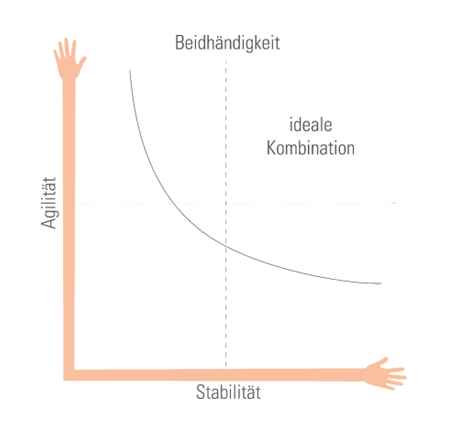
In order to even decide whether agility is needed in a company or specific area, the “land/water metaphor” helps:

If you operate in a reasonably stable environment, you can build on solid ground and will be well served by a traditional management and leadership philosophy. Too agile methods would even irritate in such a company.

On the other hand, if you are exposed to one wave of disruption after another, you better learn to surf soon. This means that such a corporate unit must be constantly on the move in order to remain in balance.

Ambidextry – the art of ambidexterity – is essential for many organisations. They need both the ability to manage the present and the artistry to tap into the even more uncertain future opportunities. The answer to land and water is the right combination of stability and agility.

One hand represents the ability to establish a stable foundation. It is about introducing clear processes, not reinventing the wheel, establishing a system of key figures – in other words, a structure that you can stick to.

The other hand stands for the ability to drive change, to be attentive to the disruptive waves coming in, to select and ride the right ones. It is about speed, optimal adaptability, continuous interaction and proactivity.

Agile transformation does not mean that every business unit should be maximally agile.

Rather, it is the movement towards the ideal combination of agility and stability. For example, a retail company may realise that it can secure its own future by providing a combined shopping experience of online world and physical outlets, while the corporate culture evolves from “command and control” to a fruitful co-existence of agile and stable elements.

Covid lockdowns add to the need for companies to be able to switch quickly between different service offerings. Retailers need webshops and good distribution, but then they need their branches again. Seminar providers need to be able to switch from face-to-face to virtual and hybrid solutions within a few days.

2. TIE: Transparency, Iteration and Empowerment

Transformation, iteration and empowerment are the three main principles of agility that can be found in all agile tools. They are suitable for defining the ideal level of agility in a company’s culture from today’s point of view. What is considered “optimal” differs depending on the industry. In the financial sector, for example, there are justified restrictions regarding the transparency of information. Companies determine for themselves what they currently consider to be the ideal degree of transparency, iteration and empowerment. The following scale questions, for example, are suitable for this purpose:

  • How would we recognise that we are living our ideal empowerment culture?
  • How would our employees/customers/leaders measure this?
  • How does it feel?
  • How would employees and managers behave?
  • What then differentiates us from other players in the market?

The answers come together to form a detailed goal picture – the vision of the transformation process. The shared vision is one of the most important motivational foundations needed to muster the necessary energy for change.

  • On a scale of 1 to 10 (10 = optimal transparency, iteration, empowerment), where do we stand today? This is how we determine where we are.
  • What is the difference between 1 and the chosen value? The answer is what is already working well and what can be built on.
  • What would have to happen in which area of the company for us to move up one point?
  • What specifically will we do next to move up one point? This is the start of the concrete action planning.

3. Transformation Navigation

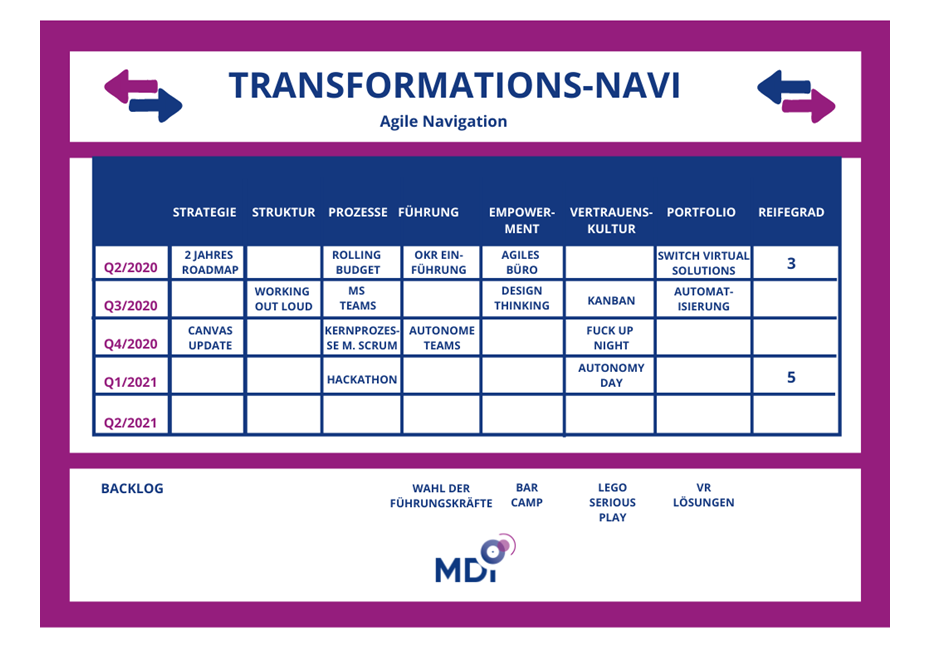
The Transformation Navi (based on ideas from HR Pioneers and McKinsey) helps us navigate progress on our agility journey. It is a matrix whose horizontal axis represents the transformation areas and whose vertical axis represents progress over time.

Every company can decide to add or omit certain areas of transformation. It should not orient itself exclusively on its own sector. Perhaps the company currently sells products such as training and in the future will mainly offer software solutions that largely replace the previous products.

In the last column, the maturity level is entered. This results from the average of the answers to the previously described position-finding questions: On a scale of 1 to 10 (10 = optimal transparency, iteration, empowerment), where do we stand today?

In terms of transparency, organisations should make the transformation navi visible to all employees. At least once a quarter, a team representative of the business units meets to look back at what has been achieved and define what will be tackled in the coming quarter.

A well thought-out and lived KPI system ensures that the continuous measurement of progress is based on an objective and stable foundation. This KPI system mostly includes metrics related to financial, customer and employee satisfaction, productivity and innovation and, in addition to the intended agility, contributes above all to stability.

4. Stakeholder Commitment Analysis

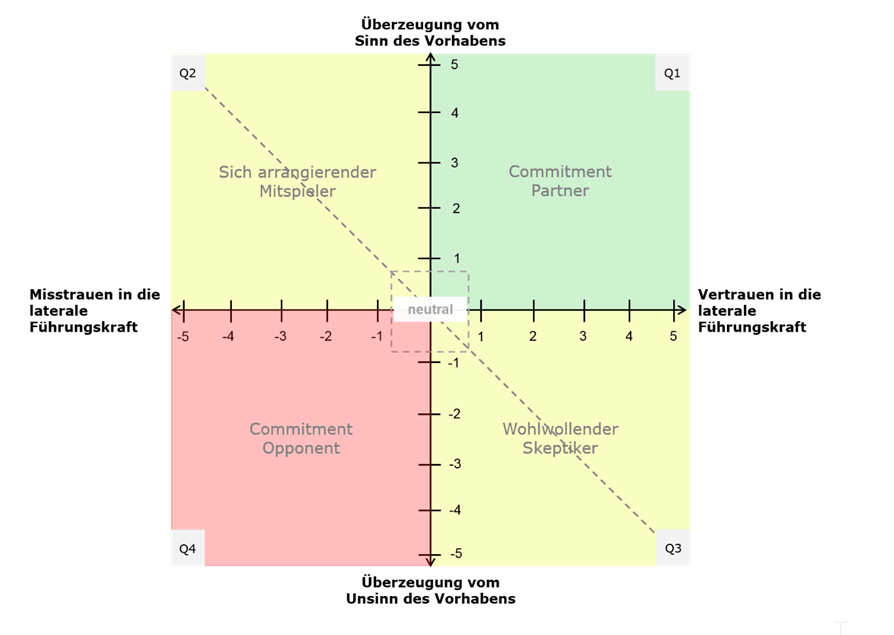
Not everyone is always convinced that change is needed. Transformation is often met with active or passive resistance. The stakeholder commitment analysis serves to get a picture of the overall situation. Agile transformation is often not imposed from above, but driven by leaders and employees at different levels. Therefore, the ability to gain commitment is needed as a lateral leader. So if you want to drive transformation, you can put yourself and the key stakeholders on the chart. 

Commitment is made up of two components: We are convinced of the sense of the project and we trust the person who wants change. If we place the different stakeholders in the four fields of the diagram, it quickly becomes clear whether the majority supports the change or rather wants to prevent it. The dashed diagonal line marks the equilibrium line. Whether the entire field tilts to the lower left towards resistance or to the upper right towards commitment at the moment of analysis also depends on the weight that the individual stakeholders or stakeholder groups bring to the table based on their positional authority, expertise and personality strength.

Based on this positional analysis, you can now take accurate steps to increase the commitment of the stakeholders. There are many ways to do this, such as holding conversations to build trust, understand interests, explain your own intention and work together to find solutions that optimise the collective benefit of all those affected by the transformation. However, it may also be useful to recruit new stakeholders who support the change and already have relevant experience. If a high level of resistance to change has been cemented in, it may ultimately be necessary to work on getting preventers to leave the field. But in most cases, a clear analysis of the situation and convincing and empathetic dialogue lead to good results.

Do you want to master the most effective tools and concepts for innovation, productivity and growth?

Then shape your path to success in digitalisation with agile leadership!

Secure a place on the course now

What might help you next?

Use It or Lose It: How AI and Digital Tools May Be Changing Our Brains

by Florian Biedermann | 26. May 2026 | Leadership and AI, Leadership Tips, Learning Transfer | 0 Comments

Use It or Lose It: How AI and Digital Tools May Be Changing Our Brains You travel to Madrid and want to chat with the locals, but you realize that after five years without practice, your rudimentary Spanish skills are now practically nonexistent and you even struggle...
Read More

How Artificial Intelligence Shapes Who We Become

by Meike Hinnenberg | 19. May 2026 | Impuls series, Leadership and AI, Leadership in the digital transformation | 0 Comments

How Artificial Intelligence Shapes Who We Become Meike’s Reflections on Artificial Intelligence Do you prefer to listen to this article? Click below to access our AI-generated audio version!How Artificial Intelligence Shapes Who We Become Meike’s Reflections on...
Read More

Zeca Ruiz on Cross-Generational Leadership and Navigating Change

by Jana Wölfl | 13. May 2026 | Leadership Impact, MDI Spotlight Series, Training Insights | 0 Comments

Zeca Ruiz on Cross-Generational Leadership and Navigating Change This blog is an excerpt from our new podcast! You can find the entire podcast episode here. Zeca Ruiz on Cross-Generational Leadership and Navigating Change In the fourth episode of our podcast “Voices...
Read More

AI-Empowered Leadership: 6 Guiding Principles

by Gunther Fürstberger | 14. April 2026 | Leadership and AI, Leadership Tips, MDI Whitepaper | 0 Comments

AI-Empowered Leadership: 6 Guiding Principles This blog post is a detailed summary of the whitepaper "Guiding Principles of AI-Empowered Leadership" by MDI's CEO, Gunther Fürstberger. You can find the full whitepaper here! Let's be honest: most conversations about AI...
Read More

What AI Shows You — and What It Doesn’t

by Meike Hinnenberg | 1. April 2026 | Digital Transformation, Impuls series, Leadership and AI | 0 Comments

What AI Shows You — and What It Doesn't Meike’s Reflections on Artificial Intelligence Do you prefer to listen to this article? Click below to access our AI-generated audio version! What AI Shows You — and What It Doesn't Meike’s Reflections on Artificial Intelligence...
Read More

Leading in the Age of AI: How AI Discourse Shapes Responsibility and Power

by Meike Hinnenberg | 18. March 2026 | Impuls series, Leadership and AI, Leadership Tips | 0 Comments

Leading in the Age of AI: How AI Discourse Shapes Responsibility and Power Meike’s Reflections on Artificial Intelligence Do you prefer to listen to this article? Click below to access our AI-generated audio version!Leading in the Age of AI: How AI Discourse Shapes...
Read More

AI Ethics for Leaders: Why Context and Critical Thinking Matter More Than Ever

by Meike Hinnenberg | 11. March 2026 | Impuls series, Leadership and AI, Learning Transfer | 0 Comments

AI Ethics for Leaders: Why Context and Critical Thinking Matter More Than Ever. Meike’s Reflections on Artificial Intelligence Do you prefer to listen to this article? Click below to access our AI-generated audio version!AI Ethics for Leaders: Why Context and Critical...
Read More

A Success Story – When AI Sharpens Human Judgement

by Claude MacDonald, Rafael Ungvari | 6. March 2026 | Customer Story, Digital Transformation, Leadership and AI | 0 Comments

A Success Story – When AI Sharpens Human Judgement Do you prefer to listen to this article? Click here to access our AI-generated audio version! When AI Amplifies Human Judgment: A Customer Success Story About This Project At MDI, we believe that great leadership and...
Read More

How Do You Lead People Who Don’t Think the Way You Do?

by Zeca Ruiz | 4. February 2026 | Leadership Impact, Leadership Tips, Learning Transfer | 0 Comments

How Do You Lead People Who Don't Think the Way You Do? Do you want to listen to this article? Click here to access our AI-generated audio version!   How do you lead people who do not think the way you do? Leadership is a challenge, especially when you are not...
Read More

How You Deal With Neurodiversity as a Leader

by Iris Kandlbauer | 3. February 2026 | Leadership Impact, Leadership Tips, Short Knowledge Bits | 0 Comments

How You Deal With Neurodiversity as a Leader You prefer listening to this article? You can find our AI-generated audio version below! How You Deal With Neurodiversity as a Leader What might be behind “strange” behavior in a team—and how leaders can deal with it...
Read More
Next Entries »

Information

  • Imprint
  • MDI company website

Social Media

  • Facebook
  • Twitter
  • Youtube
  • LinkedIn

© MDI Management Development Institute, 2020