
• MDI
  • German version
  • Contact us
MDI Management Development
  • Agile leadership
  • Lateral Leadership
  • Leadership Impact
  • Leadership Development
Select Page
Zeca Ruiz on Cross-Generational Leadership and Navigating Change

Zeca Ruiz on Cross-Generational Leadership and Navigating Change

by Jana Wölfl | May 13, 2026 | Leadership Impact, MDI Spotlight Series, Training Insights | 0 comments

Zeca Ruiz on Cross-Generational Leadership and Navigating Change

This blog is an excerpt from our new podcast! You can find the entire podcast episode here.

Zeca Ruiz on Cross-Generational Leadership and Navigating Change

In the fourth episode of our podcast “Voices of Leadership | An MDI Spotlight Series,” we virtually sat down with trainer and consultant Zeca Ruiz to discuss cross-generational management, change, and what leadership looks like in a world that keeps evolving faster than ever.

Zeca works across Latin America and Europe and focuses on leadership development, emotional intelligence, cultural transformation, and team dynamics in complex environments. During our conversation, he shared not only practical insights about leading multi-generational teams, but also deeply personal stories from his own journey into leadership.

One thing became clear very quickly: for Zeca, leadership is closely connected to change.

“Change is the only permanent thing in life.”

At the beginning of our conversation, we asked Zeca what his “superpower” as a trainer would be. His answer immediately set the tone for the rest of the discussion.

“I like to think of myself as a facilitator of transitions.”

For him, leadership is not about controlling people. It is about helping people navigate uncertainty, transformation, and growth. Zeca explained that this perspective comes from personal experience. He had originally chosen a different career path, until his father passed away unexpectedly. At only 24 years old, Zeca suddenly had to take over the family business with 150 employees.

At the same time, the world was going through the financial crisis of 2008. Business was struggling, uncertainty was everywhere, and Zeca found himself in a leadership role he had never prepared for. Instead of focusing purely on processes and structures, he started focusing on people.

“I realized that nobody was talking about leadership itself.”

That realization became a turning point. He began studying emotional intelligence, communication, coaching, and leadership development. Over time, he discovered that sustainable leadership is not created through authority alone, but through understanding people’s needs, motivations, and emotions.

What cross-generational management really means

One of the main topics of our conversation was cross-generational leadership. According to Zeca, many organizations today have up to four generations working together in the same team. While this diversity can be incredibly powerful, it can also create misunderstandings, conflicts, and frustration if leaders fail to understand the different perspectives involved.

“Our generation is a sociological concept that refers to a group of people who grew up during the same historical period and were shaped by similar experiences.”

Because each generation grew up in a different environment, their expectations around work, communication, feedback, motivation, and leadership can differ significantly. For Zeca, this is where leadership becomes especially important. Instead of judging differences, leaders need to understand them.

“If we don’t understand the differences, we will have a lot of conflicts.”

What cross-generational management really means

Understanding Generation Z

During the conversation, we also spoke in depth about Generation Z and why many organizations currently struggle to engage younger employees. According to Zeca, Gen Z grew up in a completely different world than previous generations. They were shaped by rapid technological change, constant access to information, economic instability, and a world where systems and structures change continuously.

“They need purpose. They will not just do whatever you ask because you are their boss.”

For many traditional leaders, this shift can feel uncomfortable. Hierarchical structures and purely authority-based leadership often do not work well anymore. At the same time, Zeca emphasized that younger generations also bring extraordinary strengths into organizations. He described Gen Z as highly flexible, fast-moving, and capable of learning quickly.

However, he also explained that many younger employees are more emotionally sensitive when it comes to feedback and criticism. For leaders, this means communication needs to become more conscious, empathetic, and transparent.

Why older generations still matter deeply

While much of the discussion focused on Gen Z, Zeca repeatedly emphasized that leadership is not about choosing one generation over another. Older generations still play a critical role in organizations because they provide experience, context, stability, and perspective.

“Millennials, Gen X, and Baby Boomers built the systems that Generation Z is now entering.”

Previous generations were often shaped by ideas such as long-term effort, stability, loyalty, and career development over decades. But according to Zeca, today’s reality moves much faster. For him, the real opportunity lies in combining the adaptability and creativity of younger generations with the experience and contextual understanding of older generations.

Leadership today requires flexibility

Throughout the conversation, one message appeared again and again: leadership today requires flexibility. Leaders can no longer rely on rigid structures, fixed expectations, or one-size-fits-all approaches.

“We have to be more flexible, and we have to adapt faster than ever.”

For Zeca, successful leaders are the ones who are able to understand different motivations, different communication styles, and different emotional needs within their teams. He also stressed that many people naturally resist change. That is why modern leadership requires emotional intelligence, empathy, communication skills, and the ability to create trust during uncertain times.

Leadership today requires flexibility

Leadership starts with understanding people

One of the most memorable moments in the conversation came when Zeca reflected on what leadership really means to him today. After years of working with organizations, leaders, and teams across different cultures, he believes that leadership is ultimately about understanding people.

“If we don’t use the right communication, or if we don’t understand their needs and their processes, it’s going to be difficult to have them engaged.”

This mindset also shapes his work as a trainer and consultant today. Whether he is working on leadership development, culture change, or emotional intelligence, the core question remains the same:

How do we help people grow through change instead of simply surviving it?

Conclusion

Our conversation with Zeca Ruiz showed that cross-generational leadership is far more than managing age differences. It is about understanding how people were shaped by their experiences, adapting leadership styles to different needs, and creating environments where different generations can learn from one another instead of competing against each other.

At the same time, the conversation reminded us that leadership itself is changing rapidly. Traditional structures, rigid hierarchies, and purely authority-based leadership models are becoming less effective in a world defined by uncertainty and constant transformation.

For Zeca, the future of leadership belongs to leaders who are flexible, emotionally intelligent, and capable of guiding people through change with empathy and clarity.

“Change is the only permanent thing in life.”

And perhaps that is exactly why human-centered leadership matters more than ever.

Jana Wölfl

Jana Wölfl

Marketing Assistant

Jana Wölfl is a marketing assistant at MDI and works on our blog. She has already been responsible for several areas of marketing, such as designing our new website and administering our personalist.at portal.


This could also interest you:

What If AI Doesn’t Replace Us — But Drowns Us Out?

by Martin Maglia | 24. June 2026 | Digital Transformation, Leadership and AI, Short Knowledge Bits | 0 Comments

What If AI Doesn't Replace Us — But Drowns Us Out? Over the weekend, I watched a thought-provoking video from Rick Beato. (You can find the link at the end of this article.) For those who don't know him: Rick Beato is a musician, producer, educator, guitarist, and one...
Read More

Use It or Lose It: How AI and Digital Tools May Be Changing Our Brains

by Florian Biedermann | 26. May 2026 | Leadership and AI, Leadership Tips, Learning Transfer | 0 Comments

Use It or Lose It: How AI and Digital Tools May Be Changing Our Brains You travel to Madrid and want to chat with the locals, but you realize that after five years without practice, your rudimentary Spanish skills are now practically nonexistent and you even struggle...
Read More

How Artificial Intelligence Shapes Who We Become

by Meike Hinnenberg | 19. May 2026 | Impuls series, Leadership and AI, Leadership in the digital transformation | 0 Comments

How Artificial Intelligence Shapes Who We Become Meike’s Reflections on Artificial Intelligence Do you prefer to listen to this article? Click below to access our AI-generated audio version!How Artificial Intelligence Shapes Who We Become Meike’s Reflections on...
Read More

Zeca Ruiz on Cross-Generational Leadership and Navigating Change

by Jana Wölfl | 13. May 2026 | Leadership Impact, MDI Spotlight Series, Training Insights | 0 Comments

Zeca Ruiz on Cross-Generational Leadership and Navigating Change This blog is an excerpt from our new podcast! You can find the entire podcast episode here. Zeca Ruiz on Cross-Generational Leadership and Navigating Change In the fourth episode of our podcast “Voices...
Read More

AI-Empowered Leadership: 6 Guiding Principles

by Gunther Fürstberger | 14. April 2026 | Leadership and AI, Leadership Tips, MDI Whitepaper | 0 Comments

AI-Empowered Leadership: 6 Guiding Principles This blog post is a detailed summary of the whitepaper "Guiding Principles of AI-Empowered Leadership" by MDI's CEO, Gunther Fürstberger. You can find the full whitepaper here! Let's be honest: most conversations about AI...
Read More

What AI Shows You — and What It Doesn’t

by Meike Hinnenberg | 1. April 2026 | Digital Transformation, Impuls series, Leadership and AI | 0 Comments

What AI Shows You — and What It Doesn't Meike’s Reflections on Artificial Intelligence Do you prefer to listen to this article? Click below to access our AI-generated audio version! What AI Shows You — and What It Doesn't Meike’s Reflections on Artificial Intelligence...
Read More

Leading in the Age of AI: How AI Discourse Shapes Responsibility and Power

by Meike Hinnenberg | 18. March 2026 | Impuls series, Leadership and AI, Leadership Tips | 0 Comments

Leading in the Age of AI: How AI Discourse Shapes Responsibility and Power Meike’s Reflections on Artificial Intelligence Do you prefer to listen to this article? Click below to access our AI-generated audio version!Leading in the Age of AI: How AI Discourse Shapes...
Read More

AI Ethics for Leaders: Why Context and Critical Thinking Matter More Than Ever

by Meike Hinnenberg | 11. March 2026 | Impuls series, Leadership and AI, Learning Transfer | 0 Comments

AI Ethics for Leaders: Why Context and Critical Thinking Matter More Than Ever. Meike’s Reflections on Artificial Intelligence Do you prefer to listen to this article? Click below to access our AI-generated audio version!AI Ethics for Leaders: Why Context and Critical...
Read More

A Success Story – When AI Sharpens Human Judgement

by Claude MacDonald, Rafael Ungvari | 6. March 2026 | Customer Story, Digital Transformation, Leadership and AI | 0 Comments

A Success Story – When AI Sharpens Human Judgement Do you prefer to listen to this article? Click here to access our AI-generated audio version! When AI Amplifies Human Judgment: A Customer Success Story About This Project At MDI, we believe that great leadership and...
Read More

How Do You Lead People Who Don’t Think the Way You Do?

by Zeca Ruiz | 4. February 2026 | Leadership Impact, Leadership Tips, Learning Transfer | 0 Comments

How Do You Lead People Who Don't Think the Way You Do? Do you want to listen to this article? Click here to access our AI-generated audio version!   How do you lead people who do not think the way you do? Leadership is a challenge, especially when you are not...
Read More
Self-Efficacy in Change: Why It Matters

Self-Efficacy in Change: Why It Matters

by Anita Berger | Dec 17, 2025 | Leadership Tips, Learning Transfer, Short Knowledge Bits | 0 comments

Why It Matters When Transformation Gets Hard

Do you prefer to listen to this article?

Click below to access our AI-generated audio version:

Self-Efficacy: Why It Matters When Transformation Gets Hard

Change can be exhausting.
Especially when things are unclear, priorities shift, and not everything is well-designed or well communicated.

You adjust. You adapt. You cope.
Sometimes with commitment, sometimes with resistance, sometimes with quiet frustration.

In moments like these, one factor becomes especially relevant:
how self-effective you experience yourself within the change — how oriented, capable and able to act you feel.

Not because the process is perfect.
But precisely because it often isn’t.

Change is a Process — Not a Straight Line

Change and transformation don’t happen in neat sequences.
They move in a recurring cycle of:

  • Making sense — understanding what is changing and why
  • Focusing & aligning — deciding where to place attention and energy
  • Acting & experimenting — trying things out, adjusting in motion
  • Reflecting & integrating — making meaning of what happened and what it changed

At the same time, how effective each phase becomes depends largely on how people experience themselves within it.

Change is a process — not a straight line

A Self-Reflection Checklist to Strengthen Self-Efficacy in Change

If you are currently involved in or affected by a change or transformation process, these questions are an invitation to pause and explore your own experience.

1. Perception — How am I making sense of what is happening?

  • What am I noticing most in this change right now?
  • What interpretations am I forming, and what alternative perspectives might exist?

2. Focus — Where is my attention in relation to influence and concern?

  • What am I currently concerned about that lies outside my control?
  • Where do I see opportunities to act or influence within my own Circle of Influence?

3. Mindset — How am I relating to learning and uncertainty?

  • What thoughts or reactions emerge when outcomes are unclear or mistakes happen?
  • How might a growth-oriented perspective change the way I approach this situation?

4. Personal change preference — What do I need to stay effective?

  • What kind of change energises me, and what kind of change drains me?
  • What conditions would help me stay engaged and capable in this phase?

Self-efficacy doesn’t mean controlling the change or having all the answers.
It means staying connected to your own agency within the process — even when the path isn’t clear.

Change processes need structure, direction, and people who design and guide them.
They also rely on individuals who can navigate their own perceptions, focus, and mindset within that structure.

Both sides are equally relevant.

  • Which of these questions resonates most with you right now?
  • Where do you notice your self-efficacy strengthening — or slipping — in change?

I’m looking forward to hearing your perspective!

Anita Berger

Anita Berger

MDI partner and trainer

Anita Berger is an executive coach, consultant, and trainer with a strong focus on leadership development in the VUCA/BANI world, design and facilitation of transformation processes and organizational culture development, as well as international human resources management. She is a co-owner and partner of MDI, Management Development International. With over 25 years of experience in management and leadership positions (including in the management of Coca-Cola Hellenic Austria & Slovenia & Konica Minolta Business Solutions) in various industries and company sizes, from medium-sized businesses to international corporations. Numerous contributions focus on leading virtual and hybrid teams, agile change management, organizational and leadership culture, as well as strategic talent management.
  • LinkedIn

Download our MDI Whitepaper here:

What might help you next?

What If AI Doesn’t Replace Us — But Drowns Us Out?

by Martin Maglia | 24. June 2026 | Digital Transformation, Leadership and AI, Short Knowledge Bits | 0 Comments

What If AI Doesn't Replace Us — But Drowns Us Out? Over the weekend, I watched a thought-provoking video from Rick Beato. (You can find the link at the end of this article.) For those who don't know him: Rick Beato is a musician, producer, educator, guitarist, and one...
Read More

Use It or Lose It: How AI and Digital Tools May Be Changing Our Brains

by Florian Biedermann | 26. May 2026 | Leadership and AI, Leadership Tips, Learning Transfer | 0 Comments

Use It or Lose It: How AI and Digital Tools May Be Changing Our Brains You travel to Madrid and want to chat with the locals, but you realize that after five years without practice, your rudimentary Spanish skills are now practically nonexistent and you even struggle...
Read More

How Artificial Intelligence Shapes Who We Become

by Meike Hinnenberg | 19. May 2026 | Impuls series, Leadership and AI, Leadership in the digital transformation | 0 Comments

How Artificial Intelligence Shapes Who We Become Meike’s Reflections on Artificial Intelligence Do you prefer to listen to this article? Click below to access our AI-generated audio version!How Artificial Intelligence Shapes Who We Become Meike’s Reflections on...
Read More

Zeca Ruiz on Cross-Generational Leadership and Navigating Change

by Jana Wölfl | 13. May 2026 | Leadership Impact, MDI Spotlight Series, Training Insights | 0 Comments

Zeca Ruiz on Cross-Generational Leadership and Navigating Change This blog is an excerpt from our new podcast! You can find the entire podcast episode here. Zeca Ruiz on Cross-Generational Leadership and Navigating Change In the fourth episode of our podcast “Voices...
Read More

AI-Empowered Leadership: 6 Guiding Principles

by Gunther Fürstberger | 14. April 2026 | Leadership and AI, Leadership Tips, MDI Whitepaper | 0 Comments

AI-Empowered Leadership: 6 Guiding Principles This blog post is a detailed summary of the whitepaper "Guiding Principles of AI-Empowered Leadership" by MDI's CEO, Gunther Fürstberger. You can find the full whitepaper here! Let's be honest: most conversations about AI...
Read More

What AI Shows You — and What It Doesn’t

by Meike Hinnenberg | 1. April 2026 | Digital Transformation, Impuls series, Leadership and AI | 0 Comments

What AI Shows You — and What It Doesn't Meike’s Reflections on Artificial Intelligence Do you prefer to listen to this article? Click below to access our AI-generated audio version! What AI Shows You — and What It Doesn't Meike’s Reflections on Artificial Intelligence...
Read More

Leading in the Age of AI: How AI Discourse Shapes Responsibility and Power

by Meike Hinnenberg | 18. March 2026 | Impuls series, Leadership and AI, Leadership Tips | 0 Comments

Leading in the Age of AI: How AI Discourse Shapes Responsibility and Power Meike’s Reflections on Artificial Intelligence Do you prefer to listen to this article? Click below to access our AI-generated audio version!Leading in the Age of AI: How AI Discourse Shapes...
Read More

AI Ethics for Leaders: Why Context and Critical Thinking Matter More Than Ever

by Meike Hinnenberg | 11. March 2026 | Impuls series, Leadership and AI, Learning Transfer | 0 Comments

AI Ethics for Leaders: Why Context and Critical Thinking Matter More Than Ever. Meike’s Reflections on Artificial Intelligence Do you prefer to listen to this article? Click below to access our AI-generated audio version!AI Ethics for Leaders: Why Context and Critical...
Read More

A Success Story – When AI Sharpens Human Judgement

by Claude MacDonald, Rafael Ungvari | 6. March 2026 | Customer Story, Digital Transformation, Leadership and AI | 0 Comments

A Success Story – When AI Sharpens Human Judgement Do you prefer to listen to this article? Click here to access our AI-generated audio version! When AI Amplifies Human Judgment: A Customer Success Story About This Project At MDI, we believe that great leadership and...
Read More

How Do You Lead People Who Don’t Think the Way You Do?

by Zeca Ruiz | 4. February 2026 | Leadership Impact, Leadership Tips, Learning Transfer | 0 Comments

How Do You Lead People Who Don't Think the Way You Do? Do you want to listen to this article? Click here to access our AI-generated audio version!   How do you lead people who do not think the way you do? Leadership is a challenge, especially when you are not...
Read More
Success Through Change: How to Stay Oriented During Transitions

Success Through Change: How to Stay Oriented During Transitions

by Anita Berger | Apr 14, 2025 | Impuls series, Leadership Impact, Leadership Tips | 0 comments

Success Through Change: How to Stay Oriented During Transitions

Do you prefer to listen to this article?

Click below to access our AI-generated audio version:

Success Through Change: How to Stay Oriented During Transitions

Change processes often involve challenges. They not only require structural adjustments but also an emotional examination of the new. For leaders, in particular, this means accompanying employees through the change, constructively absorbing resistance, and creating new perspectives. In this blog post, you will learn how to successfully implement changes and support your team in reorienting themselves.

This blog post is part of a change management series. Click here to go to the first part.

5. Letting Go and Finding New Perspectives

Psychological ownership – a concept developed by Jon L. Pierce, Tatiana Kostova, and Kurt T. Dirks – describes the feeling of personal responsibility and identification with a task or way of working, regardless of actual ownership. Employees invest time, energy, and commitment in their work, which creates a strong bond.

However, in change processes, this identification can lead to resistance, as it means letting go of what is familiar. In this case, it is the leader’s job to consciously guide this process while also providing orientation.

Tips:

  • Acknowledge the past: Give credit for your team’s past successes and show appreciation for their commitment.
  • Clarify the change: Be open about the need for change and emphasize the benefits for the team and the organization.
  • Offer new ways of identification: Encourage employees to actively participate in shaping change by giving them responsibility and the opportunity to help develop new structures.

6. Take Responsibility and Use Resources Wisely

Successful change requires not only strategic decisions but also a conscious use of resources. As a leader, you are challenged to strengthen your resilience while effectively leading your team through the change.

Tips:

  • Reflect on your role: regularly question your position in the change process and get support through coaching or peer feedback.
  • Self-care plan: consciously pay attention to your resources to maintain energy and clarity.
  • Use technological tools: rely on digital support, for example, through AI tools such as ChatGPT or knowledge databases, to gain new perspectives and find more efficient solutions.

Take responsibility and use resources wisely

7. Communication as the Key to Success

Transparent and continuous communication is essential to build trust and reduce uncertainty. Change processes are more likely to succeed if goals are repeatedly explained, expectations are formulated, and questions are actively encouraged.

Tips:

  • Provide regular updates: Continuously communicate the progress and background of the change.
  • Facilitate open dialogue: Create spaces for questions, feedback, and constructive exchange.
  • Consider individual needs: Tailor your communication to different types of employees to achieve the highest possible level of acceptance and participation.

8. A Structured Approach With the ADKAR-Model

The ADKAR model provides a clear structure for guiding change processes and taking employees with you step by step:

  1. Awareness: Create an understanding of the need for change.
  2. Desire: Create motivation by highlighting the benefits for individuals and the team.
  3. Knowledge: Ensure that all employees receive the necessary information and training.
  4. Ability: Support implementation with targeted coaching and constructive feedback.
  5. Reinforcement: Promote sustainable change through continuous support, further development, and transparent performance measurement.

Conclusion: Actively Shaping Change

Change processes are challenging but manageable with the right strategy. Through appreciative communication, clear structures, and conscious use of resources, you can safely lead your team through the change. Encourage a growth-oriented mindset, enable co-creation, and pay attention to your stability – because only those who are stable themselves can accompany others through challenging times.

Anita Berger

Anita Berger

MDI partner and trainer

Anita Berger is an executive coach, consultant, and trainer with a strong focus on leadership development in the VUCA/BANI world, design and facilitation of transformation processes and organizational culture development, as well as international human resources management. She is a co-owner and partner of MDI, Management Development International. With over 25 years of experience in management and leadership positions (including in the management of Coca-Cola Hellenic Austria & Slovenia & Konica Minolta Business Solutions) in various industries and company sizes, from medium-sized businesses to international corporations. Numerous contributions focus on leading virtual and hybrid teams, agile change management, organizational and leadership culture, as well as strategic talent management.
  • LinkedIn

Download our MDI Whitepaper here:

What might help you next?

What If AI Doesn’t Replace Us — But Drowns Us Out?

by Martin Maglia | 24. June 2026 | Digital Transformation, Leadership and AI, Short Knowledge Bits | 0 Comments

What If AI Doesn't Replace Us — But Drowns Us Out? Over the weekend, I watched a thought-provoking video from Rick Beato. (You can find the link at the end of this article.) For those who don't know him: Rick Beato is a musician, producer, educator, guitarist, and one...
Read More

Use It or Lose It: How AI and Digital Tools May Be Changing Our Brains

by Florian Biedermann | 26. May 2026 | Leadership and AI, Leadership Tips, Learning Transfer | 0 Comments

Use It or Lose It: How AI and Digital Tools May Be Changing Our Brains You travel to Madrid and want to chat with the locals, but you realize that after five years without practice, your rudimentary Spanish skills are now practically nonexistent and you even struggle...
Read More

How Artificial Intelligence Shapes Who We Become

by Meike Hinnenberg | 19. May 2026 | Impuls series, Leadership and AI, Leadership in the digital transformation | 0 Comments

How Artificial Intelligence Shapes Who We Become Meike’s Reflections on Artificial Intelligence Do you prefer to listen to this article? Click below to access our AI-generated audio version!How Artificial Intelligence Shapes Who We Become Meike’s Reflections on...
Read More

Zeca Ruiz on Cross-Generational Leadership and Navigating Change

by Jana Wölfl | 13. May 2026 | Leadership Impact, MDI Spotlight Series, Training Insights | 0 Comments

Zeca Ruiz on Cross-Generational Leadership and Navigating Change This blog is an excerpt from our new podcast! You can find the entire podcast episode here. Zeca Ruiz on Cross-Generational Leadership and Navigating Change In the fourth episode of our podcast “Voices...
Read More

AI-Empowered Leadership: 6 Guiding Principles

by Gunther Fürstberger | 14. April 2026 | Leadership and AI, Leadership Tips, MDI Whitepaper | 0 Comments

AI-Empowered Leadership: 6 Guiding Principles This blog post is a detailed summary of the whitepaper "Guiding Principles of AI-Empowered Leadership" by MDI's CEO, Gunther Fürstberger. You can find the full whitepaper here! Let's be honest: most conversations about AI...
Read More

What AI Shows You — and What It Doesn’t

by Meike Hinnenberg | 1. April 2026 | Digital Transformation, Impuls series, Leadership and AI | 0 Comments

What AI Shows You — and What It Doesn't Meike’s Reflections on Artificial Intelligence Do you prefer to listen to this article? Click below to access our AI-generated audio version! What AI Shows You — and What It Doesn't Meike’s Reflections on Artificial Intelligence...
Read More

Leading in the Age of AI: How AI Discourse Shapes Responsibility and Power

by Meike Hinnenberg | 18. March 2026 | Impuls series, Leadership and AI, Leadership Tips | 0 Comments

Leading in the Age of AI: How AI Discourse Shapes Responsibility and Power Meike’s Reflections on Artificial Intelligence Do you prefer to listen to this article? Click below to access our AI-generated audio version!Leading in the Age of AI: How AI Discourse Shapes...
Read More

AI Ethics for Leaders: Why Context and Critical Thinking Matter More Than Ever

by Meike Hinnenberg | 11. March 2026 | Impuls series, Leadership and AI, Learning Transfer | 0 Comments

AI Ethics for Leaders: Why Context and Critical Thinking Matter More Than Ever. Meike’s Reflections on Artificial Intelligence Do you prefer to listen to this article? Click below to access our AI-generated audio version!AI Ethics for Leaders: Why Context and Critical...
Read More

A Success Story – When AI Sharpens Human Judgement

by Claude MacDonald, Rafael Ungvari | 6. March 2026 | Customer Story, Digital Transformation, Leadership and AI | 0 Comments

A Success Story – When AI Sharpens Human Judgement Do you prefer to listen to this article? Click here to access our AI-generated audio version! When AI Amplifies Human Judgment: A Customer Success Story About This Project At MDI, we believe that great leadership and...
Read More

How Do You Lead People Who Don’t Think the Way You Do?

by Zeca Ruiz | 4. February 2026 | Leadership Impact, Leadership Tips, Learning Transfer | 0 Comments

How Do You Lead People Who Don't Think the Way You Do? Do you want to listen to this article? Click here to access our AI-generated audio version!   How do you lead people who do not think the way you do? Leadership is a challenge, especially when you are not...
Read More
4 Tips on How to Shape Change Processes as a Leader

4 Tips on How to Shape Change Processes as a Leader

by Anita Berger | Apr 3, 2025 | Impuls series, Leadership Impact, Leadership Tips | 0 comments

4 Tips on How to Shape Change Processes as a Leader

Do you prefer to listen to this article?

Click below to access our AI-generated audio version:

4 Tips on How to Shape Change Processes as a Leader

Imagine a dynamic network of paths that is constantly changing. While technological advances create new connections, existing paths are blocked by geopolitical tensions, economic crises, or social upheaval. In our globally interconnected world, events overlap rapidly – an enormous challenge that repeatedly tests companies and leaders.

As a leader, you bear responsibility in this complex environment and actively shape change. But how can you successfully support change processes? In this blog post, you will learn how to consider both the emotional and rational aspects of change, how to integrate resistance constructively, and how to promote a future-oriented mindset. With practical tips, you will develop strategies to fulfill your leadership responsibilities with clarity and effectiveness in times of high complexity and change.

1. Recognizing Different Reactions to Change

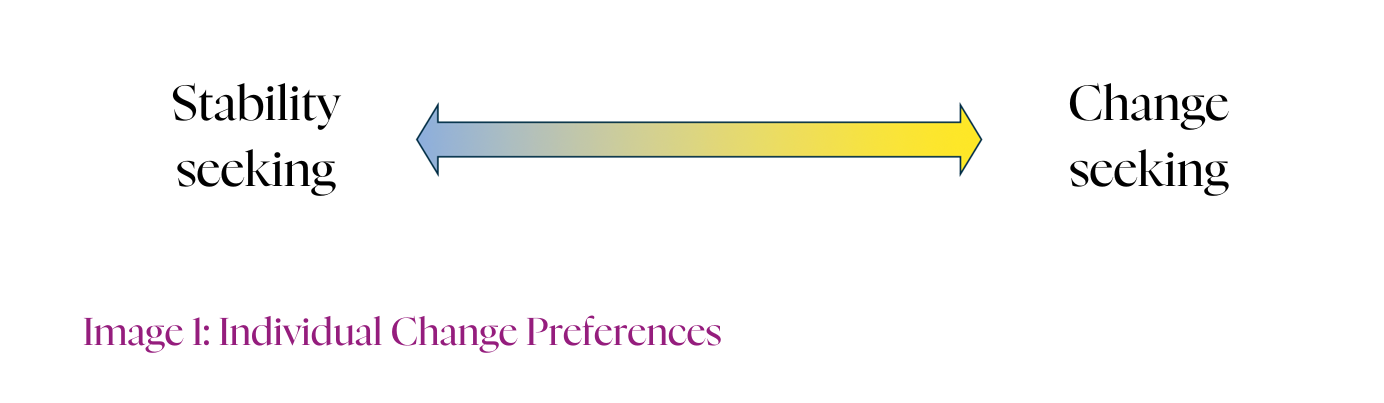
People react differently to change. While “change seekers” (people with an affinity for change) quickly recognize and want to take advantage of new opportunities, “change preservers” (people with a focus on preservation) feel more secure in the familiar status quo. These preferences are often based on individual values, experiences, and personality traits. The challenge for you as a leader is to involve both groups in change processes.

Individual Change Preferences

Tips:

  • Observe the behavior and reactions of your employees to recognize their change preferences.
  • Create orientation and proceed step by step to provide (process) security.
  • Use the energy of the “change seekers” to drive innovation while also acknowledging the contributions of the “change preservers” by involving them through transparent communication.

2. Consider Emotions in the Change Process

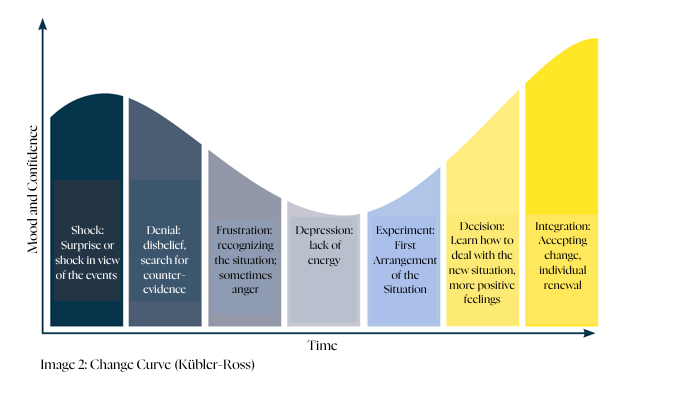
Resistance is part of every change process. As Elisabeth Kübler-Ross’s change curve (Figure 2) shows, many people go through emotional phases such as shock, frustration, and uncertainty before they reach acceptance and integration.

Tips:

  • Create an open atmosphere in which people can express their emotions and concerns.
  • Explain the change process clearly and repeatedly to enable a thorough understanding.
  • Show empathy and recognize the stress that comes with change.

    3. Establish a Growth Mindset

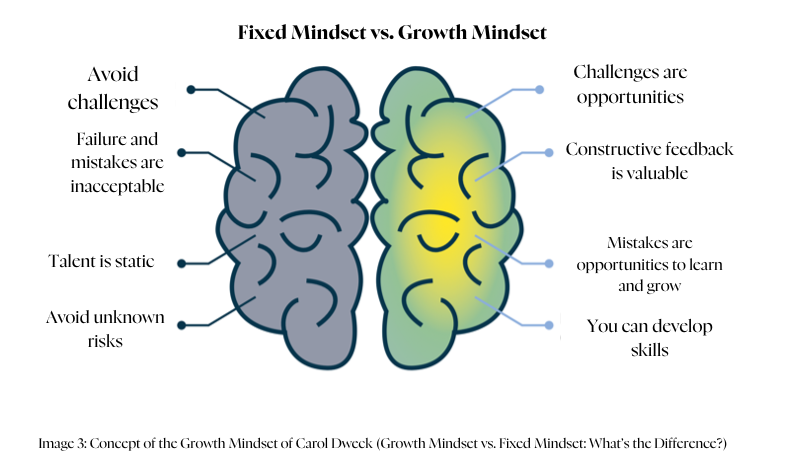
    A growth mindset helps you see challenges as opportunities, learn from mistakes, and continuously develop. This attitude is essential to remain capable of action in dynamic and complex situations.

    Tips:

    • Promote a willingness to embrace change by creating a learning-oriented environment – for example, through regular reflection sessions in which developmental steps and insights are discussed.
    • Establish an open feedback culture that supports the exchange of perspectives and ideas.
    • Create targeted learning opportunities, e.g. through peer learning or mentoring programs.
    • Celebrate progress – even small successes – and focus on positive development.
    • Set an example by being open to feedback and showing your willingness to learn.

      4. Broaden Your Perspective: Critically Question the Status Quo

      Discussions about change often focus either on the advantages of the new or the disadvantages of the change. However, the question of what disadvantages the status quo entails or whether it is even a viable option is rarely asked. This perspective can provide valuable insights for the change process.

      Image 2 Change Curve (Kübler-Ross)
      Fixed Mindset vs. Growth Mindset

      Tips:

      • Make the drivers of change transparent to create understanding and acceptance.
      • Explain the risks and disadvantages of sticking to the status quo – or make it clear if this is not a realistic option.
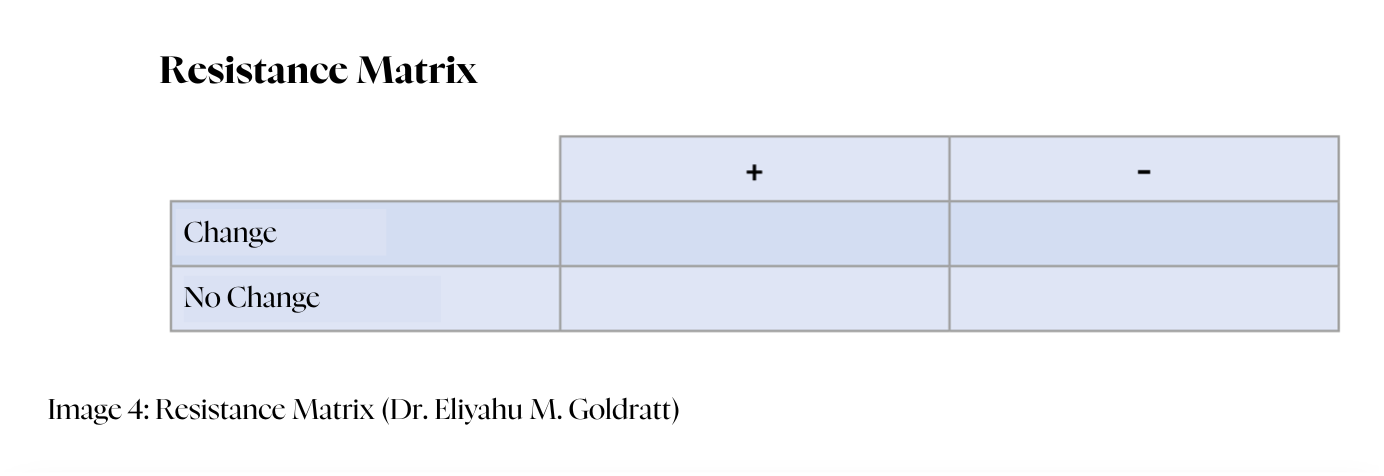
      • Use analytical tools such as the resistance matrix (Figure 4) to systematically illuminate all perspectives.
      Resistance Matrix

      Conclusion

      Change is a constant in today’s world – and as a leader, you have the task of actively shaping that change. By recognizing your team’s change preferences, taking emotions seriously, promoting a growth mindset, and incorporating different perspectives, you can successfully manage change processes. With the right strategies and clear communication, you can motivate your team to embrace change as an opportunity and help shape it.

      This blog article is the first in a series on change management. Click here to go to the second part!

      Anita Berger

      Anita Berger

      MDI partner and trainer

      Anita Berger is an executive coach, consultant, and trainer with a strong focus on leadership development in the VUCA/BANI world, design and facilitation of transformation processes and organizational culture development, as well as international human resources management. She is a co-owner and partner of MDI, Management Development International. With over 25 years of experience in management and leadership positions (including in the management of Coca-Cola Hellenic Austria & Slovenia & Konica Minolta Business Solutions) in various industries and company sizes, from medium-sized businesses to international corporations. Numerous contributions focus on leading virtual and hybrid teams, agile change management, organizational and leadership culture, as well as strategic talent management.
      • LinkedIn

      Download our MDI Whitepaper here:

      What might help you next?

      What If AI Doesn’t Replace Us — But Drowns Us Out?

      by Martin Maglia | 24. June 2026 | Digital Transformation, Leadership and AI, Short Knowledge Bits | 0 Comments

      What If AI Doesn't Replace Us — But Drowns Us Out? Over the weekend, I watched a thought-provoking video from Rick Beato. (You can find the link at the end of this article.) For those who don't know him: Rick Beato is a musician, producer, educator, guitarist, and one...
      Read More

      Use It or Lose It: How AI and Digital Tools May Be Changing Our Brains

      by Florian Biedermann | 26. May 2026 | Leadership and AI, Leadership Tips, Learning Transfer | 0 Comments

      Use It or Lose It: How AI and Digital Tools May Be Changing Our Brains You travel to Madrid and want to chat with the locals, but you realize that after five years without practice, your rudimentary Spanish skills are now practically nonexistent and you even struggle...
      Read More

      How Artificial Intelligence Shapes Who We Become

      by Meike Hinnenberg | 19. May 2026 | Impuls series, Leadership and AI, Leadership in the digital transformation | 0 Comments

      How Artificial Intelligence Shapes Who We Become Meike’s Reflections on Artificial Intelligence Do you prefer to listen to this article? Click below to access our AI-generated audio version!How Artificial Intelligence Shapes Who We Become Meike’s Reflections on...
      Read More

      Zeca Ruiz on Cross-Generational Leadership and Navigating Change

      by Jana Wölfl | 13. May 2026 | Leadership Impact, MDI Spotlight Series, Training Insights | 0 Comments

      Zeca Ruiz on Cross-Generational Leadership and Navigating Change This blog is an excerpt from our new podcast! You can find the entire podcast episode here. Zeca Ruiz on Cross-Generational Leadership and Navigating Change In the fourth episode of our podcast “Voices...
      Read More

      AI-Empowered Leadership: 6 Guiding Principles

      by Gunther Fürstberger | 14. April 2026 | Leadership and AI, Leadership Tips, MDI Whitepaper | 0 Comments

      AI-Empowered Leadership: 6 Guiding Principles This blog post is a detailed summary of the whitepaper "Guiding Principles of AI-Empowered Leadership" by MDI's CEO, Gunther Fürstberger. You can find the full whitepaper here! Let's be honest: most conversations about AI...
      Read More

      What AI Shows You — and What It Doesn’t

      by Meike Hinnenberg | 1. April 2026 | Digital Transformation, Impuls series, Leadership and AI | 0 Comments

      What AI Shows You — and What It Doesn't Meike’s Reflections on Artificial Intelligence Do you prefer to listen to this article? Click below to access our AI-generated audio version! What AI Shows You — and What It Doesn't Meike’s Reflections on Artificial Intelligence...
      Read More

      Leading in the Age of AI: How AI Discourse Shapes Responsibility and Power

      by Meike Hinnenberg | 18. March 2026 | Impuls series, Leadership and AI, Leadership Tips | 0 Comments

      Leading in the Age of AI: How AI Discourse Shapes Responsibility and Power Meike’s Reflections on Artificial Intelligence Do you prefer to listen to this article? Click below to access our AI-generated audio version!Leading in the Age of AI: How AI Discourse Shapes...
      Read More

      AI Ethics for Leaders: Why Context and Critical Thinking Matter More Than Ever

      by Meike Hinnenberg | 11. March 2026 | Impuls series, Leadership and AI, Learning Transfer | 0 Comments

      AI Ethics for Leaders: Why Context and Critical Thinking Matter More Than Ever. Meike’s Reflections on Artificial Intelligence Do you prefer to listen to this article? Click below to access our AI-generated audio version!AI Ethics for Leaders: Why Context and Critical...
      Read More

      A Success Story – When AI Sharpens Human Judgement

      by Claude MacDonald, Rafael Ungvari | 6. March 2026 | Customer Story, Digital Transformation, Leadership and AI | 0 Comments

      A Success Story – When AI Sharpens Human Judgement Do you prefer to listen to this article? Click here to access our AI-generated audio version! When AI Amplifies Human Judgment: A Customer Success Story About This Project At MDI, we believe that great leadership and...
      Read More

      How Do You Lead People Who Don’t Think the Way You Do?

      by Zeca Ruiz | 4. February 2026 | Leadership Impact, Leadership Tips, Learning Transfer | 0 Comments

      How Do You Lead People Who Don't Think the Way You Do? Do you want to listen to this article? Click here to access our AI-generated audio version!   How do you lead people who do not think the way you do? Leadership is a challenge, especially when you are not...
      Read More
      How to become resilient? Your personal superpower

      How to become resilient? Your personal superpower

      by Anita Berger, ARD | Sep 26, 2022 | Agile Leadership, Leadership Tips | 0 comments

      How to become resilient? Your personal superpower

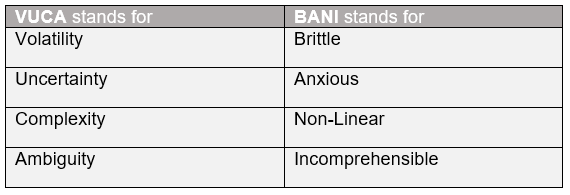
      Meeting the challenges in the VUCA/BANI world

      In this article you will get an insight into key competencies as well as starting points to strengthen your own resilience. Concrete reflection questions and tips for implementation will let you become a “pro” of your own superpower.

      VUCA & BANI

      VUCA or BANI as explanatory models for our challenges

      In our daily professional lives, we are constantly confronted with turbulence. The following models provide a framework to bring challenges closer for companies and for society as a whole:

      All these terms define what we are up against in this ever-changing society – a fragile system that is only fueled by uncertainty and anxiety, as well as complex, non-linear problems. The demands on organizations and leadership are sometimes ambiguous and contradictory, but also incomprehensible.

      Key competencies for your superpower

      to meet these challenges

      Resilience in dealing with crises and challenges

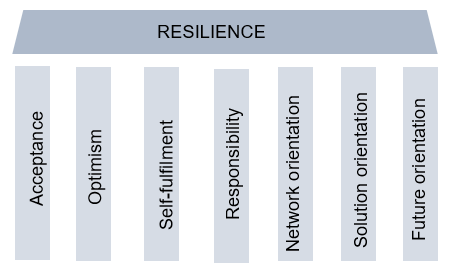
      Jamais Cascio counters these complex models with a response option: RAAT (Resilience, Awareness, Adaptation and Transparency). For the first factor alone – resilience – there are several models. I present the Vienna Resilience Model below.

      Seven key resilience competencies

      The Vienna Resilience Model describes seven key resilience competencies that positively influence a person’s resilience:

      The basic pillars of resilience are 

      • acceptance
      • optimism
      • self-fulfilment
      • responsibility
      • network orientation
      • solution orientation
      • future orientation.

      Each of these factors plays an important role in strengthening one’s resilience.

      Strengthening the superpower of resilience holistically

      In contrast to the Vienna Resilience Model, Stephen Covey identifies four pillars in his 7 Habits of Highly Effective People, which are also found in most other models to strengthen one’s resources and thus one’s resilience.

      When reflecting on how you use your resources, you should take each resource individually and consider how well you take care of each. This could be in the form of the following approaches, for example:

      • Physical: I regularly keep myself informed about things that affect my health and fitness.
      • Mental: I clear my head every day through, for example, music, silence or relaxation exercises.
      • Social: I listen to others and pay attention to what they have to say instead of thinking about what I want to say.
      • Spiritual: I have the courage to stand my ground even when others oppose me.

      Becoming the “pro” of your own superpower –

      tips for implementation

      If we want to strengthen our resilience, we sometimes need to develop new habits and behaviors or retrain “bad habits” (for example, taking the stairs instead of the elevator). James Clear’s (2020) 1% method states that the best way to achieve goals is to get a little better every day, i.e., to work towards them in small steps for maximum impact. Improving 1% per day will yield a 37-fold increase in one year.

      Conclusion

      The VUCA or BANI world presents challenges to all of us. In dealing with these challenges, we can further “nurture” or build our key competencies of resilience by being aware of them as a first step.

      In small steps and with the coupling to our previous habits, we can then integrate our resources, which further strengthens our superpower resilience holistically into our behavioral repertoire

      Read the full (german) article that was written for ARD Magazin | Edition 6814/6/2022

      Anita Berger

      Anita Berger

      Executive Coach, Consultant, Trainer & Managing Partner MDI

      Anita Berger is an executive coach, consultant and trainer specialising in leadership development and international human resource management. She is a partner of MDI Management Development International. For more than 15 years she has worked in management and leadership positions (among others as HR-
      Director at Coca-Cola Hellenic and HR Manager at Konica Minolta Business Solutions).

      • LinkedIn

      What might help you next?

      What If AI Doesn’t Replace Us — But Drowns Us Out?

      by Martin Maglia | 24. June 2026 | Digital Transformation, Leadership and AI, Short Knowledge Bits | 0 Comments

      What If AI Doesn't Replace Us — But Drowns Us Out? Over the weekend, I watched a thought-provoking video from Rick Beato. (You can find the link at the end of this article.) For those who don't know him: Rick Beato is a musician, producer, educator, guitarist, and one...
      Read More

      Use It or Lose It: How AI and Digital Tools May Be Changing Our Brains

      by Florian Biedermann | 26. May 2026 | Leadership and AI, Leadership Tips, Learning Transfer | 0 Comments

      Use It or Lose It: How AI and Digital Tools May Be Changing Our Brains You travel to Madrid and want to chat with the locals, but you realize that after five years without practice, your rudimentary Spanish skills are now practically nonexistent and you even struggle...
      Read More

      How Artificial Intelligence Shapes Who We Become

      by Meike Hinnenberg | 19. May 2026 | Impuls series, Leadership and AI, Leadership in the digital transformation | 0 Comments

      How Artificial Intelligence Shapes Who We Become Meike’s Reflections on Artificial Intelligence Do you prefer to listen to this article? Click below to access our AI-generated audio version!How Artificial Intelligence Shapes Who We Become Meike’s Reflections on...
      Read More

      Zeca Ruiz on Cross-Generational Leadership and Navigating Change

      by Jana Wölfl | 13. May 2026 | Leadership Impact, MDI Spotlight Series, Training Insights | 0 Comments

      Zeca Ruiz on Cross-Generational Leadership and Navigating Change This blog is an excerpt from our new podcast! You can find the entire podcast episode here. Zeca Ruiz on Cross-Generational Leadership and Navigating Change In the fourth episode of our podcast “Voices...
      Read More

      AI-Empowered Leadership: 6 Guiding Principles

      by Gunther Fürstberger | 14. April 2026 | Leadership and AI, Leadership Tips, MDI Whitepaper | 0 Comments

      AI-Empowered Leadership: 6 Guiding Principles This blog post is a detailed summary of the whitepaper "Guiding Principles of AI-Empowered Leadership" by MDI's CEO, Gunther Fürstberger. You can find the full whitepaper here! Let's be honest: most conversations about AI...
      Read More

      What AI Shows You — and What It Doesn’t

      by Meike Hinnenberg | 1. April 2026 | Digital Transformation, Impuls series, Leadership and AI | 0 Comments

      What AI Shows You — and What It Doesn't Meike’s Reflections on Artificial Intelligence Do you prefer to listen to this article? Click below to access our AI-generated audio version! What AI Shows You — and What It Doesn't Meike’s Reflections on Artificial Intelligence...
      Read More

      Leading in the Age of AI: How AI Discourse Shapes Responsibility and Power

      by Meike Hinnenberg | 18. March 2026 | Impuls series, Leadership and AI, Leadership Tips | 0 Comments

      Leading in the Age of AI: How AI Discourse Shapes Responsibility and Power Meike’s Reflections on Artificial Intelligence Do you prefer to listen to this article? Click below to access our AI-generated audio version!Leading in the Age of AI: How AI Discourse Shapes...
      Read More

      AI Ethics for Leaders: Why Context and Critical Thinking Matter More Than Ever

      by Meike Hinnenberg | 11. March 2026 | Impuls series, Leadership and AI, Learning Transfer | 0 Comments

      AI Ethics for Leaders: Why Context and Critical Thinking Matter More Than Ever. Meike’s Reflections on Artificial Intelligence Do you prefer to listen to this article? Click below to access our AI-generated audio version!AI Ethics for Leaders: Why Context and Critical...
      Read More

      A Success Story – When AI Sharpens Human Judgement

      by Claude MacDonald, Rafael Ungvari | 6. March 2026 | Customer Story, Digital Transformation, Leadership and AI | 0 Comments

      A Success Story – When AI Sharpens Human Judgement Do you prefer to listen to this article? Click here to access our AI-generated audio version! When AI Amplifies Human Judgment: A Customer Success Story About This Project At MDI, we believe that great leadership and...
      Read More

      How Do You Lead People Who Don’t Think the Way You Do?

      by Zeca Ruiz | 4. February 2026 | Leadership Impact, Leadership Tips, Learning Transfer | 0 Comments

      How Do You Lead People Who Don't Think the Way You Do? Do you want to listen to this article? Click here to access our AI-generated audio version!   How do you lead people who do not think the way you do? Leadership is a challenge, especially when you are not...
      Read More
      « Older Entries

      Information

      • Imprint
      • MDI company website

      Social Media

      • Facebook
      • Twitter
      • Youtube
      • LinkedIn

      © MDI Management Development Institute, 2020