
• MDI
  • German version
  • Contact us
MDI Management Development
  • Agile leadership
  • Lateral Leadership
  • Leadership Impact
  • Leadership Development
Select Page
Exploring the Influence of AI on Leadership Roles – an experiment by a CEO

Exploring the Influence of AI on Leadership Roles – an experiment by a CEO

by Gunther Fürstberger | Nov 14, 2023 | International leadership development, Leadership and AI, Leadership in the digital transformation | 0 comments

Exploring the Influence of AI on Leadership Roles:

Learn more about the ongoing ChatGPT experiment by MDI CEO Gunther Fürstberger

Do you prefer to listen to this article? Click below to access our AI-generated version. 

Exploring the Influence of AI on Leadership Roles:

Learn more about the ongoing ChatGPT experiment by MDI CEO Gunther Fürstberger

In a ChatGPT experiment, our CEO Gunther Fürstberger tried to test the boundaries between artificial intelligence and humans. He asked himself and ChatGPT the same questions to determine the differences. Read this blog post to see the results.

You can connect with Gunther Fürstberger on LinkedIn and join the conversation! 

“How much can the 4 main roles of a leader according to Covey be supported by AI”

Answers from Gunther Fürstberger:

1. Creating trust: Transparency: AI can visualize the most important things. AI can provide reliable and well-founded answers.

2. Develop visions: AI can calculate the probability of achieving a vision and create proposals for the Strategic Roadmap

3. Implement strategies: AI can coordinate alignment and coordination of priorities between departments and over time

4. Coach potentials: AI can make learning suggestions

Answers from ChatGPT:

The four main roles of a leader according to Covey – building trust, developing vision, implementing strategies, and coaching potential – can be supported to varying degrees by AI technologies. Here is an assessment of how each of these roles could benefit from AI:

Creating trust

AI can help bring transparency and objectivity to decision-making processes. Data-driven analytics can help leaders make informed decisions and build trust by demonstrating that decisions are based on verifiable information.

Developing visions

AI can help extract information from large amounts of data and identify trends that can help develop long-term visions and strategies. AI models can recognize patterns that are difficult for humans to perceive, providing valuable insights for the development of plans.

Implementing strategies

AI can assist in project and resource management. By analyzing data and predicting outcomes, AI can help leaders to better plan and adapt their strategies. Automation of recurring tasks can also create more time for strategic thinking.

Coaching potential

This is one of the biggest challenges for AI. While AI can assist to some extent in identifying individual strengths and weaknesses, the interpersonal and emotional intelligence required for effective coaching is a capability that AI has not yet fully achieved. However, AI can support learning platforms and personalized training to support the individual growth of team members.

It is important to note that AI is not meant to replace human leaders, but rather to complement and support them. Human intuition, interpersonal skills, and the ability to solve problems creatively remain crucial, especially in situations that require empathy, emotional understanding, and complex decision-making.

Better Leadership World with IDGs

“What can humans do better?”

Answers from Gunther Fürstberger:

1. Creating trust

When we talk about leading people, humans have a similar advantage. Trust is made up of integrity and competence. In terms of integrity, humans can draw on more experience with people (e.g. in the family) than with AI and would probably currently place more trust in a human leader. People can draw on intuitive skills.

2. Develop visions

Humans can use their own emotions to check how much a vision appeals to them.

3. Implement strategies

People can sometimes better recognize and deal with resistance.

4. Coaching potential

Some people are passionate about supporting the development of others.

ChatGPT answers:

Humans bring a set of skills and qualities that are difficult or even impossible to replicate by Artificial Intelligence (AI). Here are some areas where humans are often better:

Emotional intelligence and empathy

Humans can perceive subtle emotional nuances, understand interpersonal relationships, and show empathy. These skills are crucial in leadership positions, especially when it comes to motivating employees, resolving conflicts, and creating a supportive work environment.

Creativity and innovation

Creativity involves linking different ideas and concepts in unexpected ways. Humans can come up with unconventional solutions, develop ideas, and drive innovation beyond the programmatic capabilities of AI.

Complex interpersonal communication

Interpreting body language, non-verbal communication, and subtle signs is a human strength. In complex interpersonal situations, such as negotiations or conflict resolution, human understanding of communication is invaluable.

Values and ethics

People have moral and ethical considerations that influence their decision-making. The ability to weigh up right and wrong is strongly influenced by individual values and social norms, which AI does not have in the same way.

Intuition and gut feeling

People often make quick decisions based on intuition or gut feeling, based on experience and emotional signals. This can be useful in situations where data is incomplete or decision-making needs to be quick.

Contextual understanding

People can better grasp the context of a situation, including cultural, social, and historical aspects. This is important for making decisions based on a broader perspective.

Adaptability

People can adapt quickly to unexpected changes and new situations. They can react flexibly to unforeseen events and develop alternative solutions.

It is important to emphasize that AI and human skills can complement each other. AI can automate repetitive tasks, facilitate data analysis, and serve as a source of information, while humans bring their unique skills to manage complex situations and foster human relationships.

The 5 most important soft skills for leaders in the age of AI

How does AI influence the management task of delegation?

What do we delegate?

Answer from Gunther Fürstberger:

What we delegate and what we prefer to do ourselves is a personal question. It has to do with our abilities and wishes. If you want to build up a large company or a corporation should delegate as much as possible. If you want to learn as an expert, keep the exciting topics for yourself and delegate routine tasks.

As it ultimately comes down to the question of what work you want to do, what you find meaningful, and what you enjoy, it is probably better to engage in an internal dialogue about this than to leave these decisions to an AI app. AI programs such as Insightful can coach you on this, however.

Answer from ChatGPT:

Task automation

AI can automate repetitive and time-consuming tasks. This allows leaders to focus on more strategic and creative tasks.

Data analysis and decision-making

Leaders can delegate the analysis of large amounts of data and the derivation of insights to
AI systems to make informed decisions.

Communication and information management

Chatbots and intelligent assistance systems can support the management of communication and information by filtering emails, scheduling appointments, and organizing information.

Who do we delegate to?

Answer from Gunther Fürstberger:

AI itself takes on the function of an employee to whom it can be delegated. And the most interesting thing is that this employee is sure to get better, can take on more, and deliver higher-quality results. It wasn’t so long ago that we were hiring translation agencies to translate training materials into other languages.

Now this works in seconds with good quality. Learning search engines provide us with relevant information, and travel portals with suitable and affordable transportation and accommodation options. Navigation systems save us from traffic jams and radar fines. OpenAI can summarize books in 1000 characters or write poems for the Christmas party.

Which “human employees” you delegate to depends, for example, on their available capacity, skills, and wishes. If you as a line leader have a management span of e.g. 10 employees, then your assessment based on interviews is probably sufficient to decide which tasks you pass on to which person.

If the number of delegation candidates is very high, machine learning can help to create a selection of suitable candidates. There are consultant or coach databases and recruiting programs that suggest the top selection from a large number of people according to defined criteria.

Answer from ChatGPT:

AI systems and robots

Tasks can be delegated to specialized AI systems or robots that have been developed for specific tasks or processes.

Employees and teams

Leaders must decide which tasks are delegated to employees and teams and ensure that the resources and skills are in place to complete these tasks successfully. 

ai's developments

How do we delegate?

Answer from Gunther Fürstberger:

How you delegate determines the confidence and motivation with which your employees will carry out the task. Depending on their level of experience, employees should be given more or less autonomy. If the person receiving the delegation is a professional, it is sufficient to state the purpose of the task. “For example, could you please make sure that the visitors are happy”.

This would be too much for a beginner. This assessment of employees is currently still the responsibility of the leader and not an AI program. However, ChatGPT could be used to design skill tests or self-assessments. However, AI tools such as Taskade.com are good at generating lists of detailed tasks from main tasks.

Answer from ChatGPT:

Skills assessment

Leaders need to assess the skills and strengths of their employees and AI systems to delegate the right tasks to the right people or systems

Clear communication

Clear communication is crucial to set the expectations and goals of delegation. This is
particularly important when delegating tasks to AI systems as the programming and configuration must be correct.

Monitoring and feedback

Leaders need to monitor the progress and performance of delegated tasks and provide regular feedback to ensure that objectives are being met. Overall, integrating AI into delegation processes allows for a more efficient and targeted use of resources, enabling leaders to focus on strategic and valuable tasks while improving the overall performance of the organization.

However, it is important to consider the human and ethical aspects of delegation in the context of AI and ensure that it is in line with the organization’s values and goals.

How can AI contribute to corporate management?

Answer from Gunther Fürstberger:

Artificial intelligence has had a permanent place at the table in our leadership meetings since July 2023. It’s not yet a robot dressed in a costume or suit with speech recognition and output, but a member of the leadership team who gives AI a voice. At the moment, I’m taking care of it and doing it as follows:

1. We have a shared agenda document in MsTeams. About 1 day before our weekly 50-minute leadership meeting, I look at the agenda and select 1 topic, for which I usually create a ChatGPT4 prompt.

2. I show the answer in the meeting and we discuss it. There are almost always good suggestions that give us new ideas.

3. AI does not yet have a (co-)decision-making role. At the moment, it is more of a valued advisory role.

We have decided to integrate AI into company management for 2 main reasons:

As a management development institute, we see it as our responsibility to help shape the opportunities and risks of AI in leadership in general. This raises many interesting and challenging questions, such as “Do we want organizations in our society that will one day no longer be led by humans, but by AI?”

At the moment, we believe in the co-creation of leaders with AI and also want to learn from our own experiences in the spirit of “walking the talk“.

b. As a company, we are convinced that we need to keep disrupting ourselves to develop further and make a relevant and efficient contribution to society. AI currently offers enormous potential for disruption, which we want to exploit with passion and a sense of responsibility.

An interesting side effect of integrating AI at the management level is that we are using AI more consistently in a wide range of operational areas. We have now also launched an AI transformation journey for all areas of the company and introduced AI co-trainers. But there will be separate blog posts about this.

From today’s perspective, we can recommend the integration of AI in corporate management and would be delighted if you would also share your experiences with us, for example in the comments.

Leadership between Connectedness and AI-2

Now the answer from ChatGPT-4 to a slightly customized prompt:

“Please describe an example of the integration of AI in board meetings”

AI integration in board meetings: a practical example

Initial situation

An international technology company wants to increase the effectiveness of its board meetings. The meetings are often characterized by extensive reports, presentations, and data analyses, which slows down decision-making processes. It is decided to introduce an AI-powered solution to streamline discussions and facilitate real-time, data-based decisions.

Solution

1. Preparation of the meeting

An AI system consolidates all relevant data and reports from the various departments in advance. It checks these for completeness, up-to-dateness, and consistency. It then generates a summary of the most important points and visualizes them in easy-to-understand diagrams and graphics.

2. During the meeting

An AI-supported assistant projects information onto a screen in real-time. For example, if a board member asks a question about sales development in a specific market, the AI immediately displays the relevant data, historical trends, and forecasts. Through machine learning and pattern recognition, the AI can also suggest potential causes for deviations or anomalies.

3. Interactive discussions

The system enables board members to run through “what if” scenarios in real-time. For example, when discussing how an increase in the marketing budget could affect sales, the AI simulates the potential impact based on historical data and current market conditions.

4. Recording and task management

The AI records the meeting and transcribes it in real-time. Based on the discussion, it recognizes action items and assignments and automatically creates meeting minutes with a list of tasks, responsibilities, and deadlines.

5. Feedback loop

After the meeting, the AI collects feedback from the participants to continuously improve the process and the data presented. It learns from this feedback to make future meetings even more effective.

Conclusion

Integrating AI into board meetings can significantly speed up and improve the decision-making process. Providing data in real-time enables fact-based discussion and helps the board to make informed and strategic decisions. However, it is important to ensure that AI recommendations are transparent and that human intuition and expertise continue to play a central role in the decision-making process.

Insight from the ChatGTP response

So far, we have mainly used AI as a source of inspiration in management meetings. We will soon be trying out AI meeting software to optimize meeting documentation, including the formulation of action items.

Hopefully, these questions have given you something to think about. As you can see, there are still some differences between human and AI-created answers. 

Mag. Gunther Fürstberger

Mag. Gunther Fürstberger

CEO | MDI Management Development International

Gunther Fürstberger is a management trainer, author and CEO of Metaforum and MDI – a global consulting company providing solutions for leadership development. His main interest is to make the world a better place through excellent leadership. He has worked for clients including ABB, Abbvie, Boehringer Ingelheim, DHL, Hornbach, PWC and Swarovski. His core competence is leadership in digital transformation. He gained his own leadership experience as HR Manager of McDonald’s Central Europe/Central Asia.  At the age of 20 he already started working as a trainer.

  • LinkedIn

Download our International Whitepaper:

 

What serves you next?

AI-Empowered Leadership: 6 Guiding Principles

by Gunther Fürstberger | 14. April 2026 | Leadership and AI, Leadership Tips, MDI Whitepaper | 0 Comments

AI-Empowered Leadership: 6 Guiding Principles This blog post is a detailed summary of the whitepaper "Guiding Principles of AI-Empowered Leadership" by MDI's CEO, Gunther Fürstberger. You can find the full whitepaper here! Let's be honest: most conversations about AI...
Read More

What AI Shows You — and What It Doesn’t

by Meike Hinnenberg | 1. April 2026 | Digital Transformation, Impuls series, Leadership and AI | 0 Comments

What AI Shows You — and What It Doesn't Meike’s Reflections on Artificial Intelligence Do you prefer to listen to this article? Click below to access our AI-generated audio version! What AI Shows You — and What It Doesn't Meike’s Reflections on Artificial Intelligence...
Read More

Leading in the Age of AI: How AI Discourse Shapes Responsibility and Power

by Meike Hinnenberg | 18. March 2026 | Impuls series, Leadership and AI, Leadership Tips | 0 Comments

Leading in the Age of AI: How AI Discourse Shapes Responsibility and Power Meike’s Reflections on Artificial Intelligence Do you prefer to listen to this article? Click below to access our AI-generated audio version!Leading in the Age of AI: How AI Discourse Shapes...
Read More

AI Ethics for Leaders: Why Context and Critical Thinking Matter More Than Ever

by Meike Hinnenberg | 11. March 2026 | Impuls series, Leadership and AI, Learning Transfer | 0 Comments

AI Ethics for Leaders: Why Context and Critical Thinking Matter More Than Ever. Meike’s Reflections on Artificial Intelligence Do you prefer to listen to this article? Click below to access our AI-generated audio version!AI Ethics for Leaders: Why Context and Critical...
Read More

A Success Story – When AI Sharpens Human Judgement

by Claude MacDonald, Rafael Ungvari | 6. March 2026 | Customer Story, Digital Transformation, Leadership and AI | 0 Comments

A Success Story – When AI Sharpens Human Judgement Do you prefer to listen to this article? Click here to access our AI-generated audio version! When AI Amplifies Human Judgment: A Customer Success Story About This Project At MDI, we believe that great leadership and...
Read More

How Do You Lead People Who Don’t Think the Way You Do?

by Zeca Ruiz | 4. February 2026 | Leadership Impact, Leadership Tips, Learning Transfer | 0 Comments

How Do You Lead People Who Don't Think the Way You Do? Do you want to listen to this article? Click here to access our AI-generated audio version!   How do you lead people who do not think the way you do? Leadership is a challenge, especially when you are not...
Read More

How You Deal With Neurodiversity as a Leader

by Iris Kandlbauer | 3. February 2026 | Leadership Impact, Leadership Tips, Short Knowledge Bits | 0 Comments

How You Deal With Neurodiversity as a Leader You prefer listening to this article? You can find our AI-generated audio version below! How You Deal With Neurodiversity as a Leader What might be behind “strange” behavior in a team—and how leaders can deal with it...
Read More

Anita’s Key to Success for International Cooperation

by Jana Wölfl | 3. February 2026 | Leadership and AI, Leadership Tips, MDI Spotlight Series | 0 Comments

Anita's Key to Success for International Cooperation This blog is an excerpt from our new podcast! You can find the entire podcast episode here. Anita's Key to Success for International Cooperation In our new video podcast format, “Voices of Leadership – an MDI...
Read More

Fostering True Workplace Commitment

by Marcin Swierkocki | 14. January 2026 | Leadership Tips, Learning Transfer, Short Knowledge Bits | 0 Comments

Fostering True Workplace Commitment Do you prefer to listen to this article? Click below to access our AI-generated audio version! Fostering True Workplace Commitment Throughout my years of practice, I've found that deep workplace commitment is achieved not through...
Read More

Marcin Swierkocki on the Full Range Leadership Model

by Jana Wölfl | 19. December 2025 | Leadership and AI, Leadership Tips, MDI Spotlight Series | 0 Comments

Marcin Swierkocki on the Full Range Leadership Model This blog is an excerpt from our new podcast! You can find the entire podcast episode here. Marcin Swierkocki on the Full Range Leadership Model In the newest episode of our podcast “Voices of Leadership | An MDI...
Read More
AI as a Co-Trainer in Leadership Development

AI as a Co-Trainer in Leadership Development

by Gunther Fürstberger | Nov 14, 2023 | Impuls series, International leadership development, Leadership and AI | 0 comments

Artificial Intelligence as a Co-Trainer in Leadership Development

Do you prefer to listen to this blog article? Click below to access our AI-generated version. 

Artificial Intelligence as a Co-Trainer in Leadership Development

In a world that is constantly evolving, we at MDI always strive to be at the forefront of finding innovative ways to promote and sustainably improve leadership development.

Our collaboration with the MDI AI co-trainer “AICo” represents an exciting step in this direction. This ongoing experiment allows us to explore the role of artificial intelligence in leadership development and understand its impact on our participants. It’s about making the future of leadership training even more sustainable.

In this interview, we are pleased to share our initial experiences and insights from this exciting phase. We have asked some of our outstanding MDI partners to reflect on their experiences and observations. Together we will explore how the AI co-trainer has the potential to bring about a revolutionary change in leadership development.

What exactly is and does an AI Co-Trainer?

An AI co-trainer represents artificial intelligence (AI) that works together with human trainers to optimize the learning experience and learning success. I positioned a fabric owl as a symbol in the center of the seminar room and introduced it with the name AICo (Artificial Intelligence Co-Trainer). Seminar participants can ask AICo questions at any time. And I also regularly include AICo in the training.

How has the use of the AI Co-Trainer influenced your leadership development training?

I’m still in an early experimental phase, but the experience so far makes me want to do more. AICo helps in the preparation, implementation, and follow-up of a seminar. During preparation, AICo saves time in creating and updating seminar material. During the implementation, we let AICo ask e.g. ChatGPT4 if I am not sure as the main trainer.

2 current participant questions as an example: “Can the DISG typology of the sender be recognized by the wording of an email?” “Can I ask AI to reformulate my email to suit my DISC type?” AICo’s answers were convincing and fun. For the transfer phase, participants are given the task of performing a role play, for example, to consolidate what they have learned.

What challenges were better overcome thanks to the AI co-trainer?

I see the biggest challenge and opportunity in the fact that learning and adult education are being fundamentally transformed by artificial intelligence. The a-synchronous part is constantly growing and learning experiences are being tailored to the individual with AI.

The personal encounter in the seminar room will continue to have its place due to our social needs. With AICo, we can also make good use of some of the advantages of AI in face-to-face meetings. For example, AICo opened and closed a 3-day seminar with a really good 8-line poem on the seminar topic of “Lateral Leadership”.

What positive effects has the use of the AI Co-Trainer had on the training participants?

There is still the novelty and surprise effect, which leads to curiosity and therefore a willingness to learn. It also brings something playful into the room and we know that playing and learning go hand in hand. Other effects were


  • Gaining knowledge
  • Interest in experimenting more with AI ourselves
  • Energy management, e.g. through the music playlist selected by AICo or relaxation exercises that match the topic
Leadership 4.0

Can you share examples of situations in which the AI co-trainer was particularly helpful?

Another example is that I was able to get tips on how best to interact with the group based on a seminar group description. So AICo helped me to resonate even better with the group.

Are there specific areas where the AI Co-Trainer works particularly well or where there is still room for improvement?

The AI co-trainer is particularly helpful with participant questions to bring in a different perspective based on analyzing large amounts of data and to provide variety. I see room for improvement in the interaction interface.
An interface that enables voice input and output with the entire group, similar to Alexa, would of course be more elegant and can certainly be implemented soon.

At the moment, I am still acting as a “translator”, and shared access for the entire group to a program like ChatGPT with shared visualization would also be the next step. However, crystal-clear transparency and trust must be ensured that data is handled in the interests of the participants and the companies to which they belong.

The documentation can be left to an AI meeting assistant such as Otter.ai. However, the consent of all relevant stakeholders, such as the commissioning HR department, must be obtained.

How did the participants react to the AI co-trainer? Did you receive feedback from them?

Mostly with curiosity, fascination, and fun. At the same time with respect and uncertainty about where the AI journey will take us.

Which tools and functions of the AI Co-Trainer have proven to be particularly valuable for leadership development?

ChatGPT4, DeeplPro, Youtube playlists, image generators.

To what extent has your way of teaching and learning changed or expanded as a result of the AI Co-Trainer?

I see AICo and myself as a team and try to combine our different strengths. AICo has access to much more know-how, I concentrate on the interaction with the group and the overall control/facilitation.

Can you imagine integrating the AI co-trainer into your leadership development training courses in the long term? Why or why not?

AICo is now permanently engaged. People will not be replaced by AI but by people working with AI. This is especially true for the training industry. As the head of a leadership development provider, I am passionate about seizing the AI opportunity with a sense of responsibility.

Have your training materials or content changed as a result of working with the AI co-trainer?

Yes, in text, PPt, and image generation, and also by responding to inspiration from AICo. However, I think it’s essential that human creativity retains a high proportion.

What tips or advice do you have for others who are thinking about using an AI co-trainer in their leadership development training?

Just get started and keep pausing to reflect on the risks as well as the opportunities.

Mag. Gunther Fürstberger

Mag. Gunther Fürstberger

CEO | MDI Management Development International

Gunther Fürstberger is a management trainer, author and CEO of Metaforum and MDI – a global consulting company providing solutions for leadership development. His main interest is to make the world a better place through excellent leadership. He has worked for clients including ABB, Abbvie, Boehringer Ingelheim, DHL, Hornbach, PWC and Swarovski. His core competence is leadership in digital transformation. He gained his own leadership experience as HR Manager of McDonald’s Central Europe/Central Asia.  At the age of 20 he already started working as a trainer.

  • LinkedIn

Download our International Whitepaper:

 

What serves you next?

AI-Empowered Leadership: 6 Guiding Principles

by Gunther Fürstberger | 14. April 2026 | Leadership and AI, Leadership Tips, MDI Whitepaper | 0 Comments

AI-Empowered Leadership: 6 Guiding Principles This blog post is a detailed summary of the whitepaper "Guiding Principles of AI-Empowered Leadership" by MDI's CEO, Gunther Fürstberger. You can find the full whitepaper here! Let's be honest: most conversations about AI...
Read More

What AI Shows You — and What It Doesn’t

by Meike Hinnenberg | 1. April 2026 | Digital Transformation, Impuls series, Leadership and AI | 0 Comments

What AI Shows You — and What It Doesn't Meike’s Reflections on Artificial Intelligence Do you prefer to listen to this article? Click below to access our AI-generated audio version! What AI Shows You — and What It Doesn't Meike’s Reflections on Artificial Intelligence...
Read More

Leading in the Age of AI: How AI Discourse Shapes Responsibility and Power

by Meike Hinnenberg | 18. March 2026 | Impuls series, Leadership and AI, Leadership Tips | 0 Comments

Leading in the Age of AI: How AI Discourse Shapes Responsibility and Power Meike’s Reflections on Artificial Intelligence Do you prefer to listen to this article? Click below to access our AI-generated audio version!Leading in the Age of AI: How AI Discourse Shapes...
Read More

AI Ethics for Leaders: Why Context and Critical Thinking Matter More Than Ever

by Meike Hinnenberg | 11. March 2026 | Impuls series, Leadership and AI, Learning Transfer | 0 Comments

AI Ethics for Leaders: Why Context and Critical Thinking Matter More Than Ever. Meike’s Reflections on Artificial Intelligence Do you prefer to listen to this article? Click below to access our AI-generated audio version!AI Ethics for Leaders: Why Context and Critical...
Read More

A Success Story – When AI Sharpens Human Judgement

by Claude MacDonald, Rafael Ungvari | 6. March 2026 | Customer Story, Digital Transformation, Leadership and AI | 0 Comments

A Success Story – When AI Sharpens Human Judgement Do you prefer to listen to this article? Click here to access our AI-generated audio version! When AI Amplifies Human Judgment: A Customer Success Story About This Project At MDI, we believe that great leadership and...
Read More

How Do You Lead People Who Don’t Think the Way You Do?

by Zeca Ruiz | 4. February 2026 | Leadership Impact, Leadership Tips, Learning Transfer | 0 Comments

How Do You Lead People Who Don't Think the Way You Do? Do you want to listen to this article? Click here to access our AI-generated audio version!   How do you lead people who do not think the way you do? Leadership is a challenge, especially when you are not...
Read More

How You Deal With Neurodiversity as a Leader

by Iris Kandlbauer | 3. February 2026 | Leadership Impact, Leadership Tips, Short Knowledge Bits | 0 Comments

How You Deal With Neurodiversity as a Leader You prefer listening to this article? You can find our AI-generated audio version below! How You Deal With Neurodiversity as a Leader What might be behind “strange” behavior in a team—and how leaders can deal with it...
Read More

Anita’s Key to Success for International Cooperation

by Jana Wölfl | 3. February 2026 | Leadership and AI, Leadership Tips, MDI Spotlight Series | 0 Comments

Anita's Key to Success for International Cooperation This blog is an excerpt from our new podcast! You can find the entire podcast episode here. Anita's Key to Success for International Cooperation In our new video podcast format, “Voices of Leadership – an MDI...
Read More

Fostering True Workplace Commitment

by Marcin Swierkocki | 14. January 2026 | Leadership Tips, Learning Transfer, Short Knowledge Bits | 0 Comments

Fostering True Workplace Commitment Do you prefer to listen to this article? Click below to access our AI-generated audio version! Fostering True Workplace Commitment Throughout my years of practice, I've found that deep workplace commitment is achieved not through...
Read More

Marcin Swierkocki on the Full Range Leadership Model

by Jana Wölfl | 19. December 2025 | Leadership and AI, Leadership Tips, MDI Spotlight Series | 0 Comments

Marcin Swierkocki on the Full Range Leadership Model This blog is an excerpt from our new podcast! You can find the entire podcast episode here. Marcin Swierkocki on the Full Range Leadership Model In the newest episode of our podcast “Voices of Leadership | An MDI...
Read More
Inner Development Goals for a Better Leadership World

Inner Development Goals for a Better Leadership World

by Gunther Fürstberger | May 30, 2023 | International leadership development, Leadership Impact, training new leader | 0 comments

Inner Development Goals for a better leadership world

Many companies invest in training and programs to prepare their leaders for the challenges of business. But in addition to traditional goals such as increasing sales and optimizing efficiency, Inner Development Goals (IDGs) are also gaining importance.

But what exactly are IDGs and why should they matter in leadership development?

Better philosophy, a better leader

Inner Development Goals refer to the personal development and growth of leaders at a deeper level. They focus not only on improving skills and competencies but also on a leader’s inner state and awareness.

IDGs aim to help you as a leader develop your emotional intelligence, self-reflection, values, and leadership philosophy.

Organizations align their leadership development efforts with organizational goals and strategy. Traditionally, leadership development programs have focused primarily on building skills and competencies that are important to the success of the organization.

Sustainability Goals 2030

More and more companies are recognizing that financial success is not the only thing that matters; they also want to contribute to a resource-efficient circular economy to enable a livable future.

With its vision of a Sustainable World in 2030 and the Sustainable Development Goals, the United Nations has created a global framework that can serve as a guide for companies.

Unfortunately, since the world is nowhere near on track to achieving the Sustainability Development Goals, the Inner Development Goals were created. These start with the capabilities and attitudes of individuals.

Analyze your values

To align your organization’s leadership culture with the IDGs and thus with sustainability, it makes sense to start by analyzing your existing organizational values, leadership competencies, leadership rules of engagement, and leadership development activities. It is important to assess your current leadership skills and competencies and understand how well they align with your desired IDGs.

A measurable comparison of the existing competency set with the IDGs allows us to determine the degree of overlap. Where are there already strengths and where are there still areas for development? Based on your analysis, a clear goal for the development of the IDGs can be defined.

A Roadmap for Reflection

Once the degree of overlap and the goal is defined, a roadmap for the changed leadership development architecture can be created. This roadmap includes specific training and coaching activities aimed at nurturing and developing IDGs.

For example, programs can be implemented to promote self-reflection, strengthen emotional intelligence or develop a sustainability-oriented leadership personality.

A content example of leadership development geared toward IDGs might be a program to promote mindfulness and stress management. By training leaders in mindfulness techniques, you can learn to be more aware of your inner state, reduce stress, and make more conscious decisions.

This enhances your personal development and helps you stay calm and collected in challenging situations.

Sustainable Leadership Goals

Who works with IDG?

Examples of companies working with IDGs include IKEA, Google, and Novartis. The IDG movement started in 2020, so it’s still quite young. But it is spreading rapidly. There are now 350 IDG hubs worldwide and a few new ones are added every week.


Not only the quantitative growth is impressive, but also the depth of content. This is supported by the fact that renowned authors such as Amy Edmonson, Otto Scharma, and Peter Senge are among the supporters, as well as academic partners from Harvard, Stockholm, or Erasmus University.

Possible difficulties

Integrating IDGs into leadership development can encounter several challenges. For one, it requires a shift in your organizational culture to recognize the value and importance of your internal development. It also requires time and resources to implement appropriate training and programs.

To overcome these challenges, it’s important to raise your awareness of the importance of IDGs and make clear the benefits to individual and corporate development.

Companies can conduct internal communication and awareness campaigns to inform employees about the benefits of IDGs in leadership development.

Promote your learning culture

It can also be helpful to foster a culture of learning and personal development within the company. You can do this by creating learning opportunities, such as mentoring programs, coaching, or internal training.

By allowing your company to provide you as a leader with opportunities to continuously develop and pursue your IDGs, you can create a positive and supportive environment.

So far, no official certification system has been created that can objectively provide transparency on the success of IDG initiatives. But some initiatives are already underway toward measuring the impact of IDGs.

IDGs for a more sustainable planet

Integrating Inner Development Goals (IDGs) into leadership development offers companies the opportunity to develop you as a leader on a deeper level and promote sustainable and authentic leadership.

By clarifying your inner goals and values as a leader and aligning them with your actions, you can contribute not only to the financial success of the company but also to a resource-efficient circular economy and a sustainable future.

By integrating IDGs into their leadership development efforts, companies can create a new generation of leaders who are not only technically competent but also possess inner strength and awareness. This ultimately leads to an attractive corporate culture, long-term success, and a contribution to the creation of a sustainable world.

Mag. Gunther Fürstberger

Mag. Gunther Fürstberger

CEO | MDI Management Development International

Gunther Fürstberger is a management trainer, author and CEO of Metaforum and MDI – a global consulting company providing solutions for leadership development. His main interest is to make the world a better place through excellent leadership. He has worked for clients including ABB, Abbvie, Boehringer Ingelheim, DHL, Hornbach, PWC and Swarovski. His core competence is leadership in digital transformation. He gained his own leadership experience as HR Manager of McDonald’s Central Europe/Central Asia.  At the age of 20 he already started working as a trainer.

  • LinkedIn

What serves you next?

AI-Empowered Leadership: 6 Guiding Principles

by Gunther Fürstberger | 14. April 2026 | Leadership and AI, Leadership Tips, MDI Whitepaper | 0 Comments

AI-Empowered Leadership: 6 Guiding Principles This blog post is a detailed summary of the whitepaper "Guiding Principles of AI-Empowered Leadership" by MDI's CEO, Gunther Fürstberger. You can find the full whitepaper here! Let's be honest: most conversations about AI...
Read More

What AI Shows You — and What It Doesn’t

by Meike Hinnenberg | 1. April 2026 | Digital Transformation, Impuls series, Leadership and AI | 0 Comments

What AI Shows You — and What It Doesn't Meike’s Reflections on Artificial Intelligence Do you prefer to listen to this article? Click below to access our AI-generated audio version! What AI Shows You — and What It Doesn't Meike’s Reflections on Artificial Intelligence...
Read More

Leading in the Age of AI: How AI Discourse Shapes Responsibility and Power

by Meike Hinnenberg | 18. March 2026 | Impuls series, Leadership and AI, Leadership Tips | 0 Comments

Leading in the Age of AI: How AI Discourse Shapes Responsibility and Power Meike’s Reflections on Artificial Intelligence Do you prefer to listen to this article? Click below to access our AI-generated audio version!Leading in the Age of AI: How AI Discourse Shapes...
Read More

AI Ethics for Leaders: Why Context and Critical Thinking Matter More Than Ever

by Meike Hinnenberg | 11. March 2026 | Impuls series, Leadership and AI, Learning Transfer | 0 Comments

AI Ethics for Leaders: Why Context and Critical Thinking Matter More Than Ever. Meike’s Reflections on Artificial Intelligence Do you prefer to listen to this article? Click below to access our AI-generated audio version!AI Ethics for Leaders: Why Context and Critical...
Read More

A Success Story – When AI Sharpens Human Judgement

by Claude MacDonald, Rafael Ungvari | 6. March 2026 | Customer Story, Digital Transformation, Leadership and AI | 0 Comments

A Success Story – When AI Sharpens Human Judgement Do you prefer to listen to this article? Click here to access our AI-generated audio version! When AI Amplifies Human Judgment: A Customer Success Story About This Project At MDI, we believe that great leadership and...
Read More

How Do You Lead People Who Don’t Think the Way You Do?

by Zeca Ruiz | 4. February 2026 | Leadership Impact, Leadership Tips, Learning Transfer | 0 Comments

How Do You Lead People Who Don't Think the Way You Do? Do you want to listen to this article? Click here to access our AI-generated audio version!   How do you lead people who do not think the way you do? Leadership is a challenge, especially when you are not...
Read More

How You Deal With Neurodiversity as a Leader

by Iris Kandlbauer | 3. February 2026 | Leadership Impact, Leadership Tips, Short Knowledge Bits | 0 Comments

How You Deal With Neurodiversity as a Leader You prefer listening to this article? You can find our AI-generated audio version below! How You Deal With Neurodiversity as a Leader What might be behind “strange” behavior in a team—and how leaders can deal with it...
Read More

Anita’s Key to Success for International Cooperation

by Jana Wölfl | 3. February 2026 | Leadership and AI, Leadership Tips, MDI Spotlight Series | 0 Comments

Anita's Key to Success for International Cooperation This blog is an excerpt from our new podcast! You can find the entire podcast episode here. Anita's Key to Success for International Cooperation In our new video podcast format, “Voices of Leadership – an MDI...
Read More

Fostering True Workplace Commitment

by Marcin Swierkocki | 14. January 2026 | Leadership Tips, Learning Transfer, Short Knowledge Bits | 0 Comments

Fostering True Workplace Commitment Do you prefer to listen to this article? Click below to access our AI-generated audio version! Fostering True Workplace Commitment Throughout my years of practice, I've found that deep workplace commitment is achieved not through...
Read More

Marcin Swierkocki on the Full Range Leadership Model

by Jana Wölfl | 19. December 2025 | Leadership and AI, Leadership Tips, MDI Spotlight Series | 0 Comments

Marcin Swierkocki on the Full Range Leadership Model This blog is an excerpt from our new podcast! You can find the entire podcast episode here. Marcin Swierkocki on the Full Range Leadership Model In the newest episode of our podcast “Voices of Leadership | An MDI...
Read More
How to Become a Compassionate Leader – 3 tools

How to Become a Compassionate Leader – 3 tools

by Gunther Fürstberger | Apr 18, 2023 | International leadership development, Leadership in the digital transformation, MDI Inside, Training Insights | 0 comments

How to Become a Compassionate Leader in 3 Steps

At MDI, we not only develop others, but also ourselves. That’s why our CEO Gunther Fürstberger attended a three-day seminar by systems researcher Peter Senge in Stockholm, where he gained some insights. He reports on his experiences in this blog post.

The Compassionate Leadership Masterclass

Peter Senge wrote a classic of leadership literature in 1990 with “The 5th Discipline”. When I read that he was giving a 3-day seminar in Stockholm as part of the Inner Development Goals Initiative, I knew I had to experience it. I thought about Marcus Aurelius who already said “You have to know the great ones of your time”.

The sold out Compassionate Systems Leadership Masterclass by Peter Senge and Gustav Böll took place in the artistic setting of Fotografiska Museum with about 100 participants from March 29 to 31, 2023.

The seminar title sounds a bit complicated. What is Compassionate Systems Leadership all about? A first key to understanding is the organizer: the Inner Development Initiative. In 2016, UN member states adopted the 2030 Agenda for Sustainable Development. Since then, our planet has continued to deteriorate.

A new leadership system for a better planet

Us earthlings have obviously not yet developed the skills and attitude it takes to undo the damage of the industrial age.

This is where the Inner Development Initiative comes in: The change in attitude must begin with the individual. Engaging broadly and deeply with the Inner Development Goals in the 5 categories of Being, Thinking, Relating, Collaborating, and Acting will help achieve the UN Sustainable Development Goals.

Our planet now needs a different kind of leadership than we know from the industrial age. It starts with feeling nature and other people and should lead to some sense of connection with others or even all beings on the planet.

Hardly anyone wants to intentionally cause grievances, but who is really aware of the effects of their own actions? System thinking can help to understand both short- and long-term impacts and interactions a little better.

New findings on two levels

Learning for me has taken place on two levels during these days. On the one hand, I got to know new tools or deepened known tools. On the other hand, the trainers were an inspiration in their handling of the group and their use of methods.

From the numerous thinking tools I pick out the three that I found particularly typical for Compassionate Systems Leadership.

Tool 1

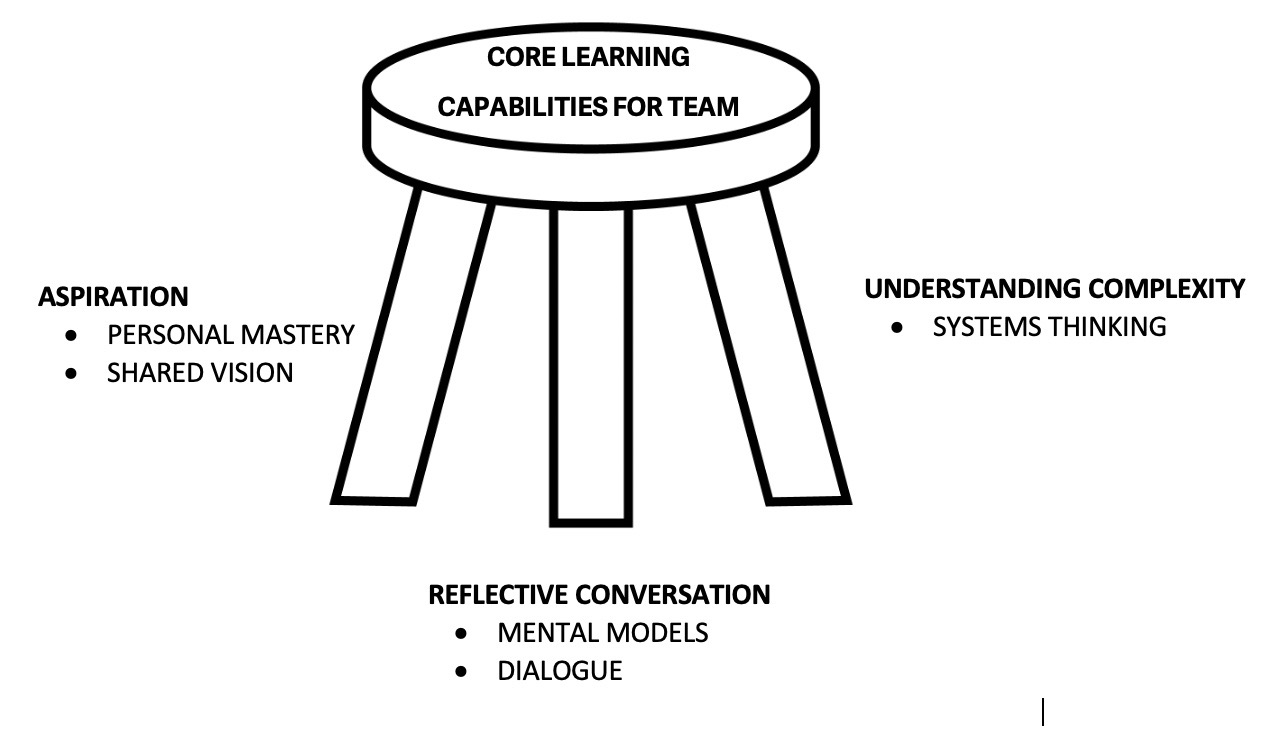
First, as an overview tool, there is the three-legged chair (see figure 1). The legs represent aspiration, reflective conversations, and systems awareness. If one leg is missing, the stool falls over.

Without a creative imagining of a better environment, there is no improvement. Without reflection or a deeper understanding of systems, we quickly end up in dead ends despite having good intentions. 

Three-legged chair

Tool 2

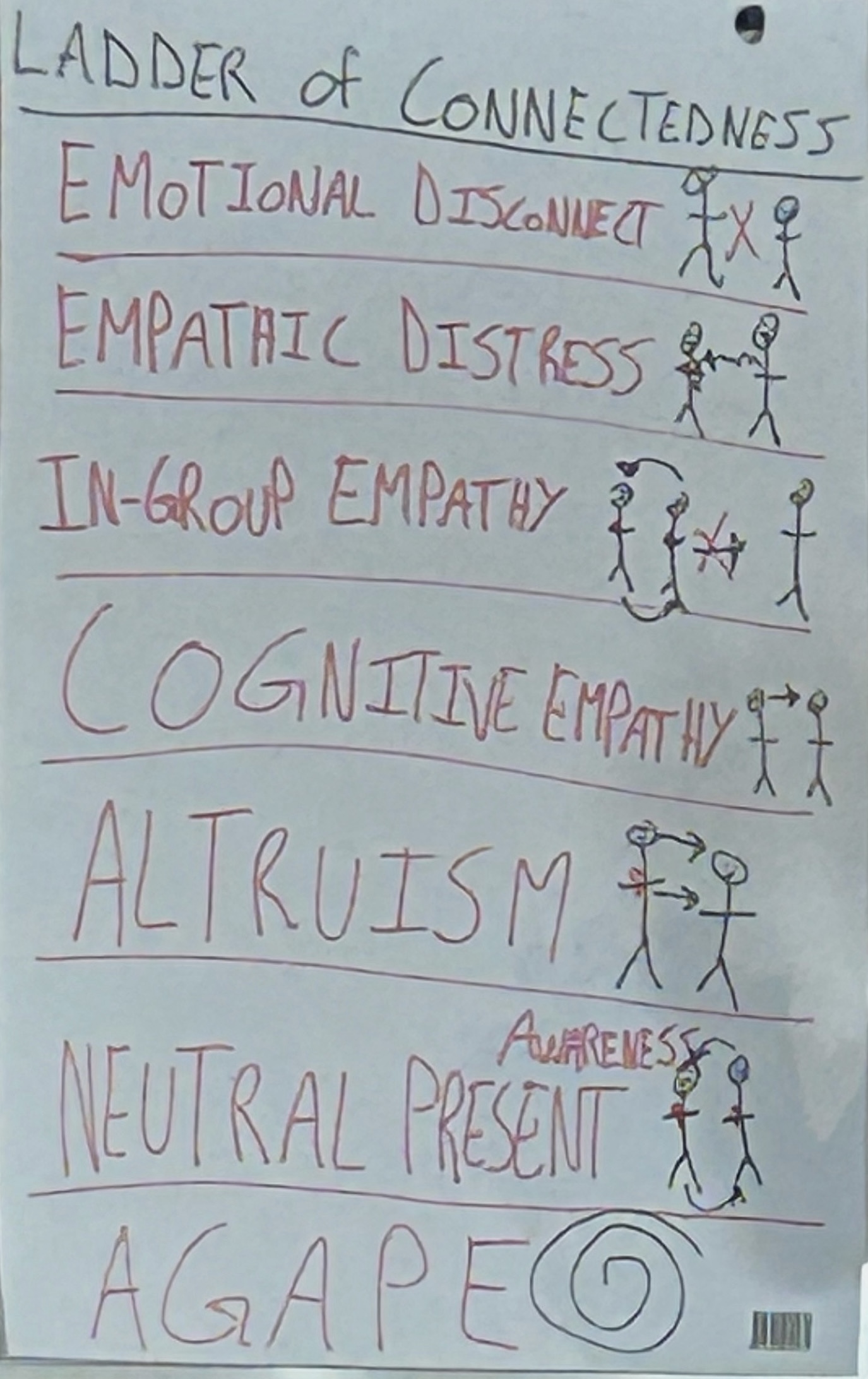
The ladder of connectedness

The second tool is the “ladder of connectedness” (see figure 2), which confused me initially: From bottom to top, the ladder levels are called “agape, neutral presence, altruism, cognitive empathy, in-group empathy, empathic stress, and emotional distance.”

We can harness gravity to move toward deeper connectedness, i.e., strive more toward the lower levels. Confusion can be a sign of real learning. I could not easily assign this idea to an already stored concept. It seemed to fit most closely with a Buddhist understanding.

We may not achieve agape, all-connected love, but we can create a neutral presence even in difficult situations. It also needs the higher levels: A surgeon should manage to distance themselves emotionally for self-protection.

Neutral instead of empathetic

Distance also helps sometimes in conflicts that go round in circles. Empathic stress is something I can relate to as a father of younger children. When my 8-year-old and my 6-year-old argue loudly with each other, it seems easier for me to demand that they stop for the short term because it helps me reduce my internal tension. But in the long run, it doesn’t help me.

In-group empathy may lead to good cooperation in the team, in the company or even in one’s own country, but at the same time it may exclude those who do not belong to the group. I take it upon myself to practice more neutral presence, which is enduring tension and contradiction.

Ladder of Connectedness

Tool 3

Creative Tension

Now our third and a simpler tool (see figure 3): The principle of creative tension. I already knew that a vision needs the right level of challenge, because something we have already achieved or something we can never achieve is not good as a vision.

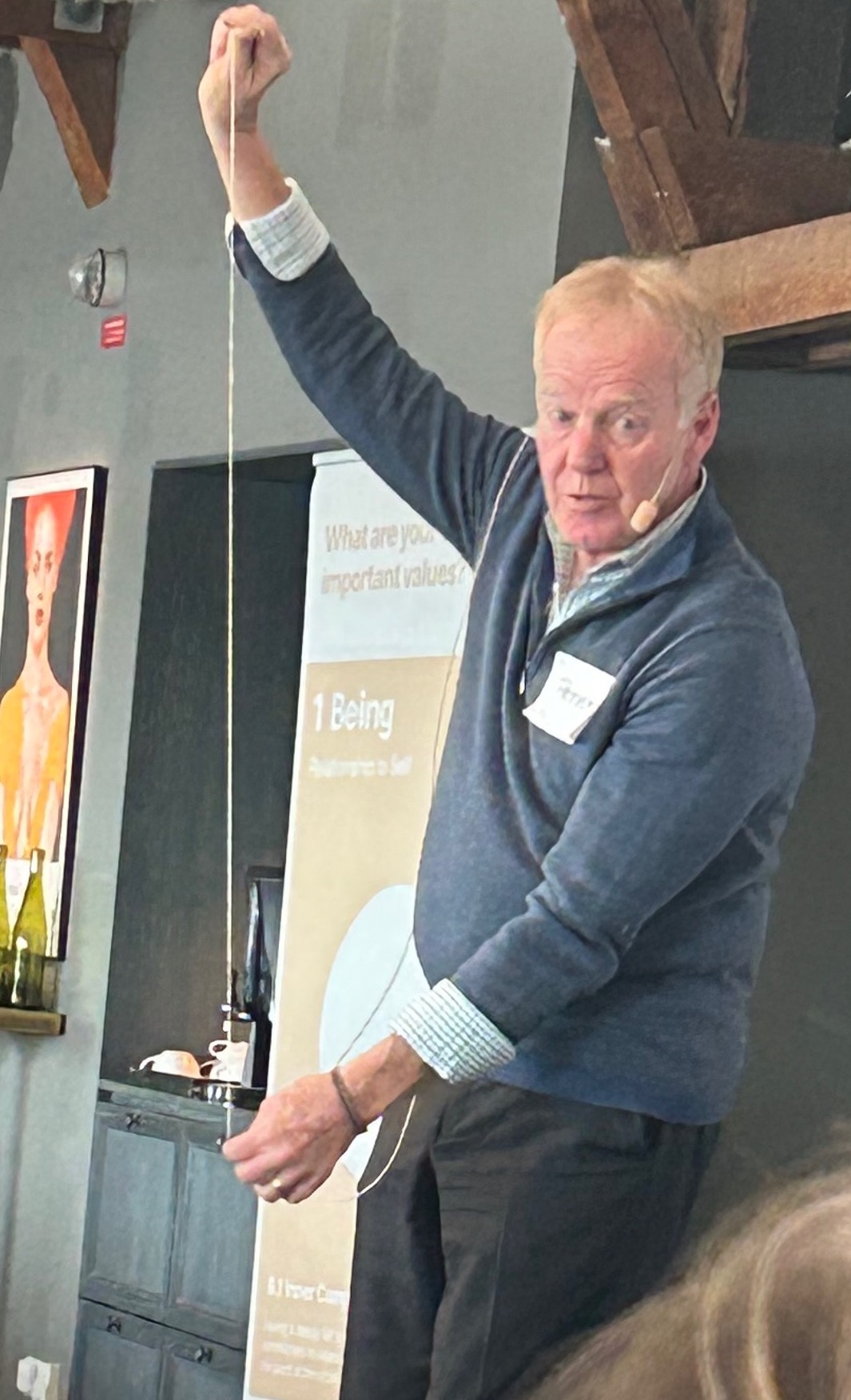
I found the continuation of the thought interesting: We can imagine the tension between reality and vision as a rubber band. When that tension becomes too uncomfortable for us, we often tend to either lower our aspirations or not tell the whole truth about the current state.

An energy source for change

A good example are an organization’s sustainability goals. When we consciously seek and hold this tension, we tap into the energy source for change. This principle of creativity is also found in theater as drama, in music as tonus, and in the Greek rhetoric. In this respect, it is not a new idea, but it is effective when we strive for change.

I was also interested in what Peter Senge is like as a person. I have already met some of the “greats of the lecture scene” away from the stage and with some of them I had the impression that it was difficult for them to live the conveyed messages themselves. That is also human.

Peter with rubber band

Peter Senge as a Human

In the morning of Day three, there was an emotionally expressed resistance from a participant who questioned the usefulness of the whole seminar. She said Peter Senge held on to the statement that we always have a choice and do not have to be influenced by external circumstances, despite her doubts expressed the day before.

Now I was curious. Will he maybe feel attacked and defend himself or let it stand as an individual opinion? He did not react immediately, but let other participants speak first. Later, he resonated, apologized, thanked for the learning opportunity, and did so with an authenticity and elegance that really impressed me.

He always treated his much younger co-trainer at eye level and was so moved several times that tears came to his eyes.

My summary

In the spirit of Marcus Aurelius, I had the opportunity to meet two greats of our time. Especially the combination of two trainers from different generations fits the challenges of our time.

Even though I have not implemented all of the presented contexts and tools and I am also not sure whether the term Compassionate System Leadership will become widely accepted, I recommend every leader to deal with the basic idea. A more sustainable leadership culture would do us and the planet good.

Mag. Gunther Fürstberger

Mag. Gunther Fürstberger

CEO | MDI Management Development International

Gunther Fürstberger is a management trainer, author and CEO of MDI – a global consulting company providing solutions for leadership development. His main interest is to make the world a better place through sustainable leadership. He has worked for clients including ABB, Abbvie, Boehringer Ingelheim, DHL, Google, Hornbach, PWC and Swarovski. His core competence is leadership in digital transformation. At the age of 20 he already started working as a trainer and he also served as HR manager in international corporations.

  • LinkedIn

What serves you next?

Leadership Horizon powered by HR INSIDE SMMIT

AI-Empowered Leadership: 6 Guiding Principles

AI-Empowered Leadership: 6 Guiding Principles This blog post is a detailed summary of the...
Read More

What AI Shows You — and What It Doesn’t

What AI Shows You — and What It Doesn't Meike’s Reflections on Artificial Intelligence Do you...
Read More

Leading in the Age of AI: How AI Discourse Shapes Responsibility and Power

Leading in the Age of AI: How AI Discourse Shapes Responsibility and Power Meike’s Reflections on...
Read More

AI Ethics for Leaders: Why Context and Critical Thinking Matter More Than Ever

AI Ethics for Leaders: Why Context and Critical Thinking Matter More Than Ever. Meike’s...
Read More

A Success Story – When AI Sharpens Human Judgement

A Success Story – When AI Sharpens Human Judgement Do you prefer to listen to this article? Click...
Read More

How Do You Lead People Who Don’t Think the Way You Do?

How Do You Lead People Who Don't Think the Way You Do? Do you want to listen to this article?...
Read More

How You Deal With Neurodiversity as a Leader

How You Deal With Neurodiversity as a Leader You prefer listening to this article? You can find...
Read More

Anita’s Key to Success for International Cooperation

Anita's Key to Success for International Cooperation This blog is an excerpt from our new podcast!...
Read More

Fostering True Workplace Commitment

Fostering True Workplace Commitment Do you prefer to listen to this article? Click below to access...
Read More

Marcin Swierkocki on the Full Range Leadership Model

Marcin Swierkocki on the Full Range Leadership Model This blog is an excerpt from our new podcast!...
Read More
Being a servant leader – Servant Leadership

Being a servant leader – Servant Leadership

by Gunther Fürstberger | Feb 14, 2023 | Leadership Impact, Leadership Tips, MDI Inside | 0 comments

Being a servant leader

“Servant Leadership” is a concept by Robert Greenleaf that describes the manager as a servant to their employees. What this model is specifically about and what its strengths are, you can read in this article.

The origin of the approach

In Hermann Hesse’s “Morgenlandfahrt”, a spiritual seeker experiences how the disappearing servant turns out to be a true leader in retrospect. This story inspired Robert Greenleaf to develop his life’s work, the concept of serving as a leader. A number of well-known authors and CEOs of companies such as Starbucks, Nordstrom and SAS followed him in designing and practicing servant leadership.

A talent management executive at a large international corporation told me one day, “I don’t believe in the honest intent of servant leadership. To me, it seems more like a motivational ploy. In the end, the ‘servant leaders’ earn a lot more than the employees they seem to serve.”


Trick or mission? Manipulated motivation to high performance or the revolution of the working world that turns the hierarchy pyramid upside down?

Managers, especially CEOs, should ask themselves what kind of leadership culture they have and want in their own organization.

The purpose of leadership

What is the purpose of leadership? This is a good question to start a reflection on developing your own leadership culture. The why question is closely related to the „for whom” question. Which stakeholders in an organization are given priority? The shareholders, the employees, the customers? Customers, in a broader sense, can also be certain groups in society or even parts of nature for which the organization wants to create added value.

Focus on employees

Servant leadership is usually associated with a focus on employees. Greenleaf sees, among other things, employee growth as a hallmark of servant leadership. “Serving the community” is also found as a frequently mentioned goal. And then there’s the aspect of getting employees to perform at their best by serving. Shareholders understandably feel comfortable with the latter.

The desired leadership culture is derived from the purpose of the organization. If the purpose of the company is to maximize profit, then human resources tend to be seen as a mean. And servant leadership will consequently be a downstream mean to promote the purpose of “motivated, high-performing human resources.”

While the upside-down pyramid is well suited to question a culture of exploitation of the powerful over the subjugated that has been going on for ages, contradictions arise if taken to its logical conclusion. Institutionalized leadership almost always goes hand in hand with power, e.g. with the right to impose positive and negative sanctions. This makes it easier to achieve organizational goals and often also benefits the led, e.g. through higher security.

However, the history of mankind until today shows that power has often been used for one’s own advantage. And in order to maintain the privileged position of the leadership group, subtile and brutal suppression mechanisms have been used.

Leadership Development

For the common good

The inverted pyramid thus also expresses the desire that leadership does not exploit but support and that the leader put others before themselves. For at least 2000 years there have been rulers who have called themselves servants, from Marcus Aurelius to Joseph II, Frederick the Great to Queen Elizabeth.

In this way, they have expressed how they interpret their privileged right to rule for the common good. Even if they did not donate their castles to the poor, they may have done more for the wellbeing of the people with the servant attitude than absolutist rulers with a “the–state–is–me attitude.”

There are also good arguments why a radical reversal of ruling relations and privileges would not be fair: Those who make an above-average commitment to goals that benefit others should also be entitled to a reward. This commitment can be in terms of time, talent and resources. However, it is questionable whether this justifies a CEO earning 147 times as much as a typical worker in Germany and 300 times as much in the USA.

In addition, there is the legal perspective with the legally anchored liability of the CEO. Someone has to take personal responsibility for wrong decisions and this is normally the managing director registered in the commercial register. Payment defaults or accidents can result in liability. Who bears this liability risk if we turn the pyramid upside down?

In the end, it will probably remain with individuals and they must then also have the possibility to implement decisions. We can flatten the pyramid, we can supplement it with self-coordinating networks, we can develop an empowerment culture – employees and managers can service each other – but ultimate, personal responsibility will remain.

Servant leadership in companies

Companies associated with servant leadership include Nordstrom, Fedex, Starbucks, Southwest Airlines (Herb Kelleher), SAS, and Marriott. Let’s look at what each of these companies value. In most companies, the positive impact of employees being treated well is seen in good customer service:

  • For example, the first stated corporate value at Marriott is “Put people first.”
  • Nordstrom also placed a lot of emphasis on customer service 120 years ago. “Do whatever it takes to take care of the customer”. (John Nordstrom 1901). This attitude has been passed down generations in the entrepreneurial family and has been enriched with humility and employee service orientation.
  • FedEx has built a servant leadership culture. FedEx believes that engaged employees – individuals who trust the organizational goals and have a strong desire to contribute – will implement the organizational plan and ultimately ensure the success of the organization.
  • At Starbucks, long-term CEO Howard Schultz emphasizes the company’s purpose: “Servant leadership is about serving a higher purpose, and when that higher purpose is recognized by everyone in the organization, everyone is indeed a servant of that purpose.” Kelly Creighton describes the organizational culture at Starbucks as: “A culture of belonging, inclusion and diversity.” It also always puts its employees first and encourages everyone to grow into leadership roles within the company. At Starbucks, employees are encouraged to build strong relationships with each other and collaborate and communicate openly. Employees can ask questions and reach out to their supervisors. Ultimately, Starbucks takes the view that “how you treat your employees is how you treat your customers.“
  • Jim Goodnight, founder and CEO of SAS says “Treat employees as if they make a difference and they will.”
  • At Southwestern Airlines, the empowerment idea is especially held dear: Colleen Barrett, former president of Southwest Airlines, explained, “Our whole leadership philosophy is very simple: treat your employees right, and good things will happen.” She assumes that Southwest Airlines has created policies, procedures and rules, but ultimately empowers its employees to use their own common sense and good judgment when needed. It trusts its employees to do the right thing when necessary and does not reprimand them for doing so. For example, if a stranded customer needs a hotel room, employees are empowered to help them if they can. And when dealing with the public, employees are encouraged to find the best solutions and approaches that make sense for the situation at hand.
hackatons create innovations and ideas for leaders

Conclusion

The term “servant leadership” could be misunderstood in the sense of continuity and exclusivity. I.e., that the manager always acts as a servant to the employees and that therefore, there would be no room for the manager to be supported by the employees. This seems onesided and unrealistic. Robert Greenleaf also called his first publication “The servant as leader” and wanted to emphasize that the desire to serve should come before the desire to lead.

Just as the communist countermovement to industrial age capitalism did not yet represent the final chapter of economic history, servant leadership also offers itself more as a line of thought and less as the terminus of a leadership culture. If we understand leading and serving as polarity, then this makes it possible to find a suitable balance for the situation in the interaction between employees and managers.

Similarly, the misunderstanding would be that serving goes in one direction. Namely, that only managers should serve their employees. Transactionally, this would be a reversal of the parent-ego to child-ego relationship. Traditionally, leadership has been seen mostly patriarchal and sometimes matriarchal, i.e. the leader has to care for the children similar to parents, but can demand obedience.

The inversion of the parent-child relationship does not really work. The relationship of two adults who support each other would be more constructive. Especially nobles and rich people have servants. The term servant indicates a subordinate position. This could be resolved in a contemporary understanding of leadership: Employees and managers support each other, partly in different ways and with different means, but at eye level, with mutual appreciation.

“If you support your employees first, they will support you.”

This application of the reciprocity principle will often bring the desired, voluntary support from employees to leadership. But there is a more enduring motivation than this psychological barter: when leaders and employees pursue common goals or a shared mission out of inner conviction and support each other to the best of their ability.

Ultimately, it is the intent of the servant leader that makes the difference: Do they care at least as much about the well-being of others as they does about their own, or do they just want to make employees feel serviced so they will work harder?

The term “servant leadership” is misleading to many. But undoubtedly, one of the most important tasks of leaders is to support their employees. This starts with perceiving and listening to what the employees need from the leader.

In summary, the main meaning of Servant Leadership could be seen as a pendulum swinging away from autocratic and exploitative leadership, but not as a final leadership concept. Rather, partnership-based cooperation at eye level between employees and managers is more suitable for this in order to pursue the jointly shared corporate mission.

Sources:

• https://www.manager-magazin.de/unternehmen/karriere/ceos-verdienen-300-mal-so-viel-wie-arbeiter-a-1041409.html

• https://www.amazon.de/Spiele-Erwachsenen-Psychologie-menschlichen-Beziehungen/dp/3499613506

• https://www.amazon.de/Die-Psychologie-%C3%9Cberzeugens-Robert-Cialdini-ebook/dp/B01MUDPFCC

• https://www.marriott.com/about/culture-and-values/history.mi

• https://hrdailyadvisor.blr.com/2018/06/01/5- real-life-brands-embody-servant-leadership/ • https://www.pallikkutam.com/edu-news/servant-leadershipstories#:~:text=FedEx%20 believes%20that%20engaged%20employees,and%20ultimately%20ensure%20organi-

zational%20success.

Mag. Gunther Fürstberger

Mag. Gunther Fürstberger

CEO | MDI Management Development International

Gunther Fürstberger is a management trainer, author and CEO of Metaforum and MDI – a global consulting company providing solutions for leadership development. His main interest is to make the world a better place through excellent leadership. He has worked for clients including ABB, Abbvie, Boehringer Ingelheim, DHL, Hornbach, PWC and Swarovski. His core competence is leadership in digital transformation. He gained his own leadership experience as HR Manager of McDonald’s Central Europe/Central Asia.  At the age of 20 he already started working as a trainer.

  • LinkedIn

What serves you next?

Leadership Horizon powered by HR INSIDE SMMIT

AI-Empowered Leadership: 6 Guiding Principles

AI-Empowered Leadership: 6 Guiding Principles This blog post is a detailed summary of the...
Read More

What AI Shows You — and What It Doesn’t

What AI Shows You — and What It Doesn't Meike’s Reflections on Artificial Intelligence Do you...
Read More

Leading in the Age of AI: How AI Discourse Shapes Responsibility and Power

Leading in the Age of AI: How AI Discourse Shapes Responsibility and Power Meike’s Reflections on...
Read More

AI Ethics for Leaders: Why Context and Critical Thinking Matter More Than Ever

AI Ethics for Leaders: Why Context and Critical Thinking Matter More Than Ever. Meike’s...
Read More

A Success Story – When AI Sharpens Human Judgement

A Success Story – When AI Sharpens Human Judgement Do you prefer to listen to this article? Click...
Read More

How Do You Lead People Who Don’t Think the Way You Do?

How Do You Lead People Who Don't Think the Way You Do? Do you want to listen to this article?...
Read More

How You Deal With Neurodiversity as a Leader

How You Deal With Neurodiversity as a Leader You prefer listening to this article? You can find...
Read More

Anita’s Key to Success for International Cooperation

Anita's Key to Success for International Cooperation This blog is an excerpt from our new podcast!...
Read More

Fostering True Workplace Commitment

Fostering True Workplace Commitment Do you prefer to listen to this article? Click below to access...
Read More

Marcin Swierkocki on the Full Range Leadership Model

Marcin Swierkocki on the Full Range Leadership Model This blog is an excerpt from our new podcast!...
Read More
« Older Entries
Next Entries »

Information

  • Imprint
  • MDI company website

Social Media

  • Facebook
  • Twitter
  • Youtube
  • LinkedIn

© MDI Management Development Institute, 2020