
• MDI
  • German version
  • Contact us
MDI Management Development
  • Agile leadership
  • Lateral Leadership
  • Leadership Impact
  • Leadership Development
Select Page
Self-Leadership: Harnessing the Power Within

Self-Leadership: Harnessing the Power Within

by Meike Hinnenberg | Dec 17, 2024 | Best Practice, Leadership Tips, Short Knowledge Bits | 0 comments

Self-Leadership: Harnessing the Power Within

Do you prefer to listen to this article? Click below to access our AI-generated audio version!

Self-Leadership: Harnessing the Power Within

In today’s fast-paced and unpredictable world, we often lack control over external circumstances or how others treat us. However, we possess one powerful tool: the ability to choose how we respond.

This doesn’t mean conforming to every situation or forcing solutions. Instead, self-leadership focuses on understanding and managing our thoughts and emotions —skills that can profoundly influence our relationships and leadership abilities.

The Core of Leadership: The “Me” Circle

Imagine leadership development as a ripple effect. At the center lies the self—the starting point for influencing all outer circles: individuals, teams, organizations, and the wider environment. The “me” dimension is foundational.

How we connect with others or design organizational systems stems directly from our inner state. For now, let’s focus on this pivotal core: self-leadership.
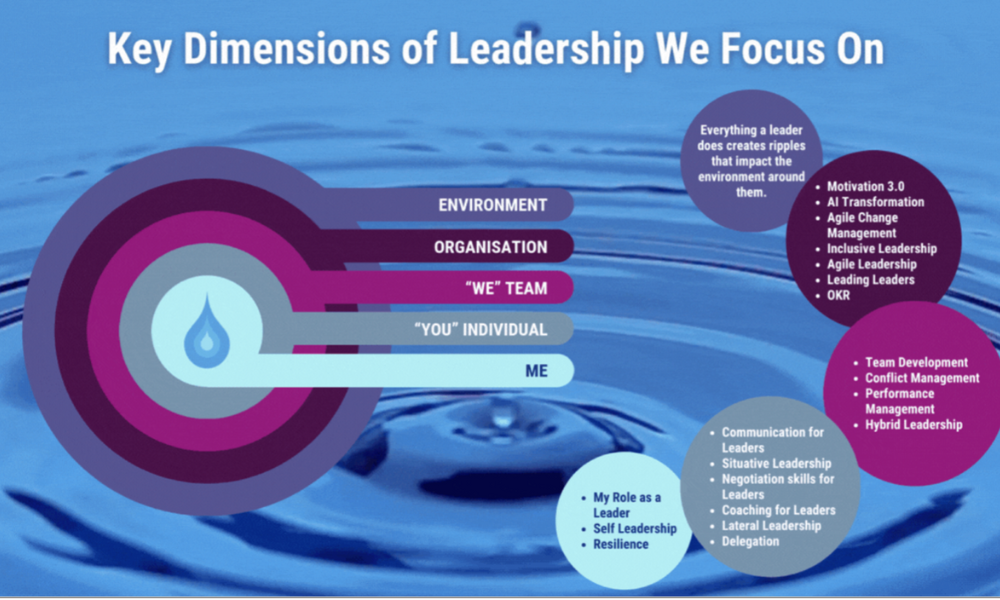
Key Dimensions of Leadership we Focus on

Empathy vs. Sympathy: Choosing Connection

Empathy is a cornerstone of self-leadership, fostering connection, while sympathy can unintentionally create distance. According to Brene Brown, empathy encompasses:

  • Perspective-taking: Seeing the world through someone else’s eyes.
  • Non-judgment: Withholding judgment about others’ experiences.
  • Emotional recognition: Identifying and validating others’ emotions.
  • Feeling with others: Truly sharing in their emotional experience.

Leaders often struggle with vulnerability, imperfection, and the uncontrollable aspects of life and relationships. Our biological wiring doesn’t help—we’re programmed to detect and react to potential threats, a survival mechanism that can hinder connection. Recognizing and addressing this is key to empathetic leadership.

Cultivating “Response-Ability”

While we can’t control external events, we can control how we react—our “response-ability.” Tools like deep, conscious breathing and regular meditation can help calm the brain’s alarm system, creating space between stimulus and response. Gratitude practices can shift our focus toward the positive, reducing the weight of perceived threats.

These habits empower leaders to make decisions thoughtfully, even amid complexity and conflicting needs.

Leadership Decision-Making: Navigating Complexity

Making decisions as a leader is inherently challenging. It’s impossible to satisfy everyone, and every decision invites criticism. Understanding this reality helps us navigate conflict, a normal part of organizational life

Decisions will always carry trade-offs, but by including diverse perspectives and maintaining self-awareness, leaders can strive for the best possible outcomes.

Embracing Your Inner Team

Self-leadership also involves recognizing and harmonizing the many voices within us—our “inner team.” Each voice represents a perspective or trait, such as the Perfectionist, the Empathetic, or the Fearful. Listening to and integrating these voices strengthens decision-making and communication.

Embracing your inner Team

Practical Exercise:

Start by asking yourself a question, like, “Should I address this conflict?” Visualize the various inner voices involved and assign them roles or characters. For instance:

  • The Perfectionist: Insists on flawless execution.
  • The Fearful: Warns of potential risks.
  • The Rational: Seeks logic and balance.
  • The Angry: Advocates fiercely for boundaries.

Identify which voices are louder or more resistant and allow each to speak. Then, appoint an “inner team leader” to mediate, ensuring all perspectives are heard and integrated into a coherent plan.

In my own inner team, I balance voices like the empathetic, the strong, the fearful, and the rational. Each one has value, and my inner leader works to harmonize them, fostering collaboration and guiding decisions that reflect the best of all perspectives.

Conclusion

Self-leadership isn’t about perfection—it’s about awareness and intentionality. By cultivating empathy, practicing response-ability, and embracing the wisdom of your inner team, you can make decisions with clarity and confidence.

When we lead ourselves effectively, we empower others to thrive, creating ripples of positive change that extend far beyond the “me” circle.

Meike Hinnenberg

Meike Hinnenberg

Learning & Development Consultant

Meike Hinnenberg is a trainer at MDI Management Development GmbH and specializes in communication, conflict management, diversity & inclusion, and lateral leadership.


  • LinkedIn

What serves you next?

4 Heuristics to Stop Mistaking Symptoms for Cause in the AI Era

by Zeca Ruiz | 24. September 2026 | Digital Transformation, Leadership and AI, Leadership Tips | 0 Comments

4 Heuristics to Stop Mistaking Symptoms for Cause in the AI Era The AI era is intensifying an old problem: acting too fast on the wrong diagnosis. Every one of us has lived through, or heard about, some organizational mess born from exactly that. In every era, every...
Read More

Human First: Leadership in the Age of AI

by Johanna Glechner | 14. September 2026 | Digital Transformation, Leadership and AI, Leadership in the digital transformation | 0 Comments

Human First: Leadership in the Age of AI My professional journey has always taken place at the intersection of two worlds that, for a long time, were treated as separate: technology and leadership. With a background in business informatics, I started my career in...
Read More

AI Transformation Is Leadership Work

by Gunther Fürstberger | 28. August 2026 | Leadership and AI, Leadership Tips, MDI Whitepaper | 0 Comments

AI Transformation Is Leadership Work The four-step loop that turns individual experiments into lasting change Many companies are already using AI—and still not transforming. Tools, pilot projects, and guidelines only add up to transformation once they deliberately...
Read More

What If AI Doesn’t Replace Us — But Drowns Us Out?

by Martin Maglia | 24. July 2026 | Digital Transformation, Leadership and AI, Short Knowledge Bits | 0 Comments

What If AI Doesn't Replace Us — But Drowns Us Out? Over the weekend, I watched a thought-provoking video from Rick Beato. (You can find the link at the end of this article.) For those who don't know him: Rick Beato is a musician, producer, educator, guitarist, and one...
Read More

Use It or Lose It: How AI and Digital Tools May Be Changing Our Brains

by Florian Biedermann | 26. June 2026 | Leadership and AI, Leadership Tips, Learning Transfer | 0 Comments

Use It or Lose It: How AI and Digital Tools May Be Changing Our Brains You travel to Madrid and want to chat with the locals, but you realize that after five years without practice, your rudimentary Spanish skills are now practically nonexistent and you even struggle...
Read More

How Artificial Intelligence Shapes Who We Become

by Meike Hinnenberg | 19. May 2026 | Impuls series, Leadership and AI, Leadership in the digital transformation | 0 Comments

How Artificial Intelligence Shapes Who We Become Meike’s Reflections on Artificial Intelligence Do you prefer to listen to this article? Click below to access our AI-generated audio version!How Artificial Intelligence Shapes Who We Become Meike’s Reflections on...
Read More

Zeca Ruiz on Cross-Generational Leadership and Navigating Change

by Jana Wölfl | 13. May 2026 | Leadership Impact, MDI Spotlight Series, Training Insights | 0 Comments

Zeca Ruiz on Cross-Generational Leadership and Navigating Change This blog is an excerpt from our new podcast! You can find the entire podcast episode here. Zeca Ruiz on Cross-Generational Leadership and Navigating Change In the fourth episode of our podcast “Voices...
Read More

What AI Shows You — and What It Doesn’t

by Meike Hinnenberg | 1. April 2026 | Digital Transformation, Impuls series, Leadership and AI | 0 Comments

What AI Shows You — and What It Doesn't Meike’s Reflections on Artificial Intelligence Do you prefer to listen to this article? Click below to access our AI-generated audio version! What AI Shows You — and What It Doesn't Meike’s Reflections on Artificial Intelligence...
Read More

Leading in the Age of AI: How AI Discourse Shapes Responsibility and Power

by Meike Hinnenberg | 18. March 2026 | Impuls series, Leadership and AI, Leadership Tips | 0 Comments

Leading in the Age of AI: How AI Discourse Shapes Responsibility and Power Meike’s Reflections on Artificial Intelligence Do you prefer to listen to this article? Click below to access our AI-generated audio version!Leading in the Age of AI: How AI Discourse Shapes...
Read More

AI Ethics for Leaders: Why Context and Critical Thinking Matter More Than Ever

by Meike Hinnenberg | 11. March 2026 | Impuls series, Leadership and AI, Learning Transfer | 0 Comments

AI Ethics for Leaders: Why Context and Critical Thinking Matter More Than Ever. Meike’s Reflections on Artificial Intelligence Do you prefer to listen to this article? Click below to access our AI-generated audio version!AI Ethics for Leaders: Why Context and Critical...
Read More
Navigating the Ethical Challenges of Algorithmic Decision-Making

Navigating the Ethical Challenges of Algorithmic Decision-Making

by Raphaela Pouzar | Aug 27, 2024 | Leadership and AI, Leadership in the digital transformation, Short Knowledge Bits | 0 comments


Navigating the Ethical Challenges of Algorithmic Decision-Making

You prefer to listen to this article? Click here to access our AI-generated audio version:

Navigating the Ethical Challenges of Algorithmic Decision-Making

by KI generated

https://blog.mdi-training.com/wp-content/uploads/2024/08/Navigating-the-Ethical-Challenges-of-Algorithmic-Decision-Making1.mp3

Navigating the Ethical Challenges of Algorithmic Decision-Making

Artificial Intelligence (AI) is transforming our world, from personalized recommendations to advanced medical diagnostics. However, as AI becomes more integrated into our lives, a critical issue has emerged: algorithmic bias. This bias occurs when AI systems are trained on flawed or incomplete data that lacks diversity, leading to unfair or discriminatory outcomes and often perpetuating existing inequalities.

What is AI Bias?

AI bias arises when algorithms reflect and amplify societal prejudices embedded in their training data. For example, suppose an AI system is trained predominantly on data from one demographic group. In that case, it may perform poorly for others, leading to unfair decisions in areas like hiring, healthcare, and law enforcement.

The Dual Nature of AI

AI offers immense benefits, but these are accompanied by significant risks. In healthcare, for instance, AI can assist in diagnosing diseases, but if the training data lacks diversity, the AI may misdiagnose conditions in underrepresented groups, exacerbating health disparities.

Global Implications: Data Colonialism

AI bias isn’t just a local issue—it has global ramifications. In many cases, data from the Global South is used to train AI systems that benefit the Global North, a practice known as data colonialism. This exploitation deepens global inequalities, as those in the Global South often do not share in the benefits of AI technologies.


Global Implications: Data Colonialism

Addressing AI Bias

To mitigate AI bias, it is essential to adopt a responsible approach to AI development. This involves recognizing the duality of AI—its potential for both benefit and harm—and taking proactive steps to minimize risks. Here are some key strategies:

  1. Diverse and Representative Data: Ensuring that AI systems are trained on diverse and representative datasets is crucial. This includes data from different demographic groups, geographic regions, and socio-economic backgrounds to minimize bias.
  2. Transparency and Accountability: AI systems should be transparent, with clear explanations of how decisions are made. Additionally, there should be mechanisms for accountability, allowing users to challenge and understand decisions that negatively impact them.
  3. Ethics by Design: Integrating ethical considerations into the design and development of AI systems is vital. This includes ongoing assessments of how AI systems impact different groups and the potential risks involved.
  4. Global Collaboration: Addressing AI bias requires global collaboration, with input from diverse stakeholders, including those from marginalized communities. Policymakers, industry leaders, and civil society must work together to create regulations and standards that ensure AI development is fair and inclusive.

Conclusion: A Path Forward

As we move forward into an increasingly AI-driven world, it is crucial to remain vigilant about the biases embedded in these technologies. Only by acknowledging and addressing these issues can companies ensure that AI serves as a tool for positive change, rather than perpetuating existing inequalities.

Murikah, W., Nthenge, J. K., & Musyoka, F. M. (2024). Bias and ethics of AI systems applied in auditing – A systematic review. Scientific African, 16, e02281. https://doi.org/10.1016/j.sciaf.2024.e02281

Ukanwa, K. (2024). Algorithmic bias: Social science research integration through the 3-D Dependable AI Framework. Current Opinion in Psychology, 58, 101836. https://doi.org/10.1016/j.copsyc.2024.101836

Caro-Burnett, J., & Kaneko, S. (2022). Is society ready for AI ethical decision-making? Lessons from a study on autonomous cars. Journal of Behavioral and Experimental Economics, 98, 101881. https://doi.org/10.1016/j.socec.2022.101881

Arora, A., Barrett, M., Lee, E., Oborn, E., & Prince, K. (2023). Risk and the future of AI: Algorithmic bias, data colonialism, and marginalization. Information and Organization, 33(3), 100478. https://doi.org/10.1016/j.infoandorg.2023.100478

Raphaela Pouzar

Raphaela Pouzar

Marketing Team Assistant

Raphaela Pouzar, a Bachelor of Business Administration student at IMC Krems, works at MDI as a marketing assistant alongside her studies. Additionally, she is currently pursuing an AI certificate from Harvard Business School.

  • LinkedIn

Download our International Whitepaper:


What serves you next?

4 Heuristics to Stop Mistaking Symptoms for Cause in the AI Era

by Zeca Ruiz | 24. September 2026 | Digital Transformation, Leadership and AI, Leadership Tips | 0 Comments

4 Heuristics to Stop Mistaking Symptoms for Cause in the AI Era The AI era is intensifying an old problem: acting too fast on the wrong diagnosis. Every one of us has lived through, or heard about, some organizational mess born from exactly that. In every era, every...
Read More

Human First: Leadership in the Age of AI

by Johanna Glechner | 14. September 2026 | Digital Transformation, Leadership and AI, Leadership in the digital transformation | 0 Comments

Human First: Leadership in the Age of AI My professional journey has always taken place at the intersection of two worlds that, for a long time, were treated as separate: technology and leadership. With a background in business informatics, I started my career in...
Read More

AI Transformation Is Leadership Work

by Gunther Fürstberger | 28. August 2026 | Leadership and AI, Leadership Tips, MDI Whitepaper | 0 Comments

AI Transformation Is Leadership Work The four-step loop that turns individual experiments into lasting change Many companies are already using AI—and still not transforming. Tools, pilot projects, and guidelines only add up to transformation once they deliberately...
Read More

What If AI Doesn’t Replace Us — But Drowns Us Out?

by Martin Maglia | 24. July 2026 | Digital Transformation, Leadership and AI, Short Knowledge Bits | 0 Comments

What If AI Doesn't Replace Us — But Drowns Us Out? Over the weekend, I watched a thought-provoking video from Rick Beato. (You can find the link at the end of this article.) For those who don't know him: Rick Beato is a musician, producer, educator, guitarist, and one...
Read More

Use It or Lose It: How AI and Digital Tools May Be Changing Our Brains

by Florian Biedermann | 26. June 2026 | Leadership and AI, Leadership Tips, Learning Transfer | 0 Comments

Use It or Lose It: How AI and Digital Tools May Be Changing Our Brains You travel to Madrid and want to chat with the locals, but you realize that after five years without practice, your rudimentary Spanish skills are now practically nonexistent and you even struggle...
Read More

How Artificial Intelligence Shapes Who We Become

by Meike Hinnenberg | 19. May 2026 | Impuls series, Leadership and AI, Leadership in the digital transformation | 0 Comments

How Artificial Intelligence Shapes Who We Become Meike’s Reflections on Artificial Intelligence Do you prefer to listen to this article? Click below to access our AI-generated audio version!How Artificial Intelligence Shapes Who We Become Meike’s Reflections on...
Read More

Zeca Ruiz on Cross-Generational Leadership and Navigating Change

by Jana Wölfl | 13. May 2026 | Leadership Impact, MDI Spotlight Series, Training Insights | 0 Comments

Zeca Ruiz on Cross-Generational Leadership and Navigating Change This blog is an excerpt from our new podcast! You can find the entire podcast episode here. Zeca Ruiz on Cross-Generational Leadership and Navigating Change In the fourth episode of our podcast “Voices...
Read More

What AI Shows You — and What It Doesn’t

by Meike Hinnenberg | 1. April 2026 | Digital Transformation, Impuls series, Leadership and AI | 0 Comments

What AI Shows You — and What It Doesn't Meike’s Reflections on Artificial Intelligence Do you prefer to listen to this article? Click below to access our AI-generated audio version! What AI Shows You — and What It Doesn't Meike’s Reflections on Artificial Intelligence...
Read More

Leading in the Age of AI: How AI Discourse Shapes Responsibility and Power

by Meike Hinnenberg | 18. March 2026 | Impuls series, Leadership and AI, Leadership Tips | 0 Comments

Leading in the Age of AI: How AI Discourse Shapes Responsibility and Power Meike’s Reflections on Artificial Intelligence Do you prefer to listen to this article? Click below to access our AI-generated audio version!Leading in the Age of AI: How AI Discourse Shapes...
Read More

AI Ethics for Leaders: Why Context and Critical Thinking Matter More Than Ever

by Meike Hinnenberg | 11. March 2026 | Impuls series, Leadership and AI, Learning Transfer | 0 Comments

AI Ethics for Leaders: Why Context and Critical Thinking Matter More Than Ever. Meike’s Reflections on Artificial Intelligence Do you prefer to listen to this article? Click below to access our AI-generated audio version!AI Ethics for Leaders: Why Context and Critical...
Read More
Beyond the Horizon: GenAI and Ethical Leadership

Beyond the Horizon: GenAI and Ethical Leadership

by Bailey Parnell | Mar 5, 2024 | Digital Transformation, Leadership and AI, Leadership in the digital transformation | 0 comments

Beyond the Horizon: GenAI and Ethical Leadership

Prefer to listen to the article? Click below to access our AI speech-generated audio. However, if you want to read it as usual, keep scrolling.

Beyond the Horizon: GenAI and Ethical Leadership

In this blog post, keynote speaker Bailey Parnell gives us a few snippets of her exciting keynote speech at our upcoming Leadership Horizon event. We discuss the transformative role of generative AI in modern organizations, delve into how AI can boost well-being, and touch upon ethical considerations leaders must address. Enjoy reading!

Bailey, as we approach the Leadership Horizon event on 04.04.2024, could you start by giving us a brief overview of your upcoming keynote? What can attendees expect to learn and gain from your presentation?

My keynote at the Leadership Horizon event will delve into the transformative role of generative AI (GenAI) in modern organizations. We will explore how AI can revolutionize productivity and performance, but also how this does not need to be at the expense of wellbeing.

Rather, there are ways that AI can support our well–being dramatically in the process. I will share the early findings of my research concerning how GenAI could and should support leadership functions and I’ll do this through the exploration of real-world applications and strategies, ethical considerations, and case studies.

The goal is to leave attendees enlightened about AI’s potential and equip them to integrate these technologies in ethical ways that both support human well-being and performance.

The theme of your keynote revolves around GenAI and its potential impact on organizations and individuals. Can you elaborate on the core potential and challenges of GenAI in contemporary settings, and how it connects to leadership and wellbeing?

GenAI presents vast innovation potential, automating complex tasks, enhancing decision-making, and radically improving efficiency across various sectors. It fosters creativity, generates solutions quickly, and personalizes user experiences, all of which can lead to significant advancements in many fields.

For example, in healthcare, GenAI can help with early disease diagnosis, personalized treatments, and accelerated drug development. However, at the same time, GenAI faces significant challenges, including ethical concerns around data privacy and consent, potential biases in AI algorithms, and the risk of job displacement due to lazy or inconsiderate leaders.

In the same example, GenAI raises concerns about patient data privacy, consent, biases, and job displacement of healthcare workers. These challenges require careful consideration to harness AI’s potential while maintaining ethical standards fully… and our humanity.

About leadership and well-being, I mentioned above how it can offer leaders tools to make more informed decisions, predict trends, and optimize operations, which would presumably lead to improved organizational performance. However, for both leaders and employees, it can also reduce mundane tasks and allow people to focus on more fulfilling and creative work.

This might enhance their job satisfaction and mental well–being. Leaders have a tough job ahead. They must navigate the ethical complexities of AI, answer questions they’ve never had to answer before about humanity, and then also use these tools to support their already-existing objectives.

The 5 most important soft skills for leaders in the age of AI

With your background in both digital well–being research and teaching businesses the skills they need to succeed, could you share some insights on how GenAI can be harnessed to boost both organizational productivity and employee well–being simultaneously?

My research in digital well-being and work with my learning design company have shown me many ways GenAI can significantly boost organizational productivity and employee well-being. Let’s look at 5 potential dual-intent uses for both performance and well–being (some of which we may explore again in the keynote):

1. Automating Routine Tasks

GenAI can handle repetitive or mundane tasks (such as report generation or scheduling). This frees employees to focus on more meaningful and creative work, thus enhancing job satisfaction and reducing burnout.

2. Personalized Employee Training

GenAI can tailor training programs to individual learning styles and professional development needs, which could simultaneously improve learning retention and also foster a more engaged and skilled workforce.

3. Enhanced Decision-Making

By providing data-driven insights and forecasts, GenAI aids in more informed decision-making, which could reduce stress and uncertainty for employees and leaders.

4. Workplace Wellness Analysis

GenAI could analyze workplace data to identify patterns related to stress, workload, and employee engagement, which would help organizations implement targeted wellness initiatives.

5. Improved Communication and Collaboration

GenAI tools can streamline communication and project management, which could lead to a more cohesive and less stressful work environment.

The list of potentials goes on…

Many people are concerned about the ethical implications of AI technologies. How can organizations strategically integrate AI to improve productivity and well–being while proactively addressing ethical questions associated with AI?

I have come up with 9 ethical considerations leaders have to make when it comes to integrating GenAI in their workplaces (this may also come up in the keynote). They must work through most of these before full integration.

At the same time, this technology is new, so be adaptable and realize things may come up that you did not intend. This is just what happens with any technological revolution. But, you can start here…

1. Data Privacy and Security – Ensuring the confidentiality and security of employee and company data.

2. Bias and Fairness – Addressing potential biases in GenAI algorithms and ensuring GenAI decisions are fair and non-discriminatory is crucial.

3. Transparency and Explainability –Transparency in how GenAI systems make decisions.

4. Consent and Choice – Respecting employee consent regarding the use of their data and providing options to opt out of GenAI monitoring or analysis, where appropriate.

5. Impact on Employment – Considering the impact of GenAI on job displacement and the ethical implications of replacing human labor with GenAI.

6. Mental Health and Wellbeing – Being mindful of the impact of GenAI on employee mental health and wellbeing, particularly regarding surveillance, performance monitoring, and increased expectations.

7. Accountability and Responsibility – Clear accountability for decisions made by GenAI systems and mechanisms for redress in case of errors or grievances.

8. Regulatory Compliance – Adhering to legal standards and regulations governing the use of GenAI in the workplace.

9. Employee Development and Training – Addressing the need for upskilling or reskilling employees in the wake of GenAI integration.

Promoting Cohesion and Retaining Talent

In your keynote description, you mention that attendees will learn how GenAI will affect their specific industry and function. Can you provide some examples or insights into how different industries can leverage AI for leadership and employee well–being?

The truth is that GenAI will affect most if not all industries eventually. I mean that.

I have already discussed healthcare above where GenAI can assist in diagnosis and patient care. In finance, GenAI could improve risk assessment and fraud detection. For creative industries, GenAI already offers tools for design and content creation, thus freeing up time for strategic thinking and innovation.

Every sector can leverage AI for leadership development, decision-making, and simple tasks like report-making. In addition to the examples I gave in question 3, here are some other assorted industries we can use and examples in a fun brainstorm…

Manufacturing Industry:

a. Performance – GenAI can optimize production lines by predicting maintenance needs and streamlining supply chain management.

b. Employee Wellbeing – GenAI can enhance safety by monitoring working conditions and predicting potential hazards.

Education Industry:

a. Performance – GenAI can create personalized learning materials and curricula and adapt them to individual student needs.

b. Employee Wellbeing – For educators, GenAI can reduce administrative burdens like grading and lesson planning, giving teachers more time to focus on student engagement and reducing work-related stress.

Aviation Industry:

a. Performance – In aviation, GenAI can assist in the predictive maintenance of aircraft, and optimize fuel efficiency through advanced flight path calculations.

b. Employee Wellbeing – GenAI can also aid in managing flight crew schedules more effectively to ensure adequate rest periods and reduce fatigue.

As you can see, this exercise could be done in any industry.

How do you see GenAI impacting the average person’s daily life? Are there practical applications that individuals can use to make their lives easier?

From personalized recommendations in entertainment and shopping to smart home devices that learn and adapt to user preferences, GenAI improves convenience and efficiency in the household as well.

AI-driven apps can help people with personal budgeting, fitness routines, building resumes, and even mental health support. I have seen this first-hand in my own family with people who are otherwise technical novices and digitally illiterate. It has made their lives easier.

As someone who has given two TED talks with millions of views, what key takeaways do you hope to leave with your audience after this keynote? How do you envision your audience feeling more confident in navigating the future of AI?

After my keynote, I believe the audience will feel slightly uneasy, but not in a bad way. This is normal when you are suddenly able to see the eventualities of the future and the major changes that will come with them.

However, my goal is to quell that unease with a framework for how they can approach these changes as they come, and even provoke them in responsible ways.

I aim for the audience to feel empowered and optimistic about the future of GenAI. My goal is for attendees to leave with a clear vision of how to integrate AI into their leadership and operations confidently.

Considering your role as the Founder & CEO of SkillsCamp and your recognition as one of Canada’s Top 100 Most Powerful Women, what personal experiences or professional milestones have shaped your understanding of the intersection between leadership, AI, and connectedness?

I went through my existential crisis when GenAI was released to the public. The reason for my stress was not because I was stressed about how it would affect me. In fact, I am now AI-assisted in every area of my life, including the leadership of my business as a non-profit.

Rather, I was concerned about how bad actors would use this technology and I was worried about all of the digitally illiterate people who have no idea what is coming. 

I have been researching digital wellbeing for over a decade and I still feel like I’m only able to scratch the surface with most people and share “What is even going on here”. I snapped out of my crisis when I remembered I am better equipped than most people in the world to help humanity through this shift, given my experience, my education, and my profession.

It gave me even more motivation to continue my research, teaching, and speaking, and to turn my non-profit into the Center for Digital Wellbeing. So, this is very personal for me now. 

In the context of leadership, can you share any personal anecdotes or case studies where the responsible use of GenAI has had a transformative impact on an organization’s success and employee well–being?

Easy. I can talk about my organization for this one. It has made my work better and faster. I already use GenAI, mostly ChatGPT, every day. Here are a few ways I use it to support my humanity as an entrepreneur of a learning design and development company…

  1. I have prompted ChatGPT by giving it a program overview, goals, design, methodology, etc., and said could you write me an executive summary for a proposal that is no longer than X characters. 
  2. I have told GPT the learning outcomes of a workshop on collaborative leadership and asked it to help me come up with role-play scenarios that mid-level managers could use in a workshop to practice X skills. 
  3. I have given it a set of data from a feedback form and asked it to pull the main themes from the answers with quotes for proof. 
  4. I have required leaders in leadership programs to use it as part of assignments (to prepare them for the future). 
  5. I have encouraged my staff to use it to enhance their work and make their lives easier (and I have not replaced it with more work).

Right now, I of course double-check and edit answers for validity, accuracy, authenticity to our brand, etc. But this is just the start. I doubt I’ll even have to do that in the future. 

Finally, what advice would you offer to leaders and professionals looking to stay ahead in the age of GenAI and connectedness? How can they prepare themselves and their organizations for the future you’ll be discussing in your keynote?

To stay ahead in the GenAI era, leaders should embrace continuous learning about GenAI advancements and not fear change – own your role in shaping it.

Bailey Parnell

Bailey Parnell

Keynote speaker and entrepreneur

Bailey Parnell is a world-renowned speaker, theorist, entrepreneur, and pioneer in the field of digital wellbeing. At just 22 years old, Bailey was named one of Canada’s Top 100 Most Powerful Women. Since then, she has partnered with prestigious organizations like the United Nations, Deloitte, the NFL, and various governments and universities around the world to share her insights on our digital lives, generative AI, human skills development, and leadership in the future of work.

  • LinkedIn

Did you know? Bailey will join our Leadership Horizon 2024!

Leadership Horizon powered by MDI

4 Heuristics to Stop Mistaking Symptoms for Cause in the AI Era

by Zeca Ruiz | 24. September 2026 | Digital Transformation, Leadership and AI, Leadership Tips | 0 Comments

4 Heuristics to Stop Mistaking Symptoms for Cause in the AI Era The AI era is intensifying an old problem: acting too fast on the wrong diagnosis. Every one of us has lived through, or heard about, some organizational mess born from exactly that. In every era, every...
Read More

Human First: Leadership in the Age of AI

by Johanna Glechner | 14. September 2026 | Digital Transformation, Leadership and AI, Leadership in the digital transformation | 0 Comments

Human First: Leadership in the Age of AI My professional journey has always taken place at the intersection of two worlds that, for a long time, were treated as separate: technology and leadership. With a background in business informatics, I started my career in...
Read More

AI Transformation Is Leadership Work

by Gunther Fürstberger | 28. August 2026 | Leadership and AI, Leadership Tips, MDI Whitepaper | 0 Comments

AI Transformation Is Leadership Work The four-step loop that turns individual experiments into lasting change Many companies are already using AI—and still not transforming. Tools, pilot projects, and guidelines only add up to transformation once they deliberately...
Read More

What If AI Doesn’t Replace Us — But Drowns Us Out?

by Martin Maglia | 24. July 2026 | Digital Transformation, Leadership and AI, Short Knowledge Bits | 0 Comments

What If AI Doesn't Replace Us — But Drowns Us Out? Over the weekend, I watched a thought-provoking video from Rick Beato. (You can find the link at the end of this article.) For those who don't know him: Rick Beato is a musician, producer, educator, guitarist, and one...
Read More

Use It or Lose It: How AI and Digital Tools May Be Changing Our Brains

by Florian Biedermann | 26. June 2026 | Leadership and AI, Leadership Tips, Learning Transfer | 0 Comments

Use It or Lose It: How AI and Digital Tools May Be Changing Our Brains You travel to Madrid and want to chat with the locals, but you realize that after five years without practice, your rudimentary Spanish skills are now practically nonexistent and you even struggle...
Read More

How Artificial Intelligence Shapes Who We Become

by Meike Hinnenberg | 19. May 2026 | Impuls series, Leadership and AI, Leadership in the digital transformation | 0 Comments

How Artificial Intelligence Shapes Who We Become Meike’s Reflections on Artificial Intelligence Do you prefer to listen to this article? Click below to access our AI-generated audio version!How Artificial Intelligence Shapes Who We Become Meike’s Reflections on...
Read More

Zeca Ruiz on Cross-Generational Leadership and Navigating Change

by Jana Wölfl | 13. May 2026 | Leadership Impact, MDI Spotlight Series, Training Insights | 0 Comments

Zeca Ruiz on Cross-Generational Leadership and Navigating Change This blog is an excerpt from our new podcast! You can find the entire podcast episode here. Zeca Ruiz on Cross-Generational Leadership and Navigating Change In the fourth episode of our podcast “Voices...
Read More

What AI Shows You — and What It Doesn’t

by Meike Hinnenberg | 1. April 2026 | Digital Transformation, Impuls series, Leadership and AI | 0 Comments

What AI Shows You — and What It Doesn't Meike’s Reflections on Artificial Intelligence Do you prefer to listen to this article? Click below to access our AI-generated audio version! What AI Shows You — and What It Doesn't Meike’s Reflections on Artificial Intelligence...
Read More

Leading in the Age of AI: How AI Discourse Shapes Responsibility and Power

by Meike Hinnenberg | 18. March 2026 | Impuls series, Leadership and AI, Leadership Tips | 0 Comments

Leading in the Age of AI: How AI Discourse Shapes Responsibility and Power Meike’s Reflections on Artificial Intelligence Do you prefer to listen to this article? Click below to access our AI-generated audio version!Leading in the Age of AI: How AI Discourse Shapes...
Read More

AI Ethics for Leaders: Why Context and Critical Thinking Matter More Than Ever

by Meike Hinnenberg | 11. March 2026 | Impuls series, Leadership and AI, Learning Transfer | 0 Comments

AI Ethics for Leaders: Why Context and Critical Thinking Matter More Than Ever. Meike’s Reflections on Artificial Intelligence Do you prefer to listen to this article? Click below to access our AI-generated audio version!AI Ethics for Leaders: Why Context and Critical...
Read More
AI in Leadership – the Ethical Dimension

AI in Leadership – the Ethical Dimension

by Alina Helmlinger | Jan 29, 2024 | Impuls series, Leadership and AI, Leadership Tips | 0 comments

AI in Leadership – The Ethical Dimension

Do you prefer to listen to this article? Click below to access our AI-generated version of this blog article!

This blog post is a continuation of an interview ” AI-Enhanced Leadership: Maximizing Potential with Intelligent Tools. Click here to read the first part.

The topic of AI is also very much about ethics. I would be particularly interested in this: What ethical considerations should leaders consider when dealing with AI?

AI can process vast amounts of data both now and in the future. This means, for example, that I can easily develop an algorithm with AI to monitor employees even better, work out certain behavioral patterns, and much more.

In other words, I can use AI to make something completely transparent that a human would never have been able to do. In theory, I could develop an AI that uses workflows to tell me exactly which employees are productive and when or who is working at their weakest.

I could also use an AI to monitor the entire company. Of course, this poses a major ethical problem – do you use artificial intelligence to monitor or facilitate work processes? These are two poles that AI could cover.

The question is, what do you want?

In your opinion, how can AI help to create personalized learning experiences for leaders and thus promote their individual development?

With AI, for example, I could create a training program for a leader where they can study at any time. The program explains content at all levels – very simple, highly complex, in a different language or format.

Soon it will also be possible to write with AI via WhatsApp, for example, to better understand the content. But this would also be possible in completely different formats – for example, I could talk to the AI or watch an AI-generated video.

In general, AI could cover everything for me. For example, I could tell it that I want to work on a language model and AI would explain to me what I need and also generate a mind map for me. This AI program would be user-friendly. That means I could use it when and where I want and at the level I need. The AI would also give me constant feedback on my learning progress and tell me where there is room for improvement.

Soon AI will be able to respond to my every wish.

AI learning modules for leaders

I hear a lot about individualization and the promotion of time- and location-independent learning, which will simply make everyday life easier – not just for leaders, but for everyone in general.

Exactly, it is independent of time and place, but can also always be tailored to my needs.

That brings me to my next question: how do you see the role of AI in the future training and development of leaders, what are the limits?

When it comes to learning content in training courses, AI will relatively soon replace the role of the trainer, because AI can do this well on an individual level. Perhaps even better than humans because of the large database.

I can simulate social interactions with an AI, but that’s where I see the limits of AI. In other words, whenever it comes to dealing with other people, AI can teach me the basics and the theory – but it can’t do the actual interpersonal aspects, i.e. working with other people.

You can also see it now after Corona, there was a brief online peak, but then people switched back to face-to-face interaction. People realized that they were missing that. This means that human interaction is now more important in a company. Nobody wants to sit in front of a screen and have everything explained to them by an AI.

Cool, thank you very much, Niels. Is there anything else you would like to add or haven’t said yet?

I see education and training as the most important skills of the 21st century – whether as a leader or an employee, everyone will have to keep learning in the 21st century and AI won’t be able to do that for us. If anything, the opposite is true – we have to learn even more than before, but AIs also make learning much easier for us.

In other words, it all evens out somewhere. We have to keep up with developments and keep learning, but this is also getting easier and easier. In other words, in the 21st century, it’s all about continuing to develop and educate ourselves and putting a bit of effort into our brains – even if we no longer have to thanks to AI.

Conclusion

With AI, (almost) anything will soon be possible – from a conversation to a generated leadership development program. Although many roles can be replaced, it is important to strengthen the interpersonal level and focus on soft skills.

You can find Niels’ homepage here!

Alina Helmlinger

Alina Helmlinger

L&D Consultant, MA

Alina has been an L&D Consultant at MDI since 2021 and supports clients from various industries in the tailor-made design of various leadership development programs and training courses. In addition to her practical knowledge and the experience she has already gained in further training, she draws on her sound theoretical knowledge from her Bachelor’s degree in Human Resources Management and her Master’s degree in Organizational and Personnel Development, which she completed in June 2022. Alina keeps calm, especially in challenging situations and leaders to reconcile the interests of different stakeholders in complex projects, thereby designing tailor-made HR solutions geared towards customers’ needs.

  • LinkedIn

Download our MDI Paper:

Paper Mock Up

This could also help you:

4 Heuristics to Stop Mistaking Symptoms for Cause in the AI Era

by Zeca Ruiz | 24. September 2026 | Digital Transformation, Leadership and AI, Leadership Tips | 0 Comments

4 Heuristics to Stop Mistaking Symptoms for Cause in the AI Era The AI era is intensifying an old problem: acting too fast on the wrong diagnosis. Every one of us has lived through, or heard about, some organizational mess born from exactly that. In every era, every...
Read More

Human First: Leadership in the Age of AI

by Johanna Glechner | 14. September 2026 | Digital Transformation, Leadership and AI, Leadership in the digital transformation | 0 Comments

Human First: Leadership in the Age of AI My professional journey has always taken place at the intersection of two worlds that, for a long time, were treated as separate: technology and leadership. With a background in business informatics, I started my career in...
Read More

AI Transformation Is Leadership Work

by Gunther Fürstberger | 28. August 2026 | Leadership and AI, Leadership Tips, MDI Whitepaper | 0 Comments

AI Transformation Is Leadership Work The four-step loop that turns individual experiments into lasting change Many companies are already using AI—and still not transforming. Tools, pilot projects, and guidelines only add up to transformation once they deliberately...
Read More

What If AI Doesn’t Replace Us — But Drowns Us Out?

by Martin Maglia | 24. July 2026 | Digital Transformation, Leadership and AI, Short Knowledge Bits | 0 Comments

What If AI Doesn't Replace Us — But Drowns Us Out? Over the weekend, I watched a thought-provoking video from Rick Beato. (You can find the link at the end of this article.) For those who don't know him: Rick Beato is a musician, producer, educator, guitarist, and one...
Read More

Use It or Lose It: How AI and Digital Tools May Be Changing Our Brains

by Florian Biedermann | 26. June 2026 | Leadership and AI, Leadership Tips, Learning Transfer | 0 Comments

Use It or Lose It: How AI and Digital Tools May Be Changing Our Brains You travel to Madrid and want to chat with the locals, but you realize that after five years without practice, your rudimentary Spanish skills are now practically nonexistent and you even struggle...
Read More

How Artificial Intelligence Shapes Who We Become

by Meike Hinnenberg | 19. May 2026 | Impuls series, Leadership and AI, Leadership in the digital transformation | 0 Comments

How Artificial Intelligence Shapes Who We Become Meike’s Reflections on Artificial Intelligence Do you prefer to listen to this article? Click below to access our AI-generated audio version!How Artificial Intelligence Shapes Who We Become Meike’s Reflections on...
Read More

Zeca Ruiz on Cross-Generational Leadership and Navigating Change

by Jana Wölfl | 13. May 2026 | Leadership Impact, MDI Spotlight Series, Training Insights | 0 Comments

Zeca Ruiz on Cross-Generational Leadership and Navigating Change This blog is an excerpt from our new podcast! You can find the entire podcast episode here. Zeca Ruiz on Cross-Generational Leadership and Navigating Change In the fourth episode of our podcast “Voices...
Read More

What AI Shows You — and What It Doesn’t

by Meike Hinnenberg | 1. April 2026 | Digital Transformation, Impuls series, Leadership and AI | 0 Comments

What AI Shows You — and What It Doesn't Meike’s Reflections on Artificial Intelligence Do you prefer to listen to this article? Click below to access our AI-generated audio version! What AI Shows You — and What It Doesn't Meike’s Reflections on Artificial Intelligence...
Read More

Leading in the Age of AI: How AI Discourse Shapes Responsibility and Power

by Meike Hinnenberg | 18. March 2026 | Impuls series, Leadership and AI, Leadership Tips | 0 Comments

Leading in the Age of AI: How AI Discourse Shapes Responsibility and Power Meike’s Reflections on Artificial Intelligence Do you prefer to listen to this article? Click below to access our AI-generated audio version!Leading in the Age of AI: How AI Discourse Shapes...
Read More

AI Ethics for Leaders: Why Context and Critical Thinking Matter More Than Ever

by Meike Hinnenberg | 11. March 2026 | Impuls series, Leadership and AI, Learning Transfer | 0 Comments

AI Ethics for Leaders: Why Context and Critical Thinking Matter More Than Ever. Meike’s Reflections on Artificial Intelligence Do you prefer to listen to this article? Click below to access our AI-generated audio version!AI Ethics for Leaders: Why Context and Critical...
Read More
Can AI Support EI Development For Leaders?

Can AI Support EI Development For Leaders?

by Vladimir Novac | Jan 29, 2024 | Impuls series, Leadership and AI, Short Knowledge Bits | 0 comments

Can AI Support EI Development For Leaders?

Do you prefer to listen to this article? Click below to access our AI-generated version of this blog article!

Our MDI trainer and partner Vladimir Novac asked around and collected a few thrilling insights on the connection between artificial and emotional intelligence. Here are 9 ways in which artificial intelligence can support leaders with their development of emotional intelligence. Enjoy reading!

1. Personalized coaching and feedback:

AI-driven platforms can provide personalized coaching to leaders based on their specific strengths and weaknesses in emotional intelligence. Real-time feedback can be generated by analyzing a leader’s communication style, facial expressions, and tone of voice during interactions.

2. Emotion recognition:

AI technologies like natural language processing and facial recognition can analyze leaders’ interactions and identify emotional cues. Feedback can be provided on how well a leader is recognizing and responding to the emotions of others.

3. Virtual reality simulations:

AI-powered VR simulations can create realistic scenarios to help leaders practice and improve their emotional intelligence in various situations. These simulations can mimic challenging workplace scenarios, allowing leaders to navigate emotional interactions in a controlled environment.

4. Chatbots for self-reflection:

AI-powered chatbots can engage leaders in conversations that prompt self-reflection on their emotional responses and decision-making processes. Chatbots can provide insights and resources to help leaders develop a deeper understanding of emotional intelligence concepts.

Are jobs being replaced by AI?

5. Data-driven insights

AI analytics can process large sets of data related to leadership behavior and performance, identifying patterns and correlations. Leaders can receive data-driven insights into their emotional intelligence development progress and areas that may need further attention.

6. Learning platforms with AI recommendations:

AI-driven learning platforms can recommend specific courses, resources, or activities tailored to a leader’s individual needs for developing emotional intelligence. Recommendations can be based on ongoing assessments and feedback.

7. Sentiment analysis in communication:

AI can be applied to analyze written or spoken communication to assess the sentiment and emotional tone. Leaders can receive feedback on how their communication may be perceived and suggestions for improvement.

8. Continuous monitoring and progress tracking:

AI tools can continuously monitor a leader’s interactions, providing ongoing feedback and tracking progress over time. Leaders can receive regular reports on their emotional intelligence development, allowing for adjustments and refinements to their learning strategies.

9. AI-powered coaching platforms:

AI-driven coaching platforms can simulate coaching sessions, providing leaders with practice scenarios and feedback on their emotional intelligence skills. These platforms may incorporate natural language processing to analyze communication patterns and emotional expressions.

As you can see, there are many ways in which AI influences leaders and their emotional intelligence. Join the conversation on Vlad’s LinkedIn to share your thoughts!

Vladimir Novac

Vladimir Novac

MDI Trainer & Partner

Vladimir Novac is based in Bucharest, Romania, and works as top-executive leadership trainer and coach around the globe. He is certified NLP Practicioner and Change Indicator Analyst and especially dedicated to the topics of team development, self leadership, performance management and change. Inspired by a big personal mission, he is enriching the MDI world since many years with knowledge and passion.

  • LinkedIn

Download our MDI Paper:

Paper Mock Up

This could also help you:

4 Heuristics to Stop Mistaking Symptoms for Cause in the AI Era

by Zeca Ruiz | 24. September 2026 | Digital Transformation, Leadership and AI, Leadership Tips | 0 Comments

4 Heuristics to Stop Mistaking Symptoms for Cause in the AI Era The AI era is intensifying an old problem: acting too fast on the wrong diagnosis. Every one of us has lived through, or heard about, some organizational mess born from exactly that. In every era, every...
Read More

Human First: Leadership in the Age of AI

by Johanna Glechner | 14. September 2026 | Digital Transformation, Leadership and AI, Leadership in the digital transformation | 0 Comments

Human First: Leadership in the Age of AI My professional journey has always taken place at the intersection of two worlds that, for a long time, were treated as separate: technology and leadership. With a background in business informatics, I started my career in...
Read More

AI Transformation Is Leadership Work

by Gunther Fürstberger | 28. August 2026 | Leadership and AI, Leadership Tips, MDI Whitepaper | 0 Comments

AI Transformation Is Leadership Work The four-step loop that turns individual experiments into lasting change Many companies are already using AI—and still not transforming. Tools, pilot projects, and guidelines only add up to transformation once they deliberately...
Read More

What If AI Doesn’t Replace Us — But Drowns Us Out?

by Martin Maglia | 24. July 2026 | Digital Transformation, Leadership and AI, Short Knowledge Bits | 0 Comments

What If AI Doesn't Replace Us — But Drowns Us Out? Over the weekend, I watched a thought-provoking video from Rick Beato. (You can find the link at the end of this article.) For those who don't know him: Rick Beato is a musician, producer, educator, guitarist, and one...
Read More

Use It or Lose It: How AI and Digital Tools May Be Changing Our Brains

by Florian Biedermann | 26. June 2026 | Leadership and AI, Leadership Tips, Learning Transfer | 0 Comments

Use It or Lose It: How AI and Digital Tools May Be Changing Our Brains You travel to Madrid and want to chat with the locals, but you realize that after five years without practice, your rudimentary Spanish skills are now practically nonexistent and you even struggle...
Read More

How Artificial Intelligence Shapes Who We Become

by Meike Hinnenberg | 19. May 2026 | Impuls series, Leadership and AI, Leadership in the digital transformation | 0 Comments

How Artificial Intelligence Shapes Who We Become Meike’s Reflections on Artificial Intelligence Do you prefer to listen to this article? Click below to access our AI-generated audio version!How Artificial Intelligence Shapes Who We Become Meike’s Reflections on...
Read More

Zeca Ruiz on Cross-Generational Leadership and Navigating Change

by Jana Wölfl | 13. May 2026 | Leadership Impact, MDI Spotlight Series, Training Insights | 0 Comments

Zeca Ruiz on Cross-Generational Leadership and Navigating Change This blog is an excerpt from our new podcast! You can find the entire podcast episode here. Zeca Ruiz on Cross-Generational Leadership and Navigating Change In the fourth episode of our podcast “Voices...
Read More

What AI Shows You — and What It Doesn’t

by Meike Hinnenberg | 1. April 2026 | Digital Transformation, Impuls series, Leadership and AI | 0 Comments

What AI Shows You — and What It Doesn't Meike’s Reflections on Artificial Intelligence Do you prefer to listen to this article? Click below to access our AI-generated audio version! What AI Shows You — and What It Doesn't Meike’s Reflections on Artificial Intelligence...
Read More

Leading in the Age of AI: How AI Discourse Shapes Responsibility and Power

by Meike Hinnenberg | 18. March 2026 | Impuls series, Leadership and AI, Leadership Tips | 0 Comments

Leading in the Age of AI: How AI Discourse Shapes Responsibility and Power Meike’s Reflections on Artificial Intelligence Do you prefer to listen to this article? Click below to access our AI-generated audio version!Leading in the Age of AI: How AI Discourse Shapes...
Read More

AI Ethics for Leaders: Why Context and Critical Thinking Matter More Than Ever

by Meike Hinnenberg | 11. March 2026 | Impuls series, Leadership and AI, Learning Transfer | 0 Comments

AI Ethics for Leaders: Why Context and Critical Thinking Matter More Than Ever. Meike’s Reflections on Artificial Intelligence Do you prefer to listen to this article? Click below to access our AI-generated audio version!AI Ethics for Leaders: Why Context and Critical...
Read More
« Older Entries
Next Entries »

Information

  • Imprint
  • MDI company website

Social Media

  • Facebook
  • Twitter
  • Youtube
  • LinkedIn

© MDI Management Development Institute, 2020