
• MDI
  • German version
  • Contact us
MDI Management Development
  • Agile leadership
  • Lateral Leadership
  • Leadership Impact
  • Leadership Development
Select Page
Efficiency with AI in Leadership Development

Efficiency with AI in Leadership Development

by Gunther Fürstberger | Oct 31, 2024 | Best Practice, Leadership and AI, MDI Inside | 0 comments

Efficiency with AI in Leadership Development

Do you prefer to listen to this article? Click below to access our AI-generated audio version!

Efficiency with AI in Leadership Development

Perhaps the first AI hype is already over, but it paves the way for a more realistic view. AI transformation is progressing at different speeds in different industries.

However, the training industry is among the pioneers: machine learning has enormous potential to make human learning more efficient, effective, and cost-effective. Since 2023, we have been experimenting intensively with artificial intelligence as a provider of leadership development and are happy to share our experiences.

AI in everyday business: a fixed routine in meetings

For a year and a half, AI has had a permanent place in every company management meeting. At least one current topic is supplemented by an LLM (Large Language Model) with a perspective or recommendation.

This practice has proven itself and enables more informed decisions with minimal time investment. Experiments with automatic logging, on the other hand, have proven less successful.

In August 2023, we launched AICO (Artificial Intelligence Co-Trainer), which has since been supporting us with energy exercises, music selection, transfer tasks, and as a knowledge source for participant questions in the seminar. Shortly after that, we tested the first ChatGPT role-playing game in a seminar and were impressed by the positive participant feedback. Initially, we provided the prompts as a transfer task.

AI transformation roadmap: planning at the company level

In January 2024, we launched a company-wide AI transformation roadmap. This means that we plan how AI can be used in key areas of the company every quarter to ensure that the entire organization is involved in this development.

In our OKR (Objectives and Key Results) planning meeting for the second quarter, we determined that no offer would be sent to customers without an AI component that covers at least 10% of the learning journey. Customers will still have the option to book the AI components that were previously free of charge.

AI transformation roadmap: planning at the company level

AI Lab: A role-playing center for real-world scenarios

In the third quarter, we plan to set up an AI lab on our website where all applications can be tested and used in a bundled form. This lab includes a role-playing center for various leadership communication situations. Participants take on the role of the leader, while the AI takes on the role of the employees.

A keyboard is no longer necessary – the role play is done by speaking and listening. After completion, the leaders receive targeted feedback that refers to the learned communication models. The role play can be repeated as often as desired, not only in the seminar but also when the situation arises in real life.

The future of learning: from 2D avatars to “superpowers”

Just as e-learning has replaced knowledge transfer in training over the last 20 years, AI has the potential to revolutionize skills development today. Currently, role-playing on the phone is still purely auditory, but soon visual avatars will be integrated as role-playing partners.

AI applications with 3D avatars for virtual reality glasses already exist. However, we suspect that 2D avatars will initially be used as learning partners because they are easier to use. These avatars are already supported by so-called “superpowers”. For example, Hume.ai gives AI coaches empathy and enables feedback on the current emotional state of the role-playing participant using voice analysis.

Real avatars as knowledge messengers and the next step in learning transfer

We are experimenting with “real avatars” of trainers who are available to participants as knowledge messengers after the seminar. This new type of learning transfer support enables agile learning when needed. Despite all efforts, learning transfer has often been a neglected topic in the industry.

Our leadership agent project (“LAgent”) is proving more challenging: we are developing an AI agent that can proactively pursue short-and long-term goals together with the leader. However, the LLMs currently available are still limited in their memory function, which would be necessary for responsible co-leadership. But this is precisely where development is progressing rapidly, and it is becoming increasingly easier to develop AI agents.

Conclusion: AI transformation in learning and development

Overall, the AI transformation in the area of learning and development is a fascinating field and is contributing significantly to the development of organizations and, by extension, society.

Mag. Gunther Fürstberger

Mag. Gunther Fürstberger

CEO | MDI Management Development International

Gunther Fürstberger is a management trainer, author and CEO of Metaforum and MDI – a global consulting company providing solutions for leadership development. His main interest is to make the world a better place through excellent leadership. He has worked for clients including ABB, Abbvie, Boehringer Ingelheim, DHL, Hornbach, PWC and Swarovski. His core competence is leadership in digital transformation. He gained his own leadership experience as HR Manager of McDonald’s Central Europe/Central Asia.  At the age of 20 he already started working as a trainer.

  • LinkedIn

Download our International Whitepaper:

 

What serves you next?

How Do You Lead People Who Don’t Think the Way You Do?

by Zeca Ruiz | 4. February 2026 | Leadership Impact, Leadership Tips, Learning Transfer | 0 Comments

How Do You Lead People Who Don't Think the Way You Do? Do you want to listen to this article? Click here to access our AI-generated audio version!   How do you lead people who do not think the way you do? Leadership is a challenge, especially when you are not...
Read More

How You Deal With Neurodiversity as a Leader

by Iris Kandlbauer | 3. February 2026 | Leadership Impact, Leadership Tips, Short Knowledge Bits | 0 Comments

How You Deal With Neurodiversity as a Leader You prefer listening to this article? You can find our AI-generated audio version below! How You Deal With Neurodiversity as a Leader What might be behind “strange” behavior in a team—and how leaders can deal with it...
Read More

Anita’s Key to Success for International Cooperation

by Jana Wölfl | 3. February 2026 | Leadership and AI, Leadership Tips, MDI Spotlight Series | 0 Comments

Anita's Key to Success for International Cooperation This blog is an excerpt from our new podcast! You can find the entire podcast episode here. Anita's Key to Success for International Cooperation In our new video podcast format, “Voices of Leadership – an MDI...
Read More

Fostering True Workplace Commitment

by Marcin Swierkocki | 14. January 2026 | Leadership Tips, Learning Transfer, Short Knowledge Bits | 0 Comments

Fostering True Workplace Commitment Do you prefer to listen to this article? Click below to access our AI-generated audio version! Fostering True Workplace Commitment Throughout my years of practice, I've found that deep workplace commitment is achieved not through...
Read More

Marcin Swierkocki on the Full Range Leadership Model

by Jana Wölfl | 19. December 2025 | Leadership and AI, Leadership Tips, MDI Spotlight Series | 0 Comments

Marcin Swierkocki on the Full Range Leadership Model This blog is an excerpt from our new podcast! You can find the entire podcast episode here. Marcin Swierkocki on the Full Range Leadership Model In the newest episode of our podcast “Voices of Leadership | An MDI...
Read More

Self-Efficacy in Change: Why It Matters

by Anita Berger | 17. December 2025 | Leadership Tips, Learning Transfer, Short Knowledge Bits | 0 Comments

Why It Matters When Transformation Gets Hard Do you prefer to listen to this article? Click below to access our AI-generated audio version:Self-Efficacy: Why It Matters When Transformation Gets Hard Change can be exhausting.Especially when things are unclear,...
Read More

Generation Z isn’t the Problem but Our System is

by Zeca Ruiz | 3. December 2025 | Impuls series, International leadership development, Leadership in the digital transformation | 0 Comments

Generation Z Isn’t the Problem, but Our System is. Read this article on crossgenerational management by Zeca Ruiz to find out more!

Read More

From Lab to Practice: What We Learned With AI

by Rafael Ungvari | 3. September 2025 | Digital Transformation, Leadership and AI, Short Knowledge Bits | 0 Comments

From Lab to Practice: What We Learned With AI Do you prefer to listen to this article? Click here to access our AI-generated audio version! From Lab to Practice: What We Learned With AI AI in organizations isn’t a one-size-fits-all solution. And in people development,...
Read More

How to Stay Connected: Leadership in Challenging Times

by Jana Wölfl | 28. August 2025 | Impuls series, Leadership in the digital transformation, Training Insights | 0 Comments

How to Stay Connected: Leadership in Challenging Times This blog is an excerpt from our new podcast! You can find the entire podcast episode here. Staying connected: Leadership in challenging times In our new video podcast format, “Voices of Leadership – an MDI...
Read More

How to Build a Psychological Safety Net at Work

by Florian Biedermann | 28. August 2025 | Best Practice, Leadership Tips, Short Knowledge Bits | 0 Comments

How to Build a Psychological Safety Net at Work Would you like to listen to this article?  Click here to access our AI-generated audio version! Have fun listening ;)How to Build a Psychological Safety Net at Work Some of you might recognize these situations at work:...
Read More
Navigating the Ethical Challenges of Algorithmic Decision-Making

Navigating the Ethical Challenges of Algorithmic Decision-Making

by Raphaela Pouzar | Aug 27, 2024 | Leadership and AI, Leadership in the digital transformation, Short Knowledge Bits | 0 comments


Navigating the Ethical Challenges of Algorithmic Decision-Making

You prefer to listen to this article? Click here to access our AI-generated audio version:

Navigating the Ethical Challenges of Algorithmic Decision-Making

by KI generated

https://blog.mdi-training.com/wp-content/uploads/2024/08/Navigating-the-Ethical-Challenges-of-Algorithmic-Decision-Making1.mp3

Navigating the Ethical Challenges of Algorithmic Decision-Making

Artificial Intelligence (AI) is transforming our world, from personalized recommendations to advanced medical diagnostics. However, as AI becomes more integrated into our lives, a critical issue has emerged: algorithmic bias. This bias occurs when AI systems are trained on flawed or incomplete data that lacks diversity, leading to unfair or discriminatory outcomes and often perpetuating existing inequalities.

What is AI Bias?

AI bias arises when algorithms reflect and amplify societal prejudices embedded in their training data. For example, suppose an AI system is trained predominantly on data from one demographic group. In that case, it may perform poorly for others, leading to unfair decisions in areas like hiring, healthcare, and law enforcement.

The Dual Nature of AI

AI offers immense benefits, but these are accompanied by significant risks. In healthcare, for instance, AI can assist in diagnosing diseases, but if the training data lacks diversity, the AI may misdiagnose conditions in underrepresented groups, exacerbating health disparities.

Global Implications: Data Colonialism

AI bias isn’t just a local issue—it has global ramifications. In many cases, data from the Global South is used to train AI systems that benefit the Global North, a practice known as data colonialism. This exploitation deepens global inequalities, as those in the Global South often do not share in the benefits of AI technologies.


Global Implications: Data Colonialism

Addressing AI Bias

To mitigate AI bias, it is essential to adopt a responsible approach to AI development. This involves recognizing the duality of AI—its potential for both benefit and harm—and taking proactive steps to minimize risks. Here are some key strategies:

  1. Diverse and Representative Data: Ensuring that AI systems are trained on diverse and representative datasets is crucial. This includes data from different demographic groups, geographic regions, and socio-economic backgrounds to minimize bias.
  2. Transparency and Accountability: AI systems should be transparent, with clear explanations of how decisions are made. Additionally, there should be mechanisms for accountability, allowing users to challenge and understand decisions that negatively impact them.
  3. Ethics by Design: Integrating ethical considerations into the design and development of AI systems is vital. This includes ongoing assessments of how AI systems impact different groups and the potential risks involved.
  4. Global Collaboration: Addressing AI bias requires global collaboration, with input from diverse stakeholders, including those from marginalized communities. Policymakers, industry leaders, and civil society must work together to create regulations and standards that ensure AI development is fair and inclusive.

Conclusion: A Path Forward

As we move forward into an increasingly AI-driven world, it is crucial to remain vigilant about the biases embedded in these technologies. Only by acknowledging and addressing these issues can companies ensure that AI serves as a tool for positive change, rather than perpetuating existing inequalities.

Murikah, W., Nthenge, J. K., & Musyoka, F. M. (2024). Bias and ethics of AI systems applied in auditing – A systematic review. Scientific African, 16, e02281. https://doi.org/10.1016/j.sciaf.2024.e02281

Ukanwa, K. (2024). Algorithmic bias: Social science research integration through the 3-D Dependable AI Framework. Current Opinion in Psychology, 58, 101836. https://doi.org/10.1016/j.copsyc.2024.101836

Caro-Burnett, J., & Kaneko, S. (2022). Is society ready for AI ethical decision-making? Lessons from a study on autonomous cars. Journal of Behavioral and Experimental Economics, 98, 101881. https://doi.org/10.1016/j.socec.2022.101881

Arora, A., Barrett, M., Lee, E., Oborn, E., & Prince, K. (2023). Risk and the future of AI: Algorithmic bias, data colonialism, and marginalization. Information and Organization, 33(3), 100478. https://doi.org/10.1016/j.infoandorg.2023.100478

Raphaela Pouzar

Raphaela Pouzar

Marketing Team Assistant

Raphaela Pouzar, a Bachelor of Business Administration student at IMC Krems, works at MDI as a marketing assistant alongside her studies. Additionally, she is currently pursuing an AI certificate from Harvard Business School.

  • LinkedIn

Download our International Whitepaper:

 

What serves you next?

How Do You Lead People Who Don’t Think the Way You Do?

by Zeca Ruiz | 4. February 2026 | Leadership Impact, Leadership Tips, Learning Transfer | 0 Comments

How Do You Lead People Who Don't Think the Way You Do? Do you want to listen to this article? Click here to access our AI-generated audio version!   How do you lead people who do not think the way you do? Leadership is a challenge, especially when you are not...
Read More

How You Deal With Neurodiversity as a Leader

by Iris Kandlbauer | 3. February 2026 | Leadership Impact, Leadership Tips, Short Knowledge Bits | 0 Comments

How You Deal With Neurodiversity as a Leader You prefer listening to this article? You can find our AI-generated audio version below! How You Deal With Neurodiversity as a Leader What might be behind “strange” behavior in a team—and how leaders can deal with it...
Read More

Anita’s Key to Success for International Cooperation

by Jana Wölfl | 3. February 2026 | Leadership and AI, Leadership Tips, MDI Spotlight Series | 0 Comments

Anita's Key to Success for International Cooperation This blog is an excerpt from our new podcast! You can find the entire podcast episode here. Anita's Key to Success for International Cooperation In our new video podcast format, “Voices of Leadership – an MDI...
Read More

Fostering True Workplace Commitment

by Marcin Swierkocki | 14. January 2026 | Leadership Tips, Learning Transfer, Short Knowledge Bits | 0 Comments

Fostering True Workplace Commitment Do you prefer to listen to this article? Click below to access our AI-generated audio version! Fostering True Workplace Commitment Throughout my years of practice, I've found that deep workplace commitment is achieved not through...
Read More

Marcin Swierkocki on the Full Range Leadership Model

by Jana Wölfl | 19. December 2025 | Leadership and AI, Leadership Tips, MDI Spotlight Series | 0 Comments

Marcin Swierkocki on the Full Range Leadership Model This blog is an excerpt from our new podcast! You can find the entire podcast episode here. Marcin Swierkocki on the Full Range Leadership Model In the newest episode of our podcast “Voices of Leadership | An MDI...
Read More

Self-Efficacy in Change: Why It Matters

by Anita Berger | 17. December 2025 | Leadership Tips, Learning Transfer, Short Knowledge Bits | 0 Comments

Why It Matters When Transformation Gets Hard Do you prefer to listen to this article? Click below to access our AI-generated audio version:Self-Efficacy: Why It Matters When Transformation Gets Hard Change can be exhausting.Especially when things are unclear,...
Read More

Generation Z isn’t the Problem but Our System is

by Zeca Ruiz | 3. December 2025 | Impuls series, International leadership development, Leadership in the digital transformation | 0 Comments

Generation Z Isn’t the Problem, but Our System is. Read this article on crossgenerational management by Zeca Ruiz to find out more!

Read More

From Lab to Practice: What We Learned With AI

by Rafael Ungvari | 3. September 2025 | Digital Transformation, Leadership and AI, Short Knowledge Bits | 0 Comments

From Lab to Practice: What We Learned With AI Do you prefer to listen to this article? Click here to access our AI-generated audio version! From Lab to Practice: What We Learned With AI AI in organizations isn’t a one-size-fits-all solution. And in people development,...
Read More

How to Stay Connected: Leadership in Challenging Times

by Jana Wölfl | 28. August 2025 | Impuls series, Leadership in the digital transformation, Training Insights | 0 Comments

How to Stay Connected: Leadership in Challenging Times This blog is an excerpt from our new podcast! You can find the entire podcast episode here. Staying connected: Leadership in challenging times In our new video podcast format, “Voices of Leadership – an MDI...
Read More

How to Build a Psychological Safety Net at Work

by Florian Biedermann | 28. August 2025 | Best Practice, Leadership Tips, Short Knowledge Bits | 0 Comments

How to Build a Psychological Safety Net at Work Would you like to listen to this article?  Click here to access our AI-generated audio version! Have fun listening ;)How to Build a Psychological Safety Net at Work Some of you might recognize these situations at work:...
Read More
Weak vs. Strong AI: Unraveling the Myths

Weak vs. Strong AI: Unraveling the Myths

by Raphaela Pouzar | Jul 22, 2024 | eLearning, Leadership and AI, Short Knowledge Bits | 0 comments


Weak vs Strong AI – Unraveling the Myths

You prefer to listen to this article? Click here to access our AI-generated audio version:

Weak vs Strong AI – Unraveling the Myths

Artificial Intelligence has become an integral part of our daily lives, from virtual assistants like Siri and Alexa to recommendation systems on Netflix and Amazon. However, there remains a significant misconception that AI can do more than humans, including possessing human-like understanding and reasoning abilities. To clarify these misconceptions, it’s essential to distinguish between “weak AI” and “strong AI,” the two paradigms within AI research.

Weak AI vs. Strong AI

Weak AI, also known as narrow AI, is designed to perform specific tasks such as image classification, game playing, or speech recognition. These systems excel at their designated functions but cannot understand or infer the underlying causes behind the data they process.

They operate based on pre-defined rules and large datasets, showcasing behavioristic characteristics rather than true cognitive processes. For example, deep learning, a subset of weak AI, uses artificial neural networks to identify patterns and make predictions but does not possess true understanding or consciousness.

In contrast, strong AI, or artificial general intelligence (AGI), aims to replicate human cognitive abilities. This includes reasoning, understanding, and the ability to learn from experiences like humans. Strong AI is not just a tool for problem-solving but is envisioned to have actual mental states, consciousness, and the capacity for imagination.

Despite its theoretical appeal, strong AI remains an elusive goal, as current AI systems lack common sense and the ability to comprehend hidden processes behind the data they analyze.

Misconceptions about AI Capabilities

One major misconception is that AI can surpass human capabilities in all aspects. While AI systems can outperform humans in specific tasks, such as playing chess or Go, they do not possess the holistic understanding and cognitive flexibility inherent to human intelligence. Current AI, intense learning models, are adept at processing vast amounts of data to make predictions but do so without understanding the context or causality behind the data.

Moreover, the myth that AI is “all algorithms” oversimplifies its complexity. AI systems rely not only on algorithms but also on high-quality data, effective user interfaces, and interdisciplinary research. Reducing AI to just a set of algorithms ignores the broader context of its development and application.


Weak vs strong AI-2

The Practical Implications of Weak AI

Despite the limitations of weak AI, its practical applications are profound. Weak AI systems provide scalable, efficient solutions for handling big data and have become ubiquitous in various industries. From spam filters and recommendation systems to voice assistants and navigation tools, weak AI enhances our daily lives by automating and optimizing routine tasks.

The Elusive Goal of Strong AI

Strong AI, with its promise of human-like cognition and understanding, remains a topic of extensive research and debate. Some argue that to achieve strong AI, future research should focus on developing compositional generative predictive models (CGPMs) that mimic the human brain’s ability to infer and understand the causes behind sensory inputs.

However, the realization of strong AI poses ethical and practical challenges, including the risk of manipulation and the need for these systems to align with long-term, homeostasis-oriented purposes. However, the development of strong AI is still a distant goal.

Conclusion

Understanding the distinction between weak AI and strong AI helps dispel common myths about AI capabilities. While weak AI systems provide valuable tools for specific tasks, strong AI remains a theoretical concept, far from realization.

Acknowledging these differences is crucial for setting realistic expectations and guiding future AI research and development. As AI technology continues to evolve, it is imperative to focus on ethical considerations and ensure that these advancements serve to enhance human potential rather than overshadow it.

Butz, M. V. (2021). Towards Strong AI. Künstl Intell, 35(1), 91–101. https://doi.org/10.1007/s13218-021-00705-x

Flowers, J. C. (2021). Strong and weak AI: Deweyan considerations. Künstl Intell. Retrieved from Worcester State University. jflowers@worcester.edu

Liu, B. (2021). “Weak AI” is likely to never become “Strong AI”, so what is its greatest value for us? arXiv preprint arXiv:2103.15294. https://doi.org/10.48550/arXiv.2103.15294

Nussbaum, F. G. (2023). A comprehensive review of AI myths and misconceptions. Review: AI Myths and Misconceptions (Version: October 31, 2023). Retrieved from frank@fgnussbaum.com

Raphaela Pouzar

Raphaela Pouzar

Marketing Team Assistant

Raphaela Pouzar, a Bachelor of Business Administration student at IMC Krems, works at MDI as a marketing assistant alongside her studies. Additionally, she is currently pursuing an AI certificate from Harvard Business School.

  • LinkedIn

Download our International Whitepaper:

 

What serves you next?

How Do You Lead People Who Don’t Think the Way You Do?

by Zeca Ruiz | 4. February 2026 | Leadership Impact, Leadership Tips, Learning Transfer | 0 Comments

How Do You Lead People Who Don't Think the Way You Do? Do you want to listen to this article? Click here to access our AI-generated audio version!   How do you lead people who do not think the way you do? Leadership is a challenge, especially when you are not...
Read More

How You Deal With Neurodiversity as a Leader

by Iris Kandlbauer | 3. February 2026 | Leadership Impact, Leadership Tips, Short Knowledge Bits | 0 Comments

How You Deal With Neurodiversity as a Leader You prefer listening to this article? You can find our AI-generated audio version below! How You Deal With Neurodiversity as a Leader What might be behind “strange” behavior in a team—and how leaders can deal with it...
Read More

Anita’s Key to Success for International Cooperation

by Jana Wölfl | 3. February 2026 | Leadership and AI, Leadership Tips, MDI Spotlight Series | 0 Comments

Anita's Key to Success for International Cooperation This blog is an excerpt from our new podcast! You can find the entire podcast episode here. Anita's Key to Success for International Cooperation In our new video podcast format, “Voices of Leadership – an MDI...
Read More

Fostering True Workplace Commitment

by Marcin Swierkocki | 14. January 2026 | Leadership Tips, Learning Transfer, Short Knowledge Bits | 0 Comments

Fostering True Workplace Commitment Do you prefer to listen to this article? Click below to access our AI-generated audio version! Fostering True Workplace Commitment Throughout my years of practice, I've found that deep workplace commitment is achieved not through...
Read More

Marcin Swierkocki on the Full Range Leadership Model

by Jana Wölfl | 19. December 2025 | Leadership and AI, Leadership Tips, MDI Spotlight Series | 0 Comments

Marcin Swierkocki on the Full Range Leadership Model This blog is an excerpt from our new podcast! You can find the entire podcast episode here. Marcin Swierkocki on the Full Range Leadership Model In the newest episode of our podcast “Voices of Leadership | An MDI...
Read More

Self-Efficacy in Change: Why It Matters

by Anita Berger | 17. December 2025 | Leadership Tips, Learning Transfer, Short Knowledge Bits | 0 Comments

Why It Matters When Transformation Gets Hard Do you prefer to listen to this article? Click below to access our AI-generated audio version:Self-Efficacy: Why It Matters When Transformation Gets Hard Change can be exhausting.Especially when things are unclear,...
Read More

Generation Z isn’t the Problem but Our System is

by Zeca Ruiz | 3. December 2025 | Impuls series, International leadership development, Leadership in the digital transformation | 0 Comments

Generation Z Isn’t the Problem, but Our System is. Read this article on crossgenerational management by Zeca Ruiz to find out more!

Read More

From Lab to Practice: What We Learned With AI

by Rafael Ungvari | 3. September 2025 | Digital Transformation, Leadership and AI, Short Knowledge Bits | 0 Comments

From Lab to Practice: What We Learned With AI Do you prefer to listen to this article? Click here to access our AI-generated audio version! From Lab to Practice: What We Learned With AI AI in organizations isn’t a one-size-fits-all solution. And in people development,...
Read More

How to Stay Connected: Leadership in Challenging Times

by Jana Wölfl | 28. August 2025 | Impuls series, Leadership in the digital transformation, Training Insights | 0 Comments

How to Stay Connected: Leadership in Challenging Times This blog is an excerpt from our new podcast! You can find the entire podcast episode here. Staying connected: Leadership in challenging times In our new video podcast format, “Voices of Leadership – an MDI...
Read More

How to Build a Psychological Safety Net at Work

by Florian Biedermann | 28. August 2025 | Best Practice, Leadership Tips, Short Knowledge Bits | 0 Comments

How to Build a Psychological Safety Net at Work Would you like to listen to this article?  Click here to access our AI-generated audio version! Have fun listening ;)How to Build a Psychological Safety Net at Work Some of you might recognize these situations at work:...
Read More
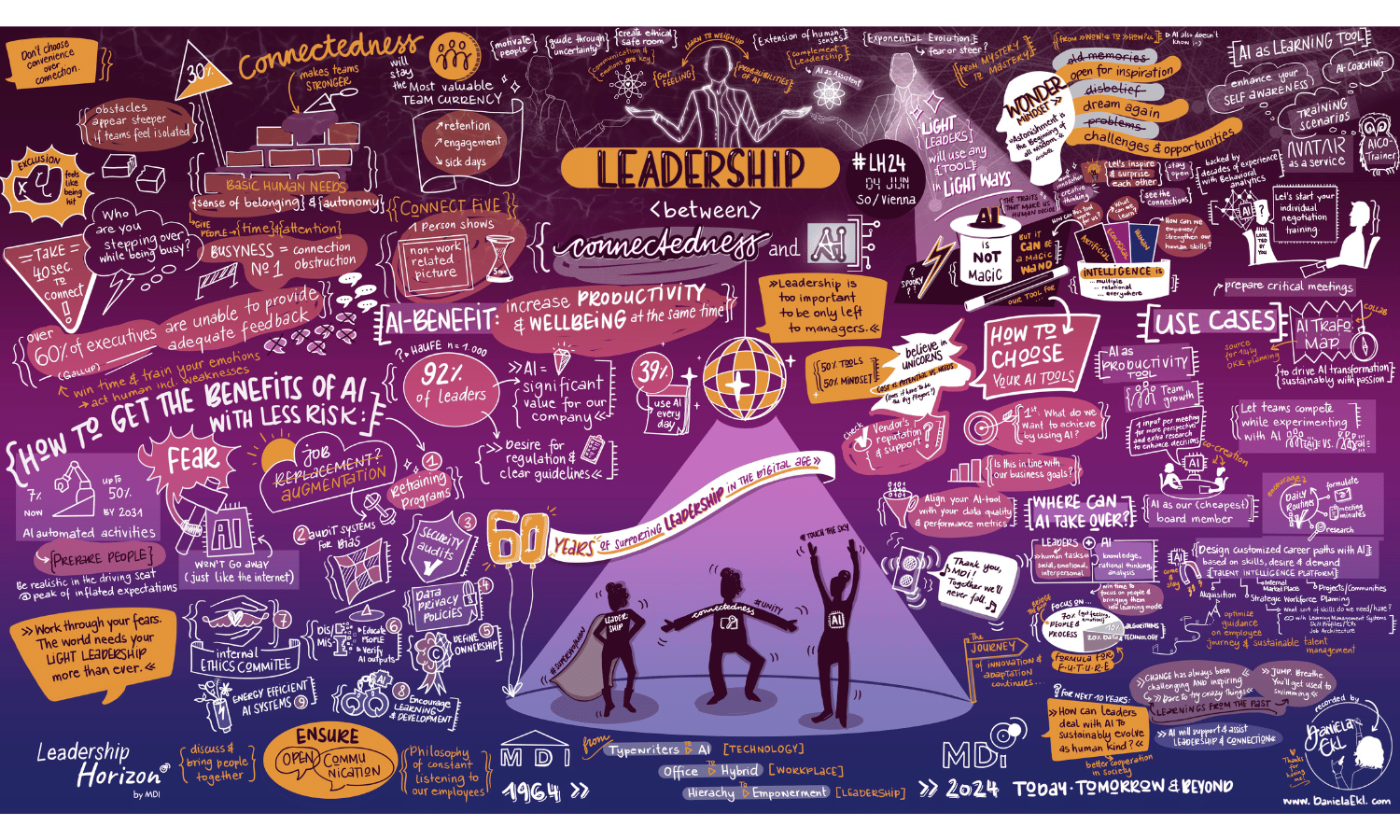
From Typewriters to AI: Leadership Over the Past 60 Years

From Typewriters to AI: Leadership Over the Past 60 Years

by Rahpaela Pouzar | Jun 12, 2024 | Leadership and AI, MDI Inside, Short Knowledge Bits | 0 comments

Photo credits: Jenny Theolin


From Typewriters to AI: Leadership Over the Past 60 Years

This was our Leadership Horizon Conference of 2024! Click here and immerse yourself in the Highlights.

From Typewriters to AI: The Evolution of Technology and Leadership Over the Past 60 Years

As we stand on the brink of a new era in technology and leadership, it’s crucial to reflect on the journey that has brought us here. Today, personal computers and hybrid work models are standard, but the path to this reality has been filled with remarkable innovations and visionary leaders.

Celebrating 60 years of MDI’s impact on shaping and training leaders, we look back at the extraordinary changes in both technology and leadership since 1964. As Isaac Newton said, “If I have seen further, it is by standing on the shoulders of giants.” Let’s embark on a journey through time to appreciate how far we’ve come.

The Birth of the Digital Age

In 1964, while The Beatles’ “A Hard Day’s Night” topped the charts, Texas Instruments introduced the integrated circuit, marking the dawn of a new era in electronics. Baby Boomers began to integrate these new technologies into the workplace, setting the stage for the digital revolution.

The creation of ARPANET, the precursor to the internet, laid the foundation for a connected world. The 1970s witnessed dynamic shifts in leadership styles, transforming corporate culture. Personal computing emerged with Microsoft and Apple at the forefront, and by 1977, the introduction of the Apple II was revolutionizing both offices and homes.

    Leadership Horizon 2024

    Technological and Cultural Expansion

    The 1980s brought mobility and connectivity into the spotlight with innovations like the Osborne 1 and Motorola’s first mobile phone. The fall of the Berlin Wall in 1989 and the standardization of TCP/IP protocols in 1983 heralded a truly interconnected world.

    Cultural phenomena such as Star Wars captivated millions, redefining the nature of storytelling. As the new millennium approached, Google and Wikipedia transformed our access to and interaction with information. Pop culture evolved with “The Simpsons,” offering a satirical view of American life through the antics of a yellow cartoon family.

    The Digital and Data Revolution

    The introduction of the iPhone and iPad seamlessly integrated technology into daily life, showcasing the adaptability and drive of Millennials stepping into leadership roles. Platforms like TikTok are redefining media consumption, fueled by the creativity and engagement of a new generation.

    Technologies like Tesla’s Autopilot and Google’s advances in quantum computing hint at the incredible possibilities of the future. Contemporary leadership now embraces global movements for climate action, reflecting an evolving focus on sustainability and social responsibility.

    Embracing the New Era

    As we adapt to the ever-changing landscape of our world, the past six decades serve as a testament to the continuous journey of innovation and leadership. Looking ahead, it’s clear that the evolution of technology and leadership will persist, driven by creativity, adaptability, and a vision for a better future.

    As we celebrate the achievements of the past, we eagerly anticipate the exciting advancements that lie ahead, knowing that the journey of innovation and leadership continues.

    Raphaela Pouzar

    Raphaela Pouzar

    Team Assistant

    Raphaela Pouzar, a Bachelor of Business Administration student at IMC Krems, works at MDI as a marketing assistant alongside her studies. Her responsibilities include writing blog entries and creating videos in both English and German for our site.

    • LinkedIn

    Download our International Whitepaper:

     

    What serves you next?

    How Do You Lead People Who Don’t Think the Way You Do?

    by Zeca Ruiz | 4. February 2026 | Leadership Impact, Leadership Tips, Learning Transfer | 0 Comments

    How Do You Lead People Who Don't Think the Way You Do? Do you want to listen to this article? Click here to access our AI-generated audio version!   How do you lead people who do not think the way you do? Leadership is a challenge, especially when you are not...
    Read More

    How You Deal With Neurodiversity as a Leader

    by Iris Kandlbauer | 3. February 2026 | Leadership Impact, Leadership Tips, Short Knowledge Bits | 0 Comments

    How You Deal With Neurodiversity as a Leader You prefer listening to this article? You can find our AI-generated audio version below! How You Deal With Neurodiversity as a Leader What might be behind “strange” behavior in a team—and how leaders can deal with it...
    Read More

    Anita’s Key to Success for International Cooperation

    by Jana Wölfl | 3. February 2026 | Leadership and AI, Leadership Tips, MDI Spotlight Series | 0 Comments

    Anita's Key to Success for International Cooperation This blog is an excerpt from our new podcast! You can find the entire podcast episode here. Anita's Key to Success for International Cooperation In our new video podcast format, “Voices of Leadership – an MDI...
    Read More

    Fostering True Workplace Commitment

    by Marcin Swierkocki | 14. January 2026 | Leadership Tips, Learning Transfer, Short Knowledge Bits | 0 Comments

    Fostering True Workplace Commitment Do you prefer to listen to this article? Click below to access our AI-generated audio version! Fostering True Workplace Commitment Throughout my years of practice, I've found that deep workplace commitment is achieved not through...
    Read More

    Marcin Swierkocki on the Full Range Leadership Model

    by Jana Wölfl | 19. December 2025 | Leadership and AI, Leadership Tips, MDI Spotlight Series | 0 Comments

    Marcin Swierkocki on the Full Range Leadership Model This blog is an excerpt from our new podcast! You can find the entire podcast episode here. Marcin Swierkocki on the Full Range Leadership Model In the newest episode of our podcast “Voices of Leadership | An MDI...
    Read More

    Self-Efficacy in Change: Why It Matters

    by Anita Berger | 17. December 2025 | Leadership Tips, Learning Transfer, Short Knowledge Bits | 0 Comments

    Why It Matters When Transformation Gets Hard Do you prefer to listen to this article? Click below to access our AI-generated audio version:Self-Efficacy: Why It Matters When Transformation Gets Hard Change can be exhausting.Especially when things are unclear,...
    Read More

    Generation Z isn’t the Problem but Our System is

    by Zeca Ruiz | 3. December 2025 | Impuls series, International leadership development, Leadership in the digital transformation | 0 Comments

    Generation Z Isn’t the Problem, but Our System is. Read this article on crossgenerational management by Zeca Ruiz to find out more!

    Read More

    From Lab to Practice: What We Learned With AI

    by Rafael Ungvari | 3. September 2025 | Digital Transformation, Leadership and AI, Short Knowledge Bits | 0 Comments

    From Lab to Practice: What We Learned With AI Do you prefer to listen to this article? Click here to access our AI-generated audio version! From Lab to Practice: What We Learned With AI AI in organizations isn’t a one-size-fits-all solution. And in people development,...
    Read More

    How to Stay Connected: Leadership in Challenging Times

    by Jana Wölfl | 28. August 2025 | Impuls series, Leadership in the digital transformation, Training Insights | 0 Comments

    How to Stay Connected: Leadership in Challenging Times This blog is an excerpt from our new podcast! You can find the entire podcast episode here. Staying connected: Leadership in challenging times In our new video podcast format, “Voices of Leadership – an MDI...
    Read More

    How to Build a Psychological Safety Net at Work

    by Florian Biedermann | 28. August 2025 | Best Practice, Leadership Tips, Short Knowledge Bits | 0 Comments

    How to Build a Psychological Safety Net at Work Would you like to listen to this article?  Click here to access our AI-generated audio version! Have fun listening ;)How to Build a Psychological Safety Net at Work Some of you might recognize these situations at work:...
    Read More
    Challenges and Opportunities of AI in China

    Challenges and Opportunities of AI in China

    by Gunther Fürstberger | Jun 10, 2024 | Leadership and AI, MDI Inside, training new leader | 0 comments

    Challenges and Opportunities in China

    Do you prefer to listen to this article? Click here to listen to the AI-generated version!

    Challenges and Opportunities of AI in China

    While some see China’s intensive video surveillance as a realization of George Orwell’s bleak vision of the future in “1984”, others argue that China is a safer place as crimes are quickly detected due to these measures.

    I, too, am concerned with the question of the benefits and harms of the use of artificial intelligence in public administration in China. In this blog post, I report on my experiences and observations on my recent trip to China.

    Travel preparations with hurdles

    I reactivated my WeChat account to prepare for my trip. This turned out to be more complicated than I had expected. Only after repeated attempts and several hours of effort did I manage to reactivate my WeChat account with the help of a WeChat friend from Taiwan.

    This automatically sets up the WeChat payment service Weixin Pay. I could link it to my Mastercard after scanning my passport and approving a photo using my cell phone camera. I thought to myself: now the public authorities can track my payment activities if they are interested.

    My experience with digital payment systems in China

    However, WeChat payment did not work in China and the alternative Alipay also failed to verify my credit cards. However, I did meet Germans who had success with Alipay. My attempts to communicate with my credit card processors didn’t change anything.

    To my relief, I realized that cash is usually accepted after all and that I could pay online for the high-speed train from Beijing to Shanghai with a foreign credit card. But the locals pay for everything with their phones.

    Political moods in China

    In personal interactions, my Chinese conversation partners also proved to be critical of the government. As long as people are talking and not typing virtually, they are relaxed. I mainly encountered a pragmatic attitude.
    From a transactional analysis perspective, they are treated like children by the authorities.

    However, they did not care much as long as they feel safe and can pursue their economic activities. My current view on this: The trend towards personal surveillance will continue despite attempts at regulation, and not just in China. More cameras are being used every year:


    • Many installed cameras by public administrations, businesses, and homeowners.
    • In addition, billions of cell phone cameras and big data analysis possibilities worldwide can monitor a large part of our lives.

    The power of surveillance: AI, resistance and political stability

    Whether in democracies, autocracies, or hybrid systems – those in political power have instruments in their hands that they can use to either benevolently or to maintain power. It is usually a combination. What seems most problematic to me is that potential resistance can be nipped in the bud. The more benevolent a system of rule is, the less resistance there will be.

    Using AI, an autocratic government can protect itself almost to the point of unassailability. However, history has proven that a lot of power corrupts. The greater the differences in power and income, the stronger the resistance.

    AI in different leadership systems

    Even the most powerful autocrats are getting older and younger people are taking over their positions. These changes are often accompanied by power struggles and thus at least temporary destabilization. AI is a new and significant aspect of the leadership system, but not the only relevant one. Other aspects are e.g:

    • Collective benefit maximization and suffering minimization for all relevant stakeholders including minorities. If an authoritarian or democratic regime achieves sustainably good results in this respect, it has a better chance of remaining in office.
    • Intelligence and education of leaders and those being led
    • Beliefs of leaders and those being led (e.g. “only the collective counts” or “it’s safer with us”)
    • The legal and executive system
    • Incentive systems and social stratification

    I also wanted to use my trip to China to further develop my views on the following 2 questions in particular:

    1. Is democracy always the best form of government?

    I remain a supporter of democracy, while at the same time maintaining the view that sometimes intelligent, benevolent autocrats can achieve better results than bad democratically legitimized governments. Over the past three decades, China has achieved amazing results in terms of prosperity, innovation, and security, for example.

    My youthful conviction that democratic systems are economically superior to autocratic ones has long been called into question by China’s one-party system. On average, however, intelligent and benevolent parties come into government more often in democracies. Above all, problematic undesirable developments can be prevented more easily and quickly.

    2. What are the benefits and harms of the new surveillance possibilities offered by AI?

    It is strange for me to see cameras even on forest paths in the Wudang Mountains. At the same time, I have rarely felt as safe at night in cities with millions of inhabitants as I do in China. In addition to security, efficiency is also a strong argument in favor of biometric recognition methods.

    I have been used to the idea for years that we are heading towards a transparent world. We are already ensuring that with our smartphones, Apple watches, etc. If we live in a society in which individual freedom and uniqueness are accepted within the harmful limits of others, transparency has little to threaten me.

    But that brings us back to question 1: if my data is being used by government agencies to maintain power or execute ideological -isms, then it may already be too late.

    Regulation with a sense of proportion

    Unfortunately, we know that even liberal democracies can become dictatorships. In recent years, in particular, there have been ominous developments in various Western countries where attempts have been made to weaken democracies through violence or manipulation.

    And we have also seen how quickly countries have become involved in wars. I therefore believe that regulation with a sense of proportion is necessary, especially when it comes to the use and storage of collected data.

    A summary of my learning journey

    For me, this learning journey was not about judging in the sense of right and wrong, but about interpreting developments in the context of history, culture, population density, religion, etc. I took one final inspiration from a leadership outcome that with me: China shows that switching to e-mobility and attractive public transportation is possible. Why are we going the other way again with combustion engines?

    Mag. Gunther Fürstberger

    Mag. Gunther Fürstberger

    CEO | MDI Management Development International

    Gunther Fürstberger is a management trainer, author and CEO of Metaforum and MDI – a global consulting company providing solutions for leadership development. His main interest is to make the world a better place through excellent leadership. He has worked for clients including ABB, Abbvie, Boehringer Ingelheim, DHL, Hornbach, PWC and Swarovski. His core competence is leadership in digital transformation. He gained his own leadership experience as HR Manager of McDonald’s Central Europe/Central Asia.  At the age of 20 he already started working as a trainer.

    • LinkedIn

    Download our International Whitepaper:

     

    What serves you next?

    How Do You Lead People Who Don’t Think the Way You Do?

    by Zeca Ruiz | 4. February 2026 | Leadership Impact, Leadership Tips, Learning Transfer | 0 Comments

    How Do You Lead People Who Don't Think the Way You Do? Do you want to listen to this article? Click here to access our AI-generated audio version!   How do you lead people who do not think the way you do? Leadership is a challenge, especially when you are not...
    Read More

    How You Deal With Neurodiversity as a Leader

    by Iris Kandlbauer | 3. February 2026 | Leadership Impact, Leadership Tips, Short Knowledge Bits | 0 Comments

    How You Deal With Neurodiversity as a Leader You prefer listening to this article? You can find our AI-generated audio version below! How You Deal With Neurodiversity as a Leader What might be behind “strange” behavior in a team—and how leaders can deal with it...
    Read More

    Anita’s Key to Success for International Cooperation

    by Jana Wölfl | 3. February 2026 | Leadership and AI, Leadership Tips, MDI Spotlight Series | 0 Comments

    Anita's Key to Success for International Cooperation This blog is an excerpt from our new podcast! You can find the entire podcast episode here. Anita's Key to Success for International Cooperation In our new video podcast format, “Voices of Leadership – an MDI...
    Read More

    Fostering True Workplace Commitment

    by Marcin Swierkocki | 14. January 2026 | Leadership Tips, Learning Transfer, Short Knowledge Bits | 0 Comments

    Fostering True Workplace Commitment Do you prefer to listen to this article? Click below to access our AI-generated audio version! Fostering True Workplace Commitment Throughout my years of practice, I've found that deep workplace commitment is achieved not through...
    Read More

    Marcin Swierkocki on the Full Range Leadership Model

    by Jana Wölfl | 19. December 2025 | Leadership and AI, Leadership Tips, MDI Spotlight Series | 0 Comments

    Marcin Swierkocki on the Full Range Leadership Model This blog is an excerpt from our new podcast! You can find the entire podcast episode here. Marcin Swierkocki on the Full Range Leadership Model In the newest episode of our podcast “Voices of Leadership | An MDI...
    Read More

    Self-Efficacy in Change: Why It Matters

    by Anita Berger | 17. December 2025 | Leadership Tips, Learning Transfer, Short Knowledge Bits | 0 Comments

    Why It Matters When Transformation Gets Hard Do you prefer to listen to this article? Click below to access our AI-generated audio version:Self-Efficacy: Why It Matters When Transformation Gets Hard Change can be exhausting.Especially when things are unclear,...
    Read More

    Generation Z isn’t the Problem but Our System is

    by Zeca Ruiz | 3. December 2025 | Impuls series, International leadership development, Leadership in the digital transformation | 0 Comments

    Generation Z Isn’t the Problem, but Our System is. Read this article on crossgenerational management by Zeca Ruiz to find out more!

    Read More

    From Lab to Practice: What We Learned With AI

    by Rafael Ungvari | 3. September 2025 | Digital Transformation, Leadership and AI, Short Knowledge Bits | 0 Comments

    From Lab to Practice: What We Learned With AI Do you prefer to listen to this article? Click here to access our AI-generated audio version! From Lab to Practice: What We Learned With AI AI in organizations isn’t a one-size-fits-all solution. And in people development,...
    Read More

    How to Stay Connected: Leadership in Challenging Times

    by Jana Wölfl | 28. August 2025 | Impuls series, Leadership in the digital transformation, Training Insights | 0 Comments

    How to Stay Connected: Leadership in Challenging Times This blog is an excerpt from our new podcast! You can find the entire podcast episode here. Staying connected: Leadership in challenging times In our new video podcast format, “Voices of Leadership – an MDI...
    Read More

    How to Build a Psychological Safety Net at Work

    by Florian Biedermann | 28. August 2025 | Best Practice, Leadership Tips, Short Knowledge Bits | 0 Comments

    How to Build a Psychological Safety Net at Work Would you like to listen to this article?  Click here to access our AI-generated audio version! Have fun listening ;)How to Build a Psychological Safety Net at Work Some of you might recognize these situations at work:...
    Read More
    « Older Entries
    Next Entries »

    Information

    • Imprint
    • MDI company website

    Social Media

    • Facebook
    • Twitter
    • Youtube
    • LinkedIn

    © MDI Management Development Institute, 2020