
• MDI
  • German version
  • Contact us
MDI Management Development
  • Agile leadership
  • Lateral Leadership
  • Leadership Impact
  • Leadership Development
Select Page
Being a servant leader – Servant Leadership

Being a servant leader – Servant Leadership

by Gunther Fürstberger | Feb 14, 2023 | Leadership Impact, Leadership Tips, MDI Inside | 0 comments

Being a servant leader

“Servant Leadership” is a concept by Robert Greenleaf that describes the manager as a servant to their employees. What this model is specifically about and what its strengths are, you can read in this article.

The origin of the approach

In Hermann Hesse’s “Morgenlandfahrt”, a spiritual seeker experiences how the disappearing servant turns out to be a true leader in retrospect. This story inspired Robert Greenleaf to develop his life’s work, the concept of serving as a leader. A number of well-known authors and CEOs of companies such as Starbucks, Nordstrom and SAS followed him in designing and practicing servant leadership.

A talent management executive at a large international corporation told me one day, “I don’t believe in the honest intent of servant leadership. To me, it seems more like a motivational ploy. In the end, the ‘servant leaders’ earn a lot more than the employees they seem to serve.”


Trick or mission? Manipulated motivation to high performance or the revolution of the working world that turns the hierarchy pyramid upside down?

Managers, especially CEOs, should ask themselves what kind of leadership culture they have and want in their own organization.

The purpose of leadership

What is the purpose of leadership? This is a good question to start a reflection on developing your own leadership culture. The why question is closely related to the „for whom” question. Which stakeholders in an organization are given priority? The shareholders, the employees, the customers? Customers, in a broader sense, can also be certain groups in society or even parts of nature for which the organization wants to create added value.

Focus on employees

Servant leadership is usually associated with a focus on employees. Greenleaf sees, among other things, employee growth as a hallmark of servant leadership. “Serving the community” is also found as a frequently mentioned goal. And then there’s the aspect of getting employees to perform at their best by serving. Shareholders understandably feel comfortable with the latter.

The desired leadership culture is derived from the purpose of the organization. If the purpose of the company is to maximize profit, then human resources tend to be seen as a mean. And servant leadership will consequently be a downstream mean to promote the purpose of “motivated, high-performing human resources.”

While the upside-down pyramid is well suited to question a culture of exploitation of the powerful over the subjugated that has been going on for ages, contradictions arise if taken to its logical conclusion. Institutionalized leadership almost always goes hand in hand with power, e.g. with the right to impose positive and negative sanctions. This makes it easier to achieve organizational goals and often also benefits the led, e.g. through higher security.

However, the history of mankind until today shows that power has often been used for one’s own advantage. And in order to maintain the privileged position of the leadership group, subtile and brutal suppression mechanisms have been used.

Leadership Development

For the common good

The inverted pyramid thus also expresses the desire that leadership does not exploit but support and that the leader put others before themselves. For at least 2000 years there have been rulers who have called themselves servants, from Marcus Aurelius to Joseph II, Frederick the Great to Queen Elizabeth.

In this way, they have expressed how they interpret their privileged right to rule for the common good. Even if they did not donate their castles to the poor, they may have done more for the wellbeing of the people with the servant attitude than absolutist rulers with a “the–state–is–me attitude.”

There are also good arguments why a radical reversal of ruling relations and privileges would not be fair: Those who make an above-average commitment to goals that benefit others should also be entitled to a reward. This commitment can be in terms of time, talent and resources. However, it is questionable whether this justifies a CEO earning 147 times as much as a typical worker in Germany and 300 times as much in the USA.

In addition, there is the legal perspective with the legally anchored liability of the CEO. Someone has to take personal responsibility for wrong decisions and this is normally the managing director registered in the commercial register. Payment defaults or accidents can result in liability. Who bears this liability risk if we turn the pyramid upside down?

In the end, it will probably remain with individuals and they must then also have the possibility to implement decisions. We can flatten the pyramid, we can supplement it with self-coordinating networks, we can develop an empowerment culture – employees and managers can service each other – but ultimate, personal responsibility will remain.

Servant leadership in companies

Companies associated with servant leadership include Nordstrom, Fedex, Starbucks, Southwest Airlines (Herb Kelleher), SAS, and Marriott. Let’s look at what each of these companies value. In most companies, the positive impact of employees being treated well is seen in good customer service:

  • For example, the first stated corporate value at Marriott is “Put people first.”
  • Nordstrom also placed a lot of emphasis on customer service 120 years ago. “Do whatever it takes to take care of the customer”. (John Nordstrom 1901). This attitude has been passed down generations in the entrepreneurial family and has been enriched with humility and employee service orientation.
  • FedEx has built a servant leadership culture. FedEx believes that engaged employees – individuals who trust the organizational goals and have a strong desire to contribute – will implement the organizational plan and ultimately ensure the success of the organization.
  • At Starbucks, long-term CEO Howard Schultz emphasizes the company’s purpose: “Servant leadership is about serving a higher purpose, and when that higher purpose is recognized by everyone in the organization, everyone is indeed a servant of that purpose.” Kelly Creighton describes the organizational culture at Starbucks as: “A culture of belonging, inclusion and diversity.” It also always puts its employees first and encourages everyone to grow into leadership roles within the company. At Starbucks, employees are encouraged to build strong relationships with each other and collaborate and communicate openly. Employees can ask questions and reach out to their supervisors. Ultimately, Starbucks takes the view that “how you treat your employees is how you treat your customers.“
  • Jim Goodnight, founder and CEO of SAS says “Treat employees as if they make a difference and they will.”
  • At Southwestern Airlines, the empowerment idea is especially held dear: Colleen Barrett, former president of Southwest Airlines, explained, “Our whole leadership philosophy is very simple: treat your employees right, and good things will happen.” She assumes that Southwest Airlines has created policies, procedures and rules, but ultimately empowers its employees to use their own common sense and good judgment when needed. It trusts its employees to do the right thing when necessary and does not reprimand them for doing so. For example, if a stranded customer needs a hotel room, employees are empowered to help them if they can. And when dealing with the public, employees are encouraged to find the best solutions and approaches that make sense for the situation at hand.

hackatons create innovations and ideas for leaders

Conclusion

The term “servant leadership” could be misunderstood in the sense of continuity and exclusivity. I.e., that the manager always acts as a servant to the employees and that therefore, there would be no room for the manager to be supported by the employees. This seems onesided and unrealistic. Robert Greenleaf also called his first publication “The servant as leader” and wanted to emphasize that the desire to serve should come before the desire to lead.

Just as the communist countermovement to industrial age capitalism did not yet represent the final chapter of economic history, servant leadership also offers itself more as a line of thought and less as the terminus of a leadership culture. If we understand leading and serving as polarity, then this makes it possible to find a suitable balance for the situation in the interaction between employees and managers.

Similarly, the misunderstanding would be that serving goes in one direction. Namely, that only managers should serve their employees. Transactionally, this would be a reversal of the parent-ego to child-ego relationship. Traditionally, leadership has been seen mostly patriarchal and sometimes matriarchal, i.e. the leader has to care for the children similar to parents, but can demand obedience.

The inversion of the parent-child relationship does not really work. The relationship of two adults who support each other would be more constructive. Especially nobles and rich people have servants. The term servant indicates a subordinate position. This could be resolved in a contemporary understanding of leadership: Employees and managers support each other, partly in different ways and with different means, but at eye level, with mutual appreciation.

“If you support your employees first, they will support you.”

This application of the reciprocity principle will often bring the desired, voluntary support from employees to leadership. But there is a more enduring motivation than this psychological barter: when leaders and employees pursue common goals or a shared mission out of inner conviction and support each other to the best of their ability.

Ultimately, it is the intent of the servant leader that makes the difference: Do they care at least as much about the well-being of others as they does about their own, or do they just want to make employees feel serviced so they will work harder?

The term “servant leadership” is misleading to many. But undoubtedly, one of the most important tasks of leaders is to support their employees. This starts with perceiving and listening to what the employees need from the leader.

In summary, the main meaning of Servant Leadership could be seen as a pendulum swinging away from autocratic and exploitative leadership, but not as a final leadership concept. Rather, partnership-based cooperation at eye level between employees and managers is more suitable for this in order to pursue the jointly shared corporate mission.

Sources:

• https://www.manager-magazin.de/unternehmen/karriere/ceos-verdienen-300-mal-so-viel-wie-arbeiter-a-1041409.html

• https://www.amazon.de/Spiele-Erwachsenen-Psychologie-menschlichen-Beziehungen/dp/3499613506

• https://www.amazon.de/Die-Psychologie-%C3%9Cberzeugens-Robert-Cialdini-ebook/dp/B01MUDPFCC

• https://www.marriott.com/about/culture-and-values/history.mi

• https://hrdailyadvisor.blr.com/2018/06/01/5- real-life-brands-embody-servant-leadership/ • https://www.pallikkutam.com/edu-news/servant-leadershipstories#:~:text=FedEx%20 believes%20that%20engaged%20employees,and%20ultimately%20ensure%20organi-

zational%20success.

Mag. Gunther Fürstberger

Mag. Gunther Fürstberger

CEO | MDI Management Development International

Gunther Fürstberger is a management trainer, author and CEO of Metaforum and MDI – a global consulting company providing solutions for leadership development. His main interest is to make the world a better place through excellent leadership. He has worked for clients including ABB, Abbvie, Boehringer Ingelheim, DHL, Hornbach, PWC and Swarovski. His core competence is leadership in digital transformation. He gained his own leadership experience as HR Manager of McDonald’s Central Europe/Central Asia.  At the age of 20 he already started working as a trainer.

  • LinkedIn

What serves you next?

Leadership Horizon powered by HR INSIDE SMMIT

AI-Empowered Leadership: 6 Guiding Principles

AI-Empowered Leadership: 6 Guiding Principles This blog post is a detailed summary of the...
Read More

What AI Shows You — and What It Doesn’t

What AI Shows You — and What It Doesn't Meike’s Reflections on Artificial Intelligence Do you...
Read More

Leading in the Age of AI: How AI Discourse Shapes Responsibility and Power

Leading in the Age of AI: How AI Discourse Shapes Responsibility and Power Meike’s Reflections on...
Read More

AI Ethics for Leaders: Why Context and Critical Thinking Matter More Than Ever

AI Ethics for Leaders: Why Context and Critical Thinking Matter More Than Ever. Meike’s...
Read More

A Success Story – When AI Sharpens Human Judgement

A Success Story – When AI Sharpens Human Judgement Do you prefer to listen to this article? Click...
Read More

How Do You Lead People Who Don’t Think the Way You Do?

How Do You Lead People Who Don't Think the Way You Do? Do you want to listen to this article?...
Read More

How You Deal With Neurodiversity as a Leader

How You Deal With Neurodiversity as a Leader You prefer listening to this article? You can find...
Read More

Anita’s Key to Success for International Cooperation

Anita's Key to Success for International Cooperation This blog is an excerpt from our new podcast!...
Read More

Fostering True Workplace Commitment

Fostering True Workplace Commitment Do you prefer to listen to this article? Click below to access...
Read More

Marcin Swierkocki on the Full Range Leadership Model

Marcin Swierkocki on the Full Range Leadership Model This blog is an excerpt from our new podcast!...
Read More
How can I actively share knowledge as a leader?

How can I actively share knowledge as a leader?

by Anita Berger | Nov 11, 2022 | Leadership Tips, learning effectiveness, Learning Transfer | 0 comments

How can I actively share knowledge as a leader?

Knowledge management – I know that I know (nothing)

How do you deal with knowledge management as a leader? What do we really know and how can we use it to our best advantage? 

Mentoring & Knowledge Management

Our MDI partner Anita Berger focuses on mentoring and knowledge management. We asked her a few questions on this topic and came up with some exciting approaches.

You can find them here in this interview:

Anita Berger

Anita Berger

Executive Coach, Consultant, Trainer & Managing Partner MDI

Anita Berger is an executive coach, consultant and trainer specialising in leadership development and international human resource management. She is a partner of MDI Management Development International. For more than 15 years she has worked in management and leadership positions (among others as HR-
Director at Coca-Cola Hellenic and HR Manager at Konica Minolta Business Solutions).

  • LinkedIn

What is knowledge management as a leader or mentor all about?

What is behind explicit and tacit knowledge?


The active and conscious generation, the use and sharing of knowledge in organizations are decisive competitive factors. Managers and mentors make a relevant contribution to this. They can make knowledge available themselves, as well as create the framework and an environment that enables and promotes knowledge management.

Explicit Knowledge

Knowledge management seems to be easier when it comes to explicit knowledge. That is, when “we know what we know” and it is “only” a matter of making this knowledge available.

Tacit Knowledge

It becomes more challenging when it comes to tacit knowledge. Implicit knowledge is the kind of knowledge that we are not always aware of – where we don’t even know what we know.

The development of explicit and tacit knowledge can be vividly described using the following example from everyday life: In the beginning, we learn explicitly: traffic rules, shifting gears, operating the clutch, … Every single step is thought through consciously. After some time, we just “drive” – it has become implicit knowledge.

We cannot easily describe what or how we do something, how we came to a decision or how we acquired the knowledge.

How can we now succeed in making tacit knowledge available ?

What concrete tips do you have for this?


The STAR method
– often known as an interview technique in recruiting – as well as the Knowledge Management For Implicit Knowledge Canvas – both are methods/techniques to become aware of what you know as a leader or as a mentor, so that you can then share this very valuable knowledge.

How does the STAR principle work and how can we apply it?

The STAR interview method is an acronym and stands for

  • Situation
  • Task
  • Action
  • Result

The STAR interview method

If, as a mentor or leader, I want to pass on knowledge about how a particular customer project was won, a cultural initiative was successfully implemented, a critical discussion with challenging stakeholders was conducted in a solution-oriented manner, or even what was a real “fuck-up” in team leadership, the STAR interview method can help.

It enables us to identify more clearly what contributed to success or to recognize what needs to be done differently in the future. Thus, implicit knowledge becomes explicit again.

  • SITUATION: What was the initial situation? Who was involved? What were the general conditions?
  • TASK: What was your task/assignment? What did you want to achieve?
  • ACTION: What did you do concretely? What concrete steps did you take?
  • RESULT: What was the concrete result? What were the consequences? What results did you achieve?

How does the Knowledge Management Canvas help us?

The Knowledge Management Canvas provides a framework to identify where tacit knowledge may exist. It provides valuable starting points for active knowledge sharing through active engagement with the areas of the Canvas.

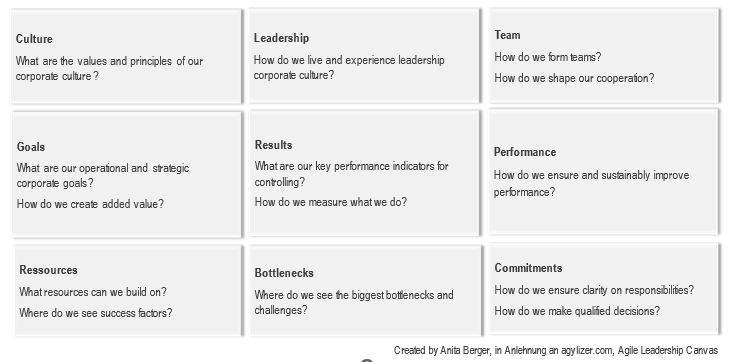
Knowledge Management – Tacit Knowledge Canvas

So how we can promote and share our knowledge is not too difficult. Often, it simply requires a more structured approach to share as a leader or mentor relevant information.

What might help you next?

AI-Empowered Leadership: 6 Guiding Principles

by Gunther Fürstberger | 14. April 2026 | Leadership and AI, Leadership Tips, MDI Whitepaper | 0 Comments

AI-Empowered Leadership: 6 Guiding Principles This blog post is a detailed summary of the whitepaper "Guiding Principles of AI-Empowered Leadership" by MDI's CEO, Gunther Fürstberger. You can find the full whitepaper here! Let's be honest: most conversations about AI...
Read More

What AI Shows You — and What It Doesn’t

by Meike Hinnenberg | 1. April 2026 | Digital Transformation, Impuls series, Leadership and AI | 0 Comments

What AI Shows You — and What It Doesn't Meike’s Reflections on Artificial Intelligence Do you prefer to listen to this article? Click below to access our AI-generated audio version! What AI Shows You — and What It Doesn't Meike’s Reflections on Artificial Intelligence...
Read More

Leading in the Age of AI: How AI Discourse Shapes Responsibility and Power

by Meike Hinnenberg | 18. March 2026 | Impuls series, Leadership and AI, Leadership Tips | 0 Comments

Leading in the Age of AI: How AI Discourse Shapes Responsibility and Power Meike’s Reflections on Artificial Intelligence Do you prefer to listen to this article? Click below to access our AI-generated audio version!Leading in the Age of AI: How AI Discourse Shapes...
Read More

AI Ethics for Leaders: Why Context and Critical Thinking Matter More Than Ever

by Meike Hinnenberg | 11. March 2026 | Impuls series, Leadership and AI, Learning Transfer | 0 Comments

AI Ethics for Leaders: Why Context and Critical Thinking Matter More Than Ever. Meike’s Reflections on Artificial Intelligence Do you prefer to listen to this article? Click below to access our AI-generated audio version!AI Ethics for Leaders: Why Context and Critical...
Read More

A Success Story – When AI Sharpens Human Judgement

by Claude MacDonald, Rafael Ungvari | 6. March 2026 | Customer Story, Digital Transformation, Leadership and AI | 0 Comments

A Success Story – When AI Sharpens Human Judgement Do you prefer to listen to this article? Click here to access our AI-generated audio version! When AI Amplifies Human Judgment: A Customer Success Story About This Project At MDI, we believe that great leadership and...
Read More

How Do You Lead People Who Don’t Think the Way You Do?

by Zeca Ruiz | 4. February 2026 | Leadership Impact, Leadership Tips, Learning Transfer | 0 Comments

How Do You Lead People Who Don't Think the Way You Do? Do you want to listen to this article? Click here to access our AI-generated audio version!   How do you lead people who do not think the way you do? Leadership is a challenge, especially when you are not...
Read More

How You Deal With Neurodiversity as a Leader

by Iris Kandlbauer | 3. February 2026 | Leadership Impact, Leadership Tips, Short Knowledge Bits | 0 Comments

How You Deal With Neurodiversity as a Leader You prefer listening to this article? You can find our AI-generated audio version below! How You Deal With Neurodiversity as a Leader What might be behind “strange” behavior in a team—and how leaders can deal with it...
Read More

Anita’s Key to Success for International Cooperation

by Jana Wölfl | 3. February 2026 | Leadership and AI, Leadership Tips, MDI Spotlight Series | 0 Comments

Anita's Key to Success for International Cooperation This blog is an excerpt from our new podcast! You can find the entire podcast episode here. Anita's Key to Success for International Cooperation In our new video podcast format, “Voices of Leadership – an MDI...
Read More

Fostering True Workplace Commitment

by Marcin Swierkocki | 14. January 2026 | Leadership Tips, Learning Transfer, Short Knowledge Bits | 0 Comments

Fostering True Workplace Commitment Do you prefer to listen to this article? Click below to access our AI-generated audio version! Fostering True Workplace Commitment Throughout my years of practice, I've found that deep workplace commitment is achieved not through...
Read More

Marcin Swierkocki on the Full Range Leadership Model

by Jana Wölfl | 19. December 2025 | Leadership and AI, Leadership Tips, MDI Spotlight Series | 0 Comments

Marcin Swierkocki on the Full Range Leadership Model This blog is an excerpt from our new podcast! You can find the entire podcast episode here. Marcin Swierkocki on the Full Range Leadership Model In the newest episode of our podcast “Voices of Leadership | An MDI...
Read More
Agile mindset beyond company boundaries

Agile mindset beyond company boundaries

by Book "Agile Leadership Development", Marina Begic | Oct 20, 2022 | Agile Leadership, Digital Transformation | 0 comments

Agile mindset beyond company boundaries

In order to compete in a constantly changing market, companies must be able to react quickly to changes.
Strong networking, increased knowledge exchange and an agile mindset beyond company boundaries are crucial.

Leadership in times of crisis

We are in highly uncertain times – everything around us is always changing and no decision is really definite. Every day we are confronted with new and unfamiliar challenges.

Sometimes, as a leader, it can feel overwhelming. In this article, you will find some practical tips on how to handle challenging situations to the best of your ability.

Without continuous development, there is stagnation

A simple but important skill when managing crises is the will to keep developing. If you grow both personally and in your role as a leader, you can essentially work in a calmer and more reflective way.

Smart networking

For this, it is important to have a good network and to share knowledge within it. Doing so is important because with an ever-increasing amount of information, we remember less and less and find it difficult to filter out the relevant information.

Find your community

Until now, most professionals exchanged knowledge at business events like Leadership Horizon – at summits, congresses or events. However, there are also virtual communities on all kinds of topics. One example is our community personalist.at – a platform for HR experts or the LinkedIn Leadership Community, where leadership development is the leading topic.

Open Knowledge

In order to learn sustainably, it is not only our previous components of technology and people that are important – but also digitisation. This is where the concept of Open Knowledge comes into play. Knowledge is open when it is easily

  • accessible,
  • changeable
  • and shareable by all.

This perspective requires organisations to reflect on how they deal with information and how it is distributed. Open Knowledge thus plays a role not only in future training, but also in the economic survival of companies.

Agility according to the TIE model

(by Gunther Fürstberger) 


In terms of the TIE model, the following factors are necessary for an agile approach:

  • Transparency (T) between companies in terms of information exchange.
  • Iteration (I) – tools, methods and content are tested and reviewed in short cycles – leading to rapid further development
  • Empowerment (E) by trusted guides, executives, opinion and market leaders.

The principle of agility is generally seen as a requirement for the ongoing changes we face. It no longer functions  as a buzzword, but rather as a must in order to be able to deal with crisis situations.

In the future, we should therefore be able to apply an agile mindset not only within a company, but also beyond the company’s boundaries.

Marina Begic

Marina Begic

Digital Business Development Expertin und Senior L&D Consultant

Marina has been working on new, effective learning methods and the future of corporate learning for over 15 years. In her current role, she is responsible for Digital Business Development at MDI, where her focus is not driven by the current buzzwords, but primarily on the feasibility of digital transformation for clients such as Erste Group, Lenzing, Semperit, Deutsche Bahn, Andritz AG, Uniqa, Mayr-Melnhof, Frequentis, RHIM. Her greatest strength is bringing loose ends together, which she impressively demonstrates time and time again with her big picture view and multi-dimensional approach. Her greatest passion is to provide learners not only with an experience, but also with real, lasting value for their real challenges.

  • LinkedIn

What serves you next?

Digital training formats for leadership development

We help make leadership development more agile with our digital training formats:

  • E-learnings
  • e-consulting
  • Blended Learning Journeys
  • Virtual Leadership
  • virtual reality
  • digital learning transfer

– we have just the right thing for your needs!

Explore now!

Or maybe this? 

How Do You Lead People Who Don’t Think the Way You Do?

by Zeca Ruiz | 4. February 2026 | Leadership Impact, Leadership Tips, Learning Transfer | 0 Comments

How Do You Lead People Who Don't Think the Way You Do? Do you want to listen to this article? Click here to access our AI-generated audio version!   How do you lead people who do not think the way you do? Leadership is a challenge, especially when you are not...
Read More

How You Deal With Neurodiversity as a Leader

by Iris Kandlbauer | 3. February 2026 | Leadership Impact, Leadership Tips, Short Knowledge Bits | 0 Comments

How You Deal With Neurodiversity as a Leader You prefer listening to this article? You can find our AI-generated audio version below! How You Deal With Neurodiversity as a Leader What might be behind “strange” behavior in a team—and how leaders can deal with it...
Read More

Generation Z isn’t the Problem but Our System is

by Zeca Ruiz | 3. December 2025 | Impuls series, International leadership development, Leadership in the digital transformation | 0 Comments

Generation Z Isn’t the Problem, but Our System is. Read this article on crossgenerational management by Zeca Ruiz to find out more!

Read More

The Lasting Impact of Leadership Horizon – Meike’s Perspectives

by Meike Hinnenberg | 2. July 2025 | Leadership Impact, MDI Inside, Short Knowledge Bits | 0 Comments

The Lasting Impact of Leadership Horizon - Meike's Perspectives Do you prefer to listen to this article? Click below to access our AI-generated audio version!The Lasting Impact of Leadership Horizon - Meike's Perspectives MDI’s Meike Hinnenberg shares her reflections...
Read More

Success Through Change: How to Stay Oriented During Transitions

by Anita Berger | 14. April 2025 | Impuls series, Leadership Impact, Leadership Tips | 0 Comments

Success Through Change: How to Stay Oriented During Transitions Do you prefer to listen to this article? Click below to access our AI-generated audio version:Success Through Change: How to Stay Oriented During Transitions Change processes often involve challenges....
Read More

4 Tips on How to Shape Change Processes as a Leader

by Anita Berger | 3. April 2025 | Impuls series, Leadership Impact, Leadership Tips | 0 Comments

4 Tips on How to Shape Change Processes as a Leader Do you prefer to listen to this article? Click below to access our AI-generated audio version:4 Tips on How to Shape Change Processes as a Leader Imagine a dynamic network of paths that is constantly changing. While...
Read More

Successful Team Building for Boehringer Ingelheim RCV

by Anita Berger | 29. March 2024 | Customer Story, International leadership development, MDI Inside | 0 Comments

Successful Team Building for Boehringer Ingelheim RCV Do you prefer to listen to this article? Click below to access our AI-generated audio version:Successful Team Building for Boehringer Ingelheim RCV In the interview with our MDI trainer and partner, Anita Berger On...
Read More

Organize Your Team in a Hybrid Workplace

by Peter Grabuschnig | 14. March 2024 | Impuls series, International leadership development, Leadership in the digital transformation | 0 Comments

Organize Your Team in a Hybrid Workplace Prefer to listen to the article? Click below to access our AI speech-generated audio. However, if you want to read it as usual, keep scrolling.Organize Your Team in a Hybrid Workplace In his new Rise Course, our MDI trainer and...
Read More

Exploring the Influence of AI on Leadership Roles – an experiment by a CEO

by Gunther Fürstberger | 14. November 2023 | International leadership development, Leadership and AI, Leadership in the digital transformation | 0 Comments

Exploring the Influence of AI on Leadership Roles: Learn more about the ongoing ChatGPT experiment by MDI CEO Gunther Fürstberger Do you prefer to listen to this article? Click below to access our AI-generated version. Exploring the Influence of AI on Leadership...
Read More

AI as a Co-Trainer in Leadership Development

by Gunther Fürstberger | 14. November 2023 | Impuls series, International leadership development, Leadership and AI | 0 Comments

Artificial Intelligence as a Co-Trainer in Leadership Development Do you prefer to listen to this blog article? Click below to access our AI-generated version. Artificial Intelligence as a Co-Trainer in Leadership Development In a world that is constantly evolving, we...
Read More
How to become resilient? Your personal superpower

How to become resilient? Your personal superpower

by Anita Berger, ARD | Sep 26, 2022 | Agile Leadership, Leadership Tips | 0 comments

How to become resilient? Your personal superpower

Meeting the challenges in the VUCA/BANI world

In this article you will get an insight into key competencies as well as starting points to strengthen your own resilience. Concrete reflection questions and tips for implementation will let you become a “pro” of your own superpower.

VUCA & BANI

VUCA or BANI as explanatory models for our challenges

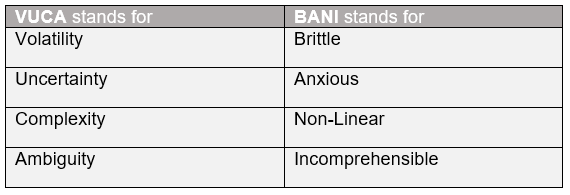
In our daily professional lives, we are constantly confronted with turbulence. The following models provide a framework to bring challenges closer for companies and for society as a whole:

All these terms define what we are up against in this ever-changing society – a fragile system that is only fueled by uncertainty and anxiety, as well as complex, non-linear problems. The demands on organizations and leadership are sometimes ambiguous and contradictory, but also incomprehensible.

Key competencies for your superpower

to meet these challenges

Resilience in dealing with crises and challenges

Jamais Cascio counters these complex models with a response option: RAAT (Resilience, Awareness, Adaptation and Transparency). For the first factor alone – resilience – there are several models. I present the Vienna Resilience Model below.

Seven key resilience competencies

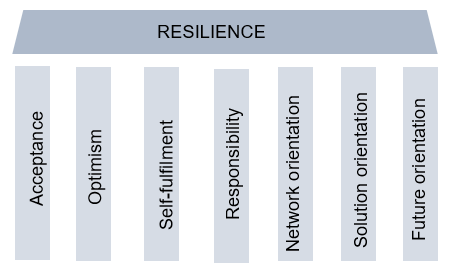
The Vienna Resilience Model describes seven key resilience competencies that positively influence a person’s resilience:

The basic pillars of resilience are 

  • acceptance
  • optimism
  • self-fulfilment
  • responsibility
  • network orientation
  • solution orientation
  • future orientation.

Each of these factors plays an important role in strengthening one’s resilience.

Strengthening the superpower of resilience holistically

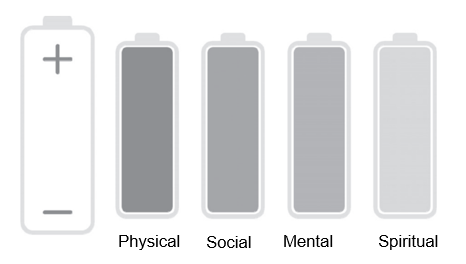
In contrast to the Vienna Resilience Model, Stephen Covey identifies four pillars in his 7 Habits of Highly Effective People, which are also found in most other models to strengthen one’s resources and thus one’s resilience.

When reflecting on how you use your resources, you should take each resource individually and consider how well you take care of each. This could be in the form of the following approaches, for example:

  • Physical: I regularly keep myself informed about things that affect my health and fitness.
  • Mental: I clear my head every day through, for example, music, silence or relaxation exercises.
  • Social: I listen to others and pay attention to what they have to say instead of thinking about what I want to say.
  • Spiritual: I have the courage to stand my ground even when others oppose me.

Becoming the “pro” of your own superpower –

tips for implementation

If we want to strengthen our resilience, we sometimes need to develop new habits and behaviors or retrain “bad habits” (for example, taking the stairs instead of the elevator). James Clear’s (2020) 1% method states that the best way to achieve goals is to get a little better every day, i.e., to work towards them in small steps for maximum impact. Improving 1% per day will yield a 37-fold increase in one year.

Conclusion

The VUCA or BANI world presents challenges to all of us. In dealing with these challenges, we can further “nurture” or build our key competencies of resilience by being aware of them as a first step.

In small steps and with the coupling to our previous habits, we can then integrate our resources, which further strengthens our superpower resilience holistically into our behavioral repertoire

Read the full (german) article that was written for ARD Magazin | Edition 6814/6/2022

Anita Berger

Anita Berger

Executive Coach, Consultant, Trainer & Managing Partner MDI

Anita Berger is an executive coach, consultant and trainer specialising in leadership development and international human resource management. She is a partner of MDI Management Development International. For more than 15 years she has worked in management and leadership positions (among others as HR-
Director at Coca-Cola Hellenic and HR Manager at Konica Minolta Business Solutions).

  • LinkedIn

What might help you next?

AI-Empowered Leadership: 6 Guiding Principles

by Gunther Fürstberger | 14. April 2026 | Leadership and AI, Leadership Tips, MDI Whitepaper | 0 Comments

AI-Empowered Leadership: 6 Guiding Principles This blog post is a detailed summary of the whitepaper "Guiding Principles of AI-Empowered Leadership" by MDI's CEO, Gunther Fürstberger. You can find the full whitepaper here! Let's be honest: most conversations about AI...
Read More

What AI Shows You — and What It Doesn’t

by Meike Hinnenberg | 1. April 2026 | Digital Transformation, Impuls series, Leadership and AI | 0 Comments

What AI Shows You — and What It Doesn't Meike’s Reflections on Artificial Intelligence Do you prefer to listen to this article? Click below to access our AI-generated audio version! What AI Shows You — and What It Doesn't Meike’s Reflections on Artificial Intelligence...
Read More

Leading in the Age of AI: How AI Discourse Shapes Responsibility and Power

by Meike Hinnenberg | 18. March 2026 | Impuls series, Leadership and AI, Leadership Tips | 0 Comments

Leading in the Age of AI: How AI Discourse Shapes Responsibility and Power Meike’s Reflections on Artificial Intelligence Do you prefer to listen to this article? Click below to access our AI-generated audio version!Leading in the Age of AI: How AI Discourse Shapes...
Read More

AI Ethics for Leaders: Why Context and Critical Thinking Matter More Than Ever

by Meike Hinnenberg | 11. March 2026 | Impuls series, Leadership and AI, Learning Transfer | 0 Comments

AI Ethics for Leaders: Why Context and Critical Thinking Matter More Than Ever. Meike’s Reflections on Artificial Intelligence Do you prefer to listen to this article? Click below to access our AI-generated audio version!AI Ethics for Leaders: Why Context and Critical...
Read More

A Success Story – When AI Sharpens Human Judgement

by Claude MacDonald, Rafael Ungvari | 6. March 2026 | Customer Story, Digital Transformation, Leadership and AI | 0 Comments

A Success Story – When AI Sharpens Human Judgement Do you prefer to listen to this article? Click here to access our AI-generated audio version! When AI Amplifies Human Judgment: A Customer Success Story About This Project At MDI, we believe that great leadership and...
Read More

How Do You Lead People Who Don’t Think the Way You Do?

by Zeca Ruiz | 4. February 2026 | Leadership Impact, Leadership Tips, Learning Transfer | 0 Comments

How Do You Lead People Who Don't Think the Way You Do? Do you want to listen to this article? Click here to access our AI-generated audio version!   How do you lead people who do not think the way you do? Leadership is a challenge, especially when you are not...
Read More

How You Deal With Neurodiversity as a Leader

by Iris Kandlbauer | 3. February 2026 | Leadership Impact, Leadership Tips, Short Knowledge Bits | 0 Comments

How You Deal With Neurodiversity as a Leader You prefer listening to this article? You can find our AI-generated audio version below! How You Deal With Neurodiversity as a Leader What might be behind “strange” behavior in a team—and how leaders can deal with it...
Read More

Anita’s Key to Success for International Cooperation

by Jana Wölfl | 3. February 2026 | Leadership and AI, Leadership Tips, MDI Spotlight Series | 0 Comments

Anita's Key to Success for International Cooperation This blog is an excerpt from our new podcast! You can find the entire podcast episode here. Anita's Key to Success for International Cooperation In our new video podcast format, “Voices of Leadership – an MDI...
Read More

Fostering True Workplace Commitment

by Marcin Swierkocki | 14. January 2026 | Leadership Tips, Learning Transfer, Short Knowledge Bits | 0 Comments

Fostering True Workplace Commitment Do you prefer to listen to this article? Click below to access our AI-generated audio version! Fostering True Workplace Commitment Throughout my years of practice, I've found that deep workplace commitment is achieved not through...
Read More

Marcin Swierkocki on the Full Range Leadership Model

by Jana Wölfl | 19. December 2025 | Leadership and AI, Leadership Tips, MDI Spotlight Series | 0 Comments

Marcin Swierkocki on the Full Range Leadership Model This blog is an excerpt from our new podcast! You can find the entire podcast episode here. Marcin Swierkocki on the Full Range Leadership Model In the newest episode of our podcast “Voices of Leadership | An MDI...
Read More
Third Workplace – A Plea for More Flexibility

Third Workplace – A Plea for More Flexibility

by Aline Deporter | Sep 20, 2022 | Best Practice, Leadership Tips, MDI Inside | 0 comments

Third Workplace – A plea for more flexibility

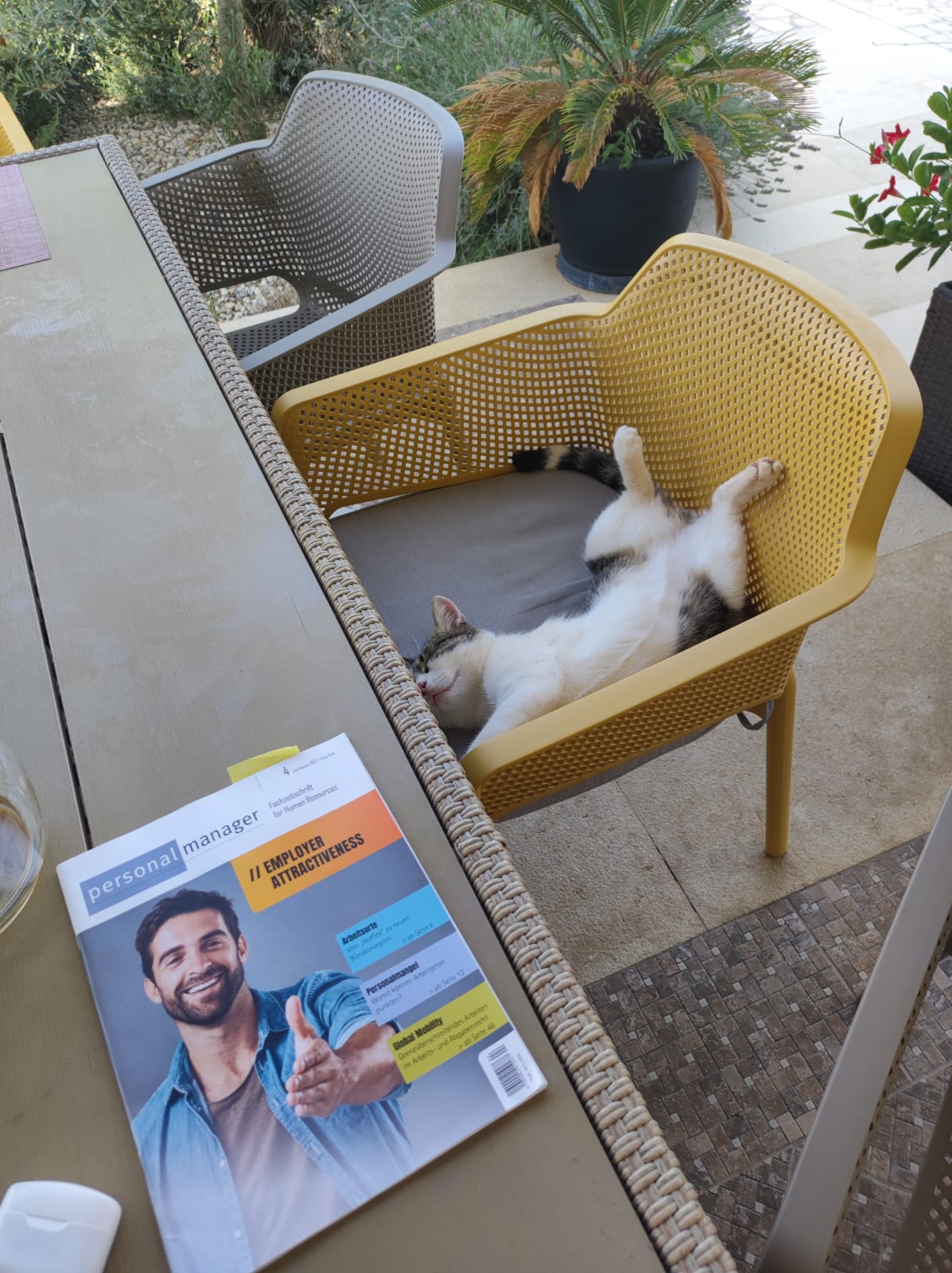
And here I am, sitting in Croatia, on the decked patio, at the dining table with my work laptop and a sleeping cat – that came with the all-inclusive holiday home ?

Work from Anywhere

Spontaneously I decided in the morning to have a “Work from Anywhere” day instead of my current holiday day – because the weather is not looking inviting. Instead, I put my holiday day on next Monday. With bright sunshine, a day at the beach is simply more fun and the relaxation factor is much higher.

Transparent communication

Luckily, our CEO feels the same way – one WhatsApp message later, the plan is set. Partner and holiday companions have flown out, so the necessary rest is guaranteed. Let’s get started!

I immediately informed our team via Microsoft Teams message @all – about the changes in my availability. When you are not visibly on site, transparent communication is all the more important. Some team members quickly took the opportunity to clarify urgent issues with me.

About Aline

Aline joined MDI in 2020 as a Marketing Manager with over 10 years of B2B marketing experience. She is primarily responsible for the overall coordinated organisation of MDI’s advertising activities and the management of marketing projects. This includes, among others, the MDI Business Unit SDI as well as Leadership Horizon and personalist.at. Aline is a strong marketing all-rounder with a passion for leadership development, digital transformation and event organisation.

In this article, Aline shares her personal experiences and some “Third Place Working” learnings.

What do I need to work effectively from anywhere?

  • A good internet connection (this is probably not a big surprise). It’s best to clarify the internet performance again by phone or email directly before you go on holiday
  • Shade when working outdoors. That way the laptop screen is not blinding
  • An extension cable (sounds trivial, but this way you can really work from anywhere)
  • If you have the possibility of renting a holiday home/hotel room with a furnished workstation or at least a PC screen, it’s even better
  • Think of enough screen breaks
  • A certain time structure and work packages with breaks
  • Water, coffee, refreshments of choice

Get to know your own working style

Personally, fewer distractions are better for me. By that I mean children, family, friends, etc. In other words, people who are not working with me at the same time. Because I am definitely a “people person”. If other people who are not working talk to me frequently, I get distracted more quickly.

So my tip here would be: get to know your own working style. I am very creative, for example, in moving forms of transport (plane, train, bus, car, etc.) or when things are happening passively around me (coffee, park, waiting room, etc.).

It shouldn’t be too quiet for me. I love music in the background and vary the style of music according to the motivation I need (chill out always works, classical music helps me to concentrate, 90s songs motivate me and encourage me to sing along loudly).

It’s also good to have several seating options so that you can remain at least somewhat ergonomic. A pool to cool down and get some exercise in between is of course a big plus. But a yoga mat or a short walk will also do.

Pro Tip – Coworking Spaces:

If there is little/no opportunity to work quietly or more ergonomically, look for co-working spaces (with daily or weekly rates) in your area. There are now an increasing number of them. Apart from the better quality of work, you can network during breaks and make new, exciting contacts.

In my area, currently Pula, there is for example the Club Kotac with free admission, air conditioned, fast internet (30/20 Mbit/s), 10-18h Mon – Fri. A great alternative!

Currently, however, I don’t want to abandon the cat, so I’ll stay ? .

There are already some search tools to help you with your quest here:

  • coworker.com
  • coworkbooking.com
  • heydesk.com
  • instantoffices.com
  • desksnear.me
  • coworkingnomads.com

Flexibility as a motivating factor for work?

Employer Attractiveness – Trends and Tendencies

By coincidence, the new issue of Personalmanager is lying next to me at the moment. The main theme of the issue is “Employer Attractiveness”.

So, what makes an employer attractive to me?

I don’t have to think about that at all: definitely high flexibility, personal responsibility, fair compensation as well as opportunities for further development, the team and the common purpose. If you look at the latest surveys on this topic, then I am not alone in this.

Needs of Gen Z & Millenials

Deloitte surveyed 23,000 Gen Z’s and Millennials about their workplace experience. The strongest topics communicated were purpose & financial security. Due to the current global situation, both generations are worried and uncertain. This has an impact on loyalty. Almost 40% (Generation Z) want to leave their job in the next 2 years.

As an employer, you should take a closer look here. Flexible working hours & locations, purpose as well as fair remuneration should be at the top of the list of must-haves.

The Hybrid Work Concept

We at MDI have been embracing the hybrid work concept, also known as the synchronous hybrid model, for some time now. Our team likes to work this way and, according to a study by Cisco, it is also very popular with other employees.

Specifically, this means a mixture of office, home office and third workplace (on the road). MDI’s hybrid work concept currently includes 60% office, 40% home office and 3 weeks third workplace (e.g. workation). I combine one week of this with a week’s holiday in Croatia, for example. The other two weeks will be spent by two other MDI colleagues and me in Greece (Rhodes). This strengthens team bonds and increases the motivation to work on location.

Open and authentic corporate culture

Of course, the respective work concept has to fit the company. The larger, the more organisationally complex.

The right way will look different for every organisation. However, I think it is important to have a clear, open and authentic corporate culture.

Potential new employees should know exactly which working concept applies and which working modalities have to be dealt with. That way, they can get a clear picture of the future work in advance. As a company, this can also reduce the fluctuation rate.

Trust & Flexibility –
Third Workplace – A plea for more flexibility

I nevertheless plead (where possible) for more flexibility. As an organisation and/or leader, have the courage to trust – because flexibility boosts mutual trust.

In my opinion, employees should be given the highest possible flexibility in order to even be able to fulfil their role as a strong and reliable member of the team.

From my own experience, I can report that this increases motivation and loyalty immensely. And sometimes all it takes is a simple WhatsApp message …

What serves you next?

What AI Shows You — and What It Doesn’t

by Meike Hinnenberg | 1. April 2026 | Digital Transformation, Impuls series, Leadership and AI | 0 Comments

What AI Shows You — and What It Doesn't Meike’s Reflections on Artificial Intelligence Do you prefer to listen to this article? Click below to access our AI-generated audio version! What AI Shows You — and What It Doesn't Meike’s Reflections on Artificial Intelligence...
Read More

A Success Story – When AI Sharpens Human Judgement

by Claude MacDonald, Rafael Ungvari | 6. March 2026 | Customer Story, Digital Transformation, Leadership and AI | 0 Comments

A Success Story – When AI Sharpens Human Judgement Do you prefer to listen to this article? Click here to access our AI-generated audio version! When AI Amplifies Human Judgment: A Customer Success Story About This Project At MDI, we believe that great leadership and...
Read More

How Do You Lead People Who Don’t Think the Way You Do?

by Zeca Ruiz | 4. February 2026 | Leadership Impact, Leadership Tips, Learning Transfer | 0 Comments

How Do You Lead People Who Don't Think the Way You Do? Do you want to listen to this article? Click here to access our AI-generated audio version!   How do you lead people who do not think the way you do? Leadership is a challenge, especially when you are not...
Read More

How You Deal With Neurodiversity as a Leader

by Iris Kandlbauer | 3. February 2026 | Leadership Impact, Leadership Tips, Short Knowledge Bits | 0 Comments

How You Deal With Neurodiversity as a Leader You prefer listening to this article? You can find our AI-generated audio version below! How You Deal With Neurodiversity as a Leader What might be behind “strange” behavior in a team—and how leaders can deal with it...
Read More

From Lab to Practice: What We Learned With AI

by Rafael Ungvari | 3. September 2025 | Digital Transformation, Leadership and AI, Short Knowledge Bits | 0 Comments

From Lab to Practice: What We Learned With AI Do you prefer to listen to this article? Click here to access our AI-generated audio version! From Lab to Practice: What We Learned With AI AI in organizations isn’t a one-size-fits-all solution. And in people development,...
Read More

The Lasting Impact of Leadership Horizon – Meike’s Perspectives

by Meike Hinnenberg | 2. July 2025 | Leadership Impact, MDI Inside, Short Knowledge Bits | 0 Comments

The Lasting Impact of Leadership Horizon - Meike's Perspectives Do you prefer to listen to this article? Click below to access our AI-generated audio version!The Lasting Impact of Leadership Horizon - Meike's Perspectives MDI’s Meike Hinnenberg shares her reflections...
Read More

Leadership and AI: Between Responsibility and Opportunity

by Marina Begic | 6. May 2025 | Digital Transformation, Leadership and AI, Leadership Tips | 0 Comments

Leadership and AI: Between Responsibility and Opportunity Do you prefer to listen to this article? Click below to access our AI-generated audio version!Leadership and AI: Between responsibility and opportunity Artificial intelligence is no longer a pipe dream – it is...
Read More

AI Hears; Humans Listen: Become a Master of Attunement

by Hamza Khan | 18. April 2025 | Digital Transformation, Leadership and AI, Leadership in the digital transformation | 0 Comments

AI Hears; Humans Listen: Become a Master of Attunement Prefer to listen to the article? Click below to access our AI speech-generated audio. However, if you want to read it as usual, keep scrolling.AI Hears; Humans Listen: Become a Master of Attunement Not Black...
Read More

Success Through Change: How to Stay Oriented During Transitions

by Anita Berger | 14. April 2025 | Impuls series, Leadership Impact, Leadership Tips | 0 Comments

Success Through Change: How to Stay Oriented During Transitions Do you prefer to listen to this article? Click below to access our AI-generated audio version:Success Through Change: How to Stay Oriented During Transitions Change processes often involve challenges....
Read More

4 Tips on How to Shape Change Processes as a Leader

by Anita Berger | 3. April 2025 | Impuls series, Leadership Impact, Leadership Tips | 0 Comments

4 Tips on How to Shape Change Processes as a Leader Do you prefer to listen to this article? Click below to access our AI-generated audio version:4 Tips on How to Shape Change Processes as a Leader Imagine a dynamic network of paths that is constantly changing. While...
Read More

« Older Entries
Next Entries »

Information

  • Imprint
  • MDI company website

Social Media

  • Facebook
  • Twitter
  • Youtube
  • LinkedIn

© MDI Management Development Institute, 2020