
• MDI
  • German version
  • Contact us
MDI Management Development
  • Agile leadership
  • Lateral Leadership
  • Leadership Impact
  • Leadership Development
Select Page
MDI’s Leadership Lab: Unlocking the Future of Leadership Training

MDI’s Leadership Lab: Unlocking the Future of Leadership Training

by Florian Biedermann | Mar 25, 2025 | Leadership and AI, Leadership in the digital transformation, MDI Inside | 0 comments

MDI’s Leadership Lab: Unlocking the Future of Leadership Training

Would you like to listen to this article? 

Click here to access our AI-generated audio version! Have fun listening 😉

MDI’s Leadership Lab: Unlocking the Future of Leadership Training

The world of learning and development (L&D) is evolving with the advancements in artificial intelligence (AI), offering new possibilities alongside established training methods. Traditional formats—classroom sessions, workshops, and coaching—remain essential for leadership development, providing deep insights and impactful learning experiences.

AI complements these approaches by enhancing personalization, enabling real-time feedback, and increasing scalability, making leadership development even more effective and accessible. AI is changing all of that by combining data analysis, machine learning, and natural language processing. Here are some inspiring ways AI is shaping the future of leadership learning and development— developed by MDI’s (Management Development International) AI Leadership Lab.

Roleplays and simulated scenarios: practicing leadership in a safe space

The MDI AI Leadership Lab enables the creation of realistic leadership simulations. These are not static case studies, but dynamic, adaptive scenarios where AI responds to a leader’s decisions in real time.

Imagine a virtual simulation where a leader faces underperformance and team tension with a new employee, a salary negotiation, or a feedback talk with a team member who frequently dominates team discussions. The MDI AI Leadership Lab provides you with a virtual roleplay with a team member that can be played via chat or a voice interface. These roleplays can introduce unexpected twists—like exaggerated demands of an employee or a challenging stakeholder response—to test how the leader adapts under pressure.

These roleplay simulations allow leaders to practice decision-making, conflict resolution, communication skills, and further challenges in a risk-free environment. They build confidence and competence by providing immersive, hands-on learning experiences.

Roleplays and simulated scenarios: practicing leadership in a safe space

Real-Time, AI-Powered Feedback

Leadership development has traditionally relied on periodic evaluations—often at the end of a program or after performance reviews. With the MDI AI Leadership Lab, each leader can receive honest, constructive feedback that is impossible to manipulate at any time.

This AI-powered tool can analyze leaders’ communication styles, decision-making patterns, and even their tone of voice during meetings. Using natural language processing, these tools provide real-time feedback on clarity, emotional tone, and collaboration tendencies. Such as the „Communication for Leaders“-roleplay that encourages you to practice the BID (Behavior, Impact, Development) model to provide constructive feedback that motivates and guides improvement.

Here, a leader might receive instant suggestions to adjust their communication style to foster better team engagement or tips on handling conflict with greater empathy. This immediate feedback allows leaders to course-correct at the moment rather than waiting weeks or months for formal evaluations.

AI as a Virtual Coach: Support on Demand

For decades, MDI has been providing coaching support next to leadership training. However, not every leader has access to a personal mentor or coach. Furthermore, it often takes some time for the coach and coachee to find a suitable time slot to start the coaching. With the MDI AI Leadership, everyone can have a virtual coach in their pocket or on their desktop – at any time. This AI-driven coach provides just-in-time advice, from managing difficult conversations to preparing for performance reviews and many other topics.

These virtual coaches can analyze real-time data, monitor progress, and offer personalized suggestions for improvement. They ask thought-provoking questions, provide empathetic guidance, help to identify patterns, and support you in solution finding.

This 24/7 support ensures leaders get the guidance they need, exactly when they need it. You can communicate with MDI AI virtual coach via voice interface or, if the room situation makes it inappropriate to talk to the coach, you might use its chat interface.

    AI as a Virtual Coach: Support on Demand

    Ask me anything – the MDI AI Leadership Knowledge bots.

    Imagine you have very specific questions about your leadership role, but no one is competent to ask. Wouldn’t it be fantastic to have a knowledge partner who is available anytime you need him?

    This kind of genie in a bottle is the MDI AI Leadership knowledge bot. Organized by topics such as lateral leadership, negotiation skills for executives, conflict management, resilience, self-leadership or inclusive leadership, and many more, these knowledge bots always deliver helpful information when required. These AI Leadership knowledge bots were trained with exclusive training materials dealing with topics that have been successfully trained for years, as well as MDI publications, and thus have extensive knowledge in the respective subject areas.

    A Smarter Way to Learn

    This enhanced capability allows AI agents to deliver more sophisticated and context-aware support, greatly improving the customer experience – in various languages. In times when informal learning and micro-learning are becoming increasingly important, chatbots are extremely attractive learning companions.

    After all, 90% of our learning takes place informally – not in the traditional seminar room – but in an exchange with each other or on the job! But what if you can’t learn in a group or if you don’t have a highly competent colleague at your side, the learning bots are the perfect solution here: rarely out of order for repairs, available to learners around the clock, and a great learning partner when learning and seeking for information.

    Conclusion: AI is a partner in leadership growth

    AI is not a replacement for human leadership, but it is a powerful partner in developing it. When used thoughtfully, AI can make leadership development more personalized, data-driven, and impactful.

    The future belongs to organizations that embrace this partnership—combining cutting-edge technology with timeless human wisdom to develop leaders who are not only competent but compassionate, self-aware, and ready to lead in an ever-changing world.

    So, the question is: Are you ready to harness AI’s potential to grow the next generation of leaders? If so, feel free to test the MDI AI Leadership Lab.

    Florian Biedermann

    Florian Biedermann

    Learning & Development Consultant at MDI

    Florian Biedermann is a Learning & Development Consultant at MDI (Management Development Institute) – a global consulting company that offers solutions for leadership development. His focus is on making complex issues understandable and inspiring people to think – and act. Florian previously worked for many years as an author and manager in the e-learning sector, after spending over a decade as a freelance journalist.


    • LinkedIn

    What serves you next?

    How Do You Lead People Who Don’t Think the Way You Do?

    by Zeca Ruiz | 4. February 2026 | Leadership Impact, Leadership Tips, Learning Transfer | 0 Comments

    How Do You Lead People Who Don't Think the Way You Do? Do you want to listen to this article? Click here to access our AI-generated audio version!   How do you lead people who do not think the way you do? Leadership is a challenge, especially when you are not...
    Read More

    How You Deal With Neurodiversity as a Leader

    by Iris Kandlbauer | 3. February 2026 | Leadership Impact, Leadership Tips, Short Knowledge Bits | 0 Comments

    How You Deal With Neurodiversity as a Leader You prefer listening to this article? You can find our AI-generated audio version below! How You Deal With Neurodiversity as a Leader What might be behind “strange” behavior in a team—and how leaders can deal with it...
    Read More

    Generation Z isn’t the Problem but Our System is

    by Zeca Ruiz | 3. December 2025 | Impuls series, International leadership development, Leadership in the digital transformation | 0 Comments

    Generation Z Isn’t the Problem, but Our System is. Read this article on crossgenerational management by Zeca Ruiz to find out more!

    Read More

    The Lasting Impact of Leadership Horizon – Meike’s Perspectives

    by Meike Hinnenberg | 2. July 2025 | Leadership Impact, MDI Inside, Short Knowledge Bits | 0 Comments

    The Lasting Impact of Leadership Horizon - Meike's Perspectives Do you prefer to listen to this article? Click below to access our AI-generated audio version!The Lasting Impact of Leadership Horizon - Meike's Perspectives MDI’s Meike Hinnenberg shares her reflections...
    Read More

    Success Through Change: How to Stay Oriented During Transitions

    by Anita Berger | 14. April 2025 | Impuls series, Leadership Impact, Leadership Tips | 0 Comments

    Success Through Change: How to Stay Oriented During Transitions Do you prefer to listen to this article? Click below to access our AI-generated audio version:Success Through Change: How to Stay Oriented During Transitions Change processes often involve challenges....
    Read More

    4 Tips on How to Shape Change Processes as a Leader

    by Anita Berger | 3. April 2025 | Impuls series, Leadership Impact, Leadership Tips | 0 Comments

    4 Tips on How to Shape Change Processes as a Leader Do you prefer to listen to this article? Click below to access our AI-generated audio version:4 Tips on How to Shape Change Processes as a Leader Imagine a dynamic network of paths that is constantly changing. While...
    Read More

    Successful Team Building for Boehringer Ingelheim RCV

    by Anita Berger | 29. March 2024 | Customer Story, International leadership development, MDI Inside | 0 Comments

    Successful Team Building for Boehringer Ingelheim RCV Do you prefer to listen to this article? Click below to access our AI-generated audio version:Successful Team Building for Boehringer Ingelheim RCV In the interview with our MDI trainer and partner, Anita Berger On...
    Read More

    Organize Your Team in a Hybrid Workplace

    by Peter Grabuschnig | 14. March 2024 | Impuls series, International leadership development, Leadership in the digital transformation | 0 Comments

    Organize Your Team in a Hybrid Workplace Prefer to listen to the article? Click below to access our AI speech-generated audio. However, if you want to read it as usual, keep scrolling.Organize Your Team in a Hybrid Workplace In his new Rise Course, our MDI trainer and...
    Read More

    Exploring the Influence of AI on Leadership Roles – an experiment by a CEO

    by Gunther Fürstberger | 14. November 2023 | International leadership development, Leadership and AI, Leadership in the digital transformation | 0 Comments

    Exploring the Influence of AI on Leadership Roles: Learn more about the ongoing ChatGPT experiment by MDI CEO Gunther Fürstberger Do you prefer to listen to this article? Click below to access our AI-generated version. Exploring the Influence of AI on Leadership...
    Read More

    AI as a Co-Trainer in Leadership Development

    by Gunther Fürstberger | 14. November 2023 | Impuls series, International leadership development, Leadership and AI | 0 Comments

    Artificial Intelligence as a Co-Trainer in Leadership Development Do you prefer to listen to this blog article? Click below to access our AI-generated version. Artificial Intelligence as a Co-Trainer in Leadership Development In a world that is constantly evolving, we...
    Read More
    AI Transformation: How Companies Need to Adapt

    AI Transformation: How Companies Need to Adapt

    by Gunther Fürstberger | Feb 12, 2025 | Digital Transformation, Leadership and AI, Leadership Tips | 0 comments

    AI transformation: how companies and leaders need to adapt

    Economic history repeatedly shows how technological leaps revolutionize entire industries. 150 years ago, sailing ships dominated world trade, while steamships were only used on lakes and rivers. But within 30 years, the ratio was reversed: steamships took over the market, while sailing ships lost their importance.

    Interestingly, it was not the established companies with capital that drove this change, but new companies that took advantage of the new technology. This is a pattern that keeps repeating itself – just as Blockbuster was replaced by Netflix or the traditional automotive industry is facing the challenge of electric mobility.

    What does this mean for our time?

    Digitization and, in particular, artificial intelligence (AI) are today’s disruptive technologies. Companies are faced with a choice: do they want to be among the pioneers or do they want to wait and see? The question of what our job description will look like in five to ten years is not a hypothetical one.

    Stability or change? The influence on digital transformation

    Some people tend to seek stability, to preserve security and proven values. Others, on the other hand, are change-seekers, curious and willing to explore new technologies. However, digital transformation requires companies to actively engage with change.

    Europe tends to regulate rather than innovate. However, AI applications are becoming increasingly important, and it is crucial not only to consider the risks but also to seize the opportunities. Responsible participation is essential to avoid being controlled from the outside.

    AI and its impact on companies

    AI and its impact on companies

    AI is changing many aspects of the economy:

    • Business opportunities and risks: Those who do not adapt could soon become irrelevant. Established processes can become ineffective while new technologies are faster, more efficient and more cost-effective.
    • Efficiency and productivity: Automated processes improve workflows, reduce errors and increase the speed of decision-making.
    • The world of work: Some jobs will disappear, while new ones will be created. The challenge lies in preparing employees for the new world of work.
    • Learning and development: AI makes it easier to create and personalize learning content, enabling better education and development processes in the long term.
    • Customer focus: AI can help create personalized customer experiences and better understand needs.

    The role of leaders

    Leaders face the challenge of creating transparency. They must educate about the potential, limitations, and deployment scenarios of AI, but they must also promote acceptance and reduce fears. A successful transformation does not proceed linearly, but rather in so-called transformation loops:


    1. Why? Why are we doing this?
    2. Planning: What steps are necessary?
    3. Implementation: How do we implement it?
    4. Evaluation: What works well, what doesn’t?

    Methods for successful AI integration

    • Target group: Clarifies for whom and for what purpose AI is used. This involves defining what results are to be achieved and how success will be measured.
    • AI roadmap & AI transformation map: Structured implementation planning helps to formulate corporate goals clearly and in a solution-oriented manner.
    • Commitment game board: Maximizes employee participation by actively involving various stakeholders in the process.
    • ADKAR model: Helps with individual change by raising awareness, motivation, knowledge transfer, application and reinforcement. The following questions could be asked: Why do we have to change? What’s in it for me? What new skills do I need? How can I apply what I have learned? How do I maintain the change?
    Learning from practice: AI at MDI

    Learning from practice: AI at MDI

    At MDI, we have set up an AI task force that works according to the principle “do, reflect, learn, do”. Early involvement and continuous reflection ensure that insights can be implemented quickly. In addition, we are constantly developing our AI Leadership Lab, which revolutionizes learning processes through AI-supported role playing, knowledge bots and leadership coaching.

    Sustainable integration into everyday business

    Regular reviews and retrospectives are crucial to the long-term success of AI in everyday business. Companies should ask themselves:

    • What are the intermediate results?
    • What are the successes?
    • What went well?
    • Where is there room for improvement?

    Implementing AI requires not only technical know-how but also communication skills. Building trust is essential because the longer internal communication is neglected, the greater the resistance to transformation.

    Leaders of the future

    To successfully deal with AI, leaders need five core competencies:

    1. Recognizing the potential of AI
    2. Enthusiasm for lifelong learning with AI
    3. Mastering agile transformation management
    4. Ensuring ethical communication
    5. Promoting responsible thinking

    The AI revolution is in full swing – companies and executives must position themselves now to remain successful in the long term.

    Want to learn more about this topic? Watch the new (German) webinar here “Mastering AI Integration: Your Roadmap for Leadership Success and Sustainable Transformation” by Gunther Fürstberger. Dive into the world of AI leadership!

    Gunther Fürstberger

    Gunther Fürstberger

    CEO | MDI Management Development International

    Gunther Fürstberger is a management trainer, author and CEO of Metaforum and MDI – a global consulting company providing solutions for leadership development. His main interest is to make the world a better place through excellent leadership. He has worked for clients including ABB, Abbvie, Boehringer Ingelheim, DHL, Hornbach, PWC and Swarovski. His core competence is leadership in digital transformation. He gained his own leadership experience as HR Manager of McDonald’s Central Europe/Central Asia.  At the age of 20 he already started working as a trainer.

    • LinkedIn

    What serves you next?

    How Do You Lead People Who Don’t Think the Way You Do?

    by Zeca Ruiz | 4. February 2026 | Leadership Impact, Leadership Tips, Learning Transfer | 0 Comments

    How Do You Lead People Who Don't Think the Way You Do? Do you want to listen to this article? Click here to access our AI-generated audio version!   How do you lead people who do not think the way you do? Leadership is a challenge, especially when you are not...
    Read More

    How You Deal With Neurodiversity as a Leader

    by Iris Kandlbauer | 3. February 2026 | Leadership Impact, Leadership Tips, Short Knowledge Bits | 0 Comments

    How You Deal With Neurodiversity as a Leader You prefer listening to this article? You can find our AI-generated audio version below! How You Deal With Neurodiversity as a Leader What might be behind “strange” behavior in a team—and how leaders can deal with it...
    Read More

    Generation Z isn’t the Problem but Our System is

    by Zeca Ruiz | 3. December 2025 | Impuls series, International leadership development, Leadership in the digital transformation | 0 Comments

    Generation Z Isn’t the Problem, but Our System is. Read this article on crossgenerational management by Zeca Ruiz to find out more!

    Read More

    The Lasting Impact of Leadership Horizon – Meike’s Perspectives

    by Meike Hinnenberg | 2. July 2025 | Leadership Impact, MDI Inside, Short Knowledge Bits | 0 Comments

    The Lasting Impact of Leadership Horizon - Meike's Perspectives Do you prefer to listen to this article? Click below to access our AI-generated audio version!The Lasting Impact of Leadership Horizon - Meike's Perspectives MDI’s Meike Hinnenberg shares her reflections...
    Read More

    Success Through Change: How to Stay Oriented During Transitions

    by Anita Berger | 14. April 2025 | Impuls series, Leadership Impact, Leadership Tips | 0 Comments

    Success Through Change: How to Stay Oriented During Transitions Do you prefer to listen to this article? Click below to access our AI-generated audio version:Success Through Change: How to Stay Oriented During Transitions Change processes often involve challenges....
    Read More

    4 Tips on How to Shape Change Processes as a Leader

    by Anita Berger | 3. April 2025 | Impuls series, Leadership Impact, Leadership Tips | 0 Comments

    4 Tips on How to Shape Change Processes as a Leader Do you prefer to listen to this article? Click below to access our AI-generated audio version:4 Tips on How to Shape Change Processes as a Leader Imagine a dynamic network of paths that is constantly changing. While...
    Read More

    Successful Team Building for Boehringer Ingelheim RCV

    by Anita Berger | 29. March 2024 | Customer Story, International leadership development, MDI Inside | 0 Comments

    Successful Team Building for Boehringer Ingelheim RCV Do you prefer to listen to this article? Click below to access our AI-generated audio version:Successful Team Building for Boehringer Ingelheim RCV In the interview with our MDI trainer and partner, Anita Berger On...
    Read More

    Organize Your Team in a Hybrid Workplace

    by Peter Grabuschnig | 14. March 2024 | Impuls series, International leadership development, Leadership in the digital transformation | 0 Comments

    Organize Your Team in a Hybrid Workplace Prefer to listen to the article? Click below to access our AI speech-generated audio. However, if you want to read it as usual, keep scrolling.Organize Your Team in a Hybrid Workplace In his new Rise Course, our MDI trainer and...
    Read More

    Exploring the Influence of AI on Leadership Roles – an experiment by a CEO

    by Gunther Fürstberger | 14. November 2023 | International leadership development, Leadership and AI, Leadership in the digital transformation | 0 Comments

    Exploring the Influence of AI on Leadership Roles: Learn more about the ongoing ChatGPT experiment by MDI CEO Gunther Fürstberger Do you prefer to listen to this article? Click below to access our AI-generated version. Exploring the Influence of AI on Leadership...
    Read More

    AI as a Co-Trainer in Leadership Development

    by Gunther Fürstberger | 14. November 2023 | Impuls series, International leadership development, Leadership and AI | 0 Comments

    Artificial Intelligence as a Co-Trainer in Leadership Development Do you prefer to listen to this blog article? Click below to access our AI-generated version. Artificial Intelligence as a Co-Trainer in Leadership Development In a world that is constantly evolving, we...
    Read More
    Mastering Communication: The Why, How, and What

    Mastering Communication: The Why, How, and What

    by Marcin Swierkocki | Jan 14, 2025 | Agile Leadership, Leadership Tips, Short Knowledge Bits | 0 comments

    Mastering Communication: The Why, How, and What

    Do you prefer to listen to this article? Click below to access our AI-generated audio version!

    Mastering Communication: The Why, How, and What

    Have you ever heard an employee say something like, “I won’t be able to meet the upcoming deadlines”? While the words may seem straightforward, they often hint at deeper underlying concerns. In this article, I delve into this statement through the lens of two well-known iceberg models, uncovering what lies beneath the surface…..

    The iceberg models of Paul Watzlawick (of communication) and William Ury’s/Roger Fisher’s and Daniel Shapiro’s (positions vs. interests) share a common structure that emphasizes the elements of human interaction. Aligning these two models provides a deeper understanding of the interplay within communication strategies.

    Watzlawick’s communication iceberg model:

    1. Above the surface – Fact-based communication: The pure content of the communication, such as words, facts or data communicated to the interlocutor. E.g.: ‘I want to complete this project by the end of this week’.
    2. Below the surface – Relational communication: The unspoken and emotional dynamic that underlies the actual content, such as tone, trust, non-verbal signals, and power. E.g.: A leader’s tone of voice suggests frustration or urgency, which influences how the message is received.

    Ury and Shapiro’s iceberg model – positions vs interests:

    1. Above the surface – Positions: Explicit messages about what someone wants. Positions are noticeable but do not yet reveal underlying motivations. E.g.: ‘I need a 10% increase in my head count next year’.
    2. Below the surface – Interests: The deeper needs, desires, fears, and motivations that drive a position. Interests often refer to humanistic needs such as autonomy, recognition, or security. E.g.: Asking for a higher amount of workers next year reflects my need for recognition, security, or justice.

    Both models emphasize the importance of understanding not only what is visible, but also what lies beneath the surface in human interaction. They agree with each other to the following extent:

    Watzlawick’s iceberg model of communication

    Ury’s/Shapiro’s iceberg model – positions vs interests

    Fact-based communication (above the surface): Focuses on the pure content of the communication, such as words, facts or data.

    Positions (above the surface): A clear request or message about what is wanted.

    Relational communication (below the surface): Focuses on implicit dynamics such as tone, emotions, trust and the quality of the relationship.

    Interests (below the surface): The deeper needs, concerns and motivations driving our positions.

    Key findings: What is said is influenced by relational aspects (e.g. trust, power). Ignoring relational dynamics quite often leads to misunderstandings.

    Key findings: Specific positions often mask hidden interests. Only an understanding of mutual interests can lead to a more constructive outcome.

    Communication models

    Practical implementation (1):

    1. Communication while staying in touch with your Stakeholders:

    Factual communication (based on your position) only serves as a starting point in reaching a solution, while relational communication (tone, trust) determines how your position is perceived. Recognizing deeper interests guides relational communication to build rapport and mutual understanding.

    2. Conflict resolution:

    Relationship breakdown (the hidden dynamic in Watzlawick’s model) results from long-established positions (evident in the Ury/Shapiro model). Addressing relational issues (e.g. respect, autonomy) generally leads to the discovery of shared/agreed interests.

    3. Key questions so as to ‘dive below the surface’:

    • What is being said by the other side? (Positions/facts)
    • How is it being said? (Relationship dynamics)
    • Why is it being said? (Interests/basic motivations).

    Practical implementation (2): Conflict in the workplace.

    Scenario: An employee says: ‘I am unable to meet the upcoming deadlines’.

    • Watzlawick’s perspective: The actual message is failure to meet a deadline; the relational message may (our assumption) include frustration or fear of being perceived as an incompetent co-worker.
    • Ury’s/Shapiro’s perspective: The position is to refuse to meet a deadline; the interest may be to avoid burnout, being overloaded, or the need for greater clarity on priorities.

    Conclusions:

    By addressing both relational communication (e.g. showing empathy, and understanding people’s psychological needs) and underlying interests (e.g. redistribution of tasks or a new role in the team), a leader is able to solve issues/problems more effectively than by merely focusing on positions or factual messages.

    Marcin Swierkocki

    Marcin Swierkocki

    Trainer, Coach & MDI Partner

    Marcin Swierkocki works as an HR business consultant who has specialized in L&D, change- and project management. He brings over 25 years of international experience in change management and operational development with him. His personal motto is influenced by Viktor Frankl: ‘Between stimulus and response there is a space. In that space is our power to choose our response. In our response lies our growth…’. His personal inspiration comes from his optimistic and positive character and by draining the energy that successfully supporting others gives him.

    • LinkedIn

    What serves you next?

    AI-Empowered Leadership: 6 Guiding Principles

    by Gunther Fürstberger | 14. April 2026 | Leadership and AI, Leadership Tips, MDI Whitepaper | 0 Comments

    AI-Empowered Leadership: 6 Guiding Principles This blog post is a detailed summary of the whitepaper "Guiding Principles of AI-Empowered Leadership" by MDI's CEO, Gunther Fürstberger. You can find the full whitepaper here! Let's be honest: most conversations about AI...
    Read More

    What AI Shows You — and What It Doesn’t

    by Meike Hinnenberg | 1. April 2026 | Digital Transformation, Impuls series, Leadership and AI | 0 Comments

    What AI Shows You — and What It Doesn't Meike’s Reflections on Artificial Intelligence Do you prefer to listen to this article? Click below to access our AI-generated audio version! What AI Shows You — and What It Doesn't Meike’s Reflections on Artificial Intelligence...
    Read More

    Leading in the Age of AI: How AI Discourse Shapes Responsibility and Power

    by Meike Hinnenberg | 18. March 2026 | Impuls series, Leadership and AI, Leadership Tips | 0 Comments

    Leading in the Age of AI: How AI Discourse Shapes Responsibility and Power Meike’s Reflections on Artificial Intelligence Do you prefer to listen to this article? Click below to access our AI-generated audio version!Leading in the Age of AI: How AI Discourse Shapes...
    Read More

    AI Ethics for Leaders: Why Context and Critical Thinking Matter More Than Ever

    by Meike Hinnenberg | 11. March 2026 | Impuls series, Leadership and AI, Learning Transfer | 0 Comments

    AI Ethics for Leaders: Why Context and Critical Thinking Matter More Than Ever. Meike’s Reflections on Artificial Intelligence Do you prefer to listen to this article? Click below to access our AI-generated audio version!AI Ethics for Leaders: Why Context and Critical...
    Read More

    A Success Story – When AI Sharpens Human Judgement

    by Claude MacDonald, Rafael Ungvari | 6. March 2026 | Customer Story, Digital Transformation, Leadership and AI | 0 Comments

    A Success Story – When AI Sharpens Human Judgement Do you prefer to listen to this article? Click here to access our AI-generated audio version! When AI Amplifies Human Judgment: A Customer Success Story About This Project At MDI, we believe that great leadership and...
    Read More

    How Do You Lead People Who Don’t Think the Way You Do?

    by Zeca Ruiz | 4. February 2026 | Leadership Impact, Leadership Tips, Learning Transfer | 0 Comments

    How Do You Lead People Who Don't Think the Way You Do? Do you want to listen to this article? Click here to access our AI-generated audio version!   How do you lead people who do not think the way you do? Leadership is a challenge, especially when you are not...
    Read More

    How You Deal With Neurodiversity as a Leader

    by Iris Kandlbauer | 3. February 2026 | Leadership Impact, Leadership Tips, Short Knowledge Bits | 0 Comments

    How You Deal With Neurodiversity as a Leader You prefer listening to this article? You can find our AI-generated audio version below! How You Deal With Neurodiversity as a Leader What might be behind “strange” behavior in a team—and how leaders can deal with it...
    Read More

    Anita’s Key to Success for International Cooperation

    by Jana Wölfl | 3. February 2026 | Leadership and AI, Leadership Tips, MDI Spotlight Series | 0 Comments

    Anita's Key to Success for International Cooperation This blog is an excerpt from our new podcast! You can find the entire podcast episode here. Anita's Key to Success for International Cooperation In our new video podcast format, “Voices of Leadership – an MDI...
    Read More

    Fostering True Workplace Commitment

    by Marcin Swierkocki | 14. January 2026 | Leadership Tips, Learning Transfer, Short Knowledge Bits | 0 Comments

    Fostering True Workplace Commitment Do you prefer to listen to this article? Click below to access our AI-generated audio version! Fostering True Workplace Commitment Throughout my years of practice, I've found that deep workplace commitment is achieved not through...
    Read More

    Marcin Swierkocki on the Full Range Leadership Model

    by Jana Wölfl | 19. December 2025 | Leadership and AI, Leadership Tips, MDI Spotlight Series | 0 Comments

    Marcin Swierkocki on the Full Range Leadership Model This blog is an excerpt from our new podcast! You can find the entire podcast episode here. Marcin Swierkocki on the Full Range Leadership Model In the newest episode of our podcast “Voices of Leadership | An MDI...
    Read More
    The Right Questions at The Right Time – Thinking From Within!

    The Right Questions at The Right Time – Thinking From Within!

    by Marcin Swierkocki | Dec 9, 2024 | Leadership Tips, MDI Inside, Training Insights | 0 comments

    The Right Questions at The Right Time – Thinking From Within!

    Do you prefer to listen to this article? Click below to access our AI-generated audio version!

    The Right Questions at the Right Time – Thinking From Within!

    It is not easy to find oneself in a world based on chaos, noise, and incoherence of values. Out of the needs flowing in one’s mind, it seems impossible to choose the one the most hidden, most needed, most personal, most genuine, and authentic. For what reason is it so difficult to delve into oneself?

    Year-End Reflections: Embracing Change and Uncertainty

    The end of the year makes us reflect and think about what we’ve done and achieved. However, it’s also a time for conclusions and a summary of our activities. The current times have made us realize that everything can change in the blink of an eye.

    The image of the reality we perceive has been distorted in one way or another – AI applications, globalization, integration, or maybe decentralization. Who knows? And what can you do about that?

    Finding Purpose: A Grounded Start to the New Year

    Today’s times have catalyzed, often ground-breaking, changes in the way we communicate both internally and with our customers. Therefore, in order not to ‘go crazy,’ it is helpful to have your answer to the question – ‘why’ do I do what I do? For me, it gives me coherence between how I think and what I do, the inner peace and joy that comes from feeling that I can use the potential I have been given for worthy causes.

    Hence, let’s not just focus on the what and the how because this allows neither reflection nor having the right perspective. Without this, life just seems to be shallow! And that’s not the right way to start New Year…

    Unveiling Purpose: Integrating Models for Lasting Impact

    Discovering your “why” can truly transform your life and work. It provides a sense of clarity and purpose that fuels real motivation and helps you stay authentic, even through challenges.

    It’s not just a path to personal success; it’s the heart of building something meaningful and lasting – a business or career that feels deeply fulfilling and genuinely worthwhile.

    I will take a moment below to zoom in on how the two models I know from the training setup can work together. This is my interpretation, and any comments or feedback will be highly appreciated.

    Unveiling Purpose: Integrating Models for Lasting Impact

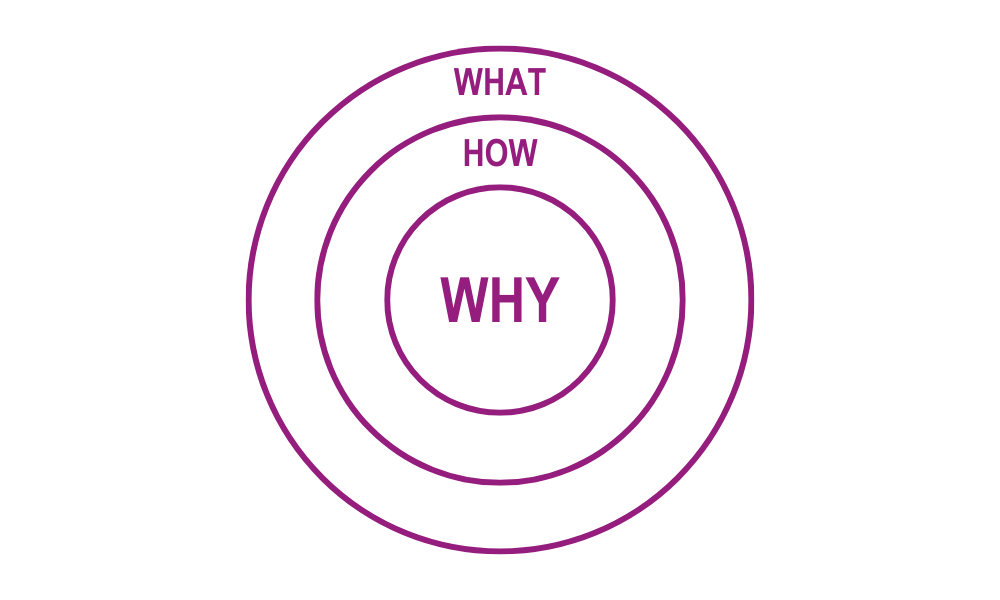
    The Dilts Logical Levels framework and Sinek’s Golden Circle

    are both correlated, as they address the layers of meaning/purpose of human actions. Each of these models explores the why, how, and what of human actions, albeit with a slightly different focus.

    Here’s how they work together:

    1. Why (Sinek) ↔ Identity and Purpose (Dilts)

    The Golden Circle – Why, in Sinek’s case, is the purpose and cause that drives individuals and organizations. It is the reason behind our actions, beyond the outcome, and provides us with a sense of what we do!

    Logical levels – Identity and Purpose. At Dilts’, the Identity level represents ‘Who’ we are, encompassing our beliefs about ourselves and our deeper purpose. At the top of his pyramid, purpose extends to a relationship with vision and mission (in the organizational context), often linked to our contribution to a larger system.

    Both frameworks represent an overarching vision and motivation, guiding everything else.

    WHY WHAT HOW

    2. How (Sinek) ↔ Beliefs, Skills and Behaviors (Dilts)

    The Golden Circle – How, in Sinek’s case, defines the process and methods. It is how we bring purpose to life, often through unique processes, values, or distinctive characteristics.

    Logical levels – Beliefs, skills, and behaviors. In Dilts’ model, Beliefs inform what we believe is possible or worth the effort (shaping the How), while skills refer to our capabilities and strategies used to implement actions. Behaviors are the actual actions taken, representing the translation of beliefs and our skills into something tangible!

    This Dilts level relates to Sinek’s How as it defines our approach, skillset, and actions that make the goal achievable. Beliefs drive motivation, skills enable action, and behaviors embody these values in practice.

    3. What (Sinek) ↔ Environment and Results (Dilts)

    Golden Circle – In Sinek’s terms, What is the outcome, the actual product, service, or result achieved? It is what people see and is often the most tangible aspect of the organization or person’s work.

    Logical levels – Environment and results. Dilts places the environment as the lowest level where the activities that shape outcomes occur. It is the place where the results are observed, evaluated, and adjusted.

    Both models represent concrete, visible output experienced by others. In both frameworks, the What is a visible manifestation of deeper levels shows how purpose and beliefs are ultimately realized.

    Conclusions:

    Sinek’s Golden Circle

    Dilts’ logical levels

    Why    

    Purpose and Identity

    How

    Beliefs, Skills, and Behaviors

    What

    Environment and Results

    Aligning these models allows us to understand not only the outcome (What) but also the deeper motivations standing behind our actions (Why) and processes (How) that drive our behavior. This synergy is particularly useful for leaders to properly guide their co-workers and organizational development.

    Marcin Swierkocki

    Marcin Swierkocki

    Trainer, Coach & MDI Partner

    Marcin Swierkocki works as an HR business consultant who has specialized in L&D, change- and project management. He brings over 25 years of international experience in change management and operational development with him. His personal motto is influenced by Viktor Frankl: ‘Between stimulus and response there is a space. In that space is our power to choose our response. In our response lies our growth…’. His personal inspiration comes from his optimistic and positive character and by draining the energy that successfully supporting others gives him.

    • LinkedIn

    What serves you next?

    AI-Empowered Leadership: 6 Guiding Principles

    by Gunther Fürstberger | 14. April 2026 | Leadership and AI, Leadership Tips, MDI Whitepaper | 0 Comments

    AI-Empowered Leadership: 6 Guiding Principles This blog post is a detailed summary of the whitepaper "Guiding Principles of AI-Empowered Leadership" by MDI's CEO, Gunther Fürstberger. You can find the full whitepaper here! Let's be honest: most conversations about AI...
    Read More

    What AI Shows You — and What It Doesn’t

    by Meike Hinnenberg | 1. April 2026 | Digital Transformation, Impuls series, Leadership and AI | 0 Comments

    What AI Shows You — and What It Doesn't Meike’s Reflections on Artificial Intelligence Do you prefer to listen to this article? Click below to access our AI-generated audio version! What AI Shows You — and What It Doesn't Meike’s Reflections on Artificial Intelligence...
    Read More

    Leading in the Age of AI: How AI Discourse Shapes Responsibility and Power

    by Meike Hinnenberg | 18. March 2026 | Impuls series, Leadership and AI, Leadership Tips | 0 Comments

    Leading in the Age of AI: How AI Discourse Shapes Responsibility and Power Meike’s Reflections on Artificial Intelligence Do you prefer to listen to this article? Click below to access our AI-generated audio version!Leading in the Age of AI: How AI Discourse Shapes...
    Read More

    AI Ethics for Leaders: Why Context and Critical Thinking Matter More Than Ever

    by Meike Hinnenberg | 11. March 2026 | Impuls series, Leadership and AI, Learning Transfer | 0 Comments

    AI Ethics for Leaders: Why Context and Critical Thinking Matter More Than Ever. Meike’s Reflections on Artificial Intelligence Do you prefer to listen to this article? Click below to access our AI-generated audio version!AI Ethics for Leaders: Why Context and Critical...
    Read More

    A Success Story – When AI Sharpens Human Judgement

    by Claude MacDonald, Rafael Ungvari | 6. March 2026 | Customer Story, Digital Transformation, Leadership and AI | 0 Comments

    A Success Story – When AI Sharpens Human Judgement Do you prefer to listen to this article? Click here to access our AI-generated audio version! When AI Amplifies Human Judgment: A Customer Success Story About This Project At MDI, we believe that great leadership and...
    Read More

    How Do You Lead People Who Don’t Think the Way You Do?

    by Zeca Ruiz | 4. February 2026 | Leadership Impact, Leadership Tips, Learning Transfer | 0 Comments

    How Do You Lead People Who Don't Think the Way You Do? Do you want to listen to this article? Click here to access our AI-generated audio version!   How do you lead people who do not think the way you do? Leadership is a challenge, especially when you are not...
    Read More

    How You Deal With Neurodiversity as a Leader

    by Iris Kandlbauer | 3. February 2026 | Leadership Impact, Leadership Tips, Short Knowledge Bits | 0 Comments

    How You Deal With Neurodiversity as a Leader You prefer listening to this article? You can find our AI-generated audio version below! How You Deal With Neurodiversity as a Leader What might be behind “strange” behavior in a team—and how leaders can deal with it...
    Read More

    Anita’s Key to Success for International Cooperation

    by Jana Wölfl | 3. February 2026 | Leadership and AI, Leadership Tips, MDI Spotlight Series | 0 Comments

    Anita's Key to Success for International Cooperation This blog is an excerpt from our new podcast! You can find the entire podcast episode here. Anita's Key to Success for International Cooperation In our new video podcast format, “Voices of Leadership – an MDI...
    Read More

    Fostering True Workplace Commitment

    by Marcin Swierkocki | 14. January 2026 | Leadership Tips, Learning Transfer, Short Knowledge Bits | 0 Comments

    Fostering True Workplace Commitment Do you prefer to listen to this article? Click below to access our AI-generated audio version! Fostering True Workplace Commitment Throughout my years of practice, I've found that deep workplace commitment is achieved not through...
    Read More

    Marcin Swierkocki on the Full Range Leadership Model

    by Jana Wölfl | 19. December 2025 | Leadership and AI, Leadership Tips, MDI Spotlight Series | 0 Comments

    Marcin Swierkocki on the Full Range Leadership Model This blog is an excerpt from our new podcast! You can find the entire podcast episode here. Marcin Swierkocki on the Full Range Leadership Model In the newest episode of our podcast “Voices of Leadership | An MDI...
    Read More
    Weak vs. Strong AI: Unraveling the Myths

    Weak vs. Strong AI: Unraveling the Myths

    by Raphaela Pouzar | Jul 22, 2024 | eLearning, Leadership and AI, Short Knowledge Bits | 0 comments


    Weak vs Strong AI – Unraveling the Myths

    You prefer to listen to this article? Click here to access our AI-generated audio version:

    Weak vs Strong AI – Unraveling the Myths

    Artificial Intelligence has become an integral part of our daily lives, from virtual assistants like Siri and Alexa to recommendation systems on Netflix and Amazon. However, there remains a significant misconception that AI can do more than humans, including possessing human-like understanding and reasoning abilities. To clarify these misconceptions, it’s essential to distinguish between “weak AI” and “strong AI,” the two paradigms within AI research.

    Weak AI vs. Strong AI

    Weak AI, also known as narrow AI, is designed to perform specific tasks such as image classification, game playing, or speech recognition. These systems excel at their designated functions but cannot understand or infer the underlying causes behind the data they process.

    They operate based on pre-defined rules and large datasets, showcasing behavioristic characteristics rather than true cognitive processes. For example, deep learning, a subset of weak AI, uses artificial neural networks to identify patterns and make predictions but does not possess true understanding or consciousness.

    In contrast, strong AI, or artificial general intelligence (AGI), aims to replicate human cognitive abilities. This includes reasoning, understanding, and the ability to learn from experiences like humans. Strong AI is not just a tool for problem-solving but is envisioned to have actual mental states, consciousness, and the capacity for imagination.

    Despite its theoretical appeal, strong AI remains an elusive goal, as current AI systems lack common sense and the ability to comprehend hidden processes behind the data they analyze.

    Misconceptions about AI Capabilities

    One major misconception is that AI can surpass human capabilities in all aspects. While AI systems can outperform humans in specific tasks, such as playing chess or Go, they do not possess the holistic understanding and cognitive flexibility inherent to human intelligence. Current AI, intense learning models, are adept at processing vast amounts of data to make predictions but do so without understanding the context or causality behind the data.

    Moreover, the myth that AI is “all algorithms” oversimplifies its complexity. AI systems rely not only on algorithms but also on high-quality data, effective user interfaces, and interdisciplinary research. Reducing AI to just a set of algorithms ignores the broader context of its development and application.


    Weak vs strong AI-2

    The Practical Implications of Weak AI

    Despite the limitations of weak AI, its practical applications are profound. Weak AI systems provide scalable, efficient solutions for handling big data and have become ubiquitous in various industries. From spam filters and recommendation systems to voice assistants and navigation tools, weak AI enhances our daily lives by automating and optimizing routine tasks.

    The Elusive Goal of Strong AI

    Strong AI, with its promise of human-like cognition and understanding, remains a topic of extensive research and debate. Some argue that to achieve strong AI, future research should focus on developing compositional generative predictive models (CGPMs) that mimic the human brain’s ability to infer and understand the causes behind sensory inputs.

    However, the realization of strong AI poses ethical and practical challenges, including the risk of manipulation and the need for these systems to align with long-term, homeostasis-oriented purposes. However, the development of strong AI is still a distant goal.

    Conclusion

    Understanding the distinction between weak AI and strong AI helps dispel common myths about AI capabilities. While weak AI systems provide valuable tools for specific tasks, strong AI remains a theoretical concept, far from realization.

    Acknowledging these differences is crucial for setting realistic expectations and guiding future AI research and development. As AI technology continues to evolve, it is imperative to focus on ethical considerations and ensure that these advancements serve to enhance human potential rather than overshadow it.

    Butz, M. V. (2021). Towards Strong AI. Künstl Intell, 35(1), 91–101. https://doi.org/10.1007/s13218-021-00705-x

    Flowers, J. C. (2021). Strong and weak AI: Deweyan considerations. Künstl Intell. Retrieved from Worcester State University. jflowers@worcester.edu

    Liu, B. (2021). “Weak AI” is likely to never become “Strong AI”, so what is its greatest value for us? arXiv preprint arXiv:2103.15294. https://doi.org/10.48550/arXiv.2103.15294

    Nussbaum, F. G. (2023). A comprehensive review of AI myths and misconceptions. Review: AI Myths and Misconceptions (Version: October 31, 2023). Retrieved from frank@fgnussbaum.com

    Raphaela Pouzar

    Raphaela Pouzar

    Marketing Team Assistant

    Raphaela Pouzar, a Bachelor of Business Administration student at IMC Krems, works at MDI as a marketing assistant alongside her studies. Additionally, she is currently pursuing an AI certificate from Harvard Business School.

    • LinkedIn

    Download our International Whitepaper:


    What serves you next?

    AI-Empowered Leadership: 6 Guiding Principles

    by Gunther Fürstberger | 14. April 2026 | Leadership and AI, Leadership Tips, MDI Whitepaper | 0 Comments

    AI-Empowered Leadership: 6 Guiding Principles This blog post is a detailed summary of the whitepaper "Guiding Principles of AI-Empowered Leadership" by MDI's CEO, Gunther Fürstberger. You can find the full whitepaper here! Let's be honest: most conversations about AI...
    Read More

    What AI Shows You — and What It Doesn’t

    by Meike Hinnenberg | 1. April 2026 | Digital Transformation, Impuls series, Leadership and AI | 0 Comments

    What AI Shows You — and What It Doesn't Meike’s Reflections on Artificial Intelligence Do you prefer to listen to this article? Click below to access our AI-generated audio version! What AI Shows You — and What It Doesn't Meike’s Reflections on Artificial Intelligence...
    Read More

    Leading in the Age of AI: How AI Discourse Shapes Responsibility and Power

    by Meike Hinnenberg | 18. March 2026 | Impuls series, Leadership and AI, Leadership Tips | 0 Comments

    Leading in the Age of AI: How AI Discourse Shapes Responsibility and Power Meike’s Reflections on Artificial Intelligence Do you prefer to listen to this article? Click below to access our AI-generated audio version!Leading in the Age of AI: How AI Discourse Shapes...
    Read More

    AI Ethics for Leaders: Why Context and Critical Thinking Matter More Than Ever

    by Meike Hinnenberg | 11. March 2026 | Impuls series, Leadership and AI, Learning Transfer | 0 Comments

    AI Ethics for Leaders: Why Context and Critical Thinking Matter More Than Ever. Meike’s Reflections on Artificial Intelligence Do you prefer to listen to this article? Click below to access our AI-generated audio version!AI Ethics for Leaders: Why Context and Critical...
    Read More

    A Success Story – When AI Sharpens Human Judgement

    by Claude MacDonald, Rafael Ungvari | 6. March 2026 | Customer Story, Digital Transformation, Leadership and AI | 0 Comments

    A Success Story – When AI Sharpens Human Judgement Do you prefer to listen to this article? Click here to access our AI-generated audio version! When AI Amplifies Human Judgment: A Customer Success Story About This Project At MDI, we believe that great leadership and...
    Read More

    How Do You Lead People Who Don’t Think the Way You Do?

    by Zeca Ruiz | 4. February 2026 | Leadership Impact, Leadership Tips, Learning Transfer | 0 Comments

    How Do You Lead People Who Don't Think the Way You Do? Do you want to listen to this article? Click here to access our AI-generated audio version!   How do you lead people who do not think the way you do? Leadership is a challenge, especially when you are not...
    Read More

    How You Deal With Neurodiversity as a Leader

    by Iris Kandlbauer | 3. February 2026 | Leadership Impact, Leadership Tips, Short Knowledge Bits | 0 Comments

    How You Deal With Neurodiversity as a Leader You prefer listening to this article? You can find our AI-generated audio version below! How You Deal With Neurodiversity as a Leader What might be behind “strange” behavior in a team—and how leaders can deal with it...
    Read More

    Anita’s Key to Success for International Cooperation

    by Jana Wölfl | 3. February 2026 | Leadership and AI, Leadership Tips, MDI Spotlight Series | 0 Comments

    Anita's Key to Success for International Cooperation This blog is an excerpt from our new podcast! You can find the entire podcast episode here. Anita's Key to Success for International Cooperation In our new video podcast format, “Voices of Leadership – an MDI...
    Read More

    Fostering True Workplace Commitment

    by Marcin Swierkocki | 14. January 2026 | Leadership Tips, Learning Transfer, Short Knowledge Bits | 0 Comments

    Fostering True Workplace Commitment Do you prefer to listen to this article? Click below to access our AI-generated audio version! Fostering True Workplace Commitment Throughout my years of practice, I've found that deep workplace commitment is achieved not through...
    Read More

    Marcin Swierkocki on the Full Range Leadership Model

    by Jana Wölfl | 19. December 2025 | Leadership and AI, Leadership Tips, MDI Spotlight Series | 0 Comments

    Marcin Swierkocki on the Full Range Leadership Model This blog is an excerpt from our new podcast! You can find the entire podcast episode here. Marcin Swierkocki on the Full Range Leadership Model In the newest episode of our podcast “Voices of Leadership | An MDI...
    Read More
    « Older Entries
    Next Entries »

    Information

    • Imprint
    • MDI company website

    Social Media

    • Facebook
    • Twitter
    • Youtube
    • LinkedIn

    © MDI Management Development Institute, 2020