
• MDI
  • German version
  • Contact us
MDI Management Development
  • Agile leadership
  • Lateral Leadership
  • Leadership Impact
  • Leadership Development
Select Page
What is Sustainable Individualization in Leadership?

What is Sustainable Individualization in Leadership?

by Iris Burner | Jun 28, 2023 | Digital Transformation, Leadership Impact, Leadership in the digital transformation | 0 comments

Sustainable individualization in leadership – pious hope or real alternative?

In line with the last blog post on our MDI website “Inner Development Goals For a Better Leadership World“, this time we dedicate ourselves to the megatrend topic of individualization and the connection with the Inner Development Goals (IDGs) towards sustainable leadership.

Individualization instead of multi-module programs

The status quo often shows that companies rely on multi-module programs to develop and train their executives. Depending on the target group, these programs provide a broad general basis of tools and methods – a so-called “toolbox” from which the appropriate tool can be selected according to the situation.

In times of ever scarcer resources (keywords: time and knowledge, cost efficiency and environment) and living realities in climate change, however, one topic is increasingly coming to the fore in the education and training of our future shapers of tomorrow: individualization.

Individualization – one of the 12 megatrends

Individualization was presented by the Zukunftsinstitut 2023 as one of the 12 megatrends. These megatrends are the central trends of our time. They are the biggest drivers of change in business and society and shape our future – not just in the short term, but in the medium to long term. Megatrends unfold their dynamics over decades.

IDGs & SDGs 2030

This time horizon may seem long, especially considering the Inner Development Goals (IDGs), which are based on the implementation of the Sustainable Development Goals for 2030. This deadline means that the implementation of this megatrend can no longer be delayed. 

But when we think of Sustainable Development Goals, can we give individualization any room at all? Doesn’t individualization always consume considerably more resources than a collective measure? 

Megatrend-Map

Quelle: Zukunftsinstitut.de 

Sustainability vs. Individualization – Dealbreaker or Complement?

Sustainability and individualization have an interesting interaction with IDGs. On the one hand, individualization can be seen as a potential challenge to sustainability, as it may require more resources and lead to fragmentation of actions. If individualized programs are developed for each leader or individual, this can add time and cost and may be inefficient.

On the other hand, individualization also offers opportunities for sustainability. By enabling people to consider their interests, strengths, and needs, tailored development and education can take place. When leaders are supported in their development processes and have the opportunity to leverage their strengths, they can develop more effective leadership approaches that are also aligned with sustainability goals.

Promoting Individual Strengths and Creating Sustainability for Leaders and Organizations

IDGs are leveraging the megatrend of individualization to promote personal development and inner growth. By focusing on individual needs and goals, they enable people to realize their full potential and shape their own growth. This also includes the development of leadership competencies required for the sustainable transformation of organizations and societies.

Sustainable individualization in leadership thus means reconciling individual development and sustainability goals. This requires careful planning and design of educational activities to address both individual needs and sustainability issues. It is about fostering individual strengths while creating a common foundation for sustainable leadership.

Transfer to practice – 3 concrete approaches

What concrete measures can companies now take to initiate a sustainable and individualized leadership era?

1. IDG potential analysis

As a possible tool, the IDG potential analysis, for example, can provide an initial basic assessment. The basis of this analysis is a questionnaire based on the five IDGs (Being, Thinking, Relating, Collaborating, and Acting). By evaluating the analysis, the leader receives a self-assessment and finds out where they stand on the company values.


The results of the analysis serve as a basis for targeted measures to promote personal and professional growth in line with the IDGs and are particularly suitable for organizational and personnel development, leadership, team development, and change processes.

generational management

2. Team workshops with team profiles

In order to validate the self-assessment, there is also the possibility to get an external assessment from a colleague. Based on this, there is the possibility to conduct team workshops with team profiles to strengthen cooperation regarding the IDGs.

3. Mentoring program

Another way to put these findings into practice is to implement a mentoring program. This program supports leaders in realizing their individual goals and needs and integrating sustainability-oriented approaches into their leadership practice.

Executives are paired individually with an experienced mentor to foster their personal development and leadership skills. Thus, individual leaders’ needs and goals are addressed by assigning them a mentor who has experience and expertise in the specific areas the leader wants to work on.

The mentoring relationship allows executives to identify their individual strengths and weaknesses and work on them specifically. At the same time, the mentor and mentee are in a two-way exchange on a variety of topics, allowing them to learn from and with each other. This helps the leaders to integrate sustainability-oriented approaches into their leadership practice and to drive positive change in their organizations.

Conclusion

Ultimately, IDGs and customization can help create a new generation of leaders who are both personally fulfilled and focused on sustainable change. By addressing the individual needs and potential of each individual, IDGs can pave the way for sustainable and individualized leadership that can have a positive impact on organizations, society, and the environment.

Commitment MDI – We support leaders who strive for a better world

As an official partner of the Inner Development Goals (IDG), we are actively engaged in collaborating with other stakeholders, organizations, and individuals to advance the integration of transformational sustainable development skills into our leadership development. Our goal is to facilitate dialogue, knowledge sharing, and collaboration to advance the SDGs agenda.

Iris Burner

Iris Burner

Learning & Development Consultant

Since 2022, Iris has been an L&D Consultant at MDI, supporting leaders and organisations worldwide in personal development and creating tailored training programs. She values the personal learning experience and ensures clients benefit from valuable insights. With a background in adult education and professional experience in a renowned corporation, Iris has a comprehensive understanding of company needs and develops customized solutions for sustainable development and growth.


  • LinkedIn

This could also help you:

AI Ethics for Leaders: Why Context and Critical Thinking Matter More Than Ever

by Meike Hinnenberg | 11. March 2026 | Impuls series, Leadership and AI, Learning Transfer | 0 Comments

AI Ethics for Leaders: Why Context and Critical Thinking Matter More Than Ever. Meike’s Reflections on Artificial Intelligence Do you prefer to listen to this article? Click below to access our AI-generated audio version!AI Ethics for Leaders: Why Context and Critical...
Read More

A Success Story – When AI Sharpens Human Judgement

by Claude MacDonald, Rafael Ungvari | 6. March 2026 | Customer Story, Digital Transformation, Leadership and AI | 0 Comments

A Success Story – When AI Sharpens Human Judgement Do you prefer to listen to this article? Click here to access our AI-generated audio version! When AI Amplifies Human Judgment: A Customer Success Story About This Project At MDI, we believe that great leadership and...
Read More

How Do You Lead People Who Don’t Think the Way You Do?

by Zeca Ruiz | 4. February 2026 | Leadership Impact, Leadership Tips, Learning Transfer | 0 Comments

How Do You Lead People Who Don't Think the Way You Do? Do you want to listen to this article? Click here to access our AI-generated audio version!   How do you lead people who do not think the way you do? Leadership is a challenge, especially when you are not...
Read More

How You Deal With Neurodiversity as a Leader

by Iris Kandlbauer | 3. February 2026 | Leadership Impact, Leadership Tips, Short Knowledge Bits | 0 Comments

How You Deal With Neurodiversity as a Leader You prefer listening to this article? You can find our AI-generated audio version below! How You Deal With Neurodiversity as a Leader What might be behind “strange” behavior in a team—and how leaders can deal with it...
Read More

Anita’s Key to Success for International Cooperation

by Jana Wölfl | 3. February 2026 | Leadership and AI, Leadership Tips, MDI Spotlight Series | 0 Comments

Anita's Key to Success for International Cooperation This blog is an excerpt from our new podcast! You can find the entire podcast episode here. Anita's Key to Success for International Cooperation In our new video podcast format, “Voices of Leadership – an MDI...
Read More

Fostering True Workplace Commitment

by Marcin Swierkocki | 14. January 2026 | Leadership Tips, Learning Transfer, Short Knowledge Bits | 0 Comments

Fostering True Workplace Commitment Do you prefer to listen to this article? Click below to access our AI-generated audio version! Fostering True Workplace Commitment Throughout my years of practice, I've found that deep workplace commitment is achieved not through...
Read More

Marcin Swierkocki on the Full Range Leadership Model

by Jana Wölfl | 19. December 2025 | Leadership and AI, Leadership Tips, MDI Spotlight Series | 0 Comments

Marcin Swierkocki on the Full Range Leadership Model This blog is an excerpt from our new podcast! You can find the entire podcast episode here. Marcin Swierkocki on the Full Range Leadership Model In the newest episode of our podcast “Voices of Leadership | An MDI...
Read More

Self-Efficacy in Change: Why It Matters

by Anita Berger | 17. December 2025 | Leadership Tips, Learning Transfer, Short Knowledge Bits | 0 Comments

Why It Matters When Transformation Gets Hard Do you prefer to listen to this article? Click below to access our AI-generated audio version:Self-Efficacy: Why It Matters When Transformation Gets Hard Change can be exhausting.Especially when things are unclear,...
Read More

Generation Z isn’t the Problem but Our System is

by Zeca Ruiz | 3. December 2025 | Impuls series, International leadership development, Leadership in the digital transformation | 0 Comments

Generation Z Isn’t the Problem, but Our System is. Read this article on crossgenerational management by Zeca Ruiz to find out more!

Read More

From Lab to Practice: What We Learned With AI

by Rafael Ungvari | 3. September 2025 | Digital Transformation, Leadership and AI, Short Knowledge Bits | 0 Comments

From Lab to Practice: What We Learned With AI Do you prefer to listen to this article? Click here to access our AI-generated audio version! From Lab to Practice: What We Learned With AI AI in organizations isn’t a one-size-fits-all solution. And in people development,...
Read More
Why Should We Lead More Sustainably?

Why Should We Lead More Sustainably?

by Aline Depoorter, Jana Wölfl | Jun 26, 2023 | Leadership Impact, Leadership Tips, MDI Inside | 0 comments

Why Should We Lead More Sustainably?

It is hard to imagine most companies today without the concept of “sustainable leadership.” Leaders are not only becoming more privately aware of the impact of climate change but also want to fight it on a corporate level.

In this article, you will learn what exactly is meant by Sustainable Leadership and how we at MDI are doing our part.

What is Sustainable Leadership?

In the Journal of Corporate Citizenship, Sustainable Leadership is defined as a leadership style that incorporates social, economic, and environmental issues into its professional concepts. Sustainable leadership is the collaboration of multiple individuals striving to provide the best possible professional future for future generations.

It is important to have an eco-centric mindset (sustainable consumption both privately and as a company), to plan for the long term, and to innovate new, environmentally friendly methods and models.

This means, then, that in a sustainable management style, strong thought is given to the future generation of workers. By consciously paying attention to the environment and planning sustainably in the company, you directly contribute to a generally more sustainable leadership culture.

What Are the Benefits of Sustainable Leadership?

According to a Forbes article, two-thirds of international organizations are striving to be more sustainable in their business. They are focusing heavily on expanding sustainable approaches because, on the one hand, they are feeling the effects of climate change both physically and financially (especially companies in the agricultural sector).

On the other hand, sustainability strategies lead to better financial performance and thus higher profitability, as a Harvard Business Review study has found.

Another relevant aspect is the fact that many job applicants prefer a sustainable management style and would rather accept a job that shares their values and where they can make a difference. 69% of workers consider the aspect of sustainability when choosing a career.

Sustainable leadership is therefore not only a financial advantage for companies but also an attractive factor for applicants and employees.

Sustainable Leadership

Sustainable Leadership @ MDI

At MDI, we also take sustainability to heart. For starters, we conduct the majority of our seminars virtually, which significantly reduces our carbon footprint by saving our participants’ travel expenses and the company travel and hotel costs.

Since virtual conferences can also have a negative impact on the environment, the quality of the video does not have to be extremely high. The type of technology also plays a major role – according to this, a fiber optic line is a much more environmentally friendly alternative to standard 3G mobile internet.

In addition, when choosing the means of transport, it is also important to us that public connections are used, for example, in order to reduce the ecological footprint. We also make sure that the average of our participants does not have a long or far journey to the seminar location.

However, MDI still has an annual CO2 emission of 119 tons, which is why we offset our greenhouse gas emissions by purchasing certificates from the “VCS & CCBS Forest Conservation Brazil” project. We also strive to implement sustainable management strategies at our main site in Vienna.

In general, we are aware of the state of the environment and we always strive to do our part for a more sustainable leadership culture in the spirit of Sustainable Leadership.

Office Inner Development Goals (IDG) Collaboration Partner

As an official Inner Development Goals (IDG) collaborating partner, we at MDI are committed to actively engaging with other stakeholders, organizations, and individuals, to promote the integration of transformational skills for sustainable development into our Leadership Development. We aim to facilitate dialogue, knowledge sharing, and collaboration to advance the agenda of the IDGs.

Read more on our Inner Development Goals for a Better Leadership World

Sources:

https://www.researchgate.net/publication/263604448_Sustainable_Leadership_Towards_a_Workable_Definition

https://www.forbes.com/sites/forbeshumanresourcescouncil/2022/09/07/the-importance-of-sustainable-leadership/?sh=36805631b6ae

https://hbr.org/2017/09/how-to-quantify-sustainabilitys-impact-on-your-bottom-line

https://news.gallup.com/poll/346619/environmental-record-factor-job-seekers.aspx

Aline Depoorter

Aline Depoorter

Marketing Manager

Aline joined MDI in 2020 as a Marketing Manager with over 10 years of B2B marketing experience. She is primarily responsible for the overall coordinated organisation of MDI’s advertising activities and the management of marketing projects. This includes, among others, the MDI Business Unit SDI as well as Leadership Horizon and personalist.at. Aline is a strong marketing all-rounder with a passion for leadership development, digital transformation and event organisation.

  • LinkedIn
Jana Wölfl

Jana Wölfl

Marketing Assistant

Jana Wölfl works at MDI as a marketing assistant and writes blog posts for our site in addition to her studies at Leiden University.

She also works for SDI and supports us with writing content there as well.

  • LinkedIn

This could also interest you:

AI Ethics for Leaders: Why Context and Critical Thinking Matter More Than Ever

by Meike Hinnenberg | 11. March 2026 | Impuls series, Leadership and AI, Learning Transfer | 0 Comments

AI Ethics for Leaders: Why Context and Critical Thinking Matter More Than Ever. Meike’s Reflections on Artificial Intelligence Do you prefer to listen to this article? Click below to access our AI-generated audio version!AI Ethics for Leaders: Why Context and Critical...
Read More

A Success Story – When AI Sharpens Human Judgement

by Claude MacDonald, Rafael Ungvari | 6. March 2026 | Customer Story, Digital Transformation, Leadership and AI | 0 Comments

A Success Story – When AI Sharpens Human Judgement Do you prefer to listen to this article? Click here to access our AI-generated audio version! When AI Amplifies Human Judgment: A Customer Success Story About This Project At MDI, we believe that great leadership and...
Read More

How Do You Lead People Who Don’t Think the Way You Do?

by Zeca Ruiz | 4. February 2026 | Leadership Impact, Leadership Tips, Learning Transfer | 0 Comments

How Do You Lead People Who Don't Think the Way You Do? Do you want to listen to this article? Click here to access our AI-generated audio version!   How do you lead people who do not think the way you do? Leadership is a challenge, especially when you are not...
Read More

How You Deal With Neurodiversity as a Leader

by Iris Kandlbauer | 3. February 2026 | Leadership Impact, Leadership Tips, Short Knowledge Bits | 0 Comments

How You Deal With Neurodiversity as a Leader You prefer listening to this article? You can find our AI-generated audio version below! How You Deal With Neurodiversity as a Leader What might be behind “strange” behavior in a team—and how leaders can deal with it...
Read More

Anita’s Key to Success for International Cooperation

by Jana Wölfl | 3. February 2026 | Leadership and AI, Leadership Tips, MDI Spotlight Series | 0 Comments

Anita's Key to Success for International Cooperation This blog is an excerpt from our new podcast! You can find the entire podcast episode here. Anita's Key to Success for International Cooperation In our new video podcast format, “Voices of Leadership – an MDI...
Read More

Fostering True Workplace Commitment

by Marcin Swierkocki | 14. January 2026 | Leadership Tips, Learning Transfer, Short Knowledge Bits | 0 Comments

Fostering True Workplace Commitment Do you prefer to listen to this article? Click below to access our AI-generated audio version! Fostering True Workplace Commitment Throughout my years of practice, I've found that deep workplace commitment is achieved not through...
Read More

Marcin Swierkocki on the Full Range Leadership Model

by Jana Wölfl | 19. December 2025 | Leadership and AI, Leadership Tips, MDI Spotlight Series | 0 Comments

Marcin Swierkocki on the Full Range Leadership Model This blog is an excerpt from our new podcast! You can find the entire podcast episode here. Marcin Swierkocki on the Full Range Leadership Model In the newest episode of our podcast “Voices of Leadership | An MDI...
Read More

Self-Efficacy in Change: Why It Matters

by Anita Berger | 17. December 2025 | Leadership Tips, Learning Transfer, Short Knowledge Bits | 0 Comments

Why It Matters When Transformation Gets Hard Do you prefer to listen to this article? Click below to access our AI-generated audio version:Self-Efficacy: Why It Matters When Transformation Gets Hard Change can be exhausting.Especially when things are unclear,...
Read More

Generation Z isn’t the Problem but Our System is

by Zeca Ruiz | 3. December 2025 | Impuls series, International leadership development, Leadership in the digital transformation | 0 Comments

Generation Z Isn’t the Problem, but Our System is. Read this article on crossgenerational management by Zeca Ruiz to find out more!

Read More

From Lab to Practice: What We Learned With AI

by Rafael Ungvari | 3. September 2025 | Digital Transformation, Leadership and AI, Short Knowledge Bits | 0 Comments

From Lab to Practice: What We Learned With AI Do you prefer to listen to this article? Click here to access our AI-generated audio version! From Lab to Practice: What We Learned With AI AI in organizations isn’t a one-size-fits-all solution. And in people development,...
Read More
Inner Development Goals for a Better Leadership World

Inner Development Goals for a Better Leadership World

by Gunther Fürstberger | May 30, 2023 | International leadership development, Leadership Impact, training new leader | 0 comments

Inner Development Goals for a better leadership world

Many companies invest in training and programs to prepare their leaders for the challenges of business. But in addition to traditional goals such as increasing sales and optimizing efficiency, Inner Development Goals (IDGs) are also gaining importance.

But what exactly are IDGs and why should they matter in leadership development?

Better philosophy, a better leader

Inner Development Goals refer to the personal development and growth of leaders at a deeper level. They focus not only on improving skills and competencies but also on a leader’s inner state and awareness.

IDGs aim to help you as a leader develop your emotional intelligence, self-reflection, values, and leadership philosophy.

Organizations align their leadership development efforts with organizational goals and strategy. Traditionally, leadership development programs have focused primarily on building skills and competencies that are important to the success of the organization.

Sustainability Goals 2030

More and more companies are recognizing that financial success is not the only thing that matters; they also want to contribute to a resource-efficient circular economy to enable a livable future.

With its vision of a Sustainable World in 2030 and the Sustainable Development Goals, the United Nations has created a global framework that can serve as a guide for companies.

Unfortunately, since the world is nowhere near on track to achieving the Sustainability Development Goals, the Inner Development Goals were created. These start with the capabilities and attitudes of individuals.

Analyze your values

To align your organization’s leadership culture with the IDGs and thus with sustainability, it makes sense to start by analyzing your existing organizational values, leadership competencies, leadership rules of engagement, and leadership development activities. It is important to assess your current leadership skills and competencies and understand how well they align with your desired IDGs.

A measurable comparison of the existing competency set with the IDGs allows us to determine the degree of overlap. Where are there already strengths and where are there still areas for development? Based on your analysis, a clear goal for the development of the IDGs can be defined.

A Roadmap for Reflection

Once the degree of overlap and the goal is defined, a roadmap for the changed leadership development architecture can be created. This roadmap includes specific training and coaching activities aimed at nurturing and developing IDGs.

For example, programs can be implemented to promote self-reflection, strengthen emotional intelligence or develop a sustainability-oriented leadership personality.

A content example of leadership development geared toward IDGs might be a program to promote mindfulness and stress management. By training leaders in mindfulness techniques, you can learn to be more aware of your inner state, reduce stress, and make more conscious decisions.

This enhances your personal development and helps you stay calm and collected in challenging situations.

Sustainable Leadership Goals

Who works with IDG?

Examples of companies working with IDGs include IKEA, Google, and Novartis. The IDG movement started in 2020, so it’s still quite young. But it is spreading rapidly. There are now 350 IDG hubs worldwide and a few new ones are added every week.


Not only the quantitative growth is impressive, but also the depth of content. This is supported by the fact that renowned authors such as Amy Edmonson, Otto Scharma, and Peter Senge are among the supporters, as well as academic partners from Harvard, Stockholm, or Erasmus University.

Possible difficulties

Integrating IDGs into leadership development can encounter several challenges. For one, it requires a shift in your organizational culture to recognize the value and importance of your internal development. It also requires time and resources to implement appropriate training and programs.

To overcome these challenges, it’s important to raise your awareness of the importance of IDGs and make clear the benefits to individual and corporate development.

Companies can conduct internal communication and awareness campaigns to inform employees about the benefits of IDGs in leadership development.

Promote your learning culture

It can also be helpful to foster a culture of learning and personal development within the company. You can do this by creating learning opportunities, such as mentoring programs, coaching, or internal training.

By allowing your company to provide you as a leader with opportunities to continuously develop and pursue your IDGs, you can create a positive and supportive environment.

So far, no official certification system has been created that can objectively provide transparency on the success of IDG initiatives. But some initiatives are already underway toward measuring the impact of IDGs.

IDGs for a more sustainable planet

Integrating Inner Development Goals (IDGs) into leadership development offers companies the opportunity to develop you as a leader on a deeper level and promote sustainable and authentic leadership.

By clarifying your inner goals and values as a leader and aligning them with your actions, you can contribute not only to the financial success of the company but also to a resource-efficient circular economy and a sustainable future.

By integrating IDGs into their leadership development efforts, companies can create a new generation of leaders who are not only technically competent but also possess inner strength and awareness. This ultimately leads to an attractive corporate culture, long-term success, and a contribution to the creation of a sustainable world.

Mag. Gunther Fürstberger

Mag. Gunther Fürstberger

CEO | MDI Management Development International

Gunther Fürstberger is a management trainer, author and CEO of Metaforum and MDI – a global consulting company providing solutions for leadership development. His main interest is to make the world a better place through excellent leadership. He has worked for clients including ABB, Abbvie, Boehringer Ingelheim, DHL, Hornbach, PWC and Swarovski. His core competence is leadership in digital transformation. He gained his own leadership experience as HR Manager of McDonald’s Central Europe/Central Asia.  At the age of 20 he already started working as a trainer.

  • LinkedIn

What serves you next?

AI Ethics for Leaders: Why Context and Critical Thinking Matter More Than Ever

by Meike Hinnenberg | 11. March 2026 | Impuls series, Leadership and AI, Learning Transfer | 0 Comments

AI Ethics for Leaders: Why Context and Critical Thinking Matter More Than Ever. Meike’s Reflections on Artificial Intelligence Do you prefer to listen to this article? Click below to access our AI-generated audio version!AI Ethics for Leaders: Why Context and Critical...
Read More

A Success Story – When AI Sharpens Human Judgement

by Claude MacDonald, Rafael Ungvari | 6. March 2026 | Customer Story, Digital Transformation, Leadership and AI | 0 Comments

A Success Story – When AI Sharpens Human Judgement Do you prefer to listen to this article? Click here to access our AI-generated audio version! When AI Amplifies Human Judgment: A Customer Success Story About This Project At MDI, we believe that great leadership and...
Read More

How Do You Lead People Who Don’t Think the Way You Do?

by Zeca Ruiz | 4. February 2026 | Leadership Impact, Leadership Tips, Learning Transfer | 0 Comments

How Do You Lead People Who Don't Think the Way You Do? Do you want to listen to this article? Click here to access our AI-generated audio version!   How do you lead people who do not think the way you do? Leadership is a challenge, especially when you are not...
Read More

How You Deal With Neurodiversity as a Leader

by Iris Kandlbauer | 3. February 2026 | Leadership Impact, Leadership Tips, Short Knowledge Bits | 0 Comments

How You Deal With Neurodiversity as a Leader You prefer listening to this article? You can find our AI-generated audio version below! How You Deal With Neurodiversity as a Leader What might be behind “strange” behavior in a team—and how leaders can deal with it...
Read More

Anita’s Key to Success for International Cooperation

by Jana Wölfl | 3. February 2026 | Leadership and AI, Leadership Tips, MDI Spotlight Series | 0 Comments

Anita's Key to Success for International Cooperation This blog is an excerpt from our new podcast! You can find the entire podcast episode here. Anita's Key to Success for International Cooperation In our new video podcast format, “Voices of Leadership – an MDI...
Read More

Fostering True Workplace Commitment

by Marcin Swierkocki | 14. January 2026 | Leadership Tips, Learning Transfer, Short Knowledge Bits | 0 Comments

Fostering True Workplace Commitment Do you prefer to listen to this article? Click below to access our AI-generated audio version! Fostering True Workplace Commitment Throughout my years of practice, I've found that deep workplace commitment is achieved not through...
Read More

Marcin Swierkocki on the Full Range Leadership Model

by Jana Wölfl | 19. December 2025 | Leadership and AI, Leadership Tips, MDI Spotlight Series | 0 Comments

Marcin Swierkocki on the Full Range Leadership Model This blog is an excerpt from our new podcast! You can find the entire podcast episode here. Marcin Swierkocki on the Full Range Leadership Model In the newest episode of our podcast “Voices of Leadership | An MDI...
Read More

Self-Efficacy in Change: Why It Matters

by Anita Berger | 17. December 2025 | Leadership Tips, Learning Transfer, Short Knowledge Bits | 0 Comments

Why It Matters When Transformation Gets Hard Do you prefer to listen to this article? Click below to access our AI-generated audio version:Self-Efficacy: Why It Matters When Transformation Gets Hard Change can be exhausting.Especially when things are unclear,...
Read More

Generation Z isn’t the Problem but Our System is

by Zeca Ruiz | 3. December 2025 | Impuls series, International leadership development, Leadership in the digital transformation | 0 Comments

Generation Z Isn’t the Problem, but Our System is. Read this article on crossgenerational management by Zeca Ruiz to find out more!

Read More

From Lab to Practice: What We Learned With AI

by Rafael Ungvari | 3. September 2025 | Digital Transformation, Leadership and AI, Short Knowledge Bits | 0 Comments

From Lab to Practice: What We Learned With AI Do you prefer to listen to this article? Click here to access our AI-generated audio version! From Lab to Practice: What We Learned With AI AI in organizations isn’t a one-size-fits-all solution. And in people development,...
Read More
How to Become a Compassionate Leader – 3 tools

How to Become a Compassionate Leader – 3 tools

by Gunther Fürstberger | Apr 18, 2023 | International leadership development, Leadership in the digital transformation, MDI Inside, Training Insights | 0 comments

How to Become a Compassionate Leader in 3 Steps

At MDI, we not only develop others, but also ourselves. That’s why our CEO Gunther Fürstberger attended a three-day seminar by systems researcher Peter Senge in Stockholm, where he gained some insights. He reports on his experiences in this blog post.

The Compassionate Leadership Masterclass

Peter Senge wrote a classic of leadership literature in 1990 with “The 5th Discipline”. When I read that he was giving a 3-day seminar in Stockholm as part of the Inner Development Goals Initiative, I knew I had to experience it. I thought about Marcus Aurelius who already said “You have to know the great ones of your time”.

The sold out Compassionate Systems Leadership Masterclass by Peter Senge and Gustav Böll took place in the artistic setting of Fotografiska Museum with about 100 participants from March 29 to 31, 2023.

The seminar title sounds a bit complicated. What is Compassionate Systems Leadership all about? A first key to understanding is the organizer: the Inner Development Initiative. In 2016, UN member states adopted the 2030 Agenda for Sustainable Development. Since then, our planet has continued to deteriorate.

A new leadership system for a better planet

Us earthlings have obviously not yet developed the skills and attitude it takes to undo the damage of the industrial age.

This is where the Inner Development Initiative comes in: The change in attitude must begin with the individual. Engaging broadly and deeply with the Inner Development Goals in the 5 categories of Being, Thinking, Relating, Collaborating, and Acting will help achieve the UN Sustainable Development Goals.

Our planet now needs a different kind of leadership than we know from the industrial age. It starts with feeling nature and other people and should lead to some sense of connection with others or even all beings on the planet.

Hardly anyone wants to intentionally cause grievances, but who is really aware of the effects of their own actions? System thinking can help to understand both short- and long-term impacts and interactions a little better.

New findings on two levels

Learning for me has taken place on two levels during these days. On the one hand, I got to know new tools or deepened known tools. On the other hand, the trainers were an inspiration in their handling of the group and their use of methods.

From the numerous thinking tools I pick out the three that I found particularly typical for Compassionate Systems Leadership.

Tool 1

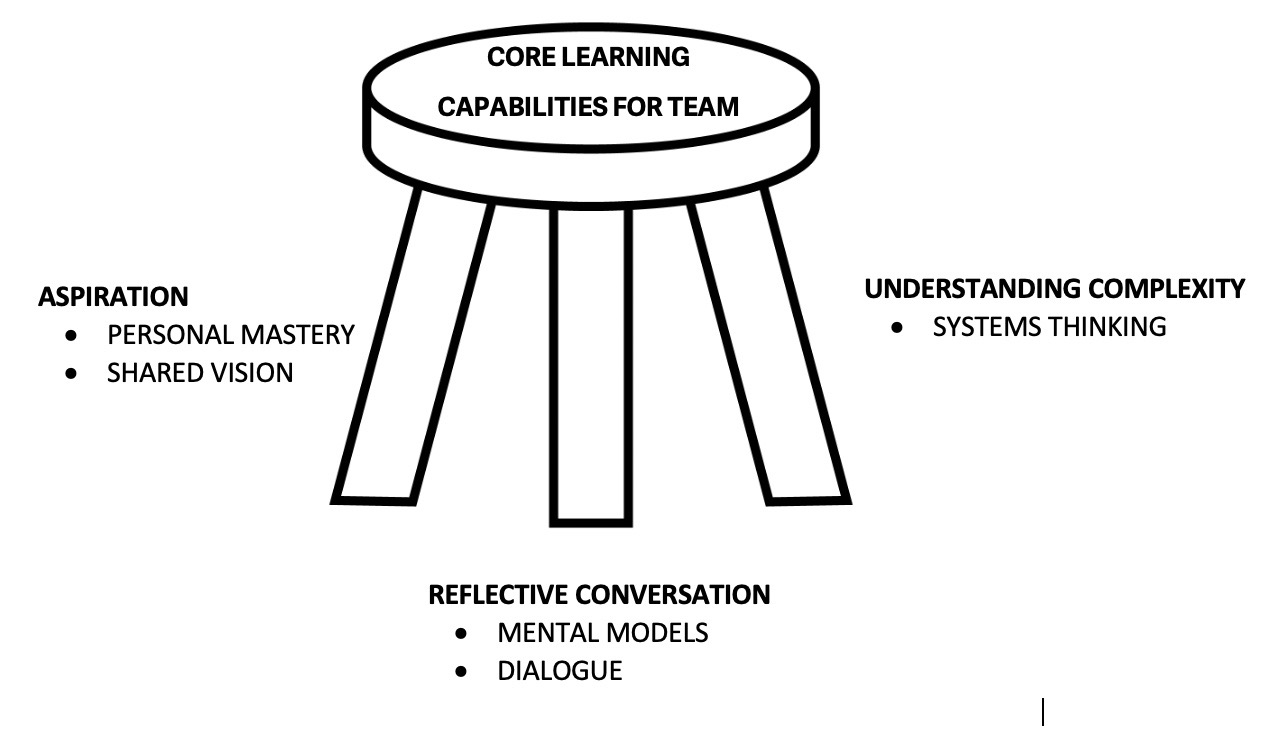
First, as an overview tool, there is the three-legged chair (see figure 1). The legs represent aspiration, reflective conversations, and systems awareness. If one leg is missing, the stool falls over.

Without a creative imagining of a better environment, there is no improvement. Without reflection or a deeper understanding of systems, we quickly end up in dead ends despite having good intentions. 

Three-legged chair

Tool 2

The ladder of connectedness

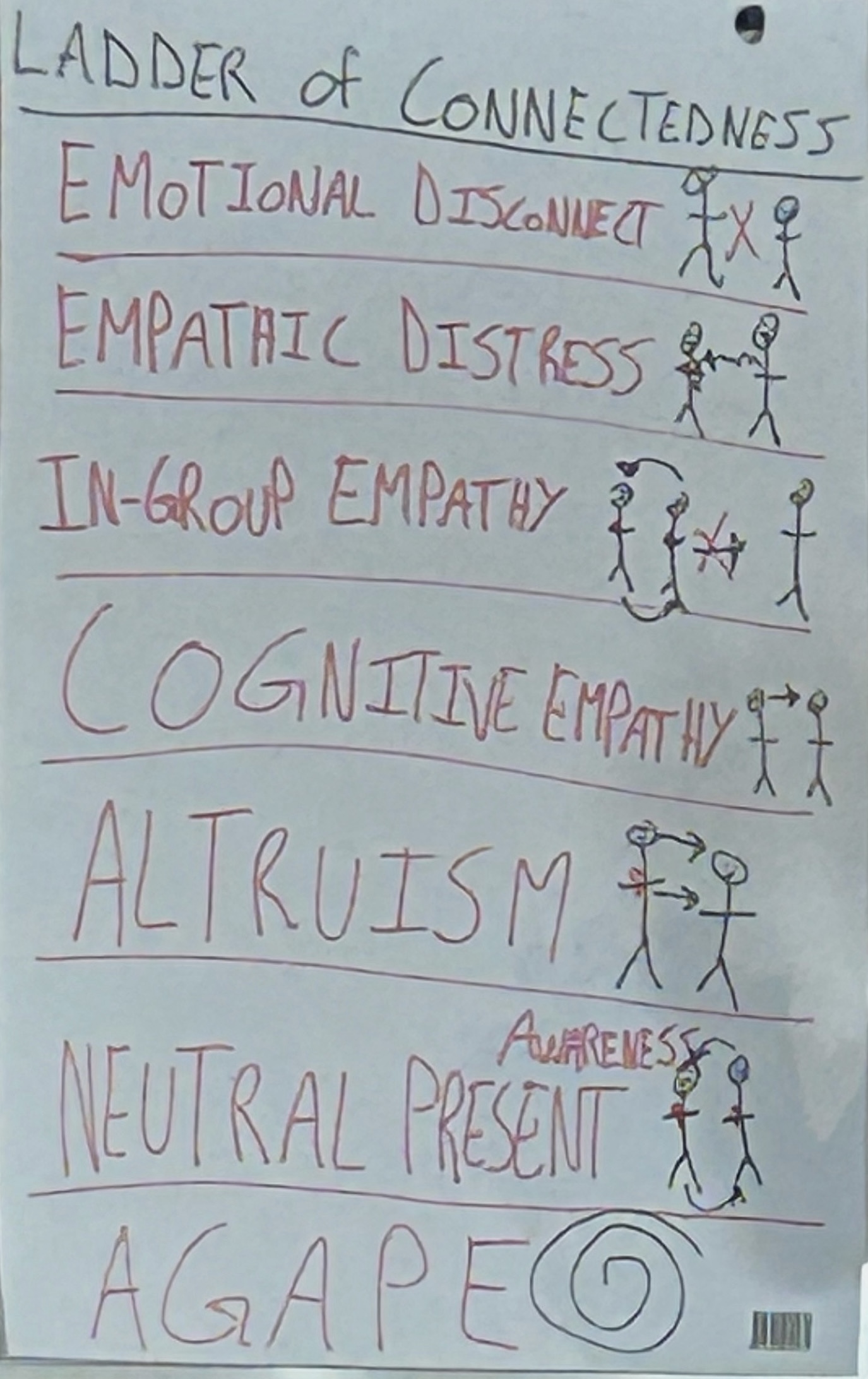
The second tool is the “ladder of connectedness” (see figure 2), which confused me initially: From bottom to top, the ladder levels are called “agape, neutral presence, altruism, cognitive empathy, in-group empathy, empathic stress, and emotional distance.”

We can harness gravity to move toward deeper connectedness, i.e., strive more toward the lower levels. Confusion can be a sign of real learning. I could not easily assign this idea to an already stored concept. It seemed to fit most closely with a Buddhist understanding.

We may not achieve agape, all-connected love, but we can create a neutral presence even in difficult situations. It also needs the higher levels: A surgeon should manage to distance themselves emotionally for self-protection.

Neutral instead of empathetic

Distance also helps sometimes in conflicts that go round in circles. Empathic stress is something I can relate to as a father of younger children. When my 8-year-old and my 6-year-old argue loudly with each other, it seems easier for me to demand that they stop for the short term because it helps me reduce my internal tension. But in the long run, it doesn’t help me.

In-group empathy may lead to good cooperation in the team, in the company or even in one’s own country, but at the same time it may exclude those who do not belong to the group. I take it upon myself to practice more neutral presence, which is enduring tension and contradiction.

Ladder of Connectedness

Tool 3

Creative Tension

Now our third and a simpler tool (see figure 3): The principle of creative tension. I already knew that a vision needs the right level of challenge, because something we have already achieved or something we can never achieve is not good as a vision.

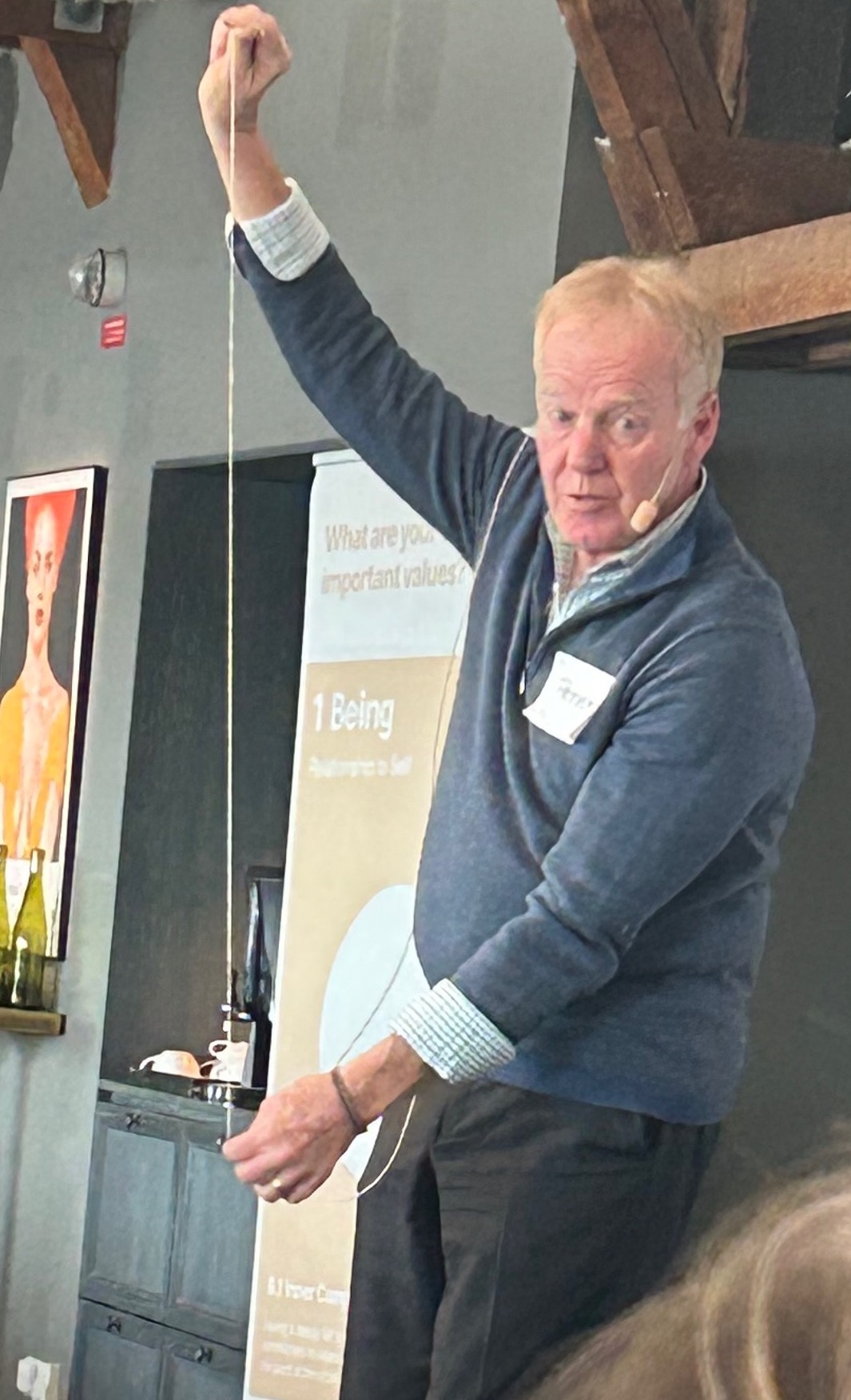
I found the continuation of the thought interesting: We can imagine the tension between reality and vision as a rubber band. When that tension becomes too uncomfortable for us, we often tend to either lower our aspirations or not tell the whole truth about the current state.

An energy source for change

A good example are an organization’s sustainability goals. When we consciously seek and hold this tension, we tap into the energy source for change. This principle of creativity is also found in theater as drama, in music as tonus, and in the Greek rhetoric. In this respect, it is not a new idea, but it is effective when we strive for change.

I was also interested in what Peter Senge is like as a person. I have already met some of the “greats of the lecture scene” away from the stage and with some of them I had the impression that it was difficult for them to live the conveyed messages themselves. That is also human.

Peter with rubber band

Peter Senge as a Human

In the morning of Day three, there was an emotionally expressed resistance from a participant who questioned the usefulness of the whole seminar. She said Peter Senge held on to the statement that we always have a choice and do not have to be influenced by external circumstances, despite her doubts expressed the day before.

Now I was curious. Will he maybe feel attacked and defend himself or let it stand as an individual opinion? He did not react immediately, but let other participants speak first. Later, he resonated, apologized, thanked for the learning opportunity, and did so with an authenticity and elegance that really impressed me.

He always treated his much younger co-trainer at eye level and was so moved several times that tears came to his eyes.

My summary

In the spirit of Marcus Aurelius, I had the opportunity to meet two greats of our time. Especially the combination of two trainers from different generations fits the challenges of our time.

Even though I have not implemented all of the presented contexts and tools and I am also not sure whether the term Compassionate System Leadership will become widely accepted, I recommend every leader to deal with the basic idea. A more sustainable leadership culture would do us and the planet good.

Mag. Gunther Fürstberger

Mag. Gunther Fürstberger

CEO | MDI Management Development International

Gunther Fürstberger is a management trainer, author and CEO of MDI – a global consulting company providing solutions for leadership development. His main interest is to make the world a better place through sustainable leadership. He has worked for clients including ABB, Abbvie, Boehringer Ingelheim, DHL, Google, Hornbach, PWC and Swarovski. His core competence is leadership in digital transformation. At the age of 20 he already started working as a trainer and he also served as HR manager in international corporations.

  • LinkedIn

What serves you next?

Leadership Horizon powered by HR INSIDE SMMIT

AI Ethics for Leaders: Why Context and Critical Thinking Matter More Than Ever

AI Ethics for Leaders: Why Context and Critical Thinking Matter More Than Ever. Meike’s...
Read More

A Success Story – When AI Sharpens Human Judgement

A Success Story – When AI Sharpens Human Judgement Do you prefer to listen to this article? Click...
Read More

How Do You Lead People Who Don’t Think the Way You Do?

How Do You Lead People Who Don't Think the Way You Do? Do you want to listen to this article?...
Read More

How You Deal With Neurodiversity as a Leader

How You Deal With Neurodiversity as a Leader You prefer listening to this article? You can find...
Read More

Anita’s Key to Success for International Cooperation

Anita's Key to Success for International Cooperation This blog is an excerpt from our new podcast!...
Read More

Fostering True Workplace Commitment

Fostering True Workplace Commitment Do you prefer to listen to this article? Click below to access...
Read More

Marcin Swierkocki on the Full Range Leadership Model

Marcin Swierkocki on the Full Range Leadership Model This blog is an excerpt from our new podcast!...
Read More

Self-Efficacy in Change: Why It Matters

Why It Matters When Transformation Gets Hard Do you prefer to listen to this article? Click below...
Read More

Generation Z isn’t the Problem but Our System is

Generation Z Isn’t the Problem, but Our System is. Read this article on crossgenerational management by Zeca Ruiz to find out more!

Read More

From Lab to Practice: What We Learned With AI

From Lab to Practice: What We Learned With AI Do you prefer to listen to this article? Click here...
Read More
5 measures for an integrative corporate culture

5 measures for an integrative corporate culture

by Desiree Jonek | Mar 6, 2023 | Best Practice, International leadership development, Leadership Tips | 0 comments

5 measures for an integrative corporate culture

In this interview, we ask Desiree Jonek , co-founder of WoMentor and the author of the brand new paper “5 effective measures to navigate the shift to an inclusive and performing corporate culture “, 3 big questions about Diversity, Equity and Inclusion (DEI):

(more…)

Next Entries »

Information

  • Imprint
  • MDI company website

Social Media

  • Facebook
  • Twitter
  • Youtube
  • LinkedIn

© MDI Management Development Institute, 2020