
• MDI
  • German version
  • Contact us
MDI Management Development
  • Agile leadership
  • Lateral Leadership
  • Leadership Impact
  • Leadership Development
Select Page
One Size Fits None: An Appeal for Better Leaders

One Size Fits None: An Appeal for Better Leaders

by Hamza Khan | Feb 27, 2023 | International leadership development, Leadership Impact, Leadership Tips | 0 comments

One Size Fits None: An Appeal for Better Leaders

According to Deloitte University Press, 86% of companies have identified developing new leaders as an “urgent” need. And upon closer inspection, it’s clear to see why. 

Incompetency as a Norm

When it comes to managers’ performance, alarmingly, the norm seems to be incompetence. In a recent study, Gallup found that companies fail to choose suitable candidates for management roles a staggering 82% of the time. Now to be fair, there are not many qualified potential people to choose from in the first place.

In another report, Gallup revealed that only 1 in 10 people possess requisite management talents, such as the ability to build relationships that create trust, open dialogue, and full transparency. And of those who do end up becoming managers, their talent is seldom nurtured. 

A survey by Career Builders found that a whopping 58% of managers receive little-to-no management training. Alas, most bosses aren’t necessarily good at making the people around them better. And how this plays out in workplaces across the planet is disheartening.

For instance, a Harvard Business Review study uncovered that 58% of people trust strangers more than their bosses. So arguably, they are more willing to let their children get into an Uber driven by a complete stranger than they are to let them work with their boss. In light of these findings, it’s no surprise that most employees—upwards of 80% according to some of the most comprehensive studies—are disengaged, looking for other jobs, and ditching traditional employment to pursue entrepreneurship. 

Who is your Leadership Inspiration?

As it happens, the modern workplace is overrun by bosses who aren’t qualified to lead. Reflect on your career for a moment by thinking about the best boss you worked for, as well as the worst boss you worked for. Once you’ve visualized them, ask yourself: whose leadership style do you strive to emulate?

If you picked the best boss you worked for, then you have an innate understanding of the complex problem at hand, as well as its embarrassingly simple solution.

On one side, it’s heartening to see organizations worldwide upgrade from simple Corporate Social Responsibility commitments to more holistic and comprehensive Environmental, Social, and Governance commitments, as well as aspire to B-Corp status.

Glimpses of a positive-sum thriving future are visible through the cracks of the prevailing zero-sum failing system. A full year before we plunged into the chaos of the COVID-19 pandemic, Marc Benioff, CEO of Salesforce, made this urgent appeal to his contemporaries at the 2019 Business Roundtable Forum: 

“The purpose of business now transcends shareholders. We need a reinvented system focused on employees, customers, communities, and the planet.”  

Leadership Inspiration

Meaningful Leadership

Benioff believes that companies should use their power to advance meaningful causes. And chief among them is the fight against climate change. In doing so, he joins a small but rising list of industry captains—including Patagonia Founder Yves Chouinard, who made headlines for relinquishing his entire stake in the company to fight climate change—who speak up about the necessary structural changes required to stand a chance against the world’s most pressing issue.

So on one side, it seems that leaders have their hearts in the right places as far as environmental sustainability is concerned. But on the other, a peculiar problem is intensifying: organizations are living shorter and shorter lives. Consider that in 1958, the average age of an S&P 500 company was a healthy 61 years. But in 2023, that number is down to a mere 18 years.

In fact, McKinsey calculates that most S&P 500 companies will disappear by 2027. I suspect that this rate of decay has a lot to do with the aforementioned issue of bad bosses. As I wrote about extensively in my pandemic-inspired book, “Leadership, Reinvented,” during times of change and crises, people don’t “step up”—they actually “fall back” and “sink” to the level of their values, training, and preparation. 

Given that most managers are incompetent and that our world is becoming increasingly volatile, uncertain, complex, and ambiguous, the problem becomes clearer: overwhelmed and incompetent bosses are reverting to and doubling down on a counterproductive style of management—a remnant of the early Industrial Revolutions, known in the leadership literature as “Dominance.” 

Dominance-Oriented Leadership

Dominance-oriented leadership it’s a one-size-fits-all style of management which relies on force and intimidation to induce fear. Below are common traits of this leadership style:

  1. Assertive
  2. Highly Directive
  3. Top-Down
  4. Traditional
  5. Command-And-Control
  6. Hierarchical 
  7. Coercive
  8. Intimidating
  9. Punitive
  10. Authoritative

Dominance-oriented leaders are inclined to enjoy giving orders, intimidating subordinates, overly relying on reward and punishment, and prioritizing the organization’s needs over those it employs. The one critical problem with this management style is that it doesn’t replicate.

And so, in the truest sense of the word, it’s an unsustainable approach to managing. After all, think back to the bad boss you visualized earlier—you’re actively choosing not to replicate their management style.



Dominance-oriented leadership

Caught up in Dominance cycles, most companies—whether on the S&P 500 or FTSE Eurofirst 300—haven’t committed to comprehensive measures to fight climate change, such as running net zero carbon operations. Staring into the abyss of time, afraid, the managers of these companies are making the grave mistake of prioritizing greater profits.

All the while, they’re exacerbating the very problem that will upend their business. Intimidation can beget compliance, but relationships based on Dominance are less stable. Getting out of unstable survival mode involves looking to the opposite approach to Dominance, namely, Prestige. 

Prestige-Oriented Leadership

This style of management involves the sharing of expertise or know-how to gain respect. Prestige-oriented leaders are servant leaders who care about relationships with their team, avoid intimidation and coercion, strive to be role models, use soft power to influence subordinates, and create more organizational leaders. Below are common traits of this leadership style:

  1. Transformational 
  2. Humble
  3. Non-Directive
  4. Empowering
  5. Egalitarian
  6. Inspiring
  7. Generous
  8. Admired
  9. Supportive
  10. Authentic

Benefits of Prestige-Oriented Leadership

Compared to Dominance, Prestige is more tedious to manifest, for it requires substantial tailoring to the needs of individuals. But the caveat is that of the two, Prestige is the only style that is widely and willingly replicated. In this way, it’s the only sustainable option. But putting aside the question of ease, Prestige is actually better for business.

A ten-year examination of stock market returns for the 20 best-ranked public companies on Glassdoor reveals that 60% have beaten the S&P 500, and 91% have had positive returns. And behold, Fortune’s Top 100 best companies to work at also outperformed the S&P 500 over the past decade. The top company, Adobe, beat the market by 9.5% each year and returned 1762% during this time.

And according to the American College of Occupational and Environmental Medicine, companies that promote a culture of health, safety, and well-being also outperformed the market by 2% per year, with a weighted return on equity of 264% (compared with the S&P 500 return of 243%). It turns out that exceptional places to work create outstanding returns for their shareholders. So while Prestige may be a more challenging path to the top, it’s absolutely worth doing.



Prestige-Oriented Leadership

Dominance or Prestige?

Are there situations where a Dominance-oriented leader performs better than a Prestige-oriented leader? Yes. A top-down, dominant approach can be efficient when a solid plan is in place, and a highly coordinated, unified effort is needed to deliver it.

A dominant leader can make each part of a company adhere to clearly defined actions, and can save time through quick and firm decision-making. But all this assumes that there is a healthy relationship between managers and employees, and that good communication and buy-in have taken place.

Which, as we know, is simply not the case in the modern workplace. One way to rethink the Prestige-Dominance dichotomy is as a permission-based blend—the privilege of successful Prestige orientation is the earned ability to switch to Dominance as the needs of the organization and its people change. 

For Human Resources and Learning & Development professionals, the business case is clear. And it needs to be communicated to managers across the organization—potential managers, newly minted managers, and C-Suite alike: lead with Prestige. Early in my career, a mentor advised me that a leader’s true purpose is to “develop new leaders.”

A coordinated contingent of Prestige-oriented leaders is critical to navigating our world away from impending environmental catastrophe and toward a sustainable positive-sum future. And this global effort depends on every organization’s ability to develop new leaders. 
Hamza Khan

Hamza Khan

Keynote Speaker

Hamza Khan is a best-selling author, award-winning entrepreneur, and globally-renowned keynote speaker whose TEDx talk “Stop Managing, Start Leading” has been viewed over two million times.

The world’s leading organizations trust him to enhance modern leadership, inspire purposeful productivity, nurture lasting resilience, and navigate constant change.

This could also interest you:
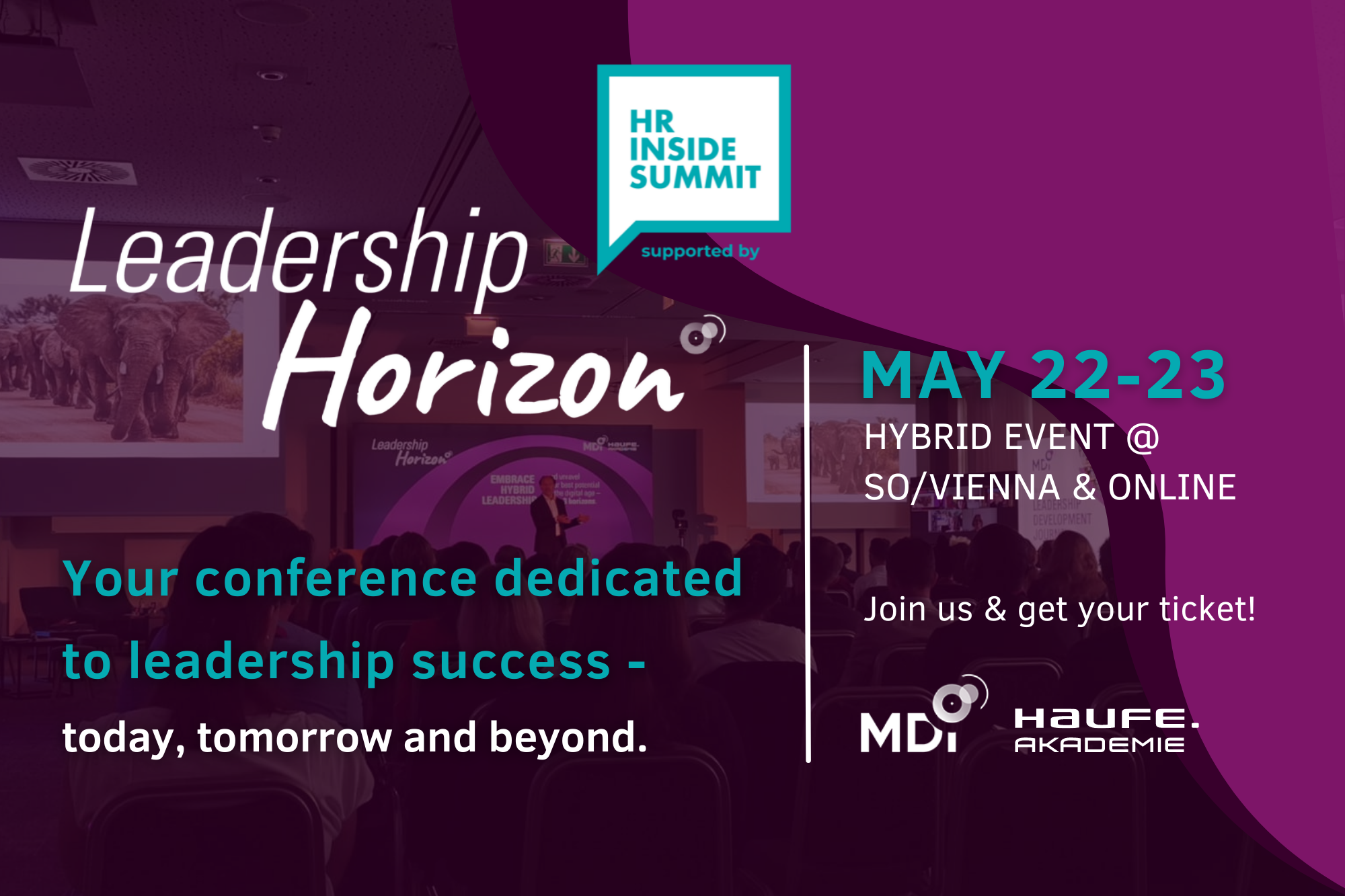
Leadership Horizon powered by HR INSIDE SMMIT

How Do You Lead People Who Don’t Think the Way You Do?

by Zeca Ruiz | 4. February 2026 | Leadership Impact, Leadership Tips, Learning Transfer | 0 Comments

How Do You Lead People Who Don't Think the Way You Do? Do you want to listen to this article? Click here to access our AI-generated audio version!   How do you lead people who do not think the way you do? Leadership is a challenge, especially when you are not...
Read More

How You Deal With Neurodiversity as a Leader

by Iris Kandlbauer | 3. February 2026 | Leadership Impact, Leadership Tips, Short Knowledge Bits | 0 Comments

How You Deal With Neurodiversity as a Leader You prefer listening to this article? You can find our AI-generated audio version below! How You Deal With Neurodiversity as a Leader What might be behind “strange” behavior in a team—and how leaders can deal with it...
Read More

Anita’s Key to Success for International Cooperation

by Jana Wölfl | 3. February 2026 | Leadership and AI, Leadership Tips, MDI Spotlight Series | 0 Comments

Anita's Key to Success for International Cooperation This blog is an excerpt from our new podcast! You can find the entire podcast episode here. Anita's Key to Success for International Cooperation In our new video podcast format, “Voices of Leadership – an MDI...
Read More

Fostering True Workplace Commitment

by Marcin Swierkocki | 14. January 2026 | Leadership Tips, Learning Transfer, Short Knowledge Bits | 0 Comments

Fostering True Workplace Commitment Do you prefer to listen to this article? Click below to access our AI-generated audio version! Fostering True Workplace Commitment Throughout my years of practice, I've found that deep workplace commitment is achieved not through...
Read More

Marcin Swierkocki on the Full Range Leadership Model

by Jana Wölfl | 19. December 2025 | Leadership and AI, Leadership Tips, MDI Spotlight Series | 0 Comments

Marcin Swierkocki on the Full Range Leadership Model This blog is an excerpt from our new podcast! You can find the entire podcast episode here. Marcin Swierkocki on the Full Range Leadership Model In the newest episode of our podcast “Voices of Leadership | An MDI...
Read More

Self-Efficacy in Change: Why It Matters

by Anita Berger | 17. December 2025 | Leadership Tips, Learning Transfer, Short Knowledge Bits | 0 Comments

Why It Matters When Transformation Gets Hard Do you prefer to listen to this article? Click below to access our AI-generated audio version:Self-Efficacy: Why It Matters When Transformation Gets Hard Change can be exhausting.Especially when things are unclear,...
Read More

Generation Z isn’t the Problem but Our System is

by Zeca Ruiz | 3. December 2025 | Impuls series, International leadership development, Leadership in the digital transformation | 0 Comments

Generation Z Isn’t the Problem, but Our System is. Read this article on crossgenerational management by Zeca Ruiz to find out more!

Read More

From Lab to Practice: What We Learned With AI

by Rafael Ungvari | 3. September 2025 | Digital Transformation, Leadership and AI, Short Knowledge Bits | 0 Comments

From Lab to Practice: What We Learned With AI Do you prefer to listen to this article? Click here to access our AI-generated audio version! From Lab to Practice: What We Learned With AI AI in organizations isn’t a one-size-fits-all solution. And in people development,...
Read More

How to Stay Connected: Leadership in Challenging Times

by Jana Wölfl | 28. August 2025 | Impuls series, Leadership in the digital transformation, Training Insights | 0 Comments

How to Stay Connected: Leadership in Challenging Times This blog is an excerpt from our new podcast! You can find the entire podcast episode here. Staying connected: Leadership in challenging times In our new video podcast format, “Voices of Leadership – an MDI...
Read More

How to Build a Psychological Safety Net at Work

by Florian Biedermann | 28. August 2025 | Best Practice, Leadership Tips, Short Knowledge Bits | 0 Comments

How to Build a Psychological Safety Net at Work Would you like to listen to this article?  Click here to access our AI-generated audio version! Have fun listening ;)How to Build a Psychological Safety Net at Work Some of you might recognize these situations at work:...
Read More
Greater employee retention through generational diversity

Greater employee retention through generational diversity

by Karen McCullough | Feb 27, 2023 | Best Practice, Leadership Impact, Leadership Tips | 0 comments

Greater employee retention through generational diversity

Over the last few decades, generational diversity in the workplace has increased significantly. The youngest Generation Z brings in new energy, while the oldest – Traditionalist Generation – often clings to used structures.

Sometimes it can be difficult when different generations work together. Keynote speaker Karen McCullough talks about such generation management in an interview.

Short fact check

Pew Research Center defines the birth years of generations:

Traditionalists: 1928-1945
Baby Boomers: 1946-1964
Gen X: 1965-1980
Millennials: 1981-1996
Gen Z:1997-2012

(more…)

Agile mindset beyond company boundaries

Agile mindset beyond company boundaries

by Book "Agile Leadership Development", Marina Begic | Oct 20, 2022 | Agile Leadership, Digital Transformation | 0 comments

Agile mindset beyond company boundaries

In order to compete in a constantly changing market, companies must be able to react quickly to changes.
Strong networking, increased knowledge exchange and an agile mindset beyond company boundaries are crucial.

Leadership in times of crisis

We are in highly uncertain times – everything around us is always changing and no decision is really definite. Every day we are confronted with new and unfamiliar challenges.

Sometimes, as a leader, it can feel overwhelming. In this article, you will find some practical tips on how to handle challenging situations to the best of your ability.

Without continuous development, there is stagnation

A simple but important skill when managing crises is the will to keep developing. If you grow both personally and in your role as a leader, you can essentially work in a calmer and more reflective way.

Smart networking

For this, it is important to have a good network and to share knowledge within it. Doing so is important because with an ever-increasing amount of information, we remember less and less and find it difficult to filter out the relevant information.

Find your community

Until now, most professionals exchanged knowledge at business events like Leadership Horizon – at summits, congresses or events. However, there are also virtual communities on all kinds of topics. One example is our community personalist.at – a platform for HR experts or the LinkedIn Leadership Community, where leadership development is the leading topic.

Open Knowledge

In order to learn sustainably, it is not only our previous components of technology and people that are important – but also digitisation. This is where the concept of Open Knowledge comes into play. Knowledge is open when it is easily

  • accessible,
  • changeable
  • and shareable by all.

This perspective requires organisations to reflect on how they deal with information and how it is distributed. Open Knowledge thus plays a role not only in future training, but also in the economic survival of companies.

Agility according to the TIE model

(by Gunther Fürstberger) 


In terms of the TIE model, the following factors are necessary for an agile approach:

  • Transparency (T) between companies in terms of information exchange.
  • Iteration (I) – tools, methods and content are tested and reviewed in short cycles – leading to rapid further development
  • Empowerment (E) by trusted guides, executives, opinion and market leaders.

The principle of agility is generally seen as a requirement for the ongoing changes we face. It no longer functions  as a buzzword, but rather as a must in order to be able to deal with crisis situations.

In the future, we should therefore be able to apply an agile mindset not only within a company, but also beyond the company’s boundaries.

Marina Begic

Marina Begic

Digital Business Development Expertin und Senior L&D Consultant

Marina has been working on new, effective learning methods and the future of corporate learning for over 15 years. In her current role, she is responsible for Digital Business Development at MDI, where her focus is not driven by the current buzzwords, but primarily on the feasibility of digital transformation for clients such as Erste Group, Lenzing, Semperit, Deutsche Bahn, Andritz AG, Uniqa, Mayr-Melnhof, Frequentis, RHIM. Her greatest strength is bringing loose ends together, which she impressively demonstrates time and time again with her big picture view and multi-dimensional approach. Her greatest passion is to provide learners not only with an experience, but also with real, lasting value for their real challenges.

  • LinkedIn

What serves you next?

Digital training formats for leadership development

We help make leadership development more agile with our digital training formats:

  • E-learnings
  • e-consulting
  • Blended Learning Journeys
  • Virtual Leadership
  • virtual reality
  • digital learning transfer

– we have just the right thing for your needs!

Explore now!

Or maybe this? 

How Do You Lead People Who Don’t Think the Way You Do?

by Zeca Ruiz | 4. February 2026 | Leadership Impact, Leadership Tips, Learning Transfer | 0 Comments

How Do You Lead People Who Don't Think the Way You Do? Do you want to listen to this article? Click here to access our AI-generated audio version!   How do you lead people who do not think the way you do? Leadership is a challenge, especially when you are not...
Read More

How You Deal With Neurodiversity as a Leader

by Iris Kandlbauer | 3. February 2026 | Leadership Impact, Leadership Tips, Short Knowledge Bits | 0 Comments

How You Deal With Neurodiversity as a Leader You prefer listening to this article? You can find our AI-generated audio version below! How You Deal With Neurodiversity as a Leader What might be behind “strange” behavior in a team—and how leaders can deal with it...
Read More

Generation Z isn’t the Problem but Our System is

by Zeca Ruiz | 3. December 2025 | Impuls series, International leadership development, Leadership in the digital transformation | 0 Comments

Generation Z Isn’t the Problem, but Our System is. Read this article on crossgenerational management by Zeca Ruiz to find out more!

Read More

The Lasting Impact of Leadership Horizon – Meike’s Perspectives

by Meike Hinnenberg | 2. July 2025 | Leadership Impact, MDI Inside, Short Knowledge Bits | 0 Comments

The Lasting Impact of Leadership Horizon - Meike's Perspectives Do you prefer to listen to this article? Click below to access our AI-generated audio version!The Lasting Impact of Leadership Horizon - Meike's Perspectives MDI’s Meike Hinnenberg shares her reflections...
Read More

Success Through Change: How to Stay Oriented During Transitions

by Anita Berger | 14. April 2025 | Impuls series, Leadership Impact, Leadership Tips | 0 Comments

Success Through Change: How to Stay Oriented During Transitions Do you prefer to listen to this article? Click below to access our AI-generated audio version:Success Through Change: How to Stay Oriented During Transitions Change processes often involve challenges....
Read More

4 Tips on How to Shape Change Processes as a Leader

by Anita Berger | 3. April 2025 | Impuls series, Leadership Impact, Leadership Tips | 0 Comments

4 Tips on How to Shape Change Processes as a Leader Do you prefer to listen to this article? Click below to access our AI-generated audio version:4 Tips on How to Shape Change Processes as a Leader Imagine a dynamic network of paths that is constantly changing. While...
Read More

Successful Team Building for Boehringer Ingelheim RCV

by Anita Berger | 29. March 2024 | Customer Story, International leadership development, MDI Inside | 0 Comments

Successful Team Building for Boehringer Ingelheim RCV Do you prefer to listen to this article? Click below to access our AI-generated audio version:Successful Team Building for Boehringer Ingelheim RCV In the interview with our MDI trainer and partner, Anita Berger On...
Read More

Organize Your Team in a Hybrid Workplace

by Peter Grabuschnig | 14. March 2024 | Impuls series, International leadership development, Leadership in the digital transformation | 0 Comments

Organize Your Team in a Hybrid Workplace Prefer to listen to the article? Click below to access our AI speech-generated audio. However, if you want to read it as usual, keep scrolling.Organize Your Team in a Hybrid Workplace In his new Rise Course, our MDI trainer and...
Read More

Exploring the Influence of AI on Leadership Roles – an experiment by a CEO

by Gunther Fürstberger | 14. November 2023 | International leadership development, Leadership and AI, Leadership in the digital transformation | 0 Comments

Exploring the Influence of AI on Leadership Roles: Learn more about the ongoing ChatGPT experiment by MDI CEO Gunther Fürstberger Do you prefer to listen to this article? Click below to access our AI-generated version. Exploring the Influence of AI on Leadership...
Read More

AI as a Co-Trainer in Leadership Development

by Gunther Fürstberger | 14. November 2023 | Impuls series, International leadership development, Leadership and AI | 0 Comments

Artificial Intelligence as a Co-Trainer in Leadership Development Do you prefer to listen to this blog article? Click below to access our AI-generated version. Artificial Intelligence as a Co-Trainer in Leadership Development In a world that is constantly evolving, we...
Read More
10 agile ways to make organizational learning more accessible

10 agile ways to make organizational learning more accessible

by Peter Grabuschnig | Jan 26, 2022 | Agile Leadership, Best Practice, learning effectiveness | 0 comments

10 agile ways to promote organizational learning.

In order to respond to the current challenges in an organization in the best possible way, different learning formats have proven to be strongly supportive in terms of implementation. These enable new knowledge to be shared proactively and flexibly in the form of impulses within the company. They also have a positive effect on the networking of participants, as they can learn from each other and develop results together.

In the following, Peter Grabuschnig presents some methods for learning and networking and their approaches from the new book by MDI: Agile Leadership Development – How Leaders Learn in a Self-Determined and Needs-Oriented Way


Knowledge as the foundation for innovation and development

In a world where buzzwords such as VUKA1, BANI2, digitalization and agility have found their way into the operational meetings of HR departments, it is essential to actively address the constantly new and changing realities of our society. Knowledge, which not only lays the foundation for acquiring new competencies but is also essential for strategic and operational decisions, must therefore have the following characteristics:

  • It must be easily understandable and accessible.

  • It must also be transparent and kept up to date.

This poses increasing challenges not only for corporations, but also for small and medium-sized companies.

Information and knowledge alone do not create competence

For this, transfer into practice, application and training are required. So in order to learn new things (development) and create new things (innovation), it is highly relevant not only to know where I can find information, but also to actively engage with it. New things can only be created through new impulses that help us sharpen our perspectives and reflect on them.

Transparency and networking as drivers of leadership development

Every year, companies invest vast sums in the further development of their workforce. Often, large training programs are rolled out that have taken months of painstaking preparation. A common disadvantage of these programs is that in most cases they are quite rigid and fixed.

However, the fact that quite a lot can happen in a year and that circumstances can change completely in just a few weeks has been demonstrated not only by previous economic crises and the Corona pandemic. This is not to say that such measures are not useful.

Nevertheless, tomorrow’s leadership development should be able to be more agile and thus more adaptive and inclusive.

In many companies, a lot of knowledge is already available through ongoing training offerings and the experiences of employees. This now needs to be leveraged and put “on the road.” This requires courageous, new and participative concepts that link employees with each other, provide them with new impulses and give them the opportunity to learn from each other. In addition to the classic transfer of knowledge and the training of methods and models, agile management development also relies above all on transparent networking of the target group and flexible adaptation of the content to the current, actual needs of the leaders involved.

10 agile ways to make organizational learning more accessible

The following are some methods for learning and networking and their approaches.

1. Leader Camps

The most successful format for networking is the Leader Camp – a modification of the Barcamp. This is a method that originated in software development. The Leader Camp is titled with a current umbrella topic and offers participants the opportunity to discuss their own issues and challenges in correlation with the umbrella topic. The format itself can either take place in presence as a large event or be conducted as an online congress.

2. Web Camp

The Web Camp is a shorter online version of the Leader Camp in which a specific topic is covered. For example, topics that have come up as a result of a Leader Camp, a survey, or even strategic or operational operational need can be further explored and worked on quickly and without much effort with a larger group of interested participants.

3. Hackathon

The Hackathon, like the Barcamp, is a format that has its origins in the field of software product development. Here, first and foremost, a basic question is asked about a topic. An example of this would be, “How can we – as a company – manage to integrate flexible working models?” An answer to this main question is then developed using a predefined creative process.

In the first step, the problem is examined, analyzed and described in detail. Then possible solutions are collected together. Clearly defined, tightly held time phases prevent the participants from getting too caught up in discussions, so the focus is always on solving the problem. The third step involves the concrete implementation of these solutions. Here, an attempt is made to develop a directly implementable option from the ideas collected. Finally, the groups present their results to each other. The hackathon is thus an ideal method for achieving results and implementation possibilities quickly, agilely and in a solution-oriented manner.

4. Masterclasses

In music, the masterclass is used as a format to learn from the best and get new impulses and ideas for your own progress. The Masterclass for Leaders has been inspired by just that. Online in a short, 90 – minute webinar format, but also implementable in presence, it thus offers many different possibilities. For example, participants can learn new things from experts and have the opportunity to reflect on knowledge they already know. They can also ask questions and exchange ideas on the topic.

The procedure is as follows: As a rule, the expert gives a keynote speech. Afterwards, they have the opportunity to ask questions and discuss the topic with her. The short duration of the format makes it easy to integrate into the daily routine of executives, who are often very busy. Participation is based on voluntariness, and if someone is unable to attend, a recording can be provided.

5. Internal Masterclasses

To make existing knowledge in the company more accessible, the format of the internal masterclass is equally suitable. It does not make sense in every area, nor is it necessary, to buy in expertise from outside. There are many experts within the company who are willing and able to share their knowledge with others. Internally organized masterclasses, conducted by colleagues, create a good mix in the formats of continuing education programs, show appreciation for the expertise of individuals and offer the opportunity to effectively share important, company-specific information with a large group of people. Possible uses for internal masterclasses from the field include a financial review with the CFO and his team at the end of the fiscal year, etc.

6. The virtual implementation of the masterclasses

enables leaders to participate independently of locations and thus, for example, a better relationship, but also a better understanding, can develop between headquarters and countries. Particularly with regard to a hybrid working model, this format is suitable for bringing information to the workforce and providing them with news and impetus. This not only creates more transparency, but also promotes trust.

7. Online training

In 2020, the rapid technological adaptation of many companies to the realities of the pandemic led to the widespread acceptance of online training and online development activities. This digitization push has enabled us to now see training formats in virtual space as an actual alternative and extension to traditional classroom training. The big challenge will be to develop quality standards for online training. Nevertheless, online training is a very good way to get to know new methods and models and to train them in a virtual set-up in an entertaining and cost-reducing way.

8. Online courses

The online course as a form of asynchronous e-learning has been on the rise for some time. Platforms such as Masterplan, Udemy, Skillshare and LinkedIn Learning have recognized this and offer a variety of courses with different licensing models for use. With online courses, knowledge on a wide variety of topics can be made available on demand, quickly and without barriers.

However, the major challenge for personnel development is now not only the quality requirements for the content conveyed, but above all the large number of courses on offer. Curating the courses requires expertise that is not yet available in most cases. In addition, the lack of quality standards for online courses makes selection even more difficult. The professional field that will deal with this selection in the future are so-called learning curators. However, here, too, the question arises as to when an artificial intelligence with suitable algorithms à la Netflix will automatically offer our continuing education program adapted to the individual needs of the individual.

9. Breakthrough Sessions

Another way to make knowledge accessible and motivate leaders to transfer what they have learned is through Breakthrough Sessions (BTS). These are short sessions for reflection, sharing and getting feedback. Let’s assume a Web Camp is held, which leads to three specific projects. The project groups work on their topics and then have the opportunity in a BTS to present their progress or results and get feedback from other interested parties. Another option would be to bring in new projects, celebrate successes that have already occurred, or simply discuss new ideas together. Essentially, it’s about reflecting back on what you’ve learned from the learning pathway and discussing together what helped with implementation, what may have been missing, or where you still need support.

10. E-Coach

Making an additional learning offering alongside live formats compact and easy to access – this is the opportunity offered by the E-Coach. The E-Coach can be seen as an info and learning package. It can take the form of a newsletter, be embedded in the intranet or LMS, or be integrated into MS Teams as an MS SharePoint page. The goal is to provide leaders with additional learning opportunities or with necessary information.

Thus, with access to curated content such as e-learnings in the form of online courses or web-based trainings, podcasts, video lectures or interesting technical articles, the e-coach offers many supplementary tips and assistance for the daily management routine. In addition, it can be used as an information page to publish training dates, enable registration for individual measures, or provide direct access links to virtual events. In this way, participants can find all the important information about their development measures in one place.

Want to learn even more?

Learn more about Agile Leadership Development in our new book (german) or simply send us an inquiry to contact@mdi-training.com.

About the book
Peter Grabuschnig

Peter Grabuschnig

MDI Partner, trainer, mindset coach and consultant.

Peter is a partner and trainer at MDI, advising major international corporations on implementing hybrid work policies and building a hybrid work and leadership culture.

He is considered an expert in training design. With his Webinar Guru Framework he has developed a tool that helps to design training content for successful and activating virtual learning.


  • LinkedIn

By the way, Peter will also be moderating our upcoming Leadership Horizon Conference 😉 

What serves you next?

How Do You Lead People Who Don’t Think the Way You Do?

by Zeca Ruiz | 4. February 2026 | Leadership Impact, Leadership Tips, Learning Transfer | 0 Comments

How Do You Lead People Who Don't Think the Way You Do? Do you want to listen to this article? Click here to access our AI-generated audio version!   How do you lead people who do not think the way you do? Leadership is a challenge, especially when you are not...
Read More

How You Deal With Neurodiversity as a Leader

by Iris Kandlbauer | 3. February 2026 | Leadership Impact, Leadership Tips, Short Knowledge Bits | 0 Comments

How You Deal With Neurodiversity as a Leader You prefer listening to this article? You can find our AI-generated audio version below! How You Deal With Neurodiversity as a Leader What might be behind “strange” behavior in a team—and how leaders can deal with it...
Read More

Generation Z isn’t the Problem but Our System is

by Zeca Ruiz | 3. December 2025 | Impuls series, International leadership development, Leadership in the digital transformation | 0 Comments

Generation Z Isn’t the Problem, but Our System is. Read this article on crossgenerational management by Zeca Ruiz to find out more!

Read More

The Lasting Impact of Leadership Horizon – Meike’s Perspectives

by Meike Hinnenberg | 2. July 2025 | Leadership Impact, MDI Inside, Short Knowledge Bits | 0 Comments

The Lasting Impact of Leadership Horizon - Meike's Perspectives Do you prefer to listen to this article? Click below to access our AI-generated audio version!The Lasting Impact of Leadership Horizon - Meike's Perspectives MDI’s Meike Hinnenberg shares her reflections...
Read More

Success Through Change: How to Stay Oriented During Transitions

by Anita Berger | 14. April 2025 | Impuls series, Leadership Impact, Leadership Tips | 0 Comments

Success Through Change: How to Stay Oriented During Transitions Do you prefer to listen to this article? Click below to access our AI-generated audio version:Success Through Change: How to Stay Oriented During Transitions Change processes often involve challenges....
Read More

4 Tips on How to Shape Change Processes as a Leader

by Anita Berger | 3. April 2025 | Impuls series, Leadership Impact, Leadership Tips | 0 Comments

4 Tips on How to Shape Change Processes as a Leader Do you prefer to listen to this article? Click below to access our AI-generated audio version:4 Tips on How to Shape Change Processes as a Leader Imagine a dynamic network of paths that is constantly changing. While...
Read More

Successful Team Building for Boehringer Ingelheim RCV

by Anita Berger | 29. March 2024 | Customer Story, International leadership development, MDI Inside | 0 Comments

Successful Team Building for Boehringer Ingelheim RCV Do you prefer to listen to this article? Click below to access our AI-generated audio version:Successful Team Building for Boehringer Ingelheim RCV In the interview with our MDI trainer and partner, Anita Berger On...
Read More

Organize Your Team in a Hybrid Workplace

by Peter Grabuschnig | 14. March 2024 | Impuls series, International leadership development, Leadership in the digital transformation | 0 Comments

Organize Your Team in a Hybrid Workplace Prefer to listen to the article? Click below to access our AI speech-generated audio. However, if you want to read it as usual, keep scrolling.Organize Your Team in a Hybrid Workplace In his new Rise Course, our MDI trainer and...
Read More

Exploring the Influence of AI on Leadership Roles – an experiment by a CEO

by Gunther Fürstberger | 14. November 2023 | International leadership development, Leadership and AI, Leadership in the digital transformation | 0 Comments

Exploring the Influence of AI on Leadership Roles: Learn more about the ongoing ChatGPT experiment by MDI CEO Gunther Fürstberger Do you prefer to listen to this article? Click below to access our AI-generated version. Exploring the Influence of AI on Leadership...
Read More

AI as a Co-Trainer in Leadership Development

by Gunther Fürstberger | 14. November 2023 | Impuls series, International leadership development, Leadership and AI | 0 Comments

Artificial Intelligence as a Co-Trainer in Leadership Development Do you prefer to listen to this blog article? Click below to access our AI-generated version. Artificial Intelligence as a Co-Trainer in Leadership Development In a world that is constantly evolving, we...
Read More

or maybe this?

How can VR help with leadership training?

How can VR help with leadership training?

by Anita Berger, Dominik Etzl | Oct 11, 2021 | Leadership Impact, Leadership in the digital transformation, Leadership Tips | 0 comments

How can VR help with leadership training?

Our Virtual Reality & Leadership Development Experts Anita Berger & Dominik Etzl talk in this Interview about Leadership Impact through VR.

Immersive learning through virtual reality

can help organizations address some of today’s key leadership challenges.

Why is virtual reality for leaders on the rise?

Dominik Etzl: Apart from the fact that VR is cool and is guaranteed to remain in every participant’s memory for a long time, VR leadership training solves a long unsolved problem: bringing virtual teams together in a (virtual) room where they can work together on problems and solutions – not just via the camera in front of the screen – but with full physical engagement and an almost face-to-face feeling.

What do new VR leadership trainings look like in practice?

Anita Berger: Some of the training experiences are designed to be “played” alone, practicing individual situations for yourself over and over again and constantly improving – for example, giving a presentation in front of a virtual audience or even the board of directors.

Other VR trainings involve the whole team and you can think of it more like a virtual escape room.

Others you do alone, but you have physical coaches next to you who guide you through the various scenarios and reflect on what you’ve experienced between VR experiences.

In addition, a distinction can be made between those VR trainings that are tailored to one’s own company and learning situations and those that are standardized and can thus be used in a variety of ways.

In order to have the greatest possible impact, it makes sense – as is already known from face-to-face training – not to view VR leadership training as a stand-alone solution, but to integrate it into a learning process that includes a good mix of synchronous and

What opportunities and possibilities does VR offer?

Anita Berger: VR offers the opportunity to engage with a broad range of content topics in an experiential way from different perspectives in iterative loops.

Different perspectives: Currently at MDI we work with 3 roles:

  • the space travelers
  • the guides/coaches 
  • the observers.

All have the opportunity to immerse themselves in all roles.

The space travelers are the players who, if you use the soccer analogy, are supposed to be on the field scoring the goals. The space mission is about saving others.

The guides/coaches have the opportunity to help the space travelers accomplish the mission. They are the coaches on the sidelines who do not play themselves, but are instrumental in the success of the mission by recognizing and responding to what the spacewalkers need.

Observers are tasked with watching what is happening on the field and on the sidelines, and sharing it in debriefings. One can also use the role of observers for assessment or development settings.

After each mission, participants switch roles and therefore gather lessons learned from the different perspectives.

Iterative Loops:

As in real life, there are many uncertainties, knowledge, and information that must first be acquired. Participants experience certain phases as exciting, fascinating, frustrating or chaotic.

After each round, what is experienced is reflected upon, processed and placed in the respective context of the content. The mission is started repeatedly until it succeeds. Therefore, the knowledge gained from the previous mission can be implemented right away.

Content topics:

The Apollo mission makes it possible to work on various topics and sets of questions.

For example, if the content context refers to “Overcoming Disruption” the different phases of

  • “Fail Fast”
  • Learning Together”
  • “Performing together”

in the different missions can be experienced by the participants.

Reflection phase:

In addition, a content-related discussion can take place, for example on topics such as:

  • Dealing with and coping with uncertainty, complexity and (over-)demanding situations.
  • Performance as a (virtual) team
  • Leading (virtual) teams to performance, through communication, collaboration, inclusion
  • situationally adapted leadership
  • Strengthening (self-)confidence and resilience
  • taking and transferring responsibility

The novel setting offers attractive and exciting development opportunities for leaders at all seniority levels up to top executives and for entire teams.

Can you actually learn better with VR?

Anita Berger: It’s best to let the results of studies speak for themselves

  • Learning takes place up to 4 times faster than in a traditional seminar setting.
  • VR learners are up to 275% more confident in implementing what they have learned after training
  • a 40% improvement over classroom training and
  • a 35% improvement over e-learning training.
  • VR participants felt 3.75 times more emotionally connected to the content than face-to-face learners and 2.3 times more than e-learners.
  • Three-quarters of participants surveyed said they had a wake-up call during the VR course on diversity and inclusion and realized they were not as inclusive as they thought.
  • During VR learning, participants were significantly less likely to drift off with their attention.
  • In the PWC study, participants in the VR setting were up to 4 times more focused during training than their e-learning peers and 1.5 times more focused than their face-to-face training peers.
PwC VR Soft Skills Training Efficacy Study

Virtual Reality for Leaders | Hands-on VR Workshop on 26.11.2021

In this compact hands-on workshop, we will show how leaders learn immersively using VR.

Experience three exciting perspectives for leadership & development in one day:

As an active participant, as a coach and as an observer.

Secure your workshop seat now!

What technology and requirements do you need for implementation?

Dominik Etzl: Until recently, the hurdle to working with VR in your own company was relatively high.

In addition to the special VR hardware from Oculus, Vive, or Sony, for example, you also needed a powerful PC to start the system in the first place. In addition, there were a lot of cables and sensors. If, on top of that, you didn’t have a permanent VR room available, but had to set up and take down again and again, or even move to a different location, you can imagine that this was partly off-putting and only suitable for a niche.

However, these times have largely been history since 2021 the latest. Nowadays, you can buy a powerful VR set starting at €350 and it includes everything you need in terms of hardware to get started. Processing power and sensors have been built into the headset in the latest models, e.g. the Oculus Quest 2, so that a PC, cables or external sensors are no longer necessary.

This makes it very easy and uncomplicated to set up and transport – even for those who have no experience with VR. In the past, it was still common to rent VR hardware – today, a purchase makes much more sense in most cases, because the price difference is cancelled out by the effort. The only requirement is now a room of about 2.5 x 2.5 meters per player, which can easily be found in most offices.

Can every company afford this?

Dominik Etzl: As already written above, one can distinguish between those VR training experiences that are tailored to one’s own company and those that can be purchased in a standardized way.

Which one is right for one’s needs depends primarily on whether the skills that are to be learned with it concern very specific processes in the company, or whether it is about, the general ability to collaborate, agile principles, handling resistance, etc.

Whereas the former usually requires several months of production time and corresponding financial resources, VR leadership training aimed at general soft skills is already available at a slightly higher normal daily training rate. Then you also have trained VR experts to ensure that the VR training is effective. 

The original german article was written for magazintraining by

Anita Berger

Anita Berger

Executive Coach, Consultant, Trainer & Managing Partner MDI

Anita Berger is an executive coach, consultant and trainer specialising in leadership development and international human resource management. She is a partner of MDI Management Development International. For more than 15 years she has worked in management and leadership positions (among others as HR-
Director at Coca-Cola Hellenic and HR Manager at Konica Minolta Business Solutions).

  • LinkedIn
Dominik Etzl

Dominik Etzl

Trainer & Solution Development Manager MDI & Manager Metaforum International.

​Dominik Etzl is Solution Development Manager and Trainer at MDI Management Development GmbH and Managing Director of Metaforum International. His focus is on topics of digital transformation, as well as OKR (Objectives & Key Results), agile leadership and lateral leadership. His goal is to support managers in leading a valuable contribution to their environment: on an individual, corporate and societal level.

  • LinkedIn

What might help you next?

How Do You Lead People Who Don’t Think the Way You Do?

by Zeca Ruiz | 4. February 2026 | Leadership Impact, Leadership Tips, Learning Transfer | 0 Comments

How Do You Lead People Who Don't Think the Way You Do? Do you want to listen to this article? Click here to access our AI-generated audio version!   How do you lead people who do not think the way you do? Leadership is a challenge, especially when you are not...
Read More

How You Deal With Neurodiversity as a Leader

by Iris Kandlbauer | 3. February 2026 | Leadership Impact, Leadership Tips, Short Knowledge Bits | 0 Comments

How You Deal With Neurodiversity as a Leader You prefer listening to this article? You can find our AI-generated audio version below! How You Deal With Neurodiversity as a Leader What might be behind “strange” behavior in a team—and how leaders can deal with it...
Read More

Anita’s Key to Success for International Cooperation

by Jana Wölfl | 3. February 2026 | Leadership and AI, Leadership Tips, MDI Spotlight Series | 0 Comments

Anita's Key to Success for International Cooperation This blog is an excerpt from our new podcast! You can find the entire podcast episode here. Anita's Key to Success for International Cooperation In our new video podcast format, “Voices of Leadership – an MDI...
Read More

Fostering True Workplace Commitment

by Marcin Swierkocki | 14. January 2026 | Leadership Tips, Learning Transfer, Short Knowledge Bits | 0 Comments

Fostering True Workplace Commitment Do you prefer to listen to this article? Click below to access our AI-generated audio version! Fostering True Workplace Commitment Throughout my years of practice, I've found that deep workplace commitment is achieved not through...
Read More

Marcin Swierkocki on the Full Range Leadership Model

by Jana Wölfl | 19. December 2025 | Leadership and AI, Leadership Tips, MDI Spotlight Series | 0 Comments

Marcin Swierkocki on the Full Range Leadership Model This blog is an excerpt from our new podcast! You can find the entire podcast episode here. Marcin Swierkocki on the Full Range Leadership Model In the newest episode of our podcast “Voices of Leadership | An MDI...
Read More

Self-Efficacy in Change: Why It Matters

by Anita Berger | 17. December 2025 | Leadership Tips, Learning Transfer, Short Knowledge Bits | 0 Comments

Why It Matters When Transformation Gets Hard Do you prefer to listen to this article? Click below to access our AI-generated audio version:Self-Efficacy: Why It Matters When Transformation Gets Hard Change can be exhausting.Especially when things are unclear,...
Read More

Generation Z isn’t the Problem but Our System is

by Zeca Ruiz | 3. December 2025 | Impuls series, International leadership development, Leadership in the digital transformation | 0 Comments

Generation Z Isn’t the Problem, but Our System is. Read this article on crossgenerational management by Zeca Ruiz to find out more!

Read More

From Lab to Practice: What We Learned With AI

by Rafael Ungvari | 3. September 2025 | Digital Transformation, Leadership and AI, Short Knowledge Bits | 0 Comments

From Lab to Practice: What We Learned With AI Do you prefer to listen to this article? Click here to access our AI-generated audio version! From Lab to Practice: What We Learned With AI AI in organizations isn’t a one-size-fits-all solution. And in people development,...
Read More

How to Stay Connected: Leadership in Challenging Times

by Jana Wölfl | 28. August 2025 | Impuls series, Leadership in the digital transformation, Training Insights | 0 Comments

How to Stay Connected: Leadership in Challenging Times This blog is an excerpt from our new podcast! You can find the entire podcast episode here. Staying connected: Leadership in challenging times In our new video podcast format, “Voices of Leadership – an MDI...
Read More

How to Build a Psychological Safety Net at Work

by Florian Biedermann | 28. August 2025 | Best Practice, Leadership Tips, Short Knowledge Bits | 0 Comments

How to Build a Psychological Safety Net at Work Would you like to listen to this article?  Click here to access our AI-generated audio version! Have fun listening ;)How to Build a Psychological Safety Net at Work Some of you might recognize these situations at work:...
Read More
« Older Entries
Next Entries »

Information

  • Imprint
  • MDI company website

Social Media

  • Facebook
  • Twitter
  • Youtube
  • LinkedIn

© MDI Management Development Institute, 2020