
• MDI
  • German version
  • Contact us
MDI Management Development
  • Agile leadership
  • Lateral Leadership
  • Leadership Impact
  • Leadership Development
Select Page
AI Transformation Is Leadership Work

AI Transformation Is Leadership Work

by Gunther Fürstberger | Aug 28, 2026 | Leadership and AI, Leadership Tips, MDI Whitepaper | 0 comments

AI Transformation Is Leadership Work

The four-step loop that turns individual experiments into lasting change

Many companies are already using AI—and still not transforming. Tools, pilot projects, and guidelines only add up to transformation once they deliberately reshape value creation, processes, and collaboration. MDI is developing an AI transformation approach that helps leaders navigate the waves of AI disruption deliberately and well. We welcome critique and suggestions for improvement: 
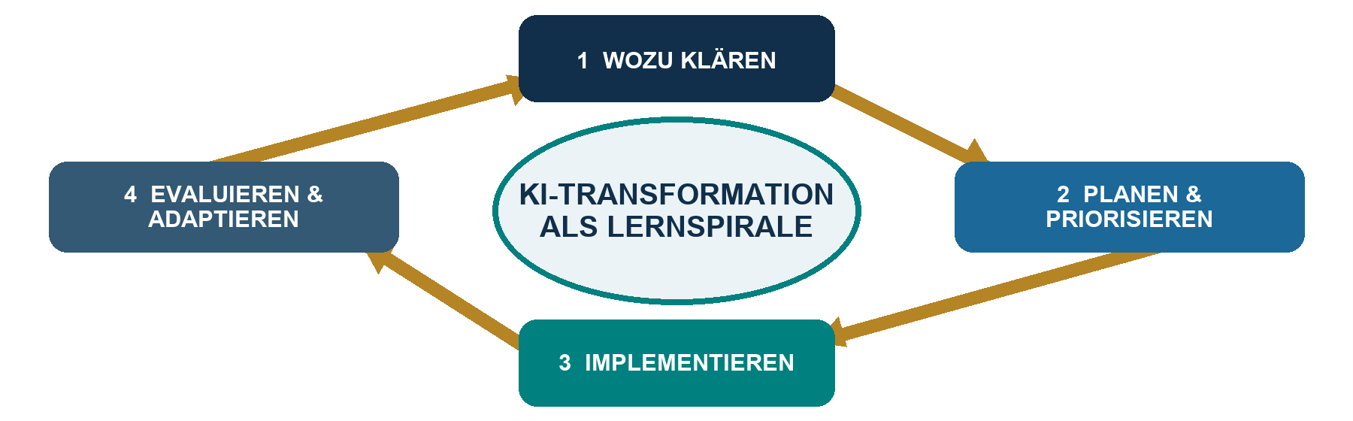
AI Transformation Is Leadership Work<br />

1. Start with the Why — Direction before Action

The starting point isn’t a tooling question, it’s a strategic decision. A SWOT analysis and a solid business case clarify what AI means for the development of the business unit: where do productivity, quality, or growth levers emerge—and where does disruption loom? From this a vision emerges that considers not just efficiency but also the impact on customer value, roles, competencies, and collaboration.

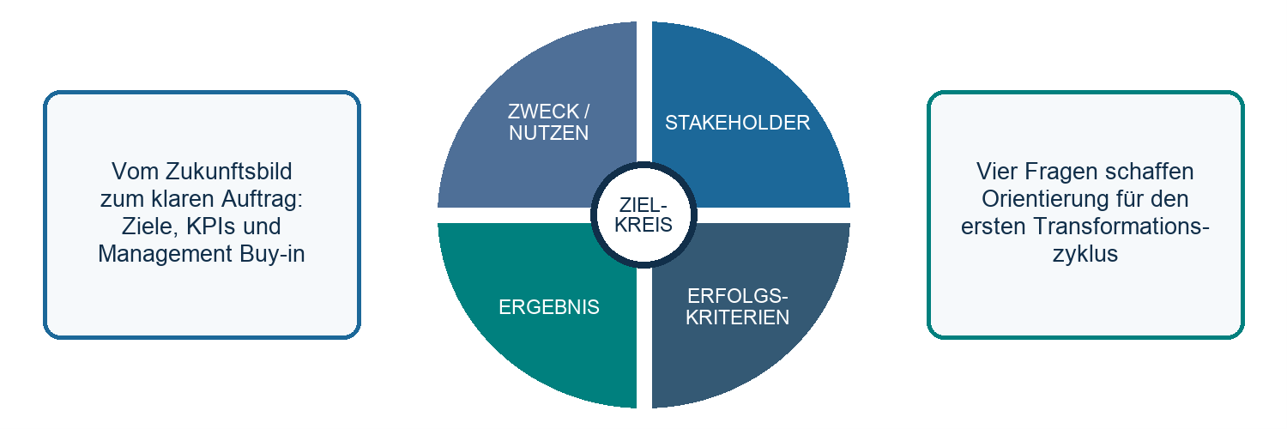
The target circle translates this future vision into a first, manageable transformation cycle: from vision to concrete goals to KPIs—such as AI literacy, number of productive use cases, productivity gains, or revenue from AI-enabled innovations. Winning management buy-in requires a clear persuasion structure: strategic pressure to act, expected benefit, required investment, key risks, and a concrete decision. That’s how enthusiasm becomes commitment.

MDI PERSPECTIVE · AI & LEADERSHIP
AI Transformation<br />

2. Plan and Prioritize — Focused Use-Case Collection

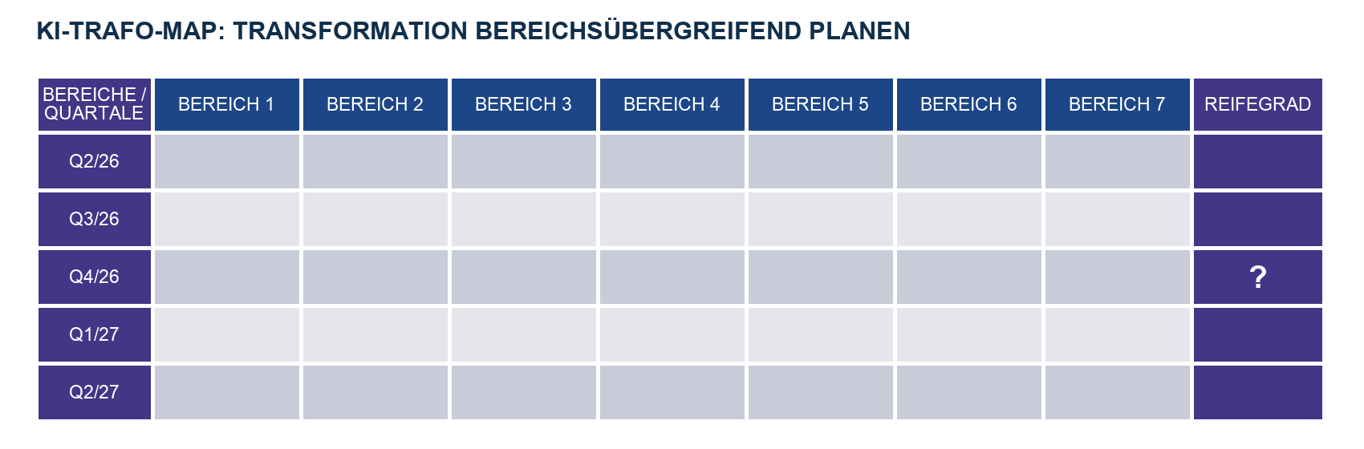
The AI transformation navigator makes visible which areas and capabilities of the company need to move first. What matters here is looking across departmental boundaries: many of the relevant opportunities lie in end-to-end digital pathways—for example, from customer inquiry through offer and delivery to service—rather than in isolated point solutions.
Picture3

Use cases are systematically identified and prioritized in an evaluation matrix based on benefit and feasibility. Quick wins generate momentum and credibility; bigger levers are prepared as experiments. At the same time, the business unit needs AI talents as multipliers, a viable technology environment, and separate backlogs for use cases and features.

The IAO model sharpens prioritized use cases with three questions:  
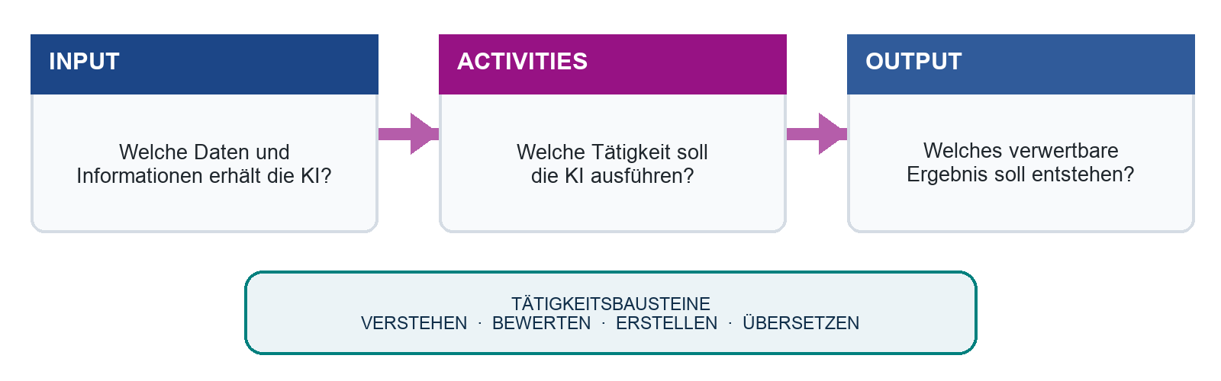
3 Fragen

3. Implement and Experiment — Start Small, Learn Fast

A radical question opens up new thinking: what would the process look like if AI took it over completely? Then comes the pragmatic decision: what can AI already responsibly take on today—and where do human judgment, relationships, and accountability remain indispensable, at least for now?

Teams develop minimum viable solutions in short increments. Roles and decision rights are clarified, stakeholder commitment is secured, and risks—from data protection and quality to dependencies—are weighed. FOBO, the Fear of Becoming Obsolete, is countered through transparent communication, participation, and skill-building.

4 Evaluate and Adapt — Turning Results into a Learning Spiral S

At the end of each cycle, what counts isn’t the number of activities but the impact. Reviews compare results against KPIs and the business case: what gets scaled, changed, or ended? Retrospectives generate insights on collaboration, process, and technology. Vision, priorities, backlogs, and technology decisions are adjusted—the next loop starts at a higher level of learning.

The personal leadership rule: anyone who truly wants to achieve AI transformation has to live it. Leaders should devote around 20% of their working time to AI learning: testing applications, critically reviewing results, sharing experiences, and visibly trying out new ways of working.

The real competency is the ability to learn.

The loop connects strategy, portfolio work, execution, and organizational learning into one governable system. This is how AI transformation becomes a permanent design task—decisive, responsible, and measurable.

    Gunther Fürstberger

    Gunther Fürstberger

    CEO | MDI Management Development International

    Gunther Fürstberger is a management trainer, author and CEO of Metaforum and MDI – a global consulting company providing solutions for leadership development. His main interest is to make the world a better place through excellent leadership. He has worked for clients including ABB, Abbvie, Boehringer Ingelheim, DHL, Hornbach, PWC and Swarovski. His core competence is leadership in digital transformation. He gained his own leadership experience as HR Manager of McDonald’s Central Europe/Central Asia.  At the age of 20 he already started working as a trainer.

    • LinkedIn

    What serves you next?

    Zeca Ruiz on Cross-Generational Leadership and Navigating Change

    by Jana Wölfl | 13. May 2026 | Leadership Impact, MDI Spotlight Series, Training Insights | 0 Comments

    Zeca Ruiz on Cross-Generational Leadership and Navigating Change This blog is an excerpt from our new podcast! You can find the entire podcast episode here. Zeca Ruiz on Cross-Generational Leadership and Navigating Change In the fourth episode of our podcast “Voices...
    Read More

    How Do You Lead People Who Don’t Think the Way You Do?

    by Zeca Ruiz | 4. February 2026 | Leadership Impact, Leadership Tips, Learning Transfer | 0 Comments

    How Do You Lead People Who Don't Think the Way You Do? Do you want to listen to this article? Click here to access our AI-generated audio version!   How do you lead people who do not think the way you do? Leadership is a challenge, especially when you are not...
    Read More

    How You Deal With Neurodiversity as a Leader

    by Iris Kandlbauer | 3. February 2026 | Leadership Impact, Leadership Tips, Short Knowledge Bits | 0 Comments

    How You Deal With Neurodiversity as a Leader You prefer listening to this article? You can find our AI-generated audio version below! How You Deal With Neurodiversity as a Leader What might be behind “strange” behavior in a team—and how leaders can deal with it...
    Read More

    Generation Z isn’t the Problem but Our System is

    by Zeca Ruiz | 3. December 2025 | Impuls series, International leadership development, Leadership in the digital transformation | 0 Comments

    Generation Z Isn’t the Problem, but Our System is. Read this article on crossgenerational management by Zeca Ruiz to find out more!

    Read More

    The Lasting Impact of Leadership Horizon – Meike’s Perspectives

    by Meike Hinnenberg | 2. July 2025 | Leadership Impact, MDI Inside, Short Knowledge Bits | 0 Comments

    The Lasting Impact of Leadership Horizon - Meike's Perspectives Do you prefer to listen to this article? Click below to access our AI-generated audio version!The Lasting Impact of Leadership Horizon - Meike's Perspectives MDI’s Meike Hinnenberg shares her reflections...
    Read More

    Success Through Change: How to Stay Oriented During Transitions

    by Anita Berger | 14. April 2025 | Impuls series, Leadership Impact, Leadership Tips | 0 Comments

    Success Through Change: How to Stay Oriented During Transitions Do you prefer to listen to this article? Click below to access our AI-generated audio version:Success Through Change: How to Stay Oriented During Transitions Change processes often involve challenges....
    Read More

    4 Tips on How to Shape Change Processes as a Leader

    by Anita Berger | 3. April 2025 | Impuls series, Leadership Impact, Leadership Tips | 0 Comments

    4 Tips on How to Shape Change Processes as a Leader Do you prefer to listen to this article? Click below to access our AI-generated audio version:4 Tips on How to Shape Change Processes as a Leader Imagine a dynamic network of paths that is constantly changing. While...
    Read More

    Successful Team Building for Boehringer Ingelheim RCV

    by Anita Berger | 29. March 2024 | Customer Story, International leadership development, MDI Inside | 0 Comments

    Successful Team Building for Boehringer Ingelheim RCV Do you prefer to listen to this article? Click below to access our AI-generated audio version:Successful Team Building for Boehringer Ingelheim RCV In the interview with our MDI trainer and partner, Anita Berger On...
    Read More

    Organize Your Team in a Hybrid Workplace

    by Peter Grabuschnig | 14. March 2024 | Impuls series, International leadership development, Leadership in the digital transformation | 0 Comments

    Organize Your Team in a Hybrid Workplace Prefer to listen to the article? Click below to access our AI speech-generated audio. However, if you want to read it as usual, keep scrolling.Organize Your Team in a Hybrid Workplace In his new Rise Course, our MDI trainer and...
    Read More

    Exploring the Influence of AI on Leadership Roles – an experiment by a CEO

    by Gunther Fürstberger | 14. November 2023 | International leadership development, Leadership and AI, Leadership in the digital transformation | 0 Comments

    Exploring the Influence of AI on Leadership Roles: Learn more about the ongoing ChatGPT experiment by MDI CEO Gunther Fürstberger Do you prefer to listen to this article? Click below to access our AI-generated version. Exploring the Influence of AI on Leadership...
    Read More
    How Artificial Intelligence Shapes Who We Become

    How Artificial Intelligence Shapes Who We Become

    by Meike Hinnenberg | May 19, 2026 | Impuls series, Leadership and AI, Leadership in the digital transformation | 0 comments

    How Artificial Intelligence Shapes Who We Become

    Meike’s Reflections on Artificial Intelligence

    Do you prefer to listen to this article? Click below to access our AI-generated audio version!

    How Artificial Intelligence Shapes Who We Become

    Meike’s Reflections on Artificial Intelligence

    This is the forth part of MDI’s leadership architect Meike Hinnenberg’s new blog reflection series on AI. You can find the previous parts on our blog site! Stay tuned for more 🙂

    How Artificial Intelligence Shapes Who We Become | Lines of Subjectivation

    Maybe the most certain of all philosophical problems is the problem of the present time and of what we are in this very moment. (Michel Foucault: The Subject and Power) The most profound technologies are those that disappear. They weave themselves into the fabric of everyday life until they are undistinguishable from it. (Marc Weiser: The computer for the 21st Century)

    The Hidden Labor Behind AI – A Berlin Exhibition

    May 2026 in Berlin; spring has arrived. Light enters the room, and a quiet warmth settles in the apartment. The window is slightly open. I sit at the same table. Again, coffee – dark, dense, almost earthy in its intensity – fills the room.

    While I follow its taste, while I continue working on this text, fragments of the exhibition The Language of Soil, which I visited earlier today, return. In this installation, the artist Anna Ehrenstein directs attention to platform workers in Nairobi, Congo, and Egypt – workers who sustain what is called Artificial Intelligence, and for whom Jeff Bezos once used the phrase “artificial artificial intelligence.”

    Employed by outsourcing partners of Big Tech companies, their work remains largely unseen. The exhibition brings together interviews, workshops, and collective narrative formats in a 220° video installation, rendering perceptible the “interplay of (post-)colonial continuities, global economies, and the labor that underpins algorithmic systems“.

    Voices from the Invisible Infrastructure

    I am watching. I am listening. A father, closely connected to his family, now estranged from his daughter; her presence recalls the CSAM he is required to review and label each day. A woman working as a content moderator, checking and filtering visual material from an armed conflict that has also affected her own family, from whom she has had no sign of life. Syrian refugees, shaped by war, displacement, and flight, now labeling sequences of images – war, torture, suicide, rape, child abuse – images that do not remain external, but return.

    Micro-Tasks, Micro-Pay

    Payment is calculated per micro-task. Ten, twenty, twenty-five cents. Sometimes less. It accumulates slowly, often to less than two dollars per hour. Contracts remain short. They are extended or they are not. Refusal is possible, but not without consequence. Continuity depends on compliance. The work moves; the workers remain replaceable.

    Where Do I Stand in This Formation?

    As I follow this movement of memories, questions begin to insist: Where am I located in the formation I am trying to describe? How am I affected by it? How do I relate to it?

    Has something like an exterior position been gained through thinking the dispositif of Artificial Intelligence, through its lines of visibility and enunciation? Is this now a stable place from which I can speak with a certain autonomy, perhaps even judge it? Or is this, too, only a movement within the same singular and historically situated configuration?

    The Illusion of the Exterior Subject

    It would be tempting to assume that what has come into view simply persists as knowledge at my disposal, while I myself remain unaffected. Such a perspective preserves the familiar figure of an exterior, self-assured subject and a stable reality upon which it acts by means of technology. And yet this assumption falters. If Artificial Intelligence is approached not merely as a set of tools but as a condition of world-disclosure, the situation becomes more complex.

    If the preceding analysis marks a shift in the conditions of seeing and saying, if what appeared self-evident is shown to depend on structured exclusions, then this shift cannot be limited to the object. It implicates the position of the one who sees and speaks, and with it the conditions under which others remain unseen and unheard. What comes into view does not simply add itself to knowledge; it alters the field in which both subject and world take shape.

    Foucault and the Making of Subjects

    The man described […], whom we are invited to free, is already in himself the effect of a subjection much more profound than himself.

    Michel Foucault’s understood his own work as an attempt “to create a history of the different modes by which, in our culture, human beings are made subjects.” (Michel Foucault: Subject and Power) We are not subjects prior to these processes. We are born into historically specific arrangements, dispositifs, within which we speak and are spoken about, see and are seen, act and are acted upon. Even if this idea is an affront to one’s ego, subjectivity does not precede these relations; it takes shape within them. Or, in a Deleuzian inflection: we are continually in processes of becoming-subject.

    Lines of Visibility: Who Gets to Appear

    If lines of visibility are conditions of perception – if they determine what can appear, in what form, and from which position – then they do not merely organize objects. They also distribute subjects: they situate them, relate them to one another, and define the positions from which something like a “self” can emerge within a given regime of visibility.

    Lines of Enunciation: Who Gets to Speak

    If lines of enunciation are conditions of sayability – if they determine who or what can speak, where agency is grammatically and conceptually placed, what can be said and in what form it becomes meaningful – then they also affect the subject. For those who speak are not exterior to these conditions.

    They take shape within them. What can be articulated, and from which position it can appear as intelligible, does not simply structure discourse; it structures the one who speaks. Subjectivity emerges here not as origin, but as effect: as something formed within a field of available statements, distinctions, and attributions of agency.

    To speak is therefore not only to express oneself, but to enter a space already organized in advance, to adopt positions, to repeat or displace existing formulations, to inhabit or refuse a grammar that distributes agency and responsibility. What appears as a self speaking is inseparable from the conditions of enunciation through which it becomes legible, both to others and to itself.

    Lines of Enunciation: Who Gets to Speak

    Lines of Subjectivation in the Dispositif of Artificial Intelligence

    In a Deleuzian sense, lines of subjectivation do not designate identities or inner states. They are trajectories through which subjects are produced: ways in which beings are called into relation with themselves, assigned positions of responsibility, and made capable or incapable of acting, speaking or refusing. They are neither purely imposed nor freely chosen, but emerge in the interplay of practices, norms, and material arrangements.

    Within the dispositif of Artificial Intelligence, such lines are not peripheral; they are constitutive of its operation. They do not merely run alongside technical systems but traverse them, linking infrastructures of computation with everyday forms of self-relation.

    We are simultaneously involved in their production and their effects: by generating data, labeling and rating outputs, prompting and correcting systems, but also by adopting Artificial Intelligence as interface, infrastructure and environment. At the same time, we are produced through these same relations and practices – as users, data subjects, workers, experts, and objects of prediction.

    The Figure of the User

    One dominant line of subjectivation produces the figure of the user. Here, the subject is addressed as an interacting point within a system, defined through traces of behavior and patterns of response. Agency is not denied but redirected: it appears as choice within pre-structured environments, as optimization within given parameters. The subject becomes legible insofar as it is continuously translated into data, and governable insofar as it can be rendered comparable, measurable and adjustable.

    The Subject as Data

    A further line produces the subject as data itself. In this configuration, life is not primarily addressed as expression but as extractable material. Actions, preferences, and linguistic traces are transformed into features, categories, and probabilities. Subjectivity no longer precedes this process; it is retroactively assembled through classification. What one is becomes inseparable from what one can be made to count as.

    The Invisible Worker

    Another line concerns labor. Here, subjects appear as infrastructural operators of AI systems: annotators, moderators, raters, validators. Their work is essential yet structurally displaced from visibility. It appears only in functional form, as “human-in-the-loop,” as quality control, as correction, while the conditions of its production remain largely unacknowledged. Subjectivation takes the form of simultaneous centrality and erasure.

    The Subject of Expertise

    A further line produces subjects of expertise. Engineers, researchers, and ethicists are positioned as rational stewards of complex systems. Responsibility is localized at the level of technical decision-making, while broader political and economic structures recede into the background. In this way, agency is reorganized as competence, and critique is often translated into questions of design, optimization, or governance.

    The Predictive Subject

    Finally, a predictive line of subjectivation renders individuals as anticipatable entities. In domains such as policing, border regimes, or welfare systems, subjects appear as risks, scores, or probabilities. They are addressed not primarily in relation to what they do, but in relation to what they are expected to do. In this configuration, subjectivation operates in advance of action: it produces subjects through the pre-structuring of possible futures.

    Alternative Practices: What the Dispositif Cannot Fully Capture

    However, not all lines of subjectivation find equal conditions of existence within the dispositif of Artificial Intelligence. Alongside those described above that are actively produced and stabilized, there are others that remain structurally disfavored, forms of becoming-subject that do not easily enter regimes of datafication, optimization, or classification. These are not external to the field, but they appear as weak intensities within it, continually at risk of being neutralized or translated into more legible forms.

    If lines of subjectivation traverse the dispositif in this way – if they produce us even as we reproduce them – then the question cannot be limited to which subjects are made possible, but must also address which remain difficult to sustain, and how this difference is lived. If they emerge in the interplay of practices, norms, and material arrangements, a further question arises: what other forms of becoming-subject might be opened through different practices? And which forms of self-relation do we, in turn, sustain or reinforce?

    Alternative Practices: What the Dispositif Cannot Fully Capture<br />

    Writing: From Struggle with Meaning to Selection Among Outputs

    What is the difference between writing a text in the slow proximity of one’s own words – hesitating, revising, following a thought that resists formulation – and producing a text through a system that calculates probable continuations? What shifts in the relation to language, if expression no longer emerges from a struggle with meaning, but from selection among pre-structured possibilities? What kind of subject takes shape when writing becomes prompting, when articulation becomes navigation within a space of outputs already statistically composed?

    What becomes of thought when it is no longer allowed to remain without immediate result? What changes if attention is not held in suspension – wandering, returning, lingering – but is continuously operationalized as input, as signal, as resource? What kind of self is formed when thinking is oriented towards an immediate answer, rather than toward the possibility of not yet knowing what it is that one thinks?

    What happens to relation when conversation is displaced by mediation? When the effort to encounter another – through hesitation, misunderstanding, goodwill, care, kindness – is replaced by a system that purportedly anticipates, summarizes, or simulates response? What is lost when affect appears as something that can be retrieved on demand, rather than something that emerges in the unpredictability of presence?

    What becomes perceptible when an artwork interrupts the smooth passage from image to category? When what is seen does not immediately resolve into recognition, but remains suspended – irreducible to function, resistant to immediate use? What kind of subject emerges in such a moment, in which perception is not yet captured by classification, and meaning does not stabilize into a single trajectory?

    And what shifts when the figure of the “annotator” ceases to appear as function and becomes encounter? When the one who labels, filters, and corrects is no longer integrated as an invisible component of the system, but appears as a situated other, whose experience cannot be exhausted by the categories that depend on it and who makes a claim on us? What becomes unstable when this presence can no longer be fully translated into data, role, or task?

    Points of Non-Coincidence: Where Other Trajectories Begin

    These questions do not lead outside the dispositif. They do not restore an untouched subject prior to its formation. But they begin to indicate points at which its operations do not fully close, and thus sites at which what Waldenfels calls Antwortlichkeit becomes possible. For in each case, something remains that does not coincide with its capture: a hesitation in language, a surplus in perception, a resistance in relation, a remainder in the other that exceeds the roles through which they are made intelligible.

    It is perhaps here – not beyond, but within these moments of non-coincidence – that other trajectories of subjectivation become thinkable. Not as stable alternatives, but as fragile deviations: ways of speaking, seeing, and relating that do not entirely align with the imperatives of calculation, prediction, and optimization, and that, precisely in this misalignment, keep the field from becoming fully closed and protect us from totalization.

    Which Forms of Life Do We Sustain?

    What these movements begin to make visible is a relation that resists simplification. We are not external to the dispositif we describe. We do not stand before it as sovereign subjects, capable of steering it from a position of independence. We are formed within it – through its lines of visibility, its regimes of enunciation, its processes of subjectivation. What we can see, what we can say, what we can become is never simply our own.

    And yet, this does not exhaust the relation. For if we are shaped within these configurations, we are not only their effect. We participate in their continuation. We stabilize them through our practices, our repetitions, our forms of use. But precisely in this, a different possibility emerges: that what is reproduced can also be shifted. That even within the field that forms us, there are movements – hesitations, deviations, reconfigurations – through which other trajectories of subjectivation can be fostered.

    Neither Determined Nor Free: A More Demanding Question

    The question, then, is not whether we are determined or free. It is more demanding: which forms of life do we sustain through the ways we see, speak, and relate? Which subjects do we become when we align ourselves seamlessly with these systems – when we allow their operations to pass through us without resistance, when we accept their abstractions as sufficient descriptions of ourselves and others? And what becomes unavailable in this alignment: which forms of attention, of relation, of language, of responsibility begin to recede when they are no longer practiced?

    Conversely, what might it mean to remain within these formations without fully coinciding with them? To inhabit their structures, but not to let them settle entirely into what we take ourselves to be? If there is no outside from which to act, then intervention must take place within the very relations that bind us – within the practices through which subjectivity is continuously produced and reproduced.

    Toward the Distribution of Forces

    It is here that another dimension comes into view. For the dispositif does not only organize what can be seen, said, and become; it also distributes forces. It channels, intensifies, and stabilizes them. It produces asymmetries, accumulations, and thresholds. To understand how these movements hold, how they persist, and how they might be altered, it becomes necessary to follow not only lines of visibility, enunciation, and subjectivation, but also the lines along which forces are arranged, transmitted, and transformed.

    Meike Hinnenberg

    Meike Hinnenberg

    Learning & Development Architect

    Meike Hinnenberg is a trainer and Learning and Development Architect at MDI Management Development GmbH and specializes in communication, conflict management, diversity & inclusion, and lateral leadership.

    • LinkedIn

    What serves you next?

    AI Transformation Is Leadership Work

    by Gunther Fürstberger | 28. August 2026 | Leadership and AI, Leadership Tips, MDI Whitepaper | 0 Comments

    AI Transformation Is Leadership Work The four-step loop that turns individual experiments into lasting change Many companies are already using AI—and still not transforming. Tools, pilot projects, and guidelines only add up to transformation once they deliberately...
    Read More

    What If AI Doesn’t Replace Us — But Drowns Us Out?

    by Martin Maglia | 24. July 2026 | Digital Transformation, Leadership and AI, Short Knowledge Bits | 0 Comments

    What If AI Doesn't Replace Us — But Drowns Us Out? Over the weekend, I watched a thought-provoking video from Rick Beato. (You can find the link at the end of this article.) For those who don't know him: Rick Beato is a musician, producer, educator, guitarist, and one...
    Read More

    Use It or Lose It: How AI and Digital Tools May Be Changing Our Brains

    by Florian Biedermann | 26. June 2026 | Leadership and AI, Leadership Tips, Learning Transfer | 0 Comments

    Use It or Lose It: How AI and Digital Tools May Be Changing Our Brains You travel to Madrid and want to chat with the locals, but you realize that after five years without practice, your rudimentary Spanish skills are now practically nonexistent and you even struggle...
    Read More

    How Artificial Intelligence Shapes Who We Become

    by Meike Hinnenberg | 19. May 2026 | Impuls series, Leadership and AI, Leadership in the digital transformation | 0 Comments

    How Artificial Intelligence Shapes Who We Become Meike’s Reflections on Artificial Intelligence Do you prefer to listen to this article? Click below to access our AI-generated audio version!How Artificial Intelligence Shapes Who We Become Meike’s Reflections on...
    Read More

    Zeca Ruiz on Cross-Generational Leadership and Navigating Change

    by Jana Wölfl | 13. May 2026 | Leadership Impact, MDI Spotlight Series, Training Insights | 0 Comments

    Zeca Ruiz on Cross-Generational Leadership and Navigating Change This blog is an excerpt from our new podcast! You can find the entire podcast episode here. Zeca Ruiz on Cross-Generational Leadership and Navigating Change In the fourth episode of our podcast “Voices...
    Read More

    What AI Shows You — and What It Doesn’t

    by Meike Hinnenberg | 1. April 2026 | Digital Transformation, Impuls series, Leadership and AI | 0 Comments

    What AI Shows You — and What It Doesn't Meike’s Reflections on Artificial Intelligence Do you prefer to listen to this article? Click below to access our AI-generated audio version! What AI Shows You — and What It Doesn't Meike’s Reflections on Artificial Intelligence...
    Read More

    Leading in the Age of AI: How AI Discourse Shapes Responsibility and Power

    by Meike Hinnenberg | 18. March 2026 | Impuls series, Leadership and AI, Leadership Tips | 0 Comments

    Leading in the Age of AI: How AI Discourse Shapes Responsibility and Power Meike’s Reflections on Artificial Intelligence Do you prefer to listen to this article? Click below to access our AI-generated audio version!Leading in the Age of AI: How AI Discourse Shapes...
    Read More

    AI Ethics for Leaders: Why Context and Critical Thinking Matter More Than Ever

    by Meike Hinnenberg | 11. March 2026 | Impuls series, Leadership and AI, Learning Transfer | 0 Comments

    AI Ethics for Leaders: Why Context and Critical Thinking Matter More Than Ever. Meike’s Reflections on Artificial Intelligence Do you prefer to listen to this article? Click below to access our AI-generated audio version!AI Ethics for Leaders: Why Context and Critical...
    Read More

    A Success Story – When AI Sharpens Human Judgement

    by Claude MacDonald, Rafael Ungvari | 6. March 2026 | Customer Story, Digital Transformation, Leadership and AI | 0 Comments

    A Success Story – When AI Sharpens Human Judgement Do you prefer to listen to this article? Click here to access our AI-generated audio version! When AI Amplifies Human Judgment: A Customer Success Story About This Project At MDI, we believe that great leadership and...
    Read More

    How Do You Lead People Who Don’t Think the Way You Do?

    by Zeca Ruiz | 4. February 2026 | Leadership Impact, Leadership Tips, Learning Transfer | 0 Comments

    How Do You Lead People Who Don't Think the Way You Do? Do you want to listen to this article? Click here to access our AI-generated audio version!   How do you lead people who do not think the way you do? Leadership is a challenge, especially when you are not...
    Read More
    Zeca Ruiz on Cross-Generational Leadership and Navigating Change

    Zeca Ruiz on Cross-Generational Leadership and Navigating Change

    by Jana Wölfl | May 13, 2026 | Leadership Impact, MDI Spotlight Series, Training Insights | 0 comments

    Zeca Ruiz on Cross-Generational Leadership and Navigating Change

    This blog is an excerpt from our new podcast! You can find the entire podcast episode here.

    Zeca Ruiz on Cross-Generational Leadership and Navigating Change

    In the fourth episode of our podcast “Voices of Leadership | An MDI Spotlight Series,” we virtually sat down with trainer and consultant Zeca Ruiz to discuss cross-generational management, change, and what leadership looks like in a world that keeps evolving faster than ever.

    Zeca works across Latin America and Europe and focuses on leadership development, emotional intelligence, cultural transformation, and team dynamics in complex environments. During our conversation, he shared not only practical insights about leading multi-generational teams, but also deeply personal stories from his own journey into leadership.

    One thing became clear very quickly: for Zeca, leadership is closely connected to change.

    “Change is the only permanent thing in life.”

    At the beginning of our conversation, we asked Zeca what his “superpower” as a trainer would be. His answer immediately set the tone for the rest of the discussion.

    “I like to think of myself as a facilitator of transitions.”

    For him, leadership is not about controlling people. It is about helping people navigate uncertainty, transformation, and growth. Zeca explained that this perspective comes from personal experience. He had originally chosen a different career path, until his father passed away unexpectedly. At only 24 years old, Zeca suddenly had to take over the family business with 150 employees.

    At the same time, the world was going through the financial crisis of 2008. Business was struggling, uncertainty was everywhere, and Zeca found himself in a leadership role he had never prepared for. Instead of focusing purely on processes and structures, he started focusing on people.

    “I realized that nobody was talking about leadership itself.”

    That realization became a turning point. He began studying emotional intelligence, communication, coaching, and leadership development. Over time, he discovered that sustainable leadership is not created through authority alone, but through understanding people’s needs, motivations, and emotions.

    What cross-generational management really means

    One of the main topics of our conversation was cross-generational leadership. According to Zeca, many organizations today have up to four generations working together in the same team. While this diversity can be incredibly powerful, it can also create misunderstandings, conflicts, and frustration if leaders fail to understand the different perspectives involved.

    “Our generation is a sociological concept that refers to a group of people who grew up during the same historical period and were shaped by similar experiences.”

    Because each generation grew up in a different environment, their expectations around work, communication, feedback, motivation, and leadership can differ significantly. For Zeca, this is where leadership becomes especially important. Instead of judging differences, leaders need to understand them.

    “If we don’t understand the differences, we will have a lot of conflicts.”

    What cross-generational management really means

    Understanding Generation Z

    During the conversation, we also spoke in depth about Generation Z and why many organizations currently struggle to engage younger employees. According to Zeca, Gen Z grew up in a completely different world than previous generations. They were shaped by rapid technological change, constant access to information, economic instability, and a world where systems and structures change continuously.

    “They need purpose. They will not just do whatever you ask because you are their boss.”

    For many traditional leaders, this shift can feel uncomfortable. Hierarchical structures and purely authority-based leadership often do not work well anymore. At the same time, Zeca emphasized that younger generations also bring extraordinary strengths into organizations. He described Gen Z as highly flexible, fast-moving, and capable of learning quickly.

    However, he also explained that many younger employees are more emotionally sensitive when it comes to feedback and criticism. For leaders, this means communication needs to become more conscious, empathetic, and transparent.

    Why older generations still matter deeply

    While much of the discussion focused on Gen Z, Zeca repeatedly emphasized that leadership is not about choosing one generation over another. Older generations still play a critical role in organizations because they provide experience, context, stability, and perspective.

    “Millennials, Gen X, and Baby Boomers built the systems that Generation Z is now entering.”

    Previous generations were often shaped by ideas such as long-term effort, stability, loyalty, and career development over decades. But according to Zeca, today’s reality moves much faster. For him, the real opportunity lies in combining the adaptability and creativity of younger generations with the experience and contextual understanding of older generations.

    Leadership today requires flexibility

    Throughout the conversation, one message appeared again and again: leadership today requires flexibility. Leaders can no longer rely on rigid structures, fixed expectations, or one-size-fits-all approaches.

    “We have to be more flexible, and we have to adapt faster than ever.”

    For Zeca, successful leaders are the ones who are able to understand different motivations, different communication styles, and different emotional needs within their teams. He also stressed that many people naturally resist change. That is why modern leadership requires emotional intelligence, empathy, communication skills, and the ability to create trust during uncertain times.

    Leadership today requires flexibility

    Leadership starts with understanding people

    One of the most memorable moments in the conversation came when Zeca reflected on what leadership really means to him today. After years of working with organizations, leaders, and teams across different cultures, he believes that leadership is ultimately about understanding people.

    “If we don’t use the right communication, or if we don’t understand their needs and their processes, it’s going to be difficult to have them engaged.”

    This mindset also shapes his work as a trainer and consultant today. Whether he is working on leadership development, culture change, or emotional intelligence, the core question remains the same:

    How do we help people grow through change instead of simply surviving it?

    Conclusion

    Our conversation with Zeca Ruiz showed that cross-generational leadership is far more than managing age differences. It is about understanding how people were shaped by their experiences, adapting leadership styles to different needs, and creating environments where different generations can learn from one another instead of competing against each other.

    At the same time, the conversation reminded us that leadership itself is changing rapidly. Traditional structures, rigid hierarchies, and purely authority-based leadership models are becoming less effective in a world defined by uncertainty and constant transformation.

    For Zeca, the future of leadership belongs to leaders who are flexible, emotionally intelligent, and capable of guiding people through change with empathy and clarity.

    “Change is the only permanent thing in life.”

    And perhaps that is exactly why human-centered leadership matters more than ever.

    Jana Wölfl

    Jana Wölfl

    Marketing Assistant

    Jana Wölfl is a marketing assistant at MDI and works on our blog. She has already been responsible for several areas of marketing, such as designing our new website and administering our personalist.at portal.

    This could also interest you:

    AI Transformation Is Leadership Work

    by Gunther Fürstberger | 28. August 2026 | Leadership and AI, Leadership Tips, MDI Whitepaper | 0 Comments

    AI Transformation Is Leadership Work The four-step loop that turns individual experiments into lasting change Many companies are already using AI—and still not transforming. Tools, pilot projects, and guidelines only add up to transformation once they deliberately...
    Read More

    What If AI Doesn’t Replace Us — But Drowns Us Out?

    by Martin Maglia | 24. July 2026 | Digital Transformation, Leadership and AI, Short Knowledge Bits | 0 Comments

    What If AI Doesn't Replace Us — But Drowns Us Out? Over the weekend, I watched a thought-provoking video from Rick Beato. (You can find the link at the end of this article.) For those who don't know him: Rick Beato is a musician, producer, educator, guitarist, and one...
    Read More

    Use It or Lose It: How AI and Digital Tools May Be Changing Our Brains

    by Florian Biedermann | 26. June 2026 | Leadership and AI, Leadership Tips, Learning Transfer | 0 Comments

    Use It or Lose It: How AI and Digital Tools May Be Changing Our Brains You travel to Madrid and want to chat with the locals, but you realize that after five years without practice, your rudimentary Spanish skills are now practically nonexistent and you even struggle...
    Read More

    How Artificial Intelligence Shapes Who We Become

    by Meike Hinnenberg | 19. May 2026 | Impuls series, Leadership and AI, Leadership in the digital transformation | 0 Comments

    How Artificial Intelligence Shapes Who We Become Meike’s Reflections on Artificial Intelligence Do you prefer to listen to this article? Click below to access our AI-generated audio version!How Artificial Intelligence Shapes Who We Become Meike’s Reflections on...
    Read More

    Zeca Ruiz on Cross-Generational Leadership and Navigating Change

    by Jana Wölfl | 13. May 2026 | Leadership Impact, MDI Spotlight Series, Training Insights | 0 Comments

    Zeca Ruiz on Cross-Generational Leadership and Navigating Change This blog is an excerpt from our new podcast! You can find the entire podcast episode here. Zeca Ruiz on Cross-Generational Leadership and Navigating Change In the fourth episode of our podcast “Voices...
    Read More

    What AI Shows You — and What It Doesn’t

    by Meike Hinnenberg | 1. April 2026 | Digital Transformation, Impuls series, Leadership and AI | 0 Comments

    What AI Shows You — and What It Doesn't Meike’s Reflections on Artificial Intelligence Do you prefer to listen to this article? Click below to access our AI-generated audio version! What AI Shows You — and What It Doesn't Meike’s Reflections on Artificial Intelligence...
    Read More

    Leading in the Age of AI: How AI Discourse Shapes Responsibility and Power

    by Meike Hinnenberg | 18. March 2026 | Impuls series, Leadership and AI, Leadership Tips | 0 Comments

    Leading in the Age of AI: How AI Discourse Shapes Responsibility and Power Meike’s Reflections on Artificial Intelligence Do you prefer to listen to this article? Click below to access our AI-generated audio version!Leading in the Age of AI: How AI Discourse Shapes...
    Read More

    AI Ethics for Leaders: Why Context and Critical Thinking Matter More Than Ever

    by Meike Hinnenberg | 11. March 2026 | Impuls series, Leadership and AI, Learning Transfer | 0 Comments

    AI Ethics for Leaders: Why Context and Critical Thinking Matter More Than Ever. Meike’s Reflections on Artificial Intelligence Do you prefer to listen to this article? Click below to access our AI-generated audio version!AI Ethics for Leaders: Why Context and Critical...
    Read More

    A Success Story – When AI Sharpens Human Judgement

    by Claude MacDonald, Rafael Ungvari | 6. March 2026 | Customer Story, Digital Transformation, Leadership and AI | 0 Comments

    A Success Story – When AI Sharpens Human Judgement Do you prefer to listen to this article? Click here to access our AI-generated audio version! When AI Amplifies Human Judgment: A Customer Success Story About This Project At MDI, we believe that great leadership and...
    Read More

    How Do You Lead People Who Don’t Think the Way You Do?

    by Zeca Ruiz | 4. February 2026 | Leadership Impact, Leadership Tips, Learning Transfer | 0 Comments

    How Do You Lead People Who Don't Think the Way You Do? Do you want to listen to this article? Click here to access our AI-generated audio version!   How do you lead people who do not think the way you do? Leadership is a challenge, especially when you are not...
    Read More
    What AI Shows You — and What It Doesn’t

    What AI Shows You — and What It Doesn’t

    by Meike Hinnenberg | Apr 1, 2026 | Digital Transformation, Impuls series, Leadership and AI | 0 comments

    What AI Shows You — and What It Doesn’t

    Meike’s Reflections on Artificial Intelligence

    Do you prefer to listen to this article? Click below to access our AI-generated audio version!

    What AI Shows You — and What It Doesn’t

    Meike’s Reflections on Artificial Intelligence

    This is the third part of MDI’s Leadership Architect Meike Hinnenberg’s reflection series. You can find parts I and II on our blog page! Stay tuned for more parts to come 🙂

    What Leaders See — and What Stays Hidden

    As lines of enunciation organize the field of sayability, lines of visibility organize the field of perception. They are conditions of seeing that circulate within a dispositif, determining what can appear as an object, what form something must assume to become perceptible, from which vantage point it is illuminated, and what must recede into shadow for this illumination to hold. A line of visibility is thus a historically specific regime of seeing: a distribution of light and darkness that brings certain realities into presence while casting others into the shadow on which this presence depends.

    Michel Foucault traced a transformation of regimes of seeing when he showed how sovereign power, once staged in the blinding spectacle of public punishment, gave way to disciplinary power embedded in architectures of continuous observation. What changed was not only the exercise of power, but the arrangement of the visible itself: spectacle yielded to surveillance, and visibility ceased to be an event and became an environment.

    When we turn to the dispositif of Artificial Intelligence, how is the terrain of perception arranged, and which lines of visibility organize this regime of seeing?

    How AI Presents Itself: Four Lines of Visibility

    Line 1: The Interface — Intelligence as Performance

    One line runs along the interface. Here, Artificial Intelligence appears as responsiveness without delay: dashboards refresh in real time, prompts yield fluent replies, and systems demonstrate competence in carefully staged demonstrations. Intelligence presents itself as performance – immediate, seamless, self-contained. What this line establishes is the perceptible surface of operation: output as event, response as evidence. The system comes into view precisely where it answers.

    Line 2: Abstraction — Structure Without Weight

    A second line follows the path of abstraction. Models are described by architectures, parameters, and accuracy scores; performance is reported numerically, and improvement is recorded as optimization. Intelligence becomes legible as a formal property, detached from situation and substrate. What comes into view is structure without weight, reasoning without environment, cognition without bodies.

    Line 3: Scale — Expansion Beyond Intervention

    A third line unfolds at the scale level. Artificial Intelligence appears as planetary infrastructure: billions of parameters, global deployment, continuous operation across time zones and continents. Its magnitude exceeds ordinary perception. Scale produces its own regime of visibility: what emerges is inevitability, momentum – expansion beyond intervention.

    Line 4: Neutrality — When Calculation Replaces Judgment

    A fourth line organizes neutrality. Artificial Intelligence appears as objective and data-driven. Its operations present themselves as technical processes rather than situated decisions. Judgment appears as calculation; outcomes appear as results rather than interventions. What appears is a world cleansed of politics, in which a large part of responsibility is shifted to the system, and context is leveled out. Neutrality here is not simply descriptive; it is productive, structuring perception so that harm, choice, and embedded values recede into shadow, while the surface of computation shines as transparent and self-evident.

    The Illusion of Autonomy — and What It Conceals

    The Illusion of Autonomy — and What It Conceals

    Together, these lines compose a regime of seeing in which Artificial Intelligence presents itself as autonomous, immaterial, and inevitable. What appears is intelligence without remainder. Yet regimes of visibility do not simply reveal; they arrange revelation. They produce perceptibility by structuring what cannot be seen at the same time.

    By citing Amazon’s crowd-working platform “Mechanical Turk” and recalling its historical namesake – the ostensibly chess-playing automaton constructed by Wolfgang von Kempelen in 1769 – Kate Crawford traces such a line of visibility and its fracture at once. The figure of the seemingly chess-playing automaton, dressed in Ottoman robes and seated before a wooden cabinet topped with a chessboard, appeared to deliberate and decide on its own. When its doors were opened, intricate gears and clockwork were revealed, offering the reassuring image of mechanical reason. Yet this visibility was carefully staged: concealed within the cabinet, a human operator followed the game in darkness, shifting position as panels were displayed to sustain the illusion. What appeared to be autonomous intelligence was, in fact, the surface effect of a hidden human presence.

    In recalling this machine, Crawford renders perceptible a continuity that the contemporary name Artificial Intelligence works to obscure: the appearance of autonomy sustained by distributed, hidden work. That Amazon names its global digital labor platform after this deceptive automaton – an illusion built not only on concealment but on the orientalist staging of a racialized figure – is at once cynical and involuntarily revealing. The name preserves, like a fossil in language, a longer history in which intelligence appears at the surface while the labor that sustains it is displaced elsewhere, often across colonial and postcolonial geographies, into bodies that remain structurally unrecognized.

    By shifting the vantage point, she intervenes in the regime of seeing itself. What appeared seamless reveals fracture lines; what appeared autonomous reveals dependence. The interface no longer appears as an origin but as a surface.

    Behind the Surface: Labor, Matter, and Geography

    Behind the abstraction of the model, material infrastructures come into view. Data centers operate at an industrial scale, consuming vast quantities of electricity and water to sustain continuous computation. Their servers depend on the conflict minerals tin, tantalum, tungsten, gold, and rare earth elements extracted from landscapes marked by toxic residues and ecological exhaustion. The expansion of machine learning contributes to growing streams of electronic waste, measured in millions of tons. What appears as immaterial intelligence is inseparable from extraction, depletion, and heat.

    Behind the neutrality of data, processes of selection and classification emerge. Machine learning systems depend on vast datasets assembled through human activity: images segmented, sentences evaluated, gestures annotated. Millions of crowd-workers across the world perform these tasks, often for minimal compensation, clicking through thousands of items in repetitive sequences that train systems to see. Content moderators encounter violence, pornography, and degradation so that others encounter sanitized outputs. Their perception becomes part of the system’s sensory apparatus, even as their presence disappears from its representation.

    Behind the scale of the system, a geography becomes perceptible: supply chains stretching across continents, data centers situated near sources of energy and water, labor distributed across time zones, extraction zones, and processing facilities linked in continuous operation. What appears as a unified technical object reveals itself as a convergence of environments, infrastructures, and bodies.

    Seeing Otherwise: From Output to System

    Artificial Intelligence does not simply appear differently once these conditions are seen. The regime of visibility itself is exposed as constructed. The lines that once produced the appearance of autonomy are revealed as arrangements that separate surface from substrate, output from labor, intelligence from matter.

    To follow these fracture lines is not merely to see more, but to see otherwise. Intelligence no longer appears as an isolated technical achievement, but as the visible surface of relations extending downward into the earth, outward across the planet, and inward into the perceptual and cognitive labor of others. What had appeared as a self-contained system becomes perceptible as a dispositif: an arrangement that produces both the object and the subjects who sustain it, while organizing the conditions under which this production can be seen or remain unseen.


    Meike Hinnenberg

    Meike Hinnenberg

    Senior Leadership Architect

    Meike Hinnenberg is a trainer and Senior Leadership Architect at MDI Management Development GmbH and specializes in communication, conflict management, diversity & inclusion, and lateral leadership.

    • LinkedIn

    Join us on May 5th for our yearly Leadership Horizon Conference!

    Leadership Horizon 2026 Banner

    What serves you next?

    AI Transformation Is Leadership Work

    by Gunther Fürstberger | 28. August 2026 | Leadership and AI, Leadership Tips, MDI Whitepaper | 0 Comments

    AI Transformation Is Leadership Work The four-step loop that turns individual experiments into lasting change Many companies are already using AI—and still not transforming. Tools, pilot projects, and guidelines only add up to transformation once they deliberately...
    Read More

    What If AI Doesn’t Replace Us — But Drowns Us Out?

    by Martin Maglia | 24. July 2026 | Digital Transformation, Leadership and AI, Short Knowledge Bits | 0 Comments

    What If AI Doesn't Replace Us — But Drowns Us Out? Over the weekend, I watched a thought-provoking video from Rick Beato. (You can find the link at the end of this article.) For those who don't know him: Rick Beato is a musician, producer, educator, guitarist, and one...
    Read More

    Use It or Lose It: How AI and Digital Tools May Be Changing Our Brains

    by Florian Biedermann | 26. June 2026 | Leadership and AI, Leadership Tips, Learning Transfer | 0 Comments

    Use It or Lose It: How AI and Digital Tools May Be Changing Our Brains You travel to Madrid and want to chat with the locals, but you realize that after five years without practice, your rudimentary Spanish skills are now practically nonexistent and you even struggle...
    Read More

    How Artificial Intelligence Shapes Who We Become

    by Meike Hinnenberg | 19. May 2026 | Impuls series, Leadership and AI, Leadership in the digital transformation | 0 Comments

    How Artificial Intelligence Shapes Who We Become Meike’s Reflections on Artificial Intelligence Do you prefer to listen to this article? Click below to access our AI-generated audio version!How Artificial Intelligence Shapes Who We Become Meike’s Reflections on...
    Read More

    Zeca Ruiz on Cross-Generational Leadership and Navigating Change

    by Jana Wölfl | 13. May 2026 | Leadership Impact, MDI Spotlight Series, Training Insights | 0 Comments

    Zeca Ruiz on Cross-Generational Leadership and Navigating Change This blog is an excerpt from our new podcast! You can find the entire podcast episode here. Zeca Ruiz on Cross-Generational Leadership and Navigating Change In the fourth episode of our podcast “Voices...
    Read More

    What AI Shows You — and What It Doesn’t

    by Meike Hinnenberg | 1. April 2026 | Digital Transformation, Impuls series, Leadership and AI | 0 Comments

    What AI Shows You — and What It Doesn't Meike’s Reflections on Artificial Intelligence Do you prefer to listen to this article? Click below to access our AI-generated audio version! What AI Shows You — and What It Doesn't Meike’s Reflections on Artificial Intelligence...
    Read More

    Leading in the Age of AI: How AI Discourse Shapes Responsibility and Power

    by Meike Hinnenberg | 18. March 2026 | Impuls series, Leadership and AI, Leadership Tips | 0 Comments

    Leading in the Age of AI: How AI Discourse Shapes Responsibility and Power Meike’s Reflections on Artificial Intelligence Do you prefer to listen to this article? Click below to access our AI-generated audio version!Leading in the Age of AI: How AI Discourse Shapes...
    Read More

    AI Ethics for Leaders: Why Context and Critical Thinking Matter More Than Ever

    by Meike Hinnenberg | 11. March 2026 | Impuls series, Leadership and AI, Learning Transfer | 0 Comments

    AI Ethics for Leaders: Why Context and Critical Thinking Matter More Than Ever. Meike’s Reflections on Artificial Intelligence Do you prefer to listen to this article? Click below to access our AI-generated audio version!AI Ethics for Leaders: Why Context and Critical...
    Read More

    A Success Story – When AI Sharpens Human Judgement

    by Claude MacDonald, Rafael Ungvari | 6. March 2026 | Customer Story, Digital Transformation, Leadership and AI | 0 Comments

    A Success Story – When AI Sharpens Human Judgement Do you prefer to listen to this article? Click here to access our AI-generated audio version! When AI Amplifies Human Judgment: A Customer Success Story About This Project At MDI, we believe that great leadership and...
    Read More

    How Do You Lead People Who Don’t Think the Way You Do?

    by Zeca Ruiz | 4. February 2026 | Leadership Impact, Leadership Tips, Learning Transfer | 0 Comments

    How Do You Lead People Who Don't Think the Way You Do? Do you want to listen to this article? Click here to access our AI-generated audio version!   How do you lead people who do not think the way you do? Leadership is a challenge, especially when you are not...
    Read More
    Leading in the Age of AI: How AI Discourse Shapes Responsibility and Power

    Leading in the Age of AI: How AI Discourse Shapes Responsibility and Power

    by Meike Hinnenberg | Mar 18, 2026 | Impuls series, Leadership and AI, Leadership Tips | 0 comments

    Leading in the Age of AI: How AI Discourse Shapes Responsibility and Power

    Meike’s Reflections on Artificial Intelligence

    Do you prefer to listen to this article? Click below to access our AI-generated audio version!

    Leading in the Age of AI: How AI Discourse Shapes Responsibility and Power

    Meike’s Reflections on Artificial Intelligence

    This is the second of seven parts of MDI’s leadership architect Meike Hinnenberg’s new blog reflection series on AI. You can find the first part here! Stay tuned for more 🙂

    Chapter II – Lines of Enunciation

    By distinguishing Artificial Intelligence as an industrial apparatus from machine learning as a set of practices, Crawford performs a gesture of ethical resistance. She interrupts the smooth circulation of the term, exposing Artificial Intelligence not as a settled object but as a line of enunciation – and in doing so opens a different path through the field.

    In Deleuze’s sense, lines of enunciation are neither utterances nor texts, neither speakers nor doctrines. They are conditions of sayability that circulate within a dispositif, delineating what can be named, thought, and acted upon.

    Most often, lines of enunciation remain invisible precisely because they work so well. They do not appear as commands, norms, or ideologies; they slip into language as description, into grammar as agency, into names that seem to pre-exist the things they gather. They do not ask to be believed: one does not need to agree with a line of enunciation to use it.

    How AI Discourse Shapes Reality and Responsibility

    These lines are not primarily repressive; they are productive. They bring objects into being (AI), generate problems (alignment, bias), propose solutions (ethical AI), and sketch futures (AI will transform everything). A critique that treats them merely as false representations, therefore, misses the point. Their force lies not (only) in what they conceal, but also in the realities they help bring into existence.

    Understanding this productivity – and, with it, understanding technology not simply as an instrument to be used wisely but as a mode of world-disclosure – is essential, especially with regard to the question of responsibility. We are not outside the dispositif. We are not independent of the social, technological, and linguistic structures through which the world becomes accessible to us. Our relation to ourselves and our access to reality are shaped within them.

    How AI Discourse Shapes Reality and Responsibility

    Response-ability

    What is therefore required is not the illusion of standing beyond these structures, but the effort to understand how the dispositif operates: what realities it brings into being, how we are positioned within it, and how we might relate to it, act within it, or even shift its lines. For now, being independent of these conditions does not mean we would not be responsible. Responsibility may instead take the form that Bernhard Waldenfels calls Antwortlichkeit (response-ability): a responsiveness to what addresses us before we fully understand it, a response that can never entirely catch up with what precedes it.

    Let us follow this path a little further to see how it shapes the field. If we turn, for example, to the website of the OECD, we read:

    AI holds the potential to address complex challenges from enhancing education and improving health care, to driving scientific innovation and climate action. However, AI systems also pose risks to privacy, safety, security, and human autonomy. Effective governance is essential to ensure AI development and deployment are safe, secure and trustworthy, with policies and regulation that foster innovation and competition.

    How Discourse Limits What Can Be Questioned

    The OECD text speaks in a language in which Artificial Intelligence already acts: it drives, addresses, and enhances. Politics enters only later, as a moderating hand. In this grammar, Artificial Intelligence appears as an agent capable of benefit or harm, yet never itself fundamentally in question. Within this frame, one may debate safety, trust, and regulation, but more structural questions about extraction, power concentration, or the desirability of AI as such struggle to surface as relevant statements. The force of such enunciation lies not in persuading belief, but in pre-structuring the field of speech itself.

    By distinguishing Artificial Intelligence as an industrial apparatus from machine learning as a set of practices, Crawford renders such a line of enunciation visible and thereby intervenes in the field of sayability. By questioning whether Artificial Intelligence is even artificial or intelligent, she shows that what appeared as an autonomous historical actor is in fact a constructed convergence: an industrial apparatus, a planetary infrastructure grounded in colonial continuities and distributed human labor.

    What material and historical infrastructures make AI possible?

    By shifting the question from “Is AI fair?” to “What material and historical infrastructures make AI possible?”, the unity of the term Artificial Intelligence fractures like the ice layer of a winter-frozen lake.

    And another layer of the acoustic landscape begins to surface: the breathing of ventilation shafts, the murmur of moving earth, the metallic heartbeat of drills, the slow chewing of stone by machines, the deep-throated hum of engines, the churning of propellers folding the sea behind them, the wind threading through stacked containers, a quiet choreography of clicks and pauses labeling one image after another, bodies trying to keep time with logistics, repetition measured in beeps, the percussion of parcels in transit – a subdued sonority of work that must remain unnoticed, a human rhythm beneath the supposedly smooth surface of automation.

    Meike Hinnenberg

    Meike Hinnenberg

    Learning & Development Architect

    Meike Hinnenberg is a trainer and Learning and Development Architect at MDI Management Development GmbH and specializes in communication, conflict management, diversity & inclusion, and lateral leadership.

    • LinkedIn

    Join us on May 5th for our yearly Leadership Horizon Conference!

    Leadership Horizon 2026 Banner

    What serves you next?

    AI Transformation Is Leadership Work

    by Gunther Fürstberger | 28. August 2026 | Leadership and AI, Leadership Tips, MDI Whitepaper | 0 Comments

    AI Transformation Is Leadership Work The four-step loop that turns individual experiments into lasting change Many companies are already using AI—and still not transforming. Tools, pilot projects, and guidelines only add up to transformation once they deliberately...
    Read More

    What If AI Doesn’t Replace Us — But Drowns Us Out?

    by Martin Maglia | 24. July 2026 | Digital Transformation, Leadership and AI, Short Knowledge Bits | 0 Comments

    What If AI Doesn't Replace Us — But Drowns Us Out? Over the weekend, I watched a thought-provoking video from Rick Beato. (You can find the link at the end of this article.) For those who don't know him: Rick Beato is a musician, producer, educator, guitarist, and one...
    Read More

    Use It or Lose It: How AI and Digital Tools May Be Changing Our Brains

    by Florian Biedermann | 26. June 2026 | Leadership and AI, Leadership Tips, Learning Transfer | 0 Comments

    Use It or Lose It: How AI and Digital Tools May Be Changing Our Brains You travel to Madrid and want to chat with the locals, but you realize that after five years without practice, your rudimentary Spanish skills are now practically nonexistent and you even struggle...
    Read More

    How Artificial Intelligence Shapes Who We Become

    by Meike Hinnenberg | 19. May 2026 | Impuls series, Leadership and AI, Leadership in the digital transformation | 0 Comments

    How Artificial Intelligence Shapes Who We Become Meike’s Reflections on Artificial Intelligence Do you prefer to listen to this article? Click below to access our AI-generated audio version!How Artificial Intelligence Shapes Who We Become Meike’s Reflections on...
    Read More

    Zeca Ruiz on Cross-Generational Leadership and Navigating Change

    by Jana Wölfl | 13. May 2026 | Leadership Impact, MDI Spotlight Series, Training Insights | 0 Comments

    Zeca Ruiz on Cross-Generational Leadership and Navigating Change This blog is an excerpt from our new podcast! You can find the entire podcast episode here. Zeca Ruiz on Cross-Generational Leadership and Navigating Change In the fourth episode of our podcast “Voices...
    Read More

    What AI Shows You — and What It Doesn’t

    by Meike Hinnenberg | 1. April 2026 | Digital Transformation, Impuls series, Leadership and AI | 0 Comments

    What AI Shows You — and What It Doesn't Meike’s Reflections on Artificial Intelligence Do you prefer to listen to this article? Click below to access our AI-generated audio version! What AI Shows You — and What It Doesn't Meike’s Reflections on Artificial Intelligence...
    Read More

    Leading in the Age of AI: How AI Discourse Shapes Responsibility and Power

    by Meike Hinnenberg | 18. March 2026 | Impuls series, Leadership and AI, Leadership Tips | 0 Comments

    Leading in the Age of AI: How AI Discourse Shapes Responsibility and Power Meike’s Reflections on Artificial Intelligence Do you prefer to listen to this article? Click below to access our AI-generated audio version!Leading in the Age of AI: How AI Discourse Shapes...
    Read More

    AI Ethics for Leaders: Why Context and Critical Thinking Matter More Than Ever

    by Meike Hinnenberg | 11. March 2026 | Impuls series, Leadership and AI, Learning Transfer | 0 Comments

    AI Ethics for Leaders: Why Context and Critical Thinking Matter More Than Ever. Meike’s Reflections on Artificial Intelligence Do you prefer to listen to this article? Click below to access our AI-generated audio version!AI Ethics for Leaders: Why Context and Critical...
    Read More

    A Success Story – When AI Sharpens Human Judgement

    by Claude MacDonald, Rafael Ungvari | 6. March 2026 | Customer Story, Digital Transformation, Leadership and AI | 0 Comments

    A Success Story – When AI Sharpens Human Judgement Do you prefer to listen to this article? Click here to access our AI-generated audio version! When AI Amplifies Human Judgment: A Customer Success Story About This Project At MDI, we believe that great leadership and...
    Read More

    How Do You Lead People Who Don’t Think the Way You Do?

    by Zeca Ruiz | 4. February 2026 | Leadership Impact, Leadership Tips, Learning Transfer | 0 Comments

    How Do You Lead People Who Don't Think the Way You Do? Do you want to listen to this article? Click here to access our AI-generated audio version!   How do you lead people who do not think the way you do? Leadership is a challenge, especially when you are not...
    Read More
    « Older Entries

    Information

    • Imprint
    • MDI company website

    Social Media

    • Facebook
    • Twitter
    • Youtube
    • LinkedIn

    © MDI Management Development Institute, 2020