
• MDI
  • German version
  • Contact us
MDI Management Development
  • Agile leadership
  • Lateral Leadership
  • Leadership Impact
  • Leadership Development
Select Page
Challenges and Solutions for Leadership in 2025

Challenges and Solutions for Leadership in 2025

by MDI & ARS Academy | Jan 14, 2025 | Best Practice, Leadership in the digital transformation, Leadership Tips | 0 comments

Challenges and Solutions for Leadership in 2025

Do you prefer to listen to this article? Click below to access our AI-generated audio version!

Leadership challenges and solutions in 2025

In an increasingly complex and uncertain world, companies and their leaders face numerous challenges. In collaboration with the ARS Academy, we conducted the Management Survey 2024. It offers valuable insights into the key issues that companies are currently dealing with and will deal with in the future.

It shows how companies can address internal and external challenges, with a particular focus on talent acquisition and work-life balance. Learn more about the results of the management survey in this blog post!

Key challenges: from talent management to digitalization

1. recruiting and retaining talent

For 67% of leaders, attracting and retaining qualified employees is the biggest challenge. The shortage of skilled workers, which is further exacerbated by demographic change, also makes it increasingly difficult to find suitable talent and retain them in the company in the long term.

Smaller companies with up to 250 employees are facing particular challenges. They often have fewer resources than large companies and must therefore be more creative to be perceived as attractive employers and to compete with the offers of larger companies.

2. Economic uncertainty

More than half of the respondents (54%) cite economic uncertainty as a problem that makes their planning more difficult. Volatile markets, geopolitical conflicts and rising operating costs mean that companies need to develop more flexible strategies.

3. Technological change

52% of companies see technological change as a key challenge. While digital skills are becoming increasingly urgent, investments in new technologies are prioritized more highly by smaller companies (65%) than by larger companies (41%).

4. Sustainability and ESG

Sustainability is also becoming more and more of a priority, mainly due to issues such as climate change and new legal requirements. 43% of companies have incorporated ESG strategies into their day-to-day operations, but only 12% reward the achievement of these goals with management bonuses.

This shows that sustainability is an issue for many companies, but is not yet fully anchored for all of them.

Key challenges: from talent management to digitalization<br />

Work-life balance: aspiration and reality

Our survey makes it clear that the work-life balance of employees is a top priority for leaders: 93% consider it to be “very important” or “somewhat important”. Interestingly, only 71% of leaders see their own work-life balance as equally fundamental.

This disparity shows that some leaders need to strengthen their role model function when it comes to self-care in order to promote a sustainable corporate culture in the long term.

The most important measures for a better work-life balance

  1. Remote work and home office: 85% of companies offer alternative working methods. We see this as a clear sign that adaptable workplace designs are becoming more and more common.
  2. Flexitime models: 82% offer flexible working hours to help their employees achieve a better work-life balance.
  3. Regular appraisals: 81% of leaders also use feedback sessions to identify and adapt to employee needs.
  4. Supporting physical and mental health: In addition to fitness programs (56%), offers such as stress management courses or access to psychological counseling (47%) play a central role. These measures help to promote the long-term well-being of employees.

The 4-day week as a pilot model

It is interesting to note that 12% of companies have already introduced a four-day working week – a model that could increase productivity and employee satisfaction in the long term. This change could also serve as a forerunner for further flexible working time models.

work life balance

Strategic solutions for the challenges of continuing education and adaptability

63% of companies rely on training to prepare employees for future challenges. Larger companies in particular (over 250 employees) focus on team-building measures and employee retention programs (66%).

50% of companies also plan to adapt their strategies to be able to react more flexibly to external influences. In small companies, this figure is as high as 59%, which demonstrates their agility.

Technological innovations

In addition to the introduction of digitization strategies (40%), technical training (55%) and access to modern hardware and software (51%) are essential components of the transformation efforts. Nevertheless, only 30% of the companies surveyed have implemented an AI strategy, which indicates a great need for further development in this area.

Leadership skills 2025: humanity and technology in harmony

The leaders of tomorrow will need a wide range of skills. According to our survey, the most important skills are:

  • Communication skills (62%): Crucial for leading teams and managing crises.
  • Leadership (59%): Essential for providing clear vision and strategy.
  • Problem-solving (48%): Critical for finding innovative solutions to complex problems.
  • Emotional intelligence (43 %): This is essential for fostering empathy and trust within the team.

These skills are crucial for overcoming the challenges of an increasingly complex and dynamic working environment and inspiring employees. Leaders must not only be technically competent, but also able to guide their teams through change and uncertainty.

Conclusion: A new balance between people and technology

The results of the 2024 management survey show that leaders need to prepare for a world in which both technological innovation and employee needs are important.

Successful leadership means remaining flexible, promoting talent, and always putting employees first. Striking the right balance between efficient work processes and a sustainable corporate culture will make all the difference – for your company and for your employees.

MDI Management International

MDI Management International

MDI is a global leader in leadership development with 60 years of experience. With offices worldwide and a network of over 250 international consultants and trainers, MDI offers training and consulting services in various languages. The company designs and implements customized programs for leaders at all levels, high potentials, experts, project managers, and salespeople – locally, internationally, and globally.
ARS Academy

ARS Academy

The ARS Academy is Austria’s largest private provider of professional seminars and is represented in all federal states. Around 1,000 selected top experts from business, practice and law pass on their knowledge in around 1,200 different events to around 18,500 participants per year.


What serves you next?

Leading in the Age of AI: How AI Discourse Shapes Responsibility and Power

by Meike Hinnenberg | 18. March 2026 | Impuls series, Leadership and AI, Leadership Tips | 0 Comments

Leading in the Age of AI: How AI Discourse Shapes Responsibility and Power Meike’s Reflections on Artificial Intelligence Do you prefer to listen to this article? Click below to access our AI-generated audio version!Leading in the Age of AI: How AI Discourse Shapes...
Read More

AI Ethics for Leaders: Why Context and Critical Thinking Matter More Than Ever

by Meike Hinnenberg | 11. March 2026 | Impuls series, Leadership and AI, Learning Transfer | 0 Comments

AI Ethics for Leaders: Why Context and Critical Thinking Matter More Than Ever. Meike’s Reflections on Artificial Intelligence Do you prefer to listen to this article? Click below to access our AI-generated audio version!AI Ethics for Leaders: Why Context and Critical...
Read More

A Success Story – When AI Sharpens Human Judgement

by Claude MacDonald, Rafael Ungvari | 6. March 2026 | Customer Story, Digital Transformation, Leadership and AI | 0 Comments

A Success Story – When AI Sharpens Human Judgement Do you prefer to listen to this article? Click here to access our AI-generated audio version! When AI Amplifies Human Judgment: A Customer Success Story About This Project At MDI, we believe that great leadership and...
Read More

How Do You Lead People Who Don’t Think the Way You Do?

by Zeca Ruiz | 4. February 2026 | Leadership Impact, Leadership Tips, Learning Transfer | 0 Comments

How Do You Lead People Who Don't Think the Way You Do? Do you want to listen to this article? Click here to access our AI-generated audio version!   How do you lead people who do not think the way you do? Leadership is a challenge, especially when you are not...
Read More

How You Deal With Neurodiversity as a Leader

by Iris Kandlbauer | 3. February 2026 | Leadership Impact, Leadership Tips, Short Knowledge Bits | 0 Comments

How You Deal With Neurodiversity as a Leader You prefer listening to this article? You can find our AI-generated audio version below! How You Deal With Neurodiversity as a Leader What might be behind “strange” behavior in a team—and how leaders can deal with it...
Read More

Anita’s Key to Success for International Cooperation

by Jana Wölfl | 3. February 2026 | Leadership and AI, Leadership Tips, MDI Spotlight Series | 0 Comments

Anita's Key to Success for International Cooperation This blog is an excerpt from our new podcast! You can find the entire podcast episode here. Anita's Key to Success for International Cooperation In our new video podcast format, “Voices of Leadership – an MDI...
Read More

Fostering True Workplace Commitment

by Marcin Swierkocki | 14. January 2026 | Leadership Tips, Learning Transfer, Short Knowledge Bits | 0 Comments

Fostering True Workplace Commitment Do you prefer to listen to this article? Click below to access our AI-generated audio version! Fostering True Workplace Commitment Throughout my years of practice, I've found that deep workplace commitment is achieved not through...
Read More

Marcin Swierkocki on the Full Range Leadership Model

by Jana Wölfl | 19. December 2025 | Leadership and AI, Leadership Tips, MDI Spotlight Series | 0 Comments

Marcin Swierkocki on the Full Range Leadership Model This blog is an excerpt from our new podcast! You can find the entire podcast episode here. Marcin Swierkocki on the Full Range Leadership Model In the newest episode of our podcast “Voices of Leadership | An MDI...
Read More

Self-Efficacy in Change: Why It Matters

by Anita Berger | 17. December 2025 | Leadership Tips, Learning Transfer, Short Knowledge Bits | 0 Comments

Why It Matters When Transformation Gets Hard Do you prefer to listen to this article? Click below to access our AI-generated audio version:Self-Efficacy: Why It Matters When Transformation Gets Hard Change can be exhausting.Especially when things are unclear,...
Read More

Generation Z isn’t the Problem but Our System is

by Zeca Ruiz | 3. December 2025 | Impuls series, International leadership development, Leadership in the digital transformation | 0 Comments

Generation Z Isn’t the Problem, but Our System is. Read this article on crossgenerational management by Zeca Ruiz to find out more!

Read More
Mastering Communication: The Why, How, and What

Mastering Communication: The Why, How, and What

by Marcin Swierkocki | Jan 14, 2025 | Agile Leadership, Leadership Tips, Short Knowledge Bits | 0 comments

Mastering Communication: The Why, How, and What

Do you prefer to listen to this article? Click below to access our AI-generated audio version!

Mastering Communication: The Why, How, and What

Have you ever heard an employee say something like, “I won’t be able to meet the upcoming deadlines”? While the words may seem straightforward, they often hint at deeper underlying concerns. In this article, I delve into this statement through the lens of two well-known iceberg models, uncovering what lies beneath the surface…..

The iceberg models of Paul Watzlawick (of communication) and William Ury’s/Roger Fisher’s and Daniel Shapiro’s (positions vs. interests) share a common structure that emphasizes the elements of human interaction. Aligning these two models provides a deeper understanding of the interplay within communication strategies.

Watzlawick’s communication iceberg model:

  1. Above the surface – Fact-based communication: The pure content of the communication, such as words, facts or data communicated to the interlocutor. E.g.: ‘I want to complete this project by the end of this week’.
  2. Below the surface – Relational communication: The unspoken and emotional dynamic that underlies the actual content, such as tone, trust, non-verbal signals, and power. E.g.: A leader’s tone of voice suggests frustration or urgency, which influences how the message is received.

Ury and Shapiro’s iceberg model – positions vs interests:

  1. Above the surface – Positions: Explicit messages about what someone wants. Positions are noticeable but do not yet reveal underlying motivations. E.g.: ‘I need a 10% increase in my head count next year’.
  2. Below the surface – Interests: The deeper needs, desires, fears, and motivations that drive a position. Interests often refer to humanistic needs such as autonomy, recognition, or security. E.g.: Asking for a higher amount of workers next year reflects my need for recognition, security, or justice.

Both models emphasize the importance of understanding not only what is visible, but also what lies beneath the surface in human interaction. They agree with each other to the following extent:

Watzlawick’s iceberg model of communication

Ury’s/Shapiro’s iceberg model – positions vs interests

Fact-based communication (above the surface): Focuses on the pure content of the communication, such as words, facts or data.

Positions (above the surface): A clear request or message about what is wanted.

Relational communication (below the surface): Focuses on implicit dynamics such as tone, emotions, trust and the quality of the relationship.

Interests (below the surface): The deeper needs, concerns and motivations driving our positions.

Key findings: What is said is influenced by relational aspects (e.g. trust, power). Ignoring relational dynamics quite often leads to misunderstandings.

Key findings: Specific positions often mask hidden interests. Only an understanding of mutual interests can lead to a more constructive outcome.

Communication models

Practical implementation (1):

1. Communication while staying in touch with your Stakeholders:

Factual communication (based on your position) only serves as a starting point in reaching a solution, while relational communication (tone, trust) determines how your position is perceived. Recognizing deeper interests guides relational communication to build rapport and mutual understanding.

2. Conflict resolution:

Relationship breakdown (the hidden dynamic in Watzlawick’s model) results from long-established positions (evident in the Ury/Shapiro model). Addressing relational issues (e.g. respect, autonomy) generally leads to the discovery of shared/agreed interests.

3. Key questions so as to ‘dive below the surface’:

  • What is being said by the other side? (Positions/facts)
  • How is it being said? (Relationship dynamics)
  • Why is it being said? (Interests/basic motivations).

Practical implementation (2): Conflict in the workplace.

Scenario: An employee says: ‘I am unable to meet the upcoming deadlines’.

  • Watzlawick’s perspective: The actual message is failure to meet a deadline; the relational message may (our assumption) include frustration or fear of being perceived as an incompetent co-worker.
  • Ury’s/Shapiro’s perspective: The position is to refuse to meet a deadline; the interest may be to avoid burnout, being overloaded, or the need for greater clarity on priorities.

Conclusions:

By addressing both relational communication (e.g. showing empathy, and understanding people’s psychological needs) and underlying interests (e.g. redistribution of tasks or a new role in the team), a leader is able to solve issues/problems more effectively than by merely focusing on positions or factual messages.

Marcin Swierkocki

Marcin Swierkocki

Trainer, Coach & MDI Partner

Marcin Swierkocki works as an HR business consultant who has specialized in L&D, change- and project management. He brings over 25 years of international experience in change management and operational development with him. His personal motto is influenced by Viktor Frankl: ‘Between stimulus and response there is a space. In that space is our power to choose our response. In our response lies our growth…’. His personal inspiration comes from his optimistic and positive character and by draining the energy that successfully supporting others gives him.

  • LinkedIn

What serves you next?

Leading in the Age of AI: How AI Discourse Shapes Responsibility and Power

by Meike Hinnenberg | 18. March 2026 | Impuls series, Leadership and AI, Leadership Tips | 0 Comments

Leading in the Age of AI: How AI Discourse Shapes Responsibility and Power Meike’s Reflections on Artificial Intelligence Do you prefer to listen to this article? Click below to access our AI-generated audio version!Leading in the Age of AI: How AI Discourse Shapes...
Read More

AI Ethics for Leaders: Why Context and Critical Thinking Matter More Than Ever

by Meike Hinnenberg | 11. March 2026 | Impuls series, Leadership and AI, Learning Transfer | 0 Comments

AI Ethics for Leaders: Why Context and Critical Thinking Matter More Than Ever. Meike’s Reflections on Artificial Intelligence Do you prefer to listen to this article? Click below to access our AI-generated audio version!AI Ethics for Leaders: Why Context and Critical...
Read More

A Success Story – When AI Sharpens Human Judgement

by Claude MacDonald, Rafael Ungvari | 6. March 2026 | Customer Story, Digital Transformation, Leadership and AI | 0 Comments

A Success Story – When AI Sharpens Human Judgement Do you prefer to listen to this article? Click here to access our AI-generated audio version! When AI Amplifies Human Judgment: A Customer Success Story About This Project At MDI, we believe that great leadership and...
Read More

How Do You Lead People Who Don’t Think the Way You Do?

by Zeca Ruiz | 4. February 2026 | Leadership Impact, Leadership Tips, Learning Transfer | 0 Comments

How Do You Lead People Who Don't Think the Way You Do? Do you want to listen to this article? Click here to access our AI-generated audio version!   How do you lead people who do not think the way you do? Leadership is a challenge, especially when you are not...
Read More

How You Deal With Neurodiversity as a Leader

by Iris Kandlbauer | 3. February 2026 | Leadership Impact, Leadership Tips, Short Knowledge Bits | 0 Comments

How You Deal With Neurodiversity as a Leader You prefer listening to this article? You can find our AI-generated audio version below! How You Deal With Neurodiversity as a Leader What might be behind “strange” behavior in a team—and how leaders can deal with it...
Read More

Anita’s Key to Success for International Cooperation

by Jana Wölfl | 3. February 2026 | Leadership and AI, Leadership Tips, MDI Spotlight Series | 0 Comments

Anita's Key to Success for International Cooperation This blog is an excerpt from our new podcast! You can find the entire podcast episode here. Anita's Key to Success for International Cooperation In our new video podcast format, “Voices of Leadership – an MDI...
Read More

Fostering True Workplace Commitment

by Marcin Swierkocki | 14. January 2026 | Leadership Tips, Learning Transfer, Short Knowledge Bits | 0 Comments

Fostering True Workplace Commitment Do you prefer to listen to this article? Click below to access our AI-generated audio version! Fostering True Workplace Commitment Throughout my years of practice, I've found that deep workplace commitment is achieved not through...
Read More

Marcin Swierkocki on the Full Range Leadership Model

by Jana Wölfl | 19. December 2025 | Leadership and AI, Leadership Tips, MDI Spotlight Series | 0 Comments

Marcin Swierkocki on the Full Range Leadership Model This blog is an excerpt from our new podcast! You can find the entire podcast episode here. Marcin Swierkocki on the Full Range Leadership Model In the newest episode of our podcast “Voices of Leadership | An MDI...
Read More

Self-Efficacy in Change: Why It Matters

by Anita Berger | 17. December 2025 | Leadership Tips, Learning Transfer, Short Knowledge Bits | 0 Comments

Why It Matters When Transformation Gets Hard Do you prefer to listen to this article? Click below to access our AI-generated audio version:Self-Efficacy: Why It Matters When Transformation Gets Hard Change can be exhausting.Especially when things are unclear,...
Read More

Generation Z isn’t the Problem but Our System is

by Zeca Ruiz | 3. December 2025 | Impuls series, International leadership development, Leadership in the digital transformation | 0 Comments

Generation Z Isn’t the Problem, but Our System is. Read this article on crossgenerational management by Zeca Ruiz to find out more!

Read More
Self-Leadership: Harnessing the Power Within

Self-Leadership: Harnessing the Power Within

by Meike Hinnenberg | Dec 17, 2024 | Best Practice, Leadership Tips, Short Knowledge Bits | 0 comments

Self-Leadership: Harnessing the Power Within

Do you prefer to listen to this article? Click below to access our AI-generated audio version!

Self-Leadership: Harnessing the Power Within

In today’s fast-paced and unpredictable world, we often lack control over external circumstances or how others treat us. However, we possess one powerful tool: the ability to choose how we respond.

This doesn’t mean conforming to every situation or forcing solutions. Instead, self-leadership focuses on understanding and managing our thoughts and emotions —skills that can profoundly influence our relationships and leadership abilities.

The Core of Leadership: The “Me” Circle

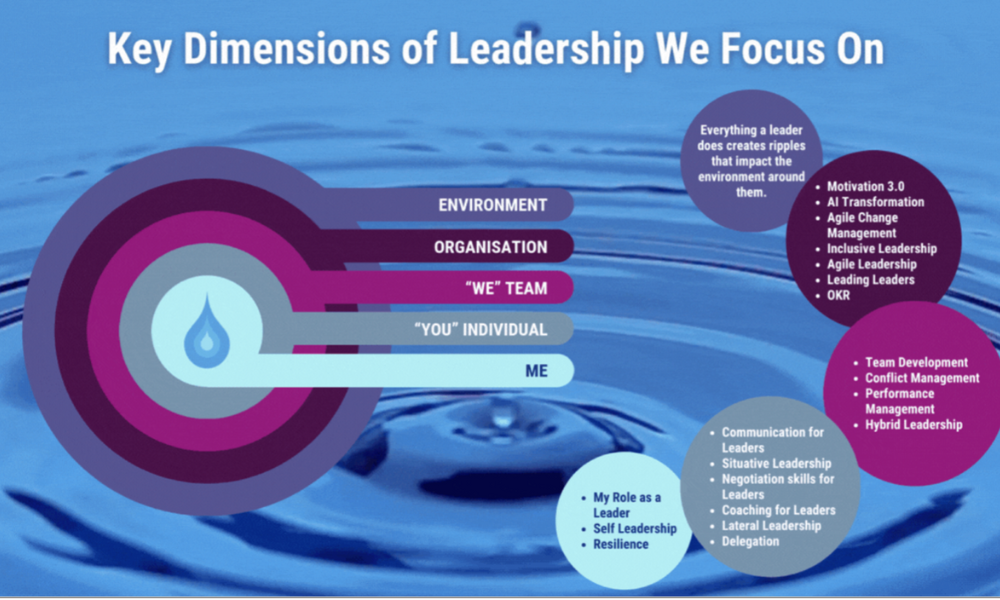
Imagine leadership development as a ripple effect. At the center lies the self—the starting point for influencing all outer circles: individuals, teams, organizations, and the wider environment. The “me” dimension is foundational.

How we connect with others or design organizational systems stems directly from our inner state. For now, let’s focus on this pivotal core: self-leadership.

Key Dimensions of Leadership we Focus on

Empathy vs. Sympathy: Choosing Connection

Empathy is a cornerstone of self-leadership, fostering connection, while sympathy can unintentionally create distance. According to Brene Brown, empathy encompasses:

  • Perspective-taking: Seeing the world through someone else’s eyes.
  • Non-judgment: Withholding judgment about others’ experiences.
  • Emotional recognition: Identifying and validating others’ emotions.
  • Feeling with others: Truly sharing in their emotional experience.

Leaders often struggle with vulnerability, imperfection, and the uncontrollable aspects of life and relationships. Our biological wiring doesn’t help—we’re programmed to detect and react to potential threats, a survival mechanism that can hinder connection. Recognizing and addressing this is key to empathetic leadership.

Cultivating “Response-Ability”

While we can’t control external events, we can control how we react—our “response-ability.” Tools like deep, conscious breathing and regular meditation can help calm the brain’s alarm system, creating space between stimulus and response. Gratitude practices can shift our focus toward the positive, reducing the weight of perceived threats.

These habits empower leaders to make decisions thoughtfully, even amid complexity and conflicting needs.

Leadership Decision-Making: Navigating Complexity

Making decisions as a leader is inherently challenging. It’s impossible to satisfy everyone, and every decision invites criticism. Understanding this reality helps us navigate conflict, a normal part of organizational life

Decisions will always carry trade-offs, but by including diverse perspectives and maintaining self-awareness, leaders can strive for the best possible outcomes.

Embracing Your Inner Team

Self-leadership also involves recognizing and harmonizing the many voices within us—our “inner team.” Each voice represents a perspective or trait, such as the Perfectionist, the Empathetic, or the Fearful. Listening to and integrating these voices strengthens decision-making and communication.

Embracing your inner Team

Practical Exercise:

Start by asking yourself a question, like, “Should I address this conflict?” Visualize the various inner voices involved and assign them roles or characters. For instance:

  • The Perfectionist: Insists on flawless execution.
  • The Fearful: Warns of potential risks.
  • The Rational: Seeks logic and balance.
  • The Angry: Advocates fiercely for boundaries.

Identify which voices are louder or more resistant and allow each to speak. Then, appoint an “inner team leader” to mediate, ensuring all perspectives are heard and integrated into a coherent plan.

In my own inner team, I balance voices like the empathetic, the strong, the fearful, and the rational. Each one has value, and my inner leader works to harmonize them, fostering collaboration and guiding decisions that reflect the best of all perspectives.

Conclusion

Self-leadership isn’t about perfection—it’s about awareness and intentionality. By cultivating empathy, practicing response-ability, and embracing the wisdom of your inner team, you can make decisions with clarity and confidence.

When we lead ourselves effectively, we empower others to thrive, creating ripples of positive change that extend far beyond the “me” circle.

Meike Hinnenberg

Meike Hinnenberg

Learning & Development Consultant

Meike Hinnenberg is a trainer at MDI Management Development GmbH and specializes in communication, conflict management, diversity & inclusion, and lateral leadership.

  • LinkedIn

What serves you next?

Leading in the Age of AI: How AI Discourse Shapes Responsibility and Power

by Meike Hinnenberg | 18. March 2026 | Impuls series, Leadership and AI, Leadership Tips | 0 Comments

Leading in the Age of AI: How AI Discourse Shapes Responsibility and Power Meike’s Reflections on Artificial Intelligence Do you prefer to listen to this article? Click below to access our AI-generated audio version!Leading in the Age of AI: How AI Discourse Shapes...
Read More

AI Ethics for Leaders: Why Context and Critical Thinking Matter More Than Ever

by Meike Hinnenberg | 11. March 2026 | Impuls series, Leadership and AI, Learning Transfer | 0 Comments

AI Ethics for Leaders: Why Context and Critical Thinking Matter More Than Ever. Meike’s Reflections on Artificial Intelligence Do you prefer to listen to this article? Click below to access our AI-generated audio version!AI Ethics for Leaders: Why Context and Critical...
Read More

A Success Story – When AI Sharpens Human Judgement

by Claude MacDonald, Rafael Ungvari | 6. March 2026 | Customer Story, Digital Transformation, Leadership and AI | 0 Comments

A Success Story – When AI Sharpens Human Judgement Do you prefer to listen to this article? Click here to access our AI-generated audio version! When AI Amplifies Human Judgment: A Customer Success Story About This Project At MDI, we believe that great leadership and...
Read More

How Do You Lead People Who Don’t Think the Way You Do?

by Zeca Ruiz | 4. February 2026 | Leadership Impact, Leadership Tips, Learning Transfer | 0 Comments

How Do You Lead People Who Don't Think the Way You Do? Do you want to listen to this article? Click here to access our AI-generated audio version!   How do you lead people who do not think the way you do? Leadership is a challenge, especially when you are not...
Read More

How You Deal With Neurodiversity as a Leader

by Iris Kandlbauer | 3. February 2026 | Leadership Impact, Leadership Tips, Short Knowledge Bits | 0 Comments

How You Deal With Neurodiversity as a Leader You prefer listening to this article? You can find our AI-generated audio version below! How You Deal With Neurodiversity as a Leader What might be behind “strange” behavior in a team—and how leaders can deal with it...
Read More

Anita’s Key to Success for International Cooperation

by Jana Wölfl | 3. February 2026 | Leadership and AI, Leadership Tips, MDI Spotlight Series | 0 Comments

Anita's Key to Success for International Cooperation This blog is an excerpt from our new podcast! You can find the entire podcast episode here. Anita's Key to Success for International Cooperation In our new video podcast format, “Voices of Leadership – an MDI...
Read More

Fostering True Workplace Commitment

by Marcin Swierkocki | 14. January 2026 | Leadership Tips, Learning Transfer, Short Knowledge Bits | 0 Comments

Fostering True Workplace Commitment Do you prefer to listen to this article? Click below to access our AI-generated audio version! Fostering True Workplace Commitment Throughout my years of practice, I've found that deep workplace commitment is achieved not through...
Read More

Marcin Swierkocki on the Full Range Leadership Model

by Jana Wölfl | 19. December 2025 | Leadership and AI, Leadership Tips, MDI Spotlight Series | 0 Comments

Marcin Swierkocki on the Full Range Leadership Model This blog is an excerpt from our new podcast! You can find the entire podcast episode here. Marcin Swierkocki on the Full Range Leadership Model In the newest episode of our podcast “Voices of Leadership | An MDI...
Read More

Self-Efficacy in Change: Why It Matters

by Anita Berger | 17. December 2025 | Leadership Tips, Learning Transfer, Short Knowledge Bits | 0 Comments

Why It Matters When Transformation Gets Hard Do you prefer to listen to this article? Click below to access our AI-generated audio version:Self-Efficacy: Why It Matters When Transformation Gets Hard Change can be exhausting.Especially when things are unclear,...
Read More

Generation Z isn’t the Problem but Our System is

by Zeca Ruiz | 3. December 2025 | Impuls series, International leadership development, Leadership in the digital transformation | 0 Comments

Generation Z Isn’t the Problem, but Our System is. Read this article on crossgenerational management by Zeca Ruiz to find out more!

Read More
Efficiency with AI in Leadership Development

Efficiency with AI in Leadership Development

by Gunther Fürstberger | Oct 31, 2024 | Best Practice, Leadership and AI, MDI Inside | 0 comments

Efficiency with AI in Leadership Development

Do you prefer to listen to this article? Click below to access our AI-generated audio version!

Efficiency with AI in Leadership Development

Perhaps the first AI hype is already over, but it paves the way for a more realistic view. AI transformation is progressing at different speeds in different industries.

However, the training industry is among the pioneers: machine learning has enormous potential to make human learning more efficient, effective, and cost-effective. Since 2023, we have been experimenting intensively with artificial intelligence as a provider of leadership development and are happy to share our experiences.

AI in everyday business: a fixed routine in meetings

For a year and a half, AI has had a permanent place in every company management meeting. At least one current topic is supplemented by an LLM (Large Language Model) with a perspective or recommendation.

This practice has proven itself and enables more informed decisions with minimal time investment. Experiments with automatic logging, on the other hand, have proven less successful.

In August 2023, we launched AICO (Artificial Intelligence Co-Trainer), which has since been supporting us with energy exercises, music selection, transfer tasks, and as a knowledge source for participant questions in the seminar. Shortly after that, we tested the first ChatGPT role-playing game in a seminar and were impressed by the positive participant feedback. Initially, we provided the prompts as a transfer task.

AI transformation roadmap: planning at the company level

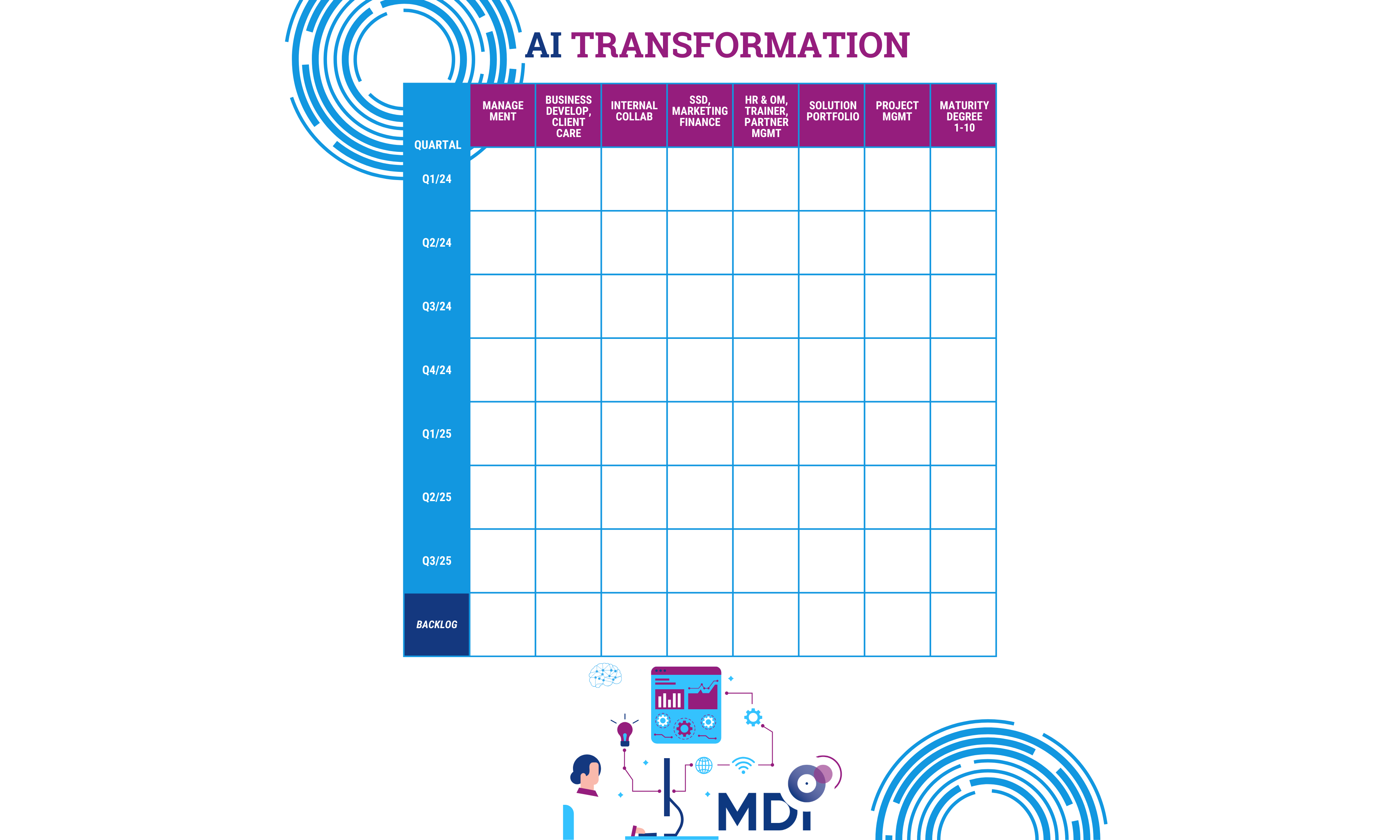
In January 2024, we launched a company-wide AI transformation roadmap. This means that we plan how AI can be used in key areas of the company every quarter to ensure that the entire organization is involved in this development.

In our OKR (Objectives and Key Results) planning meeting for the second quarter, we determined that no offer would be sent to customers without an AI component that covers at least 10% of the learning journey. Customers will still have the option to book the AI components that were previously free of charge.

AI transformation roadmap: planning at the company level

AI Lab: A role-playing center for real-world scenarios

In the third quarter, we plan to set up an AI lab on our website where all applications can be tested and used in a bundled form. This lab includes a role-playing center for various leadership communication situations. Participants take on the role of the leader, while the AI takes on the role of the employees.

A keyboard is no longer necessary – the role play is done by speaking and listening. After completion, the leaders receive targeted feedback that refers to the learned communication models. The role play can be repeated as often as desired, not only in the seminar but also when the situation arises in real life.

The future of learning: from 2D avatars to “superpowers”

Just as e-learning has replaced knowledge transfer in training over the last 20 years, AI has the potential to revolutionize skills development today. Currently, role-playing on the phone is still purely auditory, but soon visual avatars will be integrated as role-playing partners.

AI applications with 3D avatars for virtual reality glasses already exist. However, we suspect that 2D avatars will initially be used as learning partners because they are easier to use. These avatars are already supported by so-called “superpowers”. For example, Hume.ai gives AI coaches empathy and enables feedback on the current emotional state of the role-playing participant using voice analysis.

Real avatars as knowledge messengers and the next step in learning transfer

We are experimenting with “real avatars” of trainers who are available to participants as knowledge messengers after the seminar. This new type of learning transfer support enables agile learning when needed. Despite all efforts, learning transfer has often been a neglected topic in the industry.

Our leadership agent project (“LAgent”) is proving more challenging: we are developing an AI agent that can proactively pursue short-and long-term goals together with the leader. However, the LLMs currently available are still limited in their memory function, which would be necessary for responsible co-leadership. But this is precisely where development is progressing rapidly, and it is becoming increasingly easier to develop AI agents.

Conclusion: AI transformation in learning and development

Overall, the AI transformation in the area of learning and development is a fascinating field and is contributing significantly to the development of organizations and, by extension, society.

Mag. Gunther Fürstberger

Mag. Gunther Fürstberger

CEO | MDI Management Development International

Gunther Fürstberger is a management trainer, author and CEO of Metaforum and MDI – a global consulting company providing solutions for leadership development. His main interest is to make the world a better place through excellent leadership. He has worked for clients including ABB, Abbvie, Boehringer Ingelheim, DHL, Hornbach, PWC and Swarovski. His core competence is leadership in digital transformation. He gained his own leadership experience as HR Manager of McDonald’s Central Europe/Central Asia.  At the age of 20 he already started working as a trainer.

  • LinkedIn

Download our International Whitepaper:


What serves you next?

Leading in the Age of AI: How AI Discourse Shapes Responsibility and Power

by Meike Hinnenberg | 18. March 2026 | Impuls series, Leadership and AI, Leadership Tips | 0 Comments

Leading in the Age of AI: How AI Discourse Shapes Responsibility and Power Meike’s Reflections on Artificial Intelligence Do you prefer to listen to this article? Click below to access our AI-generated audio version!Leading in the Age of AI: How AI Discourse Shapes...
Read More

AI Ethics for Leaders: Why Context and Critical Thinking Matter More Than Ever

by Meike Hinnenberg | 11. March 2026 | Impuls series, Leadership and AI, Learning Transfer | 0 Comments

AI Ethics for Leaders: Why Context and Critical Thinking Matter More Than Ever. Meike’s Reflections on Artificial Intelligence Do you prefer to listen to this article? Click below to access our AI-generated audio version!AI Ethics for Leaders: Why Context and Critical...
Read More

A Success Story – When AI Sharpens Human Judgement

by Claude MacDonald, Rafael Ungvari | 6. March 2026 | Customer Story, Digital Transformation, Leadership and AI | 0 Comments

A Success Story – When AI Sharpens Human Judgement Do you prefer to listen to this article? Click here to access our AI-generated audio version! When AI Amplifies Human Judgment: A Customer Success Story About This Project At MDI, we believe that great leadership and...
Read More

How Do You Lead People Who Don’t Think the Way You Do?

by Zeca Ruiz | 4. February 2026 | Leadership Impact, Leadership Tips, Learning Transfer | 0 Comments

How Do You Lead People Who Don't Think the Way You Do? Do you want to listen to this article? Click here to access our AI-generated audio version!   How do you lead people who do not think the way you do? Leadership is a challenge, especially when you are not...
Read More

How You Deal With Neurodiversity as a Leader

by Iris Kandlbauer | 3. February 2026 | Leadership Impact, Leadership Tips, Short Knowledge Bits | 0 Comments

How You Deal With Neurodiversity as a Leader You prefer listening to this article? You can find our AI-generated audio version below! How You Deal With Neurodiversity as a Leader What might be behind “strange” behavior in a team—and how leaders can deal with it...
Read More

Anita’s Key to Success for International Cooperation

by Jana Wölfl | 3. February 2026 | Leadership and AI, Leadership Tips, MDI Spotlight Series | 0 Comments

Anita's Key to Success for International Cooperation This blog is an excerpt from our new podcast! You can find the entire podcast episode here. Anita's Key to Success for International Cooperation In our new video podcast format, “Voices of Leadership – an MDI...
Read More

Fostering True Workplace Commitment

by Marcin Swierkocki | 14. January 2026 | Leadership Tips, Learning Transfer, Short Knowledge Bits | 0 Comments

Fostering True Workplace Commitment Do you prefer to listen to this article? Click below to access our AI-generated audio version! Fostering True Workplace Commitment Throughout my years of practice, I've found that deep workplace commitment is achieved not through...
Read More

Marcin Swierkocki on the Full Range Leadership Model

by Jana Wölfl | 19. December 2025 | Leadership and AI, Leadership Tips, MDI Spotlight Series | 0 Comments

Marcin Swierkocki on the Full Range Leadership Model This blog is an excerpt from our new podcast! You can find the entire podcast episode here. Marcin Swierkocki on the Full Range Leadership Model In the newest episode of our podcast “Voices of Leadership | An MDI...
Read More

Self-Efficacy in Change: Why It Matters

by Anita Berger | 17. December 2025 | Leadership Tips, Learning Transfer, Short Knowledge Bits | 0 Comments

Why It Matters When Transformation Gets Hard Do you prefer to listen to this article? Click below to access our AI-generated audio version:Self-Efficacy: Why It Matters When Transformation Gets Hard Change can be exhausting.Especially when things are unclear,...
Read More

Generation Z isn’t the Problem but Our System is

by Zeca Ruiz | 3. December 2025 | Impuls series, International leadership development, Leadership in the digital transformation | 0 Comments

Generation Z Isn’t the Problem, but Our System is. Read this article on crossgenerational management by Zeca Ruiz to find out more!

Read More
Step by Step to Success with AI-Powered Solutions

Step by Step to Success with AI-Powered Solutions

by Marina Begic | Oct 31, 2024 | Best Practice, Digital Transformation, Leadership and AI | 0 comments

Step by Step to Success with AI-supported Solutions

Do you prefer to listen to this article? Click below to access our AI-generated audio version!

Step by Step to Success with AI-supported Solutions

A successful AI transformation in human resources development does not happen overnight. It is a process that requires a strategic approach and an agile implementation. How do you get employees on board? Combining both poles.

Sound familiar? Employees and colleagues approach you and tell you about the latest AI apps they are trying out. Many of them mention, some do not, that they do not even know whether they are allowed to use AI tools in the company. Your company may be working on a policy right now. There may not yet be a company-wide regulation or it may not yet be known. Don’t worry, you’re not alone in this attitude; 80% of companies are also waiting.

The importance of AI integration for employee motivation and competitive advantage

This could be fatal, on the one hand, because the initial motivation of employees, which is so often desired from the point of view of personnel development and leadership, could be curbed as a result. On the other hand, it could put them at a competitive disadvantage. A possible first-mover advantage shrinks with every day that passes without working on optimization using AI.

In addition to the motivation, some have no interest in the topic of AI and think they can “sit it out” or are unable to exert any influence anyway. So how can we get everyone on board? After all, as we know, we move faster when we’re all rowing in the same direction.

AI Readiness Check: assess the starting position.

Before companies embark on the AI transformation of their HR development, it makes sense to assess their current AI readiness. An AI readiness check helps to evaluate the initial situation and discuss it together. This AI readiness check provides, for example, results in the categories of strategic orientation, know-how, culture, resources, and data after a 10-minute self-assessment.

With a common starting point, it is easier to identify opportunities for integrating AI into the L&D strategy. Such a readiness check can be used in any area of the company.

AI Transformation (1000 x 600 mm)

Agile approach – AI Autonomy Day

Organize an AI Autonomy Day: Provide everyone with a day a year to work on any topic in the field of AI. Provide as little guidance as possible. Also, provide a small budget for any licenses. It is important to note that, by the GDPR, no personal or company data should be transferred to unprotected LLMs.

Trying it out can happen individually, in a team, across departments/hierarchies/teams. Provide a communication platform and make it transparent which topics are being worked on. Set a date for presenting the results. Invite relevant stakeholders and decide together what will be done with the results. Repeat the process every six months or even every quarter.

To take it to a strategic level, we recommend setting up an AI transformation roadmap. This roadmap will track the progress and plans for each area. You can decide whether to share the roadmap with everyone individually or by team/area. The results and the maturity level of the project should be recorded by the company management.

This tool offers you the following advantages:

  • Clear vision and strategic direction
  • Improved communication and alignment with stakeholders
  • Controlled resource and time management
  • Risk reduction and adaptability
  • Focused innovation and development of use cases
  • Structured approach – a clear process gets the ball rolling

To find out what leverage AI can have in your company, you need to have a basic knowledge of AI and the (technical) possibilities of AI (weak AI vs reactive AI vs AI with limited storage capacity) . On the other hand, you need to know your processes very well. Those who already have a detailed process map have a clear advantage here.

As a first step, evaluate the AI potential based on your processes and divide your processes into three process types. Then evaluate the savings potential of the activity to determine your starting point with the greatest potential.



Weak AI vs. Reactive AI vs. AI With Limited Storage Capacity

Weak AI: performs tasks, does not learn new skills (voice assistants, generative AI: image generation, text generation, research & diagnosis)

Reactive AI: does not build up memory, reacts to stimuli (spam filters, recommendation systems based on historical data such as Netflix, Amazon)

AI with limited storage capacity: stores knowledge, learns from it and makes forecasts (weather, finance, self-driving cars, chatbots)

(Source: https://ki-campus.org/videos/ki-in-unserem-alltag?locale=de)

Further training & communication

To use the topic of AI profitably and responsibly for everyone in personal development, in the team, and the company, you cannot avoid acquiring a basic knowledge of AI yourself and motivating others to do the same.

Join communities, exchange ideas with peers, and take small steps. But take them consistently and lead by example. Support your colleagues and managers with training, workshops, exchanges, and networking opportunities. Create personalized wikis and AI assistants (e.g. using GPT Builder) to make knowledge more accessible.


Marina Begic

Marina Begic

Head of Business Development – Digital Transformation Driver

Marina has been working on new, effective learning methods and the future of corporate learning for over 15 years. In her current role, she is responsible for Digital Business Development at MDI, where her focus is not driven by the current buzzwords, but primarily on the feasibility of digital transformation for clients such as Erste Group, Lenzing, Semperit, Deutsche Bahn, Andritz AG, Uniqa, Mayr-Melnhof, Frequentis, RHIM. Her greatest strength is bringing loose ends together, which she impressively demonstrates time and time again with her big picture view and multi-dimensional approach. Her greatest passion is to provide learners not only with an experience, but also with real, lasting value for their real challenges.

  • LinkedIn

What serves you next?

How Do You Lead People Who Don’t Think the Way You Do?

by Zeca Ruiz | 4. February 2026 | Leadership Impact, Leadership Tips, Learning Transfer | 0 Comments

How Do You Lead People Who Don't Think the Way You Do? Do you want to listen to this article? Click here to access our AI-generated audio version!   How do you lead people who do not think the way you do? Leadership is a challenge, especially when you are not...
Read More

How You Deal With Neurodiversity as a Leader

by Iris Kandlbauer | 3. February 2026 | Leadership Impact, Leadership Tips, Short Knowledge Bits | 0 Comments

How You Deal With Neurodiversity as a Leader You prefer listening to this article? You can find our AI-generated audio version below! How You Deal With Neurodiversity as a Leader What might be behind “strange” behavior in a team—and how leaders can deal with it...
Read More

Generation Z isn’t the Problem but Our System is

by Zeca Ruiz | 3. December 2025 | Impuls series, International leadership development, Leadership in the digital transformation | 0 Comments

Generation Z Isn’t the Problem, but Our System is. Read this article on crossgenerational management by Zeca Ruiz to find out more!

Read More

The Lasting Impact of Leadership Horizon – Meike’s Perspectives

by Meike Hinnenberg | 2. July 2025 | Leadership Impact, MDI Inside, Short Knowledge Bits | 0 Comments

The Lasting Impact of Leadership Horizon - Meike's Perspectives Do you prefer to listen to this article? Click below to access our AI-generated audio version!The Lasting Impact of Leadership Horizon - Meike's Perspectives MDI’s Meike Hinnenberg shares her reflections...
Read More

Success Through Change: How to Stay Oriented During Transitions

by Anita Berger | 14. April 2025 | Impuls series, Leadership Impact, Leadership Tips | 0 Comments

Success Through Change: How to Stay Oriented During Transitions Do you prefer to listen to this article? Click below to access our AI-generated audio version:Success Through Change: How to Stay Oriented During Transitions Change processes often involve challenges....
Read More

4 Tips on How to Shape Change Processes as a Leader

by Anita Berger | 3. April 2025 | Impuls series, Leadership Impact, Leadership Tips | 0 Comments

4 Tips on How to Shape Change Processes as a Leader Do you prefer to listen to this article? Click below to access our AI-generated audio version:4 Tips on How to Shape Change Processes as a Leader Imagine a dynamic network of paths that is constantly changing. While...
Read More

Successful Team Building for Boehringer Ingelheim RCV

by Anita Berger | 29. March 2024 | Customer Story, International leadership development, MDI Inside | 0 Comments

Successful Team Building for Boehringer Ingelheim RCV Do you prefer to listen to this article? Click below to access our AI-generated audio version:Successful Team Building for Boehringer Ingelheim RCV In the interview with our MDI trainer and partner, Anita Berger On...
Read More

Organize Your Team in a Hybrid Workplace

by Peter Grabuschnig | 14. March 2024 | Impuls series, International leadership development, Leadership in the digital transformation | 0 Comments

Organize Your Team in a Hybrid Workplace Prefer to listen to the article? Click below to access our AI speech-generated audio. However, if you want to read it as usual, keep scrolling.Organize Your Team in a Hybrid Workplace In his new Rise Course, our MDI trainer and...
Read More

Exploring the Influence of AI on Leadership Roles – an experiment by a CEO

by Gunther Fürstberger | 14. November 2023 | International leadership development, Leadership and AI, Leadership in the digital transformation | 0 Comments

Exploring the Influence of AI on Leadership Roles: Learn more about the ongoing ChatGPT experiment by MDI CEO Gunther Fürstberger Do you prefer to listen to this article? Click below to access our AI-generated version. Exploring the Influence of AI on Leadership...
Read More

AI as a Co-Trainer in Leadership Development

by Gunther Fürstberger | 14. November 2023 | Impuls series, International leadership development, Leadership and AI | 0 Comments

Artificial Intelligence as a Co-Trainer in Leadership Development Do you prefer to listen to this blog article? Click below to access our AI-generated version. Artificial Intelligence as a Co-Trainer in Leadership Development In a world that is constantly evolving, we...
Read More
« Older Entries
Next Entries »

Information

  • Imprint
  • MDI company website

Social Media

  • Facebook
  • Twitter
  • Youtube
  • LinkedIn

© MDI Management Development Institute, 2020