

• MDI
  • German version
  • Contact us
MDI Management Development
  • Agile leadership
  • Lateral Leadership
  • Leadership Impact
  • Leadership Development
Select Page
AI Ethics for Leaders: Why Context and Critical Thinking Matter More Than Ever

AI Ethics for Leaders: Why Context and Critical Thinking Matter More Than Ever

by Meike Hinnenberg | Mar 11, 2026 | Impuls series, Leadership and AI, Learning Transfer | 0 comments

AI Ethics for Leaders: Why Context and Critical Thinking Matter More Than Ever.

Meike’s Reflections on Artificial Intelligence

Do you prefer to listen to this article? Click below to access our AI-generated audio version!

AI Ethics for Leaders: Why Context and Critical Thinking Matter More Than Ever

Meike’s Reflections on Artificial Intelligence

This is the first part of a new AI blog series by our Senior Learning Architect, Meike Hinnenberg. Read her thoughts below and stay tuned for more parts to come!

The history of mining, like the devastation it leaves in its wake, is commonly overlooked in the strategic amnesia that accompanies stories of technological progress. […] As San Francisco drew enormous wealth from the mines, it was easy for the populace to forget where it all came from […] Just like the mines that served San Francisco in the nineteenth century, extraction for the technology sector is done by keeping real costs out of sight.

(Kate Crawford: Atlas of AI)

[…] – that is, as I said, the use of active forgetfulness, a porter at the door, so to speak, a custodian of psychic order, quiet, etiquette. From that we can see at once how, if forgetfulness were not present, there could be no happiness, no cheerfulness, no hoping, no pride, no present.

(Friedrich Nietzsche: The Genealogy of Morals)

It is immediately by deviating from equilibrium of animals, from tranquility – a departure engendered by the fault of Epimetheus – that mortals occur. Before the deviation, there is nothing. Then the accidental event happens, the fault of Epimetheus: to have forgotten humans. Humans are the forgotten ones. Humans only occur through their being forgotten; they only appear in disappearing.

(Bernard Stiegler: Technics and Time, 1)

Introduction

It is the beginning of February 2026 in Berlin; shortly after the big blackout in southern Berlin; shortly after several deaths and devastating losses in southern Europe in the wake of Storm Harry; shortly after a judge of the International Criminal Court was sanctioned by the United States; shortly after a cold wave driven by a destabilized jet stream claimed lives in the U.S.; shortly after deadly storms and floods across South and Southeast Asia left thousands displaced, hundreds dead and entire regions submerged; shortly after Russian strikes left thousands of households in Kyiv without heating while, almost in the same breath, the Ukrainian government entrusted the development of the namesake lithium deposit in the Kirovohrad region to TechMet – an Irish company partly backed by the U.S. government’s Development Finance Corporation and the U.S. financial firm Rock Holdings – drawing the country into the competitive circuitry of the global battery economy; shortly after …

It is the beginning of February 2026 in Berlin, and the air outside is sharp with cold. Inside my aging apartment, warmth gathers despite the leaky windows. The radiators whisper with gas that has traveled from Norway, the Netherlands, Belgium, the United States, or Azerbaijan, holding back the easterly winds for now. I sit in my kitchen. Milk warms slowly on the stove; coffee – probably carried from Africa, Asia, or South America – rises in the espresso pot and fills the room with its wonderful, familiar scent.

I open my computer, assembled through supply chains that fade into opacity, dependent on minerals, infrastructures, and forms of labor that rarely enter the frame. I open it to read the news and to begin research for a series on AI I am planning to write – aware, somewhere in the background, that even a question posed to a machine draws on energies and resources far beyond the gesture of typing it.

From this kitchen table, my orientation turns toward two recent points of departure: Kate Crawford’s Atlas of AI and her video essay  Mapping Empires.

Meike’s Reflections on Artificial Intelligence

Chapter I – The Dispositif of Artificial Intelligence

In Atlas of AI, Kate Crawford peels back the layers – conceptual and material alike – that have accrued around what we have come to call Artificial Intelligence, revealing a construct whose hidden assumptions we inhabit daily, largely unaware of the consequences they set in motion.

Her analysis unfolds as a kind of cartography, recalling Gilles Deleuze’s notion of the dispositif: a field traced by lines of visibility and invisibility, by grand narratives and what they render mute, by modes of subjectivation, fractures, continuities, and crossings – lines that intersect and mutate without ever solidifying into a universal structure.

Technologies of Domination

To draw nearer to this dispositif, to traverse its terrain, Crawford adopts the figure of the atlas. The atlas makes palpable the material and spatial dimensions condensed under the name Artificial Intelligence, even as these very conditions – its infrastructures, labors, and extractive foundations – are frequently displaced from view. 

At the same time, it affirms the situatedness of all knowledge: each map offers only a partial orientation, shaped by choices of scale, emphasis, and omission. In this convergence of aesthetic visual ordering and epistemic claim, Crawford shows that mapping is not a neutral description but a creative and political act.

Even as Crawford insists on the partiality of her own account – presenting her work as an invitation to follow emerging paths, to linger in zones of disparity, and to witness how particular perspectives come into being – she remains attentive to the darker history of the atlas itself. For atlases have never been innocent instruments of orientation alone; they have also served as technologies of domination.

The God’s Eye View

It is precisely this ambivalence that grounds her central hypothesis: that under the name Artificial Intelligence, such cartographic power is once again being mobilized. Along familiar routes of colonial exploitation and driven by an ambition no longer to draw an atlas of the world but to stand in for it, this impulse recentralizes power within the field of AI, advancing claims of universality and totality that rest on extractive regimes.

In doing so, it seeks to translate movement, communication, and labor into data, rendering the world legible from what Crawford describes as a supposedly objective, centralized “God’s eye view”.

Deterritorialization and Reterritorialization

The atlas itself operates through a double movement of what Deleuze would call deterritorialization and reterritorialization. While its cartographic abstractions unsettle fixed spatial relations and open new pathways of thought, they also carry a long-standing capacity for capture and domination.

Crawford’s intervention can be read as an attempt to amplify the deterritorializing potential of the atlas, even as she meticulously traces the reterritorializing operations to which colonialism and contemporary AIrepeatedly return.

The Ethical Task

Dispositifs, as singular and historically situated configurations, neither begin from nor arrive at the universal. And yet, in their operation, they repeatedly give rise to gestures of universalization and ambitions of totality, effects that emerge from within rather than from any transcendent ground. It is for this reason that such claims need to be traced genealogically, followed back along the paths through which they come to assert themselves.

Against this horizon, the ethical task is not to oppose totalization with a quasi-moralistic counter-universal, but to remain attentive to these movements as they unfold: to introduce shifts, frictions, and alternative pathways that keep the field open.

Ethical resistance, if it is to remain worthy of the name, must itself resist the temptation of ideology, universalization, and closure. For wherever resistance hardens into morally indignant certainty or ideological form, it risks reproducing – under the guise of critique – the very logics of universalization and reterritorialization it set out to unsettle.

Meike Hinnenberg

Meike Hinnenberg

Learning & Development Consultant

Meike Hinnenberg is a trainer, Learning and Development Consultant, and Team Lead at MDI Management Development GmbH and specializes in communication, conflict management, diversity & inclusion, and lateral leadership.

  • LinkedIn

Join us on May 5th for our yearly Leadership Horizon Conference!
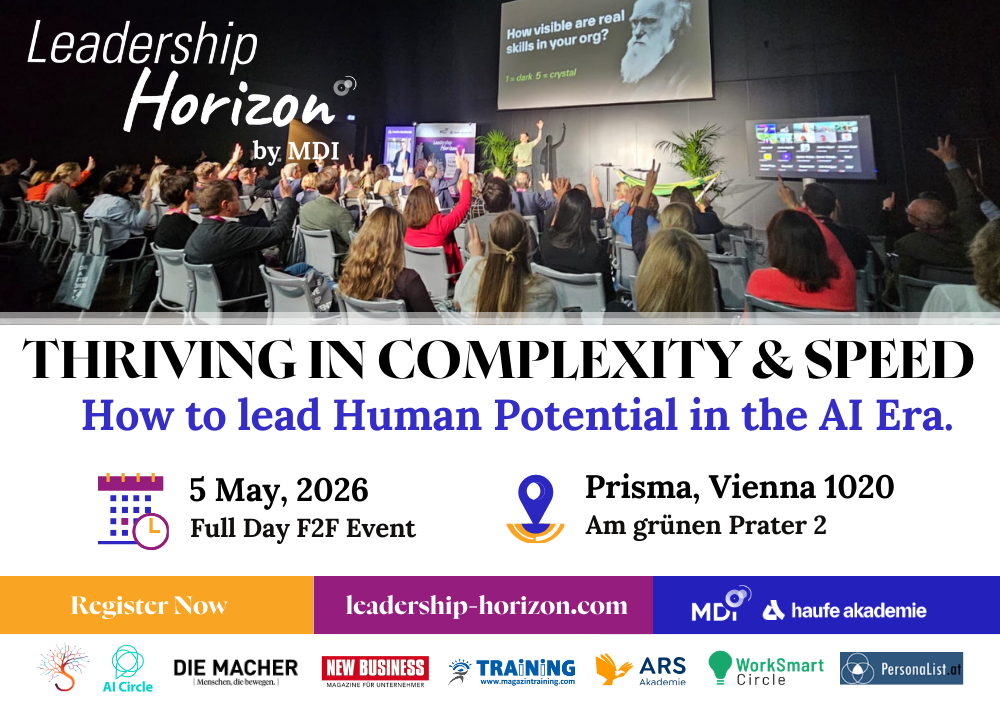
Leadership Horizon 2026 Banner

What serves you next?

AI Ethics for Leaders: Why Context and Critical Thinking Matter More Than Ever

by Meike Hinnenberg | 11. March 2026 | Impuls series, Leadership and AI, Learning Transfer | 0 Comments

AI Ethics for Leaders: Why Context and Critical Thinking Matter More Than Ever. Meike’s Reflections on Artificial Intelligence Do you prefer to listen to this article? Click below to access our AI-generated audio version!AI Ethics for Leaders: Why Context and Critical...
Read More

A Success Story – When AI Sharpens Human Judgement

by Claude MacDonald, Rafael Ungvari | 6. March 2026 | Customer Story, Digital Transformation, Leadership and AI | 0 Comments

A Success Story – When AI Sharpens Human Judgement Do you prefer to listen to this article? Click here to access our AI-generated audio version! When AI Amplifies Human Judgment: A Customer Success Story About This Project At MDI, we believe that great leadership and...
Read More

How Do You Lead People Who Don’t Think the Way You Do?

by Zeca Ruiz | 4. February 2026 | Leadership Impact, Leadership Tips, Learning Transfer | 0 Comments

How Do You Lead People Who Don't Think the Way You Do? Do you want to listen to this article? Click here to access our AI-generated audio version!   How do you lead people who do not think the way you do? Leadership is a challenge, especially when you are not...
Read More

How You Deal With Neurodiversity as a Leader

by Iris Kandlbauer | 3. February 2026 | Leadership Impact, Leadership Tips, Short Knowledge Bits | 0 Comments

How You Deal With Neurodiversity as a Leader You prefer listening to this article? You can find our AI-generated audio version below! How You Deal With Neurodiversity as a Leader What might be behind “strange” behavior in a team—and how leaders can deal with it...
Read More

Anita’s Key to Success for International Cooperation

by Jana Wölfl | 3. February 2026 | Leadership and AI, Leadership Tips, MDI Spotlight Series | 0 Comments

Anita's Key to Success for International Cooperation This blog is an excerpt from our new podcast! You can find the entire podcast episode here. Anita's Key to Success for International Cooperation In our new video podcast format, “Voices of Leadership – an MDI...
Read More

Fostering True Workplace Commitment

by Marcin Swierkocki | 14. January 2026 | Leadership Tips, Learning Transfer, Short Knowledge Bits | 0 Comments

Fostering True Workplace Commitment Do you prefer to listen to this article? Click below to access our AI-generated audio version! Fostering True Workplace Commitment Throughout my years of practice, I've found that deep workplace commitment is achieved not through...
Read More

Marcin Swierkocki on the Full Range Leadership Model

by Jana Wölfl | 19. December 2025 | Leadership and AI, Leadership Tips, MDI Spotlight Series | 0 Comments

Marcin Swierkocki on the Full Range Leadership Model This blog is an excerpt from our new podcast! You can find the entire podcast episode here. Marcin Swierkocki on the Full Range Leadership Model In the newest episode of our podcast “Voices of Leadership | An MDI...
Read More

Self-Efficacy in Change: Why It Matters

by Anita Berger | 17. December 2025 | Leadership Tips, Learning Transfer, Short Knowledge Bits | 0 Comments

Why It Matters When Transformation Gets Hard Do you prefer to listen to this article? Click below to access our AI-generated audio version:Self-Efficacy: Why It Matters When Transformation Gets Hard Change can be exhausting.Especially when things are unclear,...
Read More

Generation Z isn’t the Problem but Our System is

by Zeca Ruiz | 3. December 2025 | Impuls series, International leadership development, Leadership in the digital transformation | 0 Comments

Generation Z Isn’t the Problem, but Our System is. Read this article on crossgenerational management by Zeca Ruiz to find out more!

Read More

From Lab to Practice: What We Learned With AI

by Rafael Ungvari | 3. September 2025 | Digital Transformation, Leadership and AI, Short Knowledge Bits | 0 Comments

From Lab to Practice: What We Learned With AI Do you prefer to listen to this article? Click here to access our AI-generated audio version! From Lab to Practice: What We Learned With AI AI in organizations isn’t a one-size-fits-all solution. And in people development,...
Read More
A Success Story – When AI Sharpens Human Judgement

A Success Story – When AI Sharpens Human Judgement

by Claude MacDonald, Rafael Ungvari | Mar 6, 2026 | Customer Story, Digital Transformation, Leadership and AI | 0 comments

A Success Story – When AI Sharpens Human Judgement

Do you prefer to listen to this article? Click here to access our AI-generated audio version!

When AI Amplifies Human Judgment: A Customer Success Story

About This Project

At MDI, we believe that great leadership and sales development isn’t just about knowledge transfer — it’s about behavior change. This customer story reflects a collaboration between Claude MacDonald, MDI trainer and Sales Culture Architect, and Rafael Ungvari, MDI’s AI Product & Solution Lead, who designed and implemented the AI-driven learning environment for this engagement. Together, they bring a rare combination: deep human expertise in consultative selling and the technical capability to turn that expertise into scalable AI-powered practice tools.

The Challenge: Great Training, Not Enough Practice

Our client is a global B2B organization in the industrial chemicals industry, operating across multiple business units with complex sales cycles and technically sophisticated offerings. Sales leaders and managers play a critical role in developing the consultative selling capability of their teams, which makes closing the practice gap not just a training question but a leadership priority.

The goal was clear: strengthen Discovery skills. That means helping sales professionals ask better questions, genuinely uncover client needs, qualify opportunities more accurately, and walk into customer conversations fully prepared.

Here’s the honest challenge: the existing training worked. It created shared language and awareness. But awareness alone doesn’t change behavior. And behavior only changes with practice — lots of it.

Think of elite athletes. They don’t improve by playing more games. They improve because the practice-to-play ratio is deliberately high. In sales, that ratio is almost always inverted. Real customer conversations are high-stakes environments — there’s limited room to experiment, fail, and try again.

That’s exactly the gap we needed to close.

Why AI – and Why Role Play?

The answer wasn’t more classroom time. It was deliberate, repeatable practice at scale.

AI-driven role play made it possible to create realistic Discovery conversations on demand. Participants could practice, reflect, adjust, and replay scenarios multiple times — something impossible to replicate with peer simulations or occasional classroom role plays.

Without AI, the solution would have looked like traditional role play: useful, but hard to scale, difficult to repeat, and dependent on the availability of skilled practice partners. With AI, we could give every participant a realistic, challenging practice environment they could return to again and again.

Crucially: AI didn’t replace human judgment. It amplified it by giving people more chances to sharpen their questioning, their listening, and their situational awareness before the stakes were real.

How the Solution Was Designed

The concept was straightforward: AI avatars simulated customer interactions specifically designed to challenge participants on the exact capabilities that matter most in Discovery — questioning quality, listening and sense-making, problem framing, and opportunity qualification.

A typical session combined a short conceptual input with an AI-driven discovery role play, followed by structured reflection and a facilitator-led debrief. Participants encountered realistic customer responses and had to adapt their approach in real time — not follow a script.

The human-AI balance was intentional. Human facilitators anchored the learning in business reality, coached participants on consultative behaviors, and helped translate practice into field application. AI provided the environment: repeatable, realistic, and safe to experiment in.

The Challenge: Great Training, Not Enough Practice

What Participants Experienced

The most significant shift was in the practice-to-play ratio. Participants could run the same scenario multiple times, testing different questions and conversational strategies. This dramatically increased the practice-to-play ratio, accelerating skill development in Discovery conversations. The experience felt realistic, engaging, and directly connected to daily work — not abstract, not theoretical.

A few voices from participants (anonymized):

“The AI role plays were incredibly helpful. Being able to repeat scenarios helped me improve my discovery conversations.”

“This was a breath of fresh air — challenging, practical, and directly applicable.”

“The AI tools made it easier to structure my thinking before real customer calls.”

Results: What Actually Changed

Observed outcomes included stronger Discovery conversations with better questions and sharper listening, more structured pre-call preparation, improved opportunity qualification, and increased confidence in leading customer discussions.

Compared to traditional formats, the AI-enabled approach proved more scalable (accessible to more participants, more often), more effective (higher practice volume, faster skill development), and more sustainable (embedded as an ongoing practice tool rather than a one-time event).

Key Takeaway: AI Works Best When It Amplifies Humans

The most important lesson from this project is deceptively simple: AI is most powerful when used to amplify human judgment, not replace it.

Building consultative selling capability — especially in Discovery — requires far more deliberate practice than traditional training formats can realistically provide. AI-driven role play creates a scalable, repeatable way to embed that practice into sales development programs.

When does this approach make sense? When the capability gap is behavioral rather than knowledge-based, when practice volume matters, and when you need a safe environment for experimentation and failure.

When doesn’t it make sense? When the learning goal is primarily about mindset shifts, relationship dynamics, or complex emotional intelligence work — areas where human nuance and real relationship context are irreplaceable.

The future of effective sales training isn’t AI or humans. It’s knowing exactly where each one adds the most value — and designing for both.

Interested in exploring AI-driven role play for your sales or leadership development programs? Contact us at https://mdi-training.com/ai-enhanced-leadership-training/

Are you interested and you want to hear more from Claude MacDonald? Claude will speak at our next Leadership Horizon conference on May 5th with his keynote Business Case: When AI Amplifies Human Judgment: Lessons from the Field. 

Get your tickets now!

Claude MacDonald

Claude MacDonald

Sales Culture Architect & Leadership Strategist

Claude MacDonald is recognized as an expert in sales culture transformation. Over the past 25 years, Claude has trained and coached more than 25,000 managers, professionals, and employees from prominent organizations in Canada, the United States, and Europe. His work focuses on building the mindsets, skills, and habits that drive lasting commercial performance — from frontline sales professionals to senior leadership teams.

  • LinkedIn
Rafael Ungvari

Rafael Ungvari

Artificial Intelligence Expert

Rafael is an AI specialist at MDI and is working to redefine leadership development through artificial intelligence. To implement this idea, he has worked with our team to establish the MDI AI Leadership Lab, which serves as a hub for experimenting with and applying AI solutions together with clients and trainers.

His work builds on his studies in business informatics at WU Vienna, where he combines business perspectives with technical expertise to develop practical and sustainable digital solutions.

  • LinkedIn

Save your tickets and join us on May 5th!

Leadership Horizon 2026 Banner

This could also interest you:

AI Ethics for Leaders: Why Context and Critical Thinking Matter More Than Ever

by Meike Hinnenberg | 11. March 2026 | Impuls series, Leadership and AI, Learning Transfer | 0 Comments

AI Ethics for Leaders: Why Context and Critical Thinking Matter More Than Ever. Meike’s Reflections on Artificial Intelligence Do you prefer to listen to this article? Click below to access our AI-generated audio version!AI Ethics for Leaders: Why Context and Critical...
Read More

A Success Story – When AI Sharpens Human Judgement

by Claude MacDonald, Rafael Ungvari | 6. March 2026 | Customer Story, Digital Transformation, Leadership and AI | 0 Comments

A Success Story – When AI Sharpens Human Judgement Do you prefer to listen to this article? Click here to access our AI-generated audio version! When AI Amplifies Human Judgment: A Customer Success Story About This Project At MDI, we believe that great leadership and...
Read More

How Do You Lead People Who Don’t Think the Way You Do?

by Zeca Ruiz | 4. February 2026 | Leadership Impact, Leadership Tips, Learning Transfer | 0 Comments

How Do You Lead People Who Don't Think the Way You Do? Do you want to listen to this article? Click here to access our AI-generated audio version!   How do you lead people who do not think the way you do? Leadership is a challenge, especially when you are not...
Read More

How You Deal With Neurodiversity as a Leader

by Iris Kandlbauer | 3. February 2026 | Leadership Impact, Leadership Tips, Short Knowledge Bits | 0 Comments

How You Deal With Neurodiversity as a Leader You prefer listening to this article? You can find our AI-generated audio version below! How You Deal With Neurodiversity as a Leader What might be behind “strange” behavior in a team—and how leaders can deal with it...
Read More

Anita’s Key to Success for International Cooperation

by Jana Wölfl | 3. February 2026 | Leadership and AI, Leadership Tips, MDI Spotlight Series | 0 Comments

Anita's Key to Success for International Cooperation This blog is an excerpt from our new podcast! You can find the entire podcast episode here. Anita's Key to Success for International Cooperation In our new video podcast format, “Voices of Leadership – an MDI...
Read More

Fostering True Workplace Commitment

by Marcin Swierkocki | 14. January 2026 | Leadership Tips, Learning Transfer, Short Knowledge Bits | 0 Comments

Fostering True Workplace Commitment Do you prefer to listen to this article? Click below to access our AI-generated audio version! Fostering True Workplace Commitment Throughout my years of practice, I've found that deep workplace commitment is achieved not through...
Read More

Marcin Swierkocki on the Full Range Leadership Model

by Jana Wölfl | 19. December 2025 | Leadership and AI, Leadership Tips, MDI Spotlight Series | 0 Comments

Marcin Swierkocki on the Full Range Leadership Model This blog is an excerpt from our new podcast! You can find the entire podcast episode here. Marcin Swierkocki on the Full Range Leadership Model In the newest episode of our podcast “Voices of Leadership | An MDI...
Read More

Self-Efficacy in Change: Why It Matters

by Anita Berger | 17. December 2025 | Leadership Tips, Learning Transfer, Short Knowledge Bits | 0 Comments

Why It Matters When Transformation Gets Hard Do you prefer to listen to this article? Click below to access our AI-generated audio version:Self-Efficacy: Why It Matters When Transformation Gets Hard Change can be exhausting.Especially when things are unclear,...
Read More

Generation Z isn’t the Problem but Our System is

by Zeca Ruiz | 3. December 2025 | Impuls series, International leadership development, Leadership in the digital transformation | 0 Comments

Generation Z Isn’t the Problem, but Our System is. Read this article on crossgenerational management by Zeca Ruiz to find out more!

Read More

From Lab to Practice: What We Learned With AI

by Rafael Ungvari | 3. September 2025 | Digital Transformation, Leadership and AI, Short Knowledge Bits | 0 Comments

From Lab to Practice: What We Learned With AI Do you prefer to listen to this article? Click here to access our AI-generated audio version! From Lab to Practice: What We Learned With AI AI in organizations isn’t a one-size-fits-all solution. And in people development,...
Read More
How Do You Lead People Who Don’t Think the Way You Do?

How Do You Lead People Who Don’t Think the Way You Do?

by Zeca Ruiz | Feb 4, 2026 | Leadership Impact, Leadership Tips, Learning Transfer | 0 comments

How Do You Lead People Who Don’t Think the Way You Do?

Do you want to listen to this article? Click here to access our AI-generated audio version!


How do you lead people who do not think the way you do?

Leadership is a challenge, especially when you are not always aligned with your colleagues and employees. Our MDI Ambassador Zeca Ruiz proves that even resistance in your team can be a good thing. You want to know why and how to deal with this? Read this blog article to find out more!

First mistake: Don’t confuse alignment with unanimity

I want to start with a simple, and perhaps uncomfortable, provocation for many leaders. If everyone on your team thinks like you, something is not right.

For a long time, I believed that good leadership meant achieving quick alignment, minimal friction, and decisions flowing with little or no resistance. Today, I think exactly the opposite. Teams that are overly aligned, in the sense of agreement, tend to be fragile, predictable, and dangerous in the long run. One of the most common leadership traps is confusing alignment with unanimity.

Why You Seek Agreement

When we seek to make people think like us, it is usually not a strategic choice. It is about comfort. Agreement gives us a false sense of control, reduces our anxiety, and makes us feel validated. The problem is that it also removes the questioning that could prevent mistakes, poorly calibrated decisions, and strategic blind spots.

The truth is, you do not want people to think like you. You want them to challenge you. When they press the right buttons, the ones that test whether you truly believe in the direction you are proposing, they strengthen the decision, refine the path, and turn a personal idea into a collective commitment.

Strong contributors do not accept everything. They question, create tension, ask for clarity, and force the leader out of autopilot. And strong leaders can hold that space with presence, inner security, and genuine openness, without becoming defensive, without confusing discomfort with threat, and without silencing differences to preserve authority.

Why You Seek Agreement

This is exactly where a fundamental distinction comes in, one that deeply changed the way I lead and develop leaders. You do not need people to agree with the path. You need them to be committed to the shared destination. The role of leadership is not to create copies of yourself, but to sustain a direction that is clear enough to allow diversity of thought without losing coherence.

This Requires an Important Mindset Shift.

Questioning is not disloyalty. Thinking differently is not a lack of engagement. On the contrary, it is often a sign of responsibility, ownership, and genuine commitment to the outcome. In practice, what truly matters is ensuring that you and your team want the same outcomes, even if you take different routes to get there. That only happens when the leader stops trying to convince and starts translating the vision into the language, pace, and motivators of each team member.

People do not engage with your vision. They engage when they can see the vision through their own motivators and their own language. Now, moving into the practical side, here are a few DOs and DON’Ts that make a real difference in everyday leadership.

DOs

  • Align on the why before discussing the how.
  • Explicitly invite dissent in important decisions.
  • Publicly recognize those who challenge you with respect and constructive intent.

DON’Ts

  • Do not confuse questioning with a lack of commitment.
  • Do not demand alignment of form when alignment of intention is what truly matters.
  • Do not label people who think differently as difficult.

Putting Gen Z Into Context

How to Create Real Commitment

In addition, I like to work with a simple set of questions that help reveal motivators and create real commitment.

  • What makes you genuinely care about this project?
  • What would need to happen for you to commit even more?
  • What are you seeing here that I might not be seeing?
  • What would you regret not saying now if things went wrong later?

These questions do something powerful. They move a person from executor to co-creator. And when someone feels like a co-creator, the level of commitment changes completely.

Emotional Maturity All the Way

At the end of the day, leading people who do not think like you is less about management and more about emotional maturity. It is about holding tension without needing to win. It is about sustaining a direction that is clear enough for different voices to contribute without diluting meaning.

Perhaps the most noble role of leadership is not to create loyal followers, but to create spaces where different people can commit to something greater than themselves.

So, Here is the Final Reflection.

Who on your team truly challenges you today?
And when that happens, do you respond with defensiveness or with curiosity?

Zeca Ruiz

Zeca Ruiz

Leadership Trainer and Consultant

Zeca Ruiz is a Leadership Trainer, Facilitator and Consultant in Human and Organizational Development. He works in leadership development across Latin America and Europe, with experience in cultural transformation processes, team dynamics and the integration of systemic methodologies into corporate practice. He is a specialist in complex thinking, a generative coach and an integrative therapist, working at the intersection between human behavior, learning and the evolution of systems. He leads trainings, talks and development programs that combine depth, clarity and practical application to prepare people and organizations for high complexity environments.

  • LinkedIn

What serves you next?

How Do You Lead People Who Don’t Think the Way You Do?

by Zeca Ruiz | 4. February 2026 | Leadership Impact, Leadership Tips, Learning Transfer | 0 Comments

How Do You Lead People Who Don't Think the Way You Do? Do you want to listen to this article? Click here to access our AI-generated audio version!   How do you lead people who do not think the way you do? Leadership is a challenge, especially when you are not...
Read More

How You Deal With Neurodiversity as a Leader

by Iris Kandlbauer | 3. February 2026 | Leadership Impact, Leadership Tips, Short Knowledge Bits | 0 Comments

How You Deal With Neurodiversity as a Leader You prefer listening to this article? You can find our AI-generated audio version below! How You Deal With Neurodiversity as a Leader What might be behind “strange” behavior in a team—and how leaders can deal with it...
Read More

Generation Z isn’t the Problem but Our System is

by Zeca Ruiz | 3. December 2025 | Impuls series, International leadership development, Leadership in the digital transformation | 0 Comments

Generation Z Isn’t the Problem, but Our System is. Read this article on crossgenerational management by Zeca Ruiz to find out more!

Read More

The Lasting Impact of Leadership Horizon – Meike’s Perspectives

by Meike Hinnenberg | 2. July 2025 | Leadership Impact, MDI Inside, Short Knowledge Bits | 0 Comments

The Lasting Impact of Leadership Horizon - Meike's Perspectives Do you prefer to listen to this article? Click below to access our AI-generated audio version!The Lasting Impact of Leadership Horizon - Meike's Perspectives MDI’s Meike Hinnenberg shares her reflections...
Read More

Success Through Change: How to Stay Oriented During Transitions

by Anita Berger | 14. April 2025 | Impuls series, Leadership Impact, Leadership Tips | 0 Comments

Success Through Change: How to Stay Oriented During Transitions Do you prefer to listen to this article? Click below to access our AI-generated audio version:Success Through Change: How to Stay Oriented During Transitions Change processes often involve challenges....
Read More

4 Tips on How to Shape Change Processes as a Leader

by Anita Berger | 3. April 2025 | Impuls series, Leadership Impact, Leadership Tips | 0 Comments

4 Tips on How to Shape Change Processes as a Leader Do you prefer to listen to this article? Click below to access our AI-generated audio version:4 Tips on How to Shape Change Processes as a Leader Imagine a dynamic network of paths that is constantly changing. While...
Read More

Successful Team Building for Boehringer Ingelheim RCV

by Anita Berger | 29. March 2024 | Customer Story, International leadership development, MDI Inside | 0 Comments

Successful Team Building for Boehringer Ingelheim RCV Do you prefer to listen to this article? Click below to access our AI-generated audio version:Successful Team Building for Boehringer Ingelheim RCV In the interview with our MDI trainer and partner, Anita Berger On...
Read More

Organize Your Team in a Hybrid Workplace

by Peter Grabuschnig | 14. March 2024 | Impuls series, International leadership development, Leadership in the digital transformation | 0 Comments

Organize Your Team in a Hybrid Workplace Prefer to listen to the article? Click below to access our AI speech-generated audio. However, if you want to read it as usual, keep scrolling.Organize Your Team in a Hybrid Workplace In his new Rise Course, our MDI trainer and...
Read More

Exploring the Influence of AI on Leadership Roles – an experiment by a CEO

by Gunther Fürstberger | 14. November 2023 | International leadership development, Leadership and AI, Leadership in the digital transformation | 0 Comments

Exploring the Influence of AI on Leadership Roles: Learn more about the ongoing ChatGPT experiment by MDI CEO Gunther Fürstberger Do you prefer to listen to this article? Click below to access our AI-generated version. Exploring the Influence of AI on Leadership...
Read More

AI as a Co-Trainer in Leadership Development

by Gunther Fürstberger | 14. November 2023 | Impuls series, International leadership development, Leadership and AI | 0 Comments

Artificial Intelligence as a Co-Trainer in Leadership Development Do you prefer to listen to this blog article? Click below to access our AI-generated version. Artificial Intelligence as a Co-Trainer in Leadership Development In a world that is constantly evolving, we...
Read More
How You Deal With Neurodiversity as a Leader

How You Deal With Neurodiversity as a Leader

by Iris Kandlbauer | Feb 3, 2026 | Leadership Impact, Leadership Tips, Short Knowledge Bits | 0 comments

How You Deal With Neurodiversity as a Leader

You prefer listening to this article? You can find our AI-generated audio version below!

How You Deal With Neurodiversity as a Leader

What might be behind “strange” behavior in a team—and how leaders can deal with it constructively.

Irritating behavior—people who are absent

Everyone knows them: the colleague who never attends team events, prefers to work with headphones on, and hardly ever consults with others, but who works with incredible precision and delivers great results. Or the colleague who is chaotic, often late, full of ideas that have made many a project a success, but lacks structure.

It’s easy to jump to conclusions: unmotivated, uncooperative, lazy, they just need to make a little effort… Discussions are held, behavior is demanded – and often nothing happens. Or worse, performance declines and sick days increase. What is going on?

What could really be behind it

Instead of jumping to the conclusion that someone “just doesn’t want to,” it’s worth taking a look behind the façade. Because conspicuous or supposedly inappropriate behavior often has deeper causes:

  • Trauma & developmental experiences: People who have experienced trauma in the past often withdraw in social contexts.
  • Social anxiety/anxiety disorders: What looks like disinterest can be deep insecurity or fear of embarrassment.
  • Cultural or linguistic differences: Misunderstandings can easily arise when norms and communication styles don’t match.
  • Mental illness: Depression or overload often manifest themselves insidiously, for example through social isolation or frequent mistakes.
  • Chronic exhaustion: Care work, illness, or constant pressure lead to cognitive and emotional exhaustion.
  • Personality traits & temperament: Not everyone is extroverted or team-oriented—and they don’t have to be.
  • Neurodiversity: Autism, ADHD, giftedness, or dyslexia affect approximately 20% of people. Often, these conditions are accompanied by special strengths—but also by behavior that deviates from the “norm.”
Neurodiversity at Work

The other perspective: Challenges as strengths

What may appear to be a deficiency at first glance can actually be a resource:

  • Viktor Frankl developed logotherapy from his trauma.
  • Frida Kahlo turned emotional pain into art that still moves people today.
  • People with ADHD bring creative ideas to teams.
  • Introverts like Warren Buffett make wise decisions with caution.

Those who embrace diversity also get a diversity of solutions, ideas, and perspectives.

What does this mean for leadership?

Good leadership recognizes that people tick differently—and that this is precisely where great potential lies. It’s not about making everyone the same, but about creating the right conditions so that individual strengths can become visible and effective.

In practice, this means:

  • Instead of rushing to judgment: Look closely, observe, and understand patterns
  • Don’t just lay down rules: Have conversations, listen, and ask about needs
  • Instead of one-size-fits-all solutions: Allow for flexibility and individual ways of working
  • Don’t fixate on shortcomings: Focus on existing strengths and opportunities for development

This does not mean simply accepting problematic behavior. But it does mean understanding its origin before reacting—and then providing targeted and appropriate guidance.

Ideas for your leadership practice:

See irritations as an invitation to dialogue.

Ask yourself: What does this person need to be able to work well? What conditions promote performance and belonging for this person?

Because the ability to lead diversity determines how future-proof a company really is.

Iris Kandlbauer

Iris Kandlbauer

Trainer and Coach

Iris Kandlbauer is a coach and trainer for leadership development with a focus on dealing with diversity in teams. She supports managers in understanding and productively utilizing different ways of thinking, working, and communicating—for example, through giftedness, neurodiversity, or cultural influences. She previously worked for many years as a teacher, trainer, and specialist in interpersonal dynamics, and now brings her educational experience to bear in effective leadership coaching and sustainable team development.

  • LinkedIn

This could also interest you:

AI Ethics for Leaders: Why Context and Critical Thinking Matter More Than Ever

by Meike Hinnenberg | 11. March 2026 | Impuls series, Leadership and AI, Learning Transfer | 0 Comments

AI Ethics for Leaders: Why Context and Critical Thinking Matter More Than Ever. Meike’s Reflections on Artificial Intelligence Do you prefer to listen to this article? Click below to access our AI-generated audio version!AI Ethics for Leaders: Why Context and Critical...
Read More

A Success Story – When AI Sharpens Human Judgement

by Claude MacDonald, Rafael Ungvari | 6. March 2026 | Customer Story, Digital Transformation, Leadership and AI | 0 Comments

A Success Story – When AI Sharpens Human Judgement Do you prefer to listen to this article? Click here to access our AI-generated audio version! When AI Amplifies Human Judgment: A Customer Success Story About This Project At MDI, we believe that great leadership and...
Read More

How Do You Lead People Who Don’t Think the Way You Do?

by Zeca Ruiz | 4. February 2026 | Leadership Impact, Leadership Tips, Learning Transfer | 0 Comments

How Do You Lead People Who Don't Think the Way You Do? Do you want to listen to this article? Click here to access our AI-generated audio version!   How do you lead people who do not think the way you do? Leadership is a challenge, especially when you are not...
Read More

How You Deal With Neurodiversity as a Leader

by Iris Kandlbauer | 3. February 2026 | Leadership Impact, Leadership Tips, Short Knowledge Bits | 0 Comments

How You Deal With Neurodiversity as a Leader You prefer listening to this article? You can find our AI-generated audio version below! How You Deal With Neurodiversity as a Leader What might be behind “strange” behavior in a team—and how leaders can deal with it...
Read More

Anita’s Key to Success for International Cooperation

by Jana Wölfl | 3. February 2026 | Leadership and AI, Leadership Tips, MDI Spotlight Series | 0 Comments

Anita's Key to Success for International Cooperation This blog is an excerpt from our new podcast! You can find the entire podcast episode here. Anita's Key to Success for International Cooperation In our new video podcast format, “Voices of Leadership – an MDI...
Read More

Fostering True Workplace Commitment

by Marcin Swierkocki | 14. January 2026 | Leadership Tips, Learning Transfer, Short Knowledge Bits | 0 Comments

Fostering True Workplace Commitment Do you prefer to listen to this article? Click below to access our AI-generated audio version! Fostering True Workplace Commitment Throughout my years of practice, I've found that deep workplace commitment is achieved not through...
Read More

Marcin Swierkocki on the Full Range Leadership Model

by Jana Wölfl | 19. December 2025 | Leadership and AI, Leadership Tips, MDI Spotlight Series | 0 Comments

Marcin Swierkocki on the Full Range Leadership Model This blog is an excerpt from our new podcast! You can find the entire podcast episode here. Marcin Swierkocki on the Full Range Leadership Model In the newest episode of our podcast “Voices of Leadership | An MDI...
Read More

Self-Efficacy in Change: Why It Matters

by Anita Berger | 17. December 2025 | Leadership Tips, Learning Transfer, Short Knowledge Bits | 0 Comments

Why It Matters When Transformation Gets Hard Do you prefer to listen to this article? Click below to access our AI-generated audio version:Self-Efficacy: Why It Matters When Transformation Gets Hard Change can be exhausting.Especially when things are unclear,...
Read More

Generation Z isn’t the Problem but Our System is

by Zeca Ruiz | 3. December 2025 | Impuls series, International leadership development, Leadership in the digital transformation | 0 Comments

Generation Z Isn’t the Problem, but Our System is. Read this article on crossgenerational management by Zeca Ruiz to find out more!

Read More

From Lab to Practice: What We Learned With AI

by Rafael Ungvari | 3. September 2025 | Digital Transformation, Leadership and AI, Short Knowledge Bits | 0 Comments

From Lab to Practice: What We Learned With AI Do you prefer to listen to this article? Click here to access our AI-generated audio version! From Lab to Practice: What We Learned With AI AI in organizations isn’t a one-size-fits-all solution. And in people development,...
Read More
Anita’s Key to Success for International Cooperation

Anita’s Key to Success for International Cooperation

by Jana Wölfl | Feb 3, 2026 | Leadership and AI, Leadership Tips, MDI Spotlight Series | 0 comments

Anita’s Key to Success for International Cooperation

This blog is an excerpt from our new podcast! You can find the entire podcast episode here.

Anita’s Key to Success for International Cooperation

In our new video podcast format, “Voices of Leadership – an MDI Spotlight Series,” we regularly bring leadership experts in front of the camera to talk to them about their passions in leadership development.

This time, we spoke with Anita Jinju Wimmer, an international leader and expert. She talked about her career, shared more about her patented concept “Female Leadership Essentials,” and revealed her tips for (female) leaders.

We discussed AI in leadership contexts, lessons learned from international collaboration, and much more! Read this blog post to learn more about our conversation.

Anita’s “aha” moment in international cooperation

First, we learn about Anita’s career – she talks about growing up in Indonesia and how her intercultural background has shaped her. She particularly remembers her experience in Nigeria:

“Although I am intercultural myself, it was an ‘aha’ moment for me to realize that I had to adapt to a completely new culture.”

Opportunities and challenges of “Female Leadership Essentials”

Regarding her patented concept “Female Leadership Essentials,” Anita explains that it took a program by female leaders for female leaders. Her work is based on existing leadership studies and also combines her personal professional experience as a leader.

Anita’s concept includes these four main modules:

  • Leadership Mindset, because leadership is first and foremost a mindset
  • Self Leadership – Leadership starts with yourself
  • Leadership Tools – Tailored specifically to the needs and challenges of women
  • Authentic Leadership – Aligning leadership style and career goals with your own passions and values.

Her focus is on the topic of authenticity: “My advice to all women – be authentic. If you are more masculine, be masculine, and if you are more feminine, be feminine.” Anita is also passionate about helping women find out what they really want and what values they represent in order to be authentic and lead.

Anita describes it as a challenge that decision-makers in companies are mostly male and unwilling to adapt to new ways of thinking.

“There is still a lot of work to be done.”

Female Leadership Essentials

Staying on the ball with AI

“With every change, there are three groups of people – those who refuse to change, those who go along with it but don’t actively participate, and those who drive change forward.” In her current projects, Anita actively supports executives in making better use of artificial intelligence for themselves and their companies.

Here, too, Anita sees the conservative attitude of many male executives as a challenge. According to her, it is difficult to convince them of the importance of AI and get them to participate. In addition, executives need to invest much more time to stay on the ball:

“AI is like a different culture or language that we have to approach differently. It’s important to be open and willing to continue learning.”

How Anita masters difficult training dynamics

Two factors are important here: authenticity and listening with interest. For Anita, difficult training dynamics are an important challenge that helps her grow and learn more. Ultimately, she recommends calming your own emotions when dealing with conflict situations and approaching the other person with openness and empathy.

Conclusion

In our conversation with Anita, it became clear that authentic leadership is the key to successful international cooperation. With her concept “Female Leadership Essentials,” she empowers women to follow their own path and live their values clearly.

She shows that those who remain open, listen, and stay true to their own values can convince others, shape change, and turn challenges into opportunities.

Want to hear the whole podcast? Click here for the YouTube video and Spotify link! Follow us to make sure you don’t miss any more conversations with leadership experts.

Jana Wölfl

Jana Wölfl

Marketing Assistant

Jana Wölfl is a marketing assistant at MDI and works on our blog. She has already been responsible for several areas of marketing, such as designing our new website and administering our personalist.at portal.

This could also interest you:

AI Ethics for Leaders: Why Context and Critical Thinking Matter More Than Ever

by Meike Hinnenberg | 11. March 2026 | Impuls series, Leadership and AI, Learning Transfer | 0 Comments

AI Ethics for Leaders: Why Context and Critical Thinking Matter More Than Ever. Meike’s Reflections on Artificial Intelligence Do you prefer to listen to this article? Click below to access our AI-generated audio version!AI Ethics for Leaders: Why Context and Critical...
Read More

A Success Story – When AI Sharpens Human Judgement

by Claude MacDonald, Rafael Ungvari | 6. March 2026 | Customer Story, Digital Transformation, Leadership and AI | 0 Comments

A Success Story – When AI Sharpens Human Judgement Do you prefer to listen to this article? Click here to access our AI-generated audio version! When AI Amplifies Human Judgment: A Customer Success Story About This Project At MDI, we believe that great leadership and...
Read More

How Do You Lead People Who Don’t Think the Way You Do?

by Zeca Ruiz | 4. February 2026 | Leadership Impact, Leadership Tips, Learning Transfer | 0 Comments

How Do You Lead People Who Don't Think the Way You Do? Do you want to listen to this article? Click here to access our AI-generated audio version!   How do you lead people who do not think the way you do? Leadership is a challenge, especially when you are not...
Read More

How You Deal With Neurodiversity as a Leader

by Iris Kandlbauer | 3. February 2026 | Leadership Impact, Leadership Tips, Short Knowledge Bits | 0 Comments

How You Deal With Neurodiversity as a Leader You prefer listening to this article? You can find our AI-generated audio version below! How You Deal With Neurodiversity as a Leader What might be behind “strange” behavior in a team—and how leaders can deal with it...
Read More

Anita’s Key to Success for International Cooperation

by Jana Wölfl | 3. February 2026 | Leadership and AI, Leadership Tips, MDI Spotlight Series | 0 Comments

Anita's Key to Success for International Cooperation This blog is an excerpt from our new podcast! You can find the entire podcast episode here. Anita's Key to Success for International Cooperation In our new video podcast format, “Voices of Leadership – an MDI...
Read More

Fostering True Workplace Commitment

by Marcin Swierkocki | 14. January 2026 | Leadership Tips, Learning Transfer, Short Knowledge Bits | 0 Comments

Fostering True Workplace Commitment Do you prefer to listen to this article? Click below to access our AI-generated audio version! Fostering True Workplace Commitment Throughout my years of practice, I've found that deep workplace commitment is achieved not through...
Read More

Marcin Swierkocki on the Full Range Leadership Model

by Jana Wölfl | 19. December 2025 | Leadership and AI, Leadership Tips, MDI Spotlight Series | 0 Comments

Marcin Swierkocki on the Full Range Leadership Model This blog is an excerpt from our new podcast! You can find the entire podcast episode here. Marcin Swierkocki on the Full Range Leadership Model In the newest episode of our podcast “Voices of Leadership | An MDI...
Read More

Self-Efficacy in Change: Why It Matters

by Anita Berger | 17. December 2025 | Leadership Tips, Learning Transfer, Short Knowledge Bits | 0 Comments

Why It Matters When Transformation Gets Hard Do you prefer to listen to this article? Click below to access our AI-generated audio version:Self-Efficacy: Why It Matters When Transformation Gets Hard Change can be exhausting.Especially when things are unclear,...
Read More

Generation Z isn’t the Problem but Our System is

by Zeca Ruiz | 3. December 2025 | Impuls series, International leadership development, Leadership in the digital transformation | 0 Comments

Generation Z Isn’t the Problem, but Our System is. Read this article on crossgenerational management by Zeca Ruiz to find out more!

Read More

From Lab to Practice: What We Learned With AI

by Rafael Ungvari | 3. September 2025 | Digital Transformation, Leadership and AI, Short Knowledge Bits | 0 Comments

From Lab to Practice: What We Learned With AI Do you prefer to listen to this article? Click here to access our AI-generated audio version! From Lab to Practice: What We Learned With AI AI in organizations isn’t a one-size-fits-all solution. And in people development,...
Read More
« Older Entries

Information

  • Imprint
  • MDI company website

Social Media

  • Facebook
  • Twitter
  • Youtube
  • LinkedIn

© MDI Management Development Institute, 2020