
• MDI
  • German version
  • Contact us
MDI Management Development
  • Agile leadership
  • Lateral Leadership
  • Leadership Impact
  • Leadership Development
Select Page
3 tips for efficient and sustainable OKR results

3 tips for efficient and sustainable OKR results

by Gunther Fürstberger | Oct 17, 2022 | Best Practice, Leadership Tips, Training Insights | 0 comments

3 tips for efficient and sustain

Do you want to learn more about OKR – Objectives & Key Results? Here are 3 leadership tips for efficient and sustainable OKR results.

1. Reserve the meeting dates for a year in advance

Long-term OKR scheduling

Long-term scheduling makes it easier to adjust to spontaneous changes on short notice. OKR meetings should become a routine. Habits, once achieved, require little energy. When team members have learned that, for example, the OKR quarterly planning meeting is always on the last Thursday of the quarter and an OKR check-in meeting is scheduled every other Thursday in between – OKR becomes a no-brainer.

OKR should become a no-brainer

Experience has shown that only the timely meetings are a challenge due to many other planned events. If you always send the appointment invitations for the entire next year, the company will get used to it and you will have more energy for content-related work.

Very practical are serial appointments with individual corrections, e.g. if they fall on holidays or on the Christmas vacation.

2. Max. 8 participants in the quarterly OKR planning meeting

The optimal OKR meeting size

4 – 8 participants are an optimal size for quarterly planning meetings, in order to consider sufficiently different perspectives on the one hand and to be able to discuss actively and time-efficiently on the other. However, if the team consists of fewer members, that is also OK. 2-3 people can manage with much less time.

In planning meetings at higher hierarchical levels, such as when developing the OKR set for the entire company, more people often want to be present. This is understandable, since the quarterly priorities are set for the company.

However, discussions with more than 8 people can be lengthy or lead to different levels of participation.

Take turns and have a OKR rotation schedule

One proven way to keep the number of participants low is for owners of similar departments or functions to take turns participating. If you personally do not have a place in the next meeting, you can make your wishes known in advance via the backlog list or another representative.

All hands OKR meeting

Never has it been more important to adjust continually to a dynamic environment. OKR proves to be a great method to overcome crisis situations – read more about it here. 
3. Visualize the progress also during the quarter 

Discuss your progress regularly

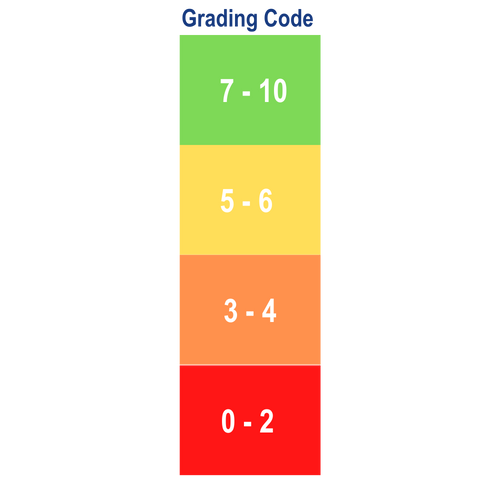
Choosing well-worded OKRs is one side of success, the other is discussing progress regularly, e.g. bi-weekly. For this, it helps to visibly grade progress. Some prefer to work with color codes from the beginning. I.e. all Key Results start in red and partly reach the colors orange, yellow and green during the quarter. Others prefer to work with the numbers 0,0 – 1 during the quarter and use the colors only at the quarterly review. A third possibility are progress bars, where the filled area increases step by step.

Progress visualization increases motivation because messenger substances such as dopamine and endorphins are released in the brain.

Mag. Gunther Fürstberger

Mag. Gunther Fürstberger

CEO | MDI Management Development International

Gunther Fürstberger is a management trainer, author and CEO of Metaforum and MDI – a global consulting company providing solutions for leadership development. His main interest is to make the world a better place through excellent leadership. He has worked for clients including ABB, Abbvie, Boehringer Ingelheim, DHL, Hornbach, PWC and Swarovski. His core competence is leadership in digital transformation. He gained his own leadership experience as HR Manager of McDonald’s Central Europe/Central Asia.  At the age of 20 he already started working as a trainer.

  • LinkedIn

What serves you next?

Benefits of OKR

What are the benefits of the OKR system?

What are the benefits of the OKR method and how does it work exactly? MDI trainer and OKR master Susanne Spath gives us an introduction and a story to visualize the OKR method.

Read article

Agile leadership orientation and basics

Agile leadership - orientation and basics

There are plenty of agile methods – but what are the benefits of each method? MDI trainer Alexandra Sock talks about her agile leadership seminar, which gives you an overview of different agile methods.

Read article

Scrum& Agile leadership

Scrum & Agile leadership

Scrum is one of the oldest agile methods and is the mother of all agile methods in many people’s opinion. Susanne Spath is OKR master and Scrum certified gives us an introduction to this method and tells us for whom it makes sense to implement Scrum.

Read article

or maybe this?

How to become resilient? Your personal superpower

How to become resilient? Your personal superpower

by Anita Berger, ARD | Sep 26, 2022 | Agile Leadership, Leadership Tips | 0 comments

How to become resilient? Your personal superpower

Meeting the challenges in the VUCA/BANI world

In this article you will get an insight into key competencies as well as starting points to strengthen your own resilience. Concrete reflection questions and tips for implementation will let you become a “pro” of your own superpower.

VUCA & BANI

VUCA or BANI as explanatory models for our challenges

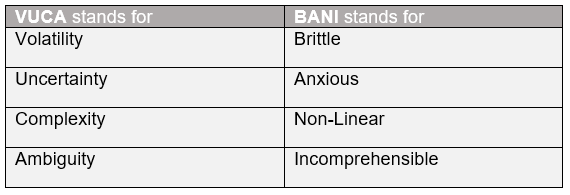
In our daily professional lives, we are constantly confronted with turbulence. The following models provide a framework to bring challenges closer for companies and for society as a whole:

All these terms define what we are up against in this ever-changing society – a fragile system that is only fueled by uncertainty and anxiety, as well as complex, non-linear problems. The demands on organizations and leadership are sometimes ambiguous and contradictory, but also incomprehensible.

Key competencies for your superpower

to meet these challenges

Resilience in dealing with crises and challenges

Jamais Cascio counters these complex models with a response option: RAAT (Resilience, Awareness, Adaptation and Transparency). For the first factor alone – resilience – there are several models. I present the Vienna Resilience Model below.

Seven key resilience competencies

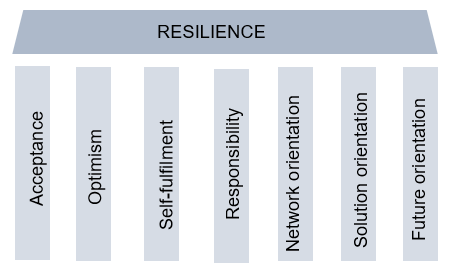
The Vienna Resilience Model describes seven key resilience competencies that positively influence a person’s resilience:

The basic pillars of resilience are 

  • acceptance
  • optimism
  • self-fulfilment
  • responsibility
  • network orientation
  • solution orientation
  • future orientation.

Each of these factors plays an important role in strengthening one’s resilience.

Strengthening the superpower of resilience holistically

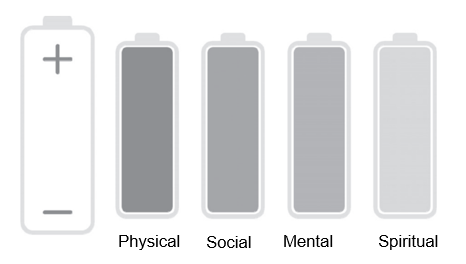
In contrast to the Vienna Resilience Model, Stephen Covey identifies four pillars in his 7 Habits of Highly Effective People, which are also found in most other models to strengthen one’s resources and thus one’s resilience.

When reflecting on how you use your resources, you should take each resource individually and consider how well you take care of each. This could be in the form of the following approaches, for example:

  • Physical: I regularly keep myself informed about things that affect my health and fitness.
  • Mental: I clear my head every day through, for example, music, silence or relaxation exercises.
  • Social: I listen to others and pay attention to what they have to say instead of thinking about what I want to say.
  • Spiritual: I have the courage to stand my ground even when others oppose me.

Becoming the “pro” of your own superpower –

tips for implementation

If we want to strengthen our resilience, we sometimes need to develop new habits and behaviors or retrain “bad habits” (for example, taking the stairs instead of the elevator). James Clear’s (2020) 1% method states that the best way to achieve goals is to get a little better every day, i.e., to work towards them in small steps for maximum impact. Improving 1% per day will yield a 37-fold increase in one year.

Conclusion

The VUCA or BANI world presents challenges to all of us. In dealing with these challenges, we can further “nurture” or build our key competencies of resilience by being aware of them as a first step.

In small steps and with the coupling to our previous habits, we can then integrate our resources, which further strengthens our superpower resilience holistically into our behavioral repertoire

Read the full (german) article that was written for ARD Magazin | Edition 6814/6/2022

Anita Berger

Anita Berger

Executive Coach, Consultant, Trainer & Managing Partner MDI

Anita Berger is an executive coach, consultant and trainer specialising in leadership development and international human resource management. She is a partner of MDI Management Development International. For more than 15 years she has worked in management and leadership positions (among others as HR-
Director at Coca-Cola Hellenic and HR Manager at Konica Minolta Business Solutions).

  • LinkedIn

What might help you next?

Leading in the Age of AI: How AI Discourse Shapes Responsibility and Power

by Meike Hinnenberg | 18. March 2026 | Impuls series, Leadership and AI, Leadership Tips | 0 Comments

Leading in the Age of AI: How AI Discourse Shapes Responsibility and Power Meike’s Reflections on Artificial Intelligence Do you prefer to listen to this article? Click below to access our AI-generated audio version!Leading in the Age of AI: How AI Discourse Shapes...
Read More

AI Ethics for Leaders: Why Context and Critical Thinking Matter More Than Ever

by Meike Hinnenberg | 11. March 2026 | Impuls series, Leadership and AI, Learning Transfer | 0 Comments

AI Ethics for Leaders: Why Context and Critical Thinking Matter More Than Ever. Meike’s Reflections on Artificial Intelligence Do you prefer to listen to this article? Click below to access our AI-generated audio version!AI Ethics for Leaders: Why Context and Critical...
Read More

A Success Story – When AI Sharpens Human Judgement

by Claude MacDonald, Rafael Ungvari | 6. March 2026 | Customer Story, Digital Transformation, Leadership and AI | 0 Comments

A Success Story – When AI Sharpens Human Judgement Do you prefer to listen to this article? Click here to access our AI-generated audio version! When AI Amplifies Human Judgment: A Customer Success Story About This Project At MDI, we believe that great leadership and...
Read More

How Do You Lead People Who Don’t Think the Way You Do?

by Zeca Ruiz | 4. February 2026 | Leadership Impact, Leadership Tips, Learning Transfer | 0 Comments

How Do You Lead People Who Don't Think the Way You Do? Do you want to listen to this article? Click here to access our AI-generated audio version!   How do you lead people who do not think the way you do? Leadership is a challenge, especially when you are not...
Read More

How You Deal With Neurodiversity as a Leader

by Iris Kandlbauer | 3. February 2026 | Leadership Impact, Leadership Tips, Short Knowledge Bits | 0 Comments

How You Deal With Neurodiversity as a Leader You prefer listening to this article? You can find our AI-generated audio version below! How You Deal With Neurodiversity as a Leader What might be behind “strange” behavior in a team—and how leaders can deal with it...
Read More

Anita’s Key to Success for International Cooperation

by Jana Wölfl | 3. February 2026 | Leadership and AI, Leadership Tips, MDI Spotlight Series | 0 Comments

Anita's Key to Success for International Cooperation This blog is an excerpt from our new podcast! You can find the entire podcast episode here. Anita's Key to Success for International Cooperation In our new video podcast format, “Voices of Leadership – an MDI...
Read More

Fostering True Workplace Commitment

by Marcin Swierkocki | 14. January 2026 | Leadership Tips, Learning Transfer, Short Knowledge Bits | 0 Comments

Fostering True Workplace Commitment Do you prefer to listen to this article? Click below to access our AI-generated audio version! Fostering True Workplace Commitment Throughout my years of practice, I've found that deep workplace commitment is achieved not through...
Read More

Marcin Swierkocki on the Full Range Leadership Model

by Jana Wölfl | 19. December 2025 | Leadership and AI, Leadership Tips, MDI Spotlight Series | 0 Comments

Marcin Swierkocki on the Full Range Leadership Model This blog is an excerpt from our new podcast! You can find the entire podcast episode here. Marcin Swierkocki on the Full Range Leadership Model In the newest episode of our podcast “Voices of Leadership | An MDI...
Read More

Self-Efficacy in Change: Why It Matters

by Anita Berger | 17. December 2025 | Leadership Tips, Learning Transfer, Short Knowledge Bits | 0 Comments

Why It Matters When Transformation Gets Hard Do you prefer to listen to this article? Click below to access our AI-generated audio version:Self-Efficacy: Why It Matters When Transformation Gets Hard Change can be exhausting.Especially when things are unclear,...
Read More

Generation Z isn’t the Problem but Our System is

by Zeca Ruiz | 3. December 2025 | Impuls series, International leadership development, Leadership in the digital transformation | 0 Comments

Generation Z Isn’t the Problem, but Our System is. Read this article on crossgenerational management by Zeca Ruiz to find out more!

Read More

Information

  • Imprint
  • MDI company website

Social Media

  • Facebook
  • Twitter
  • Youtube
  • LinkedIn

© MDI Management Development Institute, 2020