
• MDI
  • German version
  • Contact us
MDI Management Development
  • Agile leadership
  • Lateral Leadership
  • Leadership Impact
  • Leadership Development
Select Page
The ARS Seminar: Lateral Leadership and AI Role-Playing

The ARS Seminar: Lateral Leadership and AI Role-Playing

by Gunther Fürstberger | Aug 23, 2024 | Digital Transformation, Leadership in the digital transformation, MDI Inside | 0 comments

The ARS Seminar: Lateral Leadership and AI Role-Playing

Immerse yourself in the world of lateral leadership with us and experience realistic role-playing with state-of-the-art AI technology! These methods bring a breath of fresh air to the world of leadership development and show how modern approaches can be successfully applied in practice.

Role-playing in Training

Role-plays have been used in communication training for decades to try out real-life challenges in a safe environment and develop skills. These usually take place either with voluntary participants in front of the group or several groups in parallel.

In the first case, the trainer can give direct feedback, in the second case more participants have the opportunity to practice. Not everyone loves role-playing, but overall it is an effective method for developing social skills.

However, the method also has disadvantages that can now be overcome by artificial intelligence: Trainers or even professional actresses don’t work for free. Training and application dates may be far apart, and by then much will have been forgotten.

Role-playing in training

Large Language Models

With the help of LLMs (Large Language Models), on the other hand, it is possible to train as often as required at a fraction of the cost shortly before real-life use. The ChatGPT 4.0 app offers well-functioning language input and output and can access extensive knowledge, such as the DISG model or the Harvard Principles of Negotiation.

Some trainers at MDI have been experimenting with it for a year now, and the participants are enthusiastic. We demonstrate a role play in front of the group, involve several participants, and then pass on the prompt used for self-practice.

AI in Various Management Systems

We have further developed the prompts so that the feedback from the AI is precisely aligned with the models taught in the seminar. In addition, the resistance intensity of the AI role-play partner has been optimized.

Anyone who would like to experience this in reality will have the opportunity to do so in the ARS seminar “Lateral Leadership” from 22.10. to 23.10. Further exciting role-playing functions are currently being developed.

Mag. Gunther Fürstberger

Mag. Gunther Fürstberger

CEO | MDI Management Development International

Gunther Fürstberger is a management trainer, author and CEO of Metaforum and MDI – a global consulting company providing solutions for leadership development. His main interest is to make the world a better place through excellent leadership. He has worked for clients including ABB, Abbvie, Boehringer Ingelheim, DHL, Hornbach, PWC and Swarovski. His core competence is leadership in digital transformation. He gained his own leadership experience as HR Manager of McDonald’s Central Europe/Central Asia.  At the age of 20 he already started working as a trainer.

  • LinkedIn

Download our International Whitepaper:
 

What serves you next?

AI Ethics for Leaders: Why Context and Critical Thinking Matter More Than Ever

by Meike Hinnenberg | 11. March 2026 | Impuls series, Leadership and AI, Learning Transfer | 0 Comments

AI Ethics for Leaders: Why Context and Critical Thinking Matter More Than Ever. Meike’s Reflections on Artificial Intelligence Do you prefer to listen to this article? Click below to access our AI-generated audio version!AI Ethics for Leaders: Why Context and Critical...
Read More

A Success Story – When AI Sharpens Human Judgement

by Claude MacDonald, Rafael Ungvari | 6. March 2026 | Customer Story, Digital Transformation, Leadership and AI | 0 Comments

A Success Story – When AI Sharpens Human Judgement Do you prefer to listen to this article? Click here to access our AI-generated audio version! When AI Amplifies Human Judgment: A Customer Success Story About This Project At MDI, we believe that great leadership and...
Read More

How Do You Lead People Who Don’t Think the Way You Do?

by Zeca Ruiz | 4. February 2026 | Leadership Impact, Leadership Tips, Learning Transfer | 0 Comments

How Do You Lead People Who Don't Think the Way You Do? Do you want to listen to this article? Click here to access our AI-generated audio version!   How do you lead people who do not think the way you do? Leadership is a challenge, especially when you are not...
Read More

How You Deal With Neurodiversity as a Leader

by Iris Kandlbauer | 3. February 2026 | Leadership Impact, Leadership Tips, Short Knowledge Bits | 0 Comments

How You Deal With Neurodiversity as a Leader You prefer listening to this article? You can find our AI-generated audio version below! How You Deal With Neurodiversity as a Leader What might be behind “strange” behavior in a team—and how leaders can deal with it...
Read More

Anita’s Key to Success for International Cooperation

by Jana Wölfl | 3. February 2026 | Leadership and AI, Leadership Tips, MDI Spotlight Series | 0 Comments

Anita's Key to Success for International Cooperation This blog is an excerpt from our new podcast! You can find the entire podcast episode here. Anita's Key to Success for International Cooperation In our new video podcast format, “Voices of Leadership – an MDI...
Read More

Fostering True Workplace Commitment

by Marcin Swierkocki | 14. January 2026 | Leadership Tips, Learning Transfer, Short Knowledge Bits | 0 Comments

Fostering True Workplace Commitment Do you prefer to listen to this article? Click below to access our AI-generated audio version! Fostering True Workplace Commitment Throughout my years of practice, I've found that deep workplace commitment is achieved not through...
Read More

Marcin Swierkocki on the Full Range Leadership Model

by Jana Wölfl | 19. December 2025 | Leadership and AI, Leadership Tips, MDI Spotlight Series | 0 Comments

Marcin Swierkocki on the Full Range Leadership Model This blog is an excerpt from our new podcast! You can find the entire podcast episode here. Marcin Swierkocki on the Full Range Leadership Model In the newest episode of our podcast “Voices of Leadership | An MDI...
Read More

Self-Efficacy in Change: Why It Matters

by Anita Berger | 17. December 2025 | Leadership Tips, Learning Transfer, Short Knowledge Bits | 0 Comments

Why It Matters When Transformation Gets Hard Do you prefer to listen to this article? Click below to access our AI-generated audio version:Self-Efficacy: Why It Matters When Transformation Gets Hard Change can be exhausting.Especially when things are unclear,...
Read More

Generation Z isn’t the Problem but Our System is

by Zeca Ruiz | 3. December 2025 | Impuls series, International leadership development, Leadership in the digital transformation | 0 Comments

Generation Z Isn’t the Problem, but Our System is. Read this article on crossgenerational management by Zeca Ruiz to find out more!

Read More

From Lab to Practice: What We Learned With AI

by Rafael Ungvari | 3. September 2025 | Digital Transformation, Leadership and AI, Short Knowledge Bits | 0 Comments

From Lab to Practice: What We Learned With AI Do you prefer to listen to this article? Click here to access our AI-generated audio version! From Lab to Practice: What We Learned With AI AI in organizations isn’t a one-size-fits-all solution. And in people development,...
Read More
Purpose – Why Hybrid is more than a Buzzword

Purpose – Why Hybrid is more than a Buzzword

by Peter Grabuschnig | Mar 14, 2024 | Impuls series, Leadership Tips, Learning Transfer | 0 comments

Purpose – Why Hybrid is more than a Buzzword

Prefer to listen to the article? Click below to access our AI speech-generated audio. However, if you want to read it as usual, keep scrolling.

Purpose – Why Hybrid is more than a Buzzword

Is hybrid just a new trend? And what do different life realities of our employees have to do with it? In his new Rise Course, our MDI trainer and partner Peter Grabuschnig shares all his knowledge on Hybrid Leadership.

It offers a reflective look at your leadership behavior in times of new work, work location, and increasing flexibility. In this blog article, we will introduce you to the first pillar of the 3P model – Purpose. Enjoy reading!

What does hybrid even mean?

Even though the word hybrid can have different meanings in different contexts, one thing is clear – Hybrid is a mixture of two or more components. When we refer to Hybrid, we mean a combination of different workplaces, such as the office, the home office, or even abroad.

However, if we are honest, hybrid is still not perfect. That’s why I recommend considering how to enable more flexibility for employees in the future.

So who and what does this hybrid lifestyle have an impact on?

1. Ourselves:

In many companies you can now decide for yourself whether to work from home or at the office. This has significantly increased our flexibility.

2. The team:

Simply talking to our colleagues or going for a quick coffee break is not as easy as it used to be. Also, when planning office times, it is more likely to exclude others by forming groups or avoiding certain colleagues.

3. Leadership:

This goes far beyond the team level. It requires transparent communication, clear goals, and a strong commitment to the company. Maintaining performance and much more is expected of you as a leader.

4. Company:

Many companies are already considering what hybrid means for them and what benefits they can derive from it. One international client I advised even had the most productive year after the change to a hybrid setup.

Another customer decided to reduce the number of office buildings to 60%. The latter, however, is not a sustainable solution as there are days on which more people will want to go to the office.

An Appeal for better leaders

Why should I as a leader care about leading a hybrid team?

Around 45% of the global workforce, at least according to McKinsey, can do hybrid work. Whether we like it or not, for these 45% the newly gained flexibility plays an enormous role in balancing work and life.

Hybrid is also exciting from an evolutionary point of view – we went through the agricultural era, the age of industrialization, and the labor movement. Today, our computers and smartphones dictate when and where we work.

By deciding where we work, we are now able to balance our work and personal lives much better. Not only that, it has also improved other aspects:

1. Technology:

We had to learn how to use new technologies and things are now working that we couldn’t have thought possible a few years ago. For example, taking part in an online workshop with the whole team from home.

From a technical point of view, a lot has developed in the last few years. Some new technologies such as VR will digitalize our collaboration even further in the future. It would, for example, make it possible to meet in a virtual room in 3D instead of just looking at your laptop in two dimensions.

Other developments such as AI or augmented reality are also revolutionizing the way we collaborate remotely.

2. Employees:

We can no longer avoid a hybrid setup – that is mainly because our employees have demanded it and even threatened to quit if they can’t work in a flexible environment.

So to be an attractive employer today, you need to think carefully about what you need your employees to do in the office, where flexibility makes sense, and what you can offer them.

Let’s now take a closer look at the individual life realities of our team members…

People have different expectations and life concepts, their job has to suit them. If it doesn’t fit, you look for another job. The fact that many aspects of our work can be taken over by machines gives us more freedom to create.

The classical performance-based society which encourages a lot of overtime and focuses on presence is becoming increasingly outdated.

A Microsoft study has shown the situation regarding hybrid working among employees and their individual preferences. Two out of 10 respondents would like to work exclusively from the office. This can be due to a variety of reasons, such as feeling lonely at home.

Surprisingly, 3 out of 10 don’t want to go back to the office at all. This could be due to care obligations, for example. Half of the respondents want a combination. Some prefer one home office day per week, while others would like to have more. These figures give us an idea of how many different life realities we as leaders now have to juggle.

Hybride Arbeit

The one-size-fits-all approach is no longer possible and there is no uniform solution that satisfies everyone. We have to respond individually to each employee and develop a suitable solution for the whole team.

The work environment has changed considerably, but the requirements for leadership have remained the same. Employees still expect recognition, fairness, open and transparent communication, a motivating work environment in which they can develop, and flexibility to balance life and work.

The leadership priorities have shifted. For example, in the hybrid daily routine, much more attention needs to be paid to communication, so that everyone knows everything they need to know.

What has changed is not the content but the context in which we work. Thus, we need to adapt our systems and behavior to the context to be successful.

I would like to give you one more piece of food for thought. I would like to invite you to take a retrospective look at the last 6 months of your work.

  • What experiences have you had in terms of hybrid working? What has (not) worked well?
  • What were/what are your challenges?
  • What challenges will your team face in the future? What would you like to develop or continue from what you have already experienced and tried out?

You can do this task individually, with a colleague, or even in a small workshop with your whole team.

We hope you have enjoyed this snippet from Peter’s Rise course! You can contact us if you are interested in this course or follow along on our blog, where we will share other content of the course as well.

Click Here to Contact us
Peter Grabuschnig

Peter Grabuschnig

Trainer, Coach & MDI Partner

Peter is a partner and trainer at MDI, advising major international corporations on implementing hybrid work policies and building a hybrid work and leadership culture.

He is considered an expert in training design. With his Webinar Guru Framework he has developed a tool that helps to design training content for successful and activating virtual learning.

  • LinkedIn

Get a glimpse into the elearning:

Changing the World with Hybrid Leadership

Changing the World with Hybrid Leadership

by Peter Grabuschnig | Mar 14, 2024 | eLearning, Impuls series, Leadership Tips | 0 comments

Changing the World with Hybrid Leadership

Prefer to listen to the article? Click below to access our AI speech-generated audio. However, if you want to read it as usual, keep scrolling.

Changing the World with Hybrid Leadership

In his new Rise Course, our trainer and partner Peter Grabuschnig shares all his knowledge on Hybrid Leadership. It offers a reflective look at your leadership behavior in times of new work, work location, and increasing flexibility.

In this blog article, we will introduce you to the overall course and give you a few basic concepts that will be dealt with. Enjoy reading!

The Three Ps

The topic is explored from three different angles: the Purpose-People-Performance (3Ps) model developed by MDI. The course will provide theoretical knowledge and practical tips and tools that you can implement directly into your day-to-day work as a leader.

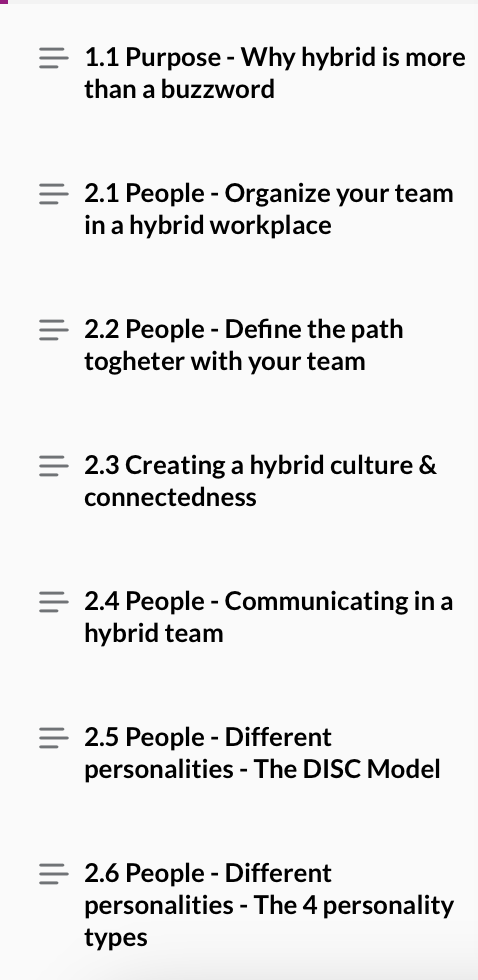
Purpose – We will look at why hybrid leadership is important and why it is not just a new buzzword.

People – We work and reflect on organizational and interpersonal issues. 

Performance – We will evaluate what constitutes performance and how we can better measure performance in the hybrid day-to-day.

What will be covered?

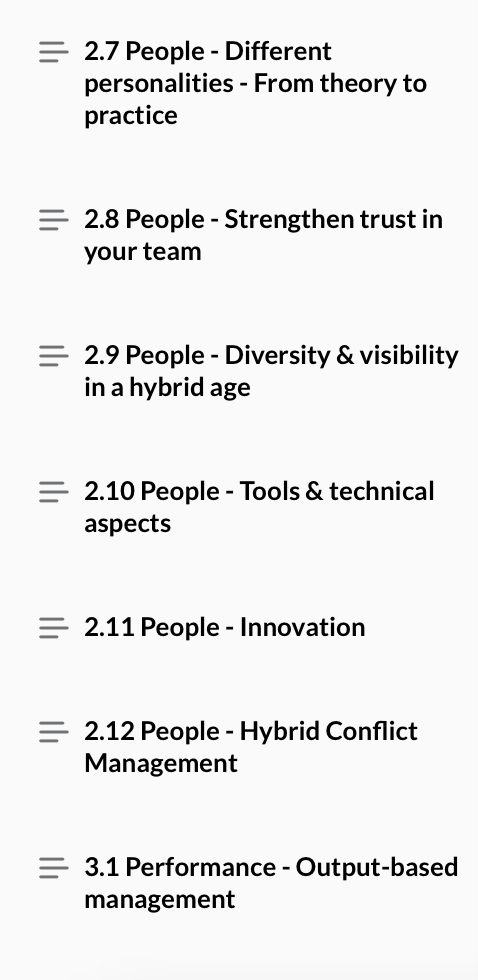
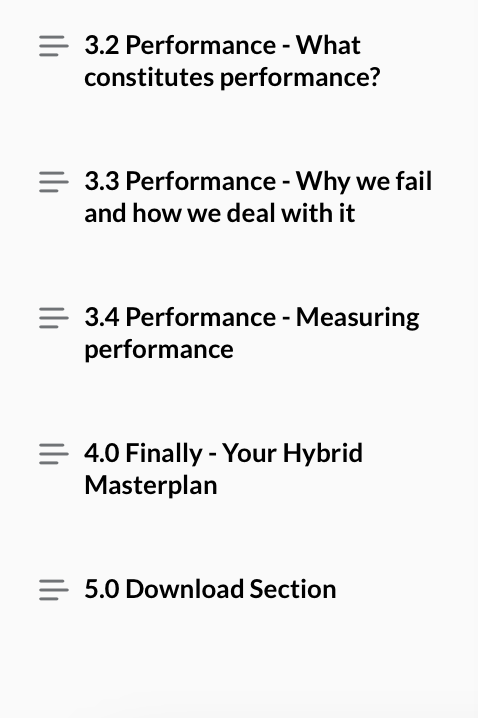
  • The impact of the flexibilization of the working world on leaders
  • Why it is no longer possible to avoid a hybrid working world and how to make the most out of it
  • How to organize your team efficiently in the new environment
  • How to deal with different life realities and personalities
  • How to conduct difficult conversations and what is important in hybrid conflicts
  • Which role do diversity and inclusion play in the hybrid context
  • What you need to foster innovation in the team
  • What you need to achieve high performance in the team
  • How to measure and push performance despite a hybrid setup

Modules

The course is modular. So you can view it entirely, or just focus on areas that are particularly relevant for you. The first module “Purpose” is recommended to be viewed in its entirety.

Goal

The goal is not to reinvent leadership, but to question and reflect on one’s leadership in the hybrid context and to get new impulses and ideas on how to lead oneself and the team in the new context of a hybrid workplace.

We are very excited to experience this new adventure with you and delve more into the complex and exciting world of hybrid leadership! You can contact us if you are interested in this Rise course or follow along on our blog, where we will share a few snippets of the course as well.

Click Here to Contact us
Peter Grabuschnig

Peter Grabuschnig

Trainer, Coach & MDI Partner

Peter is a partner and trainer at MDI, advising major international corporations on implementing hybrid work policies and building a hybrid work and leadership culture.

He is considered an expert in training design. With his Webinar Guru Framework he has developed a tool that helps to design training content for successful and activating virtual learning.

  • LinkedIn

Get a glimpse into the elearning:

AI-Enhanced Leadership: Maximizing Potential with Intelligent Tools

AI-Enhanced Leadership: Maximizing Potential with Intelligent Tools

by Alina Helmlinger | Dec 4, 2023 | Impuls series, Leadership and AI, Leadership in the digital transformation | 0 comments

AI-Enhanced Leadership: Maximizing Potential with Intelligent Tools

Let’s also take a closer look at Ai vs. human – Who has more charisma in today’s world? 

Do you prefer to listen to this article? Click below to access our AI-generated version of this blog article!

AI-Enhanced Leadership: Maximizing Potential with Intelligent Tools

The integration of artificial intelligence (AI) into the world of work presents new challenges and opportunities for leadership development. As AI revolutionizes the landscape of learning and people development, questions arise about the role of leadership in a technologically advanced environment.

In an exclusive interview with Niels Cimpa, learning coach and AI expert, we explore how AI can be integrated into leadership development and what new skills will become increasingly important in an AI-driven world.

How can artificial intelligence AI be used in leadership development and training?

I believe that artificial intelligence (AI) is playing an increasingly important role in leadership training and development, both in formal educational institutions and in continuing education programs. In my opinion, AI can teach complex models and content better and in more detail than humans because it has access to a huge database.

In a leadership seminar, for example, a human could present the basic content, but individual exercises or questions could be answered more effectively by AI. I also see great potential for AI in self-study, such as online learning. As a leader, for example, I could train with an AI to practice non-violent communication and receive individual feedback and explanations.

Thanks to its extensive database, AI can explain content to me in a wide range of scenarios and variations that go beyond the knowledge of a trainer. I therefore believe that AI can contribute a lot to leadership development, especially in terms of content.

Which skills and competencies do you think will become increasingly important for leaders in a working world shaped by AI?

I think that the role of the leader will change in a working world characterized by AI. As AI can increasingly take on content-related tasks, the focus of leaders in the 21st century is shifting away from pure specialist knowledge towards interpersonal skills.

In the future, it will be more important for leaders to think about how they motivate their team, how they set goals, and how they promote a positive culture of discussion and corporate culture. It’s about taking on a supportive and communicative role that focuses on social skills.

I also see problem-solving skills, particularly in the interpersonal area, as increasingly important. Skills such as coaching, i.e. working with people on specific topics, and guiding them through problem-solving processes are becoming increasingly important.

AI can take on many tasks, but it cannot coach or respond individually to personal problems. I therefore believe that, in addition to social skills, shaping interpersonal relationships is becoming increasingly important for leaders.


team meeting

This brings me to my next question: what challenges and opportunities does the integration of AI in leadership development present?

I see mostly opportunities in the integration of AI into leadership development, although there are also challenges. One of the biggest challenges I see is the initial skepticism and the need to find out what is feasible with AI in the company.

Leaders first have to embrace the new possibilities and try out many things. Despite initial rejection, companies that are already working with AI have significantly increased their productivity, particularly in the area of training and leadership development.

The opportunities lie primarily in the fact that leaders can focus more on leadership and developing social skills. This can make the corporate culture more human and approachable and potentially flatten hierarchies to a large extent.

Another challenge for leaders is to hand over certain tasks to AI, as they are used to being in control and being informed about everything. This requires a rethink and allowing AI to be more “competent” in certain areas. The advantage of this is that it frees up resources, both for the leader and for the company as a whole.

As a leader, it is therefore very important to think carefully about what role and tasks AI should take on in the company. It is recommended that AI is used to expand knowledge and facilitate work processes. Data protection is a key aspect of this.

I hear a lot that it is a challenge for the leaders of today and tomorrow to concretize the use of AI and to really hand over competencies and tasks so that this can also be achieved.

Yes, I agree that it is a major challenge for leaders to concretize the use of AI in the company and to effectively hand over certain skills and tasks to AI. It’s about managing this change. I would like to add that there is a lot to define, especially the strengths, weaknesses, and dangers of AI.

It is important to set clear rules about what AI can and cannot do, and what tasks it should and should not take on. Defining these guidelines for the use of AI in the company is crucial, especially in the current phase, which can seem somewhat chaotic.

Yes, and I know this myself from our company, it’s simply a matter of trying, trying, trying, as you mentioned earlier. In other words, really engaging in discourse, testing things together, and concluding yourself and your own company.

What do you think about the assumption that AI can largely affect our business in the sense of “Is it even necessary to send leaders on training courses”?

I think that the personal component in terms of learning is indispensable. The experience of seeing a person on a stage, feeling their energy, and being inspired by them is something that AI cannot replace. So I think AI will take over certain areas of training; for some people, it may even be able to do most of the training work.

However, some people prefer interpersonal contact and need the emotion and energy of a physical presence. So I don’t think AI will make the training business completely obsolete, as human interaction will continue to be important. However, there will be areas and target groups that prefer to learn with AI.

Similar to social media or YouTube, where some people prefer to learn via online courses. But I wouldn’t want to learn everything online, even if it were possible. Sometimes I just want to go to an event for the experience, the education, the networking, and that’s something that AI can’t offer me.


generational management

That’s why I think it’s really important to see AI as a complementary tool to the existing training opportunities that we use today.

Exactly, it’s about finding a balance and not competing with AI. In terms of knowledge transfer, I probably can’t compete with AI, as it is superior in this area. However, when it comes to charisma, AI can’t compete with me because it simply doesn’t have these human qualities.

Now I’d like to come to an end and talk about your book “Learning Successfully with ChatGPT”. What can leaders learn from your book for dealing with ChatGPT?

My book “Erfolgreich mit ChatGPT lernen” (Learning successfully with ChatGPT), which is mainly aimed at pupils and students, is about effective learning methods with ChatGPT. The book not only conveys specific factual knowledge but also general learning strategies on how to learn quickly and actively. Although the book is primarily aimed at younger learners, the content is useful for anyone.

The ability to quickly familiarize yourself with and understand a topic is extremely valuable. The book shows how to quickly grasp a topic and talk about it, which is especially important in interpersonal interactions. Learning is and remains an important skill, and my book provides guidance on how to acquire knowledge and learn languages efficiently. It also describes how AI can be used as support, for example as a digital assistant or mentor.

Conclusion

In summary, it can be said that the use of AI in leadership development offers the opportunity to convey complex content in a more detailed and individualized way. It is clear that AI not only serves as a tool for more efficient learning but also helps to direct leaders’ focus on social skills and team dynamics.

The challenge lies in integrating AI into existing structures in a meaningful way without neglecting the human component. The integration of AI represents a balance between technological support and the preservation of essential human interactions.

It is about using AI as a complementary tool that enriches the development of leaders without replacing the personal component of learning and leadership. AI thus serves not as a substitute, but as a valuable extension that allows leaders to focus on their core competencies while developing their skills in a technologically advanced environment.

Alina Helmlinger

Alina Helmlinger

L&D Consultant, MA

Alina has been an L&D Consultant at MDI since 2021 and supports clients from various industries in the tailor-made design of various leadership development programs and training courses. In addition to her practical knowledge and the experience she has already gained in further training, she draws on her sound theoretical knowledge from her Bachelor’s degree in Human Resources Management and her Master’s degree in Organizational and Personnel Development, which she completed in June 2022. Alina keeps calm, especially in challenging situations and leaders to reconcile the interests of different stakeholders in complex projects, thereby designing tailor-made HR solutions geared towards customers’ needs.

  • LinkedIn

Download our MDI Paper:

Paper Mock Up

This could also help you:

AI Ethics for Leaders: Why Context and Critical Thinking Matter More Than Ever

by Meike Hinnenberg | 11. March 2026 | Impuls series, Leadership and AI, Learning Transfer | 0 Comments

AI Ethics for Leaders: Why Context and Critical Thinking Matter More Than Ever. Meike’s Reflections on Artificial Intelligence Do you prefer to listen to this article? Click below to access our AI-generated audio version!AI Ethics for Leaders: Why Context and Critical...
Read More

A Success Story – When AI Sharpens Human Judgement

by Claude MacDonald, Rafael Ungvari | 6. March 2026 | Customer Story, Digital Transformation, Leadership and AI | 0 Comments

A Success Story – When AI Sharpens Human Judgement Do you prefer to listen to this article? Click here to access our AI-generated audio version! When AI Amplifies Human Judgment: A Customer Success Story About This Project At MDI, we believe that great leadership and...
Read More

How Do You Lead People Who Don’t Think the Way You Do?

by Zeca Ruiz | 4. February 2026 | Leadership Impact, Leadership Tips, Learning Transfer | 0 Comments

How Do You Lead People Who Don't Think the Way You Do? Do you want to listen to this article? Click here to access our AI-generated audio version!   How do you lead people who do not think the way you do? Leadership is a challenge, especially when you are not...
Read More

How You Deal With Neurodiversity as a Leader

by Iris Kandlbauer | 3. February 2026 | Leadership Impact, Leadership Tips, Short Knowledge Bits | 0 Comments

How You Deal With Neurodiversity as a Leader You prefer listening to this article? You can find our AI-generated audio version below! How You Deal With Neurodiversity as a Leader What might be behind “strange” behavior in a team—and how leaders can deal with it...
Read More

Anita’s Key to Success for International Cooperation

by Jana Wölfl | 3. February 2026 | Leadership and AI, Leadership Tips, MDI Spotlight Series | 0 Comments

Anita's Key to Success for International Cooperation This blog is an excerpt from our new podcast! You can find the entire podcast episode here. Anita's Key to Success for International Cooperation In our new video podcast format, “Voices of Leadership – an MDI...
Read More

Fostering True Workplace Commitment

by Marcin Swierkocki | 14. January 2026 | Leadership Tips, Learning Transfer, Short Knowledge Bits | 0 Comments

Fostering True Workplace Commitment Do you prefer to listen to this article? Click below to access our AI-generated audio version! Fostering True Workplace Commitment Throughout my years of practice, I've found that deep workplace commitment is achieved not through...
Read More

Marcin Swierkocki on the Full Range Leadership Model

by Jana Wölfl | 19. December 2025 | Leadership and AI, Leadership Tips, MDI Spotlight Series | 0 Comments

Marcin Swierkocki on the Full Range Leadership Model This blog is an excerpt from our new podcast! You can find the entire podcast episode here. Marcin Swierkocki on the Full Range Leadership Model In the newest episode of our podcast “Voices of Leadership | An MDI...
Read More

Self-Efficacy in Change: Why It Matters

by Anita Berger | 17. December 2025 | Leadership Tips, Learning Transfer, Short Knowledge Bits | 0 Comments

Why It Matters When Transformation Gets Hard Do you prefer to listen to this article? Click below to access our AI-generated audio version:Self-Efficacy: Why It Matters When Transformation Gets Hard Change can be exhausting.Especially when things are unclear,...
Read More

Generation Z isn’t the Problem but Our System is

by Zeca Ruiz | 3. December 2025 | Impuls series, International leadership development, Leadership in the digital transformation | 0 Comments

Generation Z Isn’t the Problem, but Our System is. Read this article on crossgenerational management by Zeca Ruiz to find out more!

Read More

From Lab to Practice: What We Learned With AI

by Rafael Ungvari | 3. September 2025 | Digital Transformation, Leadership and AI, Short Knowledge Bits | 0 Comments

From Lab to Practice: What We Learned With AI Do you prefer to listen to this article? Click here to access our AI-generated audio version! From Lab to Practice: What We Learned With AI AI in organizations isn’t a one-size-fits-all solution. And in people development,...
Read More
Promoting Cohesion and Retaining Talent: Leadership in Focus

Promoting Cohesion and Retaining Talent: Leadership in Focus

by Peter Grabuschnig | Aug 17, 2023 | International leadership development, Leadership in the digital transformation, training new leader | 0 comments

Promoting Cohesion and Retaining Talent: Leadership in Focus

Prefer to listen to the article? Click below to access our AI speech-generated audio. However, if you want to read it as usual, keep scrolling.

Promoting Cohesion and Retaining Talent: Leadership in Focus

In a changing world of work, where motivation and employee retention are crucial, leaders are increasingly in the spotlight. Current statistics send alarming signals: 60% of leaders receive no leadership development at all. Gallup’s “State of the Global Workplace” report highlights the urgency of this problem.

Learn with this article how targeted leadership development can strengthen cohesion and serve as a key to retaining and motivating talent.

The motivation of European employees is in danger

People lack recognition for their performance. Much emphasis is placed on employer branding and new recruiting strategies – but what can leaders use to retain and motivate employees over the long term?

The “State of the Global Workplace” report by Gallup (June 2023) confirms this lack of motivation, which many HR managers suspected. Only a small number of employees show a real commitment to their work, colleagues, or supervisors.

Most respondents merely perform their duties and see their job as a means to an end. Worryingly, 72% of these people would change jobs given a better opportunity.

In Austria, only one in 10 employees are motivated on the job and feel a strong connection to the company. These employees feel valued by their direct supervisors and are satisfied in the team environment. They are also willing to go the “extra mile,” which is important in most companies.

More recognition and flexibility

Our goal for the future, at least according to Gallup, should be to support this specific group of employees in the company. As quickly as you can lose them, turning them into loyal employees would in principle be possible.

Small changes are often enough, such as

  • increased recognition
  • more flexibility
  • confidence in their abilities
  • or the expansion of a clearly defined scope for action and decision-making.

Jon Clifton, CEO of Gallup, sums it up:

“To address the challenges of our time, we need to change the way we lead people.”

Promoting Cohesion and Retaining Talent

Leadership in focus

This is a clear message that is not only directed at HR departments but above all at leaders. Both the times and the nature of leadership are changing and require new requirements and approaches. This does not necessarily mean that previous approaches were bad.

Nevertheless, we should think about how to respond to the new realities of our time. The COVID-19 pandemic has woken people up – not only to digitalization but also to their own work-life balance.

Developing a culture of belonging

The question that now arises is how companies are able, despite growing flexibility in the form of home offices, new time models, etc., to establish a culture that creates a sense of connection and belonging despite partial physical distance.

While corporate culture is often shaped by top management, it emerges and develops in completely different places. Each team, each department, and even each division shapes its own culture. This often reflects the values of the company, but not always.

What is the reason for this? Leadership!

Employees are not motivated because of the awesomeness of the company they work for. The main reason is a well-functioning and stable team. The leader is responsible for this. And this is exactly where the starting point lies.

60% of leaders do not receive leadership development.

Individuals are often promoted into leadership positions without receiving adequate experience or training – a phenomenon known as the “Peter Principle.” These practices lead to competency gaps and tolerate poor leadership, which in turn can lead to high employee turnover.

Although there is obviously harmful leadership behavior, there is often no intervention, possibly due to relationships with top management or perceived expertise.

Promoting Cohesion and Retaining Talent

The time for tolerating bad leadership is over

This neglect has long-term negative effects on the company. It’s time to stop tolerating bad leadership. Two main ways that corporate culture is slowly decomposing are rewarding toxic team members and self-centered leaders.

Successful company cultures rely on collaboration and encouragement rather than selfish approaches. Employees with excessive egos appropriate success and discourage talented colleagues. By tolerating this harmful behavior, team dynamics are undermined.

In order to strengthen a sense of belonging, employee commitment, productivity, and resilience, it is critical to actively address poor leadership. The future requires close monitoring and effective action against this problematic behavior.

The leader is the key to any successful team.

While salary, flexibility, and additional benefits are important, they are not the all-inclusive solution. Even a modern office can’t attract someone if the team climate isn’t right. Debates about work schedules like the 4-day work week should only come to the forefront when the team and leadership are in harmony.

Improve retention:

The most effective way to solidify employee commitment to the company is through effective leadership at the direct level. Contemporary, values-based leadership development is critical.

One-off face-to-face seminars are no longer enough. Continuous support and individual team development are indispensable. Concrete steps such as coaching, empowerment, and servant leadership should be implemented comprehensively. Only in this way can the bond and togetherness in the team be strengthened to achieve successful results together.


Tips for strengthening connectedness & belonging in hybrid daily life:

  • Emphasize transparent communication, coaching, and clear goals in a community.
  • Encourage regular sharing, team activities, and projects.
  • Establish a supportive culture of appreciation.
  • Prioritize flexibility and inclusion.
  • Identify and encourage development opportunities.
  • Promote generational understanding.
  • Connect function and purpose (1on1 virtual, face-to-face solutions).
  • Enable digital collaboration.
  • Evaluate and challenge collaboration regularly.
Peter Grabuschnig

Peter Grabuschnig

Trainer, Coach & MDI Partner

Peter is a partner and trainer at MDI, advising major international corporations on implementing hybrid work policies and building a hybrid work and leadership culture.

He is considered an expert in training design. With his Webinar Guru Framework he has developed a tool that helps to design training content for successful and activating virtual learning.

  • LinkedIn

Download our Whitepaper:

Paper Mock Up
« Older Entries
Next Entries »

Information

  • Imprint
  • MDI company website

Social Media

  • Facebook
  • Twitter
  • Youtube
  • LinkedIn

© MDI Management Development Institute, 2020