
• MDI
  • German version
  • Contact us
MDI Management Development
  • Agile leadership
  • Lateral Leadership
  • Leadership Impact
  • Leadership Development
Select Page
Challenges and Solutions for Leadership in 2025

Challenges and Solutions for Leadership in 2025

by MDI & ARS Academy | Jan 14, 2025 | Best Practice, Leadership in the digital transformation, Leadership Tips | 0 comments

Challenges and Solutions for Leadership in 2025

Do you prefer to listen to this article? Click below to access our AI-generated audio version!

Leadership challenges and solutions in 2025

In an increasingly complex and uncertain world, companies and their leaders face numerous challenges. In collaboration with the ARS Academy, we conducted the Management Survey 2024. It offers valuable insights into the key issues that companies are currently dealing with and will deal with in the future.

It shows how companies can address internal and external challenges, with a particular focus on talent acquisition and work-life balance. Learn more about the results of the management survey in this blog post!

Key challenges: from talent management to digitalization

1. recruiting and retaining talent

For 67% of leaders, attracting and retaining qualified employees is the biggest challenge. The shortage of skilled workers, which is further exacerbated by demographic change, also makes it increasingly difficult to find suitable talent and retain them in the company in the long term.

Smaller companies with up to 250 employees are facing particular challenges. They often have fewer resources than large companies and must therefore be more creative to be perceived as attractive employers and to compete with the offers of larger companies.

2. Economic uncertainty

More than half of the respondents (54%) cite economic uncertainty as a problem that makes their planning more difficult. Volatile markets, geopolitical conflicts and rising operating costs mean that companies need to develop more flexible strategies.

3. Technological change

52% of companies see technological change as a key challenge. While digital skills are becoming increasingly urgent, investments in new technologies are prioritized more highly by smaller companies (65%) than by larger companies (41%).

4. Sustainability and ESG

Sustainability is also becoming more and more of a priority, mainly due to issues such as climate change and new legal requirements. 43% of companies have incorporated ESG strategies into their day-to-day operations, but only 12% reward the achievement of these goals with management bonuses.

This shows that sustainability is an issue for many companies, but is not yet fully anchored for all of them.

Key challenges: from talent management to digitalization<br />

Work-life balance: aspiration and reality

Our survey makes it clear that the work-life balance of employees is a top priority for leaders: 93% consider it to be “very important” or “somewhat important”. Interestingly, only 71% of leaders see their own work-life balance as equally fundamental.

This disparity shows that some leaders need to strengthen their role model function when it comes to self-care in order to promote a sustainable corporate culture in the long term.

The most important measures for a better work-life balance

  1. Remote work and home office: 85% of companies offer alternative working methods. We see this as a clear sign that adaptable workplace designs are becoming more and more common.
  2. Flexitime models: 82% offer flexible working hours to help their employees achieve a better work-life balance.
  3. Regular appraisals: 81% of leaders also use feedback sessions to identify and adapt to employee needs.
  4. Supporting physical and mental health: In addition to fitness programs (56%), offers such as stress management courses or access to psychological counseling (47%) play a central role. These measures help to promote the long-term well-being of employees.

The 4-day week as a pilot model

It is interesting to note that 12% of companies have already introduced a four-day working week – a model that could increase productivity and employee satisfaction in the long term. This change could also serve as a forerunner for further flexible working time models.

work life balance

Strategic solutions for the challenges of continuing education and adaptability

63% of companies rely on training to prepare employees for future challenges. Larger companies in particular (over 250 employees) focus on team-building measures and employee retention programs (66%).

50% of companies also plan to adapt their strategies to be able to react more flexibly to external influences. In small companies, this figure is as high as 59%, which demonstrates their agility.

Technological innovations

In addition to the introduction of digitization strategies (40%), technical training (55%) and access to modern hardware and software (51%) are essential components of the transformation efforts. Nevertheless, only 30% of the companies surveyed have implemented an AI strategy, which indicates a great need for further development in this area.

Leadership skills 2025: humanity and technology in harmony

The leaders of tomorrow will need a wide range of skills. According to our survey, the most important skills are:

  • Communication skills (62%): Crucial for leading teams and managing crises.
  • Leadership (59%): Essential for providing clear vision and strategy.
  • Problem-solving (48%): Critical for finding innovative solutions to complex problems.
  • Emotional intelligence (43 %): This is essential for fostering empathy and trust within the team.

These skills are crucial for overcoming the challenges of an increasingly complex and dynamic working environment and inspiring employees. Leaders must not only be technically competent, but also able to guide their teams through change and uncertainty.

Conclusion: A new balance between people and technology

The results of the 2024 management survey show that leaders need to prepare for a world in which both technological innovation and employee needs are important.

Successful leadership means remaining flexible, promoting talent, and always putting employees first. Striking the right balance between efficient work processes and a sustainable corporate culture will make all the difference – for your company and for your employees.

MDI Management International

MDI Management International

MDI is a global leader in leadership development with 60 years of experience. With offices worldwide and a network of over 250 international consultants and trainers, MDI offers training and consulting services in various languages. The company designs and implements customized programs for leaders at all levels, high potentials, experts, project managers, and salespeople – locally, internationally, and globally.
ARS Academy

ARS Academy

The ARS Academy is Austria’s largest private provider of professional seminars and is represented in all federal states. Around 1,000 selected top experts from business, practice and law pass on their knowledge in around 1,200 different events to around 18,500 participants per year.


What serves you next?

AI Ethics for Leaders: Why Context and Critical Thinking Matter More Than Ever

by Meike Hinnenberg | 11. March 2026 | Impuls series, Leadership and AI, Learning Transfer | 0 Comments

AI Ethics for Leaders: Why Context and Critical Thinking Matter More Than Ever. Meike’s Reflections on Artificial Intelligence Do you prefer to listen to this article? Click below to access our AI-generated audio version!AI Ethics for Leaders: Why Context and Critical...
Read More

A Success Story – When AI Sharpens Human Judgement

by Claude MacDonald, Rafael Ungvari | 6. March 2026 | Customer Story, Digital Transformation, Leadership and AI | 0 Comments

A Success Story – When AI Sharpens Human Judgement Do you prefer to listen to this article? Click here to access our AI-generated audio version! When AI Amplifies Human Judgment: A Customer Success Story About This Project At MDI, we believe that great leadership and...
Read More

How Do You Lead People Who Don’t Think the Way You Do?

by Zeca Ruiz | 4. February 2026 | Leadership Impact, Leadership Tips, Learning Transfer | 0 Comments

How Do You Lead People Who Don't Think the Way You Do? Do you want to listen to this article? Click here to access our AI-generated audio version!   How do you lead people who do not think the way you do? Leadership is a challenge, especially when you are not...
Read More

How You Deal With Neurodiversity as a Leader

by Iris Kandlbauer | 3. February 2026 | Leadership Impact, Leadership Tips, Short Knowledge Bits | 0 Comments

How You Deal With Neurodiversity as a Leader You prefer listening to this article? You can find our AI-generated audio version below! How You Deal With Neurodiversity as a Leader What might be behind “strange” behavior in a team—and how leaders can deal with it...
Read More

Anita’s Key to Success for International Cooperation

by Jana Wölfl | 3. February 2026 | Leadership and AI, Leadership Tips, MDI Spotlight Series | 0 Comments

Anita's Key to Success for International Cooperation This blog is an excerpt from our new podcast! You can find the entire podcast episode here. Anita's Key to Success for International Cooperation In our new video podcast format, “Voices of Leadership – an MDI...
Read More

Fostering True Workplace Commitment

by Marcin Swierkocki | 14. January 2026 | Leadership Tips, Learning Transfer, Short Knowledge Bits | 0 Comments

Fostering True Workplace Commitment Do you prefer to listen to this article? Click below to access our AI-generated audio version! Fostering True Workplace Commitment Throughout my years of practice, I've found that deep workplace commitment is achieved not through...
Read More

Marcin Swierkocki on the Full Range Leadership Model

by Jana Wölfl | 19. December 2025 | Leadership and AI, Leadership Tips, MDI Spotlight Series | 0 Comments

Marcin Swierkocki on the Full Range Leadership Model This blog is an excerpt from our new podcast! You can find the entire podcast episode here. Marcin Swierkocki on the Full Range Leadership Model In the newest episode of our podcast “Voices of Leadership | An MDI...
Read More

Self-Efficacy in Change: Why It Matters

by Anita Berger | 17. December 2025 | Leadership Tips, Learning Transfer, Short Knowledge Bits | 0 Comments

Why It Matters When Transformation Gets Hard Do you prefer to listen to this article? Click below to access our AI-generated audio version:Self-Efficacy: Why It Matters When Transformation Gets Hard Change can be exhausting.Especially when things are unclear,...
Read More

Generation Z isn’t the Problem but Our System is

by Zeca Ruiz | 3. December 2025 | Impuls series, International leadership development, Leadership in the digital transformation | 0 Comments

Generation Z Isn’t the Problem, but Our System is. Read this article on crossgenerational management by Zeca Ruiz to find out more!

Read More

From Lab to Practice: What We Learned With AI

by Rafael Ungvari | 3. September 2025 | Digital Transformation, Leadership and AI, Short Knowledge Bits | 0 Comments

From Lab to Practice: What We Learned With AI Do you prefer to listen to this article? Click here to access our AI-generated audio version! From Lab to Practice: What We Learned With AI AI in organizations isn’t a one-size-fits-all solution. And in people development,...
Read More
Challenges and Opportunities of AI in China

Challenges and Opportunities of AI in China

by Gunther Fürstberger | Jun 10, 2024 | Leadership and AI, MDI Inside, training new leader | 0 comments

Challenges and Opportunities in China

Do you prefer to listen to this article? Click here to listen to the AI-generated version!

Challenges and Opportunities of AI in China

While some see China’s intensive video surveillance as a realization of George Orwell’s bleak vision of the future in “1984”, others argue that China is a safer place as crimes are quickly detected due to these measures.

I, too, am concerned with the question of the benefits and harms of the use of artificial intelligence in public administration in China. In this blog post, I report on my experiences and observations on my recent trip to China.

Travel preparations with hurdles

I reactivated my WeChat account to prepare for my trip. This turned out to be more complicated than I had expected. Only after repeated attempts and several hours of effort did I manage to reactivate my WeChat account with the help of a WeChat friend from Taiwan.

This automatically sets up the WeChat payment service Weixin Pay. I could link it to my Mastercard after scanning my passport and approving a photo using my cell phone camera. I thought to myself: now the public authorities can track my payment activities if they are interested.

My experience with digital payment systems in China

However, WeChat payment did not work in China and the alternative Alipay also failed to verify my credit cards. However, I did meet Germans who had success with Alipay. My attempts to communicate with my credit card processors didn’t change anything.

To my relief, I realized that cash is usually accepted after all and that I could pay online for the high-speed train from Beijing to Shanghai with a foreign credit card. But the locals pay for everything with their phones.

Political moods in China

In personal interactions, my Chinese conversation partners also proved to be critical of the government. As long as people are talking and not typing virtually, they are relaxed. I mainly encountered a pragmatic attitude.
From a transactional analysis perspective, they are treated like children by the authorities.

However, they did not care much as long as they feel safe and can pursue their economic activities. My current view on this: The trend towards personal surveillance will continue despite attempts at regulation, and not just in China. More cameras are being used every year:


  • Many installed cameras by public administrations, businesses, and homeowners.
  • In addition, billions of cell phone cameras and big data analysis possibilities worldwide can monitor a large part of our lives.

The power of surveillance: AI, resistance and political stability

Whether in democracies, autocracies, or hybrid systems – those in political power have instruments in their hands that they can use to either benevolently or to maintain power. It is usually a combination. What seems most problematic to me is that potential resistance can be nipped in the bud. The more benevolent a system of rule is, the less resistance there will be.

Using AI, an autocratic government can protect itself almost to the point of unassailability. However, history has proven that a lot of power corrupts. The greater the differences in power and income, the stronger the resistance.

AI in different leadership systems

Even the most powerful autocrats are getting older and younger people are taking over their positions. These changes are often accompanied by power struggles and thus at least temporary destabilization. AI is a new and significant aspect of the leadership system, but not the only relevant one. Other aspects are e.g:

  • Collective benefit maximization and suffering minimization for all relevant stakeholders including minorities. If an authoritarian or democratic regime achieves sustainably good results in this respect, it has a better chance of remaining in office.
  • Intelligence and education of leaders and those being led
  • Beliefs of leaders and those being led (e.g. “only the collective counts” or “it’s safer with us”)
  • The legal and executive system
  • Incentive systems and social stratification

I also wanted to use my trip to China to further develop my views on the following 2 questions in particular:

1. Is democracy always the best form of government?

I remain a supporter of democracy, while at the same time maintaining the view that sometimes intelligent, benevolent autocrats can achieve better results than bad democratically legitimized governments. Over the past three decades, China has achieved amazing results in terms of prosperity, innovation, and security, for example.

My youthful conviction that democratic systems are economically superior to autocratic ones has long been called into question by China’s one-party system. On average, however, intelligent and benevolent parties come into government more often in democracies. Above all, problematic undesirable developments can be prevented more easily and quickly.

2. What are the benefits and harms of the new surveillance possibilities offered by AI?

It is strange for me to see cameras even on forest paths in the Wudang Mountains. At the same time, I have rarely felt as safe at night in cities with millions of inhabitants as I do in China. In addition to security, efficiency is also a strong argument in favor of biometric recognition methods.

I have been used to the idea for years that we are heading towards a transparent world. We are already ensuring that with our smartphones, Apple watches, etc. If we live in a society in which individual freedom and uniqueness are accepted within the harmful limits of others, transparency has little to threaten me.

But that brings us back to question 1: if my data is being used by government agencies to maintain power or execute ideological -isms, then it may already be too late.

Regulation with a sense of proportion

Unfortunately, we know that even liberal democracies can become dictatorships. In recent years, in particular, there have been ominous developments in various Western countries where attempts have been made to weaken democracies through violence or manipulation.

And we have also seen how quickly countries have become involved in wars. I therefore believe that regulation with a sense of proportion is necessary, especially when it comes to the use and storage of collected data.

A summary of my learning journey

For me, this learning journey was not about judging in the sense of right and wrong, but about interpreting developments in the context of history, culture, population density, religion, etc. I took one final inspiration from a leadership outcome that with me: China shows that switching to e-mobility and attractive public transportation is possible. Why are we going the other way again with combustion engines?

Mag. Gunther Fürstberger

Mag. Gunther Fürstberger

CEO | MDI Management Development International

Gunther Fürstberger is a management trainer, author and CEO of Metaforum and MDI – a global consulting company providing solutions for leadership development. His main interest is to make the world a better place through excellent leadership. He has worked for clients including ABB, Abbvie, Boehringer Ingelheim, DHL, Hornbach, PWC and Swarovski. His core competence is leadership in digital transformation. He gained his own leadership experience as HR Manager of McDonald’s Central Europe/Central Asia.  At the age of 20 he already started working as a trainer.

  • LinkedIn

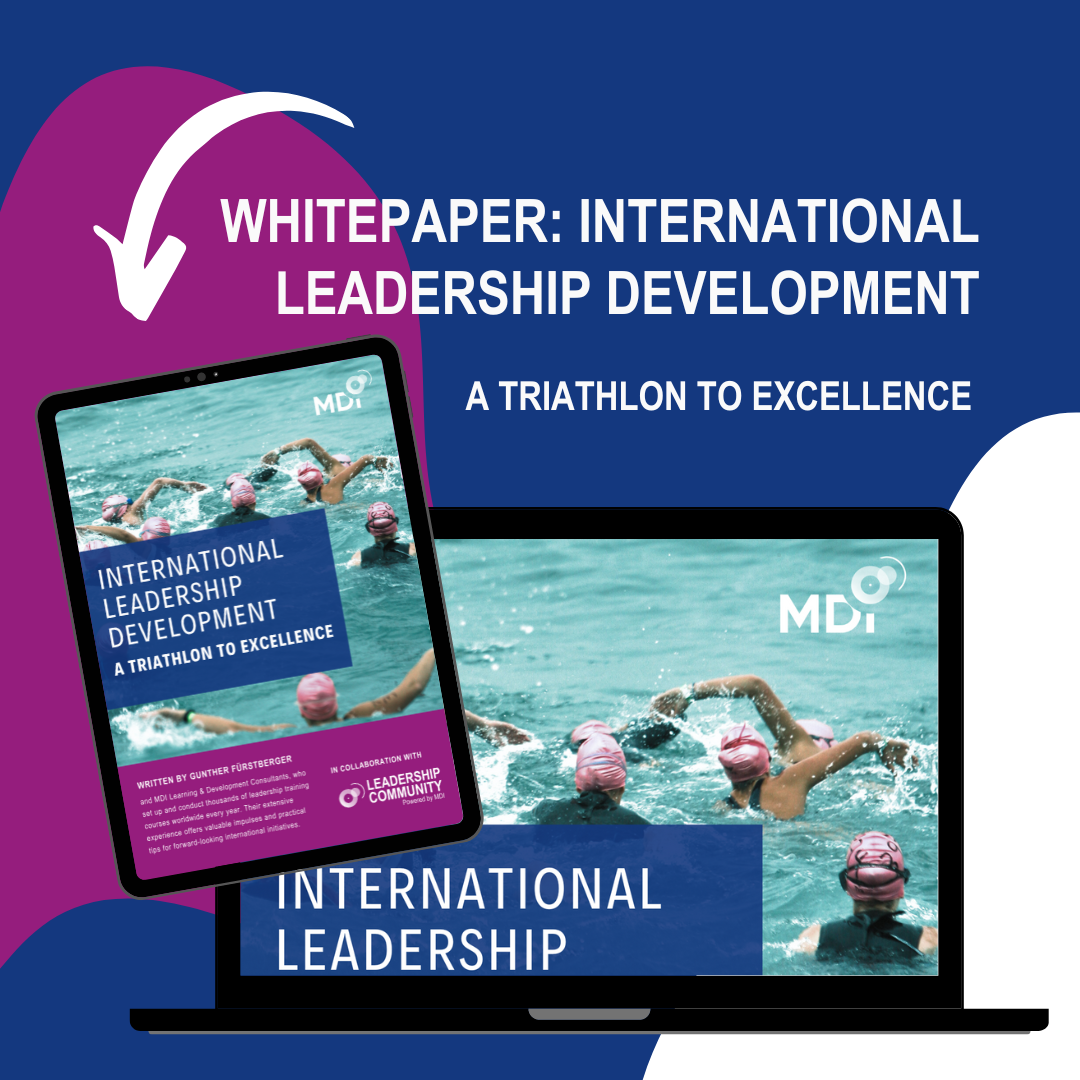
Download our International Whitepaper:


What serves you next?

AI Ethics for Leaders: Why Context and Critical Thinking Matter More Than Ever

by Meike Hinnenberg | 11. March 2026 | Impuls series, Leadership and AI, Learning Transfer | 0 Comments

AI Ethics for Leaders: Why Context and Critical Thinking Matter More Than Ever. Meike’s Reflections on Artificial Intelligence Do you prefer to listen to this article? Click below to access our AI-generated audio version!AI Ethics for Leaders: Why Context and Critical...
Read More

A Success Story – When AI Sharpens Human Judgement

by Claude MacDonald, Rafael Ungvari | 6. March 2026 | Customer Story, Digital Transformation, Leadership and AI | 0 Comments

A Success Story – When AI Sharpens Human Judgement Do you prefer to listen to this article? Click here to access our AI-generated audio version! When AI Amplifies Human Judgment: A Customer Success Story About This Project At MDI, we believe that great leadership and...
Read More

How Do You Lead People Who Don’t Think the Way You Do?

by Zeca Ruiz | 4. February 2026 | Leadership Impact, Leadership Tips, Learning Transfer | 0 Comments

How Do You Lead People Who Don't Think the Way You Do? Do you want to listen to this article? Click here to access our AI-generated audio version!   How do you lead people who do not think the way you do? Leadership is a challenge, especially when you are not...
Read More

How You Deal With Neurodiversity as a Leader

by Iris Kandlbauer | 3. February 2026 | Leadership Impact, Leadership Tips, Short Knowledge Bits | 0 Comments

How You Deal With Neurodiversity as a Leader You prefer listening to this article? You can find our AI-generated audio version below! How You Deal With Neurodiversity as a Leader What might be behind “strange” behavior in a team—and how leaders can deal with it...
Read More

Anita’s Key to Success for International Cooperation

by Jana Wölfl | 3. February 2026 | Leadership and AI, Leadership Tips, MDI Spotlight Series | 0 Comments

Anita's Key to Success for International Cooperation This blog is an excerpt from our new podcast! You can find the entire podcast episode here. Anita's Key to Success for International Cooperation In our new video podcast format, “Voices of Leadership – an MDI...
Read More

Fostering True Workplace Commitment

by Marcin Swierkocki | 14. January 2026 | Leadership Tips, Learning Transfer, Short Knowledge Bits | 0 Comments

Fostering True Workplace Commitment Do you prefer to listen to this article? Click below to access our AI-generated audio version! Fostering True Workplace Commitment Throughout my years of practice, I've found that deep workplace commitment is achieved not through...
Read More

Marcin Swierkocki on the Full Range Leadership Model

by Jana Wölfl | 19. December 2025 | Leadership and AI, Leadership Tips, MDI Spotlight Series | 0 Comments

Marcin Swierkocki on the Full Range Leadership Model This blog is an excerpt from our new podcast! You can find the entire podcast episode here. Marcin Swierkocki on the Full Range Leadership Model In the newest episode of our podcast “Voices of Leadership | An MDI...
Read More

Self-Efficacy in Change: Why It Matters

by Anita Berger | 17. December 2025 | Leadership Tips, Learning Transfer, Short Knowledge Bits | 0 Comments

Why It Matters When Transformation Gets Hard Do you prefer to listen to this article? Click below to access our AI-generated audio version:Self-Efficacy: Why It Matters When Transformation Gets Hard Change can be exhausting.Especially when things are unclear,...
Read More

Generation Z isn’t the Problem but Our System is

by Zeca Ruiz | 3. December 2025 | Impuls series, International leadership development, Leadership in the digital transformation | 0 Comments

Generation Z Isn’t the Problem, but Our System is. Read this article on crossgenerational management by Zeca Ruiz to find out more!

Read More

From Lab to Practice: What We Learned With AI

by Rafael Ungvari | 3. September 2025 | Digital Transformation, Leadership and AI, Short Knowledge Bits | 0 Comments

From Lab to Practice: What We Learned With AI Do you prefer to listen to this article? Click here to access our AI-generated audio version! From Lab to Practice: What We Learned With AI AI in organizations isn’t a one-size-fits-all solution. And in people development,...
Read More

Information

  • Imprint
  • MDI company website

Social Media

  • Facebook
  • Twitter
  • Youtube
  • LinkedIn

© MDI Management Development Institute, 2020