
• MDI
  • German version
  • Contact us
MDI Management Development
  • Agile leadership
  • Lateral Leadership
  • Leadership Impact
  • Leadership Development
Select Page
In Dialogue with Michael Kolleger: Leadership 4.0 – AI in Transition

In Dialogue with Michael Kolleger: Leadership 4.0 – AI in Transition

by Michael Kolleger | Sep 29, 2023 | Digital Transformation, Impuls series, Leadership and AI | 0 comments

In Dialogue with Michael Kolleger: Leadership 4.0 – AI in Transition

Prefer to listen to the article? Click below to access our AI speech-generated audio. However, if you want to read it as usual, keep scrolling.

In dialogue with Michael Kolleger: Leadership 4.0 and AI in transition

In the kick-off of our new expert series “Leadership 4.0: Leadership in the Changing AI Era“, Data Scientist Michael Kolleger took the time for an interview with us. As part of this interview series, we want to get a clearer picture of artificial intelligence and talk about leadership over the next few years.

Read this interview to join us in broadening your digital horizons and gaining more insight into the complexities of AI transformation.

Hello dear Michael, thank you for taking the time for this interview! First of all, please introduce yourself. How would you briefly describe yourself and your profession?

As a Data Scientist in a senior position, I am responsible for leading a highly skilled team group specialized in data-driven solutions. My career field encompasses several key functions, including presales activities, product development, and initiating innovative ideas.

In presales, I am instrumental in convincing potential customers of our data-driven solutions. I analyze their requirements and present customized solutions to meet their business needs. In product development, I work closely with our technical team to design and develop data-driven products and services. Here, the focus is on using data to improve our products.

In addition, it is my job to foster creative ideas and innovative approaches to constantly explore new opportunities for data-driven solutions and further develop our company.

What would you say are three exciting projects you’ve worked on recently related to artificial intelligence?

  • Energy Provider, Hong Kong: As a Data Scientist on this project, I had the challenging task of analyzing data from the energy sector in Hong Kong and developing intelligent solutions for the smart grid. Our work enabled us to use real-time data to predict power consumption and production and manage the network more efficiently.


  • Automotive, Germany, Investigating Generation Z’s Opinion on Mobility: In this project, my team analyzed extensive data from social media to deepen Generation Z’s understanding of mobility and language preferences. These insights helped the automotive industry to develop targeted marketing strategies and better tailor products to the needs of the young target group in the future.


  • Banking, Hong Kong, Developing New Financial Strategies with AI: In this exciting project, we supported a global bank in HK to break new ground by developing financial strategies using artificial intelligence. We analyzed market data, global economic trends, and business news to create advanced AI models. These models helped the bank make informed investment decisions, minimize risks, and optimize its portfolio management.

That sounds really exciting! But what exactly is artificial intelligence? Please describe this term as simply as possible.

Artificial intelligence (AI) is like a smart computer that tries to mimic human thinking. It learns from information, draws conclusions, and makes decisions, much like we humans do. But it’s important to understand that AI is not a panacea. Rather, it is a tool that can be used to solve very specific problems.

Think of AI as a toolbox full of specialized tools. Each of these tools is designed to tackle a specific task or problem. For example, one AI tool may be used to recognize images, another to translate text, and yet another to make predictions based on data.

The key to using AI effectively is to choose the right tool for the right task. AI can help perform complex calculations, identify patterns in data, and automate repetitive tasks. Overall, AI can help us solve specific problems faster and more efficiently, but it requires wise application and expertise to have its full impact.

In the context of artificial intelligence, some often worry that their work will be replaced by artificial intelligence. How do you see this danger? Above all, what then is the role of a leader in the use of AI?

The concern that artificial intelligence (AI) could replace human labor is understandable. In fact, some repetitive and data-intensive tasks in many industries can be automated through AI. This can lead to efficiency gains, but it also presents challenges and opportunities for the workplace.

A leader’s role in the use of AI is to provide strategic direction and accountability. Here are some important aspects:

  • Strategic alignment: leaders need to understand how AI will impact their industry and company. They should define clear strategic objectives for how AI can help achieve business goals.
  • Resource allocation: executives are responsible for allocating the necessary resources, including talent and technology, to successfully implement AI initiatives.
  • Quality control: executives must ensure that AI applications are developed and deployed ethically and responsibly. This includes privacy, bias mitigation, and transparent decision-making by AI systems.
  • Collaboration with AI: AI can complement human work by performing routine tasks while humans focus on more creative, strategic, and interpersonal tasks. Leaders should encourage the integration of humans and machines to achieve the best possible results.
  • Crisis management: when job changes due to AI are imminent, leaders need to develop strategies for retraining and redeployment to mitigate the impact on the workforce.

Overall, the introduction of AI does not necessarily mean replacing workers, but rather shifting tasks and providing an opportunity to expand human capabilities. Leaders play a critical role in making these changes positive by finding the right balance between technology and human talent.

team meeting

What skills must a leader have in order to use AI successfully? What technical skills are necessary?

In order to successfully deploy artificial intelligence (AI) in their area of responsibility, a leader should have several skills and attributes:

  • Strategic vision: the ability to develop and communicate a clear vision and strategy for the use of AI in the organization.
  • Understanding of AI fundamentals: a basic knowledge of how AI works, its applications, and its potential is essential.
  • Technological understanding: knowledge of the technologies used for AI applications and their impact on the business.

How realistic is it that a portion of our executives will be made up of robots in the future?

Extremely unlikely.

So what would such a leadership style look like? One that consists solely of artificial intelligence?

A leadership style based solely on artificial intelligence (AI) would focus on data analysis, algorithm-based decision making, and automation. In this scenario, AI would continuously analyze large amounts of data to identify trends, patterns, and opportunities. It would generate recommendations for business decisions and make them based on objective data.

AI leadership would focus on efficiency, data optimization, and predictable operations. However, human leadership elements such as emotional intelligence, empathy and interpersonal relationships would be missing. This could lead to an emphatically rational and data-focused leadership culture that certainly neglects the creative and social aspects of leadership.

Where do you see advantages and disadvantages here? What can already be taken over by artificial intelligence, what should still remain human?

Challenges and limitations:

  • Complexity of human interaction: leaders often need to manage complex interpersonal relationships, act empathically, and communicate strategic visions. This is a capability that AI systems have so far been limited in their ability to mimic.
  • Creativity and innovation: developing new ideas, strategies, and creative solutions is an essential part of leadership that requires human intelligence and experience.
  • Acceptance and trust: Acceptance of robotic leaders in the workplace and employee trust in such systems could be barriers.

Artificial intelligence (AI) has already demonstrated the ability to automate and take over human tasks in many areas. Here are some examples of tasks and work areas where AI is being used successfully:

  • Image and speech recognition: AI systems can recognize and interpret images and speech, which is used in applications such as facial recognition, text translation and virtual assistants.
  • Chatbots and customer service: AI-based chatbots can handle customer queries, solve problems and provide information.
  • Financial and investment analysis: AI can be used in the financial industry for automated analysis of market and investment data.
  • Medical diagnosis and imaging: In medicine, AI helps diagnose and analyze medical images such as X-rays and MRI scans.
  • Manufacturing and robotics: robots with built-in AI are used in manufacturing to automate tasks such as assembly, quality control, and material handling.
  • Human resource management: AI can assist in applicant selection, monitoring employee performance, and identifying training needs.
  • Traffic control: in cities, AI systems are used for traffic monitoring and optimization to improve traffic flow.
  • Cybersecurity: AI can help monitor networks and systems for threats and take quick countermeasures.
  • Translation and speech processing: AI can translate texts in real-time and enable human-like speech in chatbots and virtual assistants.

generational management

Now that we’ve talked so much about artificial intelligence – what concrete first steps can companies/leaders take? How can we incorporate AI into our everyday work step by step?

  • Education and training: Start with training and education for leaders and employees to foster a basic understanding of AI and its applications.
  • Identify use cases: Identify specific areas or tasks in your organization where AI could add value. These could be tasks with high data content or routine tasks.
  • Data preparation: make sure your data infrastructure is solid. Clean, high-quality data is critical to successful AI applications.
  • Pilot projects: Launch small pilot projects to test the feasibility of AI applications in your organization. This allows you to gain initial experience.
  • Partnerships and outsourcing: Consider working with AI experts and vendors to leverage expertise and resources without building everything in-house.
  • Ethical guidelines: Develop ethical guidelines for the use of AI to ensure that the technology is used responsibly and in line with your values.
  • Communication and change management: Make sure you inform your employees about the introduction of AI and demonstrate the added value for them. Consider fears and concerns.
  • Measuring ROI: Establish clear KPIs to measure the return on investment (ROI) of your AI initiatives and ensure they are delivering business value.
  • Scale: if pilots are successful, consider scaling up and expanding the use of AI in other areas.
  • Feedback and adaptation: continuously gather feedback from employees and adapt your AI strategy accordingly for continuous improvement. 

One last question I’d like to ask all of our guests. What do you see as the biggest challenge for leaders in the next 5 years?

Overall, leaders in the next 5 years will face the challenge of balancing technological innovation, business growth, and social responsibility while facing a rapidly changing business environment and changes in the socio-cultural environment. The ability to adapt and use technology strategically will be critical.


  • Digital transformation: leaders must successfully guide their companies through digital transformation, which means adapting business models, processes and culture to remain competitive.
  • Change in the socio-cultural environment: Generation Z, born in the late 1990s and 2000s, is shaping the socio-cultural environment with new values and behaviors. Their influence has led companies to pay increased attention to social responsibility and adapt their marketing strategies to reach this target group.
  • Talent management: attracting and retaining technology and data science professionals will be a challenge. Leaders must be able to build and develop talented teams.
  • Rapid change: Technological developments and market changes occur rapidly. Leaders must be agile and adaptable to respond to unexpected events.
  • Global uncertainties: Economic uncertainties, geopolitical tensions, and global crises could affect business operations. Leaders need to be resilient and develop risk management strategies.
  • Sustainability: sustainability goals and environmental impacts are gaining importance. Leaders must develop strategies to be environmentally responsible.
  • Workplace culture and employee well-being: Creating a positive workplace culture and employee well-being is becoming increasingly important to attract and retain skilled workers.

Thank you for this exciting interview, Michael!

Michael Kolleger

Michael Kolleger

Data Scientist

Dr. Michael KOLLEGGER is a distinguished Senior Data Scientist with an illustrious career spanning over 30 years in the field of Data Analysis and Artificial Intelligence.

With more than two decades of experience specifically dedicated to Artificial Intelligence, Dr. KOLLEGGER has consistently demonstrated his expertise in gathering and analyzing business requirements, leading to the development of innovative AI solutions.

  • LinkedIn

Download our International Whitepaper:

This could also interest you:

10 Tips for Effective Communication With Dominant Partners

by Dominik Etzl, Rafael Ungvari | 4. October 2026 | Best Practice, Leadership Tips, learning effectiveness | 0 Comments

Homer Simpson has been delighting young and old for many years. Short-tempered to the point of being slightly irascible, he speaks his mind directly. He’s constantly getting annoyed over trivial matters and doesn’t seem to place much value on the opinions and advice...
Read More

4 Heuristics to Stop Mistaking Symptoms for Cause in the AI Era

by Zeca Ruiz | 24. September 2026 | Digital Transformation, Leadership and AI, Leadership Tips | 0 Comments

4 Heuristics to Stop Mistaking Symptoms for Cause in the AI Era The AI era is intensifying an old problem: acting too fast on the wrong diagnosis. Every one of us has lived through, or heard about, some organizational mess born from exactly that. In every era, every...
Read More

Human First: Leadership in the Age of AI

by Johanna Glechner | 14. September 2026 | Digital Transformation, Leadership and AI, Leadership in the digital transformation | 0 Comments

Human First: Leadership in the Age of AI My professional journey has always taken place at the intersection of two worlds that, for a long time, were treated as separate: technology and leadership. With a background in business informatics, I started my career in...
Read More

AI Transformation Is Leadership Work

by Gunther Fürstberger | 28. August 2026 | Leadership and AI, Leadership Tips, MDI Whitepaper | 0 Comments

AI Transformation Is Leadership Work The four-step loop that turns individual experiments into lasting change Many companies are already using AI—and still not transforming. Tools, pilot projects, and guidelines only add up to transformation once they deliberately...
Read More

What If AI Doesn’t Replace Us — But Drowns Us Out?

by Martin Maglia | 24. July 2026 | Digital Transformation, Leadership and AI, Short Knowledge Bits | 0 Comments

What If AI Doesn't Replace Us — But Drowns Us Out? Over the weekend, I watched a thought-provoking video from Rick Beato. (You can find the link at the end of this article.) For those who don't know him: Rick Beato is a musician, producer, educator, guitarist, and one...
Read More

Use It or Lose It: How AI and Digital Tools May Be Changing Our Brains

by Florian Biedermann | 26. June 2026 | Leadership and AI, Leadership Tips, Learning Transfer | 0 Comments

Use It or Lose It: How AI and Digital Tools May Be Changing Our Brains You travel to Madrid and want to chat with the locals, but you realize that after five years without practice, your rudimentary Spanish skills are now practically nonexistent and you even struggle...
Read More

How Artificial Intelligence Shapes Who We Become

by Meike Hinnenberg | 19. May 2026 | Impuls series, Leadership and AI, Leadership in the digital transformation | 0 Comments

How Artificial Intelligence Shapes Who We Become Meike’s Reflections on Artificial Intelligence Do you prefer to listen to this article? Click below to access our AI-generated audio version!How Artificial Intelligence Shapes Who We Become Meike’s Reflections on...
Read More

Zeca Ruiz on Cross-Generational Leadership and Navigating Change

by Jana Wölfl | 13. May 2026 | Leadership Impact, MDI Spotlight Series, Training Insights | 0 Comments

Zeca Ruiz on Cross-Generational Leadership and Navigating Change This blog is an excerpt from our new podcast! You can find the entire podcast episode here. Zeca Ruiz on Cross-Generational Leadership and Navigating Change In the fourth episode of our podcast “Voices...
Read More

What AI Shows You — and What It Doesn’t

by Meike Hinnenberg | 1. April 2026 | Digital Transformation, Impuls series, Leadership and AI | 0 Comments

What AI Shows You — and What It Doesn't Meike’s Reflections on Artificial Intelligence Do you prefer to listen to this article? Click below to access our AI-generated audio version! What AI Shows You — and What It Doesn't Meike’s Reflections on Artificial Intelligence...
Read More

Leading in the Age of AI: How AI Discourse Shapes Responsibility and Power

by Meike Hinnenberg | 18. March 2026 | Impuls series, Leadership and AI, Leadership Tips | 0 Comments

Leading in the Age of AI: How AI Discourse Shapes Responsibility and Power Meike’s Reflections on Artificial Intelligence Do you prefer to listen to this article? Click below to access our AI-generated audio version!Leading in the Age of AI: How AI Discourse Shapes...
Read More
The 5 most important soft skills for leaders in the age of AI

The 5 most important soft skills for leaders in the age of AI

by Jana Wölfl | Sep 29, 2023 | Impuls series, Leadership and AI, Leadership Tips | 0 comments

The 5 most important soft skills for leaders in the age of AI

Prefer to listen to the article? Click below to access our AI speech-generated audio. However, if you want to read it as usual, keep scrolling.

The 5 most important soft skills for leaders in the age of AI

In times where artificial intelligence knows no boundaries and numerous programs can seemingly replace any work, leaders are placing more and more value on so-called soft management skills.

In this blog post, you will learn what exactly we mean by this and why soft management skills are indispensable, especially in the context of artificial intelligence. However, if you want to learn more about the basics of artificial intelligence, you can read the first blog post of our AI series here.

Hard vs. soft management skills

While hard management skills focus more on actually doing the job, e.g. dealing with data, managing and analyzing projects, and allocating budget, soft skills are mainly about the human aspect of leadership.

Thus, it is more about empathy, cohesion, transparent communication, etc., which means that leaders should pay more attention to social interaction with their employees. While both areas of leadership are equally relevant, there is one important factor that differentiates them:

Artificial intelligence can replace the hard aspects of leadership, but not the “soft” ones.

Especially in the aforementioned areas – i.e., data analysis and management, forecasting and budgeting – but also in project management, marketing, and HR, there are now quite a few programs that significantly simplify a leader’s tasks and make them more efficient. 

While artificial intelligence can save us some work, it cannot replace the human aspect. So the more AI takes over these technical tasks, the more important it is for leaders to focus on soft skills.

The 5 most important soft skills for leaders in the age of AI

The 5 most important soft skills for leaders in the age of AI

Of course, there is a wide range of relevant soft skills that you should apply as a leader in your everyday work. Here we present the 5 most essential ones.

1. Transparent communication

As a leader, you should be able to talk openly and honestly with your employees about internal and external topics. Also, in the context of artificial intelligence, it is important to clearly communicate to your employees where AI will be used and how your work structures will now change.

You can find more about Transparent Communication in Gunther Fürstberger’s book “Winning Commitment as a Lateral Leader” in the chapter “The Communicator and the Three Commitment Steps”.

2. Empathy and social understanding

Especially in times where roles in the company are changing rapidly and new programs and devices are constantly being introduced, it is important to be able to empathize with your employees and also understand what they need.

Because in the end, of course, it’s not just about your vision as a leader, but also about making sure your employees feel comfortable with the move to artificially intelligent programs and that any concerns about the issue can be listened to and addressed as far as possible.

More on how to boost your empathy in this article.

3. Adaptability

As a leader, you should be constantly learning about new programs and technologies to stay current. It is important not to be afraid of these changes and adapt to them as soon as possible.

soft skills

4. Awareness of cultural and gender differences

The use of artificial intelligence varies from culture to culture, which you should be especially aware of when working with other countries. Also, there is a large gender gap in the tech industry, and some AI algorithms harbor unintended biases and gender stereotypes.

Being aware of these factors can help you be mindful of the inclusive use of artificially intelligent programs.

You can read more about this topic in this article.

5. Critical thinking

While AI programs can handle some of our routine tasks, their flawless problem-solving is not guaranteed. Therefore, it is up to you as a leader to review the programs’ solutions and critically question whether they have actually handled the problem ideally.

In this article, you will find tips on how to improve your critical thinking.

Conclusion

Especially now that artificial intelligence can take over more and more tasks and facilitate processes, it is important for leaders to strengthen and develop their soft skills. Thus, a smooth transition to AI programs can succeed not only for you but also for your team and the entire organization.

Jana Wölfl

Jana Wölfl

Marketing Assistant

Jana Wölfl works at MDI as a marketing assistant and writes blog posts for our site in addition to her studies at Leiden University.

She also works for SDI and supports us with writing content there as well.

  • LinkedIn

Download our new MDI Whitepaper:

This could also interest you:

10 Tips for Effective Communication With Dominant Partners

by Dominik Etzl, Rafael Ungvari | 4. October 2026 | Best Practice, Leadership Tips, learning effectiveness | 0 Comments

Homer Simpson has been delighting young and old for many years. Short-tempered to the point of being slightly irascible, he speaks his mind directly. He’s constantly getting annoyed over trivial matters and doesn’t seem to place much value on the opinions and advice...
Read More

4 Heuristics to Stop Mistaking Symptoms for Cause in the AI Era

by Zeca Ruiz | 24. September 2026 | Digital Transformation, Leadership and AI, Leadership Tips | 0 Comments

4 Heuristics to Stop Mistaking Symptoms for Cause in the AI Era The AI era is intensifying an old problem: acting too fast on the wrong diagnosis. Every one of us has lived through, or heard about, some organizational mess born from exactly that. In every era, every...
Read More

Human First: Leadership in the Age of AI

by Johanna Glechner | 14. September 2026 | Digital Transformation, Leadership and AI, Leadership in the digital transformation | 0 Comments

Human First: Leadership in the Age of AI My professional journey has always taken place at the intersection of two worlds that, for a long time, were treated as separate: technology and leadership. With a background in business informatics, I started my career in...
Read More

AI Transformation Is Leadership Work

by Gunther Fürstberger | 28. August 2026 | Leadership and AI, Leadership Tips, MDI Whitepaper | 0 Comments

AI Transformation Is Leadership Work The four-step loop that turns individual experiments into lasting change Many companies are already using AI—and still not transforming. Tools, pilot projects, and guidelines only add up to transformation once they deliberately...
Read More

What If AI Doesn’t Replace Us — But Drowns Us Out?

by Martin Maglia | 24. July 2026 | Digital Transformation, Leadership and AI, Short Knowledge Bits | 0 Comments

What If AI Doesn't Replace Us — But Drowns Us Out? Over the weekend, I watched a thought-provoking video from Rick Beato. (You can find the link at the end of this article.) For those who don't know him: Rick Beato is a musician, producer, educator, guitarist, and one...
Read More

Use It or Lose It: How AI and Digital Tools May Be Changing Our Brains

by Florian Biedermann | 26. June 2026 | Leadership and AI, Leadership Tips, Learning Transfer | 0 Comments

Use It or Lose It: How AI and Digital Tools May Be Changing Our Brains You travel to Madrid and want to chat with the locals, but you realize that after five years without practice, your rudimentary Spanish skills are now practically nonexistent and you even struggle...
Read More

How Artificial Intelligence Shapes Who We Become

by Meike Hinnenberg | 19. May 2026 | Impuls series, Leadership and AI, Leadership in the digital transformation | 0 Comments

How Artificial Intelligence Shapes Who We Become Meike’s Reflections on Artificial Intelligence Do you prefer to listen to this article? Click below to access our AI-generated audio version!How Artificial Intelligence Shapes Who We Become Meike’s Reflections on...
Read More

Zeca Ruiz on Cross-Generational Leadership and Navigating Change

by Jana Wölfl | 13. May 2026 | Leadership Impact, MDI Spotlight Series, Training Insights | 0 Comments

Zeca Ruiz on Cross-Generational Leadership and Navigating Change This blog is an excerpt from our new podcast! You can find the entire podcast episode here. Zeca Ruiz on Cross-Generational Leadership and Navigating Change In the fourth episode of our podcast “Voices...
Read More

What AI Shows You — and What It Doesn’t

by Meike Hinnenberg | 1. April 2026 | Digital Transformation, Impuls series, Leadership and AI | 0 Comments

What AI Shows You — and What It Doesn't Meike’s Reflections on Artificial Intelligence Do you prefer to listen to this article? Click below to access our AI-generated audio version! What AI Shows You — and What It Doesn't Meike’s Reflections on Artificial Intelligence...
Read More

Leading in the Age of AI: How AI Discourse Shapes Responsibility and Power

by Meike Hinnenberg | 18. March 2026 | Impuls series, Leadership and AI, Leadership Tips | 0 Comments

Leading in the Age of AI: How AI Discourse Shapes Responsibility and Power Meike’s Reflections on Artificial Intelligence Do you prefer to listen to this article? Click below to access our AI-generated audio version!Leading in the Age of AI: How AI Discourse Shapes...
Read More
What is Sustainable Individualization in Leadership?

What is Sustainable Individualization in Leadership?

by Iris Burner | Jun 28, 2023 | Digital Transformation, Leadership Impact, Leadership in the digital transformation | 0 comments

Sustainable individualization in leadership – pious hope or real alternative?

In line with the last blog post on our MDI website “Inner Development Goals For a Better Leadership World“, this time we dedicate ourselves to the megatrend topic of individualization and the connection with the Inner Development Goals (IDGs) towards sustainable leadership.

Individualization instead of multi-module programs

The status quo often shows that companies rely on multi-module programs to develop and train their executives. Depending on the target group, these programs provide a broad general basis of tools and methods – a so-called “toolbox” from which the appropriate tool can be selected according to the situation.

In times of ever scarcer resources (keywords: time and knowledge, cost efficiency and environment) and living realities in climate change, however, one topic is increasingly coming to the fore in the education and training of our future shapers of tomorrow: individualization.

Individualization – one of the 12 megatrends

Individualization was presented by the Zukunftsinstitut 2023 as one of the 12 megatrends. These megatrends are the central trends of our time. They are the biggest drivers of change in business and society and shape our future – not just in the short term, but in the medium to long term. Megatrends unfold their dynamics over decades.

IDGs & SDGs 2030

This time horizon may seem long, especially considering the Inner Development Goals (IDGs), which are based on the implementation of the Sustainable Development Goals for 2030. This deadline means that the implementation of this megatrend can no longer be delayed. 

But when we think of Sustainable Development Goals, can we give individualization any room at all? Doesn’t individualization always consume considerably more resources than a collective measure? 

Megatrend-Map

Quelle: Zukunftsinstitut.de 

Sustainability vs. Individualization – Dealbreaker or Complement?

Sustainability and individualization have an interesting interaction with IDGs. On the one hand, individualization can be seen as a potential challenge to sustainability, as it may require more resources and lead to fragmentation of actions. If individualized programs are developed for each leader or individual, this can add time and cost and may be inefficient.

On the other hand, individualization also offers opportunities for sustainability. By enabling people to consider their interests, strengths, and needs, tailored development and education can take place. When leaders are supported in their development processes and have the opportunity to leverage their strengths, they can develop more effective leadership approaches that are also aligned with sustainability goals.

Promoting Individual Strengths and Creating Sustainability for Leaders and Organizations

IDGs are leveraging the megatrend of individualization to promote personal development and inner growth. By focusing on individual needs and goals, they enable people to realize their full potential and shape their own growth. This also includes the development of leadership competencies required for the sustainable transformation of organizations and societies.

Sustainable individualization in leadership thus means reconciling individual development and sustainability goals. This requires careful planning and design of educational activities to address both individual needs and sustainability issues. It is about fostering individual strengths while creating a common foundation for sustainable leadership.

Transfer to practice – 3 concrete approaches

What concrete measures can companies now take to initiate a sustainable and individualized leadership era?

1. IDG potential analysis

As a possible tool, the IDG potential analysis, for example, can provide an initial basic assessment. The basis of this analysis is a questionnaire based on the five IDGs (Being, Thinking, Relating, Collaborating, and Acting). By evaluating the analysis, the leader receives a self-assessment and finds out where they stand on the company values.


The results of the analysis serve as a basis for targeted measures to promote personal and professional growth in line with the IDGs and are particularly suitable for organizational and personnel development, leadership, team development, and change processes.

generational management

2. Team workshops with team profiles

In order to validate the self-assessment, there is also the possibility to get an external assessment from a colleague. Based on this, there is the possibility to conduct team workshops with team profiles to strengthen cooperation regarding the IDGs.

3. Mentoring program

Another way to put these findings into practice is to implement a mentoring program. This program supports leaders in realizing their individual goals and needs and integrating sustainability-oriented approaches into their leadership practice.

Executives are paired individually with an experienced mentor to foster their personal development and leadership skills. Thus, individual leaders’ needs and goals are addressed by assigning them a mentor who has experience and expertise in the specific areas the leader wants to work on.

The mentoring relationship allows executives to identify their individual strengths and weaknesses and work on them specifically. At the same time, the mentor and mentee are in a two-way exchange on a variety of topics, allowing them to learn from and with each other. This helps the leaders to integrate sustainability-oriented approaches into their leadership practice and to drive positive change in their organizations.

Conclusion

Ultimately, IDGs and customization can help create a new generation of leaders who are both personally fulfilled and focused on sustainable change. By addressing the individual needs and potential of each individual, IDGs can pave the way for sustainable and individualized leadership that can have a positive impact on organizations, society, and the environment.

Commitment MDI – We support leaders who strive for a better world

As an official partner of the Inner Development Goals (IDG), we are actively engaged in collaborating with other stakeholders, organizations, and individuals to advance the integration of transformational sustainable development skills into our leadership development. Our goal is to facilitate dialogue, knowledge sharing, and collaboration to advance the SDGs agenda.

Iris Burner

Iris Burner

Learning & Development Consultant

Since 2022, Iris has been an L&D Consultant at MDI, supporting leaders and organisations worldwide in personal development and creating tailored training programs. She values the personal learning experience and ensures clients benefit from valuable insights. With a background in adult education and professional experience in a renowned corporation, Iris has a comprehensive understanding of company needs and develops customized solutions for sustainable development and growth.

  • LinkedIn

This could also help you:

10 Tips for Effective Communication With Dominant Partners

by Dominik Etzl, Rafael Ungvari | 4. October 2026 | Best Practice, Leadership Tips, learning effectiveness | 0 Comments

Homer Simpson has been delighting young and old for many years. Short-tempered to the point of being slightly irascible, he speaks his mind directly. He’s constantly getting annoyed over trivial matters and doesn’t seem to place much value on the opinions and advice...
Read More

4 Heuristics to Stop Mistaking Symptoms for Cause in the AI Era

by Zeca Ruiz | 24. September 2026 | Digital Transformation, Leadership and AI, Leadership Tips | 0 Comments

4 Heuristics to Stop Mistaking Symptoms for Cause in the AI Era The AI era is intensifying an old problem: acting too fast on the wrong diagnosis. Every one of us has lived through, or heard about, some organizational mess born from exactly that. In every era, every...
Read More

Human First: Leadership in the Age of AI

by Johanna Glechner | 14. September 2026 | Digital Transformation, Leadership and AI, Leadership in the digital transformation | 0 Comments

Human First: Leadership in the Age of AI My professional journey has always taken place at the intersection of two worlds that, for a long time, were treated as separate: technology and leadership. With a background in business informatics, I started my career in...
Read More

AI Transformation Is Leadership Work

by Gunther Fürstberger | 28. August 2026 | Leadership and AI, Leadership Tips, MDI Whitepaper | 0 Comments

AI Transformation Is Leadership Work The four-step loop that turns individual experiments into lasting change Many companies are already using AI—and still not transforming. Tools, pilot projects, and guidelines only add up to transformation once they deliberately...
Read More

What If AI Doesn’t Replace Us — But Drowns Us Out?

by Martin Maglia | 24. July 2026 | Digital Transformation, Leadership and AI, Short Knowledge Bits | 0 Comments

What If AI Doesn't Replace Us — But Drowns Us Out? Over the weekend, I watched a thought-provoking video from Rick Beato. (You can find the link at the end of this article.) For those who don't know him: Rick Beato is a musician, producer, educator, guitarist, and one...
Read More

Use It or Lose It: How AI and Digital Tools May Be Changing Our Brains

by Florian Biedermann | 26. June 2026 | Leadership and AI, Leadership Tips, Learning Transfer | 0 Comments

Use It or Lose It: How AI and Digital Tools May Be Changing Our Brains You travel to Madrid and want to chat with the locals, but you realize that after five years without practice, your rudimentary Spanish skills are now practically nonexistent and you even struggle...
Read More

How Artificial Intelligence Shapes Who We Become

by Meike Hinnenberg | 19. May 2026 | Impuls series, Leadership and AI, Leadership in the digital transformation | 0 Comments

How Artificial Intelligence Shapes Who We Become Meike’s Reflections on Artificial Intelligence Do you prefer to listen to this article? Click below to access our AI-generated audio version!How Artificial Intelligence Shapes Who We Become Meike’s Reflections on...
Read More

Zeca Ruiz on Cross-Generational Leadership and Navigating Change

by Jana Wölfl | 13. May 2026 | Leadership Impact, MDI Spotlight Series, Training Insights | 0 Comments

Zeca Ruiz on Cross-Generational Leadership and Navigating Change This blog is an excerpt from our new podcast! You can find the entire podcast episode here. Zeca Ruiz on Cross-Generational Leadership and Navigating Change In the fourth episode of our podcast “Voices...
Read More

What AI Shows You — and What It Doesn’t

by Meike Hinnenberg | 1. April 2026 | Digital Transformation, Impuls series, Leadership and AI | 0 Comments

What AI Shows You — and What It Doesn't Meike’s Reflections on Artificial Intelligence Do you prefer to listen to this article? Click below to access our AI-generated audio version! What AI Shows You — and What It Doesn't Meike’s Reflections on Artificial Intelligence...
Read More

Leading in the Age of AI: How AI Discourse Shapes Responsibility and Power

by Meike Hinnenberg | 18. March 2026 | Impuls series, Leadership and AI, Leadership Tips | 0 Comments

Leading in the Age of AI: How AI Discourse Shapes Responsibility and Power Meike’s Reflections on Artificial Intelligence Do you prefer to listen to this article? Click below to access our AI-generated audio version!Leading in the Age of AI: How AI Discourse Shapes...
Read More
How to Become a Compassionate Leader – 3 tools

How to Become a Compassionate Leader – 3 tools

by Gunther Fürstberger | Apr 18, 2023 | International leadership development, Leadership in the digital transformation, MDI Inside, Training Insights | 0 comments

How to Become a Compassionate Leader in 3 Steps

At MDI, we not only develop others, but also ourselves. That’s why our CEO Gunther Fürstberger attended a three-day seminar by systems researcher Peter Senge in Stockholm, where he gained some insights. He reports on his experiences in this blog post.

The Compassionate Leadership Masterclass

Peter Senge wrote a classic of leadership literature in 1990 with “The 5th Discipline”. When I read that he was giving a 3-day seminar in Stockholm as part of the Inner Development Goals Initiative, I knew I had to experience it. I thought about Marcus Aurelius who already said “You have to know the great ones of your time”.

The sold out Compassionate Systems Leadership Masterclass by Peter Senge and Gustav Böll took place in the artistic setting of Fotografiska Museum with about 100 participants from March 29 to 31, 2023.

The seminar title sounds a bit complicated. What is Compassionate Systems Leadership all about? A first key to understanding is the organizer: the Inner Development Initiative. In 2016, UN member states adopted the 2030 Agenda for Sustainable Development. Since then, our planet has continued to deteriorate.

A new leadership system for a better planet

Us earthlings have obviously not yet developed the skills and attitude it takes to undo the damage of the industrial age.

This is where the Inner Development Initiative comes in: The change in attitude must begin with the individual. Engaging broadly and deeply with the Inner Development Goals in the 5 categories of Being, Thinking, Relating, Collaborating, and Acting will help achieve the UN Sustainable Development Goals.

Our planet now needs a different kind of leadership than we know from the industrial age. It starts with feeling nature and other people and should lead to some sense of connection with others or even all beings on the planet.

Hardly anyone wants to intentionally cause grievances, but who is really aware of the effects of their own actions? System thinking can help to understand both short- and long-term impacts and interactions a little better.

New findings on two levels

Learning for me has taken place on two levels during these days. On the one hand, I got to know new tools or deepened known tools. On the other hand, the trainers were an inspiration in their handling of the group and their use of methods.

From the numerous thinking tools I pick out the three that I found particularly typical for Compassionate Systems Leadership.

Tool 1

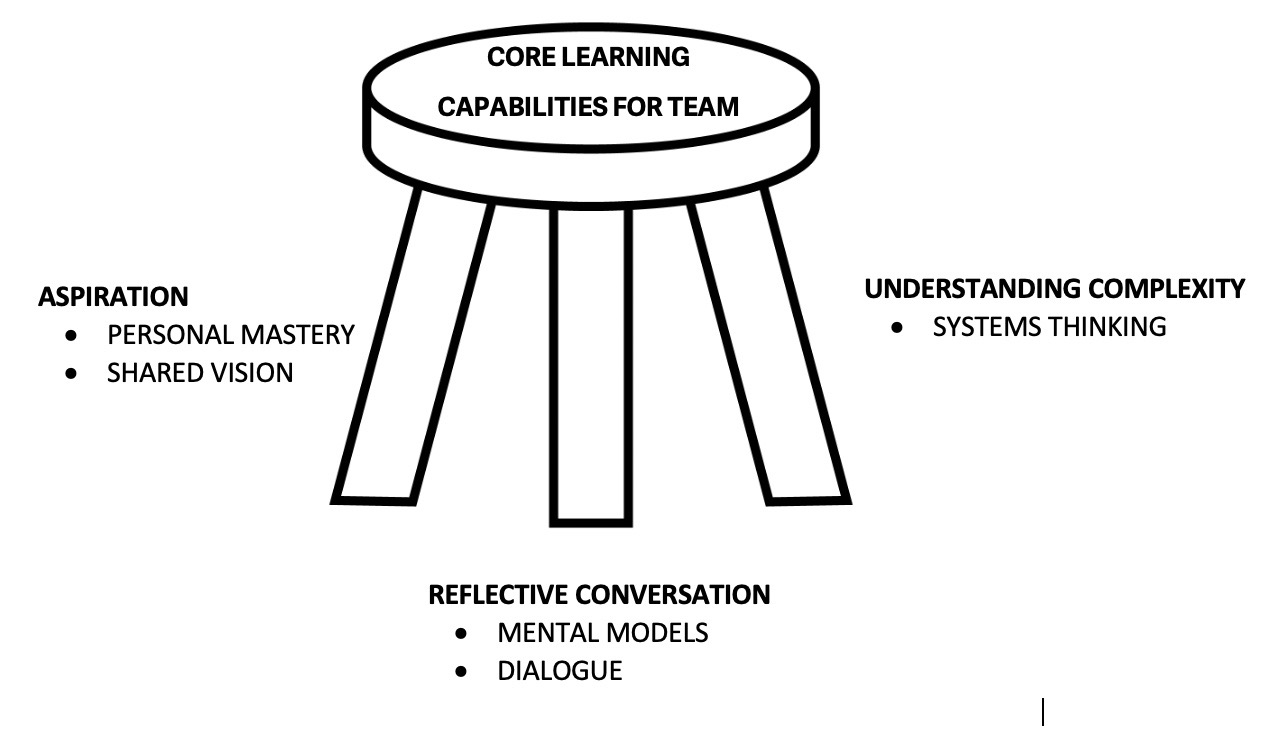
First, as an overview tool, there is the three-legged chair (see figure 1). The legs represent aspiration, reflective conversations, and systems awareness. If one leg is missing, the stool falls over.

Without a creative imagining of a better environment, there is no improvement. Without reflection or a deeper understanding of systems, we quickly end up in dead ends despite having good intentions. 

Three-legged chair

Tool 2

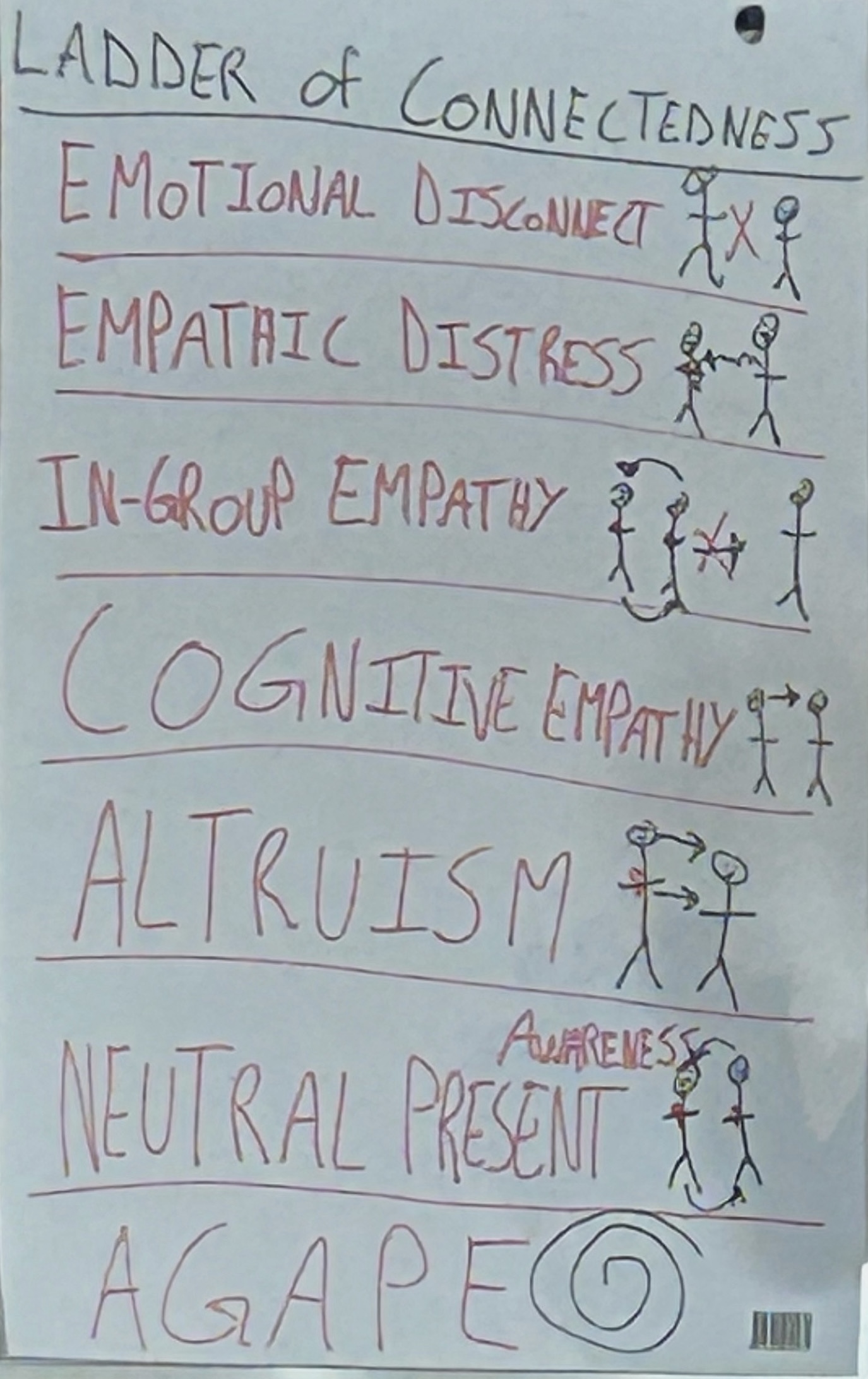
The ladder of connectedness

The second tool is the “ladder of connectedness” (see figure 2), which confused me initially: From bottom to top, the ladder levels are called “agape, neutral presence, altruism, cognitive empathy, in-group empathy, empathic stress, and emotional distance.”

We can harness gravity to move toward deeper connectedness, i.e., strive more toward the lower levels. Confusion can be a sign of real learning. I could not easily assign this idea to an already stored concept. It seemed to fit most closely with a Buddhist understanding.

We may not achieve agape, all-connected love, but we can create a neutral presence even in difficult situations. It also needs the higher levels: A surgeon should manage to distance themselves emotionally for self-protection.

Neutral instead of empathetic

Distance also helps sometimes in conflicts that go round in circles. Empathic stress is something I can relate to as a father of younger children. When my 8-year-old and my 6-year-old argue loudly with each other, it seems easier for me to demand that they stop for the short term because it helps me reduce my internal tension. But in the long run, it doesn’t help me.

In-group empathy may lead to good cooperation in the team, in the company or even in one’s own country, but at the same time it may exclude those who do not belong to the group. I take it upon myself to practice more neutral presence, which is enduring tension and contradiction.

Ladder of Connectedness

Tool 3

Creative Tension

Now our third and a simpler tool (see figure 3): The principle of creative tension. I already knew that a vision needs the right level of challenge, because something we have already achieved or something we can never achieve is not good as a vision.

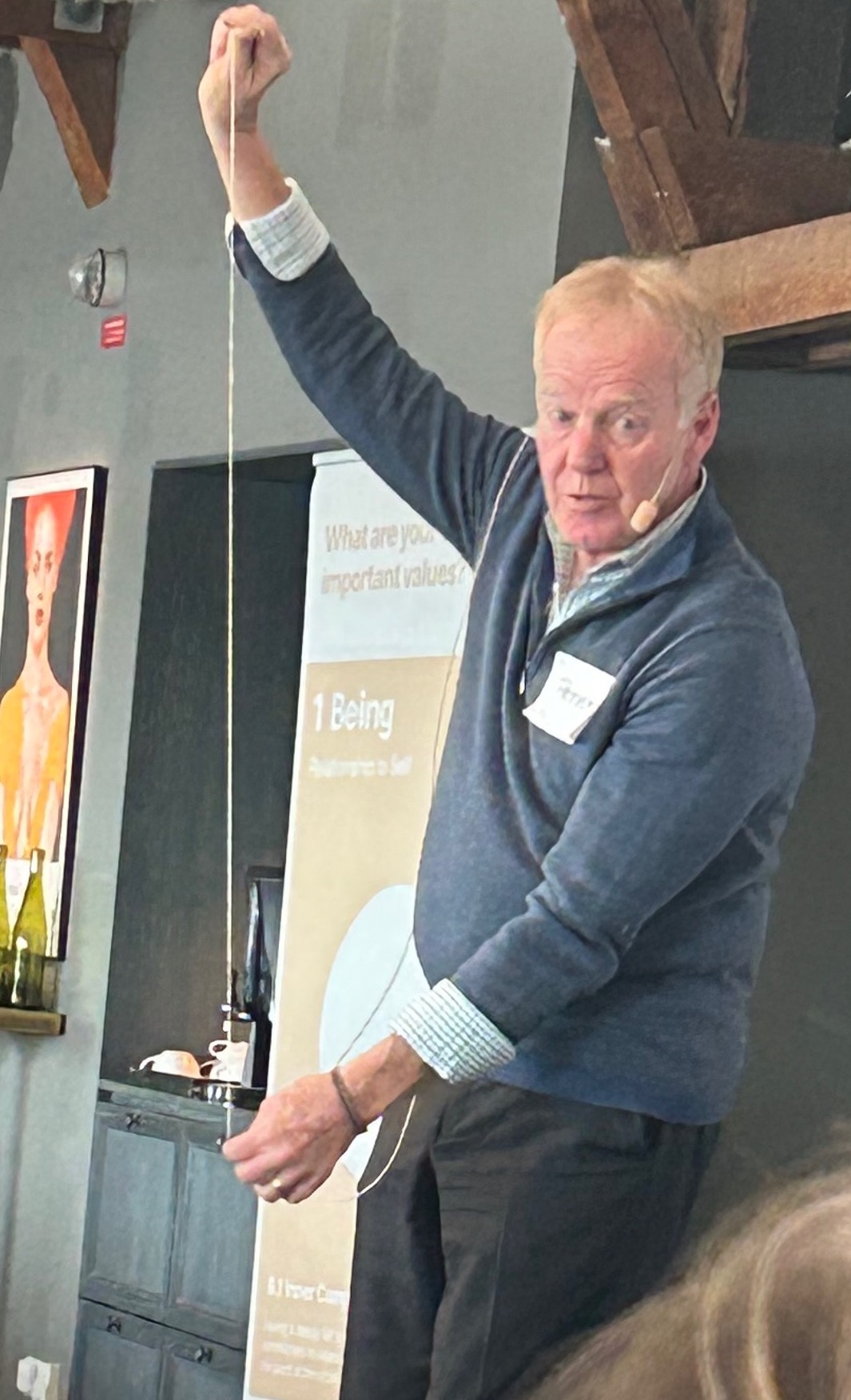
I found the continuation of the thought interesting: We can imagine the tension between reality and vision as a rubber band. When that tension becomes too uncomfortable for us, we often tend to either lower our aspirations or not tell the whole truth about the current state.

An energy source for change

A good example are an organization’s sustainability goals. When we consciously seek and hold this tension, we tap into the energy source for change. This principle of creativity is also found in theater as drama, in music as tonus, and in the Greek rhetoric. In this respect, it is not a new idea, but it is effective when we strive for change.

I was also interested in what Peter Senge is like as a person. I have already met some of the “greats of the lecture scene” away from the stage and with some of them I had the impression that it was difficult for them to live the conveyed messages themselves. That is also human.

Peter with rubber band

Peter Senge as a Human

In the morning of Day three, there was an emotionally expressed resistance from a participant who questioned the usefulness of the whole seminar. She said Peter Senge held on to the statement that we always have a choice and do not have to be influenced by external circumstances, despite her doubts expressed the day before.

Now I was curious. Will he maybe feel attacked and defend himself or let it stand as an individual opinion? He did not react immediately, but let other participants speak first. Later, he resonated, apologized, thanked for the learning opportunity, and did so with an authenticity and elegance that really impressed me.

He always treated his much younger co-trainer at eye level and was so moved several times that tears came to his eyes.

My summary

In the spirit of Marcus Aurelius, I had the opportunity to meet two greats of our time. Especially the combination of two trainers from different generations fits the challenges of our time.

Even though I have not implemented all of the presented contexts and tools and I am also not sure whether the term Compassionate System Leadership will become widely accepted, I recommend every leader to deal with the basic idea. A more sustainable leadership culture would do us and the planet good.

Mag. Gunther Fürstberger

Mag. Gunther Fürstberger

CEO | MDI Management Development International

Gunther Fürstberger is a management trainer, author and CEO of MDI – a global consulting company providing solutions for leadership development. His main interest is to make the world a better place through sustainable leadership. He has worked for clients including ABB, Abbvie, Boehringer Ingelheim, DHL, Google, Hornbach, PWC and Swarovski. His core competence is leadership in digital transformation. At the age of 20 he already started working as a trainer and he also served as HR manager in international corporations.

  • LinkedIn

What serves you next?

Leadership Horizon powered by HR INSIDE SMMIT

10 Tips for Effective Communication With Dominant Partners

Homer Simpson has been delighting young and old for many years. Short-tempered to the point of...
Read More

4 Heuristics to Stop Mistaking Symptoms for Cause in the AI Era

4 Heuristics to Stop Mistaking Symptoms for Cause in the AI Era The AI era is intensifying an old...
Read More

Human First: Leadership in the Age of AI

Human First: Leadership in the Age of AI My professional journey has always taken place at the...
Read More

AI Transformation Is Leadership Work

AI Transformation Is Leadership Work The four-step loop that turns individual experiments into...
Read More

What If AI Doesn’t Replace Us — But Drowns Us Out?

What If AI Doesn't Replace Us — But Drowns Us Out? Over the weekend, I watched a thought-provoking...
Read More

Use It or Lose It: How AI and Digital Tools May Be Changing Our Brains

Use It or Lose It: How AI and Digital Tools May Be Changing Our Brains You travel to Madrid and...
Read More

How Artificial Intelligence Shapes Who We Become

How Artificial Intelligence Shapes Who We Become Meike’s Reflections on Artificial Intelligence Do...
Read More

Zeca Ruiz on Cross-Generational Leadership and Navigating Change

Zeca Ruiz on Cross-Generational Leadership and Navigating Change This blog is an excerpt from our...
Read More

What AI Shows You — and What It Doesn’t

What AI Shows You — and What It Doesn't Meike’s Reflections on Artificial Intelligence Do you...
Read More

Leading in the Age of AI: How AI Discourse Shapes Responsibility and Power

Leading in the Age of AI: How AI Discourse Shapes Responsibility and Power Meike’s Reflections on...
Read More
When and why should leadership be shared?

When and why should leadership be shared?

by Bardia Monshi | Mar 27, 2023 | Agile Leadership, International leadership development, learning effectiveness | 0 comments

The Power of Shared Leadership

When and why should leadership be shared?

Bardia Monshi talks on-stage on 23.05.2023 @ the Leadership Horizon about the challenge of Shared Leadership. He is convinced it’s time for WeQ! He gives practical examples of when and why leadership should be shared, especially in times of uncertainty.

(more…)

« Older Entries
Next Entries »

Information

  • Imprint
  • MDI company website

Social Media

  • Facebook
  • Twitter
  • Youtube
  • LinkedIn

© MDI Management Development Institute, 2020