

• MDI
  • German version
  • Contact us
MDI Management Development
  • Agile leadership
  • Lateral Leadership
  • Leadership Impact
  • Leadership Development
Select Page
Mastering Communication: The Why, How, and What

Mastering Communication: The Why, How, and What

by Marcin Swierkocki | Jan 14, 2025 | Agile Leadership, Leadership Tips, Short Knowledge Bits | 0 comments

Mastering Communication: The Why, How, and What

Do you prefer to listen to this article? Click below to access our AI-generated audio version!

Mastering Communication: The Why, How, and What

Have you ever heard an employee say something like, “I won’t be able to meet the upcoming deadlines”? While the words may seem straightforward, they often hint at deeper underlying concerns. In this article, I delve into this statement through the lens of two well-known iceberg models, uncovering what lies beneath the surface…..

The iceberg models of Paul Watzlawick (of communication) and William Ury’s/Roger Fisher’s and Daniel Shapiro’s (positions vs. interests) share a common structure that emphasizes the elements of human interaction. Aligning these two models provides a deeper understanding of the interplay within communication strategies.

Watzlawick’s communication iceberg model:

  1. Above the surface – Fact-based communication: The pure content of the communication, such as words, facts or data communicated to the interlocutor. E.g.: ‘I want to complete this project by the end of this week’.
  2. Below the surface – Relational communication: The unspoken and emotional dynamic that underlies the actual content, such as tone, trust, non-verbal signals, and power. E.g.: A leader’s tone of voice suggests frustration or urgency, which influences how the message is received.

Ury and Shapiro’s iceberg model – positions vs interests:

  1. Above the surface – Positions: Explicit messages about what someone wants. Positions are noticeable but do not yet reveal underlying motivations. E.g.: ‘I need a 10% increase in my head count next year’.
  2. Below the surface – Interests: The deeper needs, desires, fears, and motivations that drive a position. Interests often refer to humanistic needs such as autonomy, recognition, or security. E.g.: Asking for a higher amount of workers next year reflects my need for recognition, security, or justice.

Both models emphasize the importance of understanding not only what is visible, but also what lies beneath the surface in human interaction. They agree with each other to the following extent:

Watzlawick’s iceberg model of communication

Ury’s/Shapiro’s iceberg model – positions vs interests

Fact-based communication (above the surface): Focuses on the pure content of the communication, such as words, facts or data.

Positions (above the surface): A clear request or message about what is wanted.

Relational communication (below the surface): Focuses on implicit dynamics such as tone, emotions, trust and the quality of the relationship.

Interests (below the surface): The deeper needs, concerns and motivations driving our positions.

Key findings: What is said is influenced by relational aspects (e.g. trust, power). Ignoring relational dynamics quite often leads to misunderstandings.

Key findings: Specific positions often mask hidden interests. Only an understanding of mutual interests can lead to a more constructive outcome.

Communication models

Practical implementation (1):

1. Communication while staying in touch with your Stakeholders:

Factual communication (based on your position) only serves as a starting point in reaching a solution, while relational communication (tone, trust) determines how your position is perceived. Recognizing deeper interests guides relational communication to build rapport and mutual understanding.

2. Conflict resolution:

Relationship breakdown (the hidden dynamic in Watzlawick’s model) results from long-established positions (evident in the Ury/Shapiro model). Addressing relational issues (e.g. respect, autonomy) generally leads to the discovery of shared/agreed interests.

3. Key questions so as to ‘dive below the surface’:

  • What is being said by the other side? (Positions/facts)
  • How is it being said? (Relationship dynamics)
  • Why is it being said? (Interests/basic motivations).

Practical implementation (2): Conflict in the workplace.

Scenario: An employee says: ‘I am unable to meet the upcoming deadlines’.

  • Watzlawick’s perspective: The actual message is failure to meet a deadline; the relational message may (our assumption) include frustration or fear of being perceived as an incompetent co-worker.
  • Ury’s/Shapiro’s perspective: The position is to refuse to meet a deadline; the interest may be to avoid burnout, being overloaded, or the need for greater clarity on priorities.

Conclusions:

By addressing both relational communication (e.g. showing empathy, and understanding people’s psychological needs) and underlying interests (e.g. redistribution of tasks or a new role in the team), a leader is able to solve issues/problems more effectively than by merely focusing on positions or factual messages.

Marcin Swierkocki

Marcin Swierkocki

Trainer, Coach & MDI Partner

Marcin Swierkocki works as an HR business consultant who has specialized in L&D, change- and project management. He brings over 25 years of international experience in change management and operational development with him. His personal motto is influenced by Viktor Frankl: ‘Between stimulus and response there is a space. In that space is our power to choose our response. In our response lies our growth…’. His personal inspiration comes from his optimistic and positive character and by draining the energy that successfully supporting others gives him.

  • LinkedIn

What serves you next?

10 Tips for Effective Communication With Dominant Partners

by Dominik Etzl, Rafael Ungvari | 4. October 2026 | Best Practice, Leadership Tips, learning effectiveness | 0 Comments

Homer Simpson has been delighting young and old for many years. Short-tempered to the point of being slightly irascible, he speaks his mind directly. He’s constantly getting annoyed over trivial matters and doesn’t seem to place much value on the opinions and advice...
Read More

4 Heuristics to Stop Mistaking Symptoms for Cause in the AI Era

by Zeca Ruiz | 24. September 2026 | Digital Transformation, Leadership and AI, Leadership Tips | 0 Comments

4 Heuristics to Stop Mistaking Symptoms for Cause in the AI Era The AI era is intensifying an old problem: acting too fast on the wrong diagnosis. Every one of us has lived through, or heard about, some organizational mess born from exactly that. In every era, every...
Read More

Human First: Leadership in the Age of AI

by Johanna Glechner | 14. September 2026 | Digital Transformation, Leadership and AI, Leadership in the digital transformation | 0 Comments

Human First: Leadership in the Age of AI My professional journey has always taken place at the intersection of two worlds that, for a long time, were treated as separate: technology and leadership. With a background in business informatics, I started my career in...
Read More

AI Transformation Is Leadership Work

by Gunther Fürstberger | 28. August 2026 | Leadership and AI, Leadership Tips, MDI Whitepaper | 0 Comments

AI Transformation Is Leadership Work The four-step loop that turns individual experiments into lasting change Many companies are already using AI—and still not transforming. Tools, pilot projects, and guidelines only add up to transformation once they deliberately...
Read More

What If AI Doesn’t Replace Us — But Drowns Us Out?

by Martin Maglia | 24. July 2026 | Digital Transformation, Leadership and AI, Short Knowledge Bits | 0 Comments

What If AI Doesn't Replace Us — But Drowns Us Out? Over the weekend, I watched a thought-provoking video from Rick Beato. (You can find the link at the end of this article.) For those who don't know him: Rick Beato is a musician, producer, educator, guitarist, and one...
Read More

Use It or Lose It: How AI and Digital Tools May Be Changing Our Brains

by Florian Biedermann | 26. June 2026 | Leadership and AI, Leadership Tips, Learning Transfer | 0 Comments

Use It or Lose It: How AI and Digital Tools May Be Changing Our Brains You travel to Madrid and want to chat with the locals, but you realize that after five years without practice, your rudimentary Spanish skills are now practically nonexistent and you even struggle...
Read More

How Artificial Intelligence Shapes Who We Become

by Meike Hinnenberg | 19. May 2026 | Impuls series, Leadership and AI, Leadership in the digital transformation | 0 Comments

How Artificial Intelligence Shapes Who We Become Meike’s Reflections on Artificial Intelligence Do you prefer to listen to this article? Click below to access our AI-generated audio version!How Artificial Intelligence Shapes Who We Become Meike’s Reflections on...
Read More

Zeca Ruiz on Cross-Generational Leadership and Navigating Change

by Jana Wölfl | 13. May 2026 | Leadership Impact, MDI Spotlight Series, Training Insights | 0 Comments

Zeca Ruiz on Cross-Generational Leadership and Navigating Change This blog is an excerpt from our new podcast! You can find the entire podcast episode here. Zeca Ruiz on Cross-Generational Leadership and Navigating Change In the fourth episode of our podcast “Voices...
Read More

What AI Shows You — and What It Doesn’t

by Meike Hinnenberg | 1. April 2026 | Digital Transformation, Impuls series, Leadership and AI | 0 Comments

What AI Shows You — and What It Doesn't Meike’s Reflections on Artificial Intelligence Do you prefer to listen to this article? Click below to access our AI-generated audio version! What AI Shows You — and What It Doesn't Meike’s Reflections on Artificial Intelligence...
Read More

Leading in the Age of AI: How AI Discourse Shapes Responsibility and Power

by Meike Hinnenberg | 18. March 2026 | Impuls series, Leadership and AI, Leadership Tips | 0 Comments

Leading in the Age of AI: How AI Discourse Shapes Responsibility and Power Meike’s Reflections on Artificial Intelligence Do you prefer to listen to this article? Click below to access our AI-generated audio version!Leading in the Age of AI: How AI Discourse Shapes...
Read More
Self-Leadership: Harnessing the Power Within

Self-Leadership: Harnessing the Power Within

by Meike Hinnenberg | Dec 17, 2024 | Best Practice, Leadership Tips, Short Knowledge Bits | 0 comments

Self-Leadership: Harnessing the Power Within

Do you prefer to listen to this article? Click below to access our AI-generated audio version!

Self-Leadership: Harnessing the Power Within

In today’s fast-paced and unpredictable world, we often lack control over external circumstances or how others treat us. However, we possess one powerful tool: the ability to choose how we respond.

This doesn’t mean conforming to every situation or forcing solutions. Instead, self-leadership focuses on understanding and managing our thoughts and emotions —skills that can profoundly influence our relationships and leadership abilities.

The Core of Leadership: The “Me” Circle

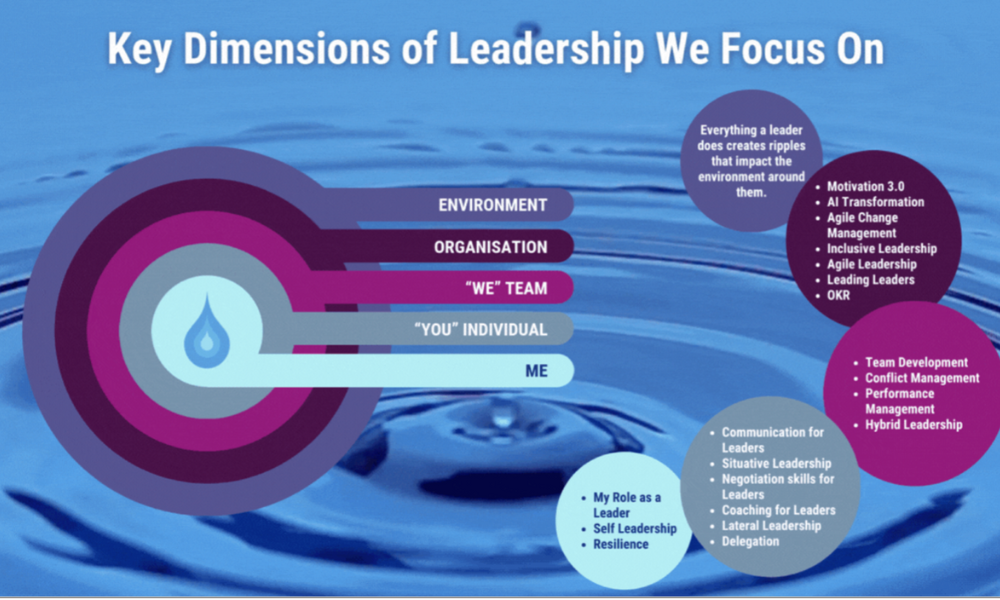
Imagine leadership development as a ripple effect. At the center lies the self—the starting point for influencing all outer circles: individuals, teams, organizations, and the wider environment. The “me” dimension is foundational.

How we connect with others or design organizational systems stems directly from our inner state. For now, let’s focus on this pivotal core: self-leadership.

Key Dimensions of Leadership we Focus on

Empathy vs. Sympathy: Choosing Connection

Empathy is a cornerstone of self-leadership, fostering connection, while sympathy can unintentionally create distance. According to Brene Brown, empathy encompasses:

  • Perspective-taking: Seeing the world through someone else’s eyes.
  • Non-judgment: Withholding judgment about others’ experiences.
  • Emotional recognition: Identifying and validating others’ emotions.
  • Feeling with others: Truly sharing in their emotional experience.

Leaders often struggle with vulnerability, imperfection, and the uncontrollable aspects of life and relationships. Our biological wiring doesn’t help—we’re programmed to detect and react to potential threats, a survival mechanism that can hinder connection. Recognizing and addressing this is key to empathetic leadership.

Cultivating “Response-Ability”

While we can’t control external events, we can control how we react—our “response-ability.” Tools like deep, conscious breathing and regular meditation can help calm the brain’s alarm system, creating space between stimulus and response. Gratitude practices can shift our focus toward the positive, reducing the weight of perceived threats.

These habits empower leaders to make decisions thoughtfully, even amid complexity and conflicting needs.

Leadership Decision-Making: Navigating Complexity

Making decisions as a leader is inherently challenging. It’s impossible to satisfy everyone, and every decision invites criticism. Understanding this reality helps us navigate conflict, a normal part of organizational life

Decisions will always carry trade-offs, but by including diverse perspectives and maintaining self-awareness, leaders can strive for the best possible outcomes.

Embracing Your Inner Team

Self-leadership also involves recognizing and harmonizing the many voices within us—our “inner team.” Each voice represents a perspective or trait, such as the Perfectionist, the Empathetic, or the Fearful. Listening to and integrating these voices strengthens decision-making and communication.

Embracing your inner Team

Practical Exercise:

Start by asking yourself a question, like, “Should I address this conflict?” Visualize the various inner voices involved and assign them roles or characters. For instance:

  • The Perfectionist: Insists on flawless execution.
  • The Fearful: Warns of potential risks.
  • The Rational: Seeks logic and balance.
  • The Angry: Advocates fiercely for boundaries.

Identify which voices are louder or more resistant and allow each to speak. Then, appoint an “inner team leader” to mediate, ensuring all perspectives are heard and integrated into a coherent plan.

In my own inner team, I balance voices like the empathetic, the strong, the fearful, and the rational. Each one has value, and my inner leader works to harmonize them, fostering collaboration and guiding decisions that reflect the best of all perspectives.

Conclusion

Self-leadership isn’t about perfection—it’s about awareness and intentionality. By cultivating empathy, practicing response-ability, and embracing the wisdom of your inner team, you can make decisions with clarity and confidence.

When we lead ourselves effectively, we empower others to thrive, creating ripples of positive change that extend far beyond the “me” circle.

Meike Hinnenberg

Meike Hinnenberg

Learning & Development Consultant

Meike Hinnenberg is a trainer at MDI Management Development GmbH and specializes in communication, conflict management, diversity & inclusion, and lateral leadership.

  • LinkedIn

What serves you next?

10 Tips for Effective Communication With Dominant Partners

by Dominik Etzl, Rafael Ungvari | 4. October 2026 | Best Practice, Leadership Tips, learning effectiveness | 0 Comments

Homer Simpson has been delighting young and old for many years. Short-tempered to the point of being slightly irascible, he speaks his mind directly. He’s constantly getting annoyed over trivial matters and doesn’t seem to place much value on the opinions and advice...
Read More

4 Heuristics to Stop Mistaking Symptoms for Cause in the AI Era

by Zeca Ruiz | 24. September 2026 | Digital Transformation, Leadership and AI, Leadership Tips | 0 Comments

4 Heuristics to Stop Mistaking Symptoms for Cause in the AI Era The AI era is intensifying an old problem: acting too fast on the wrong diagnosis. Every one of us has lived through, or heard about, some organizational mess born from exactly that. In every era, every...
Read More

Human First: Leadership in the Age of AI

by Johanna Glechner | 14. September 2026 | Digital Transformation, Leadership and AI, Leadership in the digital transformation | 0 Comments

Human First: Leadership in the Age of AI My professional journey has always taken place at the intersection of two worlds that, for a long time, were treated as separate: technology and leadership. With a background in business informatics, I started my career in...
Read More

AI Transformation Is Leadership Work

by Gunther Fürstberger | 28. August 2026 | Leadership and AI, Leadership Tips, MDI Whitepaper | 0 Comments

AI Transformation Is Leadership Work The four-step loop that turns individual experiments into lasting change Many companies are already using AI—and still not transforming. Tools, pilot projects, and guidelines only add up to transformation once they deliberately...
Read More

What If AI Doesn’t Replace Us — But Drowns Us Out?

by Martin Maglia | 24. July 2026 | Digital Transformation, Leadership and AI, Short Knowledge Bits | 0 Comments

What If AI Doesn't Replace Us — But Drowns Us Out? Over the weekend, I watched a thought-provoking video from Rick Beato. (You can find the link at the end of this article.) For those who don't know him: Rick Beato is a musician, producer, educator, guitarist, and one...
Read More

Use It or Lose It: How AI and Digital Tools May Be Changing Our Brains

by Florian Biedermann | 26. June 2026 | Leadership and AI, Leadership Tips, Learning Transfer | 0 Comments

Use It or Lose It: How AI and Digital Tools May Be Changing Our Brains You travel to Madrid and want to chat with the locals, but you realize that after five years without practice, your rudimentary Spanish skills are now practically nonexistent and you even struggle...
Read More

How Artificial Intelligence Shapes Who We Become

by Meike Hinnenberg | 19. May 2026 | Impuls series, Leadership and AI, Leadership in the digital transformation | 0 Comments

How Artificial Intelligence Shapes Who We Become Meike’s Reflections on Artificial Intelligence Do you prefer to listen to this article? Click below to access our AI-generated audio version!How Artificial Intelligence Shapes Who We Become Meike’s Reflections on...
Read More

Zeca Ruiz on Cross-Generational Leadership and Navigating Change

by Jana Wölfl | 13. May 2026 | Leadership Impact, MDI Spotlight Series, Training Insights | 0 Comments

Zeca Ruiz on Cross-Generational Leadership and Navigating Change This blog is an excerpt from our new podcast! You can find the entire podcast episode here. Zeca Ruiz on Cross-Generational Leadership and Navigating Change In the fourth episode of our podcast “Voices...
Read More

What AI Shows You — and What It Doesn’t

by Meike Hinnenberg | 1. April 2026 | Digital Transformation, Impuls series, Leadership and AI | 0 Comments

What AI Shows You — and What It Doesn't Meike’s Reflections on Artificial Intelligence Do you prefer to listen to this article? Click below to access our AI-generated audio version! What AI Shows You — and What It Doesn't Meike’s Reflections on Artificial Intelligence...
Read More

Leading in the Age of AI: How AI Discourse Shapes Responsibility and Power

by Meike Hinnenberg | 18. March 2026 | Impuls series, Leadership and AI, Leadership Tips | 0 Comments

Leading in the Age of AI: How AI Discourse Shapes Responsibility and Power Meike’s Reflections on Artificial Intelligence Do you prefer to listen to this article? Click below to access our AI-generated audio version!Leading in the Age of AI: How AI Discourse Shapes...
Read More
The Right Questions at The Right Time – Thinking From Within!

The Right Questions at The Right Time – Thinking From Within!

by Marcin Swierkocki | Dec 9, 2024 | Leadership Tips, MDI Inside, Training Insights | 0 comments

The Right Questions at The Right Time – Thinking From Within!

Do you prefer to listen to this article? Click below to access our AI-generated audio version!

The Right Questions at the Right Time – Thinking From Within!

It is not easy to find oneself in a world based on chaos, noise, and incoherence of values. Out of the needs flowing in one’s mind, it seems impossible to choose the one the most hidden, most needed, most personal, most genuine, and authentic. For what reason is it so difficult to delve into oneself?

Year-End Reflections: Embracing Change and Uncertainty

The end of the year makes us reflect and think about what we’ve done and achieved. However, it’s also a time for conclusions and a summary of our activities. The current times have made us realize that everything can change in the blink of an eye.

The image of the reality we perceive has been distorted in one way or another – AI applications, globalization, integration, or maybe decentralization. Who knows? And what can you do about that?

Finding Purpose: A Grounded Start to the New Year

Today’s times have catalyzed, often ground-breaking, changes in the way we communicate both internally and with our customers. Therefore, in order not to ‘go crazy,’ it is helpful to have your answer to the question – ‘why’ do I do what I do? For me, it gives me coherence between how I think and what I do, the inner peace and joy that comes from feeling that I can use the potential I have been given for worthy causes.

Hence, let’s not just focus on the what and the how because this allows neither reflection nor having the right perspective. Without this, life just seems to be shallow! And that’s not the right way to start New Year…

Unveiling Purpose: Integrating Models for Lasting Impact

Discovering your “why” can truly transform your life and work. It provides a sense of clarity and purpose that fuels real motivation and helps you stay authentic, even through challenges.

It’s not just a path to personal success; it’s the heart of building something meaningful and lasting – a business or career that feels deeply fulfilling and genuinely worthwhile.

I will take a moment below to zoom in on how the two models I know from the training setup can work together. This is my interpretation, and any comments or feedback will be highly appreciated.

Unveiling Purpose: Integrating Models for Lasting Impact

The Dilts Logical Levels framework and Sinek’s Golden Circle

are both correlated, as they address the layers of meaning/purpose of human actions. Each of these models explores the why, how, and what of human actions, albeit with a slightly different focus.

Here’s how they work together:

1. Why (Sinek) ↔ Identity and Purpose (Dilts)

The Golden Circle – Why, in Sinek’s case, is the purpose and cause that drives individuals and organizations. It is the reason behind our actions, beyond the outcome, and provides us with a sense of what we do!

Logical levels – Identity and Purpose. At Dilts’, the Identity level represents ‘Who’ we are, encompassing our beliefs about ourselves and our deeper purpose. At the top of his pyramid, purpose extends to a relationship with vision and mission (in the organizational context), often linked to our contribution to a larger system.

Both frameworks represent an overarching vision and motivation, guiding everything else.

WHY WHAT HOW

2. How (Sinek) ↔ Beliefs, Skills and Behaviors (Dilts)

The Golden Circle – How, in Sinek’s case, defines the process and methods. It is how we bring purpose to life, often through unique processes, values, or distinctive characteristics.

Logical levels – Beliefs, skills, and behaviors. In Dilts’ model, Beliefs inform what we believe is possible or worth the effort (shaping the How), while skills refer to our capabilities and strategies used to implement actions. Behaviors are the actual actions taken, representing the translation of beliefs and our skills into something tangible!

This Dilts level relates to Sinek’s How as it defines our approach, skillset, and actions that make the goal achievable. Beliefs drive motivation, skills enable action, and behaviors embody these values in practice.

3. What (Sinek) ↔ Environment and Results (Dilts)

Golden Circle – In Sinek’s terms, What is the outcome, the actual product, service, or result achieved? It is what people see and is often the most tangible aspect of the organization or person’s work.

Logical levels – Environment and results. Dilts places the environment as the lowest level where the activities that shape outcomes occur. It is the place where the results are observed, evaluated, and adjusted.

Both models represent concrete, visible output experienced by others. In both frameworks, the What is a visible manifestation of deeper levels shows how purpose and beliefs are ultimately realized.

Conclusions:

Sinek’s Golden Circle

Dilts’ logical levels

Why    

Purpose and Identity

How

Beliefs, Skills, and Behaviors

What

Environment and Results

Aligning these models allows us to understand not only the outcome (What) but also the deeper motivations standing behind our actions (Why) and processes (How) that drive our behavior. This synergy is particularly useful for leaders to properly guide their co-workers and organizational development.

Marcin Swierkocki

Marcin Swierkocki

Trainer, Coach & MDI Partner

Marcin Swierkocki works as an HR business consultant who has specialized in L&D, change- and project management. He brings over 25 years of international experience in change management and operational development with him. His personal motto is influenced by Viktor Frankl: ‘Between stimulus and response there is a space. In that space is our power to choose our response. In our response lies our growth…’. His personal inspiration comes from his optimistic and positive character and by draining the energy that successfully supporting others gives him.

  • LinkedIn

What serves you next?

10 Tips for Effective Communication With Dominant Partners

by Dominik Etzl, Rafael Ungvari | 4. October 2026 | Best Practice, Leadership Tips, learning effectiveness | 0 Comments

Homer Simpson has been delighting young and old for many years. Short-tempered to the point of being slightly irascible, he speaks his mind directly. He’s constantly getting annoyed over trivial matters and doesn’t seem to place much value on the opinions and advice...
Read More

4 Heuristics to Stop Mistaking Symptoms for Cause in the AI Era

by Zeca Ruiz | 24. September 2026 | Digital Transformation, Leadership and AI, Leadership Tips | 0 Comments

4 Heuristics to Stop Mistaking Symptoms for Cause in the AI Era The AI era is intensifying an old problem: acting too fast on the wrong diagnosis. Every one of us has lived through, or heard about, some organizational mess born from exactly that. In every era, every...
Read More

Human First: Leadership in the Age of AI

by Johanna Glechner | 14. September 2026 | Digital Transformation, Leadership and AI, Leadership in the digital transformation | 0 Comments

Human First: Leadership in the Age of AI My professional journey has always taken place at the intersection of two worlds that, for a long time, were treated as separate: technology and leadership. With a background in business informatics, I started my career in...
Read More

AI Transformation Is Leadership Work

by Gunther Fürstberger | 28. August 2026 | Leadership and AI, Leadership Tips, MDI Whitepaper | 0 Comments

AI Transformation Is Leadership Work The four-step loop that turns individual experiments into lasting change Many companies are already using AI—and still not transforming. Tools, pilot projects, and guidelines only add up to transformation once they deliberately...
Read More

What If AI Doesn’t Replace Us — But Drowns Us Out?

by Martin Maglia | 24. July 2026 | Digital Transformation, Leadership and AI, Short Knowledge Bits | 0 Comments

What If AI Doesn't Replace Us — But Drowns Us Out? Over the weekend, I watched a thought-provoking video from Rick Beato. (You can find the link at the end of this article.) For those who don't know him: Rick Beato is a musician, producer, educator, guitarist, and one...
Read More

Use It or Lose It: How AI and Digital Tools May Be Changing Our Brains

by Florian Biedermann | 26. June 2026 | Leadership and AI, Leadership Tips, Learning Transfer | 0 Comments

Use It or Lose It: How AI and Digital Tools May Be Changing Our Brains You travel to Madrid and want to chat with the locals, but you realize that after five years without practice, your rudimentary Spanish skills are now practically nonexistent and you even struggle...
Read More

How Artificial Intelligence Shapes Who We Become

by Meike Hinnenberg | 19. May 2026 | Impuls series, Leadership and AI, Leadership in the digital transformation | 0 Comments

How Artificial Intelligence Shapes Who We Become Meike’s Reflections on Artificial Intelligence Do you prefer to listen to this article? Click below to access our AI-generated audio version!How Artificial Intelligence Shapes Who We Become Meike’s Reflections on...
Read More

Zeca Ruiz on Cross-Generational Leadership and Navigating Change

by Jana Wölfl | 13. May 2026 | Leadership Impact, MDI Spotlight Series, Training Insights | 0 Comments

Zeca Ruiz on Cross-Generational Leadership and Navigating Change This blog is an excerpt from our new podcast! You can find the entire podcast episode here. Zeca Ruiz on Cross-Generational Leadership and Navigating Change In the fourth episode of our podcast “Voices...
Read More

What AI Shows You — and What It Doesn’t

by Meike Hinnenberg | 1. April 2026 | Digital Transformation, Impuls series, Leadership and AI | 0 Comments

What AI Shows You — and What It Doesn't Meike’s Reflections on Artificial Intelligence Do you prefer to listen to this article? Click below to access our AI-generated audio version! What AI Shows You — and What It Doesn't Meike’s Reflections on Artificial Intelligence...
Read More

Leading in the Age of AI: How AI Discourse Shapes Responsibility and Power

by Meike Hinnenberg | 18. March 2026 | Impuls series, Leadership and AI, Leadership Tips | 0 Comments

Leading in the Age of AI: How AI Discourse Shapes Responsibility and Power Meike’s Reflections on Artificial Intelligence Do you prefer to listen to this article? Click below to access our AI-generated audio version!Leading in the Age of AI: How AI Discourse Shapes...
Read More
Efficiency with AI in Leadership Development

Efficiency with AI in Leadership Development

by Gunther Fürstberger | Oct 31, 2024 | Best Practice, Leadership and AI, MDI Inside | 0 comments

Efficiency with AI in Leadership Development

Do you prefer to listen to this article? Click below to access our AI-generated audio version!

Efficiency with AI in Leadership Development

Perhaps the first AI hype is already over, but it paves the way for a more realistic view. AI transformation is progressing at different speeds in different industries.

However, the training industry is among the pioneers: machine learning has enormous potential to make human learning more efficient, effective, and cost-effective. Since 2023, we have been experimenting intensively with artificial intelligence as a provider of leadership development and are happy to share our experiences.

AI in everyday business: a fixed routine in meetings

For a year and a half, AI has had a permanent place in every company management meeting. At least one current topic is supplemented by an LLM (Large Language Model) with a perspective or recommendation.

This practice has proven itself and enables more informed decisions with minimal time investment. Experiments with automatic logging, on the other hand, have proven less successful.

In August 2023, we launched AICO (Artificial Intelligence Co-Trainer), which has since been supporting us with energy exercises, music selection, transfer tasks, and as a knowledge source for participant questions in the seminar. Shortly after that, we tested the first ChatGPT role-playing game in a seminar and were impressed by the positive participant feedback. Initially, we provided the prompts as a transfer task.

AI transformation roadmap: planning at the company level

In January 2024, we launched a company-wide AI transformation roadmap. This means that we plan how AI can be used in key areas of the company every quarter to ensure that the entire organization is involved in this development.

In our OKR (Objectives and Key Results) planning meeting for the second quarter, we determined that no offer would be sent to customers without an AI component that covers at least 10% of the learning journey. Customers will still have the option to book the AI components that were previously free of charge.

AI transformation roadmap: planning at the company level

AI Lab: A role-playing center for real-world scenarios

In the third quarter, we plan to set up an AI lab on our website where all applications can be tested and used in a bundled form. This lab includes a role-playing center for various leadership communication situations. Participants take on the role of the leader, while the AI takes on the role of the employees.

A keyboard is no longer necessary – the role play is done by speaking and listening. After completion, the leaders receive targeted feedback that refers to the learned communication models. The role play can be repeated as often as desired, not only in the seminar but also when the situation arises in real life.

The future of learning: from 2D avatars to “superpowers”

Just as e-learning has replaced knowledge transfer in training over the last 20 years, AI has the potential to revolutionize skills development today. Currently, role-playing on the phone is still purely auditory, but soon visual avatars will be integrated as role-playing partners.

AI applications with 3D avatars for virtual reality glasses already exist. However, we suspect that 2D avatars will initially be used as learning partners because they are easier to use. These avatars are already supported by so-called “superpowers”. For example, Hume.ai gives AI coaches empathy and enables feedback on the current emotional state of the role-playing participant using voice analysis.

Real avatars as knowledge messengers and the next step in learning transfer

We are experimenting with “real avatars” of trainers who are available to participants as knowledge messengers after the seminar. This new type of learning transfer support enables agile learning when needed. Despite all efforts, learning transfer has often been a neglected topic in the industry.

Our leadership agent project (“LAgent”) is proving more challenging: we are developing an AI agent that can proactively pursue short-and long-term goals together with the leader. However, the LLMs currently available are still limited in their memory function, which would be necessary for responsible co-leadership. But this is precisely where development is progressing rapidly, and it is becoming increasingly easier to develop AI agents.

Conclusion: AI transformation in learning and development

Overall, the AI transformation in the area of learning and development is a fascinating field and is contributing significantly to the development of organizations and, by extension, society.

Mag. Gunther Fürstberger

Mag. Gunther Fürstberger

CEO | MDI Management Development International

Gunther Fürstberger is a management trainer, author and CEO of Metaforum and MDI – a global consulting company providing solutions for leadership development. His main interest is to make the world a better place through excellent leadership. He has worked for clients including ABB, Abbvie, Boehringer Ingelheim, DHL, Hornbach, PWC and Swarovski. His core competence is leadership in digital transformation. He gained his own leadership experience as HR Manager of McDonald’s Central Europe/Central Asia.  At the age of 20 he already started working as a trainer.

  • LinkedIn

Download our International Whitepaper:


What serves you next?

10 Tips for Effective Communication With Dominant Partners

by Dominik Etzl, Rafael Ungvari | 4. October 2026 | Best Practice, Leadership Tips, learning effectiveness | 0 Comments

Homer Simpson has been delighting young and old for many years. Short-tempered to the point of being slightly irascible, he speaks his mind directly. He’s constantly getting annoyed over trivial matters and doesn’t seem to place much value on the opinions and advice...
Read More

4 Heuristics to Stop Mistaking Symptoms for Cause in the AI Era

by Zeca Ruiz | 24. September 2026 | Digital Transformation, Leadership and AI, Leadership Tips | 0 Comments

4 Heuristics to Stop Mistaking Symptoms for Cause in the AI Era The AI era is intensifying an old problem: acting too fast on the wrong diagnosis. Every one of us has lived through, or heard about, some organizational mess born from exactly that. In every era, every...
Read More

Human First: Leadership in the Age of AI

by Johanna Glechner | 14. September 2026 | Digital Transformation, Leadership and AI, Leadership in the digital transformation | 0 Comments

Human First: Leadership in the Age of AI My professional journey has always taken place at the intersection of two worlds that, for a long time, were treated as separate: technology and leadership. With a background in business informatics, I started my career in...
Read More

AI Transformation Is Leadership Work

by Gunther Fürstberger | 28. August 2026 | Leadership and AI, Leadership Tips, MDI Whitepaper | 0 Comments

AI Transformation Is Leadership Work The four-step loop that turns individual experiments into lasting change Many companies are already using AI—and still not transforming. Tools, pilot projects, and guidelines only add up to transformation once they deliberately...
Read More

What If AI Doesn’t Replace Us — But Drowns Us Out?

by Martin Maglia | 24. July 2026 | Digital Transformation, Leadership and AI, Short Knowledge Bits | 0 Comments

What If AI Doesn't Replace Us — But Drowns Us Out? Over the weekend, I watched a thought-provoking video from Rick Beato. (You can find the link at the end of this article.) For those who don't know him: Rick Beato is a musician, producer, educator, guitarist, and one...
Read More

Use It or Lose It: How AI and Digital Tools May Be Changing Our Brains

by Florian Biedermann | 26. June 2026 | Leadership and AI, Leadership Tips, Learning Transfer | 0 Comments

Use It or Lose It: How AI and Digital Tools May Be Changing Our Brains You travel to Madrid and want to chat with the locals, but you realize that after five years without practice, your rudimentary Spanish skills are now practically nonexistent and you even struggle...
Read More

How Artificial Intelligence Shapes Who We Become

by Meike Hinnenberg | 19. May 2026 | Impuls series, Leadership and AI, Leadership in the digital transformation | 0 Comments

How Artificial Intelligence Shapes Who We Become Meike’s Reflections on Artificial Intelligence Do you prefer to listen to this article? Click below to access our AI-generated audio version!How Artificial Intelligence Shapes Who We Become Meike’s Reflections on...
Read More

Zeca Ruiz on Cross-Generational Leadership and Navigating Change

by Jana Wölfl | 13. May 2026 | Leadership Impact, MDI Spotlight Series, Training Insights | 0 Comments

Zeca Ruiz on Cross-Generational Leadership and Navigating Change This blog is an excerpt from our new podcast! You can find the entire podcast episode here. Zeca Ruiz on Cross-Generational Leadership and Navigating Change In the fourth episode of our podcast “Voices...
Read More

What AI Shows You — and What It Doesn’t

by Meike Hinnenberg | 1. April 2026 | Digital Transformation, Impuls series, Leadership and AI | 0 Comments

What AI Shows You — and What It Doesn't Meike’s Reflections on Artificial Intelligence Do you prefer to listen to this article? Click below to access our AI-generated audio version! What AI Shows You — and What It Doesn't Meike’s Reflections on Artificial Intelligence...
Read More

Leading in the Age of AI: How AI Discourse Shapes Responsibility and Power

by Meike Hinnenberg | 18. March 2026 | Impuls series, Leadership and AI, Leadership Tips | 0 Comments

Leading in the Age of AI: How AI Discourse Shapes Responsibility and Power Meike’s Reflections on Artificial Intelligence Do you prefer to listen to this article? Click below to access our AI-generated audio version!Leading in the Age of AI: How AI Discourse Shapes...
Read More
Challenges and Opportunities of AI in China

Challenges and Opportunities of AI in China

by Gunther Fürstberger | Jun 10, 2024 | Leadership and AI, MDI Inside, training new leader | 0 comments

Challenges and Opportunities in China

Do you prefer to listen to this article? Click here to listen to the AI-generated version!

Challenges and Opportunities of AI in China

While some see China’s intensive video surveillance as a realization of George Orwell’s bleak vision of the future in “1984”, others argue that China is a safer place as crimes are quickly detected due to these measures.

I, too, am concerned with the question of the benefits and harms of the use of artificial intelligence in public administration in China. In this blog post, I report on my experiences and observations on my recent trip to China.

Travel preparations with hurdles

I reactivated my WeChat account to prepare for my trip. This turned out to be more complicated than I had expected. Only after repeated attempts and several hours of effort did I manage to reactivate my WeChat account with the help of a WeChat friend from Taiwan.

This automatically sets up the WeChat payment service Weixin Pay. I could link it to my Mastercard after scanning my passport and approving a photo using my cell phone camera. I thought to myself: now the public authorities can track my payment activities if they are interested.

My experience with digital payment systems in China

However, WeChat payment did not work in China and the alternative Alipay also failed to verify my credit cards. However, I did meet Germans who had success with Alipay. My attempts to communicate with my credit card processors didn’t change anything.

To my relief, I realized that cash is usually accepted after all and that I could pay online for the high-speed train from Beijing to Shanghai with a foreign credit card. But the locals pay for everything with their phones.

Political moods in China

In personal interactions, my Chinese conversation partners also proved to be critical of the government. As long as people are talking and not typing virtually, they are relaxed. I mainly encountered a pragmatic attitude.
From a transactional analysis perspective, they are treated like children by the authorities.

However, they did not care much as long as they feel safe and can pursue their economic activities. My current view on this: The trend towards personal surveillance will continue despite attempts at regulation, and not just in China. More cameras are being used every year:


  • Many installed cameras by public administrations, businesses, and homeowners.
  • In addition, billions of cell phone cameras and big data analysis possibilities worldwide can monitor a large part of our lives.

The power of surveillance: AI, resistance and political stability

Whether in democracies, autocracies, or hybrid systems – those in political power have instruments in their hands that they can use to either benevolently or to maintain power. It is usually a combination. What seems most problematic to me is that potential resistance can be nipped in the bud. The more benevolent a system of rule is, the less resistance there will be.

Using AI, an autocratic government can protect itself almost to the point of unassailability. However, history has proven that a lot of power corrupts. The greater the differences in power and income, the stronger the resistance.

AI in different leadership systems

Even the most powerful autocrats are getting older and younger people are taking over their positions. These changes are often accompanied by power struggles and thus at least temporary destabilization. AI is a new and significant aspect of the leadership system, but not the only relevant one. Other aspects are e.g:

  • Collective benefit maximization and suffering minimization for all relevant stakeholders including minorities. If an authoritarian or democratic regime achieves sustainably good results in this respect, it has a better chance of remaining in office.
  • Intelligence and education of leaders and those being led
  • Beliefs of leaders and those being led (e.g. “only the collective counts” or “it’s safer with us”)
  • The legal and executive system
  • Incentive systems and social stratification

I also wanted to use my trip to China to further develop my views on the following 2 questions in particular:

1. Is democracy always the best form of government?

I remain a supporter of democracy, while at the same time maintaining the view that sometimes intelligent, benevolent autocrats can achieve better results than bad democratically legitimized governments. Over the past three decades, China has achieved amazing results in terms of prosperity, innovation, and security, for example.

My youthful conviction that democratic systems are economically superior to autocratic ones has long been called into question by China’s one-party system. On average, however, intelligent and benevolent parties come into government more often in democracies. Above all, problematic undesirable developments can be prevented more easily and quickly.

2. What are the benefits and harms of the new surveillance possibilities offered by AI?

It is strange for me to see cameras even on forest paths in the Wudang Mountains. At the same time, I have rarely felt as safe at night in cities with millions of inhabitants as I do in China. In addition to security, efficiency is also a strong argument in favor of biometric recognition methods.

I have been used to the idea for years that we are heading towards a transparent world. We are already ensuring that with our smartphones, Apple watches, etc. If we live in a society in which individual freedom and uniqueness are accepted within the harmful limits of others, transparency has little to threaten me.

But that brings us back to question 1: if my data is being used by government agencies to maintain power or execute ideological -isms, then it may already be too late.

Regulation with a sense of proportion

Unfortunately, we know that even liberal democracies can become dictatorships. In recent years, in particular, there have been ominous developments in various Western countries where attempts have been made to weaken democracies through violence or manipulation.

And we have also seen how quickly countries have become involved in wars. I therefore believe that regulation with a sense of proportion is necessary, especially when it comes to the use and storage of collected data.

A summary of my learning journey

For me, this learning journey was not about judging in the sense of right and wrong, but about interpreting developments in the context of history, culture, population density, religion, etc. I took one final inspiration from a leadership outcome that with me: China shows that switching to e-mobility and attractive public transportation is possible. Why are we going the other way again with combustion engines?

Mag. Gunther Fürstberger

Mag. Gunther Fürstberger

CEO | MDI Management Development International

Gunther Fürstberger is a management trainer, author and CEO of Metaforum and MDI – a global consulting company providing solutions for leadership development. His main interest is to make the world a better place through excellent leadership. He has worked for clients including ABB, Abbvie, Boehringer Ingelheim, DHL, Hornbach, PWC and Swarovski. His core competence is leadership in digital transformation. He gained his own leadership experience as HR Manager of McDonald’s Central Europe/Central Asia.  At the age of 20 he already started working as a trainer.

  • LinkedIn

Download our International Whitepaper:


What serves you next?

10 Tips for Effective Communication With Dominant Partners

by Dominik Etzl, Rafael Ungvari | 4. October 2026 | Best Practice, Leadership Tips, learning effectiveness | 0 Comments

Homer Simpson has been delighting young and old for many years. Short-tempered to the point of being slightly irascible, he speaks his mind directly. He’s constantly getting annoyed over trivial matters and doesn’t seem to place much value on the opinions and advice...
Read More

4 Heuristics to Stop Mistaking Symptoms for Cause in the AI Era

by Zeca Ruiz | 24. September 2026 | Digital Transformation, Leadership and AI, Leadership Tips | 0 Comments

4 Heuristics to Stop Mistaking Symptoms for Cause in the AI Era The AI era is intensifying an old problem: acting too fast on the wrong diagnosis. Every one of us has lived through, or heard about, some organizational mess born from exactly that. In every era, every...
Read More

Human First: Leadership in the Age of AI

by Johanna Glechner | 14. September 2026 | Digital Transformation, Leadership and AI, Leadership in the digital transformation | 0 Comments

Human First: Leadership in the Age of AI My professional journey has always taken place at the intersection of two worlds that, for a long time, were treated as separate: technology and leadership. With a background in business informatics, I started my career in...
Read More

AI Transformation Is Leadership Work

by Gunther Fürstberger | 28. August 2026 | Leadership and AI, Leadership Tips, MDI Whitepaper | 0 Comments

AI Transformation Is Leadership Work The four-step loop that turns individual experiments into lasting change Many companies are already using AI—and still not transforming. Tools, pilot projects, and guidelines only add up to transformation once they deliberately...
Read More

What If AI Doesn’t Replace Us — But Drowns Us Out?

by Martin Maglia | 24. July 2026 | Digital Transformation, Leadership and AI, Short Knowledge Bits | 0 Comments

What If AI Doesn't Replace Us — But Drowns Us Out? Over the weekend, I watched a thought-provoking video from Rick Beato. (You can find the link at the end of this article.) For those who don't know him: Rick Beato is a musician, producer, educator, guitarist, and one...
Read More

Use It or Lose It: How AI and Digital Tools May Be Changing Our Brains

by Florian Biedermann | 26. June 2026 | Leadership and AI, Leadership Tips, Learning Transfer | 0 Comments

Use It or Lose It: How AI and Digital Tools May Be Changing Our Brains You travel to Madrid and want to chat with the locals, but you realize that after five years without practice, your rudimentary Spanish skills are now practically nonexistent and you even struggle...
Read More

How Artificial Intelligence Shapes Who We Become

by Meike Hinnenberg | 19. May 2026 | Impuls series, Leadership and AI, Leadership in the digital transformation | 0 Comments

How Artificial Intelligence Shapes Who We Become Meike’s Reflections on Artificial Intelligence Do you prefer to listen to this article? Click below to access our AI-generated audio version!How Artificial Intelligence Shapes Who We Become Meike’s Reflections on...
Read More

Zeca Ruiz on Cross-Generational Leadership and Navigating Change

by Jana Wölfl | 13. May 2026 | Leadership Impact, MDI Spotlight Series, Training Insights | 0 Comments

Zeca Ruiz on Cross-Generational Leadership and Navigating Change This blog is an excerpt from our new podcast! You can find the entire podcast episode here. Zeca Ruiz on Cross-Generational Leadership and Navigating Change In the fourth episode of our podcast “Voices...
Read More

What AI Shows You — and What It Doesn’t

by Meike Hinnenberg | 1. April 2026 | Digital Transformation, Impuls series, Leadership and AI | 0 Comments

What AI Shows You — and What It Doesn't Meike’s Reflections on Artificial Intelligence Do you prefer to listen to this article? Click below to access our AI-generated audio version! What AI Shows You — and What It Doesn't Meike’s Reflections on Artificial Intelligence...
Read More

Leading in the Age of AI: How AI Discourse Shapes Responsibility and Power

by Meike Hinnenberg | 18. March 2026 | Impuls series, Leadership and AI, Leadership Tips | 0 Comments

Leading in the Age of AI: How AI Discourse Shapes Responsibility and Power Meike’s Reflections on Artificial Intelligence Do you prefer to listen to this article? Click below to access our AI-generated audio version!Leading in the Age of AI: How AI Discourse Shapes...
Read More
« Older Entries
Next Entries »

Information

  • Imprint
  • MDI company website

Social Media

  • Facebook
  • Twitter
  • Youtube
  • LinkedIn

© MDI Management Development Institute, 2020