

When implementing change processes and new agile methods, it is extremely important to know the different personality characteristics of those involved and the resulting reactions.
Because when it comes to change, people usually show one of these two preferences: either an affinity for change (Change Seeker) or for preservation (Change Preserver).
How can a leader overcome resistance?
Basically, people are more willing to change when their inner battery is well charged and they are not stressed out much. Then they can more easily adapt to a transformation, regardless of their individual preference.
A leader should therefore find out what employees need in order to charge their batteries well and adopt a positive attitude toward the upcoming changes. This is where the Process Communication Model (PCM) can help. A great communication and personality model!
In this blog, Anita Berger, Gunther Fürstberger and Masha Ibeschitz share more about the Process Communication Model (PCM) and other valuable impulses that help to consciously initiate change.
Recognize effort
Particularly when companies are also applying new agile methods in change processes, it is a crucial success factor to take into account the change preferences of those involved. After all, agile methods require a high degree of flexibility and tolerance for uncertainty. If the people involved do not bring this flexibility and tolerance, but are rather stressed by it and resist the change, it will be difficult.
In such a context, a leader’s first task is to reflect on the degree of change the organization demands from its employees. Especially in the midst of crisis situations such as a pandemic, this quickly slips out of focus. Some leaders address the change requirements in such crisis situations as little as possible. They consider it unnecessary to talk about, since the crisis is a fact and must be faced. However, such an attitude can be perceived by employees as an insult or denial. It is therefore important to acknowledge the fact that a crisis exists and to recognize that dealing with it is difficult for each individual.
Formulate goals and expectations
It is also enormously important to explicitly formulate expectations of each other and the goal of the change project over and over again. Having a shared understanding of why certain things need to be done and constantly keeping the goal in mind helps to make better decisions and act more effectively in unforeseen situations. Furthermore, it promotes the success of change when the people in the organization initiate the change themselves.
Such an approach supports the phenomenon of “psychological ownership.” It makes it easier for those involved to perceive the change or the change processes positively, to adopt transformation-promoting attitudes and to act accordingly. Agile methods can support the positive aspects of Psychological Ownership. If ignored, negative aspects can also become effective.
Process Communication Model (PCM)
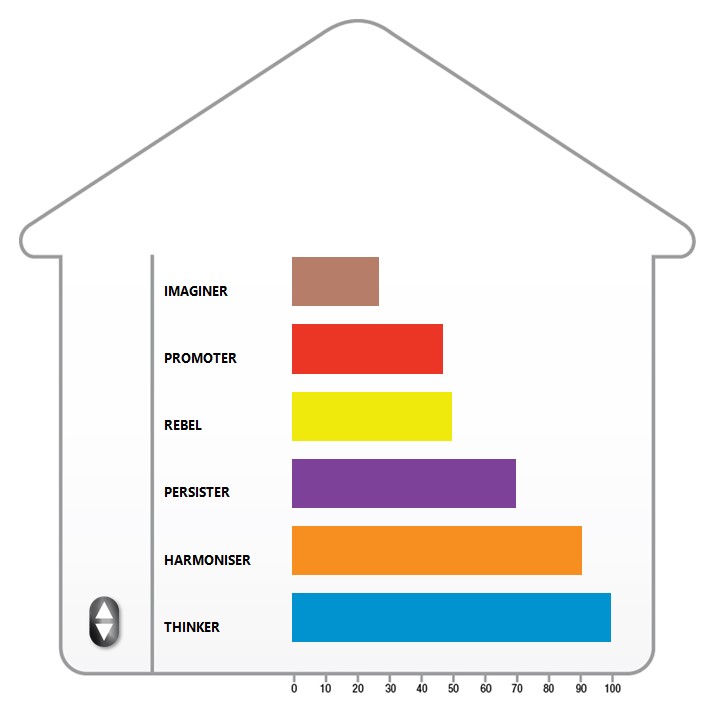
The Process Communication Model (PCM) helps them to do this. It is a communication and personality model that does not categorize people. It describes six personality types that each person has in different forms. These personality traits are like the floors of a house: at the base, on the first floor of the house, people move effortlessly. These personality parts are available to them in very strong measure. The higher a floor is in the house – in other words, the fewer parts of the respective personality are available – the more effort it takes to get there.
We notice this when we do not communicate as effectively with people to whom other parts are more easily available. In principle, however, all people have access to all floors of their house. And with the help of PCM, leaders can communicate in such a way that they pick up their employees in a way that is appropriate to their type. This is the most important requirement for effectively communicating issues – in this case, the willingness to embrace change.
Resistance manifests itself differently
The Process Communication Model (PCM) recognizes the following six personality types in every person. One of them forms the basis, usually a second or third part is also very strong. The weakest part has the greatest potential.
- The Thinker is responsible, rational and well organized.
- The Persister is committed, conscientious and has strong values.
- The Promoter is persuasive, charming, and persistent.
- The Harmonizer is empathetic, warm-hearted, and relationship-oriented.
- The Imaginer is calm, thoughtful, and imaginative.
- The Rebel is spontaneous, creative and seeks fun.
When resistance arises in a change process, it manifests itself differently – depending on which part of the personality is most pronounced in the respective person. To overcome this resistance, leaders can “pick up” the people with the different personality traits as follows:
1. people with a strong logical component.
These people are helped by structure, plans and facts. For them it is important to be able to rely on a structured approach, even if the agreed plan is only valid for a single day in turbulent times. Their resistance pattern: over-detailed, over-controlling and over-sensitive with regard to fairness, cooperation and financial matters.
2. people with a strong insistence component.
They need room for discussion and principles. The exchange of opinions is important to them. They want to be heard and seen with all their perspectives. Often this is more important for them than that their opinion is also implemented. Since this personality trait is often accompanied by great passion and commitment, their resistance to change is often just as passionate. Their resistance pattern: focus on (more and more) mistakes, start preaching, perceive and express self-righteous anger.
3. people with a strong doer part
They follow the credo: Action! Evaluation can be done afterwards! If leaders here communicate, explain, discuss or plan too much, doers get into stress and resistance. Even a change project in which there is a lot of verbal exchange is not very energizing for people with a doer component. Their resistance pattern: create negative drama, provoke and manipulate.
4. people with a strong empathic part.
They value being well met emotionally and personally. They want to be able to express themselves about insecurities and concerns and need emotionality that matches their need for harmony. For example, it can be helpful to talk about how exhausted they feel about the change process. Their pattern of resistance: surfacing self-doubt, making unnecessary mistakes and thereby unknowingly inviting others to criticize them.
5. people with a strong dreamer component.
Time for reflection is important to them in order to be able to deal well with change. If the rebel part shows an extroverted creativity, the dreamer part turns to an introverted creativity. Managers can reduce and prevent their resistance by informing them as early as possible. Their resistance pattern: stop working and sink into passivity.
6. people with a strong rebel-part.
They look for contact with others, fun and ease. For these people, a change project is a success if it is accompanied by joy, humor and creativity. This is where they find their perfect place. If resistance arises in them, they often become complainers or are offended. Their pattern of resistance: complaining, being offended, switching to stubborn, blaming.

Psychological Ownership: Why it’s so hard to let go of the old
In addition to the Process Communication Model (PCM), leaders can make use of other mechanisms or constructs when they want to help their employees give up resistance to a change process. One of these is the previously mentioned concept of Psychological Ownership. It describes the feeling that something “belongs” to you, although this is not or cannot legally be the case.
Racers experience this when they sit in a new car from a new club: First, they see themselves as simply doing their job. They are racers, so they sit in a car and race. Over time, however, that perception will change. Through the time and effort invested, they develop a sense of ownership over the vehicle. Quite unnoticed, they also develop this sense of ownership over the goals, strategies, and any actions that affect their shared future. It does not matter that there is actually no ownership and that the racer is only part of a club or brand.
This sense of ownership is also often found in people in relation to their project. They are the psychological owner of the associated successes and impacts. For companies, this has a great advantage: they have self-motivated employees who take pride in their work and careers and have a vested interest in doing top-notch work.
The flip side of Psychological Ownership becomes apparent in change projects, when a person has to part with what he has worked on with pride and a sense of personal responsibility. Strategies that make this separation easier for him are therefore important. In a change process, leaders therefore have the task of systematically and transparently introducing employees to the loss of the old. To make it easy for them to accept the new, this new should have a higher value than the old. If what comes after the change project is perceived to be “twice as good,” employees will find it easier to let go of the old. If this is done in the context of communication that matches their PCM personality type, the probability of success of the change project is massively increased.
4 success factors for your change project:
- Keep reminding your employees of the objectives and the “why” of the change project.
- Respect the individual requirements of your employees.
- Take into account the different personality traits of your employees and their needs.
- Use the advantages of Psychological Ownership and develop strategies to enable your employees to separate well from the old.
The original german article was written for blog.personal-manager.at by
Masha Ibeschitz
Founder and CEO , Think Beyond Group
As an executive coach, consultant, key speaker and reflection guide for top executives, the graduate in business administration is active worldwide and accompanies her international clients through the challenges of the “VUCA world”. Masha Ibeschitz is the founder and chairwoman of the Think Beyond Group and a shareholder of MDI. She is also the author of several non-fiction books (“Success Reloaded”, “Impact”)

Gunther Fürstberger
CEO , MDI Management Development International
Gunther Fürstberger is a management trainer, book author and CEO of MDI, a global leadership development institute and managing director of Metaforum. His core competence is leadership in the digital transformation. He gained his own leadership experience as HR manager of McDonald’s Central Europe/Central Asia, among others.

Anita Berger
Executive Coach, Consultant, Trainer & Managing Partner MDI
Anita Berger is an executive coach, consultant and trainer specialising in leadership development and international human resource management. She is a partner of MDI Management Development International. For more than 15 years she has worked in management and leadership positions (among others as HR-
Director at Coca-Cola Hellenic and HR Manager at Konica Minolta Business Solutions).