
• MDI
  • German version
  • Contact us
MDI Management Development
  • Agile leadership
  • Lateral Leadership
  • Leadership Impact
  • Leadership Development
Select Page
Leading in the Age of AI: How AI Discourse Shapes Responsibility and Power

Leading in the Age of AI: How AI Discourse Shapes Responsibility and Power

by Meike Hinnenberg | Mar 18, 2026 | Impuls series, Leadership and AI, Leadership Tips | 0 comments

Leading in the Age of AI: How AI Discourse Shapes Responsibility and Power

Meike’s Reflections on Artificial Intelligence

Do you prefer to listen to this article? Click below to access our AI-generated audio version!

Leading in the Age of AI: How AI Discourse Shapes Responsibility and Power

Meike’s Reflections on Artificial Intelligence

This is the second of seven parts of MDI’s leadership architect Meike Hinnenberg’s new blog reflection series on AI. You can find the first part here! Stay tuned for more 🙂

Chapter II – Lines of Enunciation

By distinguishing Artificial Intelligence as an industrial apparatus from machine learning as a set of practices, Crawford performs a gesture of ethical resistance. She interrupts the smooth circulation of the term, exposing Artificial Intelligence not as a settled object but as a line of enunciation – and in doing so opens a different path through the field.

In Deleuze’s sense, lines of enunciation are neither utterances nor texts, neither speakers nor doctrines. They are conditions of sayability that circulate within a dispositif, delineating what can be named, thought, and acted upon.

Most often, lines of enunciation remain invisible precisely because they work so well. They do not appear as commands, norms, or ideologies; they slip into language as description, into grammar as agency, into names that seem to pre-exist the things they gather. They do not ask to be believed: one does not need to agree with a line of enunciation to use it.

How AI Discourse Shapes Reality and Responsibility

These lines are not primarily repressive; they are productive. They bring objects into being (AI), generate problems (alignment, bias), propose solutions (ethical AI), and sketch futures (AI will transform everything). A critique that treats them merely as false representations, therefore, misses the point. Their force lies not (only) in what they conceal, but also in the realities they help bring into existence.

Understanding this productivity – and, with it, understanding technology not simply as an instrument to be used wisely but as a mode of world-disclosure – is essential, especially with regard to the question of responsibility. We are not outside the dispositif. We are not independent of the social, technological, and linguistic structures through which the world becomes accessible to us. Our relation to ourselves and our access to reality are shaped within them.

How AI Discourse Shapes Reality and Responsibility

Response-ability

What is therefore required is not the illusion of standing beyond these structures, but the effort to understand how the dispositif operates: what realities it brings into being, how we are positioned within it, and how we might relate to it, act within it, or even shift its lines. For now, being independent of these conditions does not mean we would not be responsible. Responsibility may instead take the form that Bernhard Waldenfels calls Antwortlichkeit (response-ability): a responsiveness to what addresses us before we fully understand it, a response that can never entirely catch up with what precedes it.

Let us follow this path a little further to see how it shapes the field. If we turn, for example, to the website of the OECD, we read:

AI holds the potential to address complex challenges from enhancing education and improving health care, to driving scientific innovation and climate action. However, AI systems also pose risks to privacy, safety, security, and human autonomy. Effective governance is essential to ensure AI development and deployment are safe, secure and trustworthy, with policies and regulation that foster innovation and competition.

How Discourse Limits What Can Be Questioned

The OECD text speaks in a language in which Artificial Intelligence already acts: it drives, addresses, and enhances. Politics enters only later, as a moderating hand. In this grammar, Artificial Intelligence appears as an agent capable of benefit or harm, yet never itself fundamentally in question. Within this frame, one may debate safety, trust, and regulation, but more structural questions about extraction, power concentration, or the desirability of AI as such struggle to surface as relevant statements. The force of such enunciation lies not in persuading belief, but in pre-structuring the field of speech itself.

By distinguishing Artificial Intelligence as an industrial apparatus from machine learning as a set of practices, Crawford renders such a line of enunciation visible and thereby intervenes in the field of sayability. By questioning whether Artificial Intelligence is even artificial or intelligent, she shows that what appeared as an autonomous historical actor is in fact a constructed convergence: an industrial apparatus, a planetary infrastructure grounded in colonial continuities and distributed human labor.

What material and historical infrastructures make AI possible?

By shifting the question from “Is AI fair?” to “What material and historical infrastructures make AI possible?”, the unity of the term Artificial Intelligence fractures like the ice layer of a winter-frozen lake.

And another layer of the acoustic landscape begins to surface: the breathing of ventilation shafts, the murmur of moving earth, the metallic heartbeat of drills, the slow chewing of stone by machines, the deep-throated hum of engines, the churning of propellers folding the sea behind them, the wind threading through stacked containers, a quiet choreography of clicks and pauses labeling one image after another, bodies trying to keep time with logistics, repetition measured in beeps, the percussion of parcels in transit – a subdued sonority of work that must remain unnoticed, a human rhythm beneath the supposedly smooth surface of automation.

Meike Hinnenberg

Meike Hinnenberg

Learning & Development Architect

Meike Hinnenberg is a trainer and Learning and Development Architect at MDI Management Development GmbH and specializes in communication, conflict management, diversity & inclusion, and lateral leadership.

  • LinkedIn

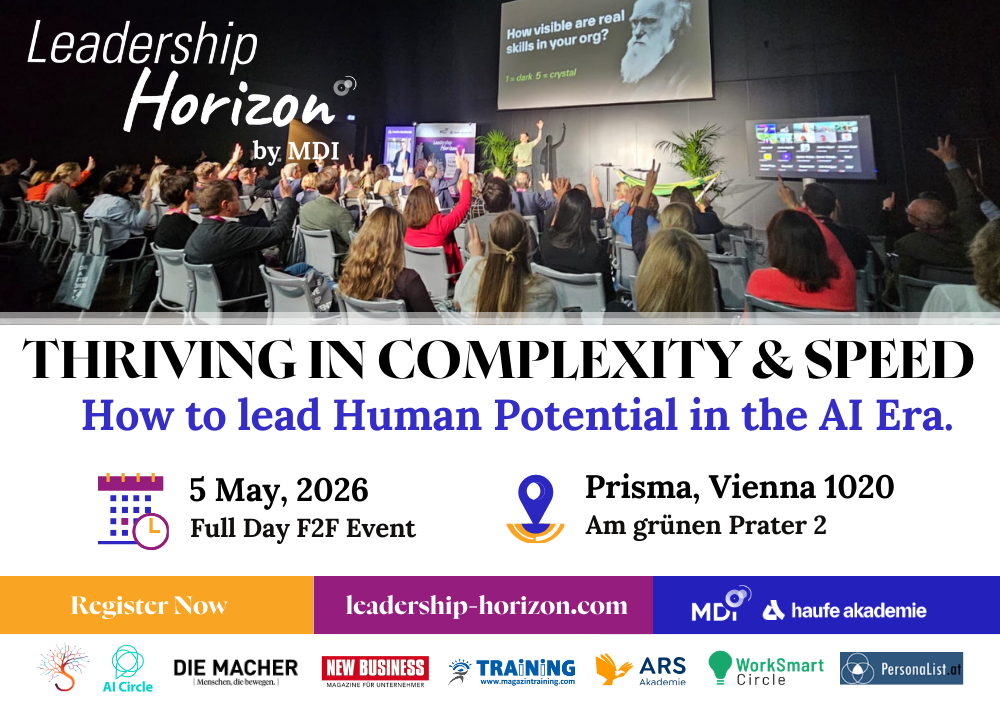
Join us on May 5th for our yearly Leadership Horizon Conference!
Leadership Horizon 2026 Banner

What serves you next?

Leading in the Age of AI: How AI Discourse Shapes Responsibility and Power

by Meike Hinnenberg | 18. March 2026 | Impuls series, Leadership and AI, Leadership Tips | 0 Comments

Leading in the Age of AI: How AI Discourse Shapes Responsibility and Power Meike’s Reflections on Artificial Intelligence Do you prefer to listen to this article? Click below to access our AI-generated audio version!Leading in the Age of AI: How AI Discourse Shapes...
Read More

AI Ethics for Leaders: Why Context and Critical Thinking Matter More Than Ever

by Meike Hinnenberg | 11. March 2026 | Impuls series, Leadership and AI, Learning Transfer | 0 Comments

AI Ethics for Leaders: Why Context and Critical Thinking Matter More Than Ever. Meike’s Reflections on Artificial Intelligence Do you prefer to listen to this article? Click below to access our AI-generated audio version!AI Ethics for Leaders: Why Context and Critical...
Read More

A Success Story – When AI Sharpens Human Judgement

by Claude MacDonald, Rafael Ungvari | 6. March 2026 | Customer Story, Digital Transformation, Leadership and AI | 0 Comments

A Success Story – When AI Sharpens Human Judgement Do you prefer to listen to this article? Click here to access our AI-generated audio version! When AI Amplifies Human Judgment: A Customer Success Story About This Project At MDI, we believe that great leadership and...
Read More

How Do You Lead People Who Don’t Think the Way You Do?

by Zeca Ruiz | 4. February 2026 | Leadership Impact, Leadership Tips, Learning Transfer | 0 Comments

How Do You Lead People Who Don't Think the Way You Do? Do you want to listen to this article? Click here to access our AI-generated audio version!   How do you lead people who do not think the way you do? Leadership is a challenge, especially when you are not...
Read More

How You Deal With Neurodiversity as a Leader

by Iris Kandlbauer | 3. February 2026 | Leadership Impact, Leadership Tips, Short Knowledge Bits | 0 Comments

How You Deal With Neurodiversity as a Leader You prefer listening to this article? You can find our AI-generated audio version below! How You Deal With Neurodiversity as a Leader What might be behind “strange” behavior in a team—and how leaders can deal with it...
Read More

Anita’s Key to Success for International Cooperation

by Jana Wölfl | 3. February 2026 | Leadership and AI, Leadership Tips, MDI Spotlight Series | 0 Comments

Anita's Key to Success for International Cooperation This blog is an excerpt from our new podcast! You can find the entire podcast episode here. Anita's Key to Success for International Cooperation In our new video podcast format, “Voices of Leadership – an MDI...
Read More

Fostering True Workplace Commitment

by Marcin Swierkocki | 14. January 2026 | Leadership Tips, Learning Transfer, Short Knowledge Bits | 0 Comments

Fostering True Workplace Commitment Do you prefer to listen to this article? Click below to access our AI-generated audio version! Fostering True Workplace Commitment Throughout my years of practice, I've found that deep workplace commitment is achieved not through...
Read More

Marcin Swierkocki on the Full Range Leadership Model

by Jana Wölfl | 19. December 2025 | Leadership and AI, Leadership Tips, MDI Spotlight Series | 0 Comments

Marcin Swierkocki on the Full Range Leadership Model This blog is an excerpt from our new podcast! You can find the entire podcast episode here. Marcin Swierkocki on the Full Range Leadership Model In the newest episode of our podcast “Voices of Leadership | An MDI...
Read More

Self-Efficacy in Change: Why It Matters

by Anita Berger | 17. December 2025 | Leadership Tips, Learning Transfer, Short Knowledge Bits | 0 Comments

Why It Matters When Transformation Gets Hard Do you prefer to listen to this article? Click below to access our AI-generated audio version:Self-Efficacy: Why It Matters When Transformation Gets Hard Change can be exhausting.Especially when things are unclear,...
Read More

Generation Z isn’t the Problem but Our System is

by Zeca Ruiz | 3. December 2025 | Impuls series, International leadership development, Leadership in the digital transformation | 0 Comments

Generation Z Isn’t the Problem, but Our System is. Read this article on crossgenerational management by Zeca Ruiz to find out more!

Read More
AI Ethics for Leaders: Why Context and Critical Thinking Matter More Than Ever

AI Ethics for Leaders: Why Context and Critical Thinking Matter More Than Ever

by Meike Hinnenberg | Mar 11, 2026 | Impuls series, Leadership and AI, Learning Transfer | 0 comments

AI Ethics for Leaders: Why Context and Critical Thinking Matter More Than Ever.

Meike’s Reflections on Artificial Intelligence

Do you prefer to listen to this article? Click below to access our AI-generated audio version!

AI Ethics for Leaders: Why Context and Critical Thinking Matter More Than Ever

Meike’s Reflections on Artificial Intelligence

This is the first part of a new AI blog series by our Senior Learning Architect, Meike Hinnenberg. Read her thoughts below and stay tuned for more parts to come!

The history of mining, like the devastation it leaves in its wake, is commonly overlooked in the strategic amnesia that accompanies stories of technological progress. […] As San Francisco drew enormous wealth from the mines, it was easy for the populace to forget where it all came from […] Just like the mines that served San Francisco in the nineteenth century, extraction for the technology sector is done by keeping real costs out of sight.

(Kate Crawford: Atlas of AI)

[…] – that is, as I said, the use of active forgetfulness, a porter at the door, so to speak, a custodian of psychic order, quiet, etiquette. From that we can see at once how, if forgetfulness were not present, there could be no happiness, no cheerfulness, no hoping, no pride, no present.

(Friedrich Nietzsche: The Genealogy of Morals)

It is immediately by deviating from equilibrium of animals, from tranquility – a departure engendered by the fault of Epimetheus – that mortals occur. Before the deviation, there is nothing. Then the accidental event happens, the fault of Epimetheus: to have forgotten humans. Humans are the forgotten ones. Humans only occur through their being forgotten; they only appear in disappearing.

(Bernard Stiegler: Technics and Time, 1)

Introduction

It is the beginning of February 2026 in Berlin; shortly after the big blackout in southern Berlin; shortly after several deaths and devastating losses in southern Europe in the wake of Storm Harry; shortly after a judge of the International Criminal Court was sanctioned by the United States; shortly after a cold wave driven by a destabilized jet stream claimed lives in the U.S.; shortly after deadly storms and floods across South and Southeast Asia left thousands displaced, hundreds dead and entire regions submerged; shortly after Russian strikes left thousands of households in Kyiv without heating while, almost in the same breath, the Ukrainian government entrusted the development of the namesake lithium deposit in the Kirovohrad region to TechMet – an Irish company partly backed by the U.S. government’s Development Finance Corporation and the U.S. financial firm Rock Holdings – drawing the country into the competitive circuitry of the global battery economy; shortly after …

It is the beginning of February 2026 in Berlin, and the air outside is sharp with cold. Inside my aging apartment, warmth gathers despite the leaky windows. The radiators whisper with gas that has traveled from Norway, the Netherlands, Belgium, the United States, or Azerbaijan, holding back the easterly winds for now. I sit in my kitchen. Milk warms slowly on the stove; coffee – probably carried from Africa, Asia, or South America – rises in the espresso pot and fills the room with its wonderful, familiar scent.

I open my computer, assembled through supply chains that fade into opacity, dependent on minerals, infrastructures, and forms of labor that rarely enter the frame. I open it to read the news and to begin research for a series on AI I am planning to write – aware, somewhere in the background, that even a question posed to a machine draws on energies and resources far beyond the gesture of typing it.

From this kitchen table, my orientation turns toward two recent points of departure: Kate Crawford’s Atlas of AI and her video essay  Mapping Empires.

Meike’s Reflections on Artificial Intelligence

Chapter I – The Dispositif of Artificial Intelligence

In Atlas of AI, Kate Crawford peels back the layers – conceptual and material alike – that have accrued around what we have come to call Artificial Intelligence, revealing a construct whose hidden assumptions we inhabit daily, largely unaware of the consequences they set in motion.

Her analysis unfolds as a kind of cartography, recalling Gilles Deleuze’s notion of the dispositif: a field traced by lines of visibility and invisibility, by grand narratives and what they render mute, by modes of subjectivation, fractures, continuities, and crossings – lines that intersect and mutate without ever solidifying into a universal structure.

Technologies of Domination

To draw nearer to this dispositif, to traverse its terrain, Crawford adopts the figure of the atlas. The atlas makes palpable the material and spatial dimensions condensed under the name Artificial Intelligence, even as these very conditions – its infrastructures, labors, and extractive foundations – are frequently displaced from view. 

At the same time, it affirms the situatedness of all knowledge: each map offers only a partial orientation, shaped by choices of scale, emphasis, and omission. In this convergence of aesthetic visual ordering and epistemic claim, Crawford shows that mapping is not a neutral description but a creative and political act.

Even as Crawford insists on the partiality of her own account – presenting her work as an invitation to follow emerging paths, to linger in zones of disparity, and to witness how particular perspectives come into being – she remains attentive to the darker history of the atlas itself. For atlases have never been innocent instruments of orientation alone; they have also served as technologies of domination.

The God’s Eye View

It is precisely this ambivalence that grounds her central hypothesis: that under the name Artificial Intelligence, such cartographic power is once again being mobilized. Along familiar routes of colonial exploitation and driven by an ambition no longer to draw an atlas of the world but to stand in for it, this impulse recentralizes power within the field of AI, advancing claims of universality and totality that rest on extractive regimes.

In doing so, it seeks to translate movement, communication, and labor into data, rendering the world legible from what Crawford describes as a supposedly objective, centralized “God’s eye view”.

Deterritorialization and Reterritorialization

The atlas itself operates through a double movement of what Deleuze would call deterritorialization and reterritorialization. While its cartographic abstractions unsettle fixed spatial relations and open new pathways of thought, they also carry a long-standing capacity for capture and domination.

Crawford’s intervention can be read as an attempt to amplify the deterritorializing potential of the atlas, even as she meticulously traces the reterritorializing operations to which colonialism and contemporary AIrepeatedly return.

The Ethical Task

Dispositifs, as singular and historically situated configurations, neither begin from nor arrive at the universal. And yet, in their operation, they repeatedly give rise to gestures of universalization and ambitions of totality, effects that emerge from within rather than from any transcendent ground. It is for this reason that such claims need to be traced genealogically, followed back along the paths through which they come to assert themselves.

Against this horizon, the ethical task is not to oppose totalization with a quasi-moralistic counter-universal, but to remain attentive to these movements as they unfold: to introduce shifts, frictions, and alternative pathways that keep the field open.

Ethical resistance, if it is to remain worthy of the name, must itself resist the temptation of ideology, universalization, and closure. For wherever resistance hardens into morally indignant certainty or ideological form, it risks reproducing – under the guise of critique – the very logics of universalization and reterritorialization it set out to unsettle.

Meike Hinnenberg

Meike Hinnenberg

Learning & Development Consultant

Meike Hinnenberg is a trainer, Learning and Development Consultant, and Team Lead at MDI Management Development GmbH and specializes in communication, conflict management, diversity & inclusion, and lateral leadership.

  • LinkedIn

Join us on May 5th for our yearly Leadership Horizon Conference!

Leadership Horizon 2026 Banner

What serves you next?

Leading in the Age of AI: How AI Discourse Shapes Responsibility and Power

by Meike Hinnenberg | 18. March 2026 | Impuls series, Leadership and AI, Leadership Tips | 0 Comments

Leading in the Age of AI: How AI Discourse Shapes Responsibility and Power Meike’s Reflections on Artificial Intelligence Do you prefer to listen to this article? Click below to access our AI-generated audio version!Leading in the Age of AI: How AI Discourse Shapes...
Read More

AI Ethics for Leaders: Why Context and Critical Thinking Matter More Than Ever

by Meike Hinnenberg | 11. March 2026 | Impuls series, Leadership and AI, Learning Transfer | 0 Comments

AI Ethics for Leaders: Why Context and Critical Thinking Matter More Than Ever. Meike’s Reflections on Artificial Intelligence Do you prefer to listen to this article? Click below to access our AI-generated audio version!AI Ethics for Leaders: Why Context and Critical...
Read More

A Success Story – When AI Sharpens Human Judgement

by Claude MacDonald, Rafael Ungvari | 6. March 2026 | Customer Story, Digital Transformation, Leadership and AI | 0 Comments

A Success Story – When AI Sharpens Human Judgement Do you prefer to listen to this article? Click here to access our AI-generated audio version! When AI Amplifies Human Judgment: A Customer Success Story About This Project At MDI, we believe that great leadership and...
Read More

How Do You Lead People Who Don’t Think the Way You Do?

by Zeca Ruiz | 4. February 2026 | Leadership Impact, Leadership Tips, Learning Transfer | 0 Comments

How Do You Lead People Who Don't Think the Way You Do? Do you want to listen to this article? Click here to access our AI-generated audio version!   How do you lead people who do not think the way you do? Leadership is a challenge, especially when you are not...
Read More

How You Deal With Neurodiversity as a Leader

by Iris Kandlbauer | 3. February 2026 | Leadership Impact, Leadership Tips, Short Knowledge Bits | 0 Comments

How You Deal With Neurodiversity as a Leader You prefer listening to this article? You can find our AI-generated audio version below! How You Deal With Neurodiversity as a Leader What might be behind “strange” behavior in a team—and how leaders can deal with it...
Read More

Anita’s Key to Success for International Cooperation

by Jana Wölfl | 3. February 2026 | Leadership and AI, Leadership Tips, MDI Spotlight Series | 0 Comments

Anita's Key to Success for International Cooperation This blog is an excerpt from our new podcast! You can find the entire podcast episode here. Anita's Key to Success for International Cooperation In our new video podcast format, “Voices of Leadership – an MDI...
Read More

Fostering True Workplace Commitment

by Marcin Swierkocki | 14. January 2026 | Leadership Tips, Learning Transfer, Short Knowledge Bits | 0 Comments

Fostering True Workplace Commitment Do you prefer to listen to this article? Click below to access our AI-generated audio version! Fostering True Workplace Commitment Throughout my years of practice, I've found that deep workplace commitment is achieved not through...
Read More

Marcin Swierkocki on the Full Range Leadership Model

by Jana Wölfl | 19. December 2025 | Leadership and AI, Leadership Tips, MDI Spotlight Series | 0 Comments

Marcin Swierkocki on the Full Range Leadership Model This blog is an excerpt from our new podcast! You can find the entire podcast episode here. Marcin Swierkocki on the Full Range Leadership Model In the newest episode of our podcast “Voices of Leadership | An MDI...
Read More

Self-Efficacy in Change: Why It Matters

by Anita Berger | 17. December 2025 | Leadership Tips, Learning Transfer, Short Knowledge Bits | 0 Comments

Why It Matters When Transformation Gets Hard Do you prefer to listen to this article? Click below to access our AI-generated audio version:Self-Efficacy: Why It Matters When Transformation Gets Hard Change can be exhausting.Especially when things are unclear,...
Read More

Generation Z isn’t the Problem but Our System is

by Zeca Ruiz | 3. December 2025 | Impuls series, International leadership development, Leadership in the digital transformation | 0 Comments

Generation Z Isn’t the Problem, but Our System is. Read this article on crossgenerational management by Zeca Ruiz to find out more!

Read More
The Lasting Impact of Leadership Horizon – Meike’s Perspectives

The Lasting Impact of Leadership Horizon – Meike’s Perspectives

by Meike Hinnenberg | Jul 2, 2025 | Leadership Impact, MDI Inside, Short Knowledge Bits | 0 comments

The Lasting Impact of Leadership Horizon – Meike’s Perspectives

Do you prefer to listen to this article? Click below to access our AI-generated audio version!

The Lasting Impact of Leadership Horizon – Meike’s Perspectives

MDI’s Meike Hinnenberg shares her reflections on this year’s Leadership Horizon and what it means to be a leader in today’s climate. Read this blog article to gain insight into her perspectives!

The #Leadership Horizon took place over a month ago.
And yet – it still lingers in my mind.

In an age where the average attention span has dropped to just 47 seconds (down from 2.5 minutes in 2004, as #GloriaMark describes), that’s not nothing.

So why does this event stay with me?

Certainly because of the valuable insights into current developments in #AI. But more than that:

It was the multi-perspectivity and the rare, dialogical space between those perspectives that left a lasting impression.

This wasn’t a sales pitch. Nor an ideologically charged debate. It was a shared space to explore the tension between

  • inspiration
  • rapid development
  • uncertainty
  • and the sheer unpredictability of a technology that both fascinates and challenges us.

Leadership and Multiperspectivity

In today’s public discourse, I often miss this kind of space. Instead, I encounter ideological simplifications that seem to fuel polarization, reducing complex issues to binary narratives. This tendency not only falls short of doing justice to the complexity of our interconnected world but also obstructs meaningful responses and undermines the solidarity we so urgently need.

In contrast, spaces like the Leadership Horizon – where different perspectives are not just tolerated but invited – feel like rare and necessary counterexamples. This event inspired me on a deeper level, much like the writings of #KlausEidenschink on conflict, polarity, and the question of the good within the evil.

It reminded me that true dialogue does not seek harmony at any cost or resolution too quickly, but stays with the tension, holds the paradox, and allows transformation to unfold from within it.

Leadership and Multiperspectivity

A Core Leadership Competence

This ability to hold tension and to stay with complexity is not just useful – it’s essential for us as leaders, because in leadership, we constantly navigate ambiguity and contradiction.

And especially now – as we face various disruptions and questions around systemic transformation, diversity etc. – we don’t need more polarization. We need the ability to manage polarities. To lead across differences. To hold both clarity and contradiction.

I know from experience how easy it is to ask for this complexity tolerance – and how hard it is to practice it. Especially under pressure, our systems revert to simplification, control, and reactivity.

That’s why this is not just about mindset – but about #conscious leadership and about creating spaces of real dialogue, where perspectives can challenge and transform us and where we remain generous in our shared human finitude.

What helps you create those spaces in your organization – where not just alignment, but true dialogue can emerge?

Meike Hinnenberg

Meike Hinnenberg

Learning & Development Consultant

Meike Hinnenberg is a trainer, Learning and Development Consultant, and Team Lead at MDI Management Development GmbH and specializes in communication, conflict management, diversity & inclusion, and lateral leadership.

  • LinkedIn

What serves you next?

Leading in the Age of AI: How AI Discourse Shapes Responsibility and Power

by Meike Hinnenberg | 18. March 2026 | Impuls series, Leadership and AI, Leadership Tips | 0 Comments

Leading in the Age of AI: How AI Discourse Shapes Responsibility and Power Meike’s Reflections on Artificial Intelligence Do you prefer to listen to this article? Click below to access our AI-generated audio version!Leading in the Age of AI: How AI Discourse Shapes...
Read More

AI Ethics for Leaders: Why Context and Critical Thinking Matter More Than Ever

by Meike Hinnenberg | 11. March 2026 | Impuls series, Leadership and AI, Learning Transfer | 0 Comments

AI Ethics for Leaders: Why Context and Critical Thinking Matter More Than Ever. Meike’s Reflections on Artificial Intelligence Do you prefer to listen to this article? Click below to access our AI-generated audio version!AI Ethics for Leaders: Why Context and Critical...
Read More

A Success Story – When AI Sharpens Human Judgement

by Claude MacDonald, Rafael Ungvari | 6. March 2026 | Customer Story, Digital Transformation, Leadership and AI | 0 Comments

A Success Story – When AI Sharpens Human Judgement Do you prefer to listen to this article? Click here to access our AI-generated audio version! When AI Amplifies Human Judgment: A Customer Success Story About This Project At MDI, we believe that great leadership and...
Read More

How Do You Lead People Who Don’t Think the Way You Do?

by Zeca Ruiz | 4. February 2026 | Leadership Impact, Leadership Tips, Learning Transfer | 0 Comments

How Do You Lead People Who Don't Think the Way You Do? Do you want to listen to this article? Click here to access our AI-generated audio version!   How do you lead people who do not think the way you do? Leadership is a challenge, especially when you are not...
Read More

How You Deal With Neurodiversity as a Leader

by Iris Kandlbauer | 3. February 2026 | Leadership Impact, Leadership Tips, Short Knowledge Bits | 0 Comments

How You Deal With Neurodiversity as a Leader You prefer listening to this article? You can find our AI-generated audio version below! How You Deal With Neurodiversity as a Leader What might be behind “strange” behavior in a team—and how leaders can deal with it...
Read More

Anita’s Key to Success for International Cooperation

by Jana Wölfl | 3. February 2026 | Leadership and AI, Leadership Tips, MDI Spotlight Series | 0 Comments

Anita's Key to Success for International Cooperation This blog is an excerpt from our new podcast! You can find the entire podcast episode here. Anita's Key to Success for International Cooperation In our new video podcast format, “Voices of Leadership – an MDI...
Read More

Fostering True Workplace Commitment

by Marcin Swierkocki | 14. January 2026 | Leadership Tips, Learning Transfer, Short Knowledge Bits | 0 Comments

Fostering True Workplace Commitment Do you prefer to listen to this article? Click below to access our AI-generated audio version! Fostering True Workplace Commitment Throughout my years of practice, I've found that deep workplace commitment is achieved not through...
Read More

Marcin Swierkocki on the Full Range Leadership Model

by Jana Wölfl | 19. December 2025 | Leadership and AI, Leadership Tips, MDI Spotlight Series | 0 Comments

Marcin Swierkocki on the Full Range Leadership Model This blog is an excerpt from our new podcast! You can find the entire podcast episode here. Marcin Swierkocki on the Full Range Leadership Model In the newest episode of our podcast “Voices of Leadership | An MDI...
Read More

Self-Efficacy in Change: Why It Matters

by Anita Berger | 17. December 2025 | Leadership Tips, Learning Transfer, Short Knowledge Bits | 0 Comments

Why It Matters When Transformation Gets Hard Do you prefer to listen to this article? Click below to access our AI-generated audio version:Self-Efficacy: Why It Matters When Transformation Gets Hard Change can be exhausting.Especially when things are unclear,...
Read More

Generation Z isn’t the Problem but Our System is

by Zeca Ruiz | 3. December 2025 | Impuls series, International leadership development, Leadership in the digital transformation | 0 Comments

Generation Z Isn’t the Problem, but Our System is. Read this article on crossgenerational management by Zeca Ruiz to find out more!

Read More
Self-Leadership: Harnessing the Power Within

Self-Leadership: Harnessing the Power Within

by Meike Hinnenberg | Dec 17, 2024 | Best Practice, Leadership Tips, Short Knowledge Bits | 0 comments

Self-Leadership: Harnessing the Power Within

Do you prefer to listen to this article? Click below to access our AI-generated audio version!

Self-Leadership: Harnessing the Power Within

In today’s fast-paced and unpredictable world, we often lack control over external circumstances or how others treat us. However, we possess one powerful tool: the ability to choose how we respond.

This doesn’t mean conforming to every situation or forcing solutions. Instead, self-leadership focuses on understanding and managing our thoughts and emotions —skills that can profoundly influence our relationships and leadership abilities.

The Core of Leadership: The “Me” Circle

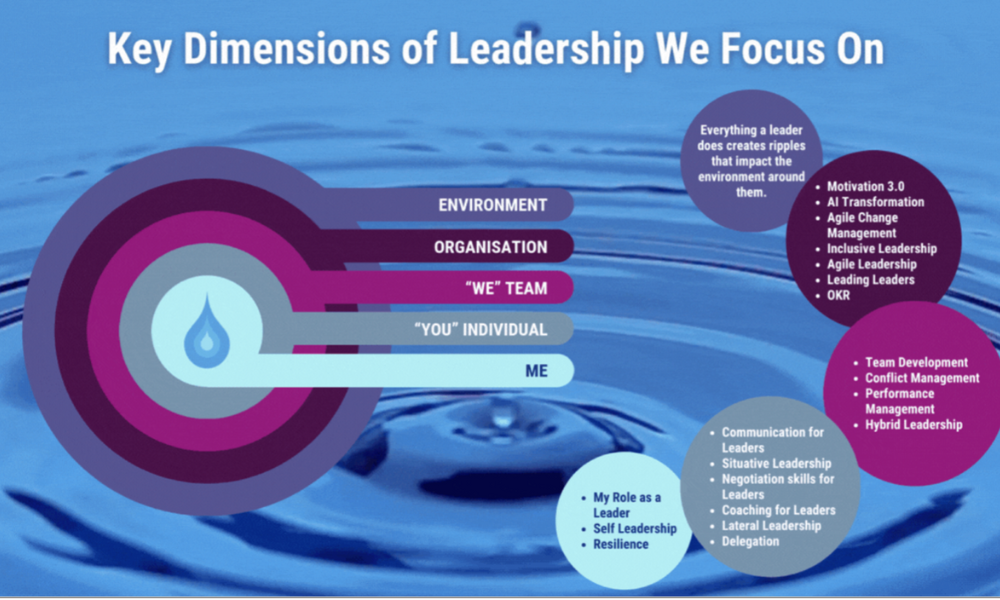
Imagine leadership development as a ripple effect. At the center lies the self—the starting point for influencing all outer circles: individuals, teams, organizations, and the wider environment. The “me” dimension is foundational.

How we connect with others or design organizational systems stems directly from our inner state. For now, let’s focus on this pivotal core: self-leadership.

Key Dimensions of Leadership we Focus on

Empathy vs. Sympathy: Choosing Connection

Empathy is a cornerstone of self-leadership, fostering connection, while sympathy can unintentionally create distance. According to Brene Brown, empathy encompasses:

  • Perspective-taking: Seeing the world through someone else’s eyes.
  • Non-judgment: Withholding judgment about others’ experiences.
  • Emotional recognition: Identifying and validating others’ emotions.
  • Feeling with others: Truly sharing in their emotional experience.

Leaders often struggle with vulnerability, imperfection, and the uncontrollable aspects of life and relationships. Our biological wiring doesn’t help—we’re programmed to detect and react to potential threats, a survival mechanism that can hinder connection. Recognizing and addressing this is key to empathetic leadership.

Cultivating “Response-Ability”

While we can’t control external events, we can control how we react—our “response-ability.” Tools like deep, conscious breathing and regular meditation can help calm the brain’s alarm system, creating space between stimulus and response. Gratitude practices can shift our focus toward the positive, reducing the weight of perceived threats.

These habits empower leaders to make decisions thoughtfully, even amid complexity and conflicting needs.

Leadership Decision-Making: Navigating Complexity

Making decisions as a leader is inherently challenging. It’s impossible to satisfy everyone, and every decision invites criticism. Understanding this reality helps us navigate conflict, a normal part of organizational life

Decisions will always carry trade-offs, but by including diverse perspectives and maintaining self-awareness, leaders can strive for the best possible outcomes.

Embracing Your Inner Team

Self-leadership also involves recognizing and harmonizing the many voices within us—our “inner team.” Each voice represents a perspective or trait, such as the Perfectionist, the Empathetic, or the Fearful. Listening to and integrating these voices strengthens decision-making and communication.

Embracing your inner Team

Practical Exercise:

Start by asking yourself a question, like, “Should I address this conflict?” Visualize the various inner voices involved and assign them roles or characters. For instance:

  • The Perfectionist: Insists on flawless execution.
  • The Fearful: Warns of potential risks.
  • The Rational: Seeks logic and balance.
  • The Angry: Advocates fiercely for boundaries.

Identify which voices are louder or more resistant and allow each to speak. Then, appoint an “inner team leader” to mediate, ensuring all perspectives are heard and integrated into a coherent plan.

In my own inner team, I balance voices like the empathetic, the strong, the fearful, and the rational. Each one has value, and my inner leader works to harmonize them, fostering collaboration and guiding decisions that reflect the best of all perspectives.

Conclusion

Self-leadership isn’t about perfection—it’s about awareness and intentionality. By cultivating empathy, practicing response-ability, and embracing the wisdom of your inner team, you can make decisions with clarity and confidence.

When we lead ourselves effectively, we empower others to thrive, creating ripples of positive change that extend far beyond the “me” circle.

Meike Hinnenberg

Meike Hinnenberg

Learning & Development Consultant

Meike Hinnenberg is a trainer at MDI Management Development GmbH and specializes in communication, conflict management, diversity & inclusion, and lateral leadership.

  • LinkedIn

What serves you next?

Leading in the Age of AI: How AI Discourse Shapes Responsibility and Power

by Meike Hinnenberg | 18. March 2026 | Impuls series, Leadership and AI, Leadership Tips | 0 Comments

Leading in the Age of AI: How AI Discourse Shapes Responsibility and Power Meike’s Reflections on Artificial Intelligence Do you prefer to listen to this article? Click below to access our AI-generated audio version!Leading in the Age of AI: How AI Discourse Shapes...
Read More

AI Ethics for Leaders: Why Context and Critical Thinking Matter More Than Ever

by Meike Hinnenberg | 11. March 2026 | Impuls series, Leadership and AI, Learning Transfer | 0 Comments

AI Ethics for Leaders: Why Context and Critical Thinking Matter More Than Ever. Meike’s Reflections on Artificial Intelligence Do you prefer to listen to this article? Click below to access our AI-generated audio version!AI Ethics for Leaders: Why Context and Critical...
Read More

A Success Story – When AI Sharpens Human Judgement

by Claude MacDonald, Rafael Ungvari | 6. March 2026 | Customer Story, Digital Transformation, Leadership and AI | 0 Comments

A Success Story – When AI Sharpens Human Judgement Do you prefer to listen to this article? Click here to access our AI-generated audio version! When AI Amplifies Human Judgment: A Customer Success Story About This Project At MDI, we believe that great leadership and...
Read More

How Do You Lead People Who Don’t Think the Way You Do?

by Zeca Ruiz | 4. February 2026 | Leadership Impact, Leadership Tips, Learning Transfer | 0 Comments

How Do You Lead People Who Don't Think the Way You Do? Do you want to listen to this article? Click here to access our AI-generated audio version!   How do you lead people who do not think the way you do? Leadership is a challenge, especially when you are not...
Read More

How You Deal With Neurodiversity as a Leader

by Iris Kandlbauer | 3. February 2026 | Leadership Impact, Leadership Tips, Short Knowledge Bits | 0 Comments

How You Deal With Neurodiversity as a Leader You prefer listening to this article? You can find our AI-generated audio version below! How You Deal With Neurodiversity as a Leader What might be behind “strange” behavior in a team—and how leaders can deal with it...
Read More

Anita’s Key to Success for International Cooperation

by Jana Wölfl | 3. February 2026 | Leadership and AI, Leadership Tips, MDI Spotlight Series | 0 Comments

Anita's Key to Success for International Cooperation This blog is an excerpt from our new podcast! You can find the entire podcast episode here. Anita's Key to Success for International Cooperation In our new video podcast format, “Voices of Leadership – an MDI...
Read More

Fostering True Workplace Commitment

by Marcin Swierkocki | 14. January 2026 | Leadership Tips, Learning Transfer, Short Knowledge Bits | 0 Comments

Fostering True Workplace Commitment Do you prefer to listen to this article? Click below to access our AI-generated audio version! Fostering True Workplace Commitment Throughout my years of practice, I've found that deep workplace commitment is achieved not through...
Read More

Marcin Swierkocki on the Full Range Leadership Model

by Jana Wölfl | 19. December 2025 | Leadership and AI, Leadership Tips, MDI Spotlight Series | 0 Comments

Marcin Swierkocki on the Full Range Leadership Model This blog is an excerpt from our new podcast! You can find the entire podcast episode here. Marcin Swierkocki on the Full Range Leadership Model In the newest episode of our podcast “Voices of Leadership | An MDI...
Read More

Self-Efficacy in Change: Why It Matters

by Anita Berger | 17. December 2025 | Leadership Tips, Learning Transfer, Short Knowledge Bits | 0 Comments

Why It Matters When Transformation Gets Hard Do you prefer to listen to this article? Click below to access our AI-generated audio version:Self-Efficacy: Why It Matters When Transformation Gets Hard Change can be exhausting.Especially when things are unclear,...
Read More

Generation Z isn’t the Problem but Our System is

by Zeca Ruiz | 3. December 2025 | Impuls series, International leadership development, Leadership in the digital transformation | 0 Comments

Generation Z Isn’t the Problem, but Our System is. Read this article on crossgenerational management by Zeca Ruiz to find out more!

Read More

Information

  • Imprint
  • MDI company website

Social Media

  • Facebook
  • Twitter
  • Youtube
  • LinkedIn

© MDI Management Development Institute, 2020