• MDI
  • German version
  • Contact us
MDI Management Development
  • Agile leadership
  • Lateral Leadership
  • Leadership Impact
  • Leadership Development
Select Page
Successful instruments for Employee Retention

Successful instruments for Employee Retention

by Christoph Monschein | Apr 26, 2023 | International leadership development, Leadership in the digital transformation, Leadership Tips | 0 comments

Successful instruments for Employee Retention

Employer Branding: How to position your company sustainably as an attractive employer

Today’s employers and leaders face several challenges. The search for qualified employees is becoming increasingly difficult and lengthy, and if you want to win over the best minds on the market, you have to have a lot to offer today’s applicants.

More than ever, the tables are being turned: High potentials are choosing their employers, not the other way around. In this distinct employee market, the company must withstand the critical gaze of potential candidates and convince them of its attractiveness as an employer.

For some time now, the recruiting process has therefore become one of the most challenging tasks for companies. The war for talents, i.e. the competition between companies for the best talents and specialists, has also become a fixed part of everyday working life in Austria.

The change of values in employer branding

It wasn’t all that long ago that if an employer offered a secure job with a good or above-average salary and a generous bonus on top, then they could choose from a pool of talent and secure the candidates who best fit the advertised positions.

Today, this is no longer enough to find motivated employees. The “cash for time” model has had its day in this country.

The younger generations in particular have much higher expectations of employers today. The focus is on topics such as the working environment, flexibility and hierarchies, corporate culture, purpose, and, last but not least, how the company deals with corporate social responsibility.

In addition to salary, flexible working time models and a healthy work-life balance, appreciation, respectful interaction, well-being in the workplace and meaningful work are of particular importance today and successful instruments for Employee Retention. 

Strengthening employer branding and positioning as an employer of choice

Companies have different ideas about corporate image and what it should look like in the future. But they all have the same goals: They want to offer their employees a better jobs and retain them in the long term. Employer branding helps to improve the company’s image and reputation as well as its employer brand.

It is an important element in achieving greater employee loyalty and reducing turnover rates, which are costly for companies. Employees who feel valued by their employer stay with the company longer and perform better. This means that employers not only have the opportunity to attract new talent but also to retain existing employees.


But how does a company manage to position itself as an employer of choice and thus secure competitive advantages in the battle for high potentials and retain the best minds?

employer branding

These are the questions companies need to ask themselves as part of the employer branding process today

  • What image do I want to have on the employer market?
  • How can I get & keep the employees I need to achieve my goals?
  • What does the “new generation” expect from employers?
  • What can established companies learn from start-ups?
  • What is the company’s purpose and how is it lived?

Measures to improve the employer brand

There are many ways in employer branding to create a modern and pleasant working environment with additional incentive systems. Since employees can be very different – keyword “Clash of Generations” – it is important to turn different screws to meet as many needs as possible.

Today, a compensation package has long been more than just a salary. It is therefore a challenge for modern management to put together a good overall package and to be authentic at the same time. Roughly speaking, there are 5 pillars that should be considered.

1. Work-Life-Balance

The name of the game in today’s job search. A good work-life balance is not only desired by applicants, it is a prerequisite and is at least as important as adequate pay. Today, it is more important than ever that the job fits in well with private life, not the other way around. This is what a company can offer in order to fulfill this wish:

  • Home Office
  • Remote Work
  • Flexible time management
  • 4-day week
  • Offer flexibility
  • Workation

2. Trust – Be a Leader, not a Boss

Employer branding is an important instrument for employee retention. It is about the social reputation of a company and the recognition of its employees as appreciative employers.

Independent work is playing an increasingly important role. In modern companies, employees are no longer purely followers of orders. Instead, they show initiative and assume responsibility. Meaningful areas of responsibility, flat hierarchies, opportunities for creative participation and development, and the strengths of each person are in the foreground.

This aspect of the management culture has a significant impact on employer branding. Positive reviews on evaluation platforms by employees should not be underestimated. Particular attention should be paid to the following:

  • Trust employees, relinquish control
  • Focus on independent work
  • Strengthen initiative & Motivation
  • Room for mistakes – talk about them & learn
  • transparency
  • communication
  • Feedback culture

3. (Tax-free) Benefits: An indispensable part of modern employer branding

A simple way to show appreciation to employees is through (tax-free) benefits. Gratitude for the work performed by employees should be reflected in more than just their salary.

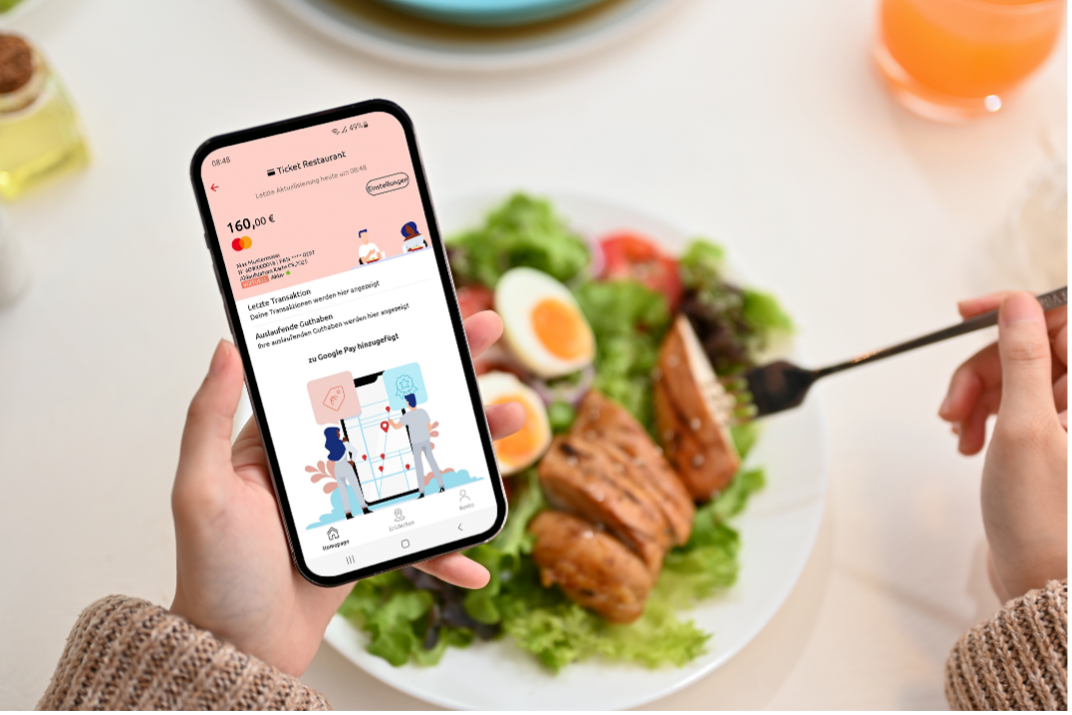
The lunch allowance is particularly attractive in Austria. Tax allowances of up to €8 per employee per working day (equivalent to an annual tax allowance of €1,760 per employee) make this incentive particularly worthwhile for both sides. A varied and balanced diet has been proven to have a positive effect on human health.

As an employer, the well-being of your employees and staff catering should therefore be close to your heart – at least because of expensive sick leave and reduced productivity.
Employer Branding

Around 300,000 employees across Austria are already using Edenred’s digital meal and food vouchers. These can be easily redeemed by recycled plastic card or directly by smartphone with Apple Pay or Google Pay at more than 20,000 redemption points in retail and catering, including online.

This ensures a balanced lunch break both in the office and in the home office – a factor that should not be underestimated, both in promoting health and employee loyalty and motivation.

The following benefits are particularly suitable as employer branding measures:

  • Meal subsidy
  • Gifts on occasions (e.g. wedding, birth, anniversary, Christmas)
  • Public transport ticket
  • Support for sports activities
  • Retirement provision
  • Discounts

4. Culture & Purpose: Indispensable in Employer Branding for Generation Z

It is becoming increasingly important, especially for young talents of the younger generations who are striving to enter the job market, that the company’s values match their own. Applicants are also increasingly paying attention to the sincere and authentic commitment of companies in the areas of sustainability and social issues – the keyword here is corporate social responsibility.

The purpose is becoming the criterion by which young applicants in particular choose their employer. It must create meaning and be in harmony with that of the employees in order to motivate and evoke the best.

Pay particular attention to the following points for successful employer branding:

  • Sincere and authentic commitment
  • No social and greenwashing
  • Clear definition & communication of purpose
  • Live purpose & values
  • Allow employees to set their own initiatives

5. Workplace – more than just a desk

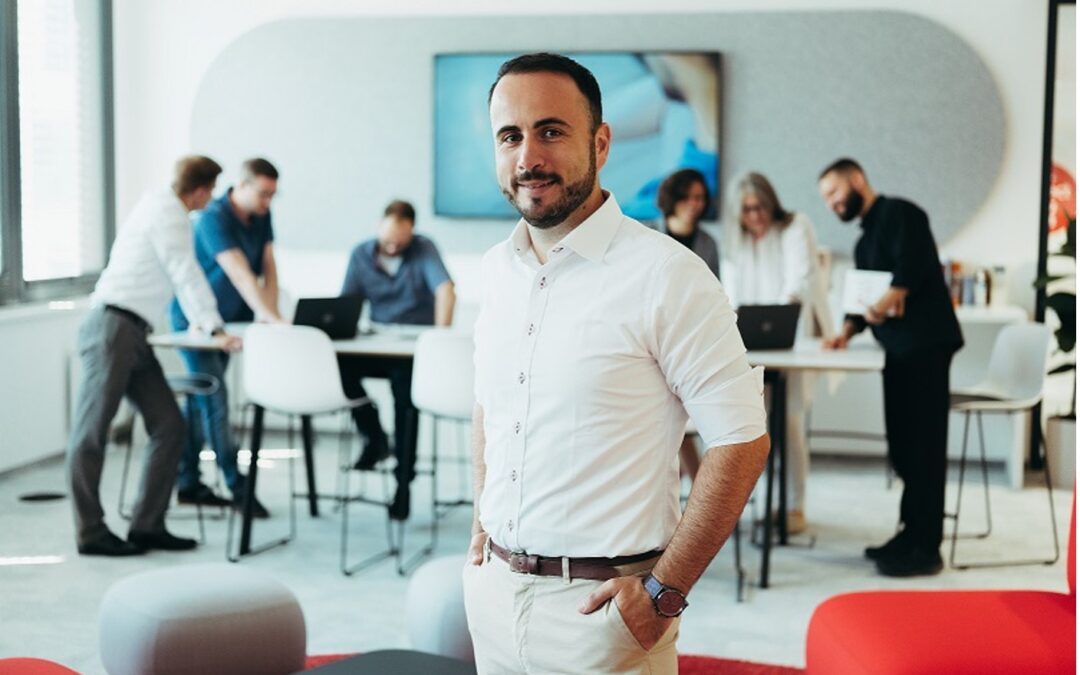
What may sound trivial at first glance is also part of employer branding: modern office environments are becoming increasingly popular. In order to work together successfully and develop innovative ideas, employees need appropriate spaces in which they can feel comfortable and develop.

Decentralized working often leads to desk-sharing concepts in offices. When desks are shared, fewer physical workstations are needed. This in turn means that space can be created for new premises. Here, the focus should be on connecting activities. Anyone who thinks a ping-pong table is the end of productivity has already lost out on some applicants. Team spirit and corporate culture can be crucial in employer branding.

A few suggestions for the use of won premises:

  • Telephone boxes
  • Writable walls
  • Space for recreation & creative development
  • Social spaces (games, food, etc.)

Employer Branding

Conclusion

Today’s applicants are looking for their employer. They expect more and want to change things. Companies need to rethink and quickly adapt to the new conditions in the labor market. The current recruiting market is an applicant market.

Companies need to clearly understand that it is not necessarily the job seekers who apply to the company, but also the companies as employers. If this understanding is given, an important first step towards modern employer branding has been taken.

To prepare for this, a very clear definition is needed of what a company can offer job seekers and why potential employees would want to work for it. Not only salary plays a role, but also and above all the purpose behind the company, the corporate culture, the team spirit, development opportunities, benefits, flexible working, and much more.

At the end of the day, it’s all about the “image” of the company. A good image requires real change and is more than clever communication. The topic of employer branding should therefore be pushed authentically across all channels and offer an honest insight into the company’s everyday life.
Christoph Monschein

Christoph Monschein

General Manager of Edenred Austria & Transformation Leader

Christoph is a transformation leader with >10 years of achieving growth and value creation in both P&L leadership and top-management consulting positions.

His experience includes delivering and implementing growth strategies as well as transformation strategies, developing management teams, leading local and global teams and driving change.

  • LinkedIn

What serves you next?

Leadership Horizon powered by HR INSIDE SMMIT

AI Ethics for Leaders: Why Context and Critical Thinking Matter More Than Ever

AI Ethics for Leaders: Why Context and Critical Thinking Matter More Than Ever. Meike’s...
Read More

A Success Story – When AI Sharpens Human Judgement

A Success Story – When AI Sharpens Human Judgement Do you prefer to listen to this article? Click...
Read More

How Do You Lead People Who Don’t Think the Way You Do?

How Do You Lead People Who Don't Think the Way You Do? Do you want to listen to this article?...
Read More

How You Deal With Neurodiversity as a Leader

How You Deal With Neurodiversity as a Leader You prefer listening to this article? You can find...
Read More

Anita’s Key to Success for International Cooperation

Anita's Key to Success for International Cooperation This blog is an excerpt from our new podcast!...
Read More

Fostering True Workplace Commitment

Fostering True Workplace Commitment Do you prefer to listen to this article? Click below to access...
Read More

Marcin Swierkocki on the Full Range Leadership Model

Marcin Swierkocki on the Full Range Leadership Model This blog is an excerpt from our new podcast!...
Read More

Self-Efficacy in Change: Why It Matters

Why It Matters When Transformation Gets Hard Do you prefer to listen to this article? Click below...
Read More

Generation Z isn’t the Problem but Our System is

Generation Z Isn’t the Problem, but Our System is. Read this article on crossgenerational management by Zeca Ruiz to find out more!

Read More

From Lab to Practice: What We Learned With AI

From Lab to Practice: What We Learned With AI Do you prefer to listen to this article? Click here...
Read More
How to Become a Compassionate Leader – 3 tools

How to Become a Compassionate Leader – 3 tools

by Gunther Fürstberger | Apr 18, 2023 | International leadership development, Leadership in the digital transformation, MDI Inside, Training Insights | 0 comments

How to Become a Compassionate Leader in 3 Steps

At MDI, we not only develop others, but also ourselves. That’s why our CEO Gunther Fürstberger attended a three-day seminar by systems researcher Peter Senge in Stockholm, where he gained some insights. He reports on his experiences in this blog post.

The Compassionate Leadership Masterclass

Peter Senge wrote a classic of leadership literature in 1990 with “The 5th Discipline”. When I read that he was giving a 3-day seminar in Stockholm as part of the Inner Development Goals Initiative, I knew I had to experience it. I thought about Marcus Aurelius who already said “You have to know the great ones of your time”.

The sold out Compassionate Systems Leadership Masterclass by Peter Senge and Gustav Böll took place in the artistic setting of Fotografiska Museum with about 100 participants from March 29 to 31, 2023.

The seminar title sounds a bit complicated. What is Compassionate Systems Leadership all about? A first key to understanding is the organizer: the Inner Development Initiative. In 2016, UN member states adopted the 2030 Agenda for Sustainable Development. Since then, our planet has continued to deteriorate.

A new leadership system for a better planet

Us earthlings have obviously not yet developed the skills and attitude it takes to undo the damage of the industrial age.

This is where the Inner Development Initiative comes in: The change in attitude must begin with the individual. Engaging broadly and deeply with the Inner Development Goals in the 5 categories of Being, Thinking, Relating, Collaborating, and Acting will help achieve the UN Sustainable Development Goals.

Our planet now needs a different kind of leadership than we know from the industrial age. It starts with feeling nature and other people and should lead to some sense of connection with others or even all beings on the planet.

Hardly anyone wants to intentionally cause grievances, but who is really aware of the effects of their own actions? System thinking can help to understand both short- and long-term impacts and interactions a little better.

New findings on two levels

Learning for me has taken place on two levels during these days. On the one hand, I got to know new tools or deepened known tools. On the other hand, the trainers were an inspiration in their handling of the group and their use of methods.

From the numerous thinking tools I pick out the three that I found particularly typical for Compassionate Systems Leadership.

Tool 1

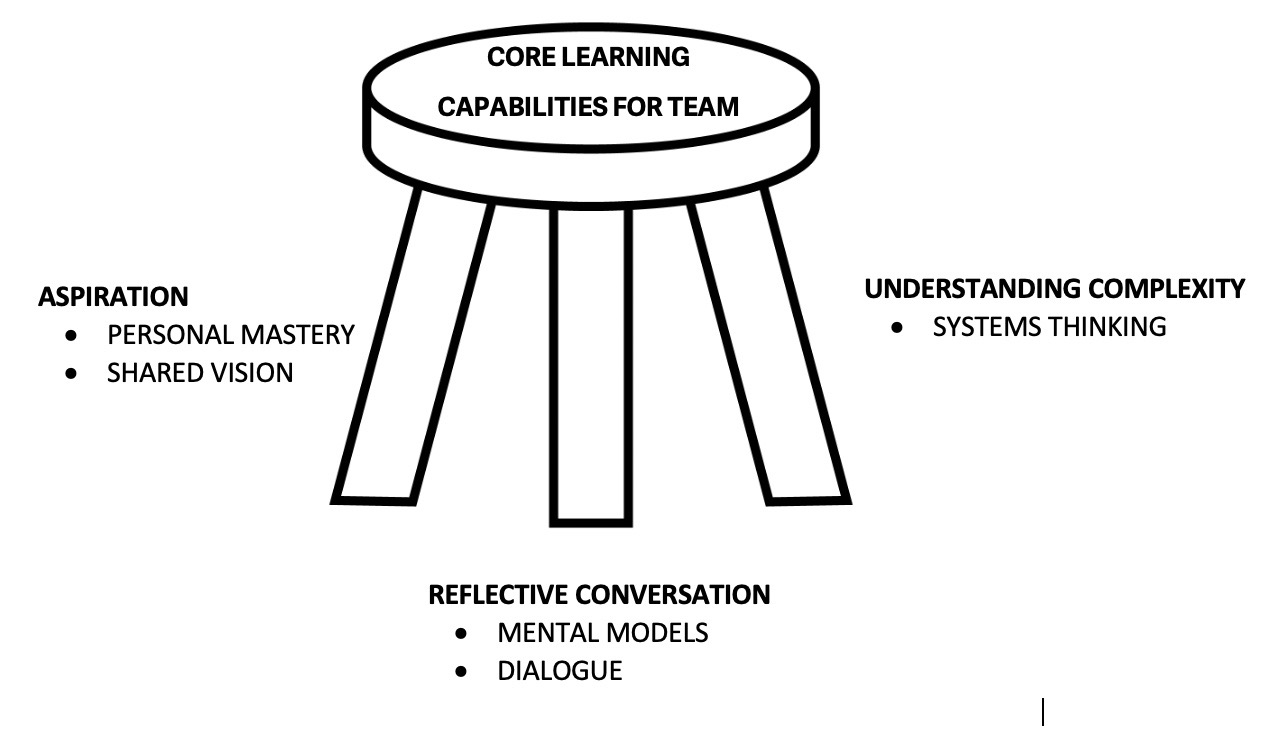
First, as an overview tool, there is the three-legged chair (see figure 1). The legs represent aspiration, reflective conversations, and systems awareness. If one leg is missing, the stool falls over.

Without a creative imagining of a better environment, there is no improvement. Without reflection or a deeper understanding of systems, we quickly end up in dead ends despite having good intentions. 

Three-legged chair

Tool 2

The ladder of connectedness

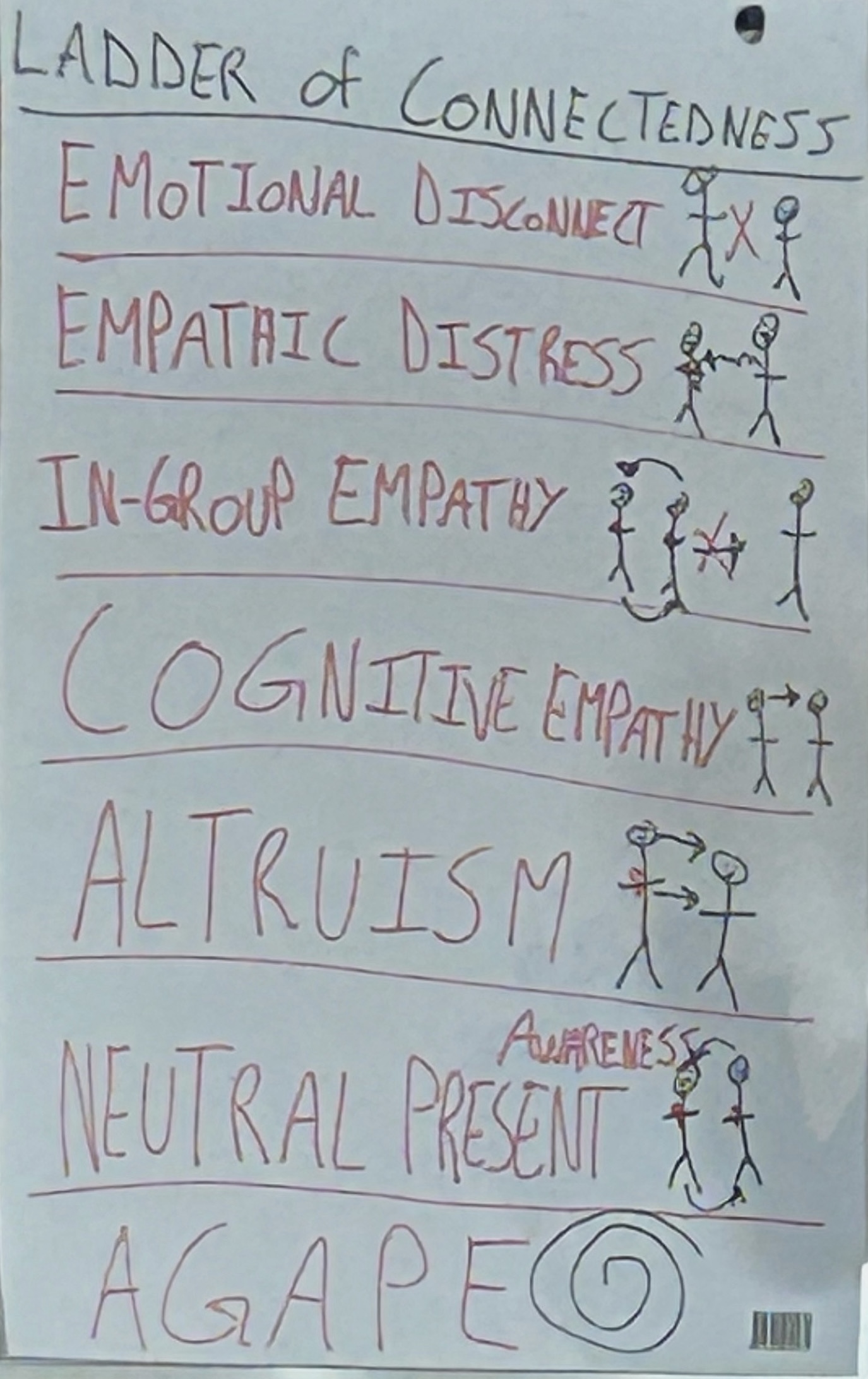
The second tool is the “ladder of connectedness” (see figure 2), which confused me initially: From bottom to top, the ladder levels are called “agape, neutral presence, altruism, cognitive empathy, in-group empathy, empathic stress, and emotional distance.”

We can harness gravity to move toward deeper connectedness, i.e., strive more toward the lower levels. Confusion can be a sign of real learning. I could not easily assign this idea to an already stored concept. It seemed to fit most closely with a Buddhist understanding.

We may not achieve agape, all-connected love, but we can create a neutral presence even in difficult situations. It also needs the higher levels: A surgeon should manage to distance themselves emotionally for self-protection.

Neutral instead of empathetic

Distance also helps sometimes in conflicts that go round in circles. Empathic stress is something I can relate to as a father of younger children. When my 8-year-old and my 6-year-old argue loudly with each other, it seems easier for me to demand that they stop for the short term because it helps me reduce my internal tension. But in the long run, it doesn’t help me.

In-group empathy may lead to good cooperation in the team, in the company or even in one’s own country, but at the same time it may exclude those who do not belong to the group. I take it upon myself to practice more neutral presence, which is enduring tension and contradiction.

Ladder of Connectedness

Tool 3

Creative Tension

Now our third and a simpler tool (see figure 3): The principle of creative tension. I already knew that a vision needs the right level of challenge, because something we have already achieved or something we can never achieve is not good as a vision.

I found the continuation of the thought interesting: We can imagine the tension between reality and vision as a rubber band. When that tension becomes too uncomfortable for us, we often tend to either lower our aspirations or not tell the whole truth about the current state.

An energy source for change

A good example are an organization’s sustainability goals. When we consciously seek and hold this tension, we tap into the energy source for change. This principle of creativity is also found in theater as drama, in music as tonus, and in the Greek rhetoric. In this respect, it is not a new idea, but it is effective when we strive for change.

I was also interested in what Peter Senge is like as a person. I have already met some of the “greats of the lecture scene” away from the stage and with some of them I had the impression that it was difficult for them to live the conveyed messages themselves. That is also human.

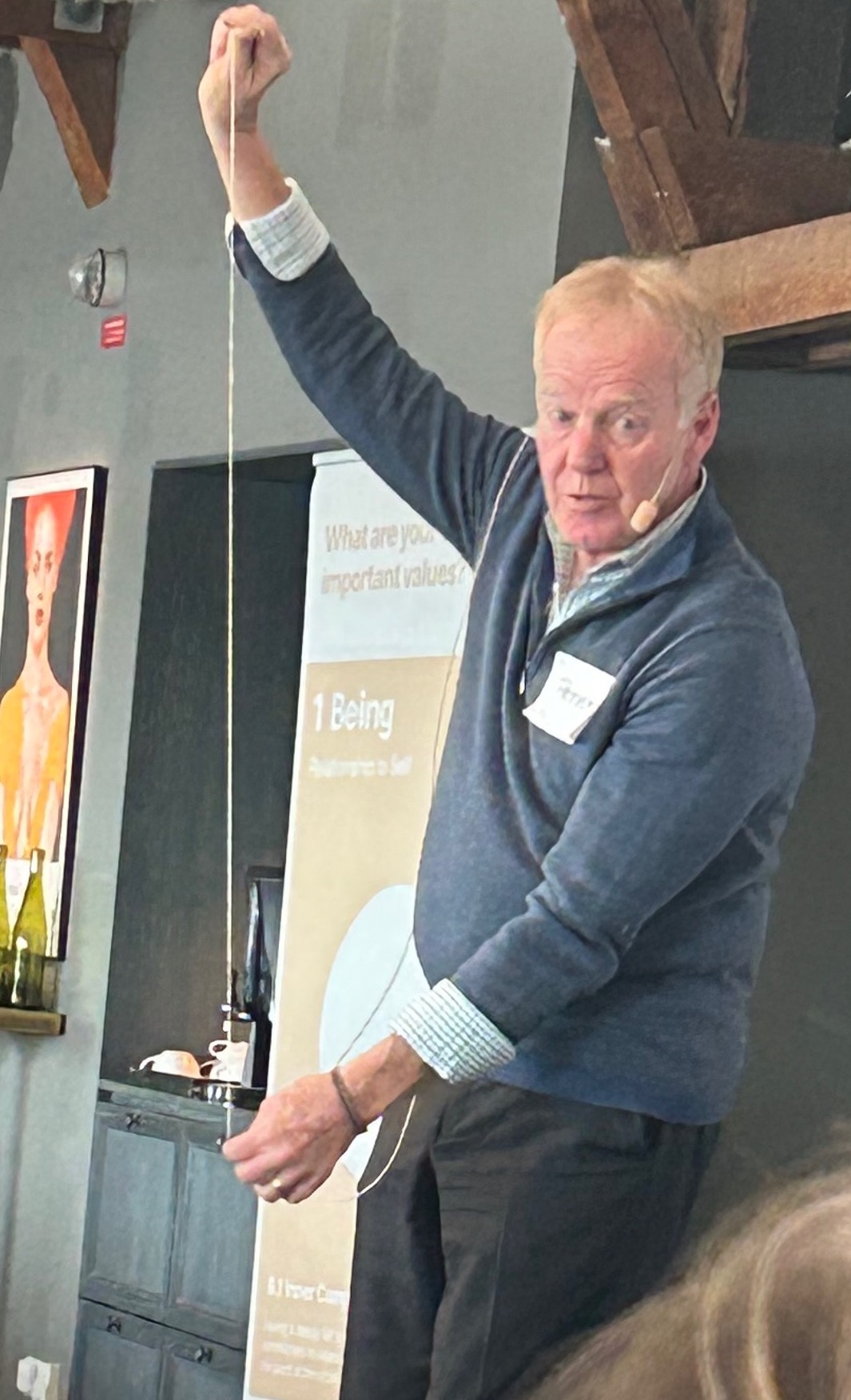
Peter with rubber band

Peter Senge as a Human

In the morning of Day three, there was an emotionally expressed resistance from a participant who questioned the usefulness of the whole seminar. She said Peter Senge held on to the statement that we always have a choice and do not have to be influenced by external circumstances, despite her doubts expressed the day before.

Now I was curious. Will he maybe feel attacked and defend himself or let it stand as an individual opinion? He did not react immediately, but let other participants speak first. Later, he resonated, apologized, thanked for the learning opportunity, and did so with an authenticity and elegance that really impressed me.

He always treated his much younger co-trainer at eye level and was so moved several times that tears came to his eyes.

My summary

In the spirit of Marcus Aurelius, I had the opportunity to meet two greats of our time. Especially the combination of two trainers from different generations fits the challenges of our time.

Even though I have not implemented all of the presented contexts and tools and I am also not sure whether the term Compassionate System Leadership will become widely accepted, I recommend every leader to deal with the basic idea. A more sustainable leadership culture would do us and the planet good.

Mag. Gunther Fürstberger

Mag. Gunther Fürstberger

CEO | MDI Management Development International

Gunther Fürstberger is a management trainer, author and CEO of MDI – a global consulting company providing solutions for leadership development. His main interest is to make the world a better place through sustainable leadership. He has worked for clients including ABB, Abbvie, Boehringer Ingelheim, DHL, Google, Hornbach, PWC and Swarovski. His core competence is leadership in digital transformation. At the age of 20 he already started working as a trainer and he also served as HR manager in international corporations.

  • LinkedIn

What serves you next?

Leadership Horizon powered by HR INSIDE SMMIT

AI Ethics for Leaders: Why Context and Critical Thinking Matter More Than Ever

AI Ethics for Leaders: Why Context and Critical Thinking Matter More Than Ever. Meike’s...
Read More

A Success Story – When AI Sharpens Human Judgement

A Success Story – When AI Sharpens Human Judgement Do you prefer to listen to this article? Click...
Read More

How Do You Lead People Who Don’t Think the Way You Do?

How Do You Lead People Who Don't Think the Way You Do? Do you want to listen to this article?...
Read More

How You Deal With Neurodiversity as a Leader

How You Deal With Neurodiversity as a Leader You prefer listening to this article? You can find...
Read More

Anita’s Key to Success for International Cooperation

Anita's Key to Success for International Cooperation This blog is an excerpt from our new podcast!...
Read More

Fostering True Workplace Commitment

Fostering True Workplace Commitment Do you prefer to listen to this article? Click below to access...
Read More

Marcin Swierkocki on the Full Range Leadership Model

Marcin Swierkocki on the Full Range Leadership Model This blog is an excerpt from our new podcast!...
Read More

Self-Efficacy in Change: Why It Matters

Why It Matters When Transformation Gets Hard Do you prefer to listen to this article? Click below...
Read More

Generation Z isn’t the Problem but Our System is

Generation Z Isn’t the Problem, but Our System is. Read this article on crossgenerational management by Zeca Ruiz to find out more!

Read More

From Lab to Practice: What We Learned With AI

From Lab to Practice: What We Learned With AI Do you prefer to listen to this article? Click here...
Read More
When and why should leadership be shared?

When and why should leadership be shared?

by Bardia Monshi | Mar 27, 2023 | Agile Leadership, International leadership development, learning effectiveness | 0 comments

The Power of Shared Leadership

When and why should leadership be shared?

Bardia Monshi talks on-stage on 23.05.2023 @ the Leadership Horizon about the challenge of Shared Leadership. He is convinced it’s time for WeQ! He gives practical examples of when and why leadership should be shared, especially in times of uncertainty.

(more…)

Next Entries »

Information

  • Imprint
  • MDI company website

Social Media

  • Facebook
  • Twitter
  • Youtube
  • LinkedIn

© MDI Management Development Institute, 2020